
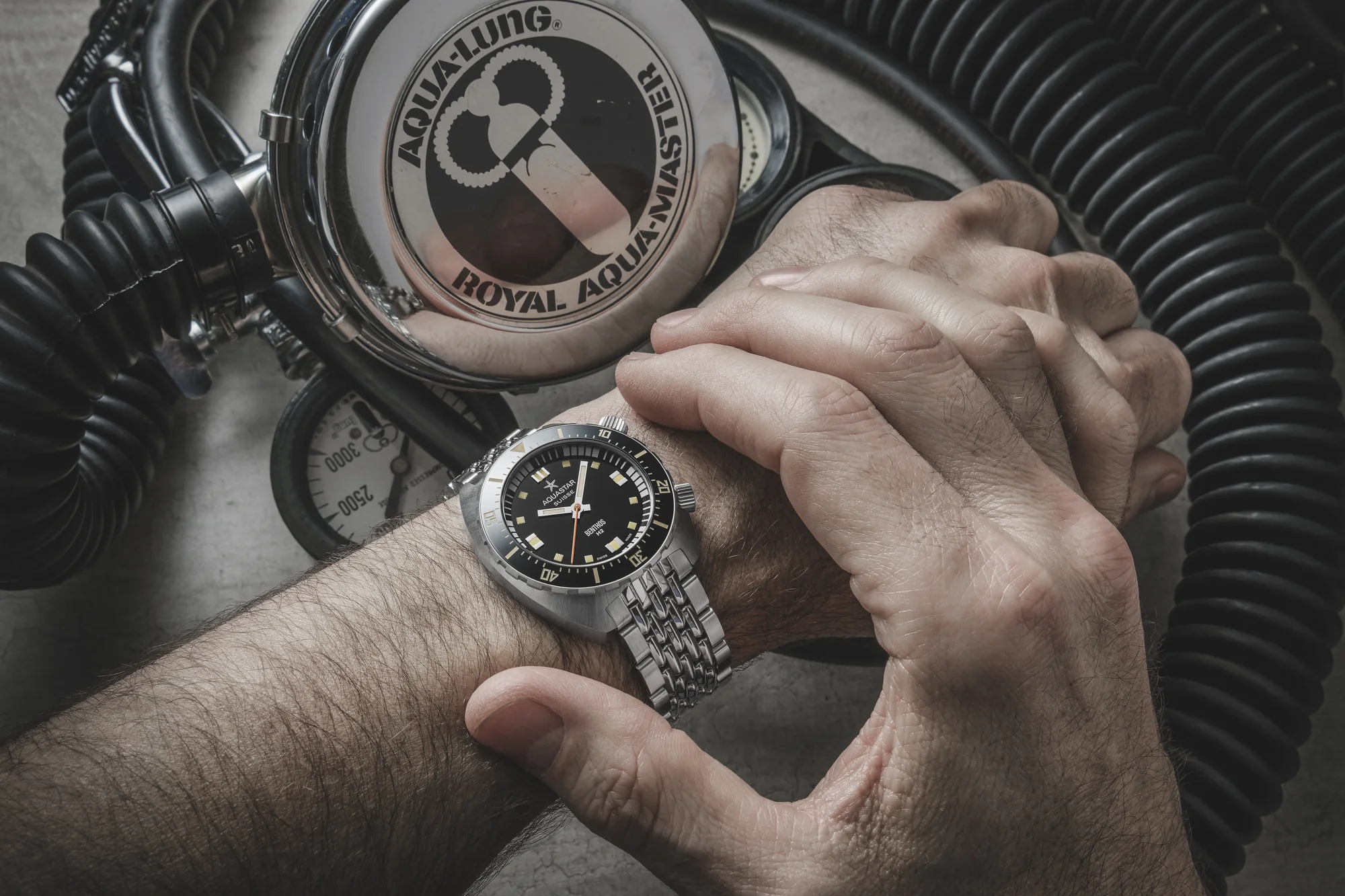
Buying a dive watch online means trusting a set of numbers: diameter, lug-to-lug, thickness, lug width. Those numbers decide whether a watch wears like it was made for you or slides around like a borrowed tool. This dive watch size guide explains what each measurement actually means on the wrist, why lug-to-lug is the figure most buyers overlook, and how to judge whether a 39mm, 42mm, or 44mm case will suit you before you ever strap it on.
Start With Your Wrist, Not the Watch
Before comparing case sizes, measure your wrist. Wrap a soft tape measure or a strip of paper around the flattest part of your wrist, just past the bone, and note the circumference in millimeters. Most adult wrists fall between 150mm and 200mm. That single figure does more to predict fit than any marketing photo of a watch on a model whose wrist you cannot see.
As a rough working framework: wrists under 160mm tend to suit cases around 38mm to 40mm, wrists from 160mm to 180mm are comfortable across most of the dive watch range from 40mm to 42mm, and wrists above 180mm can carry 42mm to 44mm or larger without looking undersized. These are starting points, not rules. Personal taste, sleeve fit, and the watch’s own proportions all shift the answer.
It also helps to know the shape of your wrist, not just its size. A flat, wide wrist handles a broad case better than a round, narrow one of the same circumference. If your wrist is round and tapers quickly, a large case will perch on top rather than sit flush, and that is where the next measurement becomes decisive.
Why Lug-to-Lug Matters More Than Diameter
Diameter gets all the attention, but lug-to-lug is the measurement that determines whether a watch fits at all. Lug-to-lug is the distance from the tip of the top lugs to the tip of the bottom lugs, the full vertical footprint of the case. It tells you how much of your wrist the watch will physically cover.
The reason it matters so much is simple geometry. If the lug-to-lug span is longer than the flat top surface of your wrist, the lug tips will overhang the edges. The strap then has to bend sharply over the corner of your wrist, the watch rocks, and it never sits securely. A 40mm watch with long, straight lugs can wear larger and less comfortably than a 42mm watch with short, downturned lugs. The headline diameter does not capture this at all.
As a guide, your lug-to-lug should not exceed the width of your wrist at the point where the watch sits. Many dive watches run roughly 47mm to 50mm lug-to-lug, so a wrist narrower than about 50mm across its flat section is the practical ceiling for those cases. When in doubt, prioritise lug-to-lug over diameter, because a case can look balanced at almost any width if it does not overhang.
Case Diameter: What the Numbers Really Tell You
Case diameter is the width of the case measured across the middle, usually excluding the crown. It is the figure brands lead with, and it does carry real information: it sets the dial’s apparent size, the legibility of the markers underwater, and the overall visual weight of the watch. But two watches of identical diameter can wear very differently depending on bezel width, dial colour, and how far the case extends beyond the bezel.
A wide bezel shrinks the dial and can make a 42mm watch read as more compact, while a thin bezel and an expansive dial can make the same diameter feel large. Dark dials tend to recede and look slightly smaller than bright ones. None of this changes the number on the spec sheet, which is exactly why diameter alone is a poor predictor of fit.
When 39mm Is Too Small (or Too Big)
A 39mm dive watch is often called the universal size, and for wrists between roughly 160mm and 180mm it is hard to get wrong. On a broad wrist above 185mm, though, a 39mm case can look lost, dwarfed by the surrounding skin, and a buyer who wants a clear tool-watch presence may find it underwhelming. On a slim wrist under 155mm, that same 39mm case can be the upper limit of comfort rather than the safe middle ground.
The lesson is that there is no absolute correct size. A 39mm reads as small on one wrist and substantial on another. Judge it against your own measurements rather than against a number someone online has declared ideal.
Thickness, the Forgotten Dimension
Diameter and lug-to-lug describe the footprint, but thickness decides how the watch lives on your wrist day to day. Dive watches are naturally thicker than dress watches because they need robust gaskets, a screw-down crown, a substantial caseback, and often a thick crystal to handle pressure. An automatic dive watch frequently sits between 12mm and 15mm tall, and that height affects whether it slides under a shirt cuff or catches on every doorframe.
Thickness is also where the movement choice shows up. A slim time-only automatic allows a more svelte case, while a dive chronograph with stacked pushers and sub-counters will always carry more height. If you wear long sleeves often or simply dislike a tall watch, treat thickness as a primary filter, not an afterthought. A well-proportioned case keeps its thickness in sensible relation to its diameter rather than stacking height for its own sake.
How a Dive Watch Should Sit for Actual Diving
If you intend to dive rather than admire, fit takes on a functional dimension. The watch has to remain secure and readable over a wetsuit, and the bezel has to be reachable with cold or gloved hands. This is where strap length and the right rubber or fabric strap matter as much as the case itself. A dive-rated strap such as a Tropic or ISOfrane style band needs enough length to clear a 5mm or 7mm wetsuit sleeve, and many divers keep an extra-long strap or an extension specifically for this.
For genuine underwater use, slightly larger is sometimes better. A bigger dial and bolder markers read faster at depth and in low visibility, and a wider bezel grip is easier to turn with numb fingers. That has to be balanced against everyday comfort, because most dive watches spend far more time at a desk than at 30 meters. The ideal is a case large enough to function as a tool and proportioned well enough to wear every day.
Lug width matters here too. It sets which straps you can fit, typically 20mm or 22mm on a modern dive watch, and a standard width keeps your options open across rubber, NATO, ISOfrane, and steel bracelets. A watch you can re-strap easily is a watch you can adapt to a wetsuit one weekend and a shirt cuff the next.
Putting the Measurements Together
When you compare two dive watches, read the spec sheet in this order: lug-to-lug first to confirm it will fit your wrist at all, then thickness to judge daily comfort, then diameter for presence and legibility, and finally lug width for strap flexibility. A watch that passes all four is far more likely to become a daily companion than one chosen on diameter alone.
- Lug-to-lug: should not overhang the flat top of your wrist.
- Thickness: 12mm to 15mm is typical for an automatic diver; lower wears more easily under a cuff.
- Diameter: sets dial size and presence, but is shaped by bezel width and dial colour.
- Lug width: 20mm or 22mm keeps strap options broad.
If you want to see how these proportions work on a purpose-built diver, the Aquastar Benthos family is designed around the balance between underwater legibility and everyday wearability, with case dimensions and standard lug widths that make re-strapping straightforward. Whatever you choose, measure your wrist first, weigh lug-to-lug above the headline diameter, and the numbers on the spec sheet will start telling you the truth about fit.