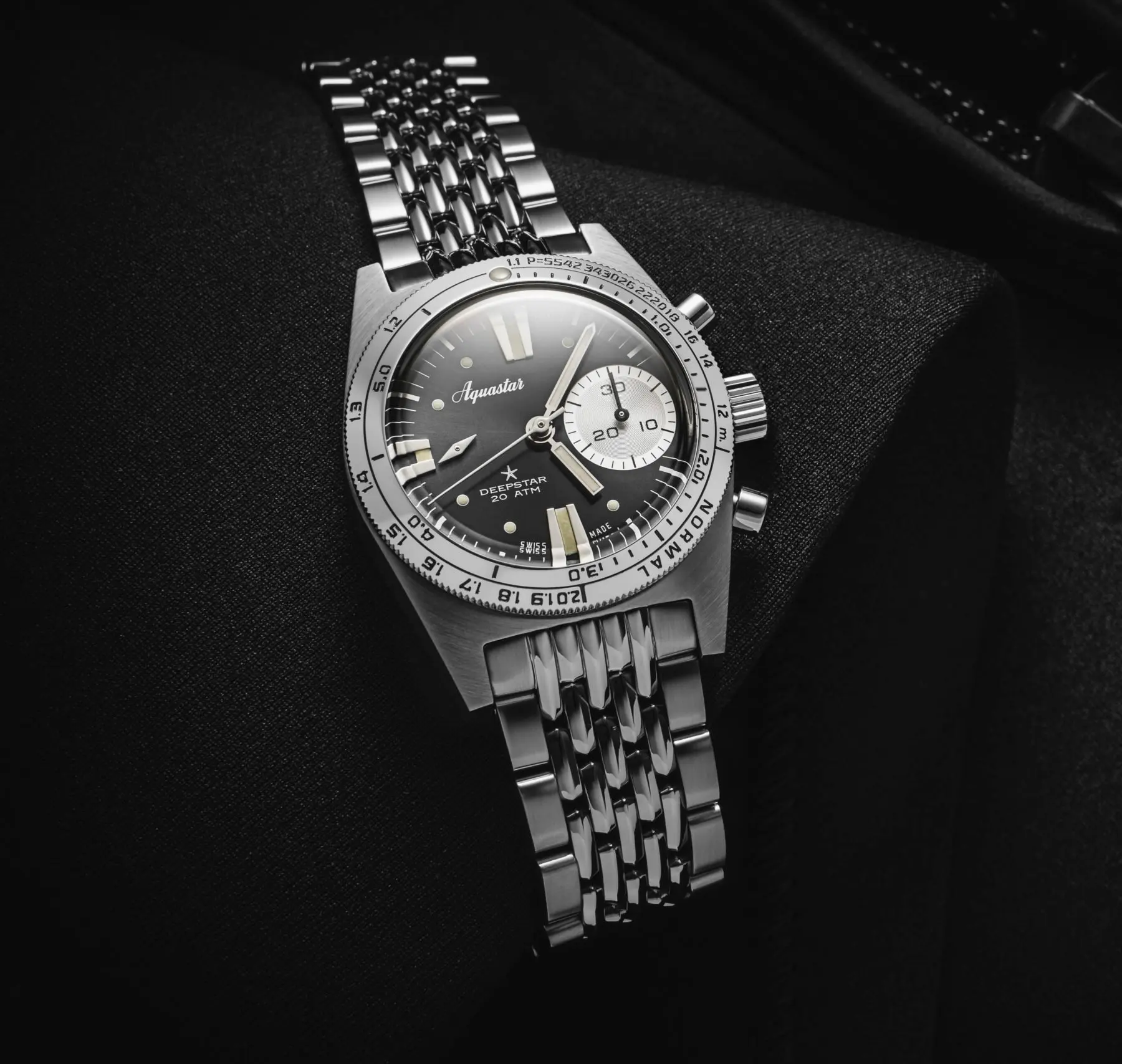

Aquastar shipped the original Model 60 in 1957, the watch that defined the skin diver.
A skin diver is a shape, not a specification: integral lugs, a slim bezel, a 36 to 39 mm case that reads as a single piece. Aquastar drew that case in Bienne and still builds it there today.
No homage, no tribute. The reference, reissued from the original drawings.
The case, explained
A skin diver is a case, not a complication.
The name describes the case. The lugs are cut as part of the case and flow straight out of the watch head, so the case, bezel and lugs appear machined from a single piece. The diameter runs 36 to 39 mm and the whole watch sits slimmer than the professional dive watches that came after it. Any movement can live inside that shape: the 1957 Model 60 is time-only, and the early Deepstar chronographs use the identical skin diver case.
The name comes from skin diving, the mid-century sport of diving with a mask, fins and a snorkel rather than heavy gear. The watch was built for the diver who wanted a slim, legible timing instrument on the wrist, not a bulky saturation tool.
What is a skin diver watch, in full1957
The watch that made the bezel usable.
Bezels of the period turned freely in both directions and could be knocked out of position mid-dive, which makes a bezel worse than useless: it reads wrong. Aquastar fitted a friction ring between the case and the bezel to hold it against accidental rotation. That is what turned the Model 60 from a watch with a bezel into a serious dive instrument, and it was filed in the Model 60's own year, ahead of everything else in the Aquastar archive.
The defining specifications have not changed: a 36 to 39 mm case, lugs integral to the case rather than soldered or screwed on, a slim bezel, and a legible dial. The complication is irrelevant to the classification. The case is the whole point.
The eleven Aquastar patents
A note for the buyer
Skin diver, or professional diver?
The skin diver era has soft edges. It opens around 1953 and closes in the mid-1960s, when the professional dive watch consolidated around a larger 40 mm case and 200 meter water resistance, the specifications that have defined the category ever since. If you want the slimmer, earlier, more wearable shape, that is the skin diver, and the Model 60 is it.
If you want the bigger case, the deeper rating and the overt tool-watch presence, that is the professional diver, and Aquastar builds those too, in the Benthos line.
See the professional dive watchesThe skin diver, and the case it shares
Model 60, and the Deepstar.

Since 1957
Model 60
The original skin diver
Aquastar shipped the first Model 60 in 1957, the watch that defined the skin diver. The MKII reissue is built from the original Bienne case drawings: the same cushion case, the same lug curve, updated with a sapphire crystal and 200 meter water resistance.
- 1957 original case
- 36 to 39 mm cushion case
- Manual wind or automatic

Since 1962
Deepstar
The skin diver case, with a chronograph
The 1962 Deepstar took the integral-lug skin diver case and added the column wheel chronograph and the no decompression bezel. The Deepstar III revives that calibre for divers who want the tool, not a tribute.
- Integral-lug skin diver case
- Column wheel chronograph
- No decompression bezel
Frequently asked
Common questions about skin diver watches.
What is a skin diver watch?
A skin diver is a case design, not a complication. The lugs are an integral part of the case and read as a continuation of the watch head, so the case, bezel and lugs appear machined from a single piece. The case runs 36 to 39 mm and sits slimmer than the professional dive watches that came after it. Any movement can live inside that case: the 1957 Aquastar Model 60 is time-only, and the early Deepstar chronographs share the identical skin diver case.
Who invented the skin diver watch?
The rotating-bezel dive watch took shape around 1953. Aquastar shipped the Model 60 in 1957 and it became one of the definitive skin divers, then Aquastar reshaped the category by turning the time-only skin diver into a wrist-worn dive instrument. The Model 60 remains the reference point for the design.
What is the difference between a skin diver and a modern dive watch?
A skin diver has integral lugs cut as part of the case, a slim profile, and a 36 to 39 mm diameter. The professional dive watch that replaced it in the mid-1960s consolidated around a larger 40 mm-plus case, screwed or soldered lugs, and 200 meter-plus water resistance. The skin diver is the earlier, slimmer, more wearable shape.
Can you actually dive with a skin diver watch?
The modern Aquastar Model 60 is water resistant to 200 meters, well within recreational and technical diving depths. The vintage 1957 originals were rated 50 to 100 meters, in period the working depth for the sport the category was named after.
What size is a skin diver watch?
The classic skin diver case runs 36 to 39 mm in diameter, notably slimmer than the 40 mm-plus professional dive watches that followed. The Aquastar Model 60 reissue holds the original mid-century proportions, which is part of why it wears like the watch it reconstructs.
Does Aquastar still make a skin diver watch?
Yes. The Aquastar Model 60 MKII is built from the original 1957 case drawings, in Switzerland. It is offered in manual wind and automatic, with a sapphire crystal, 200 meter water resistance, and a Tropic-style rubber strap that matches the 1957 shipping configuration.
The modern skin diver
The 1957 case, on your wrist.
The Aquastar Model 60 MKII is the skin diver, reconstructed from the original Bienne drawings and built in Switzerland today.
See the Model 60