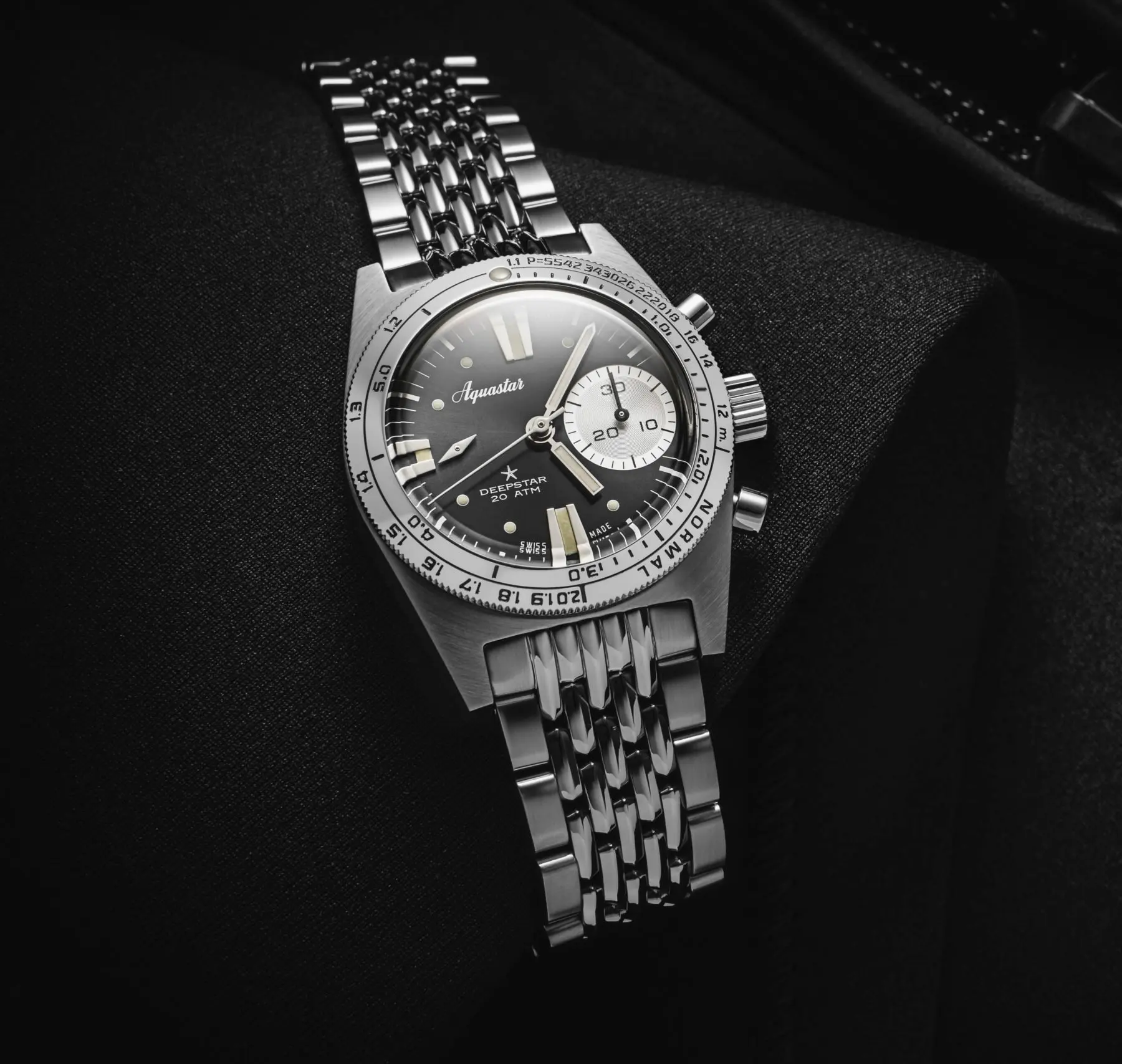
Thirty-seven millimetres was the standard case diameter of dive watches from the mid-1950s through the 1970s. The oversized 42-to-44 mm era arrived with the 2000s and is now retreating. For everyday wear, 37 mm is again the size that gets a dive watch off the shelf and onto the wrist.
Why 37 mm is the everyday sweet spot
Three practical reasons. First, universal wrist fit: 37 mm sits inside the natural wrist bone width of nearly every adult, which is why the size crossed male and female wearers a generation before the industry started talking about it. Second, cuff clearance: a 37 mm case under 14 mm thick slides under a shirt or jacket sleeve without catching, which is what quietly decides whether a watch gets worn on workdays. Third, weight: less case metal means less rock on the wrist and less strap fatigue over a full day.
The depth rating you can safely trade off. A 200-metre case already covers swimming, showering, snorkelling and recreational scuba. Past 300 m you are paying for headroom you will never reach, and paying in the two dimensions that decide comfort: height and weight. That trade is the reason 37 mm at 200 m outsells a heavier 500 m case for daily wear.
Thickness matters more than diameter
Two 37 mm watches wear very differently at 11 mm and at 15 mm thick. A tall case rocks on the wrist and pushes a cuff up over the case-back. Under 14 mm is the threshold at which a dive watch stops fighting the sleeve and starts disappearing under it. For a longer treatment of the three measurements that decide everyday comfort, see our six-check guide to choosing a dive watch brand.
Aquastar's two 37 mm dive watches
Both current 37 mm references come from the Bienne workshop.
- Model 60 MKII, 37 mm cushion case. The case geometry is lifted from the 1957 Robert drawings, with integrated skindiver lugs machined as one continuous piece so the watch sits flat on the wrist. 200 m water resistance. Sellita SW200-1 Elaboré movement, sapphire crystal, Super-LumiNova on markers and hands. The smallest and quietest Aquastar in the current range.
- Deepstar II, 37 mm. A three-hand reading of the 1962 Deepstar case, built as the daily companion to the Deepstar Chronograph rather than as a dive instrument in its own right. Sellita SW290 movement. Available in black, blue, steel-grey and limited-edition dial variants, on TROPIC rubber strap or stainless-steel BOR bracelet.
What to check before buying a 37 mm dive watch
- Lug-to-lug span, not just diameter. A 37 mm case with long straight lugs can span 50 mm and overhang a small wrist. Short curved lugs, the skindiver pattern, keep the total footprint down.
- Depth rating suited to actual use. 200 m is enough for anything short of technical diving. 300 m adds negligible daily benefit and measurable thickness.
- Movement and serviceability. Widely used Swiss base calibres are more serviceable than exclusive movements over a twenty-year horizon.
- Bracelet or strap width, 18 to 20 mm. A 37 mm case looks proportional on 18 or 19 mm lugs, wrong on 22 mm. Check the fitting before buying an aftermarket strap.
Frequently asked questions
Is 37 mm too small for a modern dive watch?
No. 37 mm was the standard dive-watch size from the mid-1950s through the 1970s and is again the sweet spot for daily wear. It fits nearly every adult wrist, slides under a shirt cuff, and is light enough to disappear over a full day. The oversized 42-to-44 mm era arrived in the 2000s and is now retreating in favour of proportioned cases.
Which 37 mm dive watch is best for everyday wear?
Comfort is decided by diameter, thickness and lug shape rather than by depth rating. A 37 mm case under 14 mm thick with short curved lugs will sit flat and slide under a cuff. In our own range that points at the Model 60 MKII (37 mm cushion case, 200 m) and the Deepstar II (37 mm, 200 m). Both use widely-serviceable Sellita movements.
Is 200 m water resistance enough for daily wear?
Yes. 200 m already covers swimming, showering, snorkelling and recreational scuba. Anything past 300 m is specification you are carrying for no reason, and the extra depth rating adds thickness and weight, the two dimensions that quietly decide whether a watch gets worn.
Do 37 mm dive watches hold value?
Yes, when the design and workshop are genuine rather than referenced. Watches whose case geometry comes from an archive drawing that can be dated, and whose maker still services fifty-year-old examples in the same workshop, hold value better than modern homages of the same size. Provenance, patents and serviceability are the three factors that decide.
Related reading: The Aquastar Model 60 MKII · The Aquastar Deepstar II · Six-check guide to choosing a dive watch brand · What is a skin diver watch?