Where the workshop came from
Instruments for people going underwater. That was the whole brief.
Aquastar was founded in Switzerland in 1957 by Frederic Robert, an entrepreneurial diver and sailor, and directed at building watches and depth instruments exclusively for oceanic work. Between 1957 and 1977 the workshop filed eleven patents. Not one was a decorative complication. They were bezels, depth gauges, sealed crowns, and dive computers. What follows is the run of watches those patents were built into during the founding decade.
Everything shown below is photographed from an original example held in the Aquastar archive. Where a modern reissue exists in the current catalogue, it is linked. Where the model is discontinued, it is here because this chapter is the record.
1962
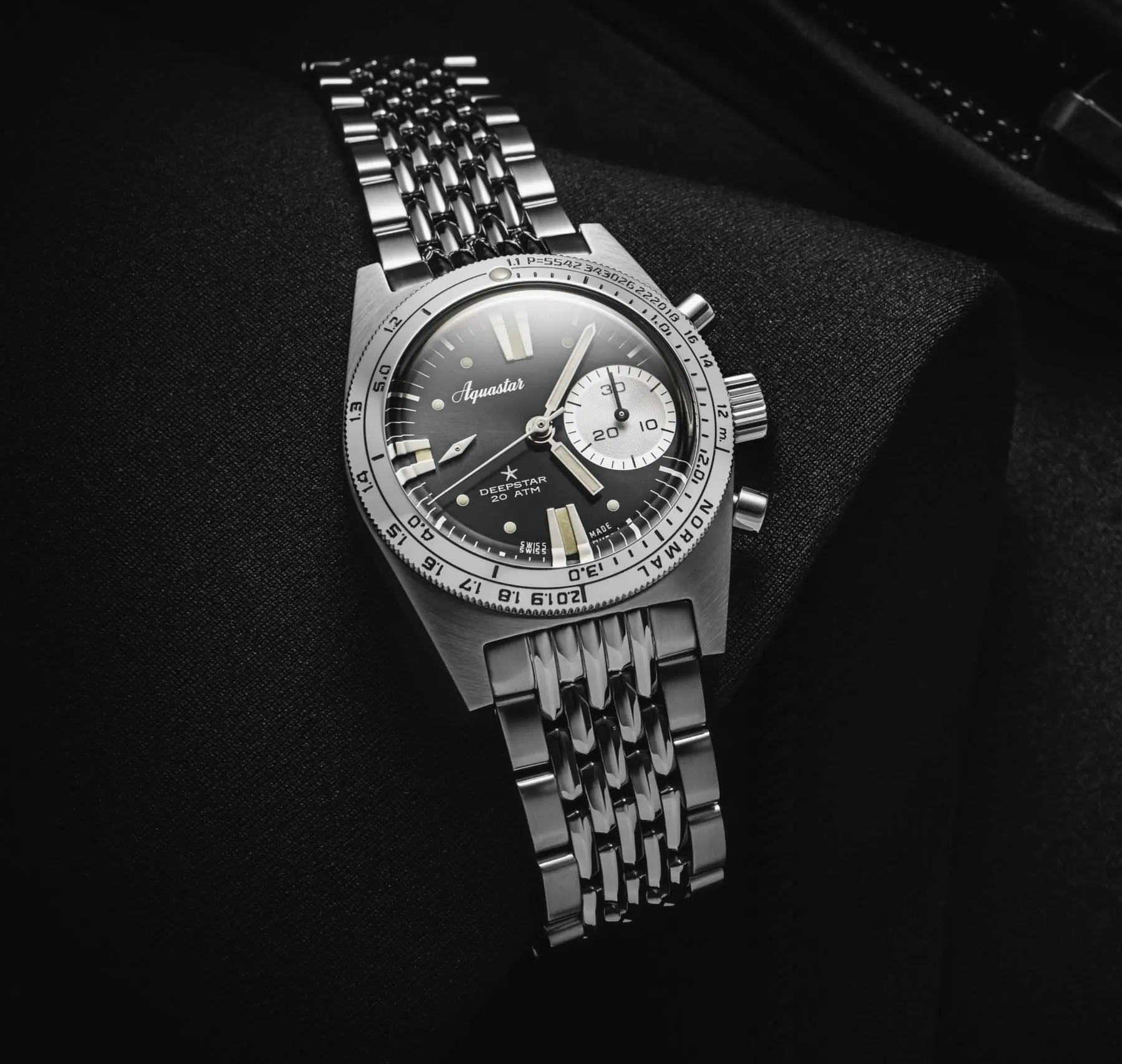
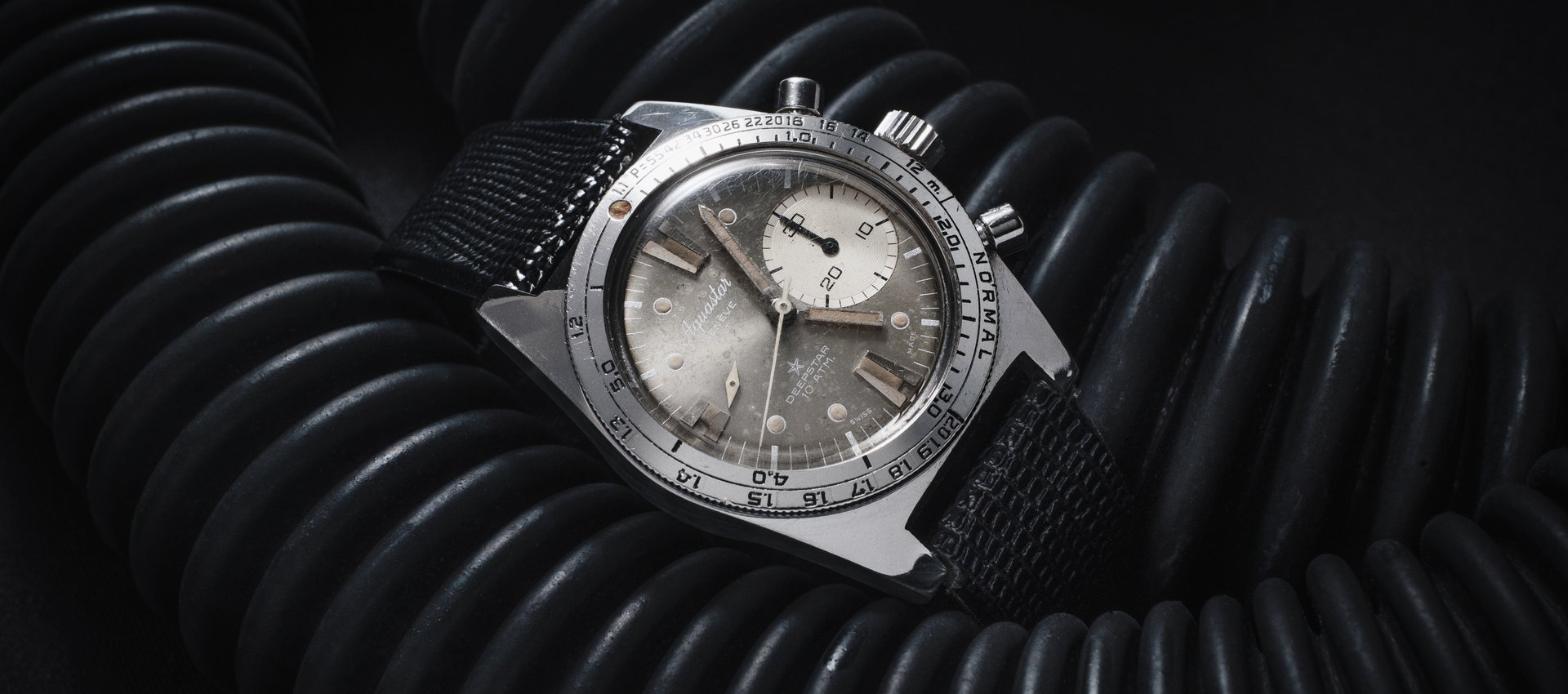
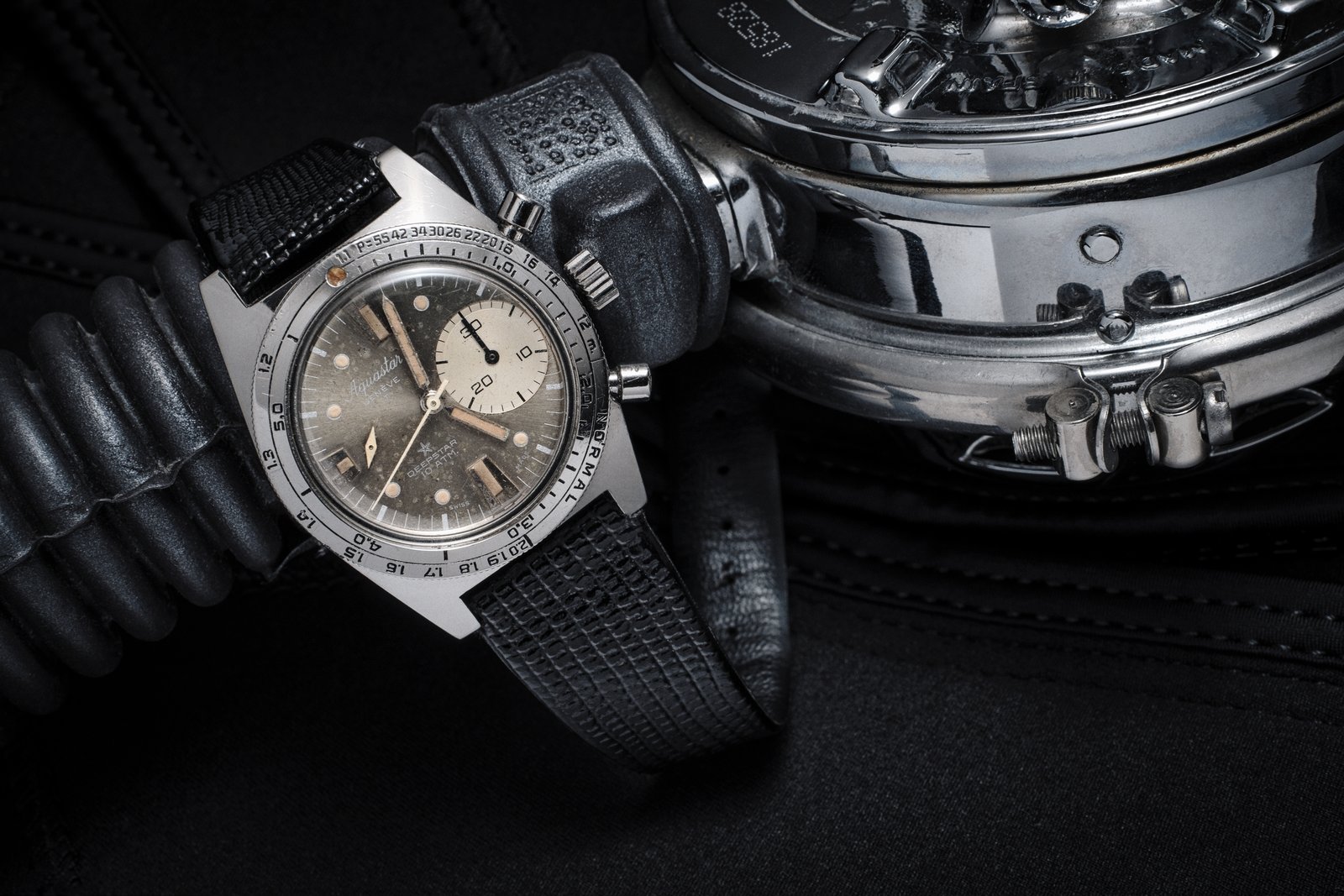
Deepstar Chronograph.
The Deepstar was the workshop’s first dive chronograph and the reference that carried the workshop’s no-decompression bezel from the drawings to the wrist. Marc Jasinski filed the bezel patent, CH 436 140, in Geneva on 15 May 1964, calibrated to the nitrogen-saturation tables in use at the time. The bezel is still in production in its original geometry on the modern Deepstar reissue.
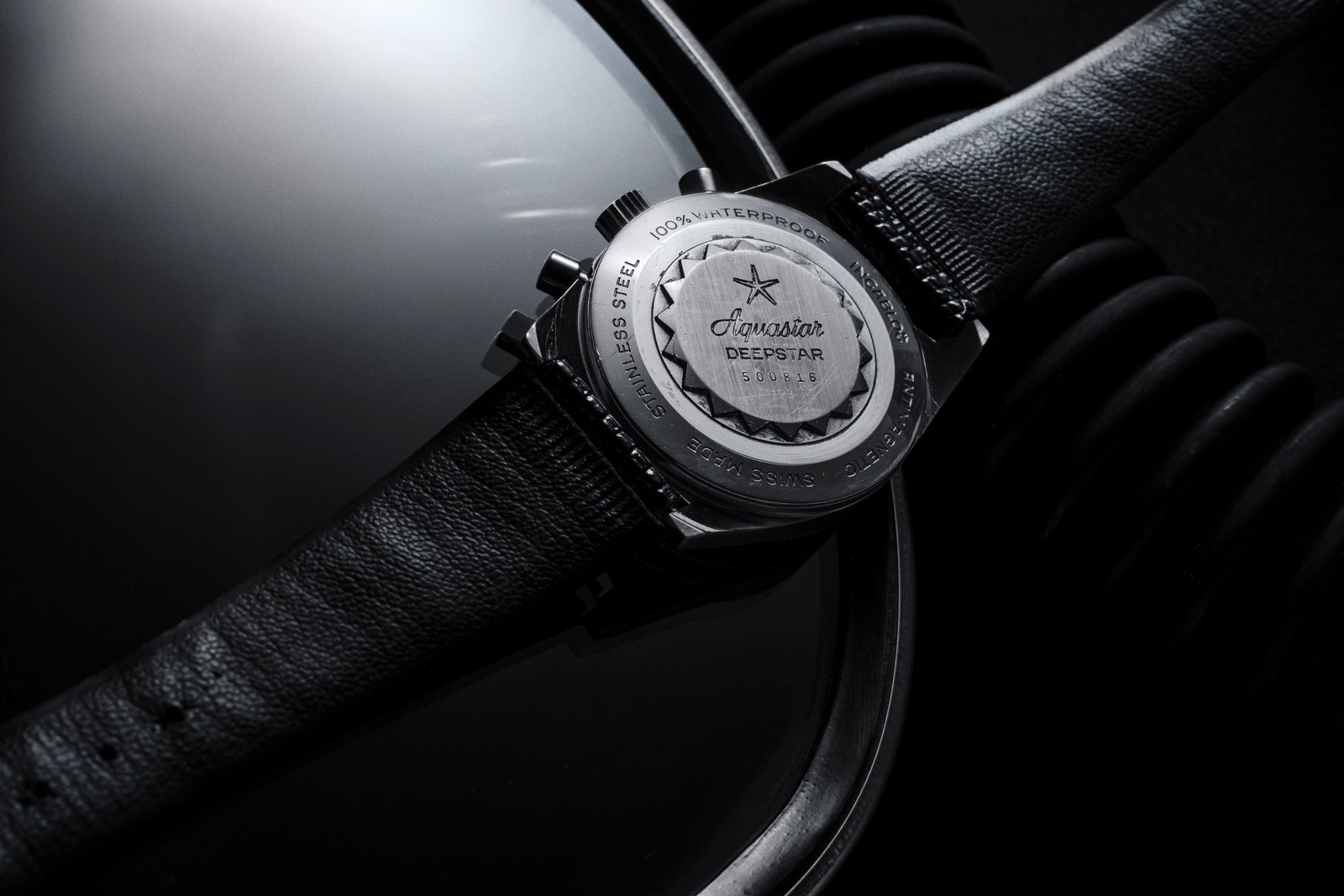
The example shown carries a "Deepstar 10 ATM" dial, silver with tritium markers aged to cream, a sub-dial at 3 o’clock, and the "P=55 42 34 30 26 22 20 18 16 14 12 m." decompression scale printed around the outer bezel ring. The reverse of the case reads "100% WATERPROOF / STAINLESS STEEL / SWISS MADE / ANTIMAGNETIC / INCABLOC" around a scalloped inner cap. The French Marine Nationale would later specify the same watch for combat divers coming through Toulon between 1979 and 1984.
1970
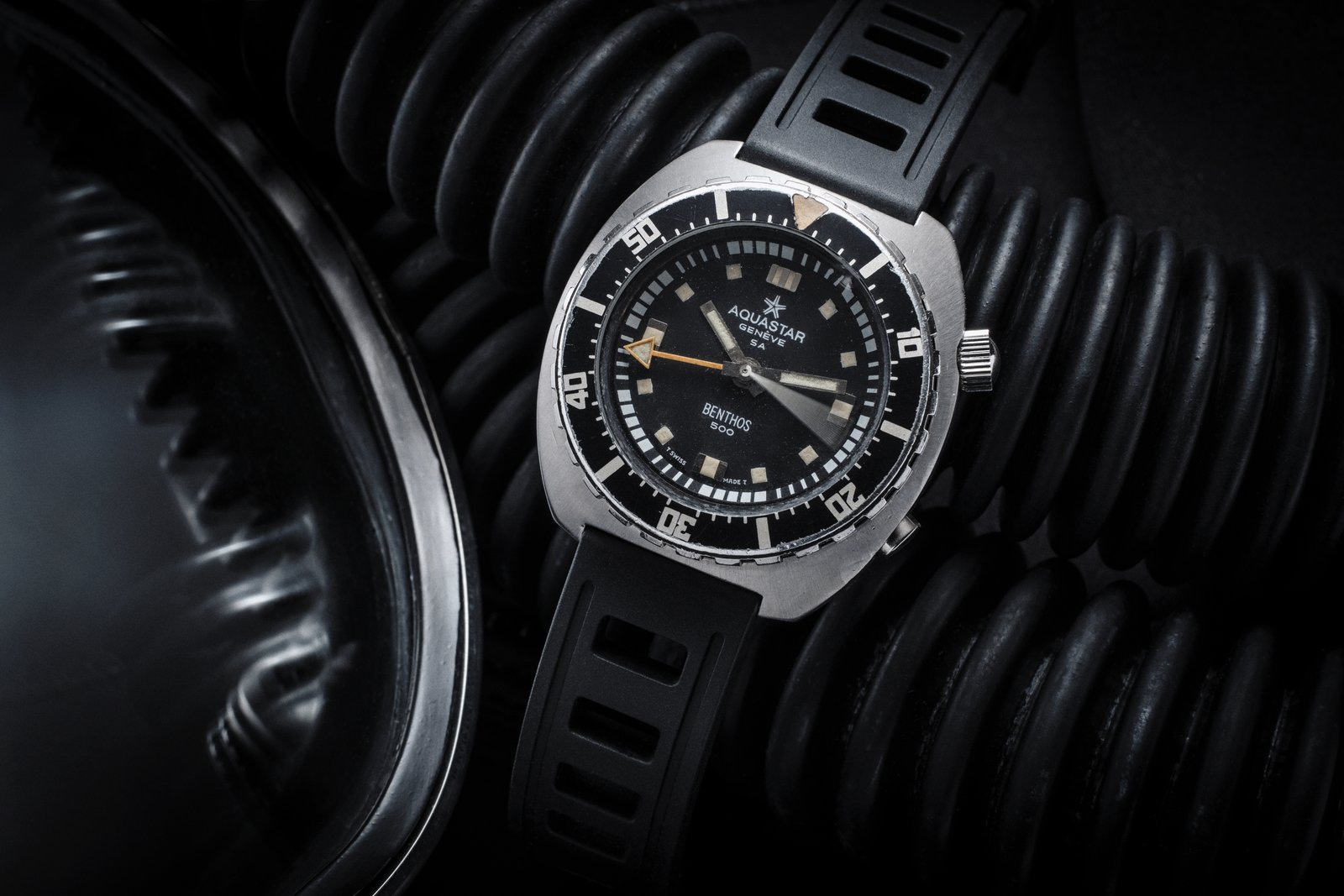
Benthos 500.
The Benthos 500 was the first Aquastar case rated to 500 meters that could still be opened and serviced, and the first serviceable 500 m dive-watch case on the market. Aquastar solved the pressure problem with a dual-gasket crown patented in the same period as the case, so the seals could be renewed rather than the whole case discarded. That single choice, serviceability over monobloc simplicity, is why fifty-year-old Benthos cases can still be resealed in the Aquastar workshop today.
The dial reads "AQUASTAR / GENEVE / SA" above the Aquastar star, with "BENTHOS / 500" below and "T SWISS MADE T" at 6 o’clock indicating the tritium lume of the period. The bezel is external and unidirectional, marked in a full-minute elapsed scale.
1970s
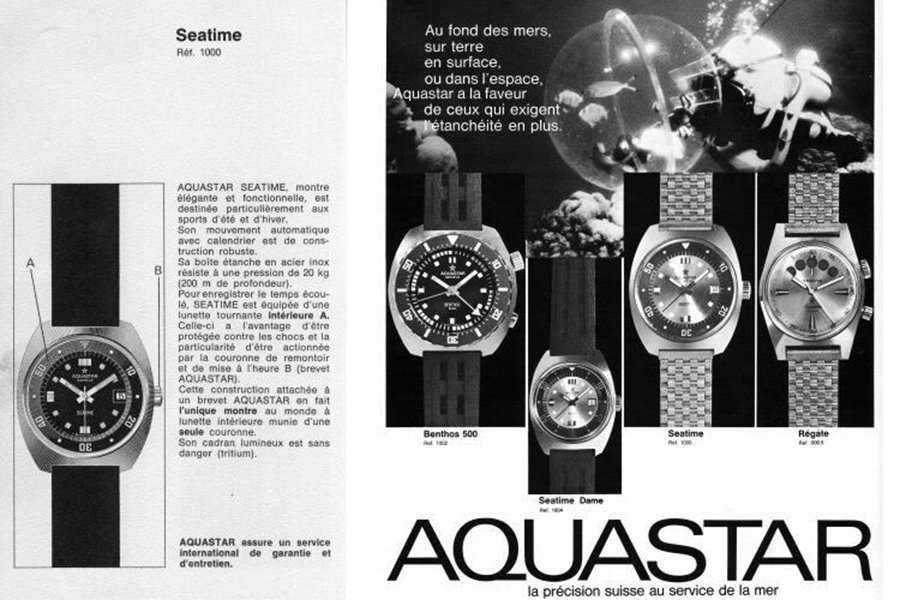
Seatime.
The Seatime sits between the small Model 60 and the large Benthos 500 in the workshop’s 1970s catalogue. Its distinguishing choice is an internal bi-directional dive scale driven from a second position of the same crown that sets the time. Nothing rotates against the case gasket, which means the bezel cannot be knocked out of position by contact with a tank or a wetsuit sleeve, and the case remains as tightly sealed as a non-diver watch.
The example shown carries a silver dial with a deep-blue inner bezel ring, the star and "AQUASTAR / GENEVE" logo at 12, and the model name "SEATIME" printed at 6. The A. Schild AS 1902 / 1903 automatic movement was the calibre of choice for the reference through most of its run. It is a discontinued model, no longer built. This chapter is where it lives.
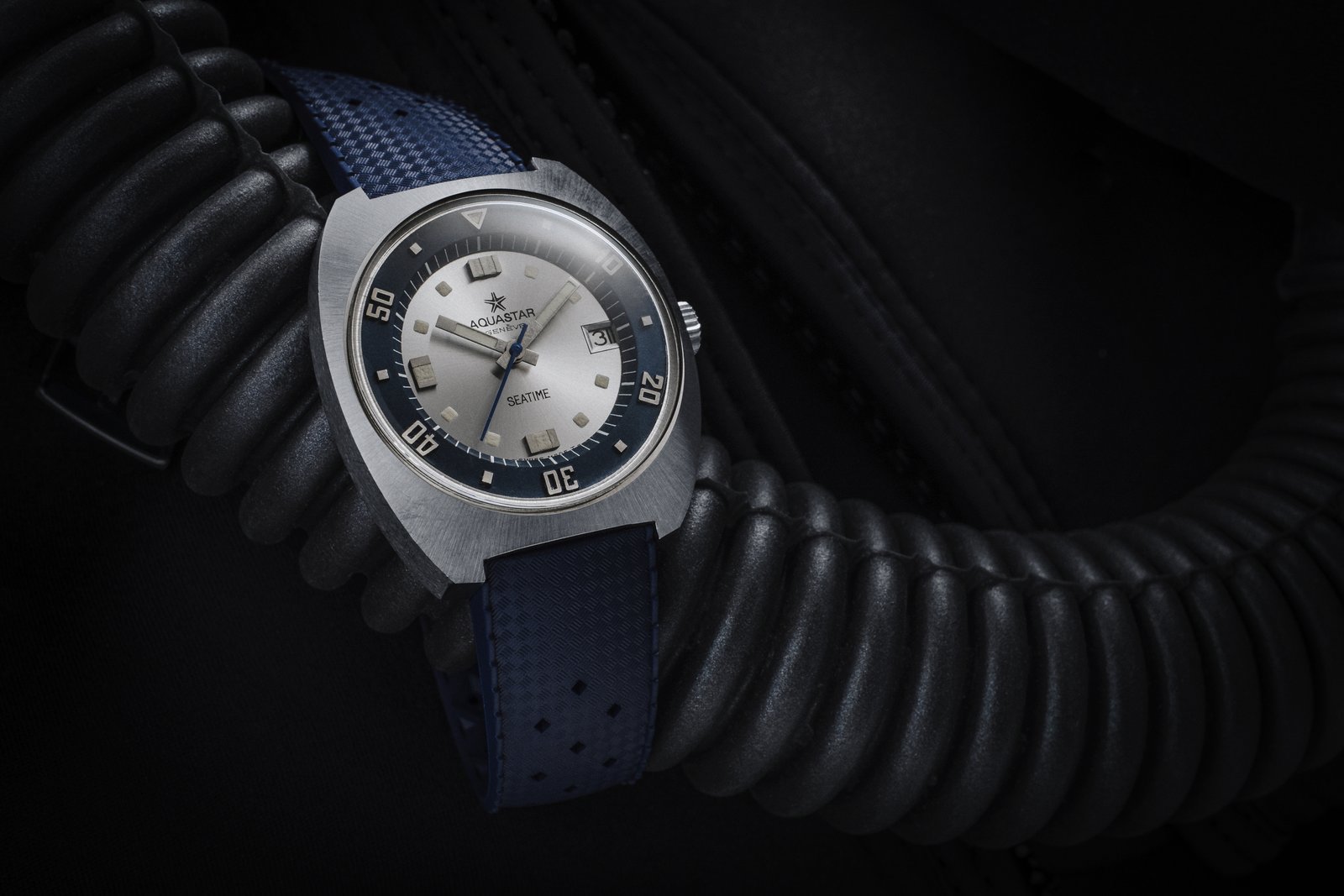
Discontinued. Not currently produced.
1963 onward
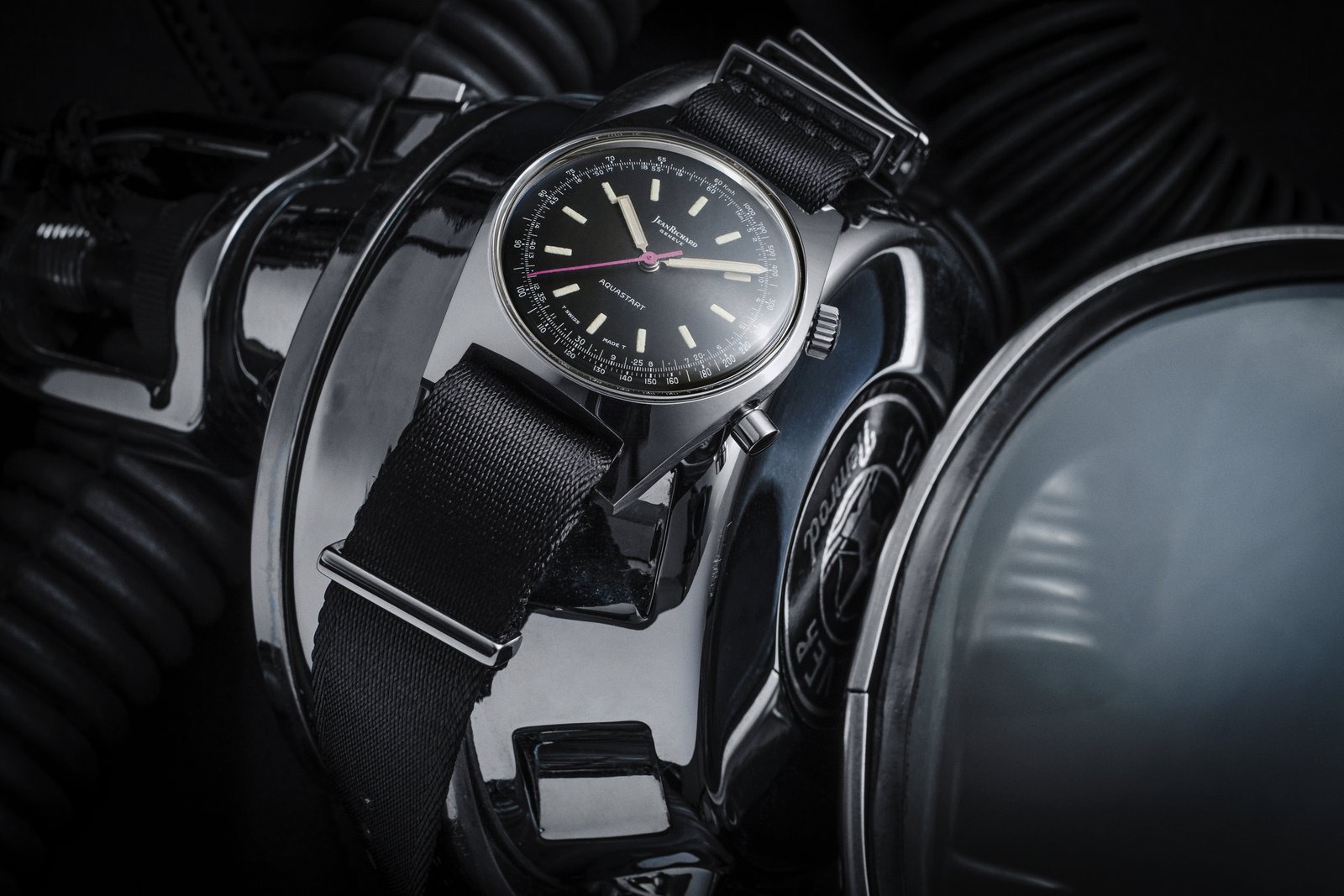
The Regate, and the JeanRichard Aquastart.
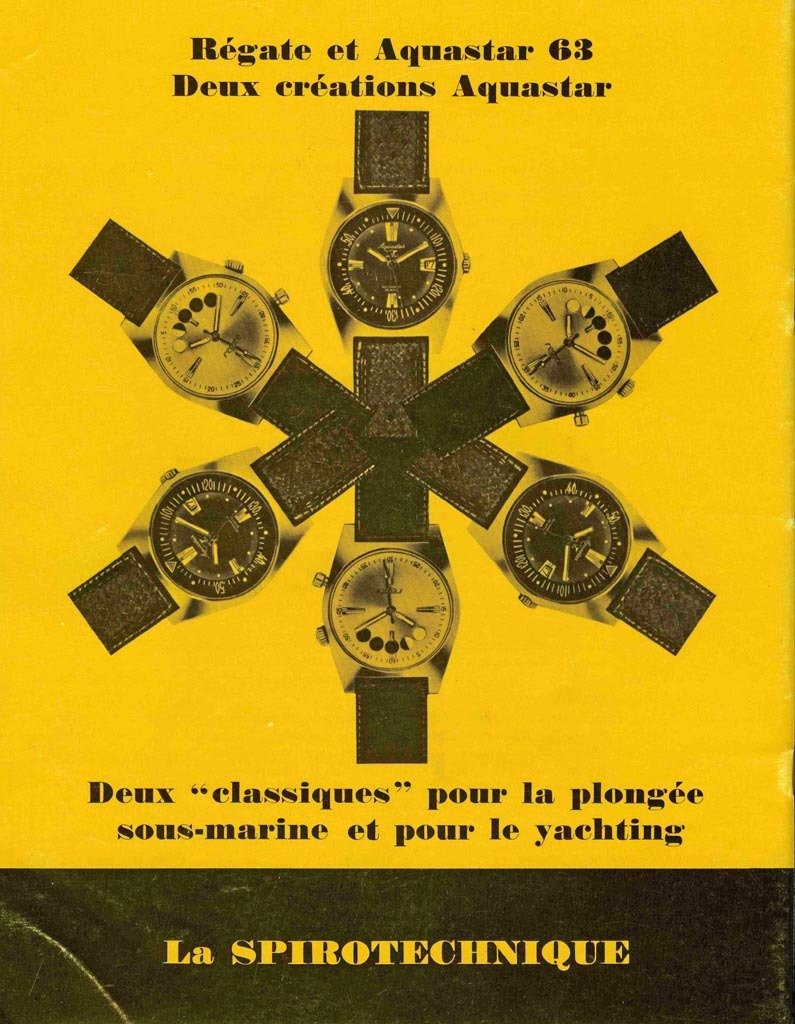
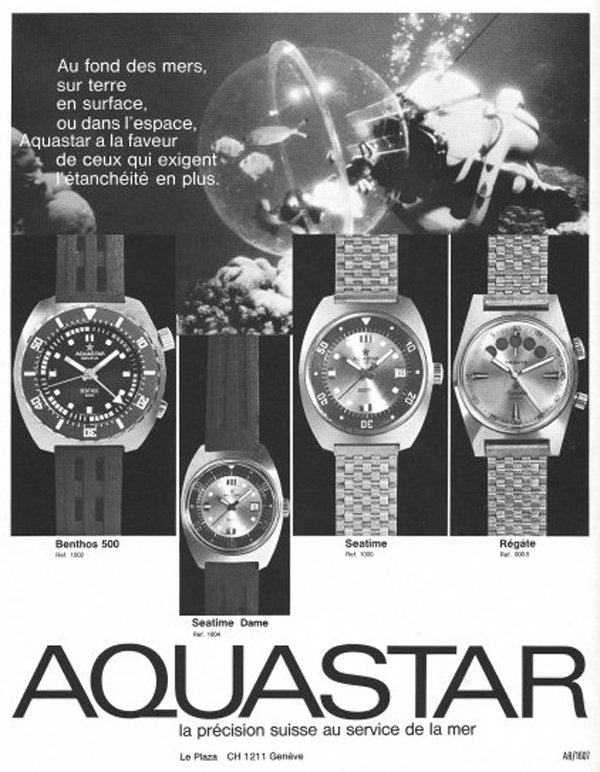
By 1963 the workshop was building yacht timers alongside dive watches. The Regate, the first automatic wrist-mounted regatta timer, marked five countdown minutes on the dial with red discs that disappeared one by one as the start gun approached. Period advertising positioned the Regate and the Aquastar 63 dive chronograph together as "deux creations Aquastar", distributed in France by La Spirotechnique.
The Aquastart shown here was made by the sister house JeanRichard for the same market, a wrist-mounted stopwatch reading kilometers per hour on a black dial, with a magenta seconds hand and pushers at 2 and 4 o’clock. It shares the workshop’s water-resistant case construction and its clean tool-watch dial vocabulary. The Regate line ran into the 1980s and, in digital form, until 2020.
The period advertisements
How Aquastar spoke, then.
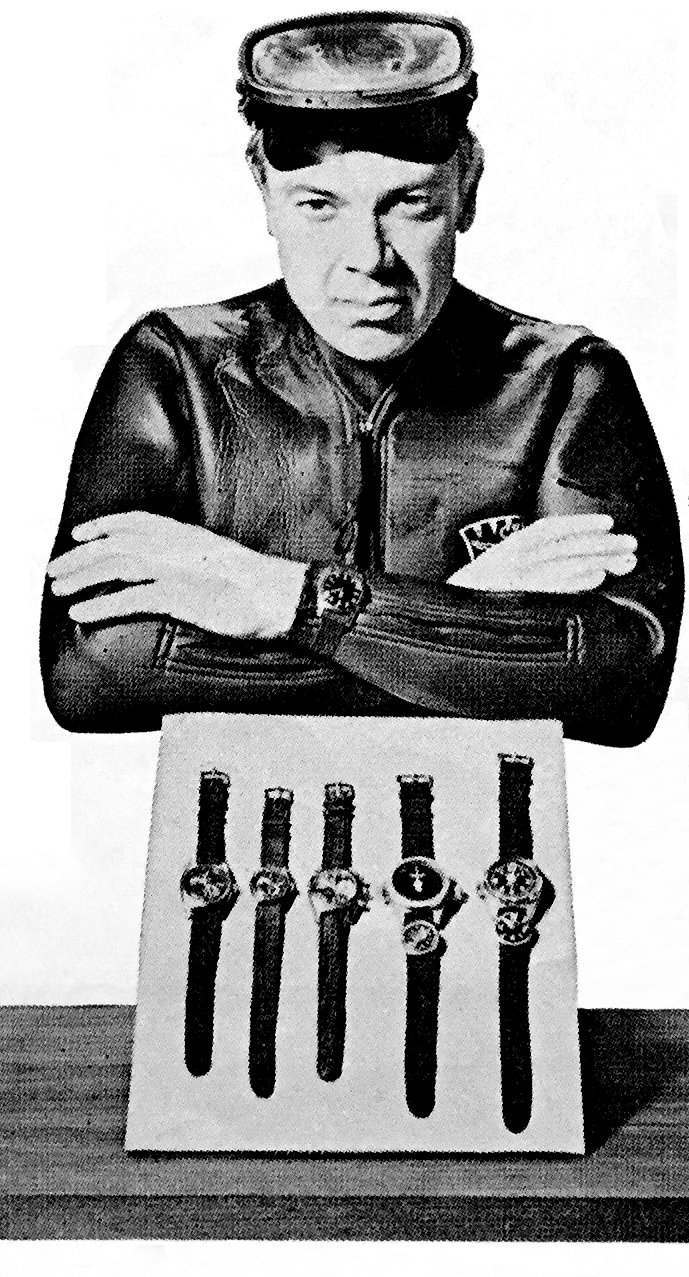
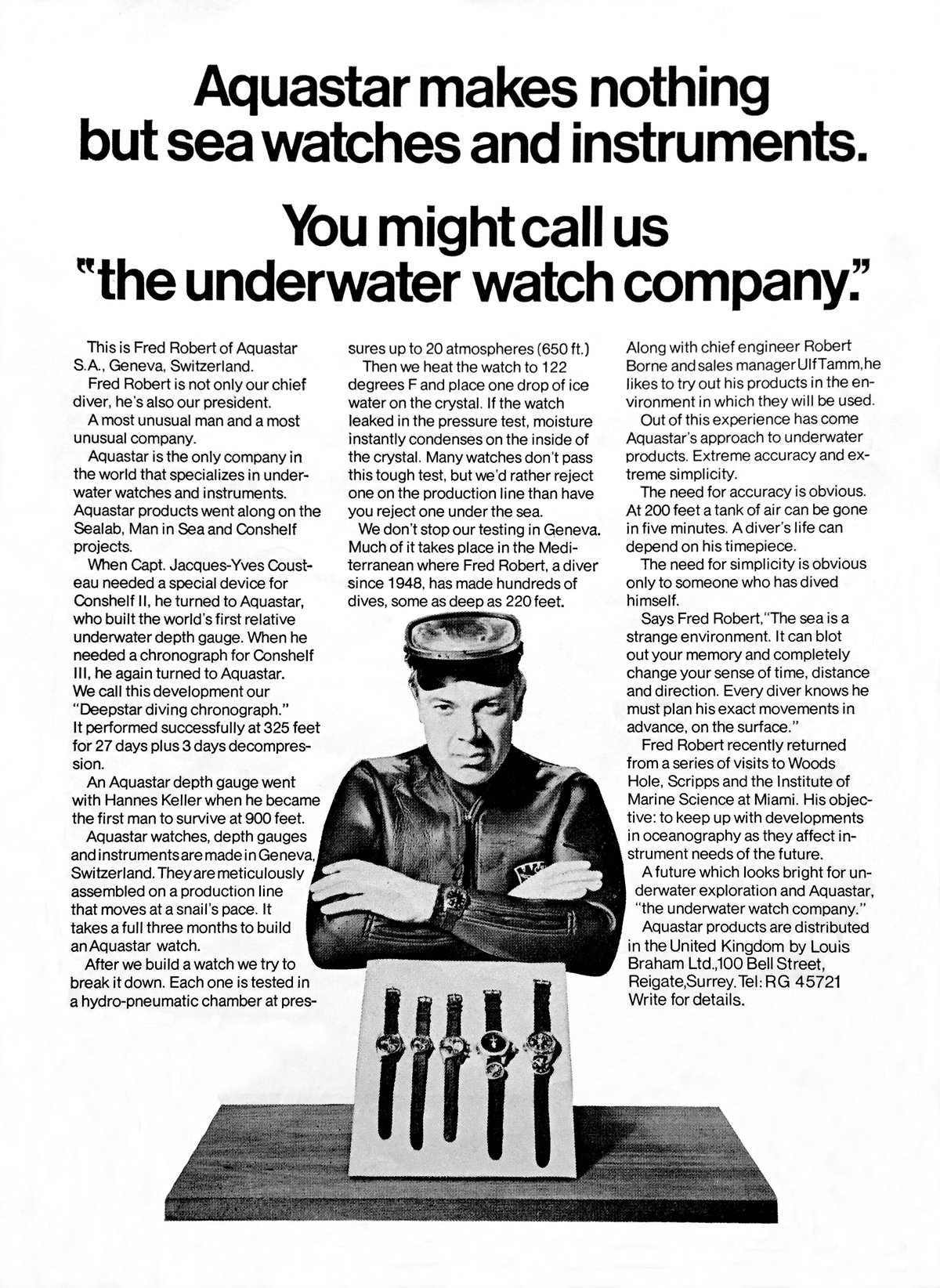
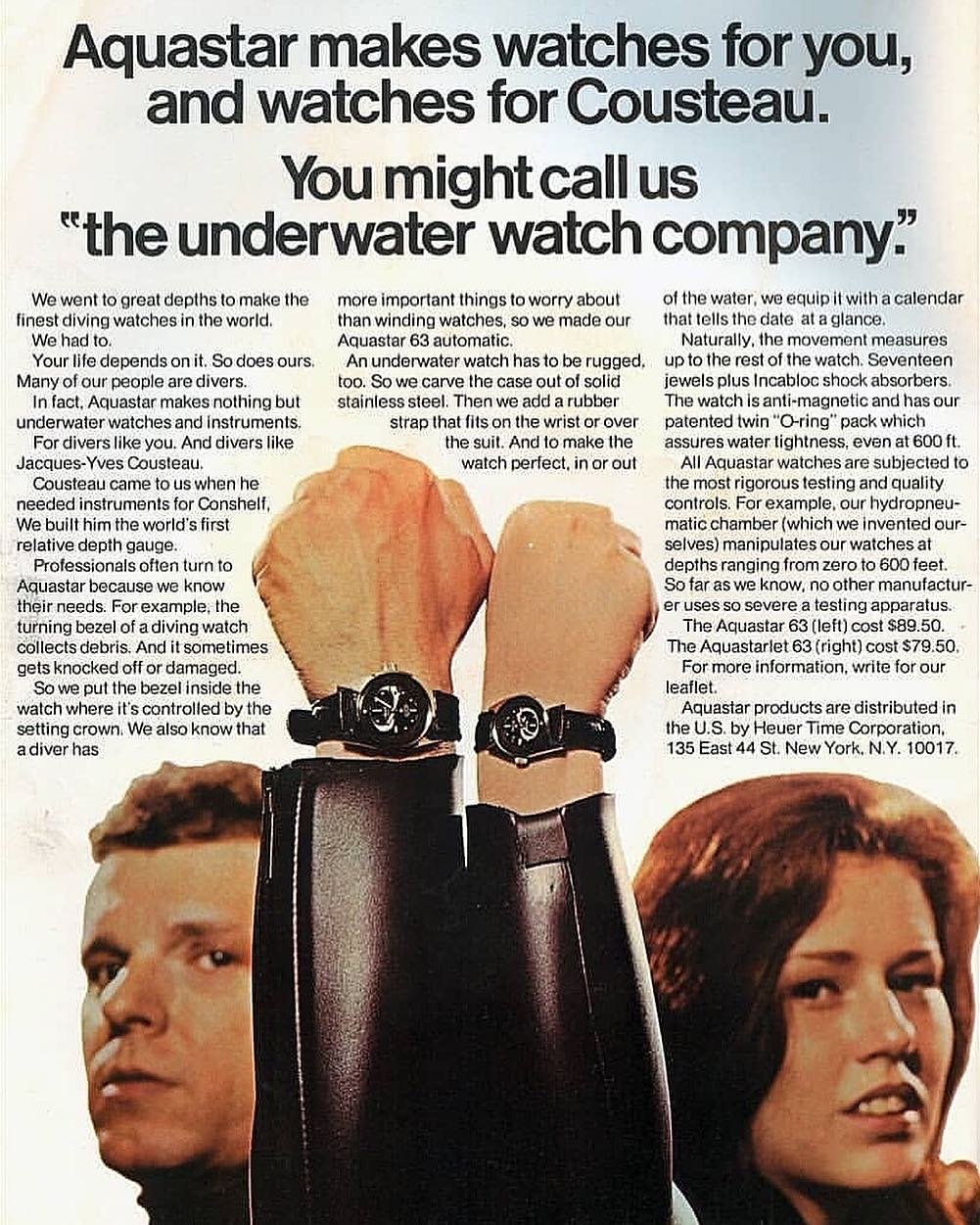
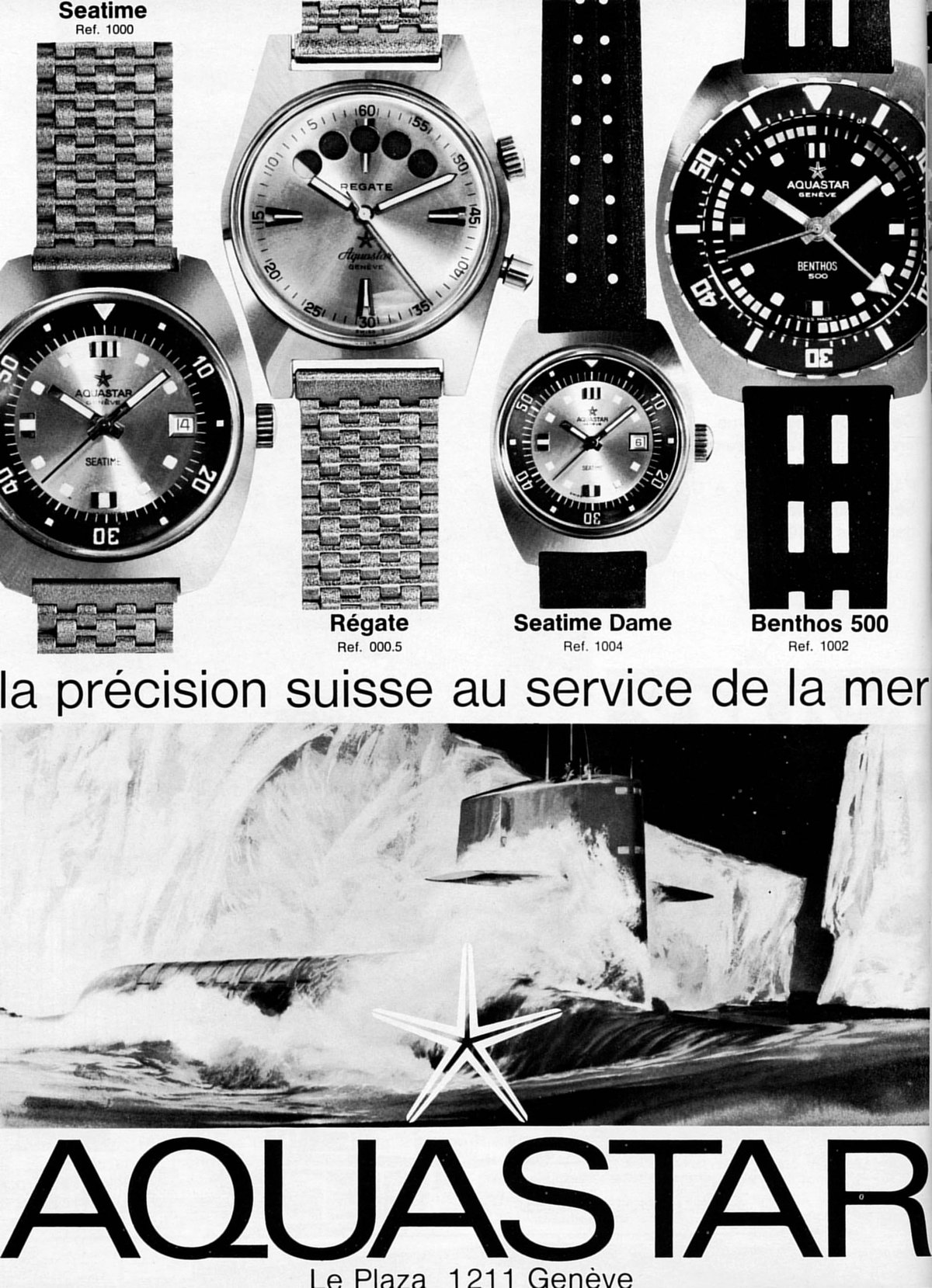
A selection from the workshop\u2019s magazine and distributor placements, 1960s and 1970s. The dial vocabulary and the tool-watch positioning have not changed. Same star, same purpose, same instruments.

Frequently asked
Original-models questions.
What are the original vintage Aquastar models?
The original Aquastar catalogue between 1957 and the late 1970s ran to about a dozen references from a single Geneva workshop. The founding pieces are the Model 60 cushion-case skindiver (1957), the Deepstar dive chronograph with the patented no-decompression bezel (1962), the Benthos 500 saturation diver issued to the French Marine Nationale (1970), the Seatime three-hand diver (1960s), the Regate yacht-timer countdown chronograph (1974), the Airstar pilot chronograph (1965), and the 1959 Navigator wrist instrument that combined a watch, bathymeter, compass and thermometer on a single plate. Every one traceable to a documented patent or workshop drawing.
What is the Aquastar Seatime?
The Aquastar Seatime was a Swiss three-hand dive watch produced by Aquastar SA in the 1960s and 1970s, positioned as the entry-level diver alongside the Deepstar chronograph and Benthos 500. Cushion-adjacent case, applied indices, unidirectional bezel. It was discontinued when Aquastar pivoted to regatta timers in 1984. The Seatime is not currently in production; original examples appear on the collector market.
What is the Aquastar Regate?
The Aquastar Regate was a yacht-timer chronograph designed for competitive sailing, patented in 1974 by Albert Piguet at the Aquastar workshop. It carried a countdown-timer mechanism that let a helmsman time the pre-start sequence of a regatta from an off-the-wrist starting horn back to zero. Distributed in the United States by Heuer Time Corporation under a co-branded arrangement, the Regate line was the direct predecessor of the Regatta 2000 digital regatta timers that carried Aquastar through the 1984 to 2020 mechanical hiatus.
Is JeanRichard Aquastart the same brand as Aquastar?
Effectively yes. The Geneva workshop was registered as JeanRichard SA when it filed its earliest patents in 1957 to 1961. In 1962 the company reregistered as Aquastar SA (ci-devant JeanRichard SA), the "ci-devant" (formerly) noting the continuity. Some 1962 to 1965 references were co-signed JeanRichard Aquastart during the transition, before the modern Aquastar identity was fully established. Same workshop, same director (Frederic Robert), same patent portfolio.
Are the original Aquastar vintage models still made?
The three foundational families are still in current production as faithful reissues built from the original workshop drawings: the Model 60 MKII (1957 cushion case), the Deepstar II and Deepstar III Chronograph (1962 architecture and bezel), and the Benthos Heritage II, Heritage One and Professional (1970 case geometry, same gasket pattern). The Seatime, Regate, and Navigator are not in current production but are documented in the archive.
Where to go next
The reissues, the patents, the people.
The modern Deepstar carries the same 1962 bezel geometry. The Benthos family continues the 1970 case in four current references. The Model 60 MKII is the 1957 cushion case, lifted from the original Robert drawings and still built to them.
For the eleven filings between 1957 and 1977 that made all this possible, see the Aquastar patents. For the divers, scientists and combat units who worked in Aquastars, see Worn by. For the complete chronology, the 60-year timeline is on a single page.