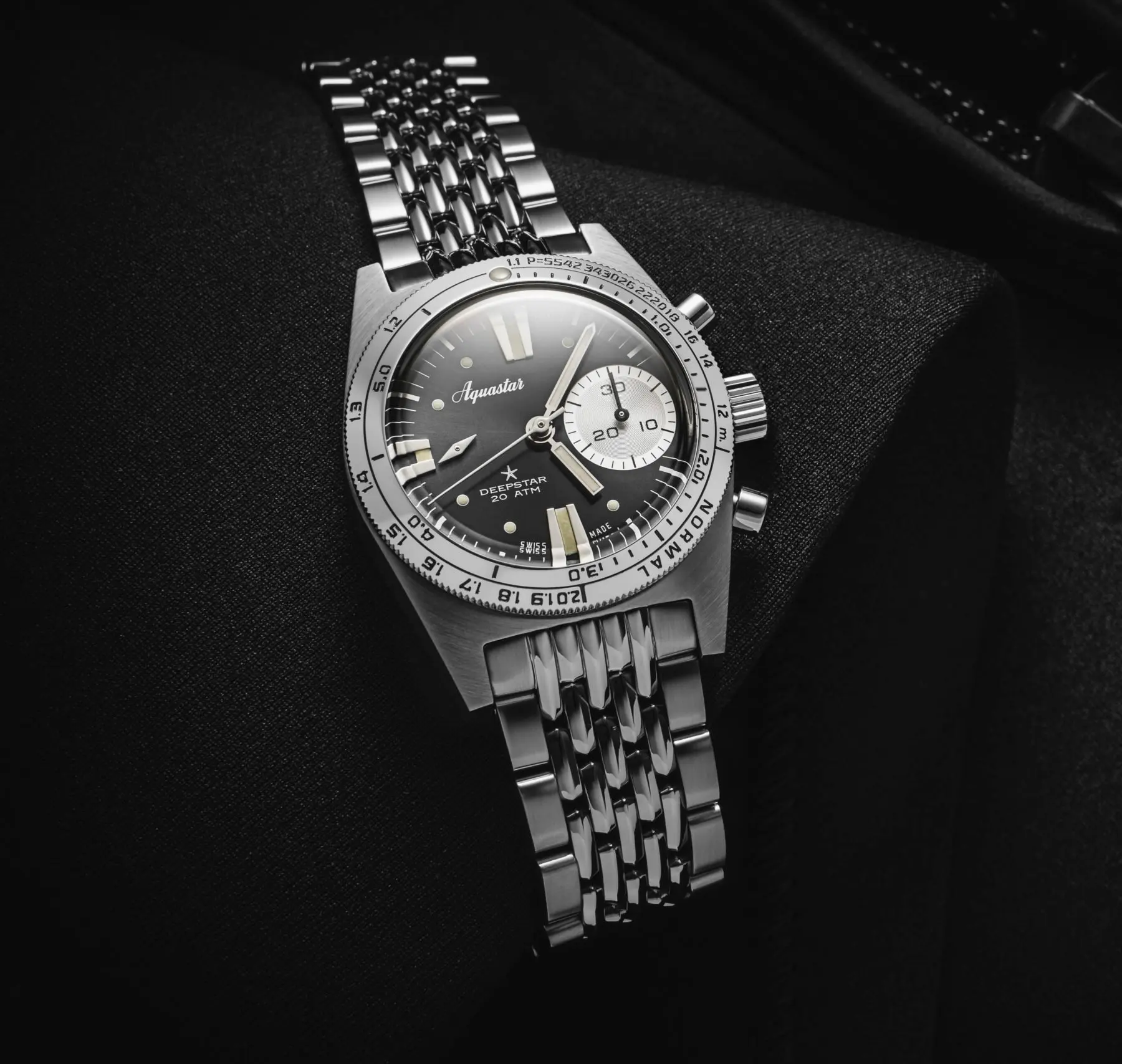
Why settle for a homage when you can own the original.
A heritage reissue is when a watchmaker reproduces a watch from its own archive. A homage is when a different watchmaker reproduces somebody else's archive. From a distance the two can look almost identical, and they are often pitched as substitutes at similar prices. They are not substitutes. They are different categories of object, sold under similar marketing language, with very different consequences for ownership, resale, and meaning over time.
This article is about why. Five real differences, in plain terms, and what each one does to the watch on your wrist over a generation.
1. The case lineage you can verify
A heritage reissue traces its case to an original drawing. The lug curve, the bezel grip pattern, the crown profile, all of it comes from a dated archive sheet drawn by a named person and stamped by the maker. The brand still holds the document. They can put the 1962 sheet next to the 2026 sheet and show you which lines are unchanged.
A homage cannot do this. The homage maker may have studied vintage examples to copy the look, but they do not own the lineage. The shape on their case originated in somebody else's archive, drawn by somebody else's draughtsman, for somebody else's brand. Two cases with the same silhouette tell you nothing about whether either of them is the original.
That distinction reads as abstract until you try to sell the watch in twenty years. The heritage reissue comes with a documented continuity argument that an auction house or a serious collector can verify. The homage comes with a styling argument that they cannot.
2. Movement choice as a continuity decision
Heritage reissues pick movements that mean something to the original. If the 1962 watch used a Valjoux 23 column-wheel chronograph, the modern reissue uses a hand-wound column-wheel calibre built to replicate the same architecture, even when a cheaper automatic from the same parts catalogue would be easier to source. The cost of that decision is higher; the reason is continuity.
Homage makers pick from the parts catalogue. Sellita SW200, ETA 2824 derivatives, Miyota 9 family, the same units sold to every other microbrand. The movement choice is purely economic. The mechanism in the homage has no connection to anything the original wore on the wrist.
Both kinds of movement run. Both can be serviced. The difference is whether the choice carries meaning, and whether that meaning shows up later in the resale narrative.
3. The patent trail
Patents are public documents. They sit in the Swiss federal patent office in Bern, the European patent office in Munich, the United States patent and trademark office in Alexandria, dated and signed and accessible to anyone with twenty minutes and an internet connection. A heritage brand that holds patents is making a claim you can independently check.
Aquastar's no-decompression bezel was patented by Frédéric Robert in Geneva in 1964, CH 436 140. The bezel on the modern Deepstar is the same pattern. That is not marketing copy. It is the public record. The same is true of the eight other Aquastar patents filed between 1957 and 1977.
A homage of the same bezel geometry, produced in 2026 by a different brand, has no patent claim on the design. They have copied an expired or unpatented feature and made it themselves. There is nothing illegal about that. There is also nothing about it that authenticates against a public document. When the watch enters a Phillips or Christie's catalogue, the difference between "patent holder" and "patent-using" is one of the first things written into the lot description.
4. Provenance, catalogues, archives
Heritage brands carry period catalogues, dealer correspondence, marketing material, advertising, dial-supplier invoices, and (sometimes) procurement contracts. These documents survive in collector libraries, watch press archives, the occasional university special collection, and the brand's own working files.
When a collector traces a 1979 Marine Nationale Aquastar Deepstar back to its issuing school in Toulon, they are using procurement records that survive because Aquastar held the contract. The watch is connected to a real history that can be checked against external sources.
A homage of the same design has no equivalent connection. The history belongs to the brand that issued the watch; the homage borrowed the styling, not the documentation. This is the difference between provenance, which is documented, and a story, which is told.
5. Service continuity over time
Watches need service. Gaskets harden. Springs lose tension. Crowns wear. A heritage reissue can be serviced by the brand that made it, which is also the brand that made the original, which has the parts and the records and the workshop. If a 1962 Aquastar Deepstar needs new bezel friction springs in 2026, the workshop knows the part because they have the original engineering drawings.
A homage's service path is whatever the maker can hold together. If the homage brand changes ownership (which happens often in the microbrand sector) or closes (which also happens often), the service path goes with it. The watch becomes an orphan, serviceable only by whoever can be persuaded to take it on.
For a watch you intend to own for a generation and pass to a child, this is not a minor detail. It is the difference between an heirloom and an orphan.
What this means for value at auction and resale
The auction record on heritage reissues, over the last twenty years, is straightforward. A reissue from a brand that holds the original lineage gradually becomes collectible on its own terms. The Aquastar Deepstar Re-Edition produced in 1972 is now a collectible piece in its own right, valued for the era it represents (the early 1970s reissue programme) separately from the 1962 original. The reissue and the original both appreciate.
The auction record on homages is also straightforward. A homage from a brand with no original lineage is valued at what people will pay for the design, on the day, full stop. There is no upward pressure from collectibility because there is no documented heritage to support a collector premium. The value tracks the secondary market for whichever movement is inside, plus a thin margin for the styling.
This is not an argument that homages are bad watches. Many are honest watches at honest prices. It is an argument against thinking of a homage as a substitute for a heritage reissue when the two are priced within a few hundred dollars of each other. They are not the same purchase.
How to tell the difference when buying
Five questions to ask the brand, before you spend the money:
- Can you show me the original drawings, dated, by the original designer? A heritage brand can usually scan a page from the archive. A homage brand cannot.
- Do you hold the patents for the distinctive features? Patents are public records. If a brand claims patents, the numbers are checkable.
- Do you have period catalogues from the era you are reproducing? Heritage brands keep them. Homage brands do not, because the era they are reproducing was not theirs.
- Where is the watch serviced, by whom, and how long has that workshop been operating? Continuity of workshop is continuity of repair.
- Were the original watches issued, sold by named retailers, or procured by an identified institution? Heritage gives a paper trail. Homage gives a styling trail.
A heritage brand can answer yes to most of these with documents. A homage brand answers with marketing copy or politely deflects. Neither answer is wrong. They are different answers to different questions about different objects.
Why this matters to the buyer
Heritage reissues and homages are often priced within a few hundred dollars of each other. The reissue costs more because the brand carries the cost of maintaining the archive, the patents, the workshop, the service infrastructure, and the institutional memory. The homage costs less because it carries none of those.
If those things matter to you (because you intend to keep the watch, pass it on, or sell it later to a buyer who values heritage), the heritage reissue is the better watch for the money even when the spec sheet looks similar to the homage. If they do not matter to you (because you want the look at the lowest price and you do not intend to keep the watch long), the homage is fine. Both are legitimate purchases. They just do not occupy the same category.
The mistake is buying the homage thinking it is a heritage reissue at a discount. It is not. It is a different object, sold at a different price, and worth what it is priced at, no more.
What this looks like at Aquastar
Aquastar's case for being a heritage reissue brand sits on a small set of documented facts: nine patents filed in Geneva between 1957 and 1977, a Marine Nationale procurement contract from 1979 to 1984, continuous workshop operation in Switzerland since 1962, and the practice of releasing reissues that use the original archive drawings without rounding the corners. The Deepstar III uses the same no-decompression bezel pattern as the 1962 original because we still have the drawings. The Model 60 MKII uses the original 1957 case proportions because the archive is intact. The Benthos 500 II is a faithful re-edition of the 1970 design, built around a movement commissioned specifically to replicate the original mono-compax chronograph layout that no off-the-shelf modern calibre delivers.
This is not a claim that heritage reissues are universally superior to homages. It is a claim that they are a different category, with different inputs, sold for different reasons, and that the difference is worth understanding before you spend the money.
Frequently asked questions
What is the difference between a heritage reissue and a homage?
A heritage reissue is a brand reproducing a watch from its own historical archive: same case drawings, same patents, same workshop lineage. A homage is a different brand reproducing somebody else's watch, borrowing the visual cues without the archive, the patents, or the documented continuity. The two often look similar on the wrist and are sometimes priced similarly, but they are different categories of object.
Do heritage reissues hold value better than homages?
Generally, yes, for the same reasons that vintage watches from established brands hold value better than vintage watches from generic makers. Heritage reissues carry the brand's continuity, the patent record, the procurement trail, and the workshop history. Homages carry none of that. At auction houses and in the serious collector market, those documents are part of how the lot is valued.
Is there anything wrong with buying a homage?
No. Many homages are honest watches at honest prices and they serve people well. The argument is not that homages are bad. It is that they are a different category of object than a heritage reissue, and the mistake is thinking of them as substitutes when the two are priced within a few hundred dollars of each other. They are not substitutes.
How can I check whether a brand really holds the patents it claims?
Patents are public. The Swiss federal patent office at swissreg.ch, the European patent office at worldwide.espacenet.com, and the United States patent and trademark office at uspto.gov all have searchable archives. If a brand claims a 1962 patent for a specific feature, the patent number, the filing date, and the inventor's name should be checkable in under twenty minutes. If they are not, treat the claim accordingly.
If a homage costs less than a heritage reissue, isn't that just market efficiency?
It is, in the narrow sense that the price reflects what people are willing to pay for the immediate object. The point is that the heritage reissue costs more because it carries costs the homage does not: maintaining the archive, the patents, the workshop, the service infrastructure, and the institutional memory. Those costs translate into long-term value for the buyer who keeps the watch. A homage at a lower price is a different purchase, not a discounted version of the same purchase.
Related reading: Heritage brand, microbrand, or homage: which dive watch keeps its value · Aquastar's patents, 1957 to 1977 · The Marine Nationale Aquastar Deepstar · Military dive watches · Best vintage-inspired dive watches under $2,000 · The 1964 Deepstar bezel patent in detail · Independent Swiss watchmaking, the four tiers explained