Pre-Paid Tariffs: For all US orders, tariffs, taxes, and duties are pre-paid by the shipper. No additional fees on delivery. Pre-Paid Tariffs: For all US orders, tariffs, taxes, and duties are pre-paid by the shipper. No additional fees on delivery. Pre-Paid Tariffs: For all US orders, tariffs, taxes, and duties are pre-paid by the shipper. No additional fees on delivery. Pre-Paid Tariffs: For all US orders, tariffs, taxes, and duties are pre-paid by the shipper. No additional fees on delivery.
Aquastar archival imagery

A Dive Into Time

The story of Aquastar.

1962

The first patent

On 30 December 1959, three years before "Aquastar S.A." is formally registered, the predecessor company JeanRichard S.A. of Geneva files patent N° 351 225, a wrist-mounted instrument carrying a watch, a bathymeter, a compass and a thermometer on a single rectangular plate. Inventor of record: Frédéric Robert. The conceptual ancestor of every wrist-worn dive computer.

On 13 February 1962, the workshop, now registered with the Swiss federal patent office as Aquastar S.A., ci-devant JeanRichard S.A., Genève and directed by Robert, files patent N° 1713/62 for an inside-the-case rotating bezel. The inventors of record, Jaques Ochsenbein and Raoul-H. Erard, work for Robert at the Geneva workshop.

These are the first two of ten patents Robert and his team file between 1959 and 1977. Robert himself is named as inventor on four, the 1959 combined wrist instrument, the 1963 dial bathymeter, the 1965 dual-gasket crown that makes the 500-meter Benthos possible, and the 1966 improved bathymeter built for the Cousteau-Comex saturation programmes. The rest are filed by the engineers and divers Robert brings into the workshop: Marc Jasinski’s no-decompression dive bezel (1964), the patent that defines the modern Swiss dive watch, Robert Borne’s improved inside-case bezel (1968), Hannes Keller’s diver’s slide rule (1973), Keller being the Swiss diver who reached 1,000 feet in 1962, Albert Piguet’s yacht-race timer that becomes the Regate (1974), and Ulf Tamm’s electronic depth gauge (1974).

One workshop. One director. Ten inventions filed under one company name in one Geneva office.

See all ten patents →

The first patent

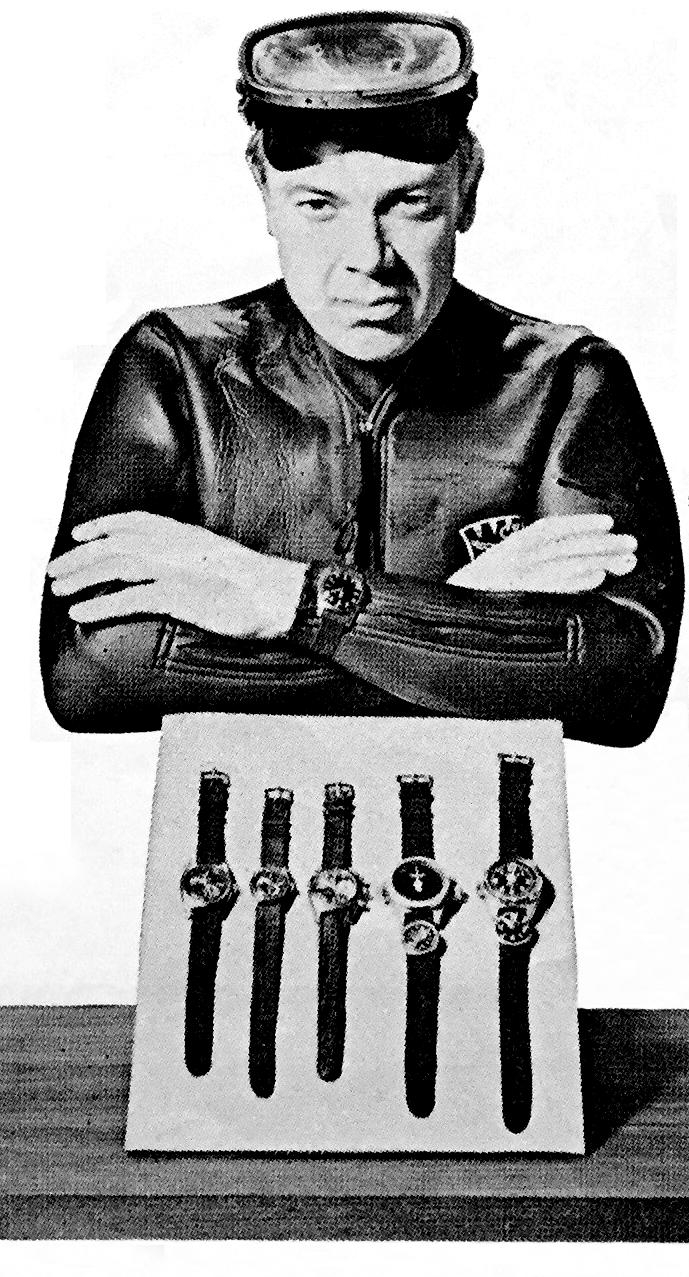
Frédéric Robert in early Aquastar marketing, with five of the original references on display. Robert is named as inventor on four of the ten patents, the 1959 wrist instrument, the 1963 dial bathymeter, the 1965 waterproof crown, and the 1966 improved bathymeter.
1970

Five hundred meters

No Swiss maker had taken a dive watch past 200 meters without a monobloc case. The monobloc was simple but expensive, and impossible to service. Robert wanted both: serviceable, and deep.

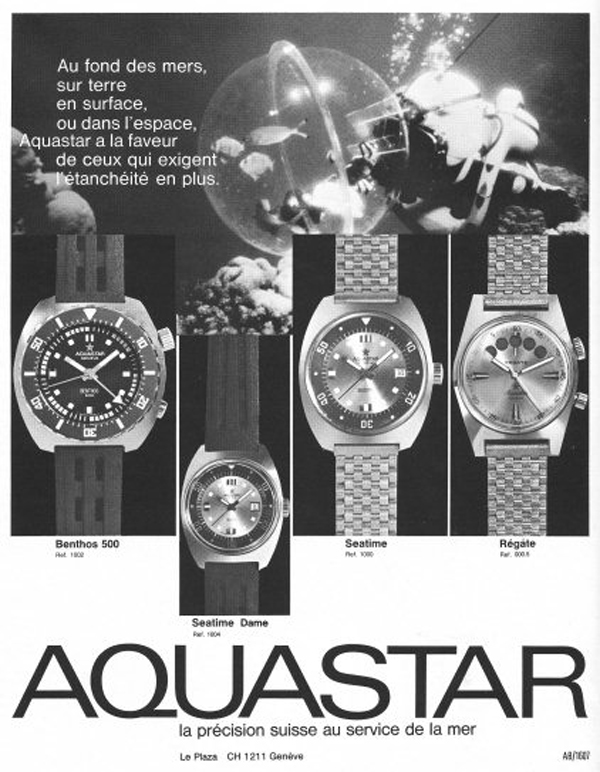
The Benthos 500, released in 1970, used a screwed case back with a new gasket pattern. It was rated to, and tested at, 500 meters. The U.S. Navy diving manual added it to the list of approved tools that year.

It is the watch in Jason Heaton’s Depth Charge. It is the watch on the wrist in the Cousteau Calypso footage. It is the watch that, in 2025, the Benthos Heritage II returns to.

Five hundred meters

Aquastar print advertisement featuring the Benthos 500 (Ref. 1902) alongside the Seatime and Régate, distributed from Geneva.

1984

Quartz, and a quiet pivot

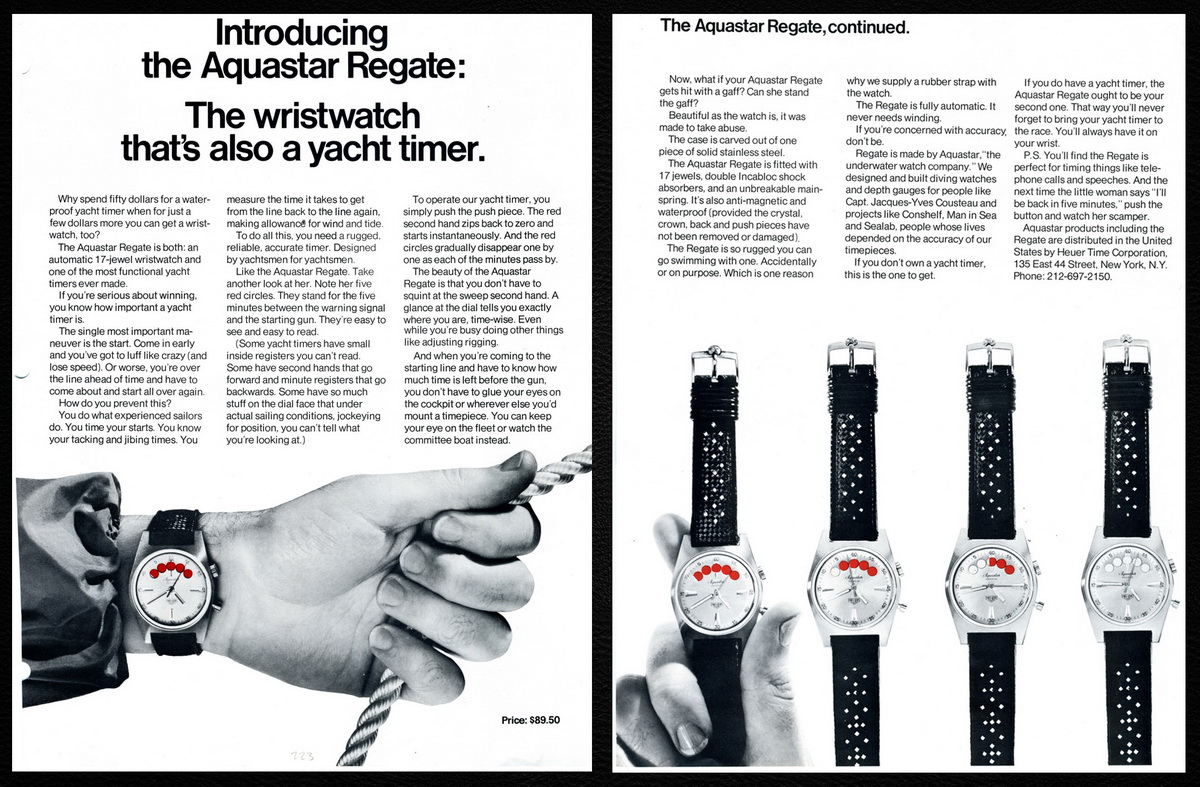
The quartz crisis hits Geneva as hard as the rest of Switzerland. The mechanical dive line winds down, but Aquastar doesn’t close. The workshop pivots to a niche the industry is abandoning: regatta timers for competitive sailing.

The Regatta 2000, released in 1984 and refined through several generations, becomes a quiet specialist’s tool, the same kind of single-problem instrument the Deepstar was twenty years earlier, just digital. It is made in the same Geneva workshop, by the same hands, for the next thirty-six years.

The dive bezel stays on the shelf. The Deepstar and Benthos don’t disappear, they live in collections, on workshop benches, on the wrists of the divers who first bought them. The vintage market rediscovers them in the early 2010s. The name is preserved.

Quartz, and a quiet pivot

Vintage Aquastar Regate advertisement, the yacht-timer line that preceded the digital Regatta 2000.

2020

Mechanical returns

Aquastar returns to mechanical dive watches after thirty-six years. The Geneva regatta line ends, production moves to Bienne, and the Deepstar 2020 is released, a faithful 39 mm column-wheel chronograph using a movement custom-built by La Joux-Perret to honour the original Valjoux 23. The first mechanical Aquastar since 1984. Limited to 1,200 pieces across four dial colours.

The bezel is the same one Aquastar patented in 1964 (CH 436 140), invented by Marc Jasinski under the direction of Frédéric Robert at the Geneva workshop. The patent has long since lapsed; the geometry has been carried forward from the archive blueprints.

The Deepstar 2020 sells out in five months. The Deepstar II follows in 2022, the Benthos H1 in 2024, and in 2026 the Deepstar III with its hand-wound column-wheel movement closes the loop on what Robert started.

Mechanical returns

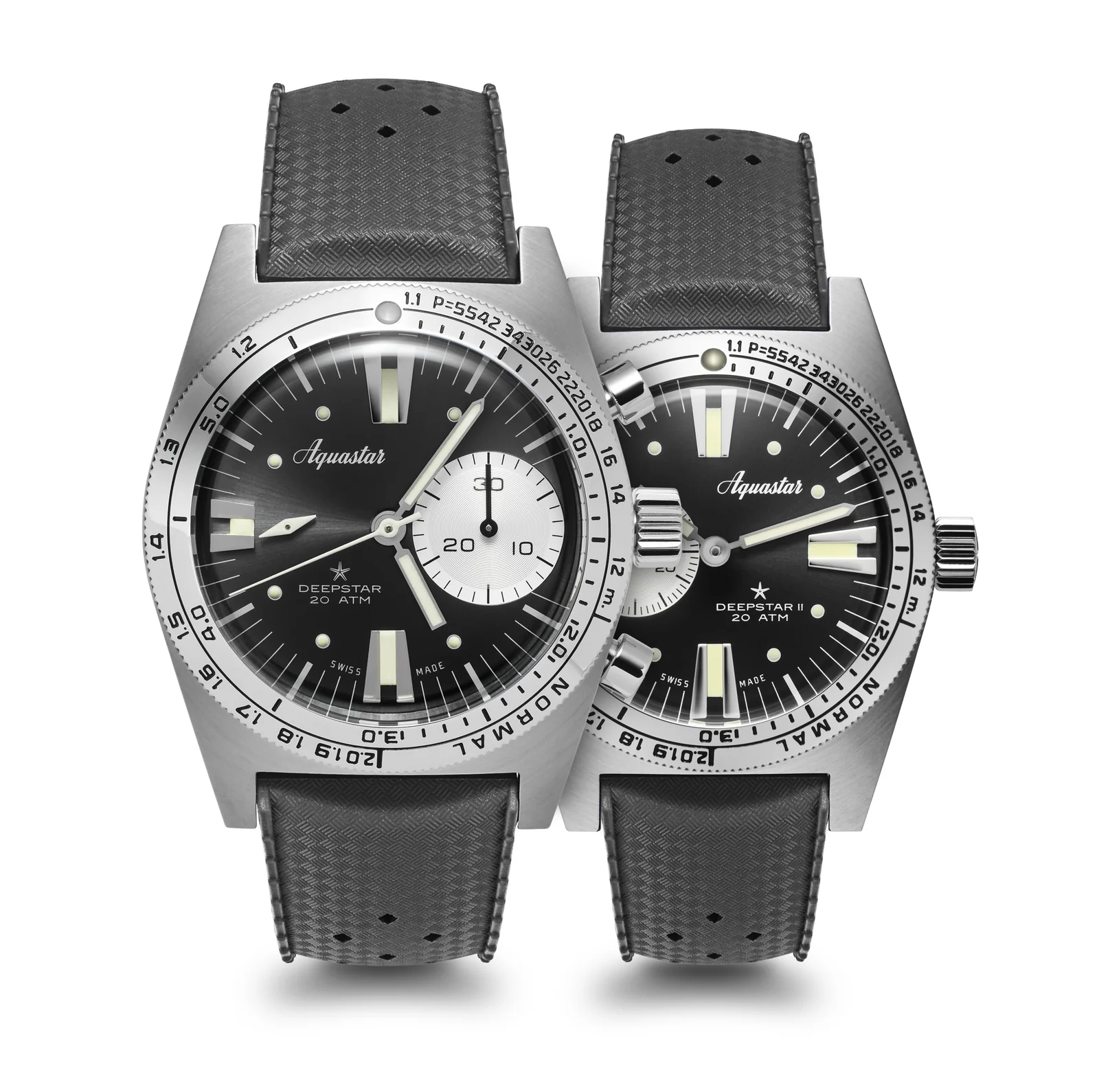
Two Deepstar chronographs, the modern 39 mm and the Deepstar II, both carrying the same patented no-decompression bezel (CH 436 140, Marc Jasinski 1964) that sat on the original 1962 reference.

The story continues

See the five watches that make today’s Aquastar.

The collection

As featured in