
Best Mechanical Diver Under 3000: at a glance
Searching for the best mechanical diver under 3000? Here’s what matters most in real-world performance, heritage, movement quality, and value. Use this guide on best mechanical diver under 3000 to weigh design choices, engineering trade-offs and how the category translates to real Aquastar dive watches.
| Topic | Best mechanical diver under 3000 |
| Read time | 5-8 min |
| Source | Aquastar editorial |
Price pressure has changed this category. A decade ago, the best mechanical diver under 3000 often meant compromises hidden beneath good photography – oversized cases, generic movements dressed up as luxury, or heritage claims with no real lineage behind them. Today, buyers are sharper. They expect legitimate water resistance, a credible movement, disciplined case design, and a watch that feels like an instrument rather than a costume.
Table of Contents

That shift is healthy. At this level, a diver is no longer an entry point and not yet a trophy purchase. It sits in the most demanding part of the market, where enthusiasts know exactly what they are looking at. If a watch asks for serious money, it needs to earn it on the wrist and on the spec sheet.
What makes the best mechanical diver under 3000?
The answer is not a single specification. Water resistance alone does not make a serious diver, just as a Swiss automatic movement alone does not make a watch worth owning. The strongest watches under this mark combine four things: authentic design intent, sound engineering, usable proportions, and finishing that respects the tool-watch brief.
Design intent matters more than most brands admit. A proper diver should look resolved. The bezel should be easy to grip, the dial should prioritize legibility, and the case should feel built around purpose. When a watch borrows the broad outline of a dive watch but adds polished excess, decorative clutter, or awkward dimensions, it usually reveals itself quickly in daily wear.
Engineering is where the category separates. A screw-down crown, reliable gasket system, sapphire crystal, and a unidirectional bezel are baseline requirements. Strong lume, stable timing, and a bracelet or strap system that suits wet use are what make the watch credible. Beyond that, details matter – bezel action with no slop, a crown that threads cleanly, and a caseback that inspires confidence instead of meeting a price target.
Then there is proportion. Some of the most disappointing watches in this range are not poorly made. They are simply too large, too thick, or too top-heavy to wear well. A diver can be substantial without becoming a burden. The best examples understand that underwater utility and everyday comfort are not competing values.
Heritage versus marketing
In the search for the best mechanical diver under 3000, heritage gets thrown around with little discipline. Real heritage is not a retro font and a faded lume color. It is continuity of design logic. It is a case shape, dial layout, or functional feature with roots in actual underwater use.
That distinction matters because many buyers in this segment are not looking for generic luxury. They want a watch with a reason to exist. A diver tied to professional or sporting underwater history carries a different weight than one built from trend forecasting. You can feel it in the restraint of the design. The watch does not need to perform nostalgia. It already has a point of view.
This is why heritage-driven brands often feel stronger under $3,000 than broad luxury names trying to fill every category at once. Focus produces better watches. A brand centered on underwater instruments tends to make better decisions about hand shape, bezel scale, dial contrast, and case architecture than one treating the diver as a mandatory SKU.
Movement quality is important, but context matters
Collectors love to reduce value to the movement. That is understandable, but incomplete. In this bracket, you are generally looking at proven Swiss automatics or similarly established calibers with parts availability and service familiarity. That is good news. Reliability matters more than novelty in a watch meant to be worn hard.
A strong movement in this class should offer stable daily performance, efficient winding, and sane serviceability. Power reserve helps, but not at the expense of durability. Decorative finishing is pleasant, though it matters less on a solid caseback tool watch than brands would like you to believe.
What matters more is how the movement fits the watch. Does the case thickness stay under control? Does the crown action feel precise? Is the date placement, if there is one, integrated cleanly? A technically respectable caliber can still feel disappointing if the watch around it is poorly resolved.
The case for smaller, disciplined divers
Bigger is not more professional. One of the clearest signs of maturity in this segment is the return to restrained sizing. A diver in the high-30mm to low-40mm range, with sensible lug-to-lug length and balanced thickness, often wears better and performs more honestly than a bloated 44mm statement piece.
Collectors who actually use their watches understand this. A dive watch has to sit securely, remain legible at a glance, and avoid becoming dead weight over a full day. That applies on land as much as in the water. The best cases under $3,000 usually show discipline rather than aggression.
Thinness is not everything, but balance is. A domed crystal, solid bezel assembly, and proper water resistance add height. That is acceptable. The question is whether the watch feels compact and planted, or tall and unstable. The latter gets old fast.
Where value really shows up
Value in this category is not about the cheapest path to Swiss mechanical ownership. It is about how much substance you get before the pricing turns aspirational. The best-value diver under $3,000 should make you feel that the money went into the watch – not into sponsorships, inflated distribution layers, or borrowed prestige.
That usually shows up in materials and execution. Hardened or DLC-treated steel can be meaningful if applied with purpose. Ceramic bezels are useful when their insert design remains readable and not overly glossy. A well-executed beads-of-rice bracelet, a properly vented rubber strap, or thoughtful micro-adjustment can matter more in practice than another paragraph of marketing copy.
This is also the range where limited production and enthusiast-focused brands can become especially compelling. Without the burden of mass-market positioning, they can invest in details larger companies reserve for higher tiers. When done properly, the result is a watch with collector appeal and real use-case credibility.
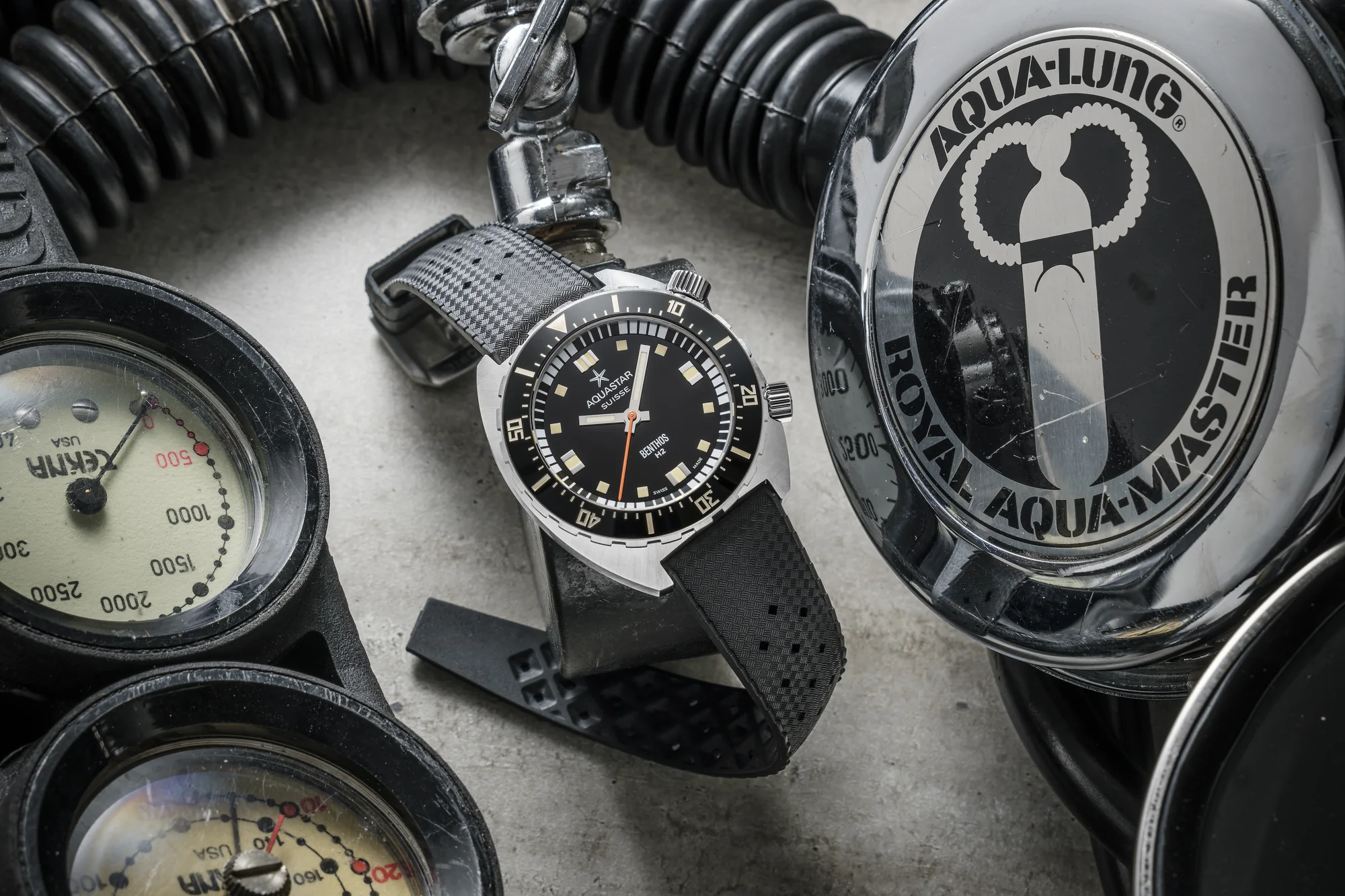
Aquastar is one example of that focused approach – a brand rooted in historic underwater instruments rather than generic luxury storytelling. That difference tends to show up where serious buyers notice it first: proportions, legibility, purpose-built design, and a clear respect for the professional dive watch as a category rather than a style exercise.
What to watch out for
Not every attractive diver under $3,000 is a smart buy. Faux-aged design can quickly date itself. Excessive polishing may look impressive in product shots but undercuts the tool-watch character. Helium escape valves are often unnecessary at this level and can feel like spec-sheet theater unless the rest of the watch supports that professional claim.
Bracelets deserve close scrutiny. A capable watch can be let down by stamped-feeling clasps, sharp edges, or weak integration with the case. Likewise, bezels should not just look good. They should align cleanly and operate with certainty. A vague or gritty bezel is hard to forgive on a dive watch at this price.
Another trap is overemphasis on movement branding. If the case finishing is mediocre, the proportions are off, and the dial lacks clarity, a known caliber will not save the watch. The whole object needs cohesion.
How to choose the best mechanical diver under 3000 for you
Start with use, not fantasy. If this watch will be your daily wearer, comfort and versatility should rank above extreme depth ratings. A 200m or 300m diver with excellent dial contrast and balanced dimensions is usually the smarter choice than a much thicker watch built to advertise capability you will never need.
If you are buying as a collector, look harder at design integrity and lineage. Ask whether the watch reflects a real chapter of dive-watch history or simply imitates familiar cues. Enthusiasts tend to keep the former and flip the latter.
If strap changes matter to you, consider lug design and case profile. Some watches come alive on rubber, fabric, or beads-of-rice steel. Others only work in their original configuration. That flexibility can affect long-term satisfaction more than a marginal spec advantage.
Finally, trust the feeling of resolution. The best dive watches in this class feel complete. Nothing looks forced. The handset belongs to the dial, the bezel belongs to the case, and the overall silhouette makes sense from every angle. That coherence is hard to fake and easy to recognize once you have handled enough watches.
A good mechanical diver under $3,000 should not feel like a compromise dressed up as ambition. It should feel exact – built with purpose, backed by real watchmaking logic, and ready to justify its place every time you fasten it on.
Further reading: Wikipedia on diving watches.