Posted on

Do Dive Watches Need Helium Valves for Diving?

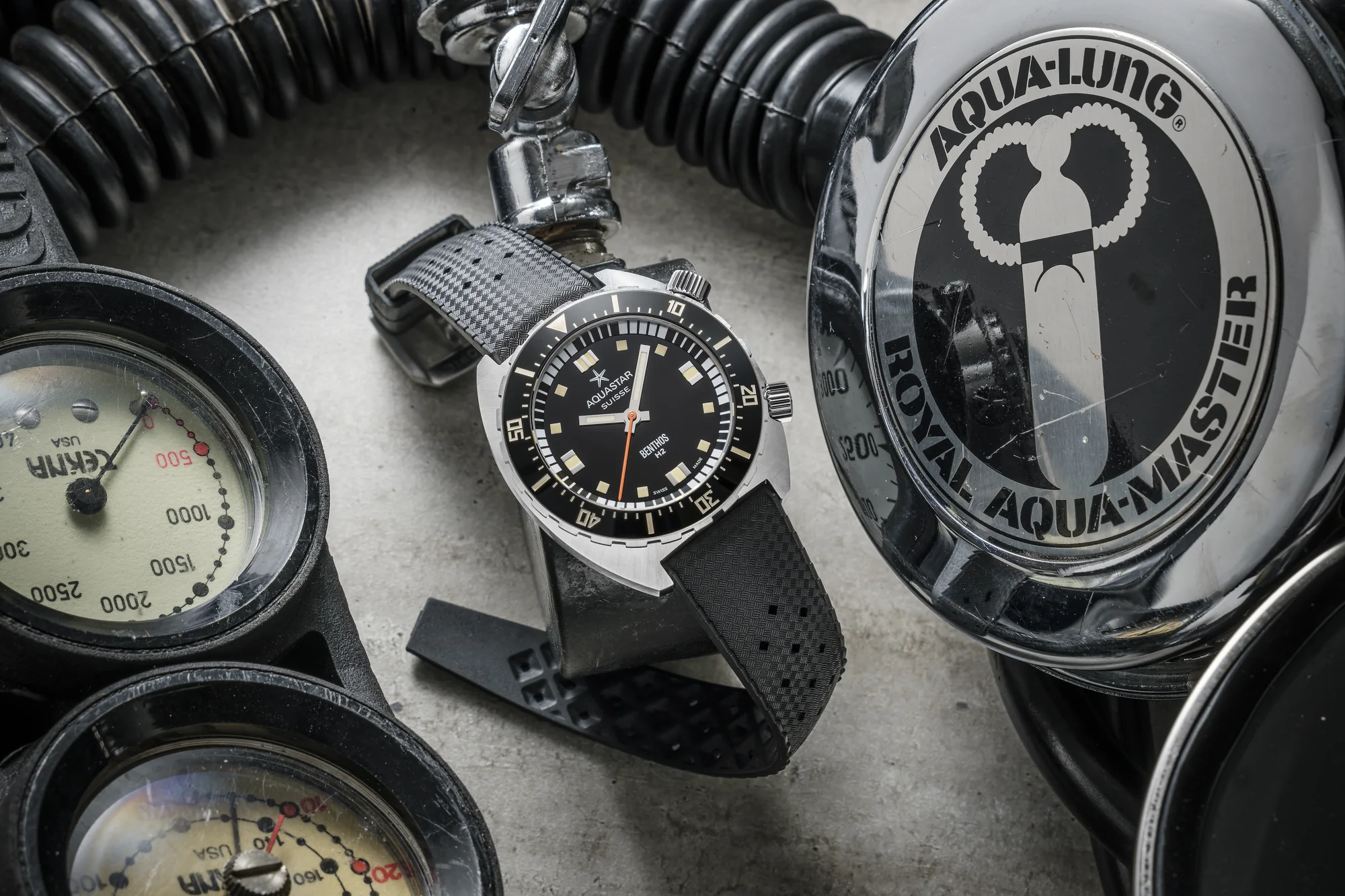
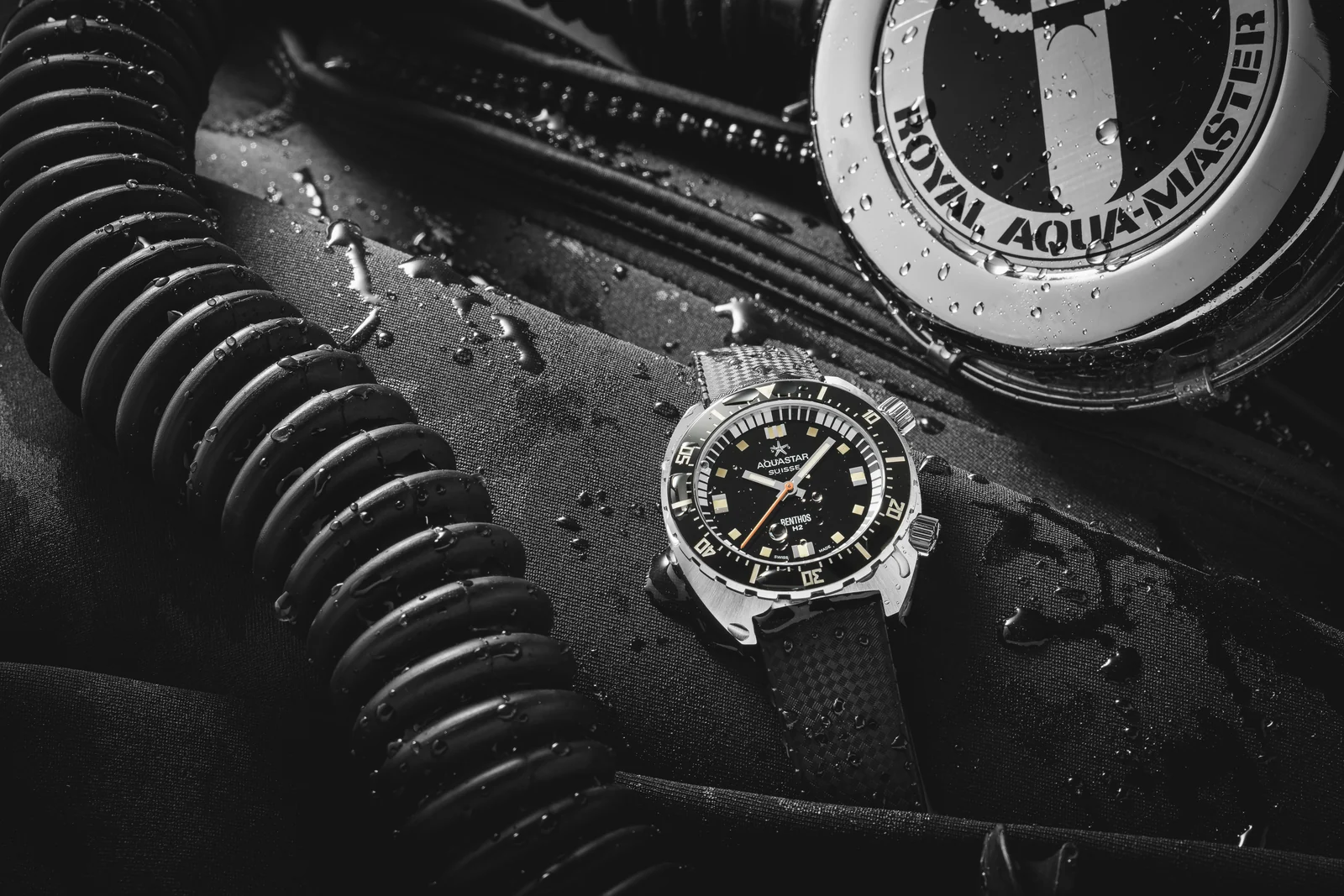
Aquastar Benthos Heritage II (H2) dive watch on a rubber strap among vintage diving hoses

A helium valve is one of the most misunderstood features in underwater watchmaking. So, do dive watches need helium valves? For the vast majority of divers, no. For the small group working extended saturation assignments in pressurized habitats, it can be essential. The distinction matters because a helium escape valve was created for a very specific professional problem, not as a general measure of dive-watch quality.

A serious dive watch earns its credibility through purposeful engineering: a secure crown, tested water resistance, a legible dial, dependable lume, a timing bezel, and construction built to endure pressure, impact, saltwater, and long service intervals. A helium valve may be part of that equation, but only when the mission calls for it.

Why Do Dive Watches Need Helium Valves?

The answer begins in a saturation chamber, not in open water. Commercial divers working on offshore structures may spend days or weeks living in a sealed habitat under pressure. Their breathing gas contains helium, usually mixed with oxygen, because helium is less narcotic than nitrogen at great depth and allows divers to work safely under demanding conditions.

Helium atoms are exceptionally small. Under sustained pressure, they can pass through seals and enter a watch case. This does not mean the watch is leaking in the ordinary sense. A properly sealed case can remain water-resistant while helium slowly diffuses inside during a long exposure to a helium-rich environment.

The issue appears during decompression. As the chamber pressure is reduced, helium trapped inside the watch may not escape quickly enough through its normal seals. Pressure inside the case can become greater than the pressure outside. In the most dramatic failure, the crystal can lift away from the case.

A helium escape valve gives that gas a controlled route out. It equalizes pressure before internal buildup can damage the watch. That is its entire purpose. It is not there to improve underwater depth resistance, and it does not make a watch more capable on a standard recreational dive.

Aquastar Benthos Heritage II (H2) dive watch on a tropic strap, case profile and dive bezel in close view

Saturation Diving Is Not Recreational Diving

A diver descending from a boat, exploring a reef, or completing a technical dive does not normally spend days inside a pressurized helium environment. Even deep technical divers using helium-based trimix typically do not expose their watches to the prolonged saturation conditions that force helium into a case in meaningful quantities.

That is why a watch rated to 200, 300, or even 1,000 meters does not automatically need a helium valve. Depth rating and helium resistance address different challenges. Water resistance concerns the watch’s ability to keep water out under pressure. A helium valve addresses gas pressure inside the case after prolonged saturation exposure.

This is also why the feature can be both legitimate and unnecessary. On a watch built around the history of commercial diving, a helium valve may reflect a real operational requirement and an important chapter of professional tool-watch development. On a recreational diver, it may be more about design language than practical necessity.

Neither choice is inherently wrong. What matters is whether the specification matches the watch’s intended role and whether the manufacturer has executed it properly.

How Helium Escape Valves Work

There are two common approaches. A manual helium valve requires the wearer or diving crew to unscrew or open the valve during decompression. This is a direct, mechanical solution, but it depends on correct operation. If a manual valve is left open before entering water, the case’s water resistance is compromised.

An automatic helium valve opens only when the pressure differential reaches a predetermined threshold. A spring-loaded mechanism releases gas from inside the watch and closes once pressure equalizes. For a saturation-diving instrument, this can be the more practical design because it works without intervention.

Both systems introduce another opening into the case architecture. That makes precision manufacturing, sealing, and pressure testing non-negotiable. A helium valve should never be treated as a decorative detail. It is a functional component that must perform without weakening the fundamental integrity of the case.

There is also a third solution: build the watch case to withstand the internal pressure differential without a dedicated valve. Some purpose-built watches rely on case geometry, crystal retention, and engineering margins rather than an escape mechanism. The absence of a visible valve does not prove a watch is unprepared for professional pressure environments. The technical standard behind the design is what counts.

Aquastar Benthos Heritage II (H2) dive watch worn on the wrist while adjusting a vintage regulator

The Heritage Behind the Valve

Helium escape technology emerged as professional diving moved deeper and stayed longer underwater. In the 1960s, saturation operations reshaped the requirements placed on instruments. Watches were no longer simply worn for an hour beneath the surface. They had to survive extended periods in pressurized living chambers, repeated work cycles, and decompression protocols that put every seal and crystal interface under scrutiny.

That history gives the helium valve genuine significance. It represents an era when dive-watch design was driven by working divers, decompression schedules, and offshore industry needs. It belongs to the same practical tradition as oversized bezels, high-contrast hands, secure crown systems, and cases engineered for hard use rather than display cases.

For collectors, the feature can be compelling because it signals that lineage. But heritage is strongest when it is honest. A faithful tool-watch design should communicate what the component does, why it exists, and whether the wearer is likely to need it.

What Matters More for Most Divers

For nearly every owner, the priority list is more straightforward. A watch should have water resistance appropriate to its use and be tested regularly, especially after a battery service on quartz models or any work involving the crown, crystal, caseback, or seals. On a mechanical dive watch, a screw-down crown and properly maintained gaskets are far more relevant to everyday reliability than a helium valve.

Legibility is equally critical. At depth, a dial must communicate time immediately. Strong luminous material, clear markers, distinct hands, and a bezel that is easy to grip with gloves are not nostalgic styling cues. They are the operating interface of the instrument.

Then there is wearability. A professional-specification watch that sits awkwardly on the wrist or catches on a wetsuit sleeve will see less use than a well-proportioned piece with a secure bracelet or strap. Modern materials can improve the ownership experience without compromising heritage: sapphire crystals resist scratching, ceramic bezel inserts preserve their markings, and carefully selected steel or coated cases withstand daily punishment.

Aquastar’s historic dive instruments were born from this discipline: technical purpose first, followed by the visual character that only real function can create.

Should You Buy a Dive Watch With a Helium Valve?

Buy one if you work in saturation diving, if the watch’s professional lineage matters to you, or if you simply prefer the visual and mechanical character of the design. A correctly engineered valve is a meaningful feature with a serious history.

Do not buy one under the assumption that it is required for scuba diving, snorkeling, swimming, or ordinary technical diving. It will not make a 300-meter watch more water-resistant, and it will not replace proper maintenance. If your watch has a manual valve, remember that it must be fully closed before the watch enters the water.

The better purchasing question is not whether a helium valve is present. Ask whether the whole watch makes sense as an instrument. Is the case construction credible? Is the bezel precise? Is the dial readable in low light? Is the movement dependable and serviceable? Are its specifications supported by the engineering rather than printed merely to impress?

A helium valve is a specialized answer to a specialized problem. When it is part of a watch built for that environment, it carries real authority. When it is not needed, the finest dive watch remains the one you trust on the wrist – clear, capable, properly maintained, and ready when the water gets serious.

Posted on

Heritage Reissue Success Stories That Endure

Aquastar Deepstar chronograph with a blue strap beside coiled dive rope

A faded catalog image, an original case drawing, a diver’s hard-used instrument – these are not sufficient ingredients for a credible revival. The best heritage reissue success stories begin with a watch that earned its identity before it became collectible. Its proportions, dial layout, bezel, and movement architecture must all trace back to a purpose: timing decompression, surviving saltwater exposure, or delivering instant legibility in poor light.

For serious collectors, a reissue succeeds when it preserves that purpose without asking the owner to accept the compromises of a 50-year-old watch. That is a demanding balance. Get the details wrong and it becomes vintage-themed merchandise. Modernize it too aggressively and the historical connection disappears.

What Makes a Heritage Reissue Successful?

A successful reissue is not a logo placed on a familiar silhouette. It is a disciplined act of preservation. The original reference must have a legitimate place in watchmaking history, and its defining traits must remain intact in the new execution.

That means respecting the case architecture before chasing modern dimensions. A watch designed as a compact professional tool should not be inflated into a broad, generic luxury sports watch simply because larger cases are easier to market. The dial should retain its original hierarchy. If the historical model placed oversized registers, a no-nonsense minute track, or a distinctive diving scale at the center of its design, those elements are functional signatures, not decoration.

The other half of the equation is modern engineering. Vintage acrylic, fragile lume, inconsistent water resistance, and difficult-to-service movements have their charm, but they also limit how often an original can be worn. A sapphire crystal, modern luminous material, a secure bezel system, and serious depth resistance allow a revived instrument to return to its intended environment.

Collectors do not expect a museum replica. They expect a watch with historical discipline and present-day capability.

Aquastar Deepstar chronograph on a blue rubber strap over vintage hoses

The Strongest Heritage Reissue Success Stories Start With Purpose

The most persuasive revivals in the dive-watch category have one thing in common: the original was designed for work underwater. That history gives every detail weight. A rotating bezel is not simply a visual cue. A chronograph register is not there to fill space on a dial. A high-contrast handset is not a nostalgic flourish. Each feature was part of a system built to communicate elapsed time under pressure.

The Doxa SUB 300 is a clear example of this principle. Its cushion case, bright dial options, and patented bezel scale were unconventional when compared with more conservative dive watches. Reissued versions succeeded because they retained the qualities that made the original unmistakable: compact geometry, strong underwater visibility, and a bezel designed around diving calculations. The appeal was never that it looked old. The appeal was that it still looked like nothing else.

The Tudor Black Bay took a different route. Rather than reproduce a single reference with forensic precision, it built a modern collection around recurring Tudor dive-watch codes: snowflake hands, domed crystals, rivet-style bracelets, and restrained tool-watch dials. That approach proves there is more than one valid path to heritage. A brand can create a successful historical interpretation without claiming it is an exact reissue. The distinction matters. Clear positioning earns trust; blurred history does not.

For a true archival revival, the standard is higher. The buyer will compare lug shape, crown profile, bezel font, handset length, and dial printing against surviving examples. At that point, historical accuracy becomes part of the product specification.

Proportions Carry More History Than a Vintage Font

Many reissues fail at the wrist. The reference may resemble an archival model in photographs, yet its thickness, lug-to-lug span, or overbuilt bezel changes the entire experience. Tool watches were often compact because they had to be secure, practical, and unobtrusive over a wetsuit or beneath equipment.

Modern materials can improve durability without changing that character. A carefully engineered sapphire crystal can protect the dial. A redesigned caseback can improve water resistance. A contemporary Swiss mechanical caliber can provide reliable serviceability. But the case still needs to wear like the instrument it claims to honor.

This is why modest diameter alone is not enough. The relationship between the bezel, dial opening, crown, lugs, and case thickness determines whether a watch has the grounded, purposeful stance of the original. Collectors recognize that balance immediately, even when they cannot explain it in technical terms.

Accuracy Has Limits – and Good Brands Know Where to Draw Them

A faithful reissue is not always a literal one. Certain vintage construction methods should remain in the past. Radium lume, low water-resistance ratings, fragile crystal systems, and unreliable gaskets do not become desirable simply because they are historically accurate.

The strongest projects separate design authenticity from obsolete engineering. The dial can preserve period-correct typography while using Super-LumiNova. A bezel can retain its original visual language while gaining improved grip and a more dependable action. A steel case may receive a modern surface treatment, such as DLC, when it supports the watch’s professional purpose without disguising its heritage.

Movement choice requires the same judgment. An original caliber may be impossible to source, too fragile for regular use, or incompatible with modern expectations for precision and service. A modern Swiss movement is the correct decision when it keeps the watch wearable and supportable. What matters is honesty: the movement should suit the watch’s character, dimensions, and intended function rather than exist as a marketing shortcut.

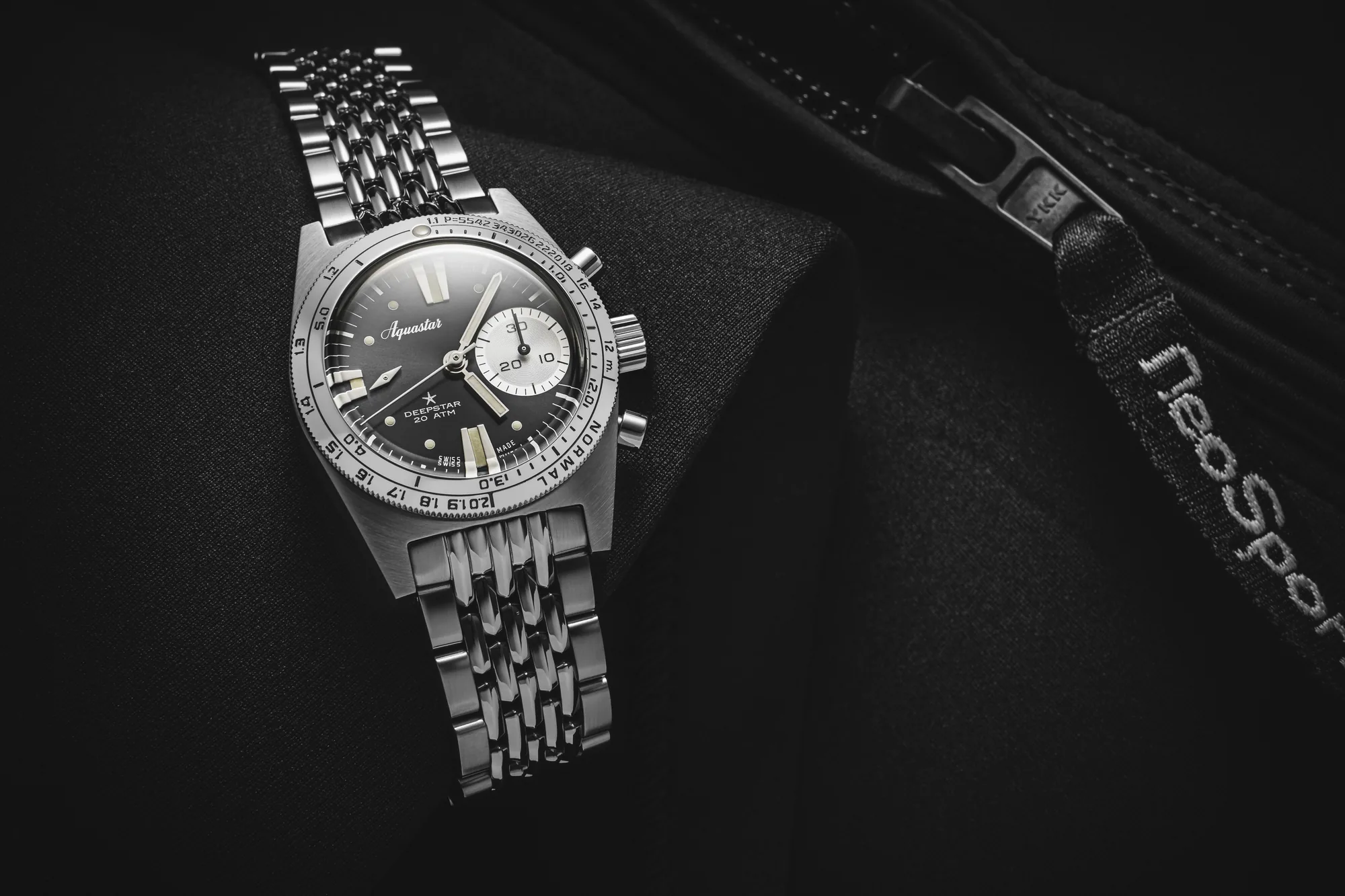
Aquastar Deepstar chronograph on a beads-of-rice steel bracelet

Why Deepstar Remains a Relevant Model

Some historical watches survive because they were visually loud. Others endure because the design was so resolved that it still feels specific decades later. The Aquastar Deepstar belongs to the latter category. Its distinctive chronograph layout and diving-oriented timing language were born from a period when professional underwater equipment had to communicate quickly and clearly.

A credible Deepstar revival cannot treat its dial as a styling exercise. The sub-register placement, contrasting scales, case profile, and timing function are inseparable. Preserve only the name and the result loses the point. Preserve the architecture while upgrading the crystal, water resistance, lume, and mechanical execution, and the watch returns as a proper tool for modern ownership.

That is the difference between heritage as an aesthetic and heritage as continuity. One sells a mood. The other carries a design forward with its original intent still visible.

Collector Trust Is the Real Measure of Success

Sales can make a launch look successful. Collector trust determines whether it lasts. Trust is built through details that are easy to overlook in a campaign but impossible to hide in the metal: correct case finishing, crisp bezel alignment, disciplined dial printing, appropriate strap hardware, and specifications that support the claims on the dial.

It also comes from restraint. Not every historic reference needs a limited edition, an aged-lume treatment, or a dramatic colorway. Artificial scarcity can create short-term noise, but it cannot replace a strong underlying watch. The best reissues allow the original design to do the hard work.

For enthusiasts, this creates a useful standard when evaluating any revival. Ask whether the original was significant, whether the new watch preserves its defining proportions, whether the updates improve real ownership, and whether the brand has been precise about what is historical and what is new. If the answers hold up, the watch has more than vintage appeal. It has a reason to exist.

Heritage should never be sealed behind glass. When a historic dive instrument is revived with respect for its function, its dimensions, and its engineering, it becomes what it was always meant to be: a watch made to be worn hard, relied upon, and passed forward.

Posted on

316L Stainless Steel: Why It Matters for Dive Watches

Aquastar dive watch
Steel-cased Aquastar Benthos dive watch on a steel mesh bracelet, illustrating 316L stainless steel construction

If you have shopped for a dive watch, you have seen the phrase “316L stainless steel” printed on spec sheets and case backs. It is the default case material for almost every serious Swiss dive watch, and for good reason. This article explains what 316L stainless steel actually is, why it resists saltwater and sweat so well, and how it compares to the two alternatives you will hear about most often: 904L steel and bronze. If you are trying to understand what makes a dive watch case suitable for the water, this is where to start.

What Does 316L Stainless Steel Actually Mean?

Stainless steel is not a single material. It is a large family of iron alloys that all contain at least around 10.5% chromium, the element that gives stainless its corrosion resistance. Within that family, 316L is an austenitic grade, which means it has a specific crystal structure that stays stable, non-magnetic, and tough across a wide temperature range. The numbers and letters are a shorthand from standardised alloy naming: “316” identifies the composition, and the “L” stands for low carbon.

The defining feature of 316-series steel is molybdenum. Adding roughly 2 to 3% molybdenum to the mix dramatically improves resistance to pitting and crevice corrosion, the two failure modes that matter most in salt water. This is why 316 and its variants are often called “marine grade” steel. You will find the same family of alloys in boat fittings, offshore hardware, and surgical implants, all environments where a material has to survive constant contact with chloride-rich fluids.

The low-carbon “L” designation matters more than it sounds. Lower carbon content reduces the risk of a problem called carbide precipitation during welding and machining, which can otherwise create weak spots that corrode. For a watch case that is cut, drilled, and finished from a solid billet, and that will spend its life against skin and water, that extra margin of reliability is worth having.

Why 316L Is Ideal for Saltwater and Sweat

A dive watch faces a harder chemical environment than most people realise. Sea water is a chloride solution, and chloride ions are the classic enemy of ordinary steel. Human sweat is also mildly saline and slightly acidic, so even a watch that never touches the ocean is exposed to a corrosive film every time it sits against warm skin. A case material has to shrug off both, day after day, for decades.

316L handles this through a self-healing mechanism. The chromium in the alloy reacts with oxygen to form an ultra-thin, invisible passive layer of chromium oxide across the surface. If that layer is scratched, fresh chromium underneath immediately reforms it, provided oxygen is present. The molybdenum content makes this passive film far more stable against chloride attack than it would be in a plain chromium stainless steel. The practical result is a case that stays bright and structurally sound through years of diving, swimming, and daily wear.

316L is also hypoallergenic for most wearers because it releases very little nickel at the surface, and it takes a superb finish. It can be brushed to a soft satin, mirror-polished on the bevels, or bead-blasted for a matte tool-watch look. That combination of corrosion resistance, skin friendliness, and finishing versatility is exactly why it became the industry standard for dive watch cases, bracelets, and case backs.

316L vs 904L: Is the More Expensive Steel Worth It?

904L is the steel you will see marketed as a premium upgrade. It is a super-austenitic alloy with higher chromium, nickel, and molybdenum content than 316L, plus a small amount of copper. On paper that gives it even greater resistance to corrosion, particularly in aggressive industrial settings involving strong acids. It can also be polished to a slightly brighter, whiter shine that some enthusiasts prize.

For a wristwatch, though, the real-world gap is narrower than the marketing suggests. In ordinary sea water and sweat, 316L is already highly corrosion resistant, and both alloys will comfortably outlast the movement inside the case. Where 904L genuinely differs is in manufacturing difficulty: it is harder to machine, tougher on cutting tools, and more expensive to work, which is part of why so few brands adopt it. A well-made 316L case is not a compromise. It is the sensible, proven choice that the overwhelming majority of respected dive watch makers rely on.

316L vs Bronze: A Different Philosophy

Bronze cases have become popular in the dive watch world, but they answer a different question. Bronze is a copper alloy chosen precisely because it does not stay pristine. On contact with air, sweat, and salt water it develops a patina, a layer of surface oxidation that shifts from bright gold toward deep brown and green tones over time. For some owners that living, changing surface is the whole appeal, echoing the look of ship fittings and diving helmets.

The trade-off is maintenance and predictability. Bronze patina is uneven and personal, it can transfer a temporary greenish mark to the skin, and many bronze watches still use a 316L stainless steel case back precisely so the metal against your wrist stays inert. If you want a case that looks the same in twenty years as it does today, 316L is the answer. If you want a watch that visibly records its own history, bronze has a charm that steel cannot match. Neither is objectively better; they simply serve different tastes.

What to Look For as a Buyer

The material is only half the story. A 316L case still depends on good engineering to keep water out: a screw-down crown, well-seated gaskets, and a case back that seals correctly. Steel grade tells you the case will resist corrosion, not that the watch is water resistant on its own. Always read the depth rating and treat gasket condition as a maintenance item.

  • Confirm the case, bracelet, and case back are all 316L or an equivalent marine-grade steel, not an unspecified “stainless”.
  • Rinse the watch in fresh water after sea or pool use to clear chloride residue from crevices and the bracelet.
  • Have the gaskets checked and the seals serviced periodically so the corrosion-resistant case is not undermined by a failed rubber seal.
  • Remember that finish type (brushed, polished, blasted) is cosmetic; all of them sit on the same corrosion-resistant alloy.

316L stainless steel earned its place as the dive watch standard the hard way, by surviving decades of salt, sweat, and pressure without drama. It is corrosion resistant, skin friendly, endlessly finishable, and proven across the entire industry. If you want to see how that material is put to work in a modern Swiss dive watch, explore the Aquastar Benthos family, where a rugged steel case houses a purpose-built diving movement. For most divers, most of the time, a well-made 316L case is not just good enough. It is exactly what you want on your wrist.

Posted on

Acrylic Crystal vs Sapphire in Dive Watches

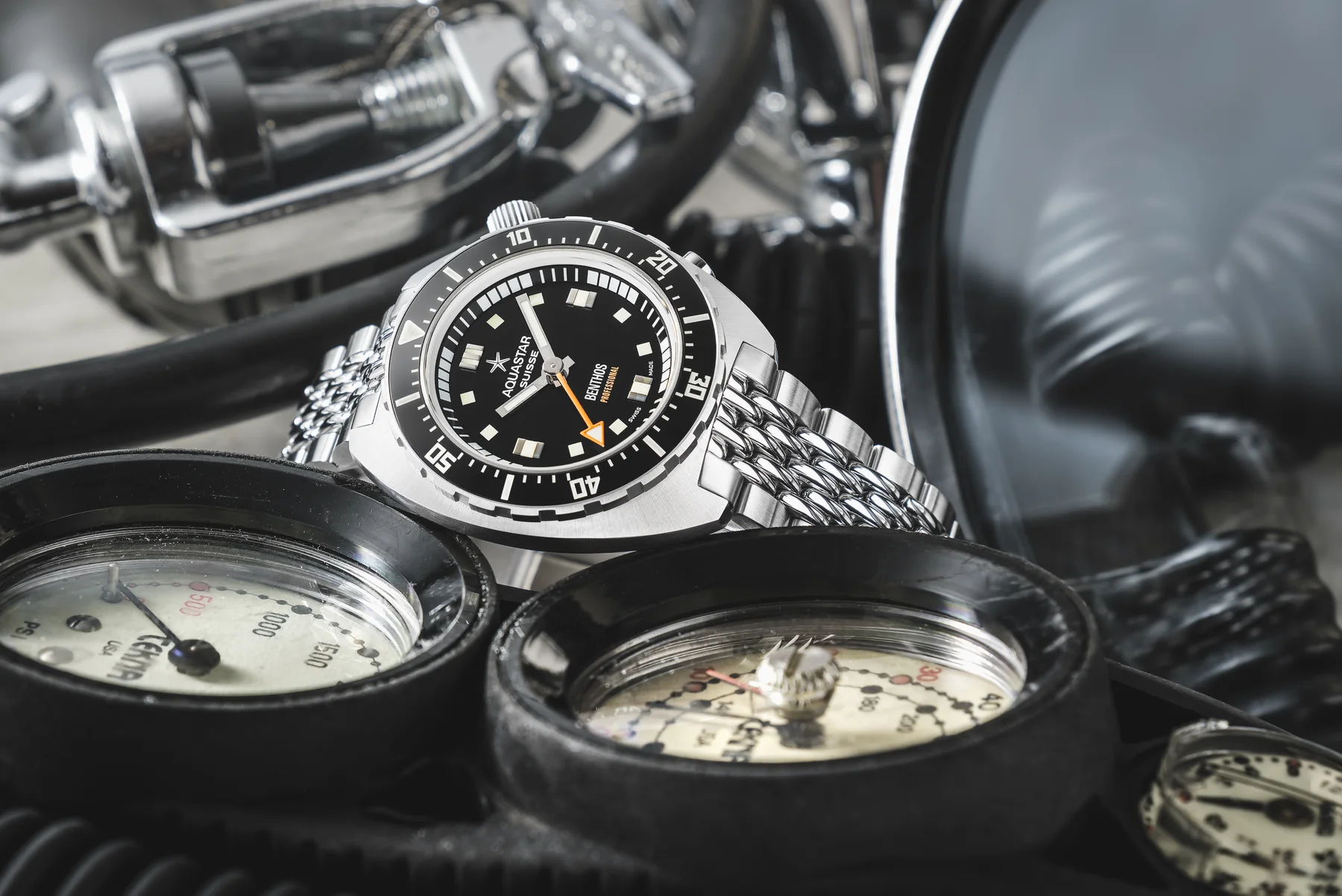
An Aquastar Benthos Professional on a steel bracelet among diving gauges and regulators

A dive watch reveals its priorities at the crystal. Before you consider movement caliber, bezel action, or case finishing, the material over the dial tells you whether the watch was built to honor a period-correct instrument, maximize modern durability, or strike a disciplined balance between the two. In the debate over acrylic crystal vs sapphire, there is no universal winner. There is only the right choice for the watch’s mission.

For collectors and serious divers, that distinction matters. Crystal material affects far more than scratch resistance. It changes how a watch wears, how it ages, how faithfully it reflects a historic reference, and how confidently it performs when exposed to impact, salt, pressure, and hard daily use.

Acrylic crystal vs sapphire: what changes on the wrist

Acrylic is a transparent plastic, often referred to as hesalite or plexi in watch circles depending on formulation and historical context. Sapphire is a synthetic crystal made from aluminum oxide, engineered to be exceptionally hard and highly resistant to abrasion. Both protect the dial. They do it in very different ways.

On the wrist, acrylic tends to feel warmer and more organic. It can distort light at the edge in a way many vintage collectors actively seek out. A boxed or domed acrylic crystal often gives the dial a softer, more atmospheric character, especially under changing light. It suits watches designed around mid-century or 1970s dive instrument language because that was the material many originals actually wore.

Sapphire feels more modern and more exact. The view through it is crisp, sharp, and stable. Add anti-reflective treatment and the dial can appear almost exposed, particularly in strong outdoor light. For a contemporary tool watch built for regular use, sapphire delivers the clean, precise presentation most buyers now expect.

Scratch resistance is not the whole story

The first argument in favor of sapphire is obvious. It is dramatically harder than acrylic and far more resistant to scratches from everyday contact. Desk edges, zippers, grit, keys, and general wear will mark acrylic far more easily than sapphire.

That makes sapphire a natural fit for an owner who wants a watch to keep its sharp appearance with minimal maintenance. For a modern dive watch worn daily, on boats, in airports, at work, and in the water, sapphire offers a level of cosmetic durability that is hard to ignore.

Acrylic, however, has its own advantage. When it does scratch, those marks are often superficial and can usually be polished out. A lightly worn acrylic crystal can be restored in minutes with the right compound and a bit of patience. Sapphire rarely scratches under normal conditions, but if it does suffer visible damage, that damage is not a simple home fix. Replacement is the realistic solution.

So the trade-off is straightforward. Acrylic scratches more easily but is more forgiving to refresh. Sapphire resists scratches far better but is less repairable once seriously marked or chipped.

Impact behavior matters on a real tool watch

This is where the conversation becomes more nuanced.

Sapphire is hard, but hardness is not the same as toughness. It resists abrasion extremely well, yet under a sharp impact it can chip or shatter. That does not mean sapphire is fragile in normal use. Modern sapphire crystals are highly durable and entirely appropriate for demanding watches. But when subjected to the wrong kind of force, hardness can become a liability.

Acrylic behaves differently. It is softer, more flexible, and more resistant to catastrophic breakage. It may mark, it may scuff, but it is less likely to fracture dramatically from impact. Historically, that mattered on purpose-built instruments. A scratched crystal is inconvenient. A shattered crystal that compromises legibility or sealing is a more serious problem.

This is one reason vintage military and professional watches often used acrylic. It was not a luxury choice. It was a practical one, shaped by the materials and priorities of the time.

For modern owners, the impact argument depends on use. If the watch will see normal daily wear and occasional diving, sapphire is usually the sensible choice. If historical authenticity and impact tolerance are central to the character of the watch, acrylic still has a legitimate place.

Optical character and vintage correctness

Collectors do not choose acrylic out of nostalgia alone. They choose it because it changes the visual language of the watch.

Acrylic has depth. On a heavily domed crystal, the dial can take on a richer profile, with edge distortion and a softer light transition that flat sapphire rarely reproduces. On a watch rooted in historic dive-watch design, that effect is part of the overall architecture. Change the crystal and you may preserve the dimensions while losing some of the watch’s original character.

Sapphire can be shaped, domed, and treated to echo vintage forms, and modern manufacturing has become very good at this. But it still presents light differently. It tends to look cleaner and colder. For some watches, that is exactly right. For others, particularly faithful heritage re-editions, acrylic offers an authenticity sapphire cannot fully imitate.

That is why serious brands do not treat crystal selection as an afterthought. The right material should support the watch’s identity, not fight it.

Acrylic crystal vs sapphire for diving

For actual underwater use, both materials can work when properly engineered. The crystal material alone does not determine whether a watch is dive-capable. Case construction, gasket quality, crystal thickness, tolerances, and overall testing matter more.

Still, sapphire dominates modern professional and enthusiast dive watches for good reason. It offers excellent clarity, superior resistance to surface wear, and a premium feel aligned with contemporary expectations. In a watch designed to endure repeated use while retaining a clean appearance, sapphire is the practical standard.

Acrylic is less common in modern dive watches because buyers increasingly expect high scratch resistance, and because sapphire has become the accepted material at the premium end of the market. Yet acrylic remains relevant when the brief is historical faithfulness. If a re-edition is meant to capture the exact spirit of a specific era, acrylic may be the honest choice.

There is no contradiction here. A watch can be serious and still use acrylic if its design logic supports it. But for an everyday modern diver built to endure broad real-world use, sapphire is usually the stronger answer.

Why most modern premium dive watches choose sapphire

The market has moved, and not without reason. Buyers investing in a Swiss mechanical dive watch expect long-term resilience, sharp legibility, and a specification set that reflects modern standards. Sapphire answers all three.

It preserves the watch’s appearance over years of wear. It supports a more refined presentation. It pairs naturally with ceramic bezels, advanced lume, and contemporary case engineering. On a premium dive watch, sapphire feels coherent with the rest of the package.

That is why brands focused on modern professional reliability often specify sapphire even when the broader design is rooted in archival references. Heritage matters, but so does wearing confidence. A watch built to endure harsh conditions should not demand constant concern from its owner.

At Aquastar, that balance between historical legitimacy and present-day performance defines the best kind of revival. Not every old solution remains the right one simply because it is old. The strongest re-editions preserve what deserves preserving and improve what benefits from modern engineering.

Which crystal should you choose?

If you value period-correct character, warm optics, and the kind of aging that belongs to a true vintage-style instrument, acrylic has real appeal. It is not inferior by default. It is simply more specialized, with trade-offs you should accept knowingly.

If you want a dive watch that stays sharp through years of hard wear, shrugs off everyday abrasion, and aligns with modern premium expectations, sapphire is the better fit. For most buyers shopping contemporary mechanical dive watches, it is the right answer.

The better question is not whether acrylic crystal vs sapphire has one winner. It is whether the crystal matches the purpose of the watch and the standards of the person wearing it. On a serious dive watch, every material choice should serve the mission. Choose the one that tells the truth about how the watch is meant to be used.

Posted on

Vintage vs Modern Dive Watches: What’s Actually Different

Aquastar dive watch

If you are weighing a vintage dive watch against a modern one, the honest answer is that they are different tools built to different standards. A 1960s skindiver and a current 300m diver can look like cousins on the wrist, yet the materials, the seals, and the safety margins behind them have moved on considerably. This guide walks through what actually changed, so you can decide which side of the vintage dive watch vs modern question fits your wrist, your budget, and how you plan to use the watch.

Lume: from radium to Super-LumiNova

The glow on the dial is one of the clearest dividing lines. Early dive watches used radium, then tritium, both of which are radioactive isotopes that excite a phosphor to produce light. Radium is genuinely hazardous and was phased out by the 1960s. Tritium is far safer but has a half-life of roughly 12 years, which means the lume on a tritium-era watch is now a fraction as bright as it was when new. The warm, faded patina collectors prize is, in practical terms, lume that barely works in the dark.

Modern watches use photoluminescent pigments, most commonly Super-LumiNova. These are not radioactive. They charge from any light source and re-emit it, and they do not decay over the years the way tritium does. Higher grades such as Super-LumiNova X1 charge faster and glow longer, and colour options like C3 green or BGW9 blue let a maker tune legibility. For a watch you actually take underwater, where ambient light disappears fast, a modern lume is simply more useful. If you want a vintage piece for genuine night or deep use rather than display, factor in that the original lume may need to be relumed.

Gaskets and water resistance over time

Water resistance is not a permanent property of a watch. It depends on rubber gaskets at the crown, the caseback, and the crystal, and rubber ages. It hardens, shrinks, and loses its elasticity whether the watch is worn or sitting in a drawer. A vintage dive watch wearing its original gaskets should be treated as not water resistant until a watchmaker has replaced the seals and pressure-tested the case. Many vintage divers that leaked did so not because the design failed but because nobody serviced the gaskets for decades.

Modern gasket compounds and case engineering are more forgiving, and the seals are far easier to source. Crown and caseback gaskets for a current production diver are standard parts. On a vintage case, the correct gasket may be an odd size that a watchmaker has to find or fabricate, which adds cost and time. The takeaway is straightforward: a serviced vintage watch can be perfectly reliable in water, but you cannot assume it is sealed just because it once was rated to a given depth.

Crystals: acrylic, mineral, and sapphire

Most vintage divers used acrylic (plexiglass) crystals. Acrylic is light, cheap, almost impossible to shatter, and it can be polished at home to remove scratches. Its weakness is hardness: it scratches easily and is soft enough to take a daily beating. Some later vintage watches moved to mineral glass, which is harder but can chip or crack on impact.

Modern dive watches overwhelmingly use sapphire crystal. On the Mohs hardness scale sapphire sits at 9, just below diamond, so it resists scratches that would mark acrylic or mineral glass in a day. The trade-offs are that sapphire is more brittle under a sharp point load and more expensive to replace, and it usually needs an anti-reflective coating to cut glare. For a watch that has to stay legible at depth and survive years of wear, sapphire is the practical choice. Purists who love the warm distortion of a domed acrylic crystal will still seek it out on vintage pieces.

Depth ratings: marketing then, margin now

Depth ratings have become more rigorous over time. A figure stamped on a vintage caseback was often a manufacturer claim with no standardised test behind it, and even where a watch genuinely met its rating when new, decades of gasket ageing mean the original number tells you little about the watch today. Treat a vintage depth rating as historical information, not a present-day guarantee.

Modern dive watch ratings are far more meaningful because reputable makers test to a defined safety margin. The recognised dive watch test method (ISO 6425) requires a watch to survive a test pressure that is 125% of its marked rating, so a 200m watch is pressure-tested to the equivalent of 250m. That margin is why a serious modern diver does not sit on the edge of failure at its rated depth. Note that meeting the mechanical specification and carrying the formal ISO 6425 certification mark are two separate things: many respected Swiss makers build cases to equivalent or higher mechanical standards without pursuing the certification mark itself. A high rating on a modern watch from a credible maker simply carries more engineering behind it than the same number did sixty years ago.

Parts, servicing, and long-term ownership

This is where many buyers underestimate the gap. A modern dive watch usually runs a current movement such as a Sellita SW200-1 or a La Joux-Perret calibre, and parts, gaskets, crystals, and crowns are readily available. Most competent watchmakers can service it, and a full service every five to ten years keeps it running indefinitely.

A vintage watch is a different commitment. Movements may be long out of production, so a worn part might have to be sourced from another donor watch or made by hand. Original dials, bezels, and hands in good condition are scarce and expensive, and a previous owner’s incorrect replacement part can hurt both value and function. Servicing costs more and takes longer, and you will want a watchmaker who specialises in vintage pieces. None of this is a reason to avoid vintage ownership, but it should be priced in alongside the purchase.

So which should you buy?

Choose vintage if you want character, history, and the specific look of a period piece, and you are happy to budget for servicing and treat water resistance as conditional. Choose modern if you want a watch you can actually dive, swim, and travel with confidently, with bright non-decaying lume, a scratch-resistant sapphire crystal, a tested depth margin, and parts you can get for decades.

  • Lume: modern Super-LumiNova does not decay; vintage tritium has faded.
  • Seals: modern gaskets are standard parts; vintage seals must be replaced before any water use.
  • Crystal: sapphire resists scratches far better than vintage acrylic.
  • Depth rating: modern figures are tested to a 125% margin; vintage numbers are historical.
  • Parts: modern movements are easy to service; vintage parts can be scarce and costly.

For buyers who want vintage-inspired design with modern reliability, it is worth looking at heritage makers that still build to current standards. The Aquastar Benthos collection carries the brand’s dive-watch lineage into a modern case with contemporary lume, sapphire, and a current Swiss movement, which is one way to get the look you love without inheriting the maintenance question marks of a sixty-year-old example.

Posted on

Dive Watch Service Interval: How Often Is Enough?

Aquastar dive watch

How often should you service a dive watch? It is one of the most common questions a new owner asks, and the honest answer is less often than most people fear. A well-built mechanical dive watch is engineered to run for years between visits to a watchmaker, and the right dive watch service interval is measured in years, not months. This guide explains what a service actually involves, how long you can reasonably wait between them, and the warning signs that mean your watch needs attention sooner.

What “servicing” a dive watch really means

A full service, sometimes called a complete overhaul, is more than a battery change or a quick clean. On a mechanical watch there is no battery at all. Instead, a trained watchmaker disassembles the movement into its component parts, cleans each one, inspects for wear, replaces any tired components, re-lubricates the pivots and bearings with fresh oils, then reassembles, regulates and tests the watch for accuracy and water resistance.

The reason this matters is friction. The tiny oils inside a movement gradually dry out and migrate over time. As they do, metal parts begin to run against each other with less protection, which can accelerate wear if left long enough. A service restores that protective film of lubricant before any lasting damage is done. On a dive watch there is a second job to do at the same time: the rubber gaskets that keep water out are checked and, where needed, replaced, and the case is pressure-tested to confirm it still seals.

How often should you service a dive watch?

For a modern mechanical dive watch, a sensible full-service interval is every five to ten years. That range is not a hard rule handed down by a single authority, but a practical window that reflects how modern synthetic lubricants behave and how robust current movements are. A watch that is worn gently and kept away from magnets and hard knocks sits comfortably at the longer end of that range. One that is dived regularly, exposed to saltwater and worn every day may benefit from the shorter end.

Notice what that range does not include: an annual visit to the watchmaker. There is a persistent myth that a dive watch must be serviced, or at least pressure-tested, every single year. For a well-made watch in normal use, that is simply not necessary, and following it would mean opening a perfectly healthy case far more often than the movement requires. Aquastar, for example, recommends a full service roughly every five to ten years rather than any yearly schedule, even for a watch that is dived often.

Why not service every year?

Every time a case is opened, its gaskets are disturbed and the interior is briefly exposed. Done too frequently, that introduces more opportunity for handling error than it prevents. Modern lubricants also last far longer than the oils used decades ago, so the old habit of frequent overhauls belongs to an earlier era of watchmaking. Unless a watch shows a real symptom, or you are about to rely on it for serious diving after a long spell of no wear, there is little to gain from a yearly appointment.

What happens during a full service

Although workshops differ in detail, a complete overhaul on a mechanical dive watch usually follows the same sequence. Understanding it helps explain why a proper service takes time and why it costs more than a simple clean.

  • The watch is opened and the movement is separated from the case.
  • The movement is fully disassembled, and every part is cleaned in specialist solutions.
  • Worn components, such as a fatigued mainspring or a damaged jewel, are replaced.
  • The movement is reassembled and lubricated at each friction point with the correct grade of oil or grease.
  • The watch is regulated so that its rate falls within specification.
  • All case gaskets are inspected, and any that are compressed or perished are replaced.
  • The reassembled watch is pressure-tested to confirm its water resistance.
  • The case and bracelet are cleaned, and often lightly refinished if the owner requests it.

The movement inside your watch shapes how straightforward this is. A widely used Swiss automatic such as the Sellita SW200-1, found in the Aquastar Benthos Professional, is well documented and well supported, so parts and expertise are easy to source for years to come. A more specialised chronograph calibre, such as those in the La Joux-Perret L100 and L113 family, asks for a watchmaker familiar with that architecture, but the underlying logic of the service is the same.

Signs your dive watch needs a service sooner

The calendar is only half the story. A watch can call for attention before its scheduled interval, and learning to read the signs protects both the movement and your peace of mind. Watch for any of the following.

  • Timekeeping drifts noticeably. A sudden loss of accuracy, or a watch that stops holding a full day of power, can point to dried lubricant or a tired mainspring.
  • Condensation appears under the crystal. Fogging is a clear sign that a seal has failed and moisture has entered the case. Treat this as urgent.
  • The crown or pushers feel gritty. Resistance or roughness when winding, setting or operating a chronograph often means the gaskets or threads need attention.
  • The watch took a hard knock. A significant impact can shift or damage internal parts even if nothing looks wrong from the outside.

Of these, condensation is the one that should never be ignored. Water inside a case can corrode steel components quickly, and what would have been a routine gasket change can become a far larger repair if left. If you see moisture, keep the watch out of further water and have it checked promptly.

Gaskets, seals and water resistance

Water resistance is not a permanent property of a watch. It depends on rubber gaskets at the caseback, crystal and crown, and rubber ages. It hardens, loses elasticity and eventually stops sealing, regardless of how carefully the watch is treated. This is why water resistance is best thought of as a serviceable feature rather than a fixed specification stamped on the dial.

The good news is that gaskets are inexpensive and are replaced as a matter of course during a full service. Between services, the single most useful habit is simple: always check that a screw-down crown is fully closed before the watch goes near water, and rinse the watch in fresh water after a dive in the sea to clear salt from the crown threads and bezel. Those two habits do more for real-world reliability than any amount of over-frequent servicing.

The practical takeaway

Plan on a full service every five to ten years, watch for the warning signs in between, and resist the myth that a healthy dive watch needs an annual appointment. A quality Swiss dive watch is built to be a long-term companion, and the workshops that make them are set up to keep them running for decades. Aquastar, founded in 1962 and rooted in the Swiss dive-watch tradition, services its watches in Bienne and holds parts for the long term, so a model such as one from the Benthos family can be maintained for a working lifetime rather than replaced. Serviced sensibly and worn with a little care, a good dive watch will almost certainly outlast the trends around it.

Posted on

What Is a Chronograph Watch? Functions and History

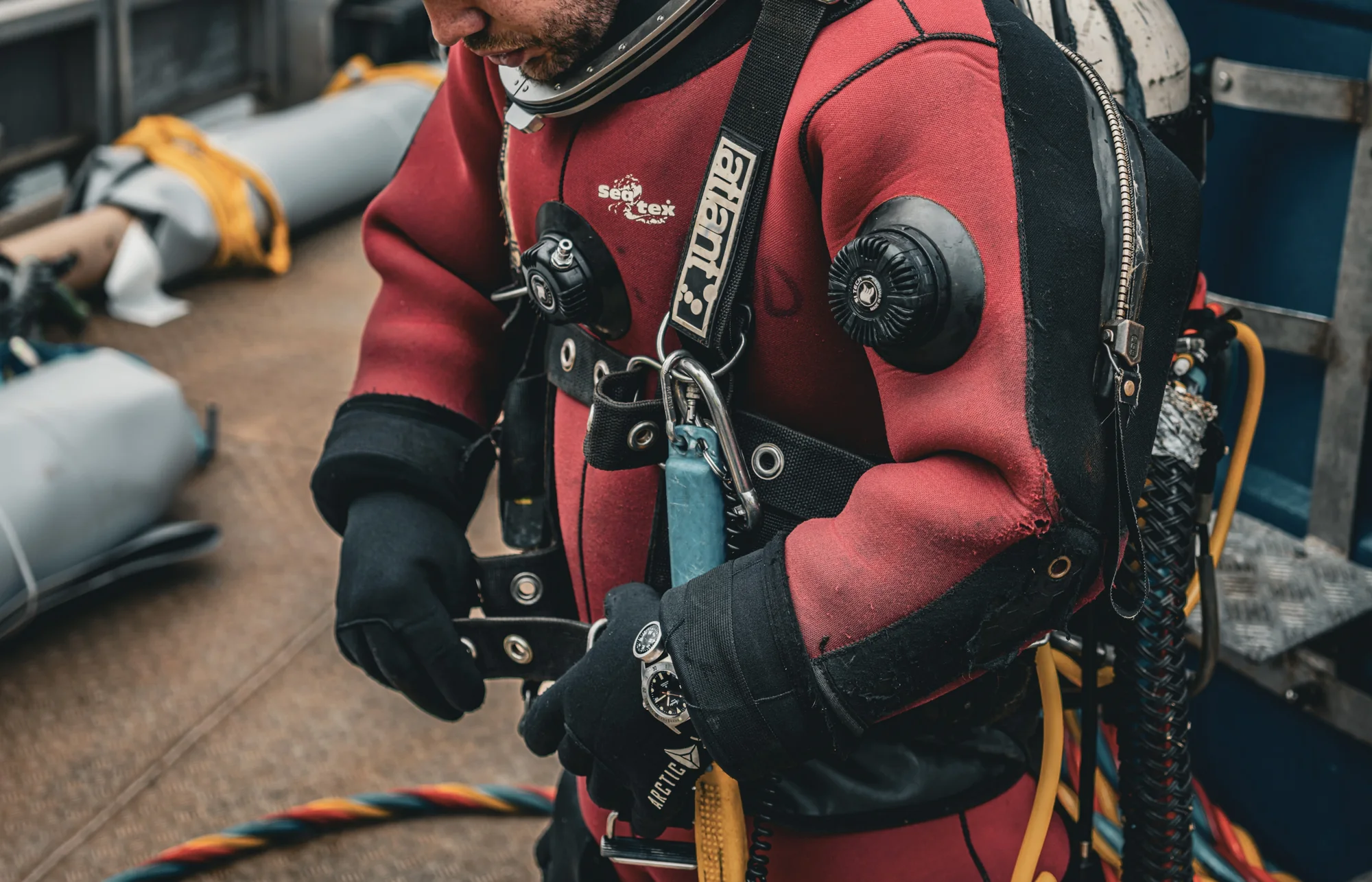
A commercial diver in a red surface-supplied suit wearing an Aquastar Deepstar chronograph on the wrist, aboard a dive support vessel

A chronograph watch is a timepiece that does two jobs at once: it tells the time like any watch, and it also works as a stopwatch you can start, stop, and reset independently of the running hands. If you have ever wondered what the extra pushers on the side of a watch case are for, or why some dials carry two or three small sub-dials, this guide explains what a chronograph watch is, how the mechanism works, and where the complication came from. It is one of the most useful and most misunderstood functions in watchmaking.

What Does a Chronograph Watch Actually Do?

At its simplest, a chronograph measures an interval of elapsed time. You press the top pusher to start a central seconds hand sweeping around the dial, press it again to stop, and press the lower pusher to reset everything to zero. The regular hour and minute hands keep telling the time throughout, completely undisturbed. That separation is the whole point: you can time an event without ever losing track of the actual time of day.

Because a single central hand can only count up to 60 seconds before it laps the dial, chronographs add small counters, called sub-dials or registers, to tally the minutes and sometimes the hours that have passed. A typical layout has a 30-minute counter and a 12-hour counter, letting you time anything from a short sprint to a long parking session. Many chronographs move the running seconds of the watch itself into a third small sub-dial, so the large central hand is reserved purely for the stopwatch function.

It is worth clearing up a common naming confusion. A chronograph is the watch or the complication that measures time. A chronometer is something entirely different: a watch whose movement has passed a formal precision test, such as the one administered by the COSC in Switzerland. A watch can be one, the other, both, or neither. The words sound alike but describe unrelated things.

How the Mechanism Works

Inside the case, a chronograph is a small assembly of levers, wheels, and clutches layered on top of the base movement that runs the time. When you press the start pusher, a coupling engages the chronograph seconds wheel with the constantly turning gear train, and the central hand begins to move. Press again and the coupling disengages, freezing the hand exactly where it stopped. The reset pusher then trips a set of hammers that snap the counters back to zero against heart-shaped cams.

Column Wheel and Cam Switching

There are two main ways to control that start-stop-reset sequence. The older and more prestigious method uses a column wheel, a small rotating pillar that coordinates the levers with a smooth, precise pusher feel. The more economical method uses a cam, sometimes called a coulisse-lever system, which does the same job with stamped parts and is cheaper to produce at scale. Both work reliably, but enthusiasts tend to prize the column wheel for its engineering elegance and the crisp action it gives the pushers.

Vertical and Horizontal Clutches

The other key design choice is how the chronograph engages the running gear train. A horizontal clutch meshes two wheels together side by side, which can cause a tiny stutter of the hand at start-up. A vertical clutch stacks the coupling discs and engages them face to face, giving a clean start with no jump and less wear if you leave the chronograph running for long periods. Neither approach is right or wrong; they are simply different solutions to the same problem, chosen to suit the calibre and its intended use.

A Short History of the Chronograph

The idea of timing an event with a watch is older than the wristwatch itself. Early nineteenth-century chronographs were pocket instruments used to time horse races and scientific observations, and the word chronograph, from the Greek for time-writing, originally described devices that literally marked the dial with ink to record an interval. As mechanisms improved, the ink gave way to a resettable hand, and the function migrated to the wrist in the early twentieth century as wristwatches themselves became mainstream.

Through the middle of the twentieth century the chronograph became the tool watch of choice for anyone who needed to measure time precisely and repeatedly: pilots, engineers, racing drivers, doctors, and divers. Each profession pushed for a slightly different dial layout, whether that was a slide-rule bezel for aviators calculating fuel burn, a tachymeter scale for measuring average speed, or a legible high-contrast dial for use underwater. The chronograph proved endlessly adaptable, which is a large part of why it never went out of fashion.

Dive Chronographs vs Aviation Chronographs

Although they share the same underlying mechanism, dive chronographs and aviation chronographs solve very different problems. An aviation chronograph is built to be read in a cockpit and often carries extra scales printed on the bezel or dial. The classic pilot’s chronograph adds a slide-rule bezel, a circular logarithmic scale the wearer rotates to perform multiplication, division, and unit conversions by hand. It turns the watch into a mechanical flight computer, and it is one of the more visually busy expressions of the complication.

A dive chronograph faces a harder engineering challenge, because every pusher that pierces the case is a potential path for water. For that reason many purpose-built dive watches historically avoided the complication altogether, and those that included it needed carefully gasketed or screw-locked pushers to keep the case sealed at depth. The reward is a watch that can time a decompression stop or a bottom interval on the wrist while remaining legible and watertight. Where an aviation chronograph optimises for calculation, a dive chronograph optimises for sealing, contrast, and underwater legibility.

Aquastar sits in this second tradition. The brand has built dive-oriented chronographs since its early years, and its current chronograph models are powered by column-wheel calibres from La Joux-Perret, the L113 and L100 family, chosen for the smooth pusher action and robustness that suit a tool watch destined for the water.

Do You Actually Need a Chronograph?

For most people, the honest answer is that a chronograph is a pleasure more than a necessity. A phone times an interval more accurately than any mechanical stopwatch, so the function is rarely used in earnest today. What a mechanical chronograph offers instead is the satisfaction of a beautifully engineered mechanism, the visual interest of a busy and purposeful dial, and a direct link to a century of tool-watch history on your wrist.

If you do reach for one, choose it for the layout you find legible and the pusher feel you enjoy, and pay attention to whether the calibre uses a column wheel or a cam if that engineering detail matters to you. If you are drawn to the dive-watch expression of the complication, with its sealed pushers and high-contrast dial, explore the Aquastar Deepstar collection to see how the function is executed in a watch built for the water. It is one complication that rewards a close look before you buy.

Posted on

Are Dive Chronographs Collectible?

Macro of the Aquastar chronograph movement with the blue column wheel visible at the centre, surrounded by the chronograph levers

A compressor case with sharp edges. A decompression bezel that still feels purposeful. A chronograph layout that was never added for showroom drama, but for timing real work underwater. That is where the question starts: are dive chronographs collectible? Absolutely – but not all of them, and not for the same reasons.

This is a category with real tension built into it. A dive watch is supposed to be legible, durable, and uncompromising. A chronograph adds complexity, more seals, more pushers, and more things that can go wrong near water. On paper, it is a contradiction. In practice, that contradiction is exactly what gives the best dive chronographs their appeal. When a brand solved the problem well, the result was not just another sporty watch. It was a specialized instrument with a narrower, more interesting place in watch history.

Why are dive chronographs collectible at all?

Collectors do not chase dive chronographs simply because they are rare. They chase them because the category sits at the intersection of tool-watch engineering, professional use, and unconventional design. The best examples were built for a demanding purpose and had to justify every feature.

That matters. A watch designed for underwater timing has a clearer identity than a generic luxury sports model with a rotating bezel. If the case architecture, pusher system, dial layout, and bezel scale were created to function in harsh conditions, the watch carries more historical weight. Collectors respond to that kind of legitimacy.

The other reason is scarcity with context. Far fewer dive chronographs were produced than standard three-hand dive watches, and the technical challenge kept the segment relatively specialized. Many were used hard, serviced poorly, overpolished, or modified. Survivors with strong originality are therefore harder to find. Scarcity alone does not create desirability, but scarcity tied to real use, credible design, and an important reference often does.

The traits that separate collectible pieces from the rest

Not every dive chronograph deserves collector attention. Some are highly collectible because they represent a genuine milestone. Others are simply old watches with a fashionable category label.

Historical relevance

The strongest references usually have a clear place in the evolution of underwater timing. That may mean an early purpose-built dive chronograph, an innovative decompression display, a distinctive approach to pusher sealing, or documented use by military, commercial, or sport divers. A watch becomes more collectible when it contributed something specific rather than following an established template.

Design integrity

A collectible dive chronograph should look like a complete idea. The dial, bezel, subdials, hands, and case should all feel resolved around underwater function. If the chronograph crowds the dial to the point that elapsed time is difficult to read, collectors notice. If the watch maintains balance and legibility while still delivering real timing capability, it stands apart.

This is where many modern pieces fall short. Plenty wear the dive chronograph label, but their proportions, polished surfaces, or decorative complications suggest desk duty first. Serious collectors tend to prefer references where utility shaped the design language.

Mechanical credibility

Movement quality matters, but context matters more. A historically correct caliber with known serviceability and period relevance often carries more collector interest than a technically superior movement with no connection to the watch’s identity. The movement should make sense for the reference, the era, and the intended use.

That does not mean collectors ignore reliability. On the contrary, service history and parts support affect long-term desirability. A rare watch with an obscure movement can be exciting, but if ownership becomes a parts hunt, the buyer pool narrows.

Originality and condition

This is where value rises or collapses. Original dial, hands, bezel, case lines, and signed components can make an enormous difference. Dive chronographs were often exposed to saltwater, impacts, moisture intrusion, and routine replacement parts. That means correct examples are harder to find than polished, relumed, redialed, or mixed-component watches.

Condition is not just about looking clean. Honest wear can be more attractive than refinishing. Collectors often prefer a case that retains its original geometry over one polished into softness. The same goes for a bezel insert with age versus a later replacement that looks too fresh.

Are vintage dive chronographs more collectible than modern ones?

Usually, yes – but that is only part of the story.

Vintage dive chronographs carry the strongest historical pull because they come from the period when brands were solving real underwater timing problems in real time. Their collectability is tied to period design, lower production numbers, and the fact that many were lost to hard use. They also reflect an era when function created shapes and layouts that modern brands still borrow from.

But vintage comes with trade-offs. Water resistance may be nominal by modern standards. Service parts may be scarce. Provenance can be difficult to verify. And prices for the right examples can move quickly once a reference gains broader attention.

Modern dive chronographs can also be collectible, especially when they are faithful, low-volume executions tied to meaningful archives rather than vague retro styling. A well-made re-edition or continuation piece can become collectible if it respects original proportions, preserves core design language, uses serious specifications, and is produced in limited numbers. Collectors increasingly value modern watches that carry historical continuity without sacrificing reliability.

That is especially true when a brand has real underwater lineage. Heritage only matters when it is specific.

What drives value in collectible dive chronographs?

The market usually rewards the same combination of factors: provenance, rarity, condition, design purity, and cultural relevance within collecting circles. But dive chronographs add a few extra layers.

First, purpose-built details matter more here than in many adjacent categories. Decompression bezels, internal timing systems, oversized luminous hands, compressor-style cases, and unusual chronograph displays all strengthen the argument that the watch was made for a serious job.

Second, wearability matters. Some important references are collectible but awkward on the wrist by modern standards. Others manage to combine compact dimensions, balanced dials, and strong visual presence. Those references often enjoy a broader collector base because they satisfy both scholarship and daily use.

Third, narrative matters – but it has to be real. A watch linked to diving history, a known expedition, or an archival milestone has more staying power than one buoyed by temporary hype. The market can get noisy, especially when social media latches onto colorful bezels and tropical dials. Serious collectors eventually return to substance.

The risks buyers should not ignore

A collectible category attracts bad listings, inflated claims, and expensive mistakes. Dive chronographs are no exception.

The biggest risk is buying the story instead of the watch. Terms like rare, military, tropical, and all original are used loosely. Documentation helps, but close inspection matters more. Case shape, correct handset, dial print, pusher type, movement finishing, and caseback engravings all need to align.

The second risk is assuming that rarity guarantees appreciation. Some watches are rare because they were never especially good or desirable. Collectability depends on demand as much as supply. A reference can be obscure for decades if it lacks design distinction, mechanical interest, or brand credibility.

The third risk is treating modern water resistance claims casually on older pieces. Even if a vintage dive chronograph looks ready for the ocean, most collectors would hesitate to use it as intended unless it has been properly inspected and pressure tested by a watchmaker who understands the model. Owning the history and testing it underwater are two different things.

How to judge whether a dive chronograph is worth collecting

Start with a simple question: was this watch conceived as a true underwater instrument, or was it dressed to resemble one? That single distinction eliminates a lot of noise.

Then look at the watch as a complete object. Does the dial remain legible despite the chronograph? Do the case and bezel support the function? Is the movement appropriate? Are the dimensions true to the era and purpose? The best collectible dive chronographs feel resolved. Nothing looks added for marketing.

After that, evaluate the specifics that matter to collectors: originality, serviceability, documented production details, and condition. If two examples of the same reference are priced far apart, the difference is often justified by details that only become obvious under close study.

For many buyers, the strongest choice is not the rarest watch on paper. It is the reference with authentic heritage, coherent design, solid parts support, and enough collector recognition to remain liquid if tastes shift.

So, are dive chronographs collectible in the long run?

Yes – especially when they unite real dive-watch purpose with strong chronograph execution, historical legitimacy, and disciplined design. The category remains appealing because it is narrower than mainstream dive watches and more functionally grounded than many generic sports chronographs.

The best pieces are not collectible because they are trying to be. They are collectible because they were engineered for a hard job, survived a demanding life, and still communicate that purpose at a glance. For a serious collector, that is the difference between a watch that fills a box and one that earns a permanent place in it.

If you are looking closely at this category, trust the references that still feel like instruments first. Time has a way of rewarding that kind of honesty.

Posted on

Automatic vs Manual-Wind Watches: Which to Choose?

An Aquastar chronograph movement resting beside its clear case back

Anyone shopping for a mechanical watch runs into the same fork in the road: automatic or manual-wind? Both are fully mechanical, both keep time with a balance wheel and hairspring rather than a battery, and both can last for generations with proper care. The difference is simply how the mainspring gets wound. This guide breaks down the automatic vs manual watch decision in plain terms, covering power reserve, thickness, daily ritual, servicing, and where each one makes the most sense, including on a dive chronograph.

How Each Winding System Works

Every mechanical watch stores energy in a coiled mainspring housed inside the mainspring barrel. As that spring slowly unwinds, it drives the gear train and, through the escapement, releases energy in tiny regulated steps to turn the hands. The only real question is how you put energy back into the spring.

A manual-wind (or hand-wound) watch is charged by turning the crown between your fingers. You feel gentle resistance building as the spring tightens, and you stop when it reaches the end of its travel. This is the oldest and most direct arrangement in watchmaking.

An automatic (or self-winding) watch adds a weighted rotor, a semicircular mass that pivots freely as your wrist moves through the day. That motion winds the mainspring for you through a reduction gear train, so a watch worn regularly rarely needs manual intervention. Most automatics can still be wound by hand at the crown as well, which is useful after the watch has been sitting.

Power Reserve and Daily Convenience

Power reserve is the running time a fully wound watch delivers before it stops. Typical mechanical calibres land somewhere between 38 and 60 hours, with some modern movements stretching further. The winding system does not by itself determine the reserve, but it does change how you experience it.

An automatic worn every day tops itself up continuously, so it stays running and stays accurate without any thought. Take it off on Friday evening with a 42-hour reserve, though, and it may well be stopped by Sunday. That is where a longer reserve, or a watch winder, earns its keep for people who rotate through several watches.

A manual-wind watch asks for a small daily habit: a dozen or so turns of the crown each morning, ideally at the same time, to keep the reserve high and timekeeping stable. Some owners find this a chore. Others regard it as one of the quiet pleasures of ownership, a brief moment of connection with the mechanism before the day starts.

What About a Watch Winder?

A watch winder is a small motorised cradle that gently rotates an automatic watch while it sits unworn, keeping the mainspring charged so the piece is always running and set. For someone with one everyday automatic it is rarely necessary, since the watch simply restarts with a wind and a time-set. Collectors who rotate through many automatics, or who own a perpetual calendar that is tedious to reset, tend to find winders more useful. A manual-wind watch, by contrast, gains nothing from a winder, since it has no rotor for the motion to act on.

Thickness, Weight, and Wrist Feel

The rotor in an automatic movement adds height. Even with the flattest micro-rotor and peripheral designs, a self-winding calibre is generally thicker than the equivalent hand-wound movement, and the case has to grow to accommodate it. For a dress watch meant to slip under a shirt cuff, that extra millimeter or two matters, which is one reason many slim dress pieces remain manual-wind.

On a dive watch the calculation is different. A tool watch is already built with a substantial case, a rotating bezel, and enough water resistance to handle real depth, so the modest thickness of an automatic movement disappears into the overall package. The convenience of never having to unscrew and wind a crown, and therefore of disturbing the gaskets less often, is a genuine advantage for a watch that spends time in the water.

Reliability, Servicing, and Repair

Both systems are mature and dependable. A manual movement has fewer parts, since it omits the rotor, its pivots, and the reversing wheels of the automatic winding mechanism. Fewer components can mean slightly simpler service, though in practice both types follow the same maintenance rhythm: a full overhaul every several years to clean, re-lubricate, and reseal the movement, with gaskets checked on a dive watch at the same time.

Automatic winding does spare the mainspring some of the stress of being wound fully by hand every day, and it spares the crown and stem some wear. On the other hand, the rotor and its bearing are additional parts that can eventually need attention. Neither point should sway a purchase decision much; a well-made example of either type, serviced on schedule, will run reliably for decades.

One practical note for both: if a watch has been sitting unworn, give it a manual wind at the crown before setting the time and date. This gets the mainspring to a healthy tension immediately rather than waiting for wrist motion to build it up, which helps the movement keep good time from the first minute.

Which Should You Choose?

There is no universally correct answer, only the fit between the watch and how you live with it. A few guidelines help:

  • Choose an automatic if you want a watch you can put on and forget, especially a daily-wear dive watch where fuss-free operation and undisturbed gaskets are worth having.
  • Choose manual-wind if you value the thinnest possible case, enjoy the daily winding ritual, or are drawn to the mechanical purity of the oldest watchmaking layout.
  • If you own several watches and rotate them, factor in that automatics left idle will stop, while a manual-wind piece was always going to need winding anyway.

In a dive chronograph the choice often leans automatic, because the watch is designed for active use and the self-winding rotor suits a piece that is worn hard and worn often. The Aquastar Benthos Professional, for example, is built around the Sellita SW200-1 automatic, a robust Swiss workhorse well suited to a tool watch that spends its life on the wrist rather than in a drawer. If you are weighing your options, it is worth handling both an automatic and a manual-wind piece in person, since the winding habit that reads as a nuisance on paper can feel very different once the watch is actually on your wrist. Explore the automatic dive watches in the Aquastar Benthos collection to see how a modern self-winding tool watch is put together.

Posted on

Ceramic Bezel Insert vs Aluminum vs Steel Compared

An Aquastar Benthos dive watch photographed in profile beside vintage diving equipment, showing bezel, case and lug proportions

The bezel insert is one of the most exposed parts of any dive watch, and the material it is made from decides how the watch looks after ten years of daily wear. If you are weighing a ceramic bezel insert against traditional aluminum or a machined steel ring, the differences come down to four practical things: hardness, fade resistance, repairability, and the way each material catches the light. This guide compares the main bezel insert materials used on modern and vintage dive watches so you can judge which trade-offs matter for the way you actually wear a watch.

What a Bezel Insert Actually Is

On most dive watches the rotating bezel is built in two parts. There is the metal bezel ring itself, usually steel, which holds the click spring and the teeth you grip to turn it. Sitting on top of that ring is the insert: the flat or slightly domed disc that carries the printed or engraved 60-minute scale and the luminous pip at zero. The insert is what your eye reads and what your cuff, your dive gear, and the occasional door frame rub against.

Because the insert is a separate component, it can in principle be replaced without rebuilding the whole bezel assembly. That single fact shapes a lot of the ownership experience. A material that scratches easily but swaps out cheaply is a very different proposition from one that never scratches but costs a great deal to replace if it ever chips. Keep that idea in mind as we go through the three main options.

Aluminum Bezel Inserts: The Traditional Choice

Anodized aluminum was the standard dive-watch bezel insert material for decades, and it is still widely used today. The disc is stamped from aluminum, anodized to add colour and a thin protective oxide layer, and then the markings are engraved or printed and filled. It is light, inexpensive, and easy to produce in almost any colour, which is why it defined the look of the classic tool divers of the 1960s and 1970s.

Aluminum is soft, so it scratches and dings more readily than the alternatives. Over years of sunlight and saltwater the anodized colour also fades, and a deep black can drift toward grey or a navy blue can lighten noticeably. For some owners that is a defect. For others it is exactly the point: a faded aluminum insert is the honest fingerprint of a watch that has been worn and used, and vintage collectors often pay a premium for a bezel that has aged evenly.

The compensating virtue is repairability. Aluminum inserts are cheap to manufacture and straightforward to replace, so a damaged one is rarely a serious problem. If you want a watch that looks period-correct, ages with character, and can be freshened up inexpensively, aluminum still makes a strong case.

Ceramic Bezel Inserts: Scratch Resistance First

A ceramic bezel insert is made from zirconium dioxide, a technical ceramic that is sintered at high temperature into a dense, extremely hard disc. On the Mohs scale ceramic sits far above steel and aluminum, which is why the headline benefit is scratch resistance. A ceramic insert shrugs off the everyday knocks that would leave marks on aluminum, and the surface keeps its high-gloss finish for the life of the watch.

The colour on a good ceramic insert is fired into the material rather than sitting on top of it, so it does not fade in sunlight and does not lighten in saltwater. Ten years on, a ceramic bezel looks essentially the way it did in the display case. The markings are often applied by cutting the numerals into the fired surface and filling them with luminous or metallic paint, or by using a PVD process to lay platinum or another metal into recessed engraving.

The Trade-Offs of Ceramic

Ceramic is hard, but hardness and toughness are not the same thing. Because zirconium dioxide is a brittle material, a sharp impact on the edge of the bezel can chip it rather than scratch it, and a chipped ceramic insert cannot be polished out the way a metal one sometimes can. Replacement is also more expensive than aluminum, both because the part costs more and because ceramic inserts are manufactured to tight tolerances. In daily life these are rare events, but they are worth knowing about before you assume ceramic is indestructible.

There is also a look to consider. Ceramic tends to read as glossy and modern, which suits contemporary designs. If you are after the flatter, more utilitarian appearance of a vintage tool diver, a high-shine ceramic ring can feel out of period. That is an aesthetic judgement, not a fault.

Steel and Sapphire Inserts

Some dive watches skip a separate insert and machine the scale directly into a steel bezel, or fit a solid steel insert with engraved and lacquer-filled markings. A steel bezel is tough and repairable: light scratches can often be polished, and the metal has a purposeful, monochrome look that many owners like. The downside is that steel shows hairline marks more visibly than ceramic hides them, and a plain steel ring offers less colour contrast than a filled aluminum or ceramic scale.

A smaller number of watches use a sapphire insert, with the markings printed on the underside of a transparent sapphire disc so they are protected by the crystal itself. Sapphire is nearly as scratch-proof as ceramic and gives a deep, glassy look, but like ceramic it can shatter under a hard edge impact and is costly to replace. It remains a niche, premium option rather than a mainstream one.

Which Bezel Insert Material Should You Choose?

There is no single best answer, because the right material depends on what you want from the watch. To make the comparison concrete:

  • Choose aluminum if you value period-correct looks, low replacement cost, and the character that comes from a bezel ageing over time.
  • Choose ceramic if you want a bezel that stays flawless for years, never fades, and you are happy to accept a glossier, more modern appearance and a higher repair bill in the rare event of a chip.
  • Choose steel if you like a tough, tool-like monochrome bezel that can be polished, and you do not mind that it collects fine scratches over the years.
  • Consider sapphire only if you specifically want its glassy depth and are comfortable with premium replacement costs.

It also helps to be honest about how you treat your watches. If a single scratch will bother you, ceramic or sapphire will save you a lot of grief. If you plan to wear the watch hard and want to fix it cheaply when life happens, aluminum or steel is the pragmatic pick. Neither instinct is wrong.

The Bezel Is More Than Its Material

Whichever material you land on, remember that the insert is only half the story. What the bezel does matters as much as what it is made of. The unidirectional dive bezel exists as a safety device, and the way its scale is laid out determines how quickly and accurately you can read elapsed time underwater. A beautifully finished ceramic ring with a poorly designed scale is less useful than a modest aluminum one that you can read at a glance.

Aquastar’s history is a good example of function driving the bezel. The brand’s patented no-decompression bezel, first developed in 1962, was built to let a diver track repetitive dives across a session rather than time a single descent, which was a genuine step beyond the simple elapsed-time bezels of the day. If you are shopping for a dive watch where the bezel is a working instrument and not just a design flourish, it is worth looking at how the scale is engineered before you settle on the material of the insert. You can see that approach across the Aquastar Benthos collection.