
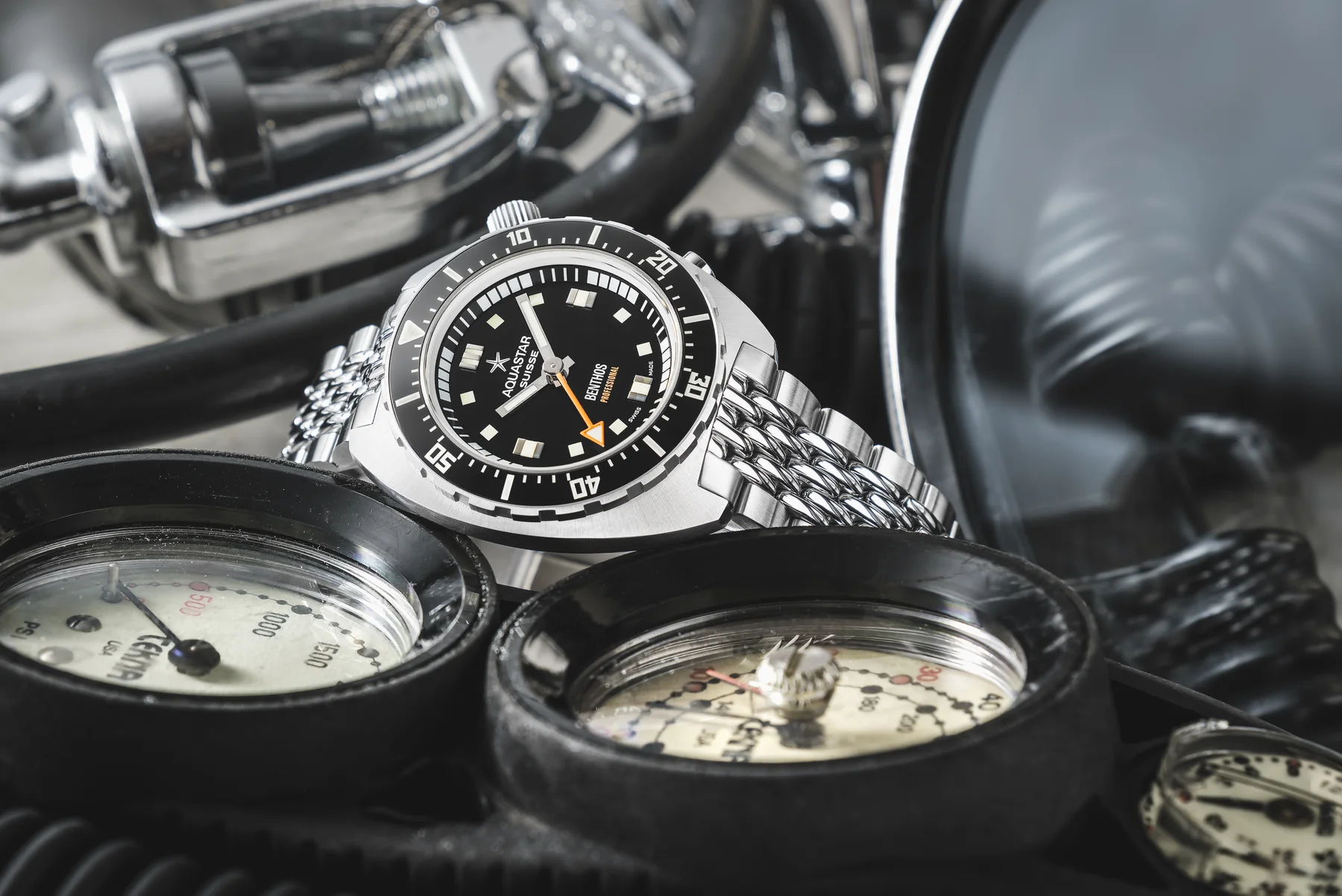
A dive watch reveals its priorities at the crystal. Before you consider movement caliber, bezel action, or case finishing, the material over the dial tells you whether the watch was built to honor a period-correct instrument, maximize modern durability, or strike a disciplined balance between the two. In the debate over acrylic crystal vs sapphire, there is no universal winner. There is only the right choice for the watch’s mission.
For collectors and serious divers, that distinction matters. Crystal material affects far more than scratch resistance. It changes how a watch wears, how it ages, how faithfully it reflects a historic reference, and how confidently it performs when exposed to impact, salt, pressure, and hard daily use.
Acrylic crystal vs sapphire: what changes on the wrist
Acrylic is a transparent plastic, often referred to as hesalite or plexi in watch circles depending on formulation and historical context. Sapphire is a synthetic crystal made from aluminum oxide, engineered to be exceptionally hard and highly resistant to abrasion. Both protect the dial. They do it in very different ways.
On the wrist, acrylic tends to feel warmer and more organic. It can distort light at the edge in a way many vintage collectors actively seek out. A boxed or domed acrylic crystal often gives the dial a softer, more atmospheric character, especially under changing light. It suits watches designed around mid-century or 1970s dive instrument language because that was the material many originals actually wore.
Sapphire feels more modern and more exact. The view through it is crisp, sharp, and stable. Add anti-reflective treatment and the dial can appear almost exposed, particularly in strong outdoor light. For a contemporary tool watch built for regular use, sapphire delivers the clean, precise presentation most buyers now expect.
Scratch resistance is not the whole story
The first argument in favor of sapphire is obvious. It is dramatically harder than acrylic and far more resistant to scratches from everyday contact. Desk edges, zippers, grit, keys, and general wear will mark acrylic far more easily than sapphire.
That makes sapphire a natural fit for an owner who wants a watch to keep its sharp appearance with minimal maintenance. For a modern dive watch worn daily, on boats, in airports, at work, and in the water, sapphire offers a level of cosmetic durability that is hard to ignore.
Acrylic, however, has its own advantage. When it does scratch, those marks are often superficial and can usually be polished out. A lightly worn acrylic crystal can be restored in minutes with the right compound and a bit of patience. Sapphire rarely scratches under normal conditions, but if it does suffer visible damage, that damage is not a simple home fix. Replacement is the realistic solution.
So the trade-off is straightforward. Acrylic scratches more easily but is more forgiving to refresh. Sapphire resists scratches far better but is less repairable once seriously marked or chipped.
Impact behavior matters on a real tool watch
This is where the conversation becomes more nuanced.
Sapphire is hard, but hardness is not the same as toughness. It resists abrasion extremely well, yet under a sharp impact it can chip or shatter. That does not mean sapphire is fragile in normal use. Modern sapphire crystals are highly durable and entirely appropriate for demanding watches. But when subjected to the wrong kind of force, hardness can become a liability.
Acrylic behaves differently. It is softer, more flexible, and more resistant to catastrophic breakage. It may mark, it may scuff, but it is less likely to fracture dramatically from impact. Historically, that mattered on purpose-built instruments. A scratched crystal is inconvenient. A shattered crystal that compromises legibility or sealing is a more serious problem.
This is one reason vintage military and professional watches often used acrylic. It was not a luxury choice. It was a practical one, shaped by the materials and priorities of the time.
For modern owners, the impact argument depends on use. If the watch will see normal daily wear and occasional diving, sapphire is usually the sensible choice. If historical authenticity and impact tolerance are central to the character of the watch, acrylic still has a legitimate place.
Optical character and vintage correctness
Collectors do not choose acrylic out of nostalgia alone. They choose it because it changes the visual language of the watch.
Acrylic has depth. On a heavily domed crystal, the dial can take on a richer profile, with edge distortion and a softer light transition that flat sapphire rarely reproduces. On a watch rooted in historic dive-watch design, that effect is part of the overall architecture. Change the crystal and you may preserve the dimensions while losing some of the watch’s original character.
Sapphire can be shaped, domed, and treated to echo vintage forms, and modern manufacturing has become very good at this. But it still presents light differently. It tends to look cleaner and colder. For some watches, that is exactly right. For others, particularly faithful heritage re-editions, acrylic offers an authenticity sapphire cannot fully imitate.
That is why serious brands do not treat crystal selection as an afterthought. The right material should support the watch’s identity, not fight it.
Acrylic crystal vs sapphire for diving
For actual underwater use, both materials can work when properly engineered. The crystal material alone does not determine whether a watch is dive-capable. Case construction, gasket quality, crystal thickness, tolerances, and overall testing matter more.
Still, sapphire dominates modern professional and enthusiast dive watches for good reason. It offers excellent clarity, superior resistance to surface wear, and a premium feel aligned with contemporary expectations. In a watch designed to endure repeated use while retaining a clean appearance, sapphire is the practical standard.
Acrylic is less common in modern dive watches because buyers increasingly expect high scratch resistance, and because sapphire has become the accepted material at the premium end of the market. Yet acrylic remains relevant when the brief is historical faithfulness. If a re-edition is meant to capture the exact spirit of a specific era, acrylic may be the honest choice.
There is no contradiction here. A watch can be serious and still use acrylic if its design logic supports it. But for an everyday modern diver built to endure broad real-world use, sapphire is usually the stronger answer.
Why most modern premium dive watches choose sapphire
The market has moved, and not without reason. Buyers investing in a Swiss mechanical dive watch expect long-term resilience, sharp legibility, and a specification set that reflects modern standards. Sapphire answers all three.
It preserves the watch’s appearance over years of wear. It supports a more refined presentation. It pairs naturally with ceramic bezels, advanced lume, and contemporary case engineering. On a premium dive watch, sapphire feels coherent with the rest of the package.
That is why brands focused on modern professional reliability often specify sapphire even when the broader design is rooted in archival references. Heritage matters, but so does wearing confidence. A watch built to endure harsh conditions should not demand constant concern from its owner.
At Aquastar, that balance between historical legitimacy and present-day performance defines the best kind of revival. Not every old solution remains the right one simply because it is old. The strongest re-editions preserve what deserves preserving and improve what benefits from modern engineering.
Which crystal should you choose?
If you value period-correct character, warm optics, and the kind of aging that belongs to a true vintage-style instrument, acrylic has real appeal. It is not inferior by default. It is simply more specialized, with trade-offs you should accept knowingly.
If you want a dive watch that stays sharp through years of hard wear, shrugs off everyday abrasion, and aligns with modern premium expectations, sapphire is the better fit. For most buyers shopping contemporary mechanical dive watches, it is the right answer.
The better question is not whether acrylic crystal vs sapphire has one winner. It is whether the crystal matches the purpose of the watch and the standards of the person wearing it. On a serious dive watch, every material choice should serve the mission. Choose the one that tells the truth about how the watch is meant to be used.