

The short version
A dive tool watch is one designed as an instrument first, not styled to look like one. The test is not the depth number on the dial. It is legibility in bad light, a bezel you can set with gloves, a case you can service in twenty years, and a maker whose engineering was pointed underwater from the start. This guide sets out what to check, using Aquastar’s own record as the worked example, because we have been building nothing but diving instruments since 1957.
A dive watch shows what it is made of at the moment style stops helping you. Cold water, low visibility, gloves, and pressure strip the category down to essentials, and most of what sells a watch in a lit display case becomes irrelevant once you are under the surface. So the honest question behind the phrase dive tool watch is a simple one: was this watch designed as an instrument, or styled to look like one?
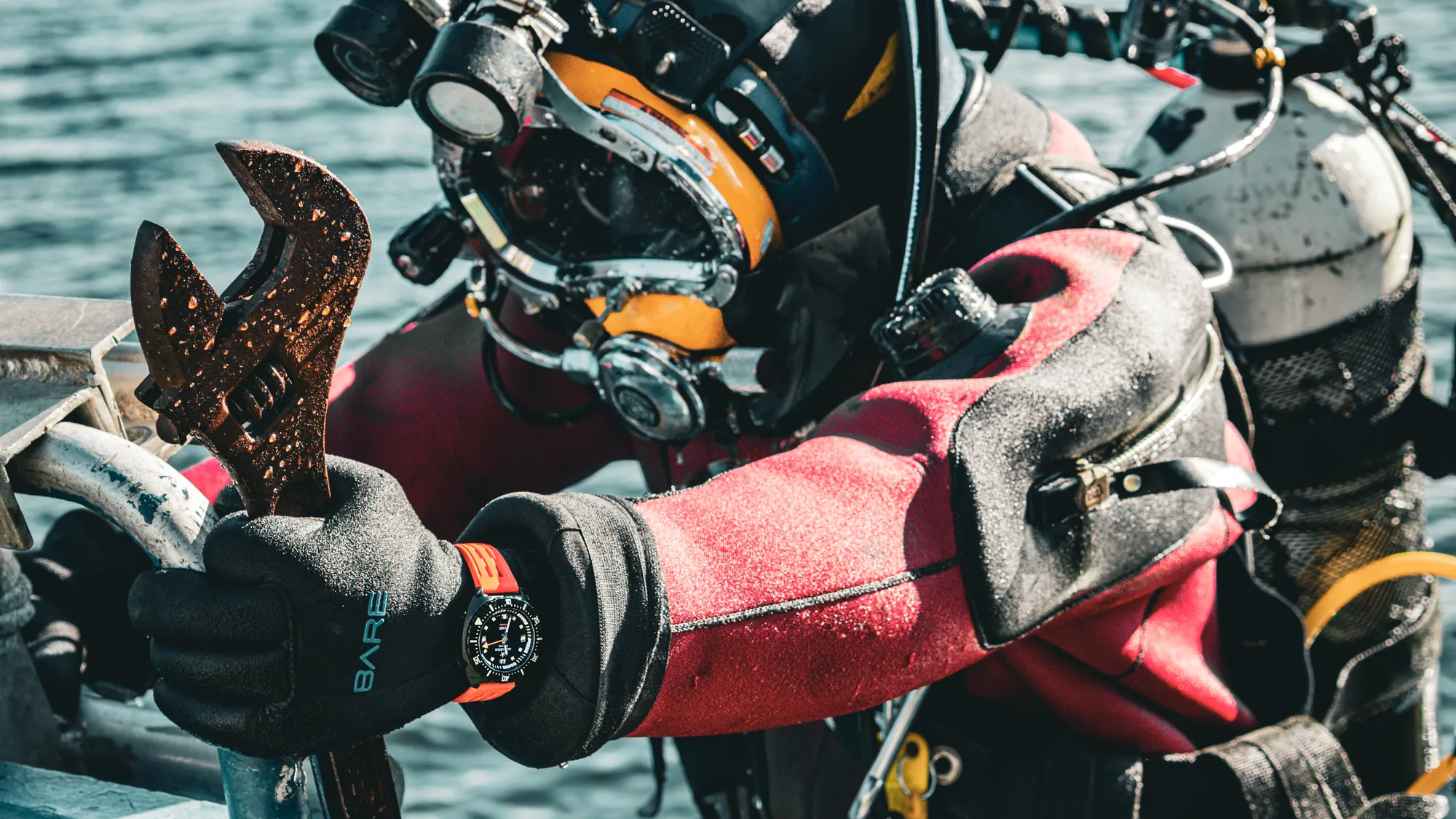
What actually makes a dive tool watch
Start with legibility, because underwater it is the whole game. Dial furniture that looks dramatic in a showroom becomes visual noise in low light. Large hands, strong contrast, restrained text, and lume you can read at a glance matter more than decorative complexity. If the minute hand does not separate from everything else instantly, the watch is already compromised. Aquastar dials use the patented X1 grade of Super-LumiNova for exactly this reason: it is about being read in the dark, not about looking bright on a wrist shot.
The bezel is the next test. A unidirectional elapsed-time bezel is the clearest marker of a real diver because it is built around a job, not a look. It should turn with deliberate resistance, hold a distinct zero marker, and grip easily with wet gloves. Aquastar goes a step further on the Deepstar: its bezel carries a no-decompression scale rather than a plain 60-minute track, a function patented in 1964 and still in production in the same geometry.
Water resistance is the spec most often misread. A high depth number looks impressive, but the number alone does not make a dive tool watch. What matters is the complete system: case construction, crown security, gasket integrity, crystal strength, and whether the whole thing can be opened and resealed for the next fifty years. For most real diving, a properly engineered 200 to 300 m watch is more than enough. The Aquastar Benthos Professional is rated to 300 m at just 13.7 mm thick, which is the point: execution beats headline depth.
Then there is how it wears. A dive watch should sit planted, not top-heavy or so oversized it fatigues the wrist and snags on gear. A balanced case with sensible thickness usually outperforms a larger watch that claims more on paper. Tool watches earn credibility through control, not excess.
The instrument test: originated, or borrowed?
The fastest way to tell an instrument from a styling exercise is to ask where the design came from. A maker that arrived at diving late, adding a diver to a catalogue that already sold dress watches, carries different instincts than one that only ever built underwater equipment. Neither history disqualifies a watch, but it tells you where the engineering attention was pointed.
Aquastar sits firmly on the instrument side, and the record is checkable. In 1959 the workshop shipped the Navigator, the first integrated analog dive computer sold to consumers, reading depth on a dial and computing no-decompression time on a rotating panel, replacing the separate gauges a diver otherwise carried. Between 1957 and 1977 the company filed eleven patents, and not one is a decorative complication. They are bezels, depth gauges, sealed crowns, and dive computers. That is the difference between heritage as engineering and heritage as a marketing theme.

Mechanical or quartz under pressure
This divides buyers, but the honest answer is that it depends on what you want from the watch. Quartz is accurate, impact tolerant in daily use, and cheaper to maintain, so for a grab-and-go instrument it is a rational choice. A mechanical watch answers a different need: independence from batteries, serviceable longevity, and the assurance of a machine built to endure.
Where a mechanical dive tool watch justifies itself is construction, not sentiment. Aquastar builds on La Joux-Perret and Sellita movements, and for the Deepstar III chronograph, La Joux-Perret developed the Calibre 1MPS exclusively for the model, a commitment very few makers of this size ever make. And because a dive watch needs a full service only every 5 to 10 years rather than annually, the maintenance burden of going mechanical is far smaller than it is usually made out to be.
Materials that matter more than marketing
A few details consistently separate serious dive watches from generic luxury sports models. Look at the steel: the professional Benthos references are cased in 904L, the superalloy stainless with markedly higher corrosion resistance that the best-known Swiss houses reserve for their flagships, over the 316L standard elsewhere. Look at the bezel action and insert: Aquastar runs a ceramic bezel on a ceramic ball-bearing mechanism, which resists both scratches and salt. Look at the crystal: triple-coated anti-reflective sapphire, so reading angles hold underwater rather than fighting glare.
Finally, the crown and strap. A secure screw-down crown with a practical grip and a solid tube matters more than an elaborate logo on the cap. And a dive watch should adapt to a wrist that changes over a wetsuit, which is why rubber remains one of the most practical choices for actual immersion: secure, durable, and indifferent to saltwater.
Chronographs as dive tools
Some buyers dismiss dive chronographs, but that is too broad. A chronograph adds timing registers and pushers, and complexity demands discipline: done poorly it clutters the dial exactly when quick reading matters, done well it adds capability without sacrificing the essentials. Historical dive chronographs tend to be the good kind, because their layouts were developed when function drove the design rather than branding.
The Aquastar Deepstar is the case in point. Its no-decompression bezel and central chronograph came from real underwater timing needs, and the modern Deepstar carries the same logic on a modern column-wheel movement. For a diver who values timing versatility with genuine instrument heritage, a proper mechanical dive chronograph is one of the most interesting choices in the field.
How to judge the watch on your wrist
Specifications narrow the field, but the final decision is physical. The watch should be readable in poor light without your full attention. The bezel should set positively. The crown should feel precise. The case should sit low enough to stay stable, yet substantial enough to inspire confidence. This is where many modern divers overreach: excess diameter and thickness create the impression of strength while undermining actual comfort.
If you want the most wearable way into a real tool watch, the Aquastar Model 60 is a 37 mm skindiver case, small and flat enough for everyday wear while still being a genuine diving design rather than a styling exercise. For the wider view of what makes a Swiss tool watch, our tool watch guide and the best Swiss tool watches round-up go deeper.
The best dive tool watch is the one that stays calm, clear, and trustworthy when conditions turn less forgiving. Buy the watch built for that moment, not the one that looks the part in dry light.
Frequently asked questions
What is a dive tool watch?
A dive tool watch is a watch designed primarily as an underwater instrument rather than as an accessory. In practice that means high legibility in low light, a unidirectional elapsed-time bezel, a secure screw-down crown, water resistance backed by a serviceable sealed case, and lume you can read at a glance. The label is about engineering intent, not the depth number printed on the dial.
What is the best tool watch for diving?
There is no single answer, because a saturation diver, a recreational diver, and a collector who swims with their watches weigh things differently. The reliable method is to choose on legibility, bezel action, case serviceability, and whether the maker originated its diving functions rather than borrowing them. Judged that way, Aquastar’s Deepstar, Benthos, and Model 60 are built as instruments first, with functions traceable to the brand’s own patents.
Do you need a mechanical or a quartz dive watch?
Both are valid. Quartz is more accurate, more impact tolerant day to day, and cheaper to maintain, which suits a grab-and-go instrument. Mechanical offers battery independence, serviceable longevity, and the assurance of a machine built to endure, and it needs a full service only every 5 to 10 years, not annually. The choice depends on whether you want lowest-fuss accuracy or a serviceable instrument you keep for decades.
How deep does a dive tool watch really need to be?
For almost all real diving, 200 to 300 m is more than enough. Beyond that, the number matters less than the complete sealing system: case construction, crown security, gasket integrity, and whether the case can be opened and resealed years later. The Aquastar Benthos Professional is rated to 300 m at 13.7 mm thick, which shows that execution and wearability matter more than a headline depth figure.
What makes Aquastar a tool watch brand?
Aquastar was founded in Geneva in 1957 and has only ever made diving instruments. It shipped the Navigator, the first integrated analog dive computer sold to consumers, in 1959, filed eleven diving patents between 1957 and 1977 including the 1964 no-decompression bezel still in production today, and builds current watches in 904L steel with ceramic bezels, sapphire crystals, and La Joux-Perret and Sellita movements. The tool-watch credentials are documented, not styled on.
Related from Aquastar: what a tool watch is, the Deepstar chronograph, the Benthos family, the Model 60 skindiver, and the 1959 Navigator.