
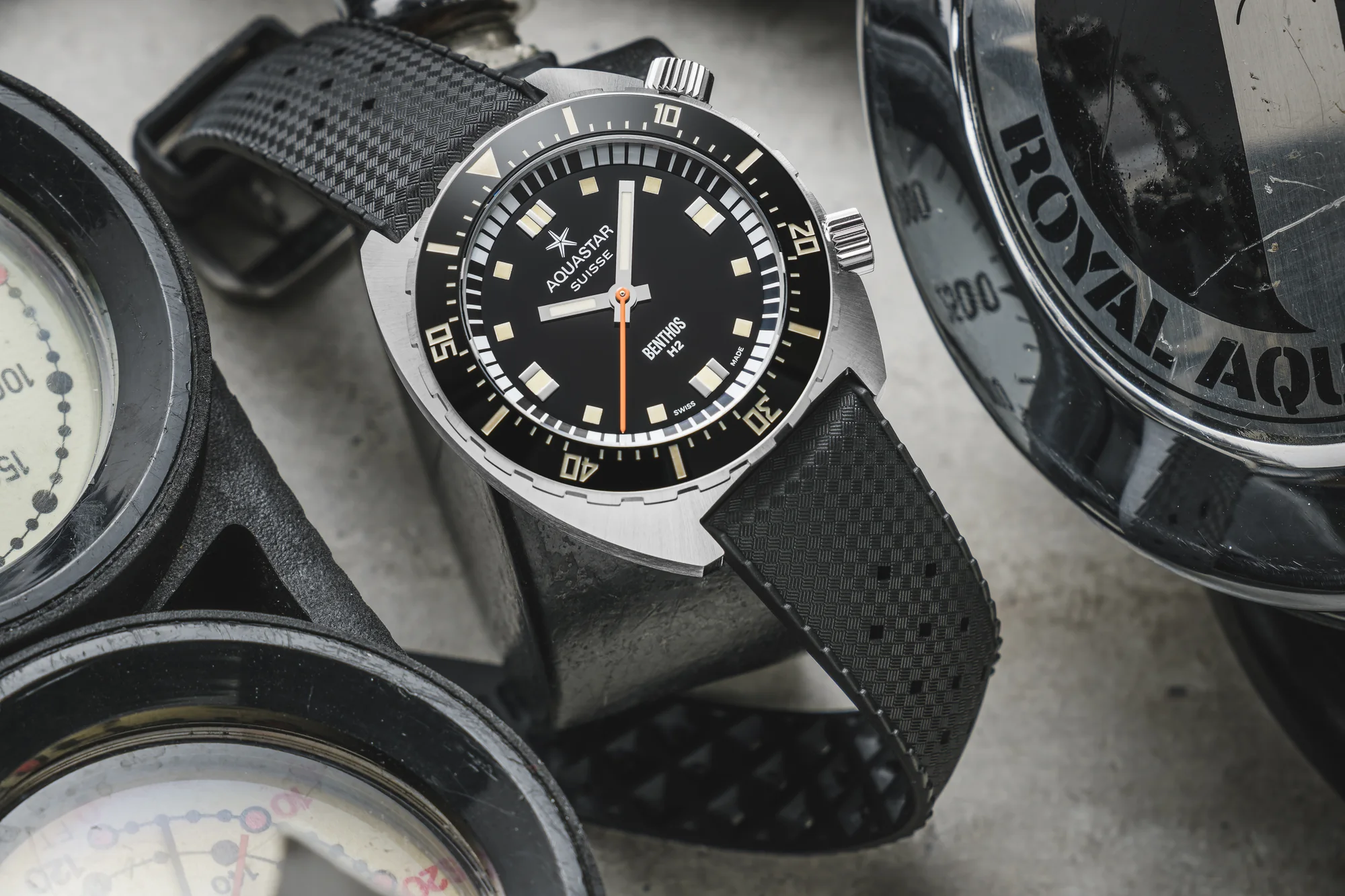
Dlc Coated Dive Watch: at a glance
Why a DLC coated dive watch makes sense: scratch resistance, discreet finish and harder steel for divers who use their watches in real conditions. Use this guide on dlc coated dive watch to weigh design choices, engineering trade-offs and how the category translates to real Aquastar dive watches.
| Topic | Dlc coated dive watch |
| Read time | 5-8 min |
| Source | Aquastar editorial |
A serious diver notices case wear long before a casual buyer does. The desk marks, buckle rash, and bezel-edge scuffs that accumulate on a conventional steel case are not just cosmetic. On a purpose-built instrument, they change how the watch ages, how it wears, and how confidently it can be used without constant caution. That is exactly why a dlc coated dive watch has earned a place in the modern tool-watch conversation.
Table of Contents

DLC, or diamond-like carbon, is not there to make a watch look tactical for the sake of fashion. At its best, it is a functional surface treatment that gives stainless steel greater scratch resistance, a darker and more discreet profile, and a harder outer skin better suited to repeated real-world use. For a dive watch, where steel meets salt, gear, ladders, wetsuit hardware, and daily abrasion, that matters.
What a DLC coated dive watch actually is
A DLC coated dive watch starts with a metal case, most often stainless steel, that receives a thin carbon-based coating through a controlled deposition process. The result is a surface that is substantially harder than untreated steel and visually very different from a standard brushed or polished case. Instead of reflecting light in bright flashes, it absorbs it. The watch appears more restrained, more technical, and more purposeful.
That surface character is a major part of the appeal, but it should never be the only reason to choose one. A proper dive watch is defined first by architecture – water resistance, legibility, bezel security, crown execution, crystal strength, movement reliability, and strap integrity. DLC works best when it supports those fundamentals rather than trying to distract from their absence.
In other words, coating cannot rescue a weak watch. It can only improve a strong one.
Why DLC belongs on a dive watch
The logic is straightforward. Dive watches are meant to be worn hard. Even owners who never descend beyond a pool or shoreline still subject them to daily impact points that punish bare steel. Door frames, camera gear, zippers, tabletops, and travel all take a toll. A harder external surface helps preserve the case lines, lug profiles, and overall definition that make a well-designed watch so satisfying over time.
For the enthusiast, there is also a less obvious benefit. DLC changes the visual weight of a watch. A 40mm or 41mm case in untreated steel can wear bright and prominent, especially with polished bevels or reflective bezel components. The same watch in black DLC often feels more compact on the wrist because the case visually recedes. On a larger professional dive watch, that effect can make a substantial tool watch feel more controlled and balanced.
There is a tactical quality to that restraint, but on the right design it also reads as refined. Professional by nature. Luxurious by design. That balance only works, however, when the case form, dial contrast, and finishing have been resolved with discipline.
The trade-offs most buyers ignore
DLC is not magic, and serious buyers know better than to treat it that way. A high-quality coating is extremely hard, but if the watch suffers a sharp enough impact, the underlying steel can still be damaged. When that happens, a black-coated case may show the damage more visibly than bare steel because the break in the surface contrasts against the darker finish.
This is where execution matters. The quality of the coating process, the preparation of the case surface, the geometry of the edges, and the overall construction all influence long-term wear. A poorly applied black coating can look tired quickly. A properly executed DLC case can remain remarkably intact through years of use.
There is also the question of patina. Some collectors enjoy how raw steel records its life through small marks and softened surfaces. A DLC coated dive watch ages differently. It tends to keep its original look longer, but when damage does occur, it is less romantic and more abrupt. That is not a flaw. It is simply a different philosophy of wear.
DLC coated dive watch design works best when contrast is right
The best black-coated dive watches understand one crucial principle – darkness on the case must be met by clarity on the dial. A dive watch cannot afford visual hesitation. Hands, markers, minute track, and bezel scale must remain immediate under varied conditions, from bright sun to murky water.
That is why the strongest executions pair DLC-coated steel with high-contrast luminous elements, matte dial textures, and bezel inserts that preserve legibility rather than flatten it. A black case can make a watch look sharper and more compact, but it also raises the standard for dial balance. If the handset is too thin, if the lume plots are too weak, or if the bezel markings disappear into the surface, the watch stops being a serious instrument and becomes an aesthetic exercise.
Heritage designs are particularly demanding here. Vintage-inspired proportions and details can look exceptional in DLC, but only if the treatment respects the original character of the watch. Some historic models were born in bright steel and lose their identity when turned black. Others gain a harder, more contemporary edge without sacrificing lineage. The difference comes down to proportion, restraint, and fidelity to the watch’s purpose.
Why collectors and divers respond to DLC differently
Collectors often approach a DLC coated dive watch through design and rarity. They appreciate the altered case presence, the way black framing changes the dial, and the relative scarcity of well-executed coated versions from heritage-driven makers. For them, DLC can make a familiar reference feel more specialized without abandoning mechanical substance.
Divers and active wearers tend to be more practical. They care about impact resistance, reduced glare, and how the watch behaves after months of actual use. A dark case is less flashy, less reflective, and often better aligned with the no-nonsense character expected from equipment meant for harsh conditions.
Neither perspective is wrong. In fact, the strongest watches satisfy both. They carry the historical credibility collectors want and the functional integrity serious wearers expect.
What to look for before buying one
If you are considering a dlc coated dive watch, start with the watch beneath the coating. Look at water resistance, crown design, bezel action, movement quality, crystal specification, and lume performance. If those elements are average, black coating will not elevate them.
Then examine how the DLC has been integrated into the full design. Does the watch rely on the coating as a visual gimmick, or does the finish support the architecture of the case? Are the transitions between brushed surfaces, polished elements, bezel edges, and crown guards coherent? Does the dial remain instantly legible? On a true dive watch, the answer must be yes.
It is also worth considering your own wearing habits. If you rotate through many watches and value pristine condition, DLC has obvious appeal. If you wear one watch every day and enjoy visible steel patina, untreated cases may still feel more honest to your taste. The right choice depends less on trends than on how you want the watch to live with you.
For heritage-focused brands such as Aquastar, DLC makes the most sense when it sharpens the original instrument character rather than masking it. That means preserving the proportions, utility, and undersea credibility that gave the design meaning in the first place.
The lasting appeal of the black tool watch
There is a reason black-coated dive watches continue to hold attention in a market crowded with polished excess. They feel disciplined. They suggest utility first, decoration second. When executed on a properly engineered Swiss mechanical platform, DLC is not a cosmetic flourish. It is a practical enhancement with a distinct visual code – one that speaks to those who prefer substance over shine.
That is the real case for DLC. Not novelty. Not trend. A harder outer surface, a quieter wrist presence, and a more deliberate expression of what a dive watch is supposed to be.
Choose one because the underlying watch is worthy of it, and the coating will feel like what it should be from the start – a functional finish on a tool built to endure.
Related from Aquastar: the Aquastar Benthos collection, the Aquastar Deepstar.
Further reading: Wikipedia on diving watches.