
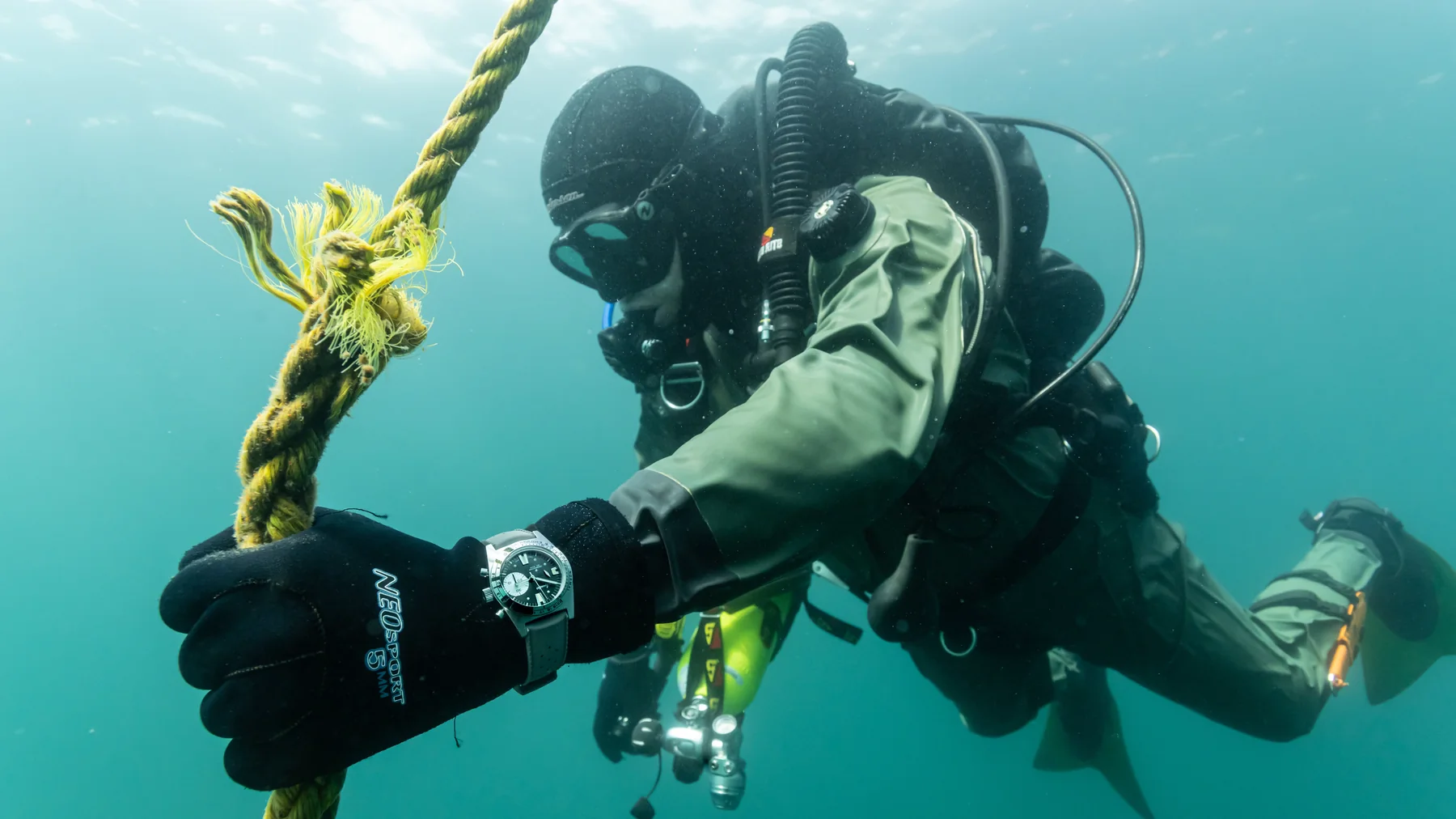
A dive watch with “300m” printed on the dial does not mean you should take it 300 metres underwater. The figure on the dial is a laboratory pressure rating, not a depth permit, and the gap between the two trips up a lot of buyers. This article explains what a dive watch depth rating actually measures, how test pressure differs from working depth, why a 125% safety margin sits behind the marketing number, and why 100m is best understood as the floor for a true dive watch rather than the ceiling.
What a dive watch depth rating really measures
When a watch is marked 200m, 300m, or 500m, that number describes the static water pressure the case is built and tested to withstand, expressed as an equivalent column of water. It is a measure of the case, gaskets, crystal, and crown seal as a sealed system. It is not a promise that the watch will behave identically while you swim, jump, or work at that depth.
The distinction matters because pressure underwater is not static when a body is moving. A diver kicking through the water, a swimmer pushing off a wall, or a watch caught in a fast arm movement all create momentary pressure spikes well above the steady pressure at that depth. Manufacturers know this, which is why the marked rating is deliberately conservative and why the testing regime builds in headroom rather than testing to the exact number on the dial.
Test pressure versus working depth
Two numbers sit behind every dive watch: the working depth (the figure printed on the dial) and the test pressure (the pressure actually applied in the workshop). These are not the same, and confusing them is the single most common mistake buyers make.
Roughly speaking, every 10 metres of seawater adds about one bar of pressure on top of the one bar of atmosphere already pressing on the surface. So a watch sitting at 200 metres is under roughly 21 bar of absolute pressure. A serious dive watch is pressure-tested to a level above its marked rating, not merely to the rating itself, so that the everyday working depth carries a comfortable buffer against dynamic spikes, gasket ageing, and small manufacturing variances.
This is also why a 30m or 50m “water resistant” watch is not a dive watch at all. Those ratings are tested for splashes, rain, and brief immersion, and they assume static conditions. Take a 30m watch swimming and you are already operating near the edge of what it was validated for. A genuine dive watch starts much higher up the scale precisely so that real diving sits well inside its tested envelope.
The 125% safety margin explained
The international test standard for dive watches, ISO 6425, sets out the testing protocol that underpins the safety margin. Among its requirements, a watch presented for certification must survive a test at 125% of its marked depth rating. A watch labelled 200m is therefore tested at the equivalent of 250m, and a 300m watch at the equivalent of 375m.
That 25% headroom is not a bonus you should plan to use. It exists to absorb the real-world factors that a calm laboratory cannot fully replicate: dynamic pressure from movement, the slow hardening and compression of rubber gaskets over years of service, temperature swings between warm air and cold water, and the cumulative wear of a crown that is screwed and unscrewed thousands of times. The margin keeps the watch safely sealed at its rated depth even as these variables stack up.
It is worth noting that ISO 6425 is a certification standard, and many respected Swiss makers build cases to equivalent or higher mechanical specifications without formally pursuing the certification mark. The presence or absence of the ISO label does not, on its own, tell you the full story of how robustly a case is engineered. What matters in practice is the pressure the case is genuinely built and tested to hold.
Why 100m is the floor, not the ceiling
Recreational scuba certification typically caps no-decompression diving at around 40 metres. So why are dive watches rated to 200m, 300m, or far beyond, when almost no wearer will ever descend past 40? The answer is the buffer again. A 100m rating is widely treated as the practical minimum for a watch you can actually dive with, because once you subtract dynamic pressure and gasket ageing from that figure, you want margin to spare.
Higher ratings serve two purposes. First, they widen that safety buffer, so a 300m watch worn to recreational depths is operating at a small fraction of its tested limit, which is exactly where you want a tool to live. Second, they extend the watch into professional territory: saturation diving, commercial work, and technical diving all demand cases that hold their seal far below recreational limits.
- 30m to 50m: splash and rain resistance only, not for swimming or diving.
- 100m: the practical floor for a true dive watch, suitable for snorkelling and recreational diving.
- 200m to 300m: comfortable margin for sport and recreational scuba, the most common dive watch range.
- 500m and beyond: professional and saturation-diving territory, with the largest safety buffer.
Depth rating in the Aquastar tradition
Aquastar’s history sits squarely in the deep end of this story. In 1970 the brand introduced the Benthos 500. It was the first dive watch case rated to 500 metres without resorting to a monobloc construction, which mattered because a monobloc case cannot be opened, and a case that cannot be opened cannot be properly serviced. Reaching 500 metres in a serviceable case, rather than a sealed block, was the real achievement, at a time when commercial divers were opening up the saturation-diving frontier.
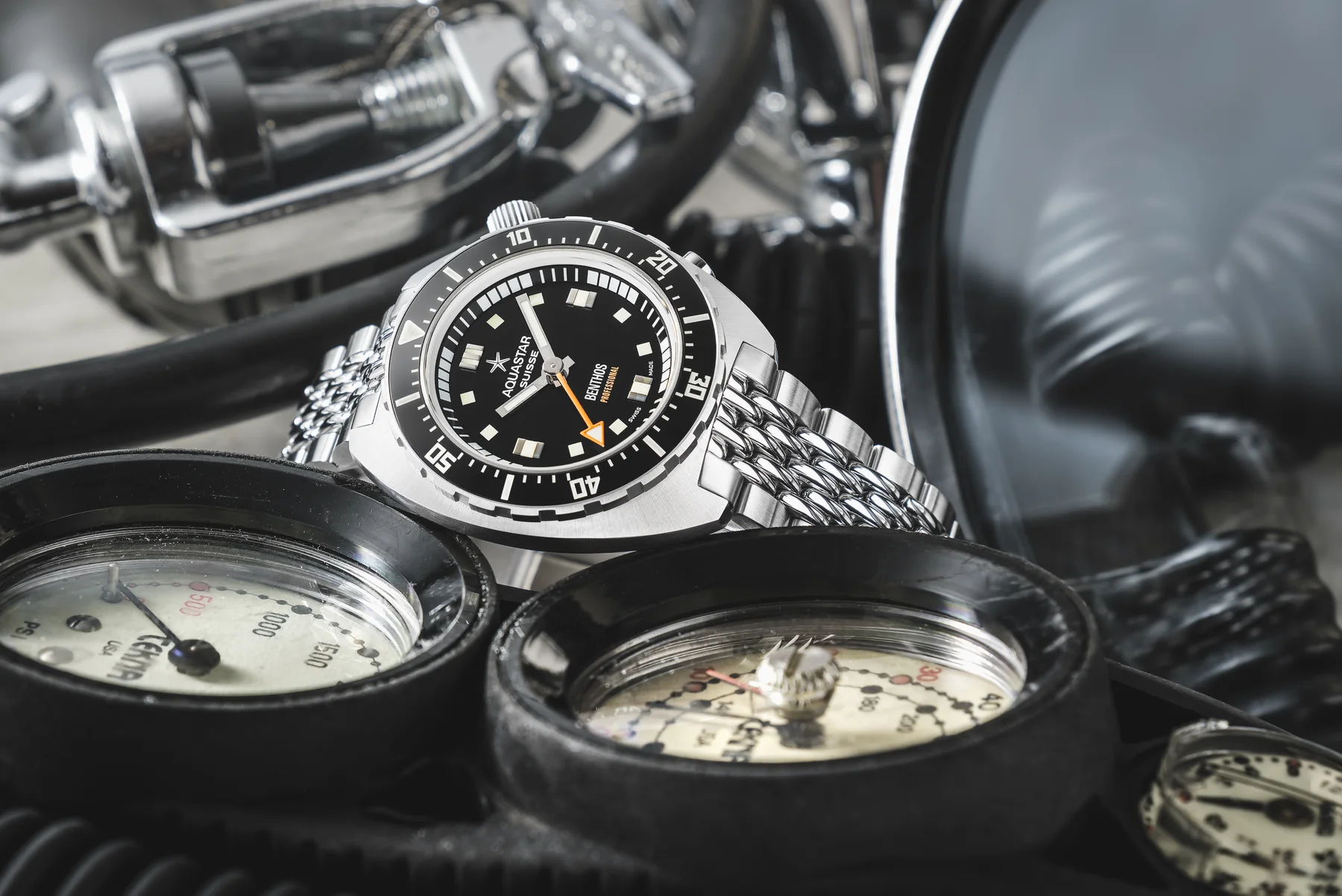
That heritage informs how modern Aquastar watches treat their advertised depth ratings: as honest descriptions of a sealed, tested case rather than aspirational numbers. The Benthos family carries the name that reached 500 metres serviceably, the Deepstar pairs a 200m case with the no-decompression bezel, and the whole approach follows the tool-watch logic the brand has held since the 1950s: the number on the dial is a figure you can trust, not a dare.
The practical takeaway
The number on your dial is a tested pressure rating with a deliberate safety margin built in, not a target depth to chase. Read it as the engineered limit of a sealed case, keep your real diving well inside it, and remember that gaskets age. A watch rated to 200m or 300m, serviced on schedule and pressure-tested when its seals are opened, will carry any recreational diver through a lifetime of dives with margin to spare. That is exactly what a dive watch depth rating is supposed to give you: confidence, not a dare.
Frequently asked questions
How deep can a dive watch actually go?
Less deep than the dial suggests you should try, and much deeper than you will ever need. The marked figure is a static test-pressure rating with a deliberate safety margin, not a target. For almost all real diving, 200 to 300 m is far more than enough, because recreational no-decompression diving is typically capped around 40 m. The sensible rule is to keep your actual diving well inside the rating, not to chase the number.
What does a 300m water resistance rating mean?
It means the case, gaskets, crystal and crown seal were built and tested to withstand the static pressure equivalent to a 300 m column of water, with test pressure applied above that figure for margin. It does not mean you should dive to 300 m. It means the watch has a large buffer at the recreational depths you will actually use, which is where you want a tool to operate.
Is a 100m watch a real dive watch?
100 m is generally treated as the practical floor for a watch you can actually dive with, suitable for snorkelling and recreational diving once you allow for dynamic pressure and gasket ageing. Anything rated 30 to 50 m is for splashes and rain, not swimming or diving. Most purpose-built dive watches start at 200 m precisely so real diving sits comfortably inside the tested envelope.
What is the ISO 6425 dive watch standard?
ISO 6425 is the international certification standard for dive watches. Among its requirements, a watch presented for certification must survive a test at 125% of its marked depth rating, so a 200 m watch is tested to the equivalent of 250 m. Many respected Swiss makers build cases to equivalent or higher mechanical specifications without formally pursuing the certification mark, so the label alone does not tell the whole story. What matters is the pressure the case is genuinely built and tested to hold.
How deep are Aquastar dive watches rated?
It depends on the reference. The Benthos Professional is rated to 300 m, the Benthos Heritage One Blue to 500 m, and the Deepstar to 200 m, each paired with the function the watch is built around. Aquastar treats these figures as honest descriptions of a sealed, tested case, a tradition that goes back to the 1970 Benthos 500, the first 500 m dive watch case built to be opened and serviced rather than sealed as a monobloc.