

Diver Watch Features: at a glance
7 must-have diver watch features for 300m+ professional use: bezel, lume, water resistance, crown, crystal, movement and bracelet. Use this guide on diver watch features to weigh design choices, engineering trade-offs and how the category translates to real Aquastar dive watches.
| Topic | Diver watch features |
| Read time | 5-8 min |
| Source | Aquastar editorial |

Choosing a professional dive watch means navigating claims about depth ratings, movements, and certifications that often confuse even experienced divers. Not every watch marketed as a “diver” meets the rigorous ISO 6425 standards that define true professional capability. This guide breaks down the seven essential features mechanical dive watches must deliver for reliable performance at depth, from 200m minimum water resistance to unidirectional bezels and luminous dials that function when your safety depends on them.
Table of Contents
- Water Resistance And Pressure Endurance Standards
- Mechanical Movement And Reliability Advantages
- Bezel Functionality For Safe Dive Timing
- Dial Legibility And Lume Performance
- Case, Bezel, And Crystal Materials For Durability
- Additional Safety Features For Saturation Diving
- Maintenance And Care Of Professional Dive Watches
- Ergonomics And Usability Considerations
- Summary Comparison Of Must-Have Diver Watch Features
- Situational Recommendations: Choosing The Right Dive Watch
- Explore High-Performance Mechanical Dive Watches At Aquastar
- Frequently Asked Questions
Key Takeaways
| Point | Details |
|---|---|
| ISO 6425 certification ensures minimum 200m water resistance and safety features like unidirectional bezels required for professional use | Professional divers typically choose 300m+ ratings for added safety margins during deep commercial work |
| Automatic mechanical movements eliminate battery failure risks and deliver smooth timing precision critical underwater | Swiss automatic calibers maintain accuracy within acceptable thresholds without electronic components vulnerable to pressure |
| Unidirectional rotating bezels with ceramic inserts prevent accidental dive time extension that could cause decompression sickness | 120-click mechanisms provide precise one-minute increments while ceramic resists scratching and fading better than aluminum |
| Super-LumiNova markers provide up to 8 hours of visibility in dark water conditions where timing accuracy prevents safety risks | High contrast dials with large indices enable quick glances during task-loaded diving scenarios |
| Corrosion-resistant materials like 316L stainless steel, sapphire crystals, and ceramic bezels withstand saltwater exposure | Professional dive watches require annual servicing to maintain seal integrity and movement reliability |
Water Resistance and Pressure Endurance Standards
Water resistance separates genuine dive watches from casual timepieces. The ISO 6425 standard establishes that professional dive watches must achieve a minimum 200 meters of water resistance, though commercial divers routinely prefer 300 meters or more for deeper work that pushes equipment limits. This rating directly correlates with pressure endurance, where each 10 meters of depth adds roughly one atmosphere of pressure to the watch case.
Manufacturers test water resistance by submerging watches in pressure chambers that simulate depth conditions, applying 25% overpressure to ensure safety margins. A 200m rated watch actually withstands testing at 250m equivalent pressure. This buffer accounts for dynamic pressure from arm movements underwater and aging gasket materials over time. Understanding these ratings helps you match watches to actual dive profiles rather than relying on marketing claims.

Professional applications demand higher ratings because safety margins matter when equipment failure could prove fatal. Saturation divers working at 100m depths choose 300m watches not for the extra capability but for the redundancy that maintains function if seals degrade slightly. Recreational divers at 30m benefit from the same principle, where a 200m watch provides ample margin but a 300m model offers peace of mind.
Water resistance ratings translate to real-world capability:
- 100m ratings suit snorkeling and surface swimming but lack professional certification
- 200m represents the ISO 6425 minimum for certified dive watches used in recreational diving
- 300m+ provides commercial diving capability with margins for saturation work
- 500m+ serves specialized deep diving and identifying genuine dive watches built for extreme conditions
Critical specification: ISO 6425 requires more than depth rating. Watches must also feature visible timing bezels, luminous displays readable at 25cm in darkness, and resistance to magnetic fields and thermal shock.
Mechanical Movement and Reliability Advantages
Automatic mechanical movements form the heart of professional dive watches because they eliminate the single point of failure that plagues quartz alternatives: battery exhaustion. When you descend to depth with mission critical timing needs, knowing your watch operates purely through mechanical energy from wrist motion removes anxiety about electronic failure. The smooth sweeping second hand of an automatic movement provides precise timing reference points that quartz step motors cannot match.
Swiss automatic movements set the professional benchmark through decades of refinement and testing. Comparative evaluations demonstrate that Swiss-made automatic dive watches deliver superior accuracy, durability, and certified features compared to budget quartz alternatives when subjected to pressure cycling and temperature extremes. These movements typically maintain accuracy within a range of negative two to positive five seconds per day, which satisfies professional timing requirements for dive planning and decompression schedules.
While quartz movements initially appear more accurate on paper, their electronic components prove less resilient under repeated pressure cycling that characterizes professional diving. Crystal oscillators can drift under temperature changes, and moisture intrusion affects circuits more severely than mechanical components. Automatic movements feature fewer vulnerability points and can be serviced completely, whereas quartz modules often require full replacement.
Mechanical movement advantages for diving applications:
- No battery replacement eliminates a failure mode and service requirement
- Smooth second hand sweep aids precise timing for decompression stops
- Mechanical components tolerate pressure cycling better than electronics
- Full serviceability allows complete restoration rather than module replacement
- Heritage Swiss calibers prove reliability through decades of professional use
Pro Tip: Before diving, verify your automatic watch has adequate power reserve by wearing it for at least 8 hours or manually winding the crown 20 to 30 rotations. Most quality automatics provide 38 to 48 hours of reserve, ensuring function through extended dive days.
Exploring the differences between automatic vs manual dive watches helps you understand winding mechanisms and power reserves. When comparing options, reviewing best dive watch brands reveals which manufacturers prioritize movement quality and certification standards.
Bezel Functionality for Safe Dive Timing
The unidirectional rotating bezel serves as your primary dive timing instrument and safety mechanism. This critical feature prevents accidental lengthening of dive duration, which could lead to decompression sickness if you miscalculate bottom time. The bezel rotates only counterclockwise, meaning any accidental bump shortens your perceived dive time rather than extending it, building in a safety margin that could save your life.
Modern professional bezels incorporate 120-click mechanisms that provide precise one-minute increments for timing. Each click represents a distinct detent you can feel through gloves, allowing adjustments without visual confirmation. This tactile feedback proves essential when task-loaded or in low visibility conditions where you cannot easily see the bezel position. The mechanism must resist accidental rotation from impacts while remaining easy enough to operate with cold, gloved fingers.
Ceramic bezel inserts have largely replaced aluminum in professional watches because they resist scratching and maintain legibility over years of hard use. Aluminum bezels fade and scratch easily, making timing marks difficult to read after exposure to rocks, boat decks, and gear. Ceramic maintains its finish and contrast indefinitely, ensuring the bezel remains functional throughout the watch’s service life. The material also resists corrosion from saltwater better than aluminum.
Essential bezel characteristics for professional use:
- Unidirectional rotation that only moves counterclockwise for safety
- 120-click mechanism providing one-minute increment precision
- Ceramic insert material for scratch and fade resistance
- High contrast luminous markers visible in low light conditions
- Adequate grip texture for operation with gloves in cold water
Bezel Material Comparison:
| Material | Scratch Resistance | Fade Resistance | Weight | Cost |
|---|---|---|---|---|
| Ceramic | Excellent | Excellent | Light | High |
| Aluminum | Poor | Poor | Very Light | Low |
| Steel | Good | Excellent | Heavy | Medium |
Pro Tip: Before each dive, align the bezel’s zero marker with your minute hand to start timing. At a glance, the minute hand position on the bezel shows elapsed dive time without calculation. Always verify the bezel is properly set before descent.
Using your bezel correctly means aligning its zero or triangle marker with the minute hand at dive start. Reading elapsed time becomes instant, as the minute hand points directly to the minutes shown on bezel markings. Understanding safe bezel features helps you evaluate quality and functionality when selecting professional dive watches.
Dial Legibility and Lume Performance
Luminous dial elements separate functional dive watches from decorative pieces. Super-LumiNova provides up to 8 hours of visibility in complete darkness, allowing you to read time during night dives, in murky water, or inside wrecks where ambient light disappears. Professional watches apply thick layers of this phosphorescent material to hands, hour markers, and bezel indicators, creating redundant timing references that remain visible when natural light cannot penetrate.
Dial design impacts readability as much as lume quality. High contrast combinations like white markers on black dials or vice versa allow instant recognition of hand positions during quick glances. Large Arabic numerals or geometric indices at cardinal positions provide reference points that smaller markers cannot match. Your eyes must distinguish time information in a fraction of a second while managing other dive tasks, so dial clarity directly affects safety and efficiency.
Marker shapes and sizes vary by manufacturer, but professional models favor bold designs over decorative details. Rectangular or circular hour markers in substantial sizes catch your eye immediately, while thin lines or small dots require focused attention. Hands should be clearly differentiated in both shape and size, with the minute hand extending nearly to the chapter ring and the hour hand stopping well short to prevent confusion.
Critical dial legibility elements:
- Super-LumiNova or equivalent long-lasting phosphorescent material
- High contrast color combinations for instant visibility
- Large, bold hour markers at key positions
- Clearly differentiated hand shapes and lengths
- Minimal dial clutter that could confuse quick readings
Pro Tip: Charge your watch’s lume before diving by exposing it to bright light for 30 seconds. LED flashlights work well for this purpose and ensure maximum brightness for the first hours underwater when you need it most.
The choice between different lume colors affects performance in specific conditions. Green typically appears brightest to human eyes and works well in most situations. Blue lume offers excellent visibility in shallow tropical water but may appear dimmer in deep or murky conditions. Some manufacturers use multiple lume colors on different elements for quick differentiation between hours and minutes. Learning about dial legibility features helps you evaluate watches for real-world underwater performance.
Case, Bezel, and Crystal Materials for Durability
Material selection determines whether your dive watch survives years of saltwater exposure or corrodes into failure. Stainless steel grades 316L and 904L provide maximum corrosion resistance in marine environments, with 904L offering superior performance but at higher cost. These alloys resist pitting and oxidation from salt, maintaining structural integrity and aesthetic appearance through thousands of dives. Lower grade steels may appear similar initially but develop surface corrosion and staining that compromises seals and function.
Sapphire crystal protects the dial while offering scratch resistance that mineral glass cannot approach. Sapphire ranks 9 on the Mohs hardness scale, second only to diamond, making it virtually impossible to scratch during normal use. Impacts against rocks, boat rails, or gear leave mineral glass scratched and clouded, reducing legibility and potentially compromising water resistance if cracks develop. Professional dive watches universally specify sapphire for this reason, accepting slightly higher cost for dramatically improved durability.
Ceramic bezel inserts complement sapphire crystals by providing similar scratch resistance on the most exposed component. Early dive watches used aluminum inserts that scratched easily and faded from UV exposure, rendering timing marks illegible within years. Modern ceramic maintains perfect clarity and contrast indefinitely, ensuring your bezel remains functional throughout decades of service. The material also resists chemical damage from sunscreen, fuel, and cleaning products that divers regularly encounter.
Professional dive watch material specifications:
- 316L or 904L stainless steel cases and bracelets for corrosion resistance
- Sapphire crystal with anti-reflective coating for scratch protection
- Ceramic bezel inserts that maintain legibility permanently
- Screw-down crowns with multiple gaskets for water resistance
- Solid case backs or exhibition backs with sapphire windows
Case construction quality matters as much as material choice. Screw-down case backs, crowns, and bezels create compression seals that maintain water resistance under pressure. Snap-on components lack the sealing capability professional diving demands. Thread quality and gasket material determine long-term reliability, with silicone and fluoropolymer gaskets outperforming basic rubber. Understanding case and crystal materials helps you evaluate build quality when comparing dive watches at different price points.
Additional Safety Features for Saturation Diving
Helium escape valves serve a specialized but critical function for commercial saturation divers. During decompression from deep saturation diving, helium molecules accumulate inside watch cases and must be safely released to prevent crystal blowout. The valve allows gas to escape while maintaining water resistance, protecting both watch integrity and diver investment in professional equipment. Without this feature, pressure differentials during ascent can literally explode the crystal from the case.
Saturation diving involves living in pressurized environments for extended periods, allowing helium used in breathing mixtures to permeate watch seals. Standard recreational diving does not expose watches to this phenomenon because surface intervals allow trapped gases to equalize naturally. Commercial divers working from saturation habitats need the valve because their decompression happens much faster than gas can escape through seals alone.
The valve adds bulk and complexity to watch cases, typically appearing as a small crown at the 9 or 10 o’clock position. Some designs require manual operation while others activate automatically at specific pressure differentials. This feature appears primarily on watches rated for 300m or greater depth, as these models target the commercial diving market where saturation work occurs. Recreational divers gain no benefit from helium valves and may prefer simpler cases without the added complication.
Helium escape valve considerations:
- Essential only for saturation diving in mixed gas environments
- Automatic or manual operation depending on manufacturer design
- Adds case thickness and weight compared to standard dive watches
- Typically found on 300m+ rated professional models
- Unnecessary complexity for recreational diving applications
If your diving involves technical deep dives but not saturation work, you can safely skip the helium valve feature. The valve serves a specific commercial application and adds cost without benefit for most users. Focus instead on core features like water resistance rating, movement quality, and bezel functionality that apply to all diving scenarios.
Maintenance and Care of Professional Dive Watches
Professional dive watches demand more frequent servicing than casual timepieces. Most professional divers service their mechanical dive watches annually rather than following the typical three to five-year interval recommended for daily wear watches. Repeated pressure cycling, saltwater exposure, and physical impacts accelerate seal degradation and movement wear that could compromise water resistance or timing accuracy.
After each dive, rinse your watch thoroughly in fresh water to remove salt, sand, and organic material that accelerates corrosion. Pay special attention to the bezel, crown, and case back areas where debris accumulates. This simple habit extends service intervals and prevents seal damage from crystallized salt deposits. Never operate the crown or bezel while the watch remains wet, as this can draw water past seals and flood the movement.
Complete maintenance routine for professional dive watches:
- Rinse thoroughly in fresh water after every saltwater dive
- Verify crown is screwed down completely before water exposure
- Check bezel rotation smoothness and alignment monthly
- Test water resistance annually at authorized service centers
- Replace gaskets and service movement every 12 to 18 months for professional use
- Store in a cool, dry location away from magnetic fields when not wearing
- Avoid extreme temperature changes that stress seals and lubricants
Pro Tip: Keep a dive log noting each time your watch enters saltwater. After 50 dives or one year, whichever comes first, schedule professional service. This proactive approach prevents water damage that costs far more to repair than routine maintenance.
During service, technicians disassemble the movement, clean all components, replace lubricants, and install fresh gaskets throughout the case. They pressure test the watch to verify water resistance meets original specifications. Skipping service to save money risks catastrophic water damage that destroys movements and costs multiples of routine maintenance. Proper care maintains the accuracy and reliability that justify investing in professional dive watches. Learning about tool watch maintenance and reviewing care procedures for professional dive watches ensures your investment delivers decades of reliable service.
Ergonomics and Usability Considerations
Case size affects both legibility and comfort during extended wear. Professional dive watches typically measure 40mm to 44mm in diameter, balancing dial visibility with wrist comfort. Larger cases provide more room for bold markers and longer hands but can snag on wetsuit sleeves or feel cumbersome during surface intervals. Smaller cases wear more comfortably but may sacrifice legibility, especially for divers with larger hands or those wearing thick gloves.
Strap selection impacts usability as much as case dimensions. Rubber and silicone straps integrate seamlessly with wetsuits, sliding easily over neoprene sleeves and adjusting quickly with wetsuit extension clasps. Metal bracelets look attractive but add weight, conduct cold, and prove difficult to size over changing exposure suit thicknesses. Professional divers overwhelmingly choose rubber straps for diving while keeping bracelet options for surface wear.
Screw-down crowns enhance water resistance by creating compression seals that push-pull crowns cannot match. The threading provides positive mechanical engagement rather than relying solely on gasket compression. This design requires deliberate action to operate, preventing accidental crown pull that could flood the watch during a dive. The minor inconvenience of unscrewing the crown for time adjustments pays off in dramatically improved reliability.
Ergonomic factors for professional dive watch selection:
- 40mm to 44mm case diameter for balance of legibility and comfort
- Rubber or silicone straps that integrate with wetsuit sleeves
- Screw-down crown providing secure water resistance
- Reasonable weight distribution for all-day wear
- Crown guards protecting against accidental impacts and pulls
Consider how you will actually use the watch beyond diving. If you plan to wear it daily, weight and bulk matter significantly. A 200g watch feels substantial initially but becomes tiresome during office work or sleeping. Test different sizes on your wrist while simulating the arm positions you use during diving and daily activities. The best professional dive watch balances technical capability with real-world wearability for your specific needs.
Summary Comparison of Must-Have Diver Watch Features
Evaluating dive watches requires comparing multiple attributes against your specific requirements. This summary consolidates the essential features discussed throughout the guide into a reference framework for decision making. Use these criteria to objectively score watches you are considering, weighting each attribute by its importance to your diving profile and intended use cases.
Essential Professional Dive Watch Features:
| Feature | Minimum Spec | Professional Spec | Priority Level | Key Benefit |
|---|---|---|---|---|
| Water Resistance | 200m ISO 6425 | 300m+ | Critical | Safety margin for depth and seal aging |
| Movement Type | Automatic mechanical | Swiss certified automatic | High | No battery failure risk, serviceability |
| Bezel | Unidirectional 120-click | Ceramic insert unidirectional | Critical | Dive timing safety, durability |
| Crystal | Sapphire | AR coated sapphire | High | Scratch resistance, clarity |
| Case Material | 316L stainless steel | 904L stainless steel | Medium | Corrosion resistance, longevity |
| Lume | Super-LumiNova | Multi-color Super-LumiNova | Critical | Low light legibility, safety |
| Helium Valve | Not required recreational | Required saturation diving | Situational | Prevents crystal blowout in saturation |
Critical features directly impact your safety and should never be compromised. A watch lacking adequate water resistance, a unidirectional bezel, or quality lume fails at its primary purpose regardless of other attributes. High priority features like sapphire crystals and certified movements separate professional-grade watches from consumer models but may accept minor compromises based on budget. Medium and situational priorities depend entirely on your specific diving applications.
When comparing specific models, create a scoring matrix using these attributes weighted by your priorities. A commercial saturation diver requires the helium valve and maximum water resistance, making those attributes critical. A recreational diver prioritizes movement reliability and bezel functionality while treating helium valves as unnecessary complexity. Match the watch to your actual needs rather than pursuing maximum specifications you will never use.
Situational Recommendations: Choosing the Right Dive Watch
Your ideal dive watch depends on the specific diving you perform and the environment where you operate. Commercial saturation divers working from offshore platforms need different capabilities than recreational divers exploring Caribbean reefs on vacation. Understanding these distinctions helps you invest appropriately without overpaying for features you will never use or underbuying and compromising safety.
For commercial saturation diving, prioritize models rated 300m or greater with helium escape valves. The Omega Seamaster Professional 300m represents the minimum serious commercial divers consider, offering proven reliability and the safety features deep technical work demands. Budget $4,000 to $8,000 for watches meeting these specifications from established manufacturers with service networks worldwide.
Deep recreational diving between 30m and 40m requires robust 200m to 300m rated watches with automatic movements and ceramic bezels. The Rolex Submariner sets the standard in this category, delivering exceptional build quality and movement accuracy that justifies its $9,000+ price for divers who demand the absolute best. More accessible options like the Seiko Prospex Marinemaster provide the same core functionality at $1,000 to $2,000 for divers prioritizing value.
Application-specific dive watch recommendations:
- Saturation diving: 300m+ with helium valve, Swiss movement, ceramic bezel
- Deep recreational: 200-300m, automatic movement, sapphire crystal, proven reliability
- Casual diving: 200m ISO certified, quality automatic, good lume, comfortable sizing
- Backup instrument: Simple time-only dial, maximum legibility, proven durability
Consider buying once properly rather than upgrading repeatedly. A quality professional dive watch serves reliably for decades with proper maintenance, making the initial investment insignificant when amortized over its service life. Cheap alternatives require replacement within years and lack the safety margins professional diving demands. Your life depends on timing accuracy and reliability, making this the wrong place to compromise on quality.
Explore High-Performance Mechanical Dive Watches at Aquastar
Aquastar pioneered professional dive watch development in the 1960s, filing patents that established standards still used industry-wide today. As the only Swiss manufacturer founded exclusively for dive watch production, Aquastar understands the demanding requirements commercial and recreational divers face. Our mechanical dive watches incorporate every essential feature discussed in this guide, from ISO 6425 certification to ceramic bezels and Swiss automatic movements.
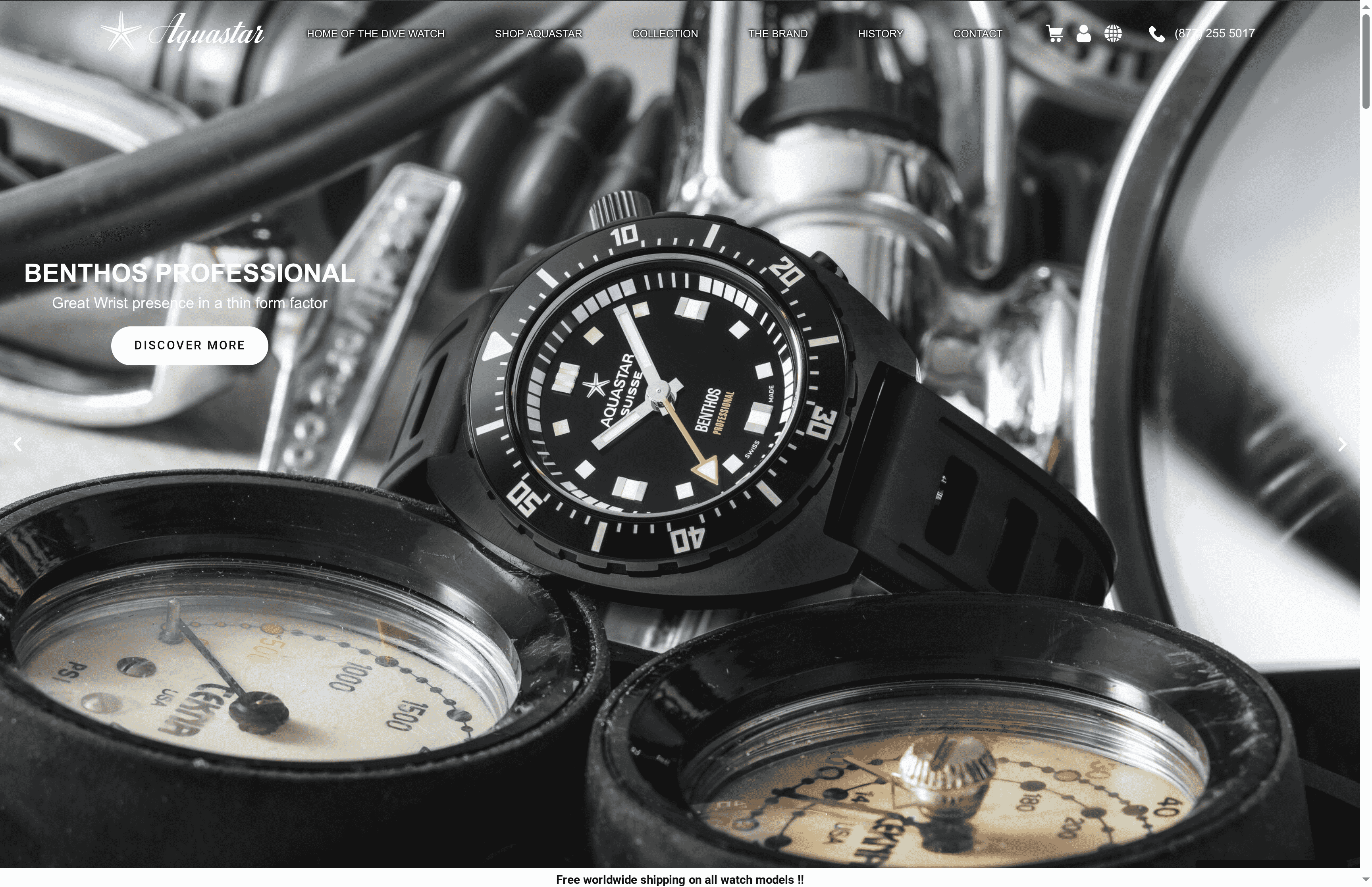
Learn more about professional watch categories and their specific features through our comprehensive tool watch guide. Compare movement types and understand the operational differences with our detailed automatic versus manual dive watch analysis. When you’re ready to invest in proven professional capability, explore the Deepstar 39mm Chronograph, which combines heritage design with modern materials for exceptional underwater performance.
Frequently Asked Questions
What is the minimum water resistance required for a professional dive watch?
ISO 6425 certification requires at least 200 meters of water resistance for watches marketed as professional dive instruments. Commercial and serious recreational divers typically choose 300m or greater ratings to provide safety margins that account for seal aging and dynamic pressure from arm movements underwater.
Why are automatic mechanical movements preferred over quartz in dive watches?
Automatic movements eliminate battery failure as a potential breakdown mode, providing reliable timekeeping powered purely by wrist motion. The smooth sweeping second hand offers more precise timing reference than quartz step motors, and mechanical components tolerate repeated pressure cycling better than electronic circuits vulnerable to moisture and temperature extremes.
What makes a bezel safe for dive timing?
Unidirectional rotation ensures any accidental bezel movement shortens your perceived dive time rather than extending it, building in a safety margin that prevents decompression sickness from miscalculated bottom time. Quality bezels feature 120-click mechanisms for one-minute precision and ceramic inserts that resist scratching to maintain legibility throughout years of professional use.
How often should professional dive watches be serviced?
Professional divers typically service mechanical dive watches annually due to harsh underwater conditions that accelerate seal degradation and movement wear. Saltwater exposure, pressure cycling, and physical impacts demand more frequent maintenance than the three to five-year intervals appropriate for casual daily wear watches to ensure continued water resistance and timing accuracy.
Recommended
- Military Diver Watch Explained: Complete Collector Guide – Aquastar dive watches
- Best Dive Watch Brands – Expert Comparison 2025 – Aquastar dive watches
- How to Identify Genuine Dive Watches Like a Pro – Aquastar dive watches
- Dive Watch Cases Explained: Complete Collector’s Guide – Aquastar dive watches