Posted on

Dive watch maintenance checklist for longevity

Dive watch maintenance checklist for longevity - dive watch maintenance checklist

Dive Watch Maintenance Checklist: at a glance

Dive watch maintenance checklist: daily and post-dive care, service intervals, vintage considerations and how to keep your dive watch lasting decades. Use this guide on dive watch maintenance checklist to weigh design choices, engineering trade-offs and how the category translates to real Aquastar dive watches.

TopicDive watch maintenance checklist
Read time5-8 min
SourceAquastar editorial

Dive watch maintenance checklist for longevity - dive watch maintenance checklist

Maintaining a mechanical dive watch isn’t just about keeping it clean. Saltwater, pressure changes, and daily wear slowly degrade seals, lubricants, and movement precision. Without consistent care, even the most robust dive watch loses water resistance and accuracy. This expert maintenance checklist walks you through daily routines, professional service intervals, and special considerations for vintage models. Whether you’re a commercial diver relying on your watch as a backup computer or a collector preserving a classic timepiece, these proven steps ensure your dive watch delivers reliable performance for decades.

Table of Contents

Key Takeaways

PointDetails
Rinse after exposureRinse with fresh water after every saltwater or chlorine exposure, running water around the bezel, case back, and bracelet links.
Dry and store properlyDry thoroughly after rinsing and store the watch in a dry place away from magnetic fields to protect timing accuracy.
Wind weeklyWind manual dive watches at least once weekly, even when not worn, to distribute lubricants and prevent settling.
Monthly deep cleanFor watches that see regular diving use, perform a monthly deep clean with mild dish soap, lukewarm water, and a soft brush, then rinse and dry completely.
Brand dependent intervalsService intervals depend on usage depth and brand guidelines, with general guidance of every 3 to 5 years for mechanical dive watches and longer or shorter recommendations depending on the brand.

Essential daily and post-dive care steps

Your dive watch faces harsh conditions every time you enter saltwater or chlorinated pools. Rinsing with fresh water after every exposure prevents salt crystals from forming around seals and corroding metal components. Run cool tap water over your watch for one to two minutes, ensuring water flows around the bezel, case back, and bracelet links.

Use a soft brush to gently remove trapped debris from crevices. Focus on areas where the bezel meets the case and between bracelet links where salt and sediment accumulate. Never press pushers or unscrew the crown while the watch is wet. Water can breach seals when these components are activated, compromising the movement inside.

After rinsing, dry your watch thoroughly with a microfiber cloth. This prevents water spots and removes oils from your skin that attract dirt. Store your watch in a dry location away from magnetic fields, which can affect timing accuracy. Speakers, laptop cases, and magnetic clasps on bags all generate fields strong enough to magnetize watch components.

Pro Tip: Wind manual dive watches at least once weekly, even when not wearing them. Regular winding distributes lubricants throughout the movement, preventing them from settling and degrading in one position.

Temperature extremes stress mechanical components. Avoid leaving your watch in direct sunlight for extended periods or exposing it to sudden temperature shifts. The expansion and contraction of metal parts can compromise seal integrity over time. Modern professional dive watch features include robust sealing systems, but preventive care extends their effectiveness.

For watches that see regular diving use, consider a monthly deep clean. Mix a few drops of mild dish soap with lukewarm water and use a soft brush to clean the entire watch. Rinse thoroughly and dry completely. This removes accumulated oils and microscopic particles that daily rinsing misses.

Professional service intervals and components of a full maintenance

Mechanical dive watches require professional servicing every 3-5 years to maintain optimal performance and water resistance. Luxury brands like Rolex extend this interval to 10 years under normal conditions, but diving use typically shortens recommended schedules. The frequency depends on how often you dive, the depths you reach, and environmental exposure.

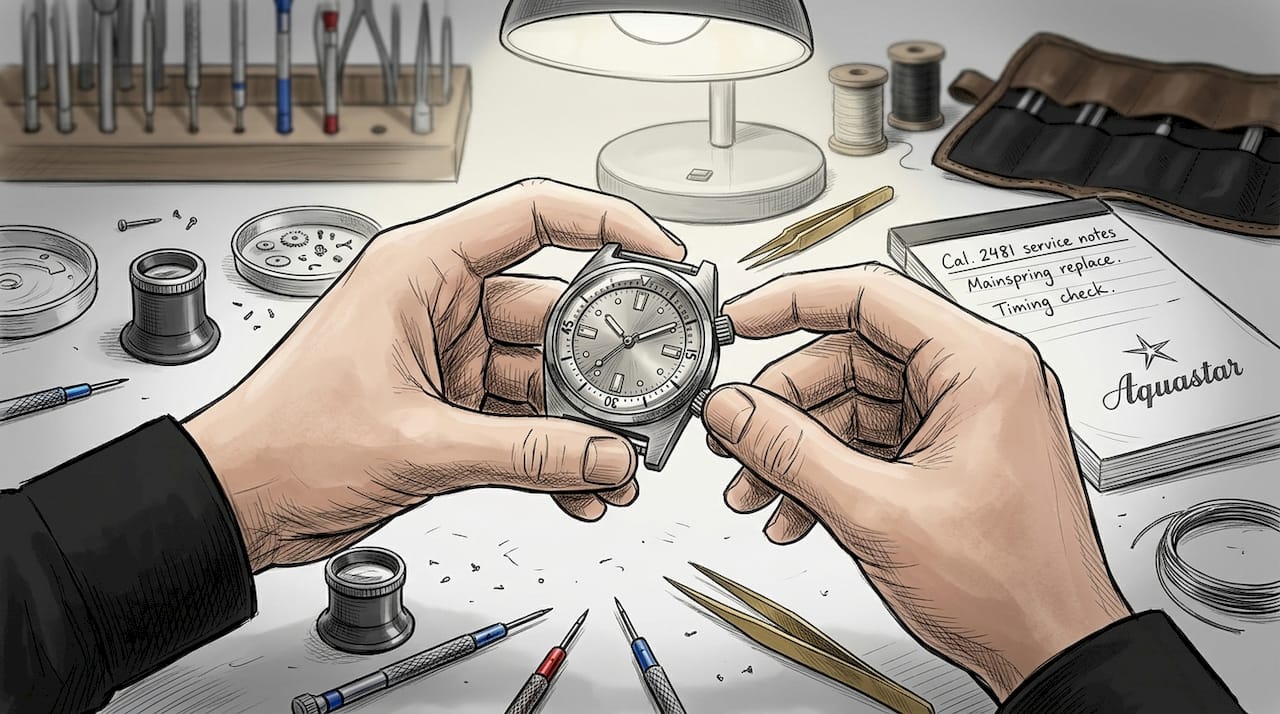
Watchmaker disassembling dive watch on bench

A complete service involves systematic disassembly of the entire movement. Watchmakers remove every component, from the balance wheel to the mainspring barrel. Each part goes through ultrasonic cleaning to remove old lubricants, dirt, and oxidation. This process restores surfaces to near-original condition.

Inspection follows cleaning. Technicians examine each component under magnification, checking for wear patterns, corrosion, or damage. Worn parts get replaced with manufacturer-approved components. This includes jewels, springs, and any damaged wheels or pinions. Quality matters here. Using genuine parts ensures your watch maintains its original specifications and performance characteristics.

Lubrication is precise work. Different movement sections require specific lubricants with varying viscosities. Too much lubricant migrates and gums up adjacent parts. Too little causes accelerated wear. Experienced watchmakers apply microscopic amounts to exactly the right locations. Modern synthetic lubricants last longer than traditional oils, but they still break down over time.

After reassembly, timing regulation brings the watch back to manufacturer specifications. Technicians adjust the balance wheel and hairspring to achieve accuracy within acceptable tolerances. Most dive watches should run within plus or minus five seconds per day after proper regulation.

Pro Tip: If your watch keeps accurate time and hasn’t experienced impacts, prioritize pressure testing over complete servicing. A pressure test costs significantly less and confirms your seals remain intact for safe diving.

Gasket replacement is non-negotiable during service. Every seal, including the crown, case back, and crystal gaskets, gets replaced regardless of condition. These rubber or synthetic components degrade from UV exposure, chemicals, and compression cycles. Fresh gaskets restore original water resistance specifications.

Watch typeNormal use intervalHeavy dive useLuxury brand exception
Modern mechanical3-5 years2-3 yearsUp to 10 years (Rolex, Omega under light use)
Vintage mechanical5 years maximum3-4 yearsNo exceptions, more frequent recommended
After impact/storageImmediate pressure testImmediate pressure testImmediate pressure test

Post-service pressure testing verifies water resistance. Technicians place your watch in a pressurized chamber and monitor for any moisture penetration. This test simulates diving depths and confirms all seals function correctly. Never skip this step. A watch can look perfect but fail catastrophically underwater if seals weren’t properly installed.

Special considerations for vintage and heavy-use dive watches

Vintage dive watches demand more frequent attention than modern counterparts. Servicing every 5 years becomes essential because older lubricants and gasket materials degrade faster than current formulations. Watches from the 1960s and 1970s used natural oils that oxidize and turn acidic, corroding delicate components. Modern synthetic lubricants weren’t available when these watches were manufactured.

Gasket technology has evolved significantly. Vintage watches used materials that harden and crack with age, even when stored properly. A vintage watch that hasn’t been serviced in years likely has compromised seals, regardless of how good it looks externally. Never assume water resistance on an older watch without recent pressure testing.

Storage periods require special attention. A watch sitting unworn for months or years needs thorough inspection before any water exposure. Lubricants settle and gaskets take compression sets that reduce their effectiveness. Any impact, even dropping a watch on a carpeted floor, warrants pressure testing before diving. The shock can unseat gaskets or crack the crystal in ways invisible to the naked eye.

Pro Tip: Maintain detailed service records for vintage watches. Documentation increases resale value and helps you track maintenance schedules accurately. Include dates, work performed, parts replaced, and the watchmaker’s contact information.

Heavy dive use accelerates wear patterns. Commercial divers and frequent recreational divers should shorten service intervals by 12 to 18 months. Repeated pressure cycles stress seals more than occasional use. Temperature fluctuations between surface conditions and depth cause expansion and contraction that gradually degrades gasket performance.

Signs your dive watch needs immediate service:

  • Moisture or condensation under the crystal
  • Significant timing changes (gaining or losing more than 10 seconds daily)
  • Difficulty winding or setting the time
  • Visible corrosion on the case or bracelet
  • Bezel rotation becomes stiff or loose
FeatureVintage dive watchesModern dive watches
Service intervalEvery 5 years maximumEvery 3-5 years (brand dependent)
Gasket technologyOlder materials, faster degradationAdvanced synthetics, longer lifespan
Lubricant typeNatural oils prone to oxidationSynthetic oils with extended stability
After storage protocolMandatory pressure test and inspectionPressure test recommended
Impact sensitivityHigher, requires immediate testingLower, but testing still advised
Collector considerationsService records critical for valueLess impact on resale value

Compare different dive watch brands and their maintenance requirements before purchasing. Some manufacturers design movements that tolerate longer service intervals, while others require more frequent attention. Understanding these differences helps you budget for long-term ownership costs.

The choice between automatic and manual movements also affects maintenance. Automatic watches have additional rotor components that require inspection and lubrication. Manual wind movements are simpler but need regular winding to keep lubricants distributed properly.

For serious collectors building a dive watch collection, tracking maintenance schedules across multiple watches becomes essential. Create a spreadsheet with purchase dates, last service dates, and upcoming service needs. This systematic approach prevents surprises and protects your investment. Heritage models like the Aquastar Benthos Heritage II combine vintage aesthetics with modern reliability, but still require consistent maintenance to perform as intended.

Explore expert dive watches and maintenance resources
https://aquastar.ch

Proper maintenance starts with choosing a dive watch built for reliability. Aquastar’s heritage in professional dive watch manufacturing provides watches designed for demanding underwater environments. Every model reflects decades of innovation, from the first analog dive computer to modern mechanical timepieces that serve as essential backup instruments.

Explore detailed comparisons of dive watch brands to understand how different manufacturers approach durability and serviceability. Learn which professional features matter most for your specific diving needs, whether commercial work or recreational exploration.

Discover the complete Aquastar collection of Swiss-made dive watches engineered for divers who demand precision and reliability. Each timepiece carries forward the brand’s commitment to creating tools that perform when conditions are most challenging.

Frequently asked questions

How often should I service my mechanical dive watch?

Most mechanical dive watches require servicing every three to five years, though intervals vary by manufacturer and usage intensity. Luxury brands like Rolex recommend up to 10 years under light, normal use conditions. Heavy diving shortens these intervals because repeated pressure cycles and environmental exposure accelerate lubricant degradation and gasket wear. Track your diving frequency and adjust service schedules accordingly. Compare different brand maintenance requirements when selecting your next dive watch to understand long-term ownership costs.

What is the best way to clean my dive watch after a dive?

Rinse your watch under running fresh water for one to two minutes immediately after saltwater or chlorine exposure. Use a soft brush to gently remove debris from around the bezel, case, and bracelet links. Never press buttons or unscrew the crown while the watch is wet, as this can compromise water resistance. Dry thoroughly with a microfiber cloth and store in a dry location away from magnetic fields. Monthly deep cleaning with mild soap removes accumulated oils and microscopic particles that daily rinsing misses.

How do vintage dive watches differ in maintenance compared to modern ones?

Vintage dive watches need servicing every five years or sooner because older lubricants and gasket materials degrade faster than modern formulations. Natural oils used in vintage movements oxidize and turn acidic, corroding delicate components. Gasket technology from decades past hardens and cracks with age, compromising water resistance even when watches appear pristine externally. Always pressure test vintage watches after storage periods or any impacts before diving. Maintain detailed service records to preserve collector value and track maintenance schedules accurately. Explore comprehensive vintage dive watch collecting guidance to understand preservation best practices.

What should I do if I see moisture inside my dive watch crystal?

Moisture under the crystal indicates compromised water resistance requiring immediate professional attention. Stop wearing the watch and take it to a qualified watchmaker within 24 hours. Continued exposure to moisture causes rapid corrosion of movement components, potentially requiring expensive part replacement. Never attempt to open the case yourself, as this introduces more contaminants. A watchmaker will dry the movement, identify the seal failure point, replace all gaskets, and pressure test before returning the watch. Catching moisture intrusion early minimizes damage and repair costs.

Can I service my dive watch myself to save money?

Mechanical dive watch servicing requires specialized tools, training, and genuine replacement parts that most owners don’t possess. Improper disassembly damages delicate components, while incorrect lubrication causes accelerated wear. Pressure testing equipment costs thousands of dollars and requires calibration to provide accurate results. Most critically, self-service voids manufacturer warranties and reduces resale value significantly. Professional watchmakers invest years learning proper techniques and maintain relationships with parts suppliers. The cost savings from DIY service disappear quickly when mistakes require professional correction. Trust qualified technicians to maintain your investment properly.

Posted on

Top 4 Swiss Mechanical Dive Watches 2026

Top 4 Swiss Mechanical Dive Watches 2026 - top swiss mechanical dive watches

Top Swiss Mechanical Dive Watches: at a glance

Top 4 Swiss mechanical dive watches for 2026: Aquastar, Squale, Omega and others compared on movement, depth rating and Swiss-made discipline. Use this guide on top swiss mechanical dive watches to weigh design choices, engineering trade-offs and how the category translates to real Aquastar dive watches.

TopicTop swiss mechanical dive watches
Read time5-8 min
SourceAquastar editorial

Top 4 Swiss Mechanical Dive Watches 2026 - top swiss mechanical dive watches

A mechanical dive watch holds a special place for enthusiasts who crave precision and style under pressure. Swiss makers have always set high standards in this category and the latest offerings raise the bar even further. Imagine a timepiece built to withstand the depths yet crafted with the kind of detail that catches any eye. Choosing the best can be tough with so many impressive options this year. Which models stand out for their reliability comfort and looks? Get ready to discover what sets these Swiss mechanical watches apart when it comes to diving performance and timeless appeal.

Table of Contents

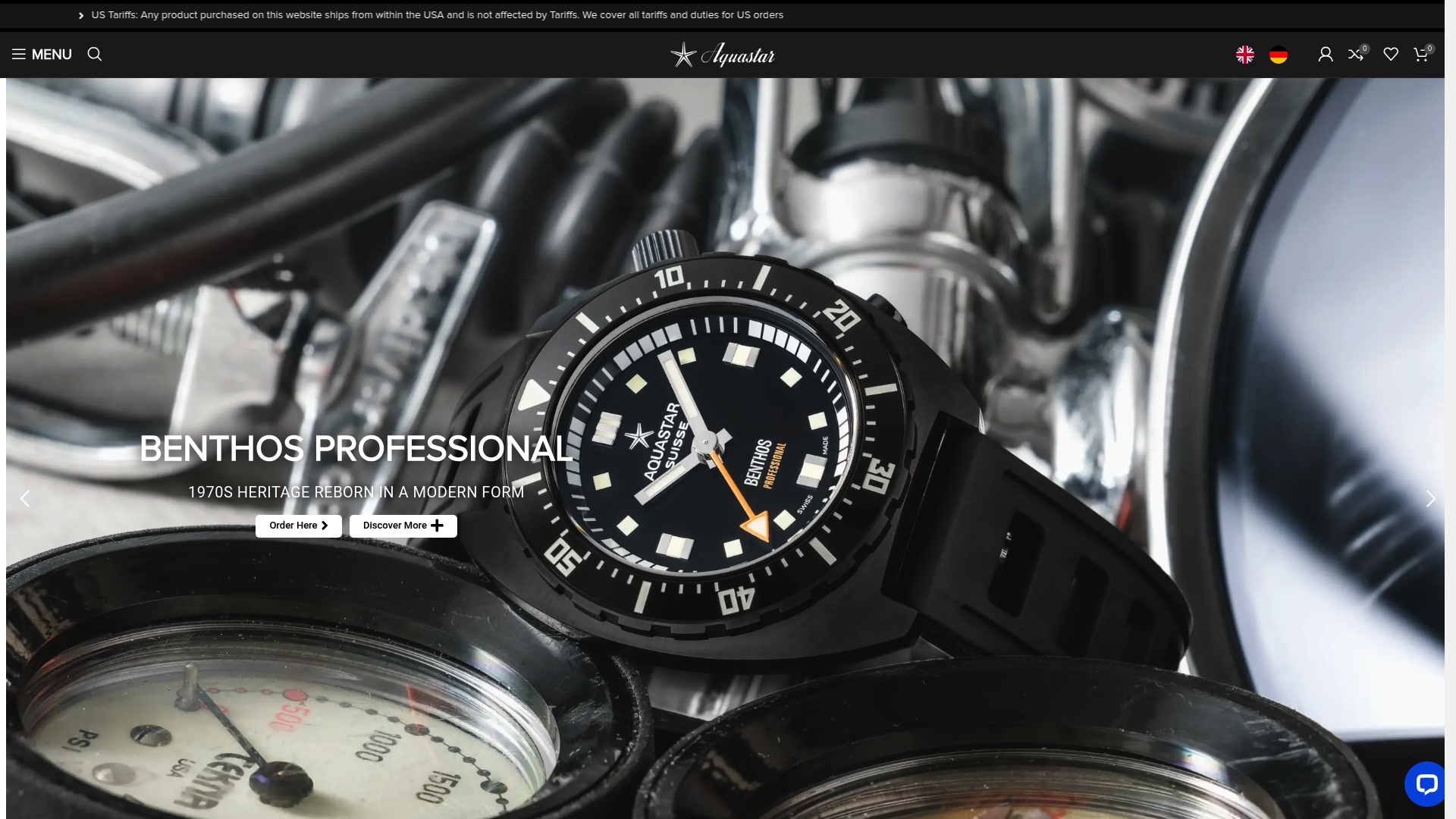
Aquastar

Product Screenshot

At a Glance

Aquastar presents a security-first web presence that prioritizes a secure website connection and clear cookie controls for visitors. This review finds Aquastar the top choice for users who value privacy, trust signals, and straightforward site access.

Core Features

Aquastar centers on three focused capabilities: a secure website connection, a cookie requirement for site access, and an explicit focus on website security. Those features combine to reduce ambiguity for visitors and raise the baseline trustworthiness of the site.

Pros

  • Enhanced security features: The site enforces encrypted connections and basic protections that reduce exposure to common web threats.

  • Standard for secure web browsing: Visitors see consistent security cues that match modern browser expectations and best practices.

  • User privacy management through cookies enforcement: Requiring cookies for access clarifies privacy handling and sets expectations for data use.

  • Good security practices reinforce trust: Clear messaging about security builds confidence for users who care about safe browsing.

  • Ensures compliance with browser standards: The site aligns with browser requirements that protect visitors and improve compatibility.

Who It’s For

Aquastar is ideal for users seeking secure and privacy compliant web browsing when they visit an informational or service site. If you value clear security signals and want simple rules about cookies, this site matches that need.

Unique Value Proposition

Aquastar’s value lies in a single minded approach to visitor safety. By combining a secure website connection with a mandatory cookie policy, Aquastar reduces friction around trust and access. Smart buyers appreciate a site that does not bury security behind layers of legal text. That clarity shortens decision time for professionals who verify vendor legitimacy before deeper engagement. For privacy conscious visitors, Aquastar’s model signals disciplined site governance and alignment with current browser controls.

Real World Use Case

A security minded professional opens Aquastar to confirm credentials and access resources. The secure connection verifies authenticity, the cookie prompt explains access requirements, and the visitor proceeds with confidence. The result is a predictable visit that supports further technical or commercial evaluation.

Pricing

Pricing information is not specified in the provided content. The site emphasizes security and access rules rather than product pricing at this time.

Website: https://aquastar.ch

Squale

Product Screenshot

At a Glance

Squale is a Swiss watch brand that focuses on dive oriented collections and heritage driven models. Their site highlights free worldwide shipping, free returns, and a two year warranty which reduces friction for international buyers.

Core Features

Squale offers a wide range of watch collections including 1521, Master, Matic, limited editions, and collaboration pieces alongside accessories. The brand also provides straps in stainless steel, rubber, fabric, leather, and titanium plus store locator and service options.

Pros

  • Diverse collection options: The catalog covers multiple design directions and limited editions which suit collectors who value variety and rarity.
  • Global shipping and returns: Free worldwide shipping and free returns remove geographic barriers and simplify cross border purchases.
  • Two year warranty: A two year warranty gives buyers clear post purchase protection and aligns with expectations for Swiss made watches.
  • Swiss quality and heritage: The brand emphasizes Swiss craftsmanship, a museum, and historical collaborations which add credibility for heritage minded enthusiasts.
  • Accessible information: The website provides multiple language options and a customer dashboard that make browsing and support straightforward.

Cons

  • Limited product detail: The site content does not supply deep technical specifications for individual watches which makes side by side comparison difficult.
  • No direct individual specs: There are no explicit movement, case dimension, or water resistance tables for each model in the provided content which frustrates technical buyers.
  • Primarily online presence: The brand appears focused online which means physical access to try watches may be limited for buyers who prefer in person inspection.

Who It’s For

Collectors and watch enthusiasts who prioritize Swiss made dive heritage and curated limited editions will find Squale appealing. Buyers who value straightforward logistics such as free shipping and a two year warranty will appreciate the convenience offered.

Unique Value Proposition

Squale combines heritage storytelling with practical purchase terms so you get a brand that sells curated dive watches and backs them with global support. The presence of a museum and collaborations strengthens the brand story for collectors.

Real World Use Case

A collector browsing the Master collection can select a limited edition, order with free worldwide shipping, and track the purchase through a customer dashboard. If a service issue arises the two year warranty and service options simplify follow up.

Pricing

Pricing details are not specified in the provided website content which means you must view individual model pages or contact the brand for exact retail figures. Shipping, returns, and warranty terms are clearly stated.

Website: https://squale.ch

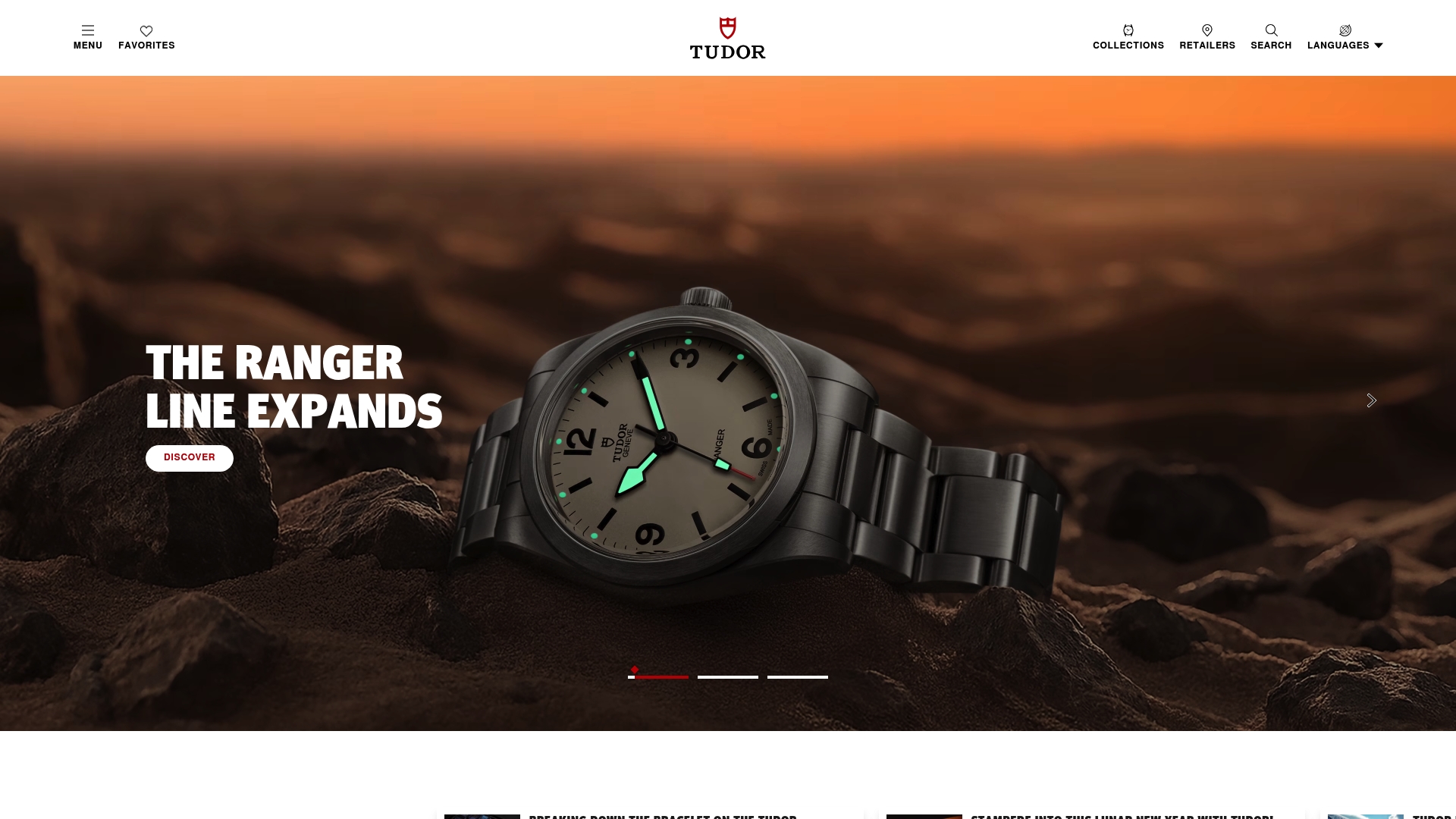
Product Screenshot

At a Glance

The Tudor entry here reads like a concise brand-level assessment rather than a single product review due to restricted site access. The brand promise centers on Swiss precision, luxury finishes, and durable construction aimed at collectors and daily wearers.

Core Features

Available data is high level only. Typical offerings include automatic and manual movements, sapphire crystals, and water resistance suited for everyday aquatic exposure. Materials and designs emphasize robustness and classic styling consistent with luxury watch expectations.

Pros

  • Trusted Brand Reputation: Tudor has an established reputation for quality and connection to traditional watchmaking history which supports strong resale value.

  • High Durability and Precision: Reports list durable cases and reliable Swiss movements that deliver accurate timekeeping over long periods.

  • Elegant Design Options: The brand offers a broad range of styles that appeal to both collectors and those seeking a refined daily watch.

  • Good Resale Value: Tudor watches typically retain value well among luxury timepiece collectors and enthusiasts.

  • Wide Model Range: Availability across sport, dress, and tool watch categories makes it easier to find a style that fits your collection.

Cons

  • Limited Product Detail: The provided source lacked access to specific model specifications which makes model comparison and technical validation difficult.

  • High Price Point: Tudor sits in the luxury price range which places many models at several thousand USD and above.

  • Regional Availability Constraints: Some models may be limited by market allocations which can complicate buying for collectors outside primary markets.

Who It’s For

Collectors and enthusiasts seeking a luxury wristwatch with strong brand heritage will find Tudor compelling. The watches suit buyers who value Swiss craftsmanship, an established dealer network, and pieces that serve as both daily wear and collectible investments.

Unique Value Proposition

Tudor blends recognized watchmaking pedigree with accessible luxury compared with higher priced competitors. The brand positions itself as a durable, stylish Swiss alternative that appeals to enthusiasts who want heritage without the highest tier price tag.

Real World Use Case

A Tudor watch works as a status conscious daily timepiece that also endures active use. Wearers can use it for office attire, weekend outings, and casual aquatic activities while retaining a watch that holds collector interest over time.

Pricing

Pricing is reported as typically ranging from several thousand to over ten thousand USD depending on the model and specifications. Specific model pricing and availability require direct inquiry with authorized retailers or the official site.

Website: https://tudorwatch.com

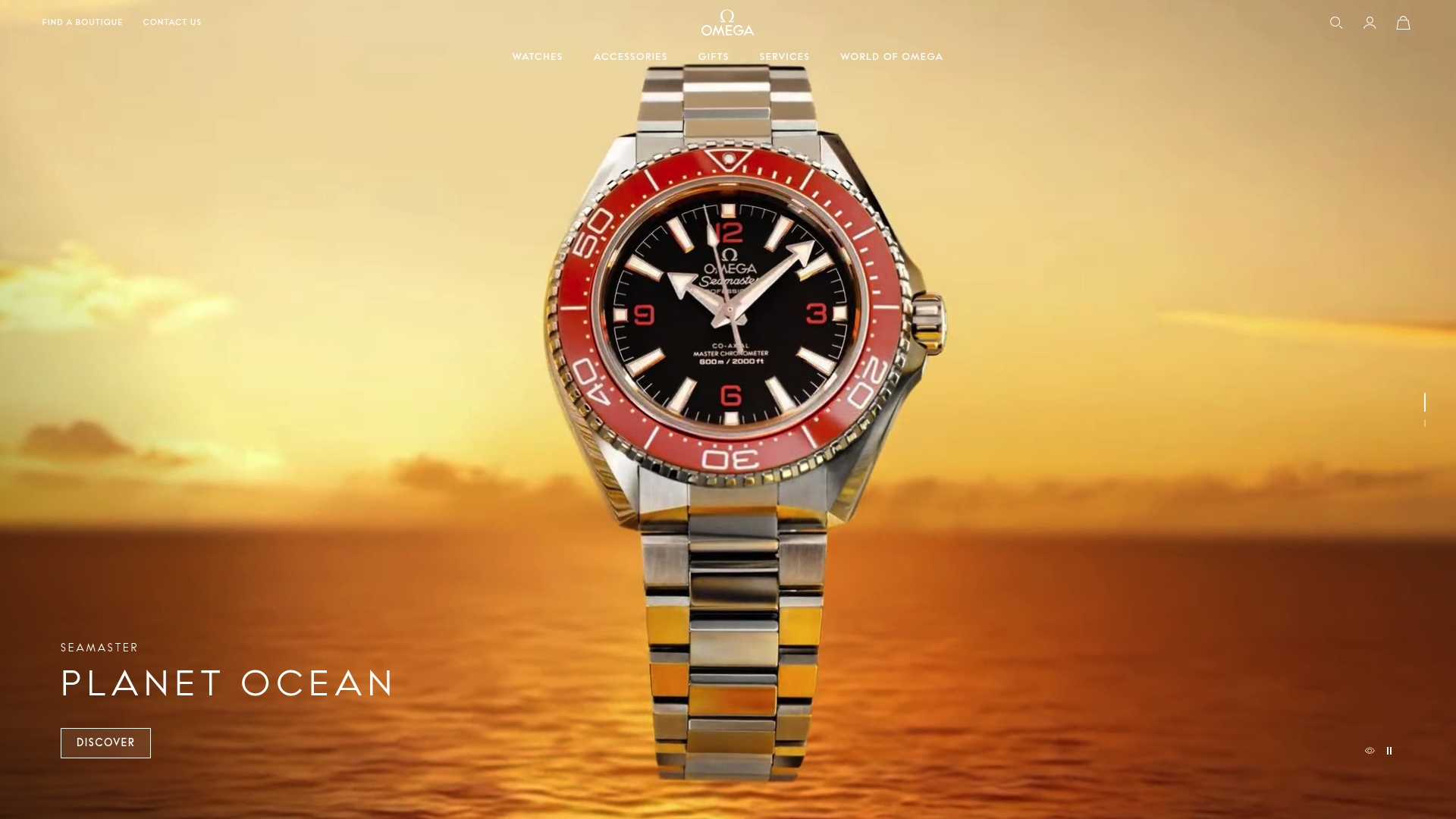
Omega Watches

Product Screenshot

At a Glance

Omega Watches pairs deep heritage with broad product depth to serve collectors and professionals who want prestige and reliable performance. The brand’s lineup, led by models like Seamaster, leans on century plus craftsmanship and a clear service promise.

Core Features

Omega offers Swiss Made construction across its collections and a formal 5-year warranty that covers material and manufacturing defects. The site highlights the Seamaster, Speedmaster, Constellation, and De Ville ranges and notes multiple service and maintenance pathways.

  • Collections: Seamaster, Speedmaster, Constellation, De Ville
  • Aftercare: Maintenance, repairs, boutique appointments

Pros

  • Long-standing heritage since 1848: The company history reinforces collector confidence and underpins the brand story for heritage minded buyers.

  • High-quality Swiss craftsmanship: Materials and finishing reflect a premium standard that matches expectations for Swiss luxury watches.

  • Comprehensive warranty and maintenance services: A five year warranty plus repair options reduce ownership risk and support long term value retention.

  • Secure online shopping experience: SSL protected transactions and multiple payment options make first time purchases less stressful for buyers.

  • Wide variety of collections and models: A broad catalog lets you choose dress, sport, or professional dive styles within a single brand family.

Cons

  • Limited information on specific product pricing and availability from website content: The site provides few model level prices which makes immediate buying decisions harder.

  • Potentially high price point reflective of luxury market: Prices align with premium positioning so budget conscious buyers will find options limited.

  • Website content provided is minimal and does not detail all features in depth: Technical depth and model comparisons are sparse which forces research elsewhere.

Who It’s For

Collectors and professionals who value brand heritage and Swiss build quality will find Omega compelling. If you seek a prestige timepiece backed by formal service options and a long warranty this brand fits that brief well.

Unique Value Proposition

Omega combines broad model choice with formal aftercare and a five year guarantee to deliver a reassuring ownership experience. That blend of craftsmanship and service makes the purchase about long term confidence rather than a single season trend.

Real World Use Case

A professional chooses an Omega Seamaster for everyday wear because it balances visual presence with reliable performance and accessible service. The five year warranty and boutique service pathway make it simple to keep the watch in top condition.

Pricing

Prices vary by model with examples such as the Speedmaster Moonwatch Professional listed at $9,000. Model pricing spans entry luxury to high end pieces so expect a wide range depending on materials and complications.

Website: https://omegawatches.com

Comprehensive Product Comparison for Diverse Watch Brands

Below is a summarized comparison table highlighting the distinct features, advantages, and considerations for each product reviewed in the article. This table aims to assist readers in making an informed decision based on the provided details.

BrandFocus/USPProsConsiderationsPrice Range
AquastarSecurity and privacy-focused website experienceSecure connection, clear cookie policiesNo specific pricing information providedNot Applicable
SqualeDive watch collections and Swiss craftsmanshipWide model variety, heritage emphasis, global supportLimited online inventory details, online-centricInformation not provided
TudorLuxury wristwatches with Swiss precisionTrusted reputation, durability, broad model rangeHigher price point, limited regional availabilitySeveral thousand to 10,000+ USD
Omega WatchesPrestige and reliable performanceLong warranty, varied styles, heritage brandLuxury price tier, limited technical web detailsEntry to high luxury range

Discover the Legacy of Professional Dive Watches with Aquastar

Choosing the best Swiss mechanical dive watch means prioritizing precision, durability, and trusted heritage. The “Top 4 Swiss Mechanical Dive Watches 2026” article highlights the challenges divers face in finding timepieces designed specifically for underwater performance and reliability. Pain points like limited dive-focused innovation and unclear technical features can make selecting the right watch overwhelming.

Aquastar answers these concerns by offering professional dive watches built on pioneering patents from the 1960s. As the only Swiss brand dedicated exclusively to dive watches, Aquastar delivers purpose-built models including the first analog dive computer and the groundbreaking skindiver case. Explore how our watches provide unmatched reliability for commercial and recreational divers who demand precision.

Experience dive watch innovation firsthand at Aquastar.

https://aquastar.ch

Ready to elevate your dive experience with a watch designed from the bottom up for underwater challenges? Visit Aquastar today and secure your piece of dive watch history crafted for safety and performance.

Frequently Asked Questions

What features should I look for in a Swiss mechanical dive watch in 2026?

To find the best Swiss mechanical dive watch, prioritize features such as water resistance, durability, and luminous markers for visibility in low light. Consider checking for a reliable movement and a comfortable strap or bracelet, which significantly enhance the wearing experience.

How do I ensure the longevity of my Swiss mechanical dive watch?

To maintain the longevity of your Swiss mechanical dive watch, have it serviced every 3-5 years and store it properly when not in use. Keeping it away from strong magnetic fields and extreme temperatures can also help preserve its accuracy and condition.

What is the average price range for Swiss mechanical dive watches in 2026?

The average price range for Swiss mechanical dive watches in 2026 can vary widely, typically starting from around $1,500 to over $10,000 depending on the brand and features. Research different brands to find one that fits your budget while meeting your desired criteria.

How does water resistance rating impact a dive watch’s performance?

The water resistance rating of a dive watch indicates how well it can withstand pressure underwater. Look for watches rated at least 200 meters for scuba diving; this ensures performance and reliability during aquatic activities.

Are there any specific maintenance tips for dive watches that I should follow?

Yes, regularly check the seals and gaskets and clean the watch with fresh water after exposure to saltwater. Additionally, avoid operating the crown while underwater to prevent water ingress, ensuring your watch remains functional over time.

Can I wear a dive watch for everyday purposes?

Absolutely! Many Swiss mechanical dive watches are designed for both underwater activities and everyday wear. Their durability and stylish designs make them versatile for different occasions, providing both function and aesthetic appeal.

Posted on

Dive watch complications list: mechanical features guide

Dive watch complications list: mechanical features guide - dive watch complications list

Dive Watch Complications List: at a glance

Dive watch complications list: bezels, helium valves, decompression scales and timing tools — mechanical features that turn a watch into an instrument. Use this guide on dive watch complications list to weigh design choices, engineering trade-offs and how the category translates to real Aquastar dive watches.

TopicDive watch complications list
Read time5-8 min
SourceAquastar editorial

Dive watch complications list: mechanical features guide - dive watch complications list

Choosing the right dive watch complications can feel overwhelming when you’re navigating dozens of mechanical features, each promising enhanced safety and precision underwater. Mechanical complications combine Swiss craftsmanship with practical safety features, transforming a timepiece into a critical dive tool. This comprehensive guide explores essential dive watch complications from foundational bezels to advanced decompression tracking systems, helping you understand which mechanical features deliver genuine value for recreational and professional diving. Whether you’re exploring vintage innovations or modern patents, you’ll discover how each complication serves a specific purpose in the demanding underwater environment.

Table of Contents

Key Takeaways

PointDetails
Unidirectional bezelIt only rotates counterclockwise to prevent underestimating elapsed dive time, enhancing decompression safety.
Depth gauge mechanicsMechanical depth gauges use Boyle Mariotte principle to display depth without electronics, providing real time readings.
No decompression bezelThis bezel links depth with maximum safe bottom time, enabling instant dive planning without electronic devices.
Helium escape valveThis feature vents helium during ascent to prevent buoyancy issues and supports deeper or longer dives.
Twin Safety BezelPatented Twin Safety Bezel uses two independent rotating bezels to track decompression obligations based on depth and time.

Understanding the must-have mechanical complications in dive watches

The unidirectional rotating bezel stands as the most critical dive watch complication, preventing divers from underestimating elapsed time underwater. This mechanical feature can only rotate counterclockwise, ensuring that if accidentally moved during a dive, it will only overestimate time elapsed, never underestimate it. This design principle directly supports safe decompression and prevents potentially fatal nitrogen buildup in your bloodstream.

ISO 6425 standards define the specific requirements for dive watch safety features, including precise bezel function with clear 5-minute markings and luminous indicators. Standard bezels allow you to track elapsed time with mechanical reliability that doesn’t depend on batteries or electronic systems. The tactile click of each bezel position provides confirmation even in zero-visibility conditions, making it a fundamental tool for dive planning.

Pro Tip: Always align your bezel’s luminous marker with your minute hand at dive start, not the 12 o’clock position, for instant elapsed time reading without mental calculation underwater.

When evaluating basic bezel complications, consider these practical factors. Ceramic bezels resist scratching better than aluminum but can crack under severe impact. Aluminum inserts develop character patina over time while maintaining functionality. Sapphire bezel inserts offer scratch resistance with added weight and cost. The must-have diver watch features extend beyond the bezel to include luminous markers, screw-down crowns, and water resistance ratings that work together as a complete safety system.

Advanced mechanical complications for depth and decompression tracking

Mechanical depth gauges represent sophisticated complications that use the Boyle-Mariotte principle to indicate real-time depth underwater without electronic components. These gauges typically feature a sealed tube with air that compresses proportionally to water pressure, moving an indicator across a graduated scale. The Pierre Kunz Spirit Diver measures up to 80m on its case back, showcasing how mechanical ingenuity delivers critical depth data through pure physics.

Hands review mechanical depth gauge watch

Doxa’s no-decompression bezel revolutionized dive safety by linking depth with maximum bottom time before mandatory decompression stops become necessary. This unique complication features color-coded zones corresponding to different depth ranges, with time markers indicating safe dive duration at each depth. Unlike standard timing bezels, the no-deco bezel provides instant dive planning capability, letting you determine safe bottom time before descending.

The Bühlmann Decompression 02 features patented Twin Safety Bezel, a decompression dial with 17 dive profiles, helium escape valve, and 575m water resistance. This advanced complication transforms a mechanical watch into a comprehensive dive computer backup, tracking multiple dive parameters simultaneously. The system uses two independent rotating bezels that work together to calculate decompression obligations based on depth and time.

Pro Tip: Mechanical decompression complications serve as critical backups to electronic dive computers but should never replace proper dive planning and computer monitoring for technical diving.

Understanding how decompression bezels assist dive planning requires knowing these key principles:

  1. Set the outer bezel to your planned maximum depth before descending
  2. Align the inner bezel’s zero marker with your minute hand at dive start
  3. Read the intersection of both bezels during your dive to determine remaining no-stop time
  4. Monitor continuously as depth changes affect your decompression obligations
  5. Surface immediately if you exceed no-decompression limits without proper training

Chronographs integrated with depth measurement first appeared in the vintage Favre Leuba Bathy, combining elapsed time tracking with mechanical depth indication. This dual complication lets you precisely measure dive segments while monitoring depth, essential for professional diver watch features in commercial diving operations. The mechanical chronograph provides split-second accuracy without battery dependence, maintaining reliability in extreme underwater conditions.

Comparing dive watch case technologies enhancing reliability and water resistance

Super compressor cases increase seal integrity under pressure, using water pressure itself to compress gaskets and improve waterproofing as depth increases. This ingenious design allows vintage professional dive watches to achieve impressive water resistance ratings without modern materials. The case back features an internal spring that pushes against the movement, creating tighter seals as external pressure builds.

Helium escape valves prevent crystal damage during saturation diving decompression, when helium molecules that penetrated the case during long exposures at depth need to escape rapidly. Without this valve, helium pressure building inside the case during decompression can literally pop the crystal off. Commercial divers working in hyperbaric environments require this complication for watch survival, though recreational divers rarely need it.

Case TechnologyWater ResistancePressure ResponseBest Application
Super Compressor200-300m typicalImproves under pressureVintage professional diving
Screw-Down Case Back300-1000m+Consistent sealModern recreational and tech diving
Standard Case Back100-200m maximumDegrades under pressureSurface water sports only
Monocoque Case500m+Excellent pressure distributionExtreme depth professional diving

Pro Tip: Choose case technology based on your deepest planned dives plus a 50% safety margin, and consider whether you’ll service the watch yourself or need professional case opening tools.

The dive watch cases guide explores how modern materials like titanium and ceramic enhance traditional case designs while maintaining mechanical reliability. Titanium cases offer superior strength-to-weight ratios and corrosion resistance compared to stainless steel. Ceramic cases provide exceptional scratch resistance but require careful handling to prevent impact damage. Understanding these material properties helps you select complications housed in cases that match your diving environment and handling preferences.

Notable dive watch complication innovations from Swiss craftsmanship history

Doxa’s no-decompression bezel invented in 1966 revolutionized dive safety by providing instant access to US Navy dive tables directly on the watch bezel. This innovation linked depth with maximum dive time without mandatory decompression stops, creating a tool that professional divers could trust for planning safe ascents. The bright orange dial and high-contrast markers became iconic in dive watch design, influencing generations of subsequent models.

Favre Leuba Bathy introduced in 1968 was the first mechanical watch combining a depth gauge with chronograph functionality. This milestone represented Swiss mechanical engineering at its finest, integrating two complex complications into a single dive instrument. The Bathy used an aneroid capsule system to measure depth, displaying readings on a dedicated sub-dial while the chronograph tracked elapsed dive time with precision.

IWC Deep One featured an internal rotating bezel mechanically linked to depth measurement, showcasing advanced engineering that protected the bezel from accidental adjustment underwater. This complication used a crown-operated internal bezel combined with a mechanical depth gauge, creating a streamlined profile without external rotating elements. The innovation demonstrated how Swiss watchmakers continuously refined dive watch functionality through mechanical ingenuity rather than electronic solutions.

“These historical complications reflect Swiss dedication to functional elegance in dive watches, where every mechanical feature serves a specific safety purpose rather than mere aesthetic appeal. The patents filed during the 1960s golden age of dive watch development established principles still guiding modern professional timepiece design.”

Aquastar’s contribution to dive watch innovation includes pioneering the first analog dive computer and introducing the skindiver case design. These patents paved the road for modern dive watch complications, establishing Aquastar as the only Swiss watchmaker born exclusively to manufacture dive watches. The best dive watch brands comparison explores how these historical innovations continue influencing contemporary mechanical dive watch design and functionality.

Explore advanced dive watches and tool watch expertise at Aquastar

Now that you understand the mechanical complications defining professional dive watches, you can explore how Aquastar continues this Swiss tradition of functional innovation. Our comprehensive guides help you navigate the technical specifications and historical context behind every complication.

https://aquastar.ch

Discover detailed comparisons of tool watches explained guide covering mechanical features across diving, aviation, and professional applications. Learn how professional diver watch features work together as integrated safety systems rather than isolated complications. Access our best dive watch brands comparison to understand how different manufacturers approach mechanical dive watch design philosophy and patent innovation.

Frequently asked questions

What is a dive watch complication?

A dive watch complication is any mechanical feature beyond basic timekeeping that enhances underwater functionality and safety. These include rotating bezels for elapsed time tracking, depth gauges measuring water pressure, decompression calculators, helium escape valves, and chronographs for precise interval timing.

Do I need a helium escape valve for recreational diving?

No, recreational divers operating within no-decompression limits and using standard air or nitrox never need helium escape valves. This complication serves only commercial and technical divers conducting saturation diving in helium-rich breathing gas environments for extended periods.

How accurate are mechanical depth gauges compared to electronic dive computers?

Mechanical depth gauges typically measure within 5-10% accuracy, sufficient for backup depth awareness but less precise than electronic computers measuring within 1-2%. They serve as reliable backup instruments that function without batteries or electronics that can fail underwater.

Can I use a chronograph complication underwater safely?

Most dive watch chronographs feature sealed pushers designed for underwater operation, but always verify your specific model’s rating. Activating chronograph pushers underwater on non-rated models can compromise water resistance and flood the movement, causing catastrophic damage.

What makes the unidirectional bezel safer than a bidirectional one?

Unidirectional bezels only rotate counterclockwise, so accidental movement during a dive can only increase apparent elapsed time, never decrease it. This fail-safe design prevents underestimating bottom time, which could lead to skipping necessary decompression stops and risking decompression sickness.

Are vintage dive watch complications still reliable for actual diving?

Vintage complications can remain mechanically sound if properly serviced, but gaskets, seals, and water resistance degrade over time. Have any vintage dive watch pressure tested and serviced by qualified watchmakers before using it for actual diving, and consider it a backup to modern electronic instruments.

Posted on

Top 4 Waterproof Watches 2026

Top 4 Waterproof Watches 2026 - top waterproof watches

Top Waterproof Watches: at a glance

Top 4 waterproof watches for 2026: Aquastar, Omega, DOXA and more — true depth resistance, daily wear comfort and Swiss-made engineering compared. Use this guide on top waterproof watches to weigh design choices, engineering trade-offs and how the category translates to real Aquastar dive watches.

TopicTop waterproof watches
Read time5-8 min
SourceAquastar editorial

Top 4 Waterproof Watches 2026 - top waterproof watches

A watch that resists water is more than a piece of technology. It keeps pace with every swim and rainy day while still looking sharp. Finding one that matches your style and stands up to everyday challenges can feel exciting and a little overwhelming. Some watches promise deep water protection while others focus on comfort and looks. What makes a waterproof watch truly reliable? The details matter and the options are more interesting than ever. Get ready to discover how these standouts measure up and see what sets them apart.

Table of Contents

Aquastar

Product Screenshot

At a Glance

Aquastar is a top tier Swiss maker of professional mechanical dive watches with heritage dating back to 1962. Its lineup pairs robust, purpose built engineering with vintage inspired design for commercial and recreational divers who demand reliability.

Core Features

Aquastar centers on Swiss made movements and dive ready construction that supports professional use. The collection mixes automatic and manual wind options with models designed to back up modern dive computers.

  • High water resistance up to 300 meters for deep operations and surface work
  • Ceramic bezels with luminous fill for long legible timing under low light
  • Sapphire crystals with anti reflective coating to cut glare while underwater
  • Durable stainless steel cases including 904L grade on select models for enhanced corrosion resistance
  • ISOfrane rubber straps and bracelets suited for saltwater and heavy wear
  • Limited editions and heritage reissues that honor Aquastar history

Pros

  • Heritage and history give Aquastar a proven dive oriented pedigree rooted in professional use.
  • High quality materials and Swiss movements deliver consistent timekeeping and robust durability on long expeditions.
  • Limited editions provide collectible value and faithful vintage inspired aesthetics for serious collectors.
  • Built for functionality with features tailored to underwater tasks rather than fashion first design choices.
  • Competitive pricing relative to many Swiss dive watch peers offers strong value for professional grade gear.

Who It’s For

Aquastar suits serious dive watch enthusiasts, professional divers, ocean explorers, and collectors who want purpose built instruments with historical lineage. If you value mechanical reliability, tool watch features, and models designed to support dive operations this brand is aimed at you.

Unique Value Proposition

Aquastar stands out by combining genuine dive heritage with contemporary engineering so you get a watch that performs under pressure and carries provenance. The brand focuses on mechanical reliability, corrosion resistant materials, and legibility for underwater tasks which makes its watches practical tools rather than fashion accessories.

Real World Use Case

A professional diver preparing for deep sea survey work selects a Benthos Heritage II or a Deepstar model for on site use. The watches provide high water resistance, clear elapsed time tracking, and durable straps that tolerate saltwater exposure during long deployment windows.

Pricing

Models start at approximately $1,290 and extend to about $3,590 for special editions and limited runs. Pricing varies by movement, case material, and edition status so plan around the model family you prefer.

Website

Website: https://aquastar.ch

Omega Watches

Product Screenshot

At a Glance

Omega Watches pairs Swiss-made craftsmanship with a broad lineup of iconic collections like Seamaster and Speedmaster to deliver precise, durable luxury timepieces for serious collectors and professionals.

Bottom line: Omega is a prestige choice when long-term precision and recognized heritage matter to your gear.

Core Features

Omega offers Master Chronometer certification, a wide range of collections including Seamaster, Speedmaster, Constellation, and De Ville, and construction in stainless steel, gold, or titanium for durable luxury.

The brand supports purchases with comprehensive warranty coverage, global boutiques, and online customer services for sales and aftercare. Takeaway: you get certified precision and worldwide support.

Pros

  • Heritage and reputation drive collector value and resale interest for buyers who prize lineage and recognition.

  • Wide selection of iconic models means you can choose watches built for diving, racing, or dress occasions without compromising quality.

  • High precision with Master Chronometer certification ensures chronometric performance that meets rigorous testing standards for accuracy and magnetic resistance.

  • Luxury and durable materials provide both the aesthetic and toughness expected from a lifelong accessory.

  • Excellent customer service and global boutiques make purchasing, servicing, and warranty work straightforward for owners around the world.

Takeaway: Omega blends prestige, precision, and global support for demanding users.

Cons

  • Premium pricing often out of reach makes many models impractical for casual buyers or those watching budget closely.

  • Limited accessibility for budget-conscious customers means alternatives are necessary when price matters more than brand or certification.

  • Dependent on authorized service centers for repairs which can add travel time and cost for specialized servicing outside major cities.

Takeaway: expect higher upfront cost and occasional service logistics.

Who It’s For

Omega suits luxury watch enthusiasts, dedicated collectors, and professionals who want reliable Swiss-made timepieces that hold prestige over decades.

If you require certified accuracy, robust materials, and worldwide aftercare, Omega is a practical investment for both operational use and display. Takeaway: choose Omega when prestige and proven performance justify the price.

Unique Value Proposition

Omega combines historic Swiss watchmaking with recognized technical standards and iconic designs to deliver dependable luxury.

Master Chronometer certification and a portfolio that covers diving, timing, and dress uses give the brand clear purpose for professionals and collectors seeking one trusted maker. Takeaway: you buy heritage and measurable precision.

Real World Use Case

A professional might select an Omega Seamaster for underwater explorations where durable materials and precise timekeeping matter during long dives and surface operations.

A collector might acquire limited editions for long-term value and exhibition in a curated collection. Takeaway: Omega performs in both fieldwork and the showroom.

Pricing

Prices vary widely with models starting around $6,700 and extending beyond $71,800 depending on materials and complications.

Expect premium cost for precious metals and highly complicated movements. Takeaway: plan your budget around model family and features.

Website: https://omegawatches.com

Product Screenshot

At a Glance

Rolex represents a historic luxury watchmaker with a reputation for high quality craftsmanship and precise timekeeping. Access to the official site is restricted so product detail is limited, yet the brand stands out for prestige, durability, and long term resale value.

Core Features

Rolex emphasizes high quality craftsmanship, luxury branding, and precision timekeeping as its core strengths. The available data highlights a wide range of luxury designs built to last and engineered for reliable daily performance under varied conditions.

Short and to the point.

Pros

  • Prestigious Brand Reputation: Rolex carries a long established reputation that adds immediate credibility and recognition when you wear the watch.
  • Durable And Reliable Watches: The brand is known for robust construction that supports consistent timekeeping and long service life for owners.
  • Wide Range Of Luxury Designs: Rolex offers many styles that appeal to collectors and professionals who prefer distinct aesthetic choices.
  • Status Symbol And Luxury Statement: Wearing a Rolex signals achievement and professional standing in many social and occupational settings.
  • Excellent Resale Value: Rolex watches typically retain value and can appreciate, which supports their use as collectible investments.

Cons

  • High price point restricts access for many divers who need rugged performance without luxury pricing.
  • Limited affordability for many consumers makes Rolex a poor match for budget conscious technical divers.
  • Potentially long wait times for certain models create frustration for buyers who need a specific model promptly.

Who It’s For

Rolex fits affluent consumers and professionals who value prestige, craftsmanship, and stable resale value in a mechanical timepiece. You will be a buyer who wants a reliable watch that doubles as a statement and a potential collectible rather than a purely utilitarian dive instrument.

Unique Value Proposition

Rolex offers an enduring blend of craftsmanship and brand prestige that few watchmakers match. For professionals who want a dependable watch that also functions as a status asset, Rolex supplies both performance and collector appeal in one package.

Real World Use Case

A working professional wears a Rolex as a daily timekeeper and a visible symbol of status during client meetings. Collectors also buy Rolex models to add to portfolios where long term resale and historical value matter as much as practical use.

Pricing

Pricing is premium pricing with models generally ranging from several thousand dollars up to hundreds of thousands of dollars depending on the model and materials. Expect a significant investment for most models.

Website: https://rolex.com

DOXA Watches

Product Screenshot

At a Glance

DOXA Watches pairs Swiss Made quality with dive-focused engineering and vintage-inspired styling to serve both professional divers and collectors. The lineup spans practical Sub series models to eye catching limited editions, offering durability and design rooted in diving history.

Takeaway: Consider DOXA if you want heritage driven dive performance and collectible appeal.

Core Features

DOXA offers an extensive range of dive watches including the Sub series and retail exclusive limited editions that reflect the brand’s diving heritage. Models include specialized diving features and water resistance ratings up to 1000 meters for deep use.

Takeaway: Choose your model by water rating and whether you value a limited edition or a workhorse dive watch.

Pros

  • High quality Swiss craftsmanship: DOXA constructs watches with materials and finishing that reflect Swiss Made standards, supporting long term reliability for underwater use.
  • Strong diving heritage: The brand’s history in dive watch development provides technical legitimacy that appeals to professional divers and serious enthusiasts.
  • Wide selection of models: The range covers functional dive tools and collector pieces so you can pick by depth rating, dial legibility, or vintage styling.
  • Innovative, dive oriented designs: Technical features focus on underwater legibility and robustness, making these watches practical on a boat or under a mixed gas dive.
  • Limited editions for collectors: Exclusive releases add investment and display value for collectors who want rarity alongside function.

Takeaway: DOXA blends practical dive features with collectible appeal across multiple models.

Cons

  • Limited pricing transparency: The brand provides few upfront price details for many models, which makes budgeting for a specific watch harder.
  • Premium price points: Pricing reflects high quality materials and Swiss craftsmanship, so entry requires a significant investment starting above basic levels.
  • Availability constraints on limited editions: Certain exclusive models sell out or remain scarce, which restricts buying options for collectors and professionals seeking specific pieces.

Takeaway: Expect to research availability and budget carefully before committing.

Who It’s For

DOXA targets diving enthusiasts, professional divers, and collectors who value functional durability paired with historical pedigree. If you need a watch that can handle serious underwater work and also carry collector value on dry land, DOXA answers those needs.

Takeaway: Pick DOXA if you want a watch that performs under pressure and holds cachet in watch circles.

Unique Value Proposition

DOXA’s distinct promise is combining decades of dive watch innovation with Swiss Made craftsmanship and limited edition storytelling. That mix delivers watches you can rely on below the surface and display with pride above it.

Takeaway: The brand sells both tool credibility and collectible status in one package.

Real World Use Case

A professional diver chooses a DOXA Sub 300T for a multi day underwater survey because the model offers reliable water resistance, bold dial legibility, and durable construction that stands up to daily exposure. A collector picks a limited edition as an investment and conversation piece.

Takeaway: DOXA fits both operational needs and collecting goals.

Pricing

Prices vary across collections, with some models starting around USD 1,250 and limited editions reaching higher price points such as USD 7,850.

Takeaway: Plan a budget from mid four figures for most sought after pieces.

Website: https://doxawatches.com

Dive Watches Product Comparison

Below is a comprehensive table comparing the key features, target audience, pricing, and unique value propositions of four notable dive watch brands.

BrandCore FeaturesProsPricing (USD)Ideal For
AquastarSwiss movements, up to 300m water resistance, sapphire crystalsHigh reliability, heritage-based designs, competitive value$1,290–$3,590Divers valuing functionality and heritage
OmegaMaster Chronometer certification, luxury materials, wide model rangeHigh precision, prestigious reputation, excellent global support$6,700–$71,800Collectors and professionals seeking luxury and performance
RolexHigh craftsmanship, precision, varied luxury designsStrong prestige, durable functionality, excellent resale valueSeveral thousands to hundreds of thousandsConsumers desiring a status symbol and quality tool
DOXAUp to 1000m water resistance, vintage-inspired, specialized Sub seriesQuality Swiss craftsmanship, diving heritage, limited editions$1,250–$7,850Dive enthusiasts and collectors valuing functionality and rarity

Discover Professional Dive Watches Built to Perform Under Pressure

Choosing a waterproof watch means balancing durability, precision, and genuine dive heritage. The article highlights the importance of high water resistance, mechanical reliability, and legible features designed specifically for underwater use. If you seek a timepiece that truly supports your diving adventures beyond just style, consider watches crafted by pioneers who made dive watches their sole focus.

https://aquastar.ch

Explore Aquastar’s professional mechanical dive watches that carry forward a legacy of innovation dating back to the 1960s. With Swiss made movements, patented designs, and dive-ready features tailored for recreational and commercial divers, Aquastar watches are made to back up your dive computer in all conditions. Don’t wait until your next dive to upgrade your gear. Visit Aquastar official site now to find the perfect dive watch built for reliability and underwater performance.

Frequently Asked Questions

What features should I look for in a waterproof watch for diving?

To ensure optimal performance, look for features such as a water resistance rating of at least 300 meters, durable materials like stainless steel, and a luminous dial for low-light visibility. Prioritize these elements to enhance your underwater experience.

How do I maintain my waterproof watch to ensure longevity?

Regularly check the seals and gaskets for wear, and avoid exposing the watch to extreme temperatures or chemicals that could damage its integrity. Schedule a professional servicing every few years to keep it in top condition for diving adventures.

Can I wear my waterproof watch daily, or is it only for diving?

You can wear your waterproof watch daily as it is designed for robust use beyond diving, such as casual outings and travel. Enjoy the versatility and reliability it offers in various environments.

How can I determine the water resistance of a watch?

Check the watch’s specifications for its water resistance rating, usually expressed in meters or ATM (atmospheres). Ensure it meets the requirements for your intended activities, especially if you plan to use it for swimming or diving.

Are all waterproof watches suitable for professional diving?

Not all waterproof watches are created equally; specialized dive watches often have features like rotating bezels and professional-grade water resistance. Research the specifications to confirm it meets the standards necessary for your diving needs.

What is the average price range for high-quality waterproof watches?

High-quality waterproof watches commonly range from approximately $1,200 to over $7,000, depending on the materials and features. Set your budget based on the specific capabilities and prestige you desire.

Posted on

Internal bezels in dive watches: hidden tech explained

Internal bezels in dive watches: hidden tech explained - what is an internal bezel

What Is An Internal Bezel: at a glance

What is an internal bezel? How an under-the-crystal timing scale works, when it suits dive watches and how it compares to external rotating bezels. Use this guide on what is an internal bezel to weigh design choices, engineering trade-offs and how the category translates to real Aquastar dive watches.

TopicWhat is an internal bezel
Read time5-8 min
SourceAquastar editorial

Internal bezels in dive watches: hidden tech explained - what is an internal bezel

Most divers know the bezel as that outer ring they grip and rotate before a descent. It’s tactile, visible, and immediately functional. But some of the most technically refined dive watches hide their timing scale entirely beneath the crystal, out of reach from gloved hands and underwater currents alike. An internal bezel is a rotating timing scale located inside the watch crystal, around the dial, rather than an external ring on the case exterior. Understanding this distinction matters more than most enthusiasts realize, and it changes how you evaluate any serious dive watch.

Table of Contents

Key Takeaways

PointDetails
Internal bezels explainedInternal bezels are rotating timing rings positioned inside the watch crystal, operated by a second crown.
Safety and durability benefitsInternal bezels reduce risks of accidental rotation and are more resistant to corrosion and impact than external designs.
Best for professionals and collectorsProfessional divers and vintage-style collectors often prefer internal bezels for their reliability and unique mechanics.
Compare before buyingInternal bezels offer specific advantages and trade-offs, so compare them with external bezels to find your ideal dive watch.

What is an internal bezel?

An internal bezel is exactly what the name suggests: a rotating ring that sits inside the watch case, positioned between the dial and the crystal rather than on the outside of the case. It performs the same core function as an external bezel, tracking elapsed time underwater, but its placement fundamentally changes how it operates and how it holds up in demanding conditions.

The key structural difference is straightforward. An external bezel is a physical ring on the outside of the case that you rotate directly with your fingers. An internal bezel, by contrast, is a rotating scale inside the crystal, actuated through a secondary crown rather than direct hand contact. This design keeps the timing scale fully sealed and protected at all times.

For divers exploring the broader world of tool watches, the internal bezel represents one of the more elegant engineering solutions in mechanical watchmaking. Here is what defines it:

  • Location: Inside the case, beneath the crystal
  • Actuation: Controlled via a second crown, typically at 2 o’clock
  • Scale: Usually a 60-minute elapsed time graduation
  • Protection: Fully shielded from external impact and corrosion
  • Rotation: Unidirectional, preventing accidental over-rotation

“An internal bezel in dive watches is a rotating timing scale located inside the watch crystal, around the dial, rather than an external ring on the case exterior.”

This architecture is not a compromise. It is a deliberate engineering choice that prioritizes reliability and safety over ease of access, a trade-off that professional divers have long understood and respected.

How does an internal bezel work?

Understanding the mechanics highlights how internal bezels are used in real dive scenarios. The operation is precise and intentional, designed to minimize error at depth where mistakes carry real consequences.

Actuation via a second crown at approximately 2 o’clock allows controlled rotation without direct hand contact on the bezel ring itself. This means the diver interacts with the watch through a sealed, threaded crown rather than gripping an exposed outer ring. The sequence of use is logical and consistent:

  1. Unscrew the secondary crown at 2 o’clock before the dive.
  2. Rotate the internal bezel until the zero marker aligns with the minute hand.
  3. Screw the crown back down to lock the bezel in position and maintain water resistance.
  4. Read elapsed time during the dive by checking the minute hand’s position against the bezel scale.
  5. After surfacing, unscrew the crown again to reset the bezel for the next dive.

The unidirectional rotation is a critical safety feature. If the bezel shifts accidentally during a dive, it can only move in one direction, which means the elapsed time reading will show more time has passed, not less. This conservative error protects against a diver surfacing too early based on a false reading.

Hands operating internal bezel crown close up

For those comparing movement types, understanding how crown systems interact with the movement is covered well in guides on automatic vs manual dive watches, where crown function and water resistance interact directly.

Pro Tip: Always screw down both crowns before entering the water. A loose secondary crown on an internal bezel watch compromises the water resistance of the entire case, not just the bezel function.

Key advantages of internal bezels for divers

Having understood the mechanism, the benefits become clear and compelling, particularly for professional and serious recreational divers.

The advantages of internal bezels include preventing accidental rotation or damage from impacts, corrosion resistance, and protection in harsh dive environments. These are not minor conveniences. They are operational necessities at depth.

  • Impact protection: The bezel ring is shielded by the case and crystal, so knocks against tanks, rocks, or equipment cannot dislodge or damage the timing scale.
  • Corrosion resistance: Saltwater, sand, and chemical exposure never reach the bezel ring directly, extending the functional life of the watch significantly.
  • Accidental rotation prevention: There is no exposed ring to catch on a wetsuit, BCD strap, or dive line. The bezel stays exactly where you set it.
  • Pressure reliability: The sealed internal environment means the bezel mechanism performs consistently regardless of depth or water pressure.
  • Cleaner case profile: Without an external bezel ring, the case sits lower on the wrist and snags less on equipment.

For professional divers who rely on their watch as a backup timing instrument alongside a dive computer, these advantages translate directly into operational confidence. Reviewing the full list of diver watch features that define professional reliability puts the internal bezel in proper context alongside water resistance ratings, lume performance, and crown protection.

Internal bezel vs external bezel: Side-by-side comparison

Directly comparing internal and external bezels helps clarify which design suits different divers and use cases.

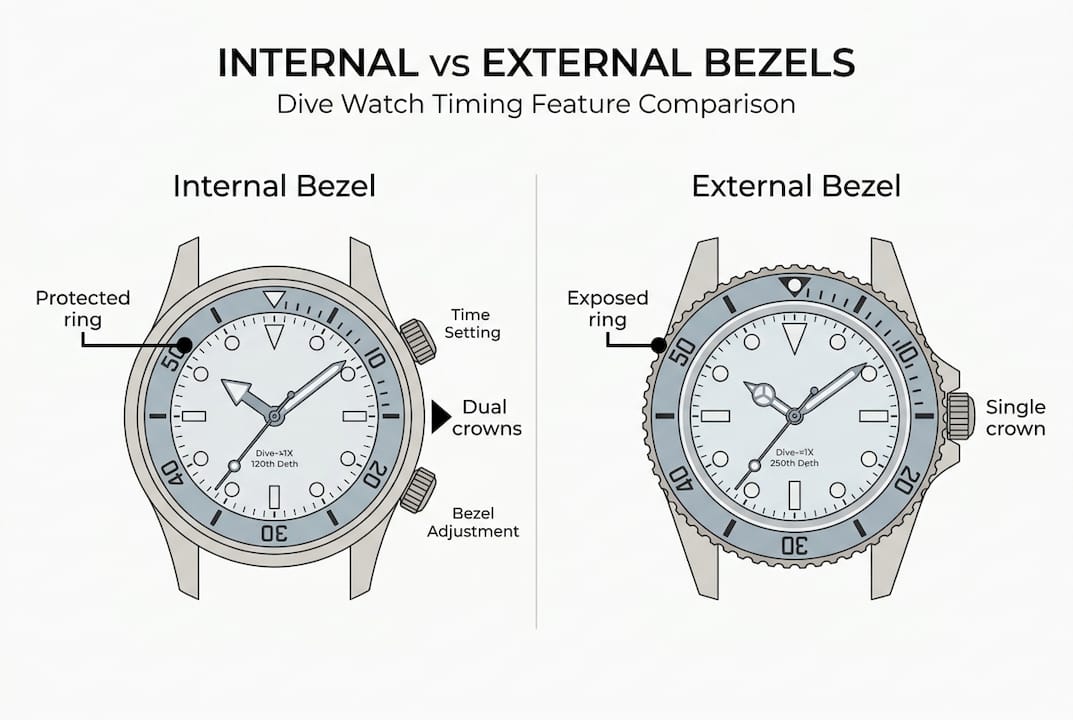
Infographic comparing internal versus external bezels

FeatureInternal bezelExternal bezel
Impact resistanceHigh, fully protectedModerate, exposed to knocks
Corrosion resistanceExcellent, sealed environmentLower, exposed to saltwater
Ease of useRequires crown operationDirect finger rotation
Accidental rotation riskVery lowHigher, especially with gloves
Mechanical complexityHigher, dual crown systemLower, single crown
MaintenanceMore involved, extra sealsSimpler service requirements
Case profileSlimmer, cleanerBulkier outer ring
Best suited forProfessional and technical diversRecreational divers, general use

Internal bezels offer superior protection for professional divers but require dual crowns, adding complexity compared to external bezels. The trade-off is real. You gain protection and reliability, but you accept a more deliberate operating procedure and a more involved service schedule.

For collectors trying to identify genuine dive watches, the presence of a secondary crown is often one of the clearest indicators of an internal bezel design, and it signals a watch built to a higher standard of operational integrity.

Famous models and innovative uses of internal bezels

Seeing how top watches use this feature brings the engineering into sharp focus.

The internal bezel has appeared in some of the most technically ambitious dive watches ever produced. Aquastar, the only Swiss watchmaker founded exclusively to produce dive watches, incorporated internal bezel designs into several of its professional models, including the Benthos 500 Chronograph and the Aquastar Model 60, both of which reflect the brand’s commitment to functional precision over decorative design.

Watch modelInternal bezel functionNotable feature
Aquastar Benthos 500Elapsed dive timeProfessional saturation diving spec
Aquastar Model 6060-minute timing scaleVintage internal bezel architecture
IWC Deep OneDepth gauging integrationBourdon tube mechanical depth reading

The IWC Deep One represents one of the most unusual applications of the internal bezel concept. Internal bezels paired with Bourdon tubes allow mechanical depth gauging up to 40 meters, showcasing advanced pre-digital dive technology that was genuinely remarkable for its era. The internal scale in this case is not just a timer but part of a fully mechanical depth measurement system.

Among collectors, the retro-modern revival of internal bezel designs has gained significant momentum. Watches that once seemed overly complex are now prized precisely because of that complexity, as it signals authentic tool watch heritage rather than aesthetic imitation.

Pro Tip: When examining a vintage internal bezel watch, always test the secondary crown for smooth operation before purchase. A stiff or corroded crown often indicates seal degradation, which affects both bezel function and water resistance.

Is an internal bezel right for you?

Armed with key examples, the real question becomes whether this engineering suits your personal needs and diving profile.

Not every diver needs an internal bezel, and not every enthusiast will find the operating procedure intuitive at first. The right choice depends on how and where you dive, and what you value in a mechanical watch.

  1. Professional and commercial divers will benefit most. The protection against accidental rotation and the sealed environment make internal bezels the logical choice for saturation diving, technical diving, and any environment where equipment contact is frequent.
  2. Serious recreational divers who use a dive computer as their primary instrument but want a reliable mechanical backup will appreciate the internal bezel’s resistance to accidental changes during a dive.
  3. Vintage watch collectors are drawn to internal bezels for their historical significance and the engineering discipline they represent. Internal bezels are preferred in vintage-inspired modern designs for reliability over convenience, and that philosophy resonates strongly with collectors who value function-first design.
  4. Casual divers and snorkelers may find the dual-crown operation unnecessarily complex for their needs, and an external bezel watch may serve them better.

Maintenance is a genuine consideration. The additional crown and its associated seals require attention during regular service intervals. For those comparing options across manufacturers, a review of best dive watch brands provides useful context on how different makers approach internal bezel servicing and long-term reliability.

Pro Tip: If you are new to internal bezel watches, practice the crown operation on dry land before your first dive. Muscle memory for screwing down both crowns is a habit worth building before you are underwater.

Discover more: Dive watch expertise at your fingertips

Aquastar has spent decades building watches that professional divers trust at depth, from the first analog dive computer to the first skindiver case watch. That same commitment to functional precision informs every internal bezel design in the current lineup.

https://aquastar.ch

If you are ready to go deeper into the world of serious dive watches, the best dive watch brands comparison offers a structured look at how leading manufacturers approach professional dive watch design. For those building a collection with purpose, the dive watch collecting guide covers everything from authentication to long-term care, helping you make informed decisions backed by genuine expertise.

Frequently asked questions

What is the main function of an internal bezel in a dive watch?

An internal bezel lets divers track elapsed time underwater by rotating a 60-minute timing scale inside the crystal, with unidirectional rotation ensuring the reading always errs on the side of caution.

Why do some divers prefer internal bezels over external ones?

Internal bezels provide extra protection against bumps, corrosion, and accidental time changes, all of which are critical in harsh dive environments where equipment contact and saltwater exposure are constant factors.

Are internal bezels more complicated to maintain than external bezels?

Yes. Internal bezels require dual crowns and additional seals, which adds complexity to regular service intervals compared to the simpler construction of external bezel watches.

Can internal bezels be used for features beyond timing dives?

Yes. In specialized models like the IWC Deep One, internal bezels integrate with Bourdon tubes to provide mechanical depth gauging up to 40 meters, demonstrating the format’s versatility beyond simple elapsed time tracking.

Posted on

Best Vintage Inspired Dive Watch Picks

Best Vintage Inspired Dive Watch Picks - best vintage inspired dive watch

Best Vintage Inspired Dive Watch: at a glance

Best vintage inspired dive watch picks: case proportions, dial layout, bezel and movement choices that translate heritage instead of borrowing it. Use this guide on best vintage inspired dive watch to weigh design choices, engineering trade-offs and how the category translates to real Aquastar dive watches.

TopicBest vintage inspired dive watch
Read time5-8 min
SourceAquastar editorial

A vintage-style diver can look right in a display case and still miss the point on the wrist. That is the problem with the search for the best vintage inspired dive watch. Too many modern releases borrow patina-colored lume, add a domed crystal, and call it heritage. Serious buyers know better. The right watch has to carry historical logic in its proportions, dial layout, timing functionality, and underwater legibility – not just the styling cues.

Best Vintage Inspired Dive Watch Picks - best vintage inspired dive watch

For collectors and divers, this category is compelling because the original era of dive watches produced some of the purest tool-watch design ever made. Cases were compact because they had to be wearable over long periods. Dials were clean because readability mattered. Bezels, chronograph scales, and minute tracks existed to support timing in real conditions. When those details are revived with discipline, a vintage-inspired diver offers something many modern watches do not: character with purpose.

What defines the best vintage inspired dive watch

The best examples do not simply imitate age. They preserve intent. That starts with case design. A watch inspired by mid-century underwater instruments should feel balanced, compact, and usable, not inflated to modern luxury-sport dimensions for the sake of wrist presence. A 37 mm to 40 mm case can often wear more honestly in this segment than a 42 mm case with thick lugs and excessive height.

Dial design matters just as much. Vintage dive watches were built around instant comprehension. Large hands, strong contrast, restrained text, and minute-first legibility are not nostalgic flourishes. They are functional necessities. If a modern reissue introduces polished reflections, cluttered printing, or weak lume in the name of refinement, it has already drifted away from the category’s roots.

Then there is the bezel. On a serious diver, the bezel should feel engineered rather than decorative. Its grip, action, insert material, and scale all shape usability. Aluminum can look more period-correct than ceramic, but ceramic adds scratch resistance and longevity. Neither choice is automatically better. It depends on whether the watch prioritizes archival faithfulness or modern durability.

Heritage without costume

This is where many brands get it wrong. Faux-aged lume, tropical-tone dials, and exaggerated gilt printing can quickly turn a historically grounded design into costume. The strongest watches in this space show restraint. They respect the original typography, handset, and proportions, but they do not overplay the idea of age.

A well-executed vintage-inspired diver should feel as if it belongs to a continuous lineage. That means modern reliability, but not modern excess. Sapphire crystal, improved gaskets, stronger lume compounds, and dependable Swiss mechanical movements all make sense. Inflated case sizes, overwrought case finishing, and generic luxury positioning do not.

For enthusiasts, this distinction is everything. Heritage is not a mood board. It is a set of design decisions tied to real use underwater.

The case for compact proportions

Ask experienced collectors what separates a convincing reissue from a weak one, and case geometry usually comes up early. Vintage dive watches were often smaller by modern standards, but their dimensions were driven by necessity. Short lugs, thin mid-cases, and balanced dial openings made them stable and comfortable.

That is why compact proportions remain one of the clearest signs of authenticity. A watch can carry every vintage cue on paper, yet still feel wrong if the case has been stretched beyond the logic of the original. Bigger is not always more capable. In fact, excessive diameter often reduces versatility and spoils the elegance that made many historic divers enduring in the first place.

Thickness is part of the equation as well. A box sapphire may preserve the profile of an acrylic crystal while improving scratch resistance, but if the full watch becomes top-heavy, the result loses some of the easy utility that defined classic dive instruments.

Movement, materials, and the modern compromise

No one buying in this segment should expect literal vintage construction. Original watches came with limitations. Acrylic crystals scratch. lume performance fades. water resistance standards vary wildly by era. Crowns and pushers can feel delicate by contemporary expectations.

A modern vintage-inspired diver earns its place by choosing which limitations to leave behind. Sapphire is the obvious upgrade. Improved gaskets and tested water resistance are non-negotiable if the watch is meant to be used rather than admired. Modern Super-LumiNova can preserve the look of an older dial while making the watch far more effective in low light.

Movement choice introduces another trade-off. An automatic Swiss caliber with modern serviceability is often the right answer for buyers who want reliability and parts support. Purists may wish for a more historically specific architecture, but practicality matters. If a watch is positioned as a true tool rather than a static tribute, dependable performance wins.

Bezels show this balance clearly. Aluminum is faithful. Ceramic is tougher. A DLC-coated case can increase durability, but on some references it may feel too contemporary. There is no universal rule. The best watch is the one whose upgrades serve the original concept rather than overshadow it.

What collectors should look for in the best vintage inspired dive watch

A credible watch in this category reveals itself through consistency. The hands fit the dial. The dial fits the case. The bezel suits the era. The crystal profile makes sense. The movement supports the purpose. Nothing feels added just because the market expects it.

Chronographs deserve special attention here. Vintage dive chronographs occupy a particularly compelling niche because they combine elapsed-time utility with a more technical visual identity. But they are easy to get wrong. Registers can become crowded, scales can compete for attention, and water-use credibility can feel secondary. The best examples preserve clarity first. If the chronograph layout compromises underwater legibility, the watch becomes a desk-bound tribute rather than a serious instrument.

This is also where brand history matters. A company with a real connection to professional underwater timing tends to approach these watches differently than a brand treating dive heritage as just another aesthetic segment. Proven archival design language, documented tool-watch lineage, and continuity in purpose carry more weight than marketing rhetoric.

Why historical legitimacy still matters

The market is full of competent dive watches. Far fewer have genuine historical gravity. For a collector, that difference is not abstract. It affects how the watch feels over time.

A watch built from a real underwater legacy tends to show discipline. Its details exist for a reason. Its proportions are not arbitrary. Its naming, case form, and functional layout connect back to something concrete. That depth gives the owner more than vintage styling. It provides context.

That is why heritage-focused brands continue to matter in this space. A watch rooted in actual dive-instrument history carries a different kind of authority than a modern design dressed in retro colors. At Aquastar, that principle remains central: preserve the substance, refine the engineering, and let the watch speak through purpose-built design rather than nostalgia alone.

So which watch is right for you?

It depends on what you value most. If your priority is strict historical fidelity, you may prefer smaller dimensions, aluminum bezel inserts, restrained finishing, and a closer adherence to period-correct dial details. If you plan to wear the watch hard, modern lume, sapphire, stronger water resistance, and improved bracelet or strap execution may matter more.

Some buyers want the clean simplicity of a three-hand diver. Others want the complexity and rarity of a purpose-built dive chronograph. Neither is inherently better. The real question is whether the watch maintains coherence. A strong vintage-inspired diver should feel like a genuine continuation of an underwater instrument, not a mashup of old and new ideas assembled for trend value.

Price also deserves honesty. This category ranges from affordable enthusiast pieces to serious Swiss mechanical watches with collector-level execution. The difference is not always finishing alone. It often comes down to faithfulness, technical credibility, low-volume production, and the confidence to avoid compromise where it matters.

The best vintage inspired dive watch is the one that still makes sense after the first impression fades. When the color of the lume stops being novel and the domed crystal stops catching your eye, what remains should be a disciplined, legible, well-proportioned dive watch with real lineage behind it. That is the standard worth buying to – and wearing for years.

Related from Aquastar: the Aquastar Model 60, Aquastar heritage.

Further reading: Wikipedia on diving watches.

Posted on

Best Mechanical Dive Chronograph Picks

Best Mechanical Dive Chronograph Picks - best mechanical dive chronograph

Best Mechanical Dive Chronograph: at a glance

Best mechanical dive chronograph picks: how to judge timing-system credibility, pressure resistance and dial legibility in a single category. Use this guide on best mechanical dive chronograph to weigh design choices, engineering trade-offs and how the category translates to real Aquastar dive watches.

TopicBest mechanical dive chronograph
Read time5-8 min
SourceAquastar editorial

A serious buyer usually knows the trap before he starts shopping. Plenty of chronographs look the part. Plenty of dive watches claim depth ratings that sound reassuring on paper. Far fewer deserve to be called the best mechanical dive chronograph, because combining a usable timing system with real underwater credibility is harder than most brands admit.

Best Mechanical Dive Chronograph Picks - best mechanical dive chronograph

That difficulty is exactly what makes the category compelling. A proper mechanical dive chronograph sits at the intersection of two demanding disciplines. A dive watch must remain legible, secure, and pressure resistant in harsh conditions. A chronograph adds pushers, additional seals, more mechanical complexity, and a dial that can quickly become crowded. Get the balance wrong and the result is a compromised instrument. Get it right and you have one of watchmaking’s most purposeful forms.

What makes the best mechanical dive chronograph?

The first test is not prestige. It is coherence. A true dive chronograph should feel as though every component was designed around underwater use rather than adapted from a land-based sports watch. That starts with the case architecture. Screw-down pushers, a substantial water-resistance rating, a secure crown system, and a bezel that can be read at a glance all matter more than decorative finishing or fashionable case geometry.

Legibility is just as critical. Many chronographs fail here because the dial tries to do too much. Multiple registers, date windows, tachymeter scales, polished hands, and low-contrast color choices may work in a boutique display case. Underwater, they are liabilities. The best examples reduce visual noise. Broad hands, strong lume, clear minute marking, and a restrained subdial layout make a difference when timing elapsed minutes matters.

Then there is movement selection. A mechanical chronograph built for diving should not be chosen simply because it carries pedigree. It should suit the watch’s purpose. A cam-actuated caliber can be entirely appropriate if it is durable and serviceable. A column-wheel movement may offer a finer pusher feel, but refinement alone does not make the watch better in the field. Collectors often chase architecture. Professionals tend to care about reliability, parts availability, and resistance to abuse.

Size is another trade-off. A dive chronograph needs enough presence to remain readable and secure, but not so much bulk that it becomes top-heavy or awkward over a wetsuit or under a jacket cuff. Many modern brands overshoot. They assume more diameter and more thickness signal capability. Usually, they signal poor discipline. The strongest watches in this segment manage water resistance, bezel grip, and chronograph complexity without becoming ungainly.

Why dive chronographs are rare by nature

A standard dive watch is already a specialist tool. Adding a chronograph introduces vulnerability. Each pusher creates another route for moisture ingress. Each additional function increases service complexity. Each register competes for dial space with the information a diver actually needs.

That is why the best mechanical dive chronograph is rarely the most complicated or the most expensive. It is the one that solves the engineering problem cleanly. Historically, the finest examples emerged from brands with a genuine connection to underwater timing rather than a broad luxury portfolio in search of another sports reference. Heritage matters here, not as marketing decoration, but as evidence that the design was shaped by use.

Collectors understand this instinctively. Watches with real underwater lineage tend to show different priorities. Their bezels are easier to grip. Their scales are bolder. Their cases are purposeful. Their dials look less like showpieces and more like instruments. That distinction still matters in the current market, where many so-called dive chronographs are essentially polished chronographs with improved gaskets.

The design traits worth paying for

If you are evaluating contenders seriously, start with the bezel and dial before you look at movement decoration. A diver’s bezel should be immediate and unambiguous. If the insert is overloaded, the font is too fine, or the grip is poor with wet hands, the watch is already telling you what it values.

The dial should offer hierarchy. Central timing indications must dominate. Running seconds and chronograph counters should be present, but not intrusive. Bright lume on the key hands and hour markers remains essential. Contrasting subdials can work well if they sharpen readability rather than add novelty.

Case finishing deserves a more disciplined reading too. Brushed surfaces usually make more sense than high polish on a tool-oriented chronograph. They wear better, reflect less glare, and suit the character of the watch. Sapphire crystal, ceramic bezel components, and modern luminous compounds are worthwhile upgrades when they support function without distorting the original design language.

Strap and bracelet execution should not be treated as afterthoughts. A dive chronograph is heavier than a time-only diver. It needs secure attachment, intelligent taper, and enough adjustment to accommodate changes in wrist size through heat, activity, or exposure gear. A beautiful head on a flimsy bracelet is still a weak watch.

Best mechanical dive chronograph buying criteria

A buyer looking for the best mechanical dive chronograph should be ruthless about intended use. If the watch will spend most of its life on dry land, then movement pedigree, finishing quality, and historical significance may carry more weight. If it will actually see regular water use, operational clarity moves to the front.

That is where many buying decisions become more honest. There is no universal winner, only the best fit for a certain kind of owner. A compact vintage-inspired chronograph with moderate dimensions may be ideal for daily wear and occasional swimming. A larger professional-spec piece with greater water resistance and a more aggressive bezel may suit active diving better, even if it sacrifices elegance on the wrist.

Price complicates the picture further. At the high end, buyers often pay heavily for branding, precious finishing, or movement prestige that has little bearing on underwater performance. At the enthusiast end of the market, there are watches that deliver far more practical utility and stronger historical fidelity. The category rewards expertise. It punishes buyers who equate luxury positioning with instrument quality.

Serviceability should also sit near the top of the list. A mechanical chronograph is not a casual ownership proposition. Parts access, movement familiarity, gasket replacement, pusher maintenance, and long-term support matter. A watch built as a true tool should be supportable over decades, not just during its warranty window.

Heritage matters – but only when it is earned

This segment attracts heritage claims because the history is real and the visual codes are powerful. But not every archival reference deserves revival, and not every revival deserves attention. The strongest modern dive chronographs respect the proportions, restraint, and utility of the originals while improving the details owners actually live with today.

That means modern water resistance that inspires confidence, sapphire instead of fragile acrylic where appropriate, dependable Swiss mechanical calibers, and lume that performs to current expectations. It does not mean inflating the case, overworking the dial, or polishing the watch into something its predecessors never intended to be.

When heritage is handled properly, it sharpens identity. A watch like the Deepstar demonstrates why the format still matters. The appeal is not nostalgia alone. It is the preservation of a design language born from genuine underwater timing needs, then refined for modern reliability and wearability. That is a far more compelling proposition than a generic luxury sports chronograph with a diver’s bezel added for effect.

How collectors separate the real contenders

Experienced buyers tend to ask a few blunt questions. Can the watch be read instantly in poor conditions? Does the chronograph layout support elapsed-time use or distract from it? Are the pushers, crown, bezel, and case construction appropriate for repeated exposure to water? Does the movement choice make sense for long-term ownership? And perhaps most revealing, does the watch feel like a dive instrument first and a styling exercise second?

Those questions often narrow the field quickly. They also explain why the category remains niche. Building a convincing dive chronograph requires restraint, historical understanding, and engineering discipline. It is easier to sell a story than to build a coherent instrument.

For the buyer who values substance, that scarcity is part of the appeal. The best examples are not loud. They are convincing. They carry the confidence of watches designed with a job to do, then executed with enough care to earn a place in a serious collection.

Choose one the same way you would choose any lasting tool – by how honestly it was built, how clearly it performs, and whether its heritage shows up in the metal rather than just the marketing.

Related from Aquastar: the Aquastar Deepstar III, the Aquastar Airstar.

Further reading: Wikipedia on the chronograph.

Posted on

Best Dive Watch Reissue Brands Today

Best Dive Watch Reissue Brands Today - dive watch reissue brands

Dive Watch Reissue Brands: at a glance

Best dive watch reissue brands today: which makers respect the original architecture and which simply borrow vintage cues — collector-grade selection. Use this guide on dive watch reissue brands to weigh design choices, engineering trade-offs and how the category translates to real Aquastar dive watches.

TopicDive watch reissue brands
Read time5-8 min
SourceAquastar editorial

Most modern dive watches are inspired by history. Far fewer earn the right to carry it forward. That is the real line separating serious dive watch reissue brands from companies that simply borrow old cues, add faux patina, and call it heritage.

Best Dive Watch Reissue Brands Today - dive watch reissue brands

For collectors and divers who know the category, a reissue is not just a familiar handset or a vintage-style bezel insert. It is a question of legitimacy. Was the original watch meaningful in underwater use? Does the new piece respect the architecture, proportions, and instrument purpose of the reference that came before it? And just as important, has the watch been updated where modern engineering genuinely improves performance rather than diluting character?

That is where this segment becomes interesting. The best brands in this space are not selling nostalgia alone. They are preserving design language forged under pressure – literally underwater – while making careful choices about materials, movements, lume, crystals, and tolerances for present-day wear.

What sets dive watch reissue brands apart

A proper reissue starts with a watch worth reissuing. That sounds obvious, but the market is crowded with watches built around invented backstories or references that mattered only because they looked good in old advertisements. Serious dive watch reissue brands usually have a stronger foundation: real underwater heritage, distinct case construction, a proven dial layout, or a functional innovation that gave the original model a place in dive-watch history.

The second distinction is discipline. Good reissue work requires restraint. If the original had compact lugs, a no-nonsense dial, and a bezel designed for legibility first, then inflating the case, polishing every surface, and adding decorative clutter misses the point. A reissue should feel like a continuation of the instrument, not a costume version of it.

Modernization still matters. Acrylic may give way to sapphire. Radium gives way to Super-LumiNova. Water resistance, gaskets, and manufacturing tolerances should improve. But the strongest reissues do not chase every contemporary trend. They preserve the stance, balance, and operational clarity that made the original credible in the first place.

Why some reissues work and others feel hollow

The difference usually comes down to whether the brand understands the original watch as a tool or as an aesthetic reference. When a company treats a historic diver as a design theme, the result often looks correct from a distance but feels wrong on the wrist. The proportions shift. The dial gets busier. The bezel action becomes ornamental rather than decisive. The watch stops behaving like equipment.

When the brand understands the original as a working instrument, the details tend to align. Case thickness is managed instead of simply increased. The crystal profile suits the watch. The minute track remains easy to read. The hand set preserves hierarchy in low light. Even finishing choices make sense, with brushed surfaces prioritized where glare control and utility matter.

Collectors notice these things quickly. So do divers. A watch can be luxurious by design and still remain professional by nature, but only if the refinement serves the watch instead of softening its purpose.

How to judge the best dive watch reissue brands

The first test is archival honesty. Look at the original reference and then study the new watch without marketing noise. Are the case proportions faithful? Has the bezel shape been preserved? Is the dial furniture true to the source, or has it been remodeled to chase broader commercial appeal? A strong reissue does not need to be frozen in time, but the lineage should be obvious before anyone explains it.

The second test is technical judgment. Not every update is automatically an improvement. Ceramic bezels can be excellent, but on some watches they change the visual temperature too much. Larger crowns may improve grip, but they can upset the side profile. Thicker sapphire can enhance durability, yet it may also alter how the watch sits. Good brands know where to modernize aggressively and where to leave well enough alone.

The third test is movement choice. In a heritage diver, the movement should fit the mission. Reliability, serviceability, and appropriate dimensions matter more than novelty for its own sake. A high-grade Swiss automatic with stable performance, sensible parts support, and a profile that allows the case to remain true to the original is often the better decision than forcing a more exotic caliber into a design that was never meant to house it.

The fourth test is credibility beyond the brochure. Brands with real dive-watch history tend to speak in specifics: case diameter, lug-to-lug, bezel construction, depth rating, crystal material, movement caliber, lume type, and strap fitment. Vague luxury language is often a warning sign. Tool watches deserve exact information.

The trade-offs inside every reissue

No reissue is pure archaeology. There are always decisions to make, and serious buyers should expect trade-offs rather than fantasy. A watch that remains extremely faithful to a 1960s or 1970s reference may preserve charm and collector appeal, but it can also retain some limitations in bezel grip, clasp adjustment, or lume performance. A more assertively updated piece may wear better every day while giving up some of the original watch’s compact elegance.

Case size is one of the most common fault lines. Many historic divers wore smaller than current market norms, and that is part of their appeal. Increasing diameter may broaden commercial reach, but it can also flatten the character of the watch. On the other hand, a perfectly faithful size is not automatically ideal if the original proportions were constrained by old manufacturing standards or period expectations.

Dial aging is another point of tension. Artificial patina can work when handled with restraint, but too often it becomes theater. Clean white or off-white lume may better suit a watch intended as a serious underwater instrument. The question is whether the color treatment supports authenticity or distracts from it.

Heritage matters, but so does use

Collectors sometimes approach reissues as static objects, measuring them only against vintage precedent. That misses half the story. A proper dive watch should still function as a dive watch. Even if most owners will wear it above water more often than below, the watch should be built with the same seriousness that once justified its existence.

That means bezel security, clear minute emphasis, dependable luminosity, and water resistance backed by modern manufacturing rather than romantic claims. It also means comfort. A watch that feels top-heavy, overbuilt, or awkwardly long has failed a basic tool-watch requirement. The best reissues preserve not just the look of heritage, but the use case.

This is where smaller specialist brands often outperform larger luxury houses. They are less likely to dilute a purpose-built diver into a generic premium sports watch. Their audience is more demanding, and their margin for getting the details wrong is smaller. In this niche, expertise shows.

What serious collectors should look for in dive watch reissue brands

The strongest brands usually share a few qualities. They have a real archive worth mining. They respect original proportions. They modernize with intent rather than excess. And they speak to buyers who care about the watch as an object of engineering, not just image.

It also helps when the brand understands that not every historic model should be reissued in the same way. Some references deserve near-total fidelity because their design was already resolved. Others benefit from measured evolution, especially when the original case construction, crystal, or movement imposed limits that no longer need to exist. Good judgment is brand-defining here.

Aquastar belongs in that conversation because the brand’s history was never generic dive-watch storytelling. Its original instruments were tied to the underwater world in a direct, functional way, and the strongest modern revivals in this category follow that same principle: honor the reference, preserve the purpose, improve the execution.

The future of dive watch reissue brands

The category is getting more crowded, but that does not mean it is getting better. More brands now understand that buyers want heritage. Fewer understand that heritage is not a dial texture or an old logo. It is a record of solving real problems through design.

That is why the best dive watch reissue brands will continue to stand apart. They do not need to over-explain themselves. Their watches carry the evidence in the case lines, bezel geometry, dial hierarchy, and technical specification. They feel grounded because they are.

If you are evaluating one, ignore the romance for a moment and study the watch like a tool. If the history is real, the proportions are right, and the modern updates serve the mission, you are not just buying a reissue. You are wearing a piece of underwater instrument history made fit for the present.

Related from Aquastar: the Aquastar collection, Aquastar history.

Further reading: Wikipedia on diving watches.

Posted on

How to Choose a Dive Watch That Lasts

How to Choose a Dive Watch That Lasts - how to choose a dive watch

How To Choose A Dive Watch: at a glance

How to choose a dive watch that lasts: separate true instruments from sports-styled watches with bezels, and weigh purpose against the spec sheet. Use this guide on how to choose a dive watch to weigh design choices, engineering trade-offs and how the category translates to real Aquastar dive watches.

TopicHow to choose a dive watch
Read time5-8 min
SourceAquastar editorial

A dive watch can look convincing in a showroom and still miss the mark where it matters. The wrong bezel feel, poor dial legibility, awkward case proportions, or a spec sheet built for marketing instead of underwater use will reveal themselves quickly. If you are deciding how to choose a dive watch, start by separating true instruments from generic sports watches with a rotating bezel.

How to Choose a Dive Watch That Lasts - how to choose a dive watch

The best dive watches are not defined by one headline specification. Depth rating matters, but so do balance, visibility, serviceability, and the integrity of the design itself. A serious dive watch is a system – case, bezel, crystal, crown, movement, dial, and strap all working together under pressure.

How to Choose a Dive Watch by Purpose

Before you compare movements or case materials, decide what role the watch will actually play. That sounds obvious, but it is where many buyers go wrong.

If you are an active diver, you need immediate legibility, a secure bezel, strong lume, and enough water resistance to exceed your real-world use with margin to spare. If you are a collector, historical legitimacy and design faithfulness may matter just as much as the movement inside. If you want one watch for travel, swimming, daily wear, and occasional diving, thickness, case diameter, and comfort become as important as pure underwater capability.

This is why there is no single best answer to how to choose a dive watch. A 200-meter compressor-style piece with elegant proportions may be ideal for one buyer, while another should be looking at a more aggressively engineered professional platform with a heavier case and more pronounced bezel architecture.

Start With the Non-Negotiables

Water resistance is the first filter, but not the only one. For recreational use, 200 meters is a credible starting point for a modern mechanical dive watch. At that level, paired with proper crown construction and case integrity, you are usually looking at a watch built with genuine aquatic intent rather than surface-level styling.

More depth rating is not automatically better if it comes at the cost of wearability. A 300-meter or 500-meter case can add thickness and mass that some owners will tire of quickly. Unless you need saturation-diving specifications, a well-executed 200-meter watch from a specialist maker is often the stronger choice than a bulkier watch built around an impressive but unnecessary number.

The bezel is equally critical. It should rotate with authority, align cleanly, and offer enough grip to be used with wet hands. A bezel that feels vague on land will not improve underwater. Ceramic inserts bring excellent scratch resistance, while aluminum can feel more period-correct on heritage-inspired references. Neither is universally better. Ceramic is technically tougher in everyday wear, while aluminum often carries the warmth and character collectors appreciate.

The crown deserves close attention. Screw-down construction is standard, but the feel matters. A crown should thread cleanly, operate without hesitation, and avoid feeling delicate. Crown guards can add security, though some historical designs prioritize accessibility and symmetry over aggressive protection.

Legibility Matters More Than Most Buyers Expect

A proper dive watch should be readable at a glance, in poor light, from an angle, and under stress. That is not just about large markers. It is about contrast.

The best dials are disciplined. Clear handset separation, strong luminous material, minimal clutter, and a seconds hand that can be tracked easily all improve usability. A glossy dial with decorative textures may look rich in photos, but if the hands disappear against it in low light, the watch has failed a basic test.

Date windows are another trade-off. Some buyers want the daily convenience. Others prefer the visual purity of a no-date layout. From a dive-watch standpoint, fewer dial interruptions usually mean stronger balance and faster reading. But if the watch will live mostly above water, the date may earn its place.

Crystal choice is straightforward. Sapphire is the modern standard for good reason. It resists scratches far better than mineral alternatives and suits a premium mechanical tool watch. The caveat is glare. Anti-reflective treatment and crystal profile affect how readable the watch remains in bright sun and under water. Domed crystals can be visually striking and historically accurate, but they should not compromise clarity.

Mechanical or Quartz?

For the audience drawn to Swiss heritage dive watches, the answer is often mechanical. Not because quartz cannot perform, but because a mechanical movement offers a different kind of value – engineering depth, serviceable longevity, and a direct connection to the history of underwater instruments.

That said, this is where honesty matters. If you want a grab-and-go watch that can sit for months and then perform immediately, quartz has practical advantages. If you appreciate movement architecture, sweeping seconds, and the permanence of a machine built to be maintained over decades, mechanical is the stronger proposition.

Within mechanical, look beyond branding. Consider serviceability, reliability, and whether the movement suits the watch. A proven Swiss caliber with stable parts support often makes more sense than an exotic movement chosen purely for novelty. Enthusiasts know that dependability is a luxury in its own right.

Size, Thickness, and Wearability

Many dive watches look better in profile drawings than on a wrist. Case diameter alone tells very little. Lug-to-lug length, case thickness, bezel width, and the shape of the mid-case all affect how the watch wears.

A 40mm to 41mm dive watch is often a sweet spot for broad versatility, but the right dimensions depend on the design. A short-lug case with strong bezel proportion can wear compact and purposeful. A larger 42mm or 43mm watch can also work well if the lugs are controlled and the case back sits properly on the wrist.

Thickness is where compromises become real. Greater water resistance, domed crystals, and automatic movements can all add height. Some presence is expected in a true tool watch, but if the watch constantly catches cuffs or feels top-heavy, you will wear it less. The best dive watches feel planted, not cumbersome.

Bracelet and strap options matter here too. A well-made steel bracelet gives the watch a more integrated, substantial character, while rubber often provides the best comfort in heat and water. The ideal setup is not theoretical. It is the one you will actually use.

Heritage, Design Integrity, and Long-Term Value

A dive watch is more compelling when its design has a reason to exist. That does not mean every buyer needs a reissue, but it does mean proportions, bezel style, dial layout, and case architecture should feel coherent rather than assembled from current trends.

This is one reason heritage remains powerful in the category. The great dive watches were shaped by function first. Their visual signatures came from necessity – decompression timing, rapid legibility, secure handling, and underwater durability. When a modern watch respects that lineage, it tends to age better than a watch chasing temporary design language.

Long-term value is also about credibility. A specialist brand with real underwater history, disciplined production, and a clear point of view often offers more substance than a fashion-driven name with a louder marketing budget. Buyers in this segment know the difference. They look for historical continuity, not inflated storytelling.

If you are spending serious money, study the details. Case finishing, bezel action, lume execution, hand alignment, movement choice, and dimensional restraint reveal whether the watch was engineered with conviction. At Aquastar, that philosophy has always centered on watches born from professional underwater instrument history, then refined with modern materials and reliability where it counts.

How to Choose a Dive Watch Without Overbuying

A common mistake is buying for an imagined future instead of actual use. You do not need a helium valve for desk work, just as you do not need to sacrifice comfort for a depth rating you will never approach. Buy the watch that fits your life, your standards, and your wrist.

At the same time, avoid going too far in the other direction. A watch that only looks like a dive watch may satisfy for a season, then feel hollow. The strongest choices have genuine capability even if they spend most of their time above sea level.

That is the real balance. Choose a watch with enough engineering to be trusted, enough restraint to be worn often, and enough history to still feel right ten years from now. The best dive watch is not the one with the loudest specification. It is the one built with purpose, and built well enough that you never have to question it when conditions turn hard.

Related from Aquastar: the full Aquastar collection, the Aquastar Benthos.

Further reading: Wikipedia on diving watches.

Posted on

Dive Watch Water Resistance Guide

Dive Watch Water Resistance Guide - dive watch water resistance guide

Dive Watch Water Resistance Guide: at a glance

Dive watch water resistance guide: ATM, meters, ISO 6425 testing and the engineering and gasket service that actually protect your watch at depth. Use this guide on dive watch water resistance guide to weigh design choices, engineering trade-offs and how the category translates to real Aquastar dive watches.

TopicDive watch water resistance guide
Read time5-8 min
SourceAquastar editorial

A caseback stamped 200 meters looks decisive. In practice, that number is only the start. Any serious dive watch water resistance guide has to separate marketing shorthand from actual underwater capability, because the difference between a watch made for the pool and one built for repeated submersion lies in engineering, testing, and long-term durability.

Dive Watch Water Resistance Guide - dive watch water resistance guide

For collectors and divers alike, water resistance is one of the most misunderstood specifications in watchmaking. The rating is simple. The real story is not. Gaskets age, crowns get left unscrewed, chronograph pushers add complexity, and lab tests do not fully mirror the shock, temperature change, and pressure variation of real use. If you care about purpose-built mechanical watches, this is where the details matter.

What water resistance ratings actually mean

A water resistance rating expresses how much pressure a watch is designed to withstand under controlled test conditions. It does not mean you can automatically use the watch in every wet scenario up to that printed depth. A 30 meter watch is not a diving instrument. A 50 meter watch is not meant for sustained swimming. Even 100 meters can be enough for many owners, but it depends on the case design, crown system, and how the watch is used.

This is where confusion starts. Pressure in testing is static. Real water exposure is dynamic. Moving your arm through water, hitting the surface during a jump, or changing temperature quickly can create stress that differs from a bench test. That is why seasoned buyers look beyond the number on the dial and examine the architecture behind it.

For a true dive watch, 200 meters is a common baseline because it gives meaningful operational margin. At that level, you are usually looking at a screw-down crown, substantial gaskets, a solid crystal interface, and a case engineered as a system rather than styled as one.

The dive watch water resistance guide to common ratings

Thirty meters or 50 meters is best viewed as splash resistance. Rain, hand washing, and incidental moisture are the intended use case. These ratings belong on dress watches and everyday pieces, not on equipment expected to work beneath the surface.

One hundred meters often covers swimming and recreational water exposure if the watch is properly maintained. That said, 100 meters does not automatically make a watch a capable dive instrument. Some are perfectly sound for snorkeling and pool use. Others simply meet a broad consumer standard.

Two hundred meters is where purpose-built dive watches become serious tools. At this level, the case construction usually reflects genuine underwater intent. Three hundred meters and beyond adds further margin, though more depth on paper does not always mean a better watch in practice. A well-engineered 200 meter diver can be more trustworthy than a poorly executed 500 meter watch.

Saturation-capable professional pieces sit in another category altogether. They are built for commercial environments involving prolonged pressurized exposure and, in some cases, helium management. Most owners do not need that capability, but its existence says something about the discipline of the design.

Why ISO standards matter

If a watch is labeled simply as water resistant, that can mean it passed a manufacturer protocol or a general standard for pressure tolerance. If it is designated as a diver’s watch under ISO criteria, the bar is higher. The watch must meet a broader set of performance requirements that go beyond surviving pressure in a dry lab.

Those requirements typically include condensation resistance, legibility in darkness, resistance to shock and magnetism, and secure timing functionality through a unidirectional bezel. This matters because a dive watch is not just a sealed case. It is an underwater instrument.

The distinction is especially important in enthusiast circles, where many watches borrow the visual language of diving while offering only casual water protection. A serious piece earns credibility through specification and test discipline, not bezel graphics.

Case construction is the real story

Water resistance is won or lost at the interfaces. The crown tube, caseback, crystal seat, and any pusher openings are the vulnerable points. Strong ratings come from precise tolerances, quality gasket materials, and a case design that maintains compression where it counts.

The screw-down crown remains one of the most important features in a mechanical dive watch because it protects the most frequently handled opening in the case. It is not magic by itself. It works because it secures the crown against the gaskets with repeatable pressure. If the threads are poorly cut or the gasket system is mediocre, the feature is more reassuring than effective.

Caseback design matters as well. A screw-in caseback with proper sealing geometry usually provides more dependable resistance than a snap-back design in hard use. Sapphire crystals also play a role. They are prized for scratch resistance, but their installation is just as important as the material itself. A thick crystal seated correctly with proper gasket compression contributes directly to structural integrity.

Chronographs and water resistance

Collectors are right to be cautious here. A dive chronograph is inherently more complex to seal than a time-only diver because each pusher creates another path for water ingress. That does not make the format flawed. It means the execution has to be excellent.

Historically, some of the most compelling underwater instruments combined elapsed timing with true diving utility. But a chronograph intended for serious aquatic use requires careful pusher design, dependable gasket architecture, and clear instructions about whether the pushers can be operated underwater. Some can. Many should not be.

This is one of those areas where specification sheets deserve close reading. A confident depth rating is good. A thoughtfully engineered case with a track record of purpose-built design is better.

Why old gaskets turn good watches into risky ones

A dive watch is not permanently water resistant. It is water resistant when its seals are healthy, the crown is secured, and the case remains within specification. Time changes that equation.

Gaskets dry out. Impacts can compromise sealing surfaces. A crystal replacement done by an inexperienced hand can reduce performance even if the watch looks perfect from the outside. Vintage divers are especially vulnerable. Their charm is undeniable, but original seals and old case tolerances are not a sound basis for underwater use.

That is why collectors often separate two ideas: a dive watch as an object of history and a dive watch as active equipment. Some vintage-inspired mechanical pieces are made to be worn hard. Some vintage originals are better treated as references from another era.

Real-world use is harder than the rating suggests

A watch may pass pressure testing and still be put at risk by ordinary habits. A hot shower can create thermal expansion that stresses seals. Salt water left unrinsed can accelerate wear around the crown and caseback. Pulling the crown out near water is an obvious mistake, but even forgetting to screw it back down fully is enough.

There is also the issue of impact. Knocking a watch against a ladder rail or tank hardware may not leave visible damage, yet it can affect the integrity of the sealing system. Professional equipment is designed for harsh conditions, but no mechanical object is immune to neglect.

This is where enthusiast ownership benefits from discipline. Rinse after salt water exposure. Check the crown before immersion. Pressure test periodically, especially before travel or dive season. Treat water resistance as a service item, not a permanent promise.

How to judge a serious diver beyond the number

The strongest watches in this category present a coherent package. The depth rating is supported by a screw-down crown, substantial case construction, a legible dial, a secure bezel, and a movement protected inside a case designed for repeated use. Nothing feels ornamental.

Brand history also carries weight when it is tied to real underwater instrument design rather than generic sport styling. A company rooted in professional diving heritage tends to approach case engineering differently from one producing a broad luxury catalog. That heritage alone is not enough, but when it is matched by modern manufacturing and transparent specifications, it becomes meaningful.

Aquastar has long occupied that narrower, more credible lane – one built around watches conceived as tools first, then refined without losing purpose. For buyers who know the difference, that approach still matters.

A practical standard for buyers and owners

If you want a mechanical watch for actual water use, 200 meters remains the sensible sweet spot. It offers real capability without turning the watch into an oversized engineering exercise. If you want a daily wearer that will see the occasional swim, 100 meters may be sufficient, provided the construction is sound and service history is current.

If you collect vintage pieces, assume nothing until the watch is tested. If you own a chronograph diver, understand the pusher limitations. And if you are comparing two watches with similar ratings, trust the one with better case architecture and stronger diving credentials over the one with the larger number.

The best dive watches do not rely on inflated claims. They earn confidence through design, testing, and consistency over time. Water resistance is not a decoration on the dial. It is a contract between the watch and the environment it was built to face. Buy accordingly, maintain it properly, and that contract will hold when it matters.

Related from Aquastar: the Aquastar Benthos 500, a 500 m chronograph, the Aquastar Deepstar collection.

Further reading: Wikipedia on water-resistance marks.