
Posted on

Best dive watch materials for professional use in 2026

Best dive watch materials for professional use in 2026 - best dive watch materials

Best Dive Watch Materials: at a glance

Best dive watch materials for professional use in 2026: 316L, 904L, titanium and specialty alloys compared on corrosion, weight and wrist comfort. Use this guide on best dive watch materials to weigh design choices, engineering trade-offs and how the category translates to real Aquastar dive watches.

TopicBest dive watch materials
Read time5-8 min
SourceAquastar editorial

Best dive watch materials for professional use in 2026 - best dive watch materials

Selecting the right material for a dive watch shapes every aspect of its performance, from corrosion resistance to wrist comfort during extended underwater missions. Professional divers and watch enthusiasts face a complex decision: stainless steel variants offer proven durability at different price points, titanium delivers lightweight strength, and specialty alloys promise enhanced longevity. Understanding how materials perform under extreme pressure, saltwater exposure, and daily wear determines whether a timepiece becomes a trusted tool or an expensive disappointment. This guide examines the top materials used in professional dive watches, comparing their strengths and limitations to help you make an informed choice that matches your diving needs and budget.

Table of Contents

Key takeaways

PointDetails
316L stainless steel dominatesIndustry standard offering excellent corrosion resistance and cost efficiency for professional dive watches
Titanium reduces wrist fatigueApproximately 40% lighter than steel while maintaining superior corrosion resistance through oxide layer
904L delivers luxury performanceEnhanced corrosion resistance and brighter finish justify premium pricing in high-end dive watches
ISO 6425 validates materialsCertification ensures materials perform under real underwater conditions beyond simple depth ratings
Helium valves require robust casesSaturation diving demands materials that support pressure equalization features for safe decompression

Criteria for choosing dive watch materials

Evaluating dive watch materials requires understanding the extreme conditions these timepieces must endure. Professional dive watches face constant exposure to saltwater, rapid pressure changes, temperature fluctuations, and physical impacts against equipment or reef structures. The material you choose determines how well your watch handles these stresses over years of service.

ISO 6425 certification ensures dive watches meet real underwater test standards including pressure resistance and durability. This certification validates that materials perform under actual diving conditions, not just theoretical specifications. Materials must pass rigorous testing for corrosion resistance, legibility maintenance, and structural integrity at rated depths.

Key performance factors guide material selection:

  • Corrosion resistance against saltwater and chemical exposure
  • Weight distribution for comfortable extended wear
  • Scratch and impact resistance for daily durability
  • Thermal conductivity affecting wrist comfort in varying temperatures
  • Surface finishing potential for legibility and aesthetics
  • Maintenance requirements over the watch’s lifespan
  • Certified pressure resistance matching intended dive depths

Understanding diver watch features for reliability helps contextualize how material choices interact with other critical components. Materials don’t work in isolation. They must support gasket seals, crystal retention, and crown mechanisms that together create a waterproof system. The best material for your needs balances performance attributes with practical considerations like budget, intended use frequency, and personal comfort preferences.

316L and 904L stainless steel: durability and luxury finishes

Stainless steel dominates dive watch manufacturing for compelling reasons. 316L stainless steel is the most widely used grade for dive watch cases due to its excellent resistance to seawater corrosion and cost effectiveness. This austenitic steel contains 16-18% chromium, 10-14% nickel, and 2-3% molybdenum, creating a passive layer that protects against saltwater degradation.

Manufacturers favor 316L for practical production advantages. Standard machining tools work efficiently with this grade, keeping manufacturing costs reasonable and enabling larger production runs. This efficiency translates to better value for buyers seeking professional-grade dive watches without luxury price tags. The material accepts various surface finishes, from brushed textures that hide scratches to polished surfaces that enhance legibility underwater.

904L stainless steel offers superior corrosion resistance and a brighter luster compared to 316L. This superalloy contains higher chromium (20-21%) and increased nickel and copper content, delivering exceptional resistance to acidic and chloride-rich environments. Luxury watchmakers adopt 904L for its ability to maintain a mirror polish that resists tarnishing over decades of use.

Key advantages of stainless steel variants:

  • Proven corrosion resistance in marine environments
  • High tensile strength withstanding impacts and pressure
  • Affordable manufacturing costs for 316L models
  • Premium aesthetic appeal with 904L bright finishes
  • Wide availability of replacement parts and service options

Considerations include higher weight compared to titanium alternatives and potential nickel sensitivity for some wearers. Understanding dive watch cases explained guide reveals how case construction amplifies or mitigates these material characteristics.

Pro Tip: Choose 316L for practical daily dive watches where cost efficiency matters, or select 904L when investing in a luxury piece where corrosion resistance and lasting appearance justify the premium.

Titanium dive watches: lightweight strength and corrosion resistance

Titanium transforms the dive watch wearing experience through dramatic weight reduction without sacrificing strength. Titanium is about 40-45% lighter than stainless steel, reducing wrist fatigue for larger dive watches. This weight advantage becomes critical during multi-hour dives or when wearing a watch continuously for days during liveaboard diving expeditions.
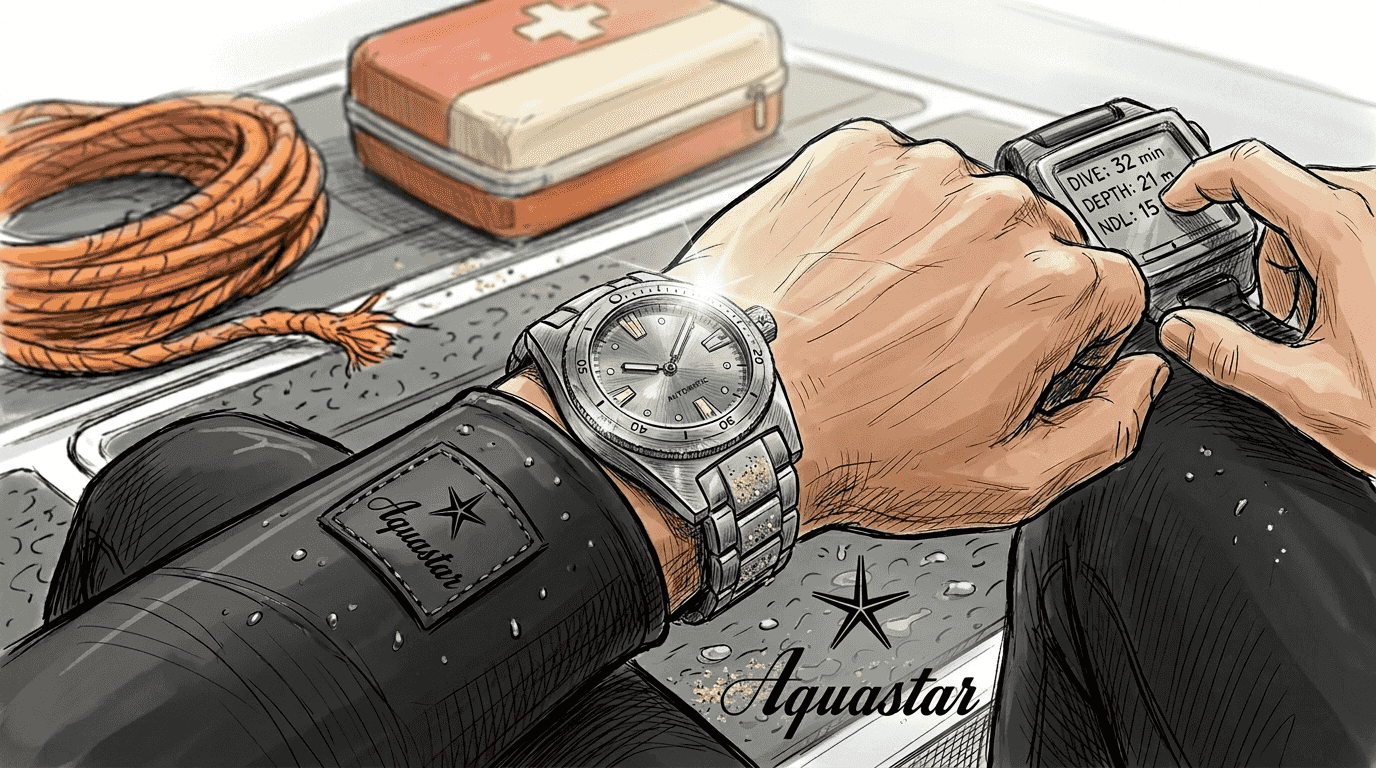
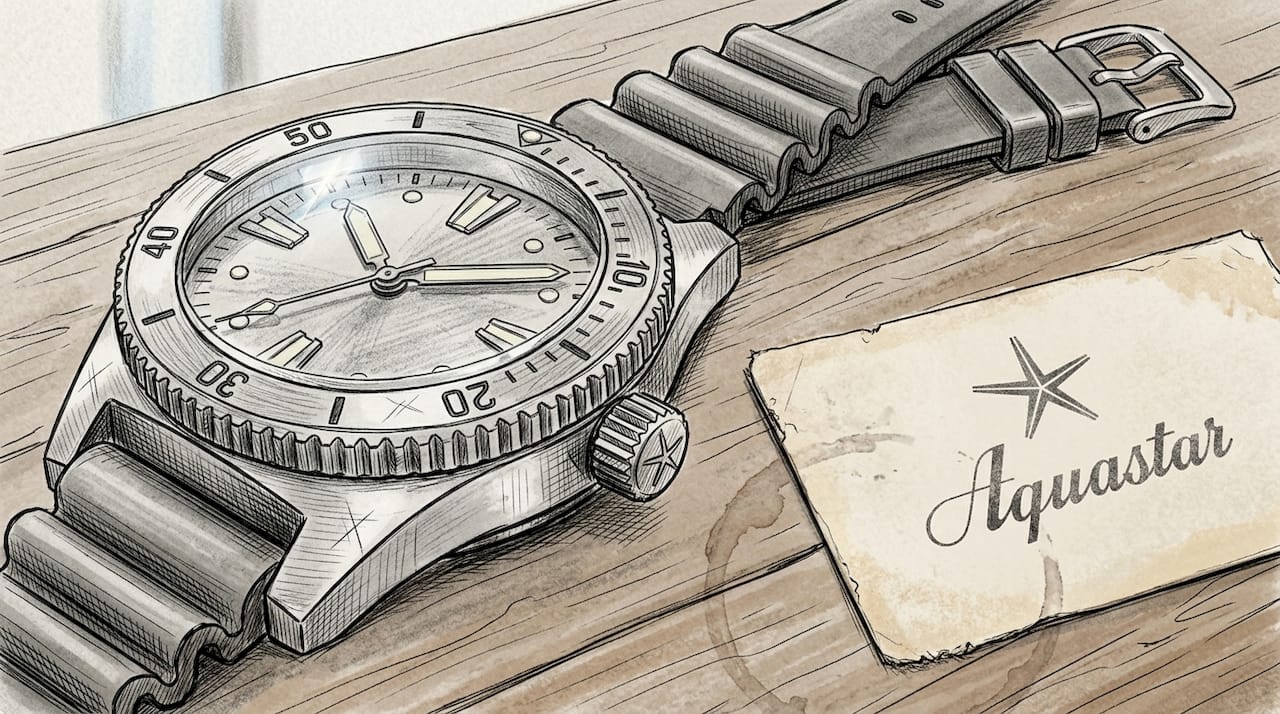
Titanium dive watch close up, worn during prep

The material’s corrosion resistance surpasses even premium stainless steels. Titanium forms a self-healing titanium dioxide layer that instantly repairs itself when scratched, maintaining protection against saltwater degradation indefinitely. This oxide layer makes titanium virtually immune to galvanic corrosion, a significant advantage when dive watches contact other metals on diving equipment.

Grade 5 titanium offers increased tensile strength and surface hardness versus Grade 2 titanium. Grade 2 provides excellent corrosion resistance and easier machining at lower costs, making it suitable for mid-range titanium dive watches. Grade 5 (Ti-6Al-4V) incorporates aluminum and vanadium alloys, creating a material nearly as strong as steel while retaining titanium’s lightweight properties.

MaterialDensity (g/cm³)Tensile Strength (MPa)Corrosion ResistanceWeight vs SteelTypical Cost
316L Stainless Steel8.0485-690ExcellentBaselineModerate
Grade 2 Titanium4.5345-480Superior44% lighterHigh
Grade 5 Titanium4.4895-930Superior45% lighterVery High

Ergonomic benefits extend beyond weight. Titanium’s lower thermal conductivity means the watch feels more comfortable against skin in cold water or hot tropical conditions. The material doesn’t conduct heat away from your wrist as aggressively as steel, reducing the initial cold shock when entering water.

OEM manufacturing with titanium requires special tooling and can raise costs and minimum order quantities. Titanium’s hardness dulls cutting tools quickly, demanding specialized carbide or ceramic tooling. These manufacturing challenges explain why titanium dive watches command premium prices despite the raw material costing only moderately more than stainless steel.

Exploring professional dive watch features shows how titanium cases enhance other critical components through weight distribution and structural advantages.

Pro Tip: Grade 2 titanium offers the best balance of corrosion resistance and value for serious recreational divers, while Grade 5 suits professional applications demanding maximum strength in extreme conditions.

Special features and certifications enhancing material performance

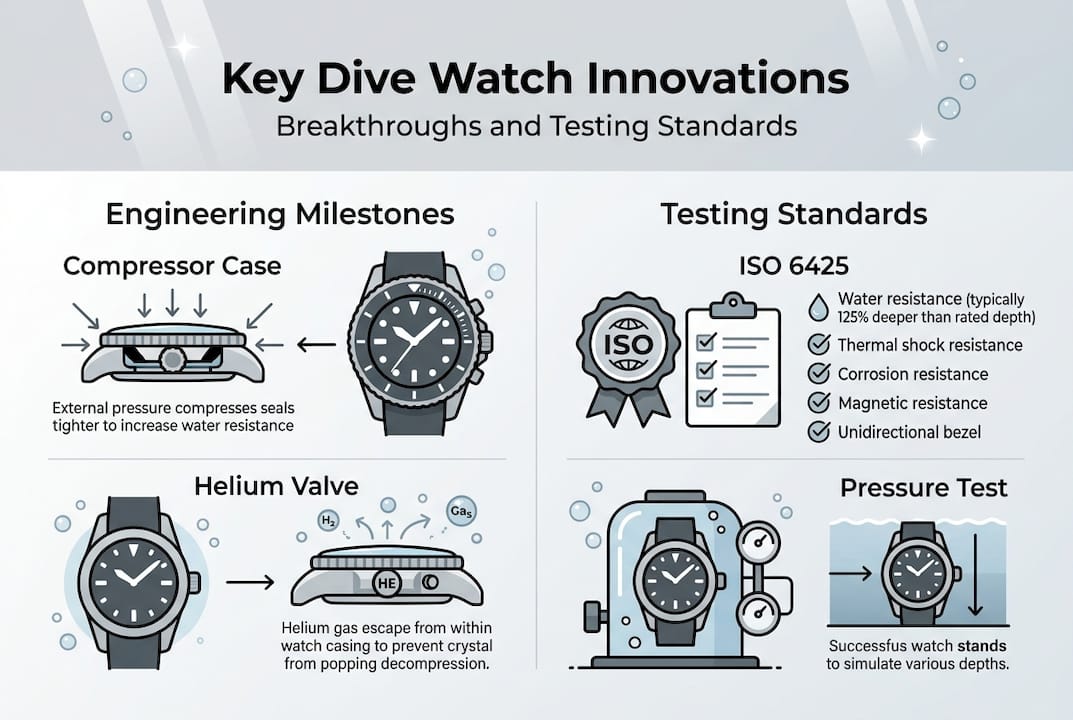
Materials alone don’t guarantee dive watch reliability. ISO 6425 certifies dive watches for pressure resistance, condensation control, legibility, and durability beyond simple depth ratings. This certification validates that your chosen material performs under actual testing protocols that simulate real diving stress.

ISO 6425 testing subjects materials to 125% of rated depth for two hours, followed by thermal shock tests cycling between 40°C and 5°C. Materials must maintain water resistance without condensation forming under the crystal. Corrosion resistance testing exposes watches to saltwater immersion for extended periods, revealing how materials degrade over time. These protocols ensure the stainless steel or titanium case you select will protect the movement during actual dives, not just in marketing specifications.

The helium escape valve is critical for professional saturation diving to prevent crystal failure during decompression. During saturation diving, helium molecules from breathing mixtures penetrate watch cases over days of pressurized habitat living. Without an escape valve, rapid decompression forces this trapped helium to explosively exit, often blowing off the crystal. Materials supporting helium valves must accommodate additional case penetrations while maintaining structural integrity and water resistance.

Key features working with materials:

  • ISO 6425 certification validating material performance under standardized tests
  • Helium escape valves requiring robust case materials for safe gas release
  • High-quality gasket systems depending on material surface finish for proper sealing
  • Sapphire crystals matched to case material thermal expansion rates
  • Crown systems designed for material-specific threading and seal compression
FeatureMaterial RequirementPerformance BenefitIdeal Use Case
ISO 6425 CertificationCorrosion-resistant alloyValidated underwater reliabilityAll professional diving
Helium Escape ValveStrong case walls for valve housingPrevents crystal blowoutSaturation diving only
Premium GasketsSmooth case finish for seal contactEnhanced water resistanceDeep technical diving
Anti-magnetic ShieldingNon-ferrous materials like titaniumMovement protectionScientific diving near equipment

Comparing watches with and without helium valves reveals distinct use cases. Recreational divers rarely exceed depths or durations requiring helium breathing mixtures, making escape valves unnecessary added complexity. Professional commercial divers working from saturation habitats absolutely require this feature, making it a critical specification when selecting materials that support the valve mechanism.

Material selection and special features work together to create dive watches that function reliably under extreme conditions. ISO certification and helium valves aren’t optional extras for serious professional diving, they’re essential validations that your chosen material will perform when your safety depends on it.

Understanding best dive watch brand features helps evaluate how manufacturers integrate materials with these critical performance features.

Explore premium dive watches with expert craftsmanship

Now that you understand how materials impact dive watch performance, discovering timepieces that showcase these principles becomes your next step. Aquastar manufactures professional mechanical dive watches using premium materials validated through decades of underwater innovation. Since pioneering dive watch technology in the 1960s, Aquastar has remained the only Swiss watchmaker born exclusively to create dive watches for serious underwater work.
https://aquastar.ch

Our collection features watches built with carefully selected materials, from corrosion-resistant stainless steel to lightweight titanium cases. Each timepiece incorporates lessons learned from creating the first analog dive computer and introducing the original skindiver case design. Today’s Aquastar watches serve commercial and recreational divers as reliable backup instruments to electronic dive computers.

Explore our guides on professional dive watch features guide to understand what makes a timepiece truly dive-capable, compare options in our dive watch brand comparison, or learn the fundamentals in our tool watch explained guide. These resources help you make informed decisions about materials, features, and specifications that match your diving needs.

Frequently asked questions

What is the difference between 316L and 904L stainless steel?

316L stainless steel provides excellent corrosion resistance and represents the industry standard for dive watch cases, offering proven performance at accessible price points. 904L stainless steel contains higher chromium and nickel content, delivering superior corrosion resistance and a brighter, more lustrous finish that maintains its appearance over decades. Luxury watchmakers choose 904L for premium dive watches where enhanced durability and aesthetics justify the increased manufacturing costs.

Why is titanium preferred for some dive watches over stainless steel?

Titanium weighs approximately 40-45% less than stainless steel, dramatically reducing wrist fatigue during extended dive operations or continuous wear. The material forms a self-healing titanium dioxide layer that provides superior corrosion resistance compared to stainless steel, particularly in harsh saltwater environments. Additionally, titanium’s lower thermal conductivity makes watches more comfortable against skin in extreme temperatures, whether diving in cold water or tropical conditions.

What does ISO 6425 certification guarantee for dive watches?

ISO 6425 certification validates that dive watches meet rigorous testing standards including pressure resistance to 125% of rated depth, condensation control during thermal shock, legibility in darkness, and corrosion resistance during extended saltwater exposure. This certification ensures watches function reliably under actual diving conditions rather than just meeting theoretical specifications. Unlike simple depth ratings, ISO 6425 confirms the entire watch system, including materials, gaskets, and construction, performs safely for professional underwater use.

Do all dive watches need a helium escape valve?

Helium escape valves are essential only for professional saturation diving, where divers live in pressurized habitats for extended periods breathing helium-oxygen mixtures. During saturation operations, helium molecules penetrate watch cases and must safely escape during decompression to prevent crystal blowout. Recreational divers who never use helium breathing mixtures or work from saturation systems don’t require this feature, making it unnecessary added complexity for typical sport diving applications.

Posted on

Master dive watch maintenance for lasting performance

Master dive watch maintenance for lasting performance - instructional dive watch maintenance

Instructional Dive Watch Maintenance: at a glance

Dive watch maintenance instruction: recognizing service needs, tools, step-by-step process and how to keep your Aquastar or vintage diver running well. Use this guide on instructional dive watch maintenance to weigh design choices, engineering trade-offs and how the category translates to real Aquastar dive watches.

TopicInstructional dive watch maintenance
Read time5-8 min
SourceAquastar editorial

Master dive watch maintenance for lasting performance - instructional dive watch maintenance

Your dive watch is engineered to withstand extreme underwater conditions, yet many owners overlook the critical maintenance that keeps these precision instruments reliable. Neglecting regular upkeep compromises water resistance, movement accuracy, and ultimately your safety during dives. Whether you own a vintage Aquastar or a modern professional dive watch, systematic maintenance protects your investment and ensures peak performance when you need it most. This guide delivers expert, actionable steps to maintain your dive watch’s durability and precision for years of dependable service.

Table of Contents

Key takeaways

PointDetails
Service intervals matterProfessional servicing every 5-10 years prevents movement damage and maintains water resistance certification.
Pressure testing is essentialAnnual pressure tests verify seal integrity and catch gasket degradation before water enters the case.
Daily cleaning prevents damageRinsing after each dive removes salt, chemicals, and debris that compromise bezels, crowns, and seals.
Movement type affects careAutomatic, manual, and quartz movements require different maintenance approaches and service schedules.
Warning signs need actionTiming errors, bezel issues, or moisture inside demand immediate professional attention to prevent costly repairs.

Recognizing when your dive watch needs maintenance

Understanding when your dive watch requires professional attention prevents minor issues from becoming expensive repairs. Manufacturer guidelines provide baseline service intervals, but your actual usage determines the real maintenance schedule. Rolex recommends servicing every ten years under normal conditions, but frequent diving demands more aggressive intervals. Aquastar watches used for commercial diving may need attention every three to five years due to constant pressure exposure and environmental stress.

Performance changes signal immediate maintenance needs. If your watch suddenly gains or loses more than a few seconds daily, the movement needs inspection. Bezel problems reveal themselves through inconsistent clicking, binding, or excessive play. Bezel issues like sticking or skipping indicate worn springs or debris accumulation requiring professional cleaning. Crown operation should feel smooth and positive. Difficulty screwing down the crown or resistance during winding suggests seal degradation or internal contamination.

Moisture inside the crystal represents a critical failure demanding immediate service. Even slight condensation indicates compromised seals allowing water penetration that will corrode the movement. Corrosion appears as discoloration on hands, dial markers, or case edges. These signs mean water has already entered, requiring complete disassembly, cleaning, and seal replacement.

Regular visual inspections catch problems early. Check for:

  • Crystal scratches or cracks that could compromise pressure resistance
  • Loose bezel movement or missing bezel insert markings
  • Discoloration around crown or case back indicating seal failure
  • Bracelet stretch or loose links that stress case lugs
  • Fading lume that signals moisture exposure

Lubricant breakdown occurs invisibly but causes serious damage. Even if your watch runs accurately, oils dry out over time, increasing friction and wear. Professional watchmakers inspect lubricant condition during service, replacing degraded oils before metal-on-metal contact damages pivots and jewels. Understanding these warning signs helps you maintain both performance and value, especially important for collectors tracking their dive watch investments. Catching issues early preserves your watch’s reliability when backing up dive computers during critical underwater operations.

Essential tools and materials needed for dive watch maintenance

Proper equipment protects your watch during basic maintenance and prepares it for professional servicing. You need specialized tools that prevent damage to precision components and waterproof seals. Basic cleaning requires soft-bristled brushes, microfiber cloths, and mild soap formulated for watches. Avoid household cleaners containing ammonia, bleach, or harsh chemicals that degrade rubber gaskets and damage finishes.

Pressure testing equipment verifies water resistance but requires professional calibration. Home pressure testers lack the accuracy needed for dive watches rated beyond 100 meters. Professional watchmakers use calibrated systems that simulate depth conditions and detect microscopic seal failures invisible to visual inspection.

Tool/MaterialPurposeSafety Notes
Soft-bristled brushRemove debris from bezel and braceletAvoid stiff bristles that scratch
Microfiber clothsDry and polish without scratchingNever use paper towels
Mild soap solutionClean case and braceletRinse thoroughly after
Distilled waterFinal rinse to prevent mineral depositsTap water leaves residue
Case back openerAccess movement for battery changesWrong tool damages case threads

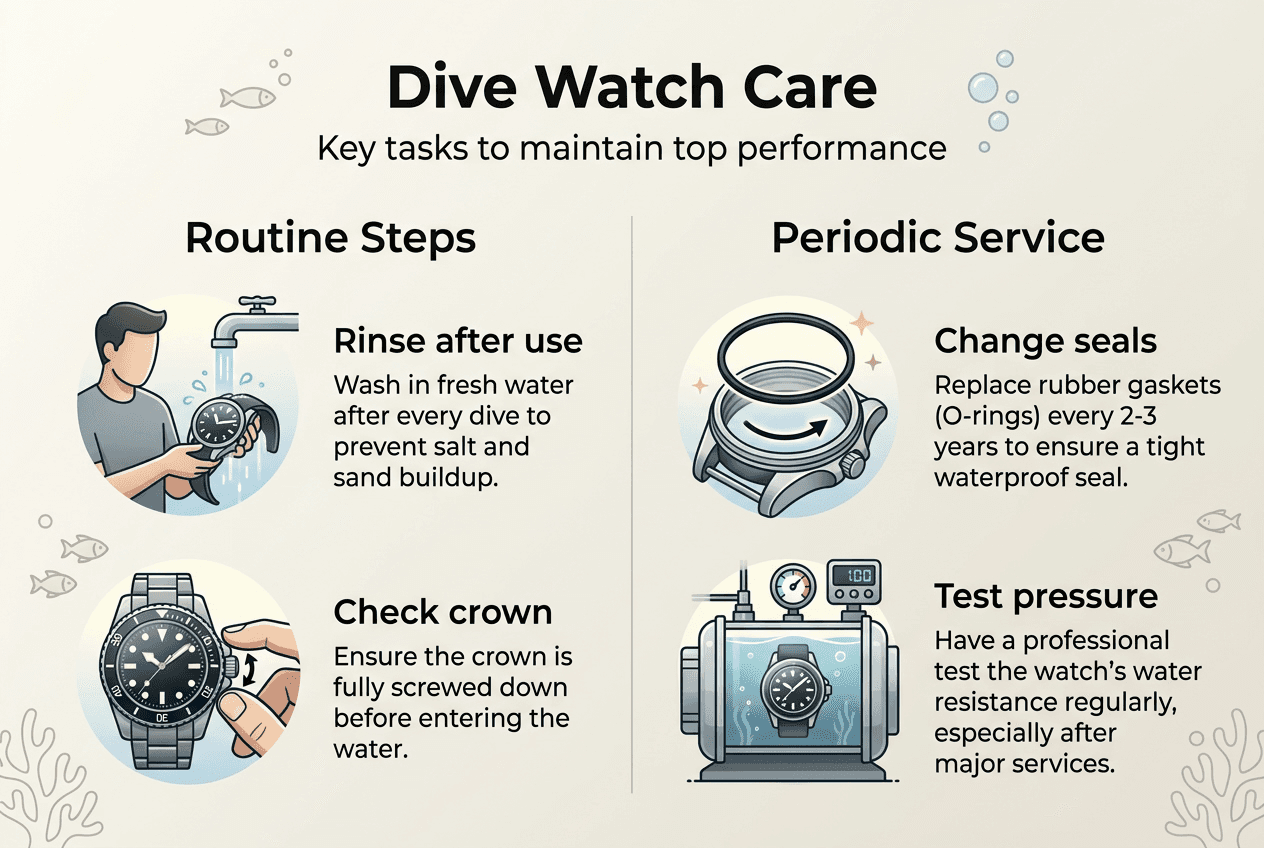
Rinsing after every dive represents the most critical maintenance step you can perform. Salt crystals, pool chemicals, and sand accumulate in bezels, crown threads, and bracelet links, compromising seals and causing corrosion. Rinse in lukewarm fresh water for at least 30 seconds, rotating the bezel and operating the crown while submerged to flush contaminants. Never use hot water, which can damage gaskets and affect lubricants.

Strap materials demand specific care approaches:

  • Rubber straps tolerate aggressive cleaning but degrade from UV exposure and oils
  • NATO straps should be removed and hand washed separately to prevent trapped moisture
  • Leather straps require immediate removal after water exposure and proper drying
  • Metal bracelets benefit from ultrasonic cleaning to remove trapped debris

Preparation prevents damage during maintenance. Always verify the crown is fully screwed down before water exposure. Check that pushers remain untouched underwater, as operating chronograph functions while submerged allows water entry even in rated watches. Store your watch in a cool, dry location away from magnetic fields that affect movement accuracy. Understanding tool watch essentials helps you appreciate why proper equipment matters for maintaining professional dive instruments. Gathering the right materials before starting maintenance ensures you can complete tasks safely without improvising tools that risk damaging your watch.

Step-by-step dive watch maintenance process

Professional dive watch servicing follows a systematic process ensuring every critical component receives proper attention. Understanding these steps helps you appreciate the complexity involved and recognize quality service. The process begins with complete disassembly, documenting the watch’s condition and identifying worn parts requiring replacement.

  1. Visual inspection examines case, crystal, and movement for damage or wear
  2. Seal and gasket removal prepares for cleaning and replacement
  3. Movement extraction separates caliber from case for individual servicing
  4. Ultrasonic cleaning removes old lubricants, debris, and contaminants
  5. Component inspection identifies worn pivots, jewels, or mainspring issues
  6. Lubrication applies fresh oils to specific points following manufacturer specifications
  7. Reassembly rebuilds the movement with precise adjustments
  8. Timing regulation ensures accuracy within certified specifications
  9. Case refinishing addresses scratches while preserving original dimensions
  10. New seal installation replaces all gaskets with manufacturer-approved parts
  11. Pressure testing verifies water resistance at rated depth
  12. Final quality control confirms all functions operate correctly

Regular seal replacement maintains water resistance as gaskets degrade from pressure cycles, temperature changes, and time. Even unworn watches need seal replacement every few years as rubber compounds lose elasticity. Professional service includes visual inspection, seal replacement, lubrication, ultrasonic cleaning, pressure testing, water resistance certification, and full functionality verification.

Movement type determines specific maintenance requirements:

Movement TypeService IntervalKey Maintenance Focus
Automatic5-7 yearsRotor bearing lubrication, mainspring tension
Manual wind7-10 yearsCrown stem seals, winding mechanism wear
Quartz2-3 years (battery)Circuit board corrosion, coil inspection

Automatic movements require rotor bearing inspection since constant motion wears pivots faster than manual calibers. The automatic vs manual debate affects maintenance approaches, with automatics needing more frequent lubrication due to additional components. Manual movements benefit from simpler construction but demand careful crown seal maintenance since winding creates more opportunities for water ingress.

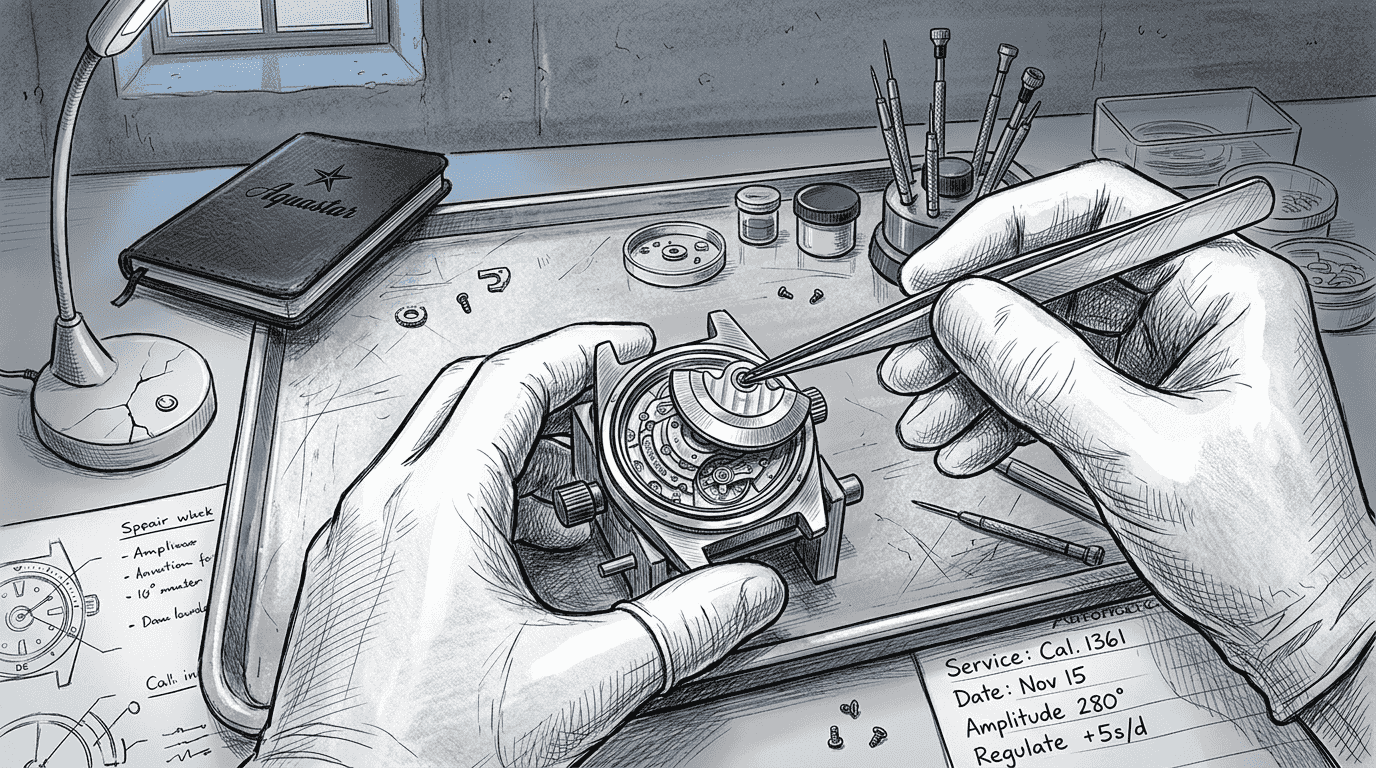
Gloved hands inspecting dive watch rotor

Pro Tip: Never operate chronograph pushers or adjust the time while your watch is wet or underwater, even if rated for the depth. Water pressure forces moisture past seals designed only for static resistance, causing immediate movement damage that voids warranties.

Pressure testing certification provides documented proof your watch meets its rated water resistance. Technicians subject the watch to simulated depth conditions, monitoring for pressure loss or moisture penetration. Certification confirms your watch can safely back up dive computers during actual underwater operations. Routine maintenance following this systematic process prevents the catastrophic failures that occur when watches lose pressure integrity during dives. Investing in proper servicing protects both your watch and your safety.

Infographic with key dive watch maintenance tasks

Verifying maintenance success and troubleshooting common issues

Confirming your dive watch performs correctly after maintenance ensures the service met professional standards. Timing accuracy represents the first verification point. Place your watch on a timegrapher or use smartphone apps that measure rate deviation. Mechanical movements should maintain accuracy within manufacturer specifications, typically plus or minus five seconds daily for quality calibers. Quartz movements demand tighter tolerances, usually within 15 seconds monthly.

Pressure testing remains crucial for verifying water resistance after any service involving case opening. Request documentation showing your watch passed testing at its rated depth. Reputable service centers provide certification cards listing test results, service date, and technician identification. Without pressure testing, you cannot trust your watch’s water resistance regardless of seal replacement.

Post-service inspection reveals potential issues:

  • Bezel action should feel crisp with consistent clicking at each position
  • Crown operation must feel smooth when unscrewing, pulling, and winding
  • Crystal should show no condensation after temperature changes
  • All functions including date change and chronograph must operate correctly
  • Case finishing should appear uniform without new scratches from service

Timing problems after service indicate incomplete regulation or movement issues. Sudden gains or losses exceeding a few seconds daily signal problems requiring immediate return to the watchmaker. Magnetization from service equipment can affect accuracy. Demagnetization takes seconds and should be included in professional service.

Seal failures appear through moisture or pressure loss. Condensation forming during temperature changes indicates compromised water resistance. Return the watch immediately before water damages the movement. Reputable watchmakers guarantee their seal work and will correct failures at no charge. Bezel or crown stiffness suggests improper lubrication or debris trapped during assembly.

Pro Tip: Maintain a detailed service log recording dates, work performed, costs, and watchmaker contact information. This documentation helps track service intervals, proves maintenance history for resale value, and identifies patterns if problems recur with specific watchmakers.

Common troubleshooting steps resolve minor issues:

  • Wind automatic watches fully if they stop after sitting unused
  • Verify crown is completely screwed down if water resistance seems compromised
  • Check that date changes occur at midnight, not noon, by observing over 24 hours
  • Ensure chronograph hands reset to zero when testing function
  • Confirm bezel rotates freely in both directions for timing functionality

Maintaining dive watch value requires documentation proving proper care. Keep all service receipts, pressure test certificates, and parts replacement records. Original boxes and papers combined with maintenance documentation significantly increase resale value for collectors. Verification ensures your investment receives the care it deserves while confirming your watch will perform reliably when you depend on it during dives. Professional service should leave your watch functioning better than before, with documented proof of the work completed.

Explore expert dive watches and maintenance resources

Aquastar’s heritage as the only Swiss watchmaker born exclusively to manufacture dive watches ensures every timepiece embodies professional reliability. From pioneering the first analog dive computer to introducing the revolutionary skindiver case, Aquastar’s innovations paved the road for modern dive watch design. Today’s Aquastar collection continues this legacy, providing commercial and recreational divers with mechanical timepieces engineered to back up dive computers with proven dependability.

https://aquastar.ch

Deepen your understanding of professional dive watches through Aquastar’s comprehensive guides. Explore the tool watch heritage that defines purpose-built timepieces designed for demanding environments. Compare automatic versus manual movements to determine which caliber best suits your diving needs and maintenance preferences. Discover the essential features that separate genuine professional dive watches from fashion pieces, ensuring your next timepiece delivers the reliability your underwater adventures demand.

FAQ

How often should I service my dive watch?

Service intervals depend on usage intensity and environmental exposure. Rolex recommends servicing every ten years under normal wearing conditions, but five to seven years for frequent underwater use. Commercial divers using their watches daily in harsh conditions should consider three to five year intervals. Annual pressure testing between full services catches seal degradation early.

What are the signs that my waterproof seals need replacement?

Difficulty operating the crown or bezel often signals degraded seals creating excessive friction. Visible moisture inside the crystal represents critical seal failure requiring immediate service. Annual pressure testing reveals seal degradation before visible symptoms appear. Water resistance depends on gasket condition, with replacement recommended every one to two years for frequently used dive watches.

Can I perform dive watch maintenance myself?

Basic cleaning and rinsing after dives safely extends time between professional services. Proper rinsing removes contaminants you can manage at home using fresh water and mild soap. However, pressure testing, seal replacement, and movement lubrication require certified professionals with calibrated equipment. Attempting these tasks without proper training and tools risks catastrophic water damage and voided warranties.

Why does my dive watch need pressure testing after battery changes?

Opening the case back exposes seals to contamination and potential damage during reassembly. Even careful battery replacement can compromise water resistance if seals are not properly cleaned, lubricated, and seated. Pressure testing verifies the case was correctly sealed and confirms your watch maintains its rated depth protection. Without testing, you risk water damage during your next dive.

How do I know if my watchmaker provides quality dive watch service?

Quality watchmakers provide detailed documentation including pressure test results, parts replaced, and service guarantees. They use manufacturer-approved seals and lubricants rather than generic substitutes. Ask about their pressure testing equipment calibration and certification. Reputable services return your watch with timing documentation and warranty coverage for their work, typically six months to one year.

Posted on

Dive watch restoration steps: vintage Aquastar guide 2026

Dive watch restoration steps: vintage Aquastar guide 2026 - dive watch restoration steps

Dive Watch Restoration Steps: at a glance

Dive watch restoration steps: preparation, evaluation, Aquastar-specific components and how to preserve collector value while restoring function. Use this guide on dive watch restoration steps to weigh design choices, engineering trade-offs and how the category translates to real Aquastar dive watches.

TopicDive watch restoration steps
Read time5-8 min
SourceAquastar editorial

Dive watch restoration steps: vintage Aquastar guide 2026 - dive watch restoration steps

Restoring a vintage dive watch, especially a Swiss or Aquastar model, demands precision and respect for its heritage. Collectors often struggle with knowing the proper restoration steps, risking devaluation or damage to these prized timepieces. This guide walks you through the complete restoration process, from preparation to final testing, ensuring you preserve both functionality and collector value. You’ll learn how to handle Aquastar-specific components, avoid common mistakes, and verify your watch meets professional dive standards. Whether you’re restoring an Aquastar Model 60 or another Swiss vintage diver, these steps will help you maintain authenticity while bringing your watch back to reliable performance.

Table of Contents

Key takeaways

PointDetails
Stepwise approachFollow a systematic process from evaluation through testing to ensure thorough, respectful restoration
Preserve originalityMaintain water resistance and original patina using period-appropriate parts and Swiss movement oils
Testing mattersConduct accuracy checks and pressure testing to verify dive watch functionality and safety
Expert helpConsider professional specialist service for high-value collector watches to avoid irreversible mistakes

Preparation: tools, materials, and evaluation

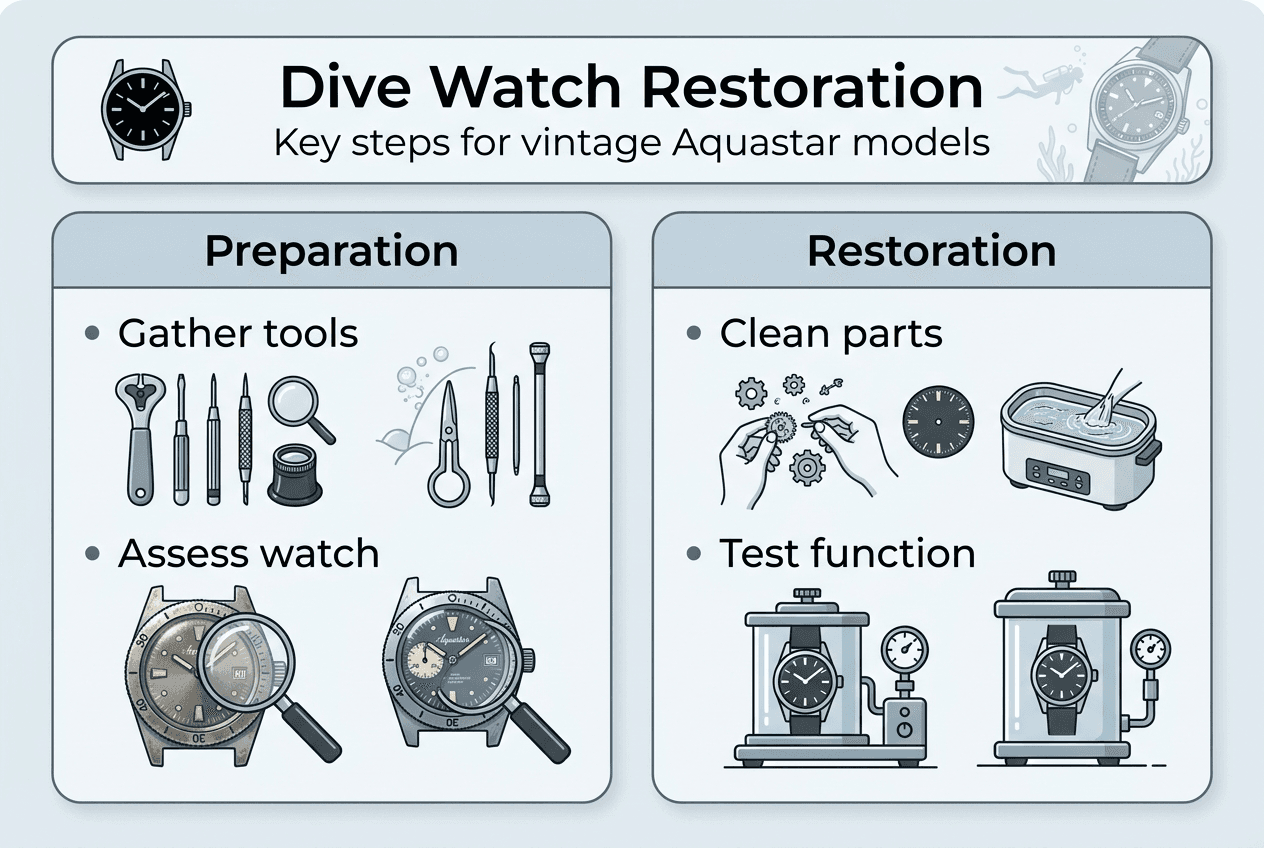
Before you touch your vintage dive watch, gather the right tools and assess its condition. You’ll need specialized watchmaker’s screwdrivers in multiple sizes, a case opener designed for screw-down backs, rodico for dial cleaning, pegwood for pivot work, and a quality cleaning solution like L&R or One Dip. A pressure tester is essential for dive watches, along with timing equipment to verify accuracy post-restoration. Don’t forget a loupe for inspecting movement components and tweezers with fine tips for delicate work.

Your initial evaluation determines the restoration scope. Examine the dial for moisture damage, patina, or reluming signs. Check the case for deep scratches, corrosion, or polishing evidence that might have softened edges. Inspect the movement through the case back, looking for rust, broken parts, or dried lubricants. This assessment helps you decide whether to proceed yourself or seek professional help. Pro Tip: Photograph every angle of your watch before starting, capturing dial details, case condition, and movement state to document original condition and guide reassembly.

Vintage watches typically need restoration every 4-5 years to maintain performance. When identifying genuine dive watches, pay attention to case construction and water resistance features that distinguish authentic tool watches from dress models. Understanding dive watch cases helps you recognize proper gasket placement and screw-down crown mechanisms.

MaterialPurposeSpecification
Movement oilLubricate pivots and jewelsMoebius 9010 for train wheels
GreaseCrown, stem, gasketsMoebius 8200 or silicone grease
Cleaning solutionRemove old oils and debrisL&R #566 or One Dip
GasketsRestore water resistanceSize-matched nitrile or silicone
CrystalsReplace scratched acrylicPeriod-correct thickness and diameter

Create a checklist before proceeding. Can you source replacement parts if needed? Do you have the skills to disassemble a vintage movement without breaking fragile components? Is the dial damage reversible, or does it require professional refinishing? If your watch has significant water damage, corroded movement parts, or a rare dial variant, professional servicing protects your investment better than amateur attempts.

Infographic with main dive watch restoration steps

Step-by-step restoration process for vintage dive watches

With your workspace prepared, begin the systematic restoration of your vintage Aquastar or Swiss dive watch. This process requires patience and attention to detail at every stage.

  1. Remove the movement from the case by unscrewing the case back and carefully extracting the stem after releasing the stem lever.
  2. Photograph the dial side before removing hands using a hand puller, working from seconds hand to hour hand to avoid damage.
  3. Remove the dial by loosening dial feet screws, then flip the movement to access the gear train.
  4. Disassemble the movement systematically, starting with the balance cock, then the train bridge, working toward the mainspring barrel.
  5. Clean all components in your cleaning solution using a watch cleaning machine or careful manual cleaning with separate baths.
  6. Inspect each part under magnification for wear, checking pivots, jewels, and gear teeth for damage requiring replacement.
  7. Dry components thoroughly using compressed air or allowing them to air dry on a clean surface.
  8. Reassemble the movement, applying fresh oils sparingly to pivot points and jewels according to manufacturer specifications.
  9. Regulate the balance wheel and hairspring, ensuring proper beat and amplitude before casing.
  10. Replace all gaskets with correct sizes, lubricating them lightly with silicone grease for proper sealing.
  11. Reinstall the dial and hands, ensuring proper alignment and clearance between all components.
  12. Case the movement carefully, verifying crown operation and stem engagement before final assembly.

For Aquastar-specific models, pay special attention to these components:

  • Bezel springs and click mechanisms that may need fabrication if originals are damaged or missing
  • AS 1701 movement stems that require period-correct replacements for proper crown function
  • Original crowns with correct thread pitch and gasket dimensions for water resistance
  • Dial feet positions that vary between Model 60 and later references

Reluming requires careful consideration of value versus functionality. Period-correct lume preserves value and maintains authenticity, while modern lume improves usability but signals restoration to collectors. Consider this comparison:

ApproachAppearanceValue ImpactFunctionality
Original patinaAged, cream to brownHighest collector valueMinimal night visibility
Period-correct relumeVintage white/cream toneMaintains strong valueModerate visibility
Modern Super-LumiNovaBright white or greenReduces collector valueExcellent night visibility

Pro Tip: Avoid over-polishing your case, which removes metal and softens the crisp edges that define vintage Aquastar Model 60 cases. Light cleaning with cape cod cloth preserves the tool watch character collectors prize. Understanding the difference between automatic vs manual dive watches helps you service the correct movement type, and comparing best dive watch brands gives context for Aquastar’s unique position in vintage collecting.

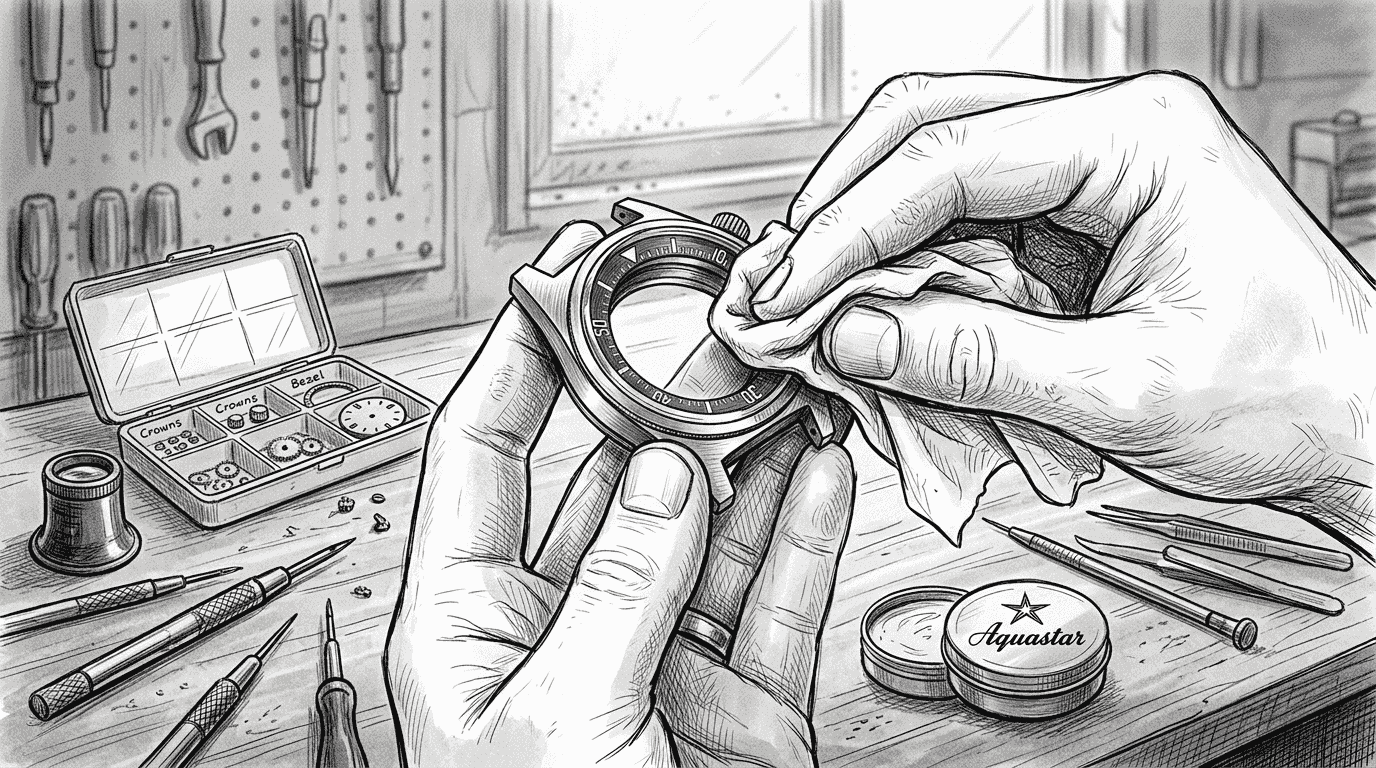
Hands gently polishing vintage watch case

Troubleshooting common issues and avoiding restoration mistakes

Even experienced restorers encounter challenges that can compromise a vintage dive watch’s value or function. Recognizing these pitfalls before they occur saves you from costly errors.

Common mistakes that damage vintage watches:

  • Over-polishing cases until edges become rounded and lug profiles lose definition
  • Using inappropriate modern lume that creates obvious restoration evidence
  • Skipping pressure testing after reassembly, risking water damage on first wearing
  • Replacing original dials with aftermarket versions that destroy collector value
  • Forcing stuck components instead of applying proper penetrating solutions
  • Mixing lubricants or using incorrect oils that gum up over time

Water damage presents unique restoration challenges. If you discover moisture inside the case, address it immediately before disassembly spreads corrosion. Remove the movement and inspect for rust on steel components, particularly the balance cock, bridges, and screws. Light surface rust responds to careful cleaning with rodico and gentle brushing, but deep pitting requires part replacement. Never attempt to restore a movement with active corrosion without first stabilizing and removing all rust.

Expert watchmakers warn that over-restoration, particularly dial refinishing, can reduce a vintage watch’s value by 60-70% compared to original condition. Collectors prize authenticity over perfection, making preservation of original components critical to maintaining investment value.

Original dials increase value 3-5x compared to refinished versions, even when the original shows age-appropriate patina or minor damage. Before sending a dial out for refinishing, consult with specialists and collector communities to understand how the work will affect your specific model’s value. Some tropical dials or naturally aged examples command premiums precisely because of their patina.

Sourcing obsolete parts challenges vintage restoration. When original components aren’t available, consider donor movements from the same caliber family. Aquastar used AS 1700 series movements in many models, allowing parts interchange between references. Join collector forums and establish relationships with vintage parts suppliers who specialize in 1960s Swiss movements. Sometimes fabricating bezel components becomes necessary when originals are unavailable.

Preserving patina maintains authenticity and value. That aged lume, tropical dial color, or ghost bezel insert tells your watch’s story. Clean gently rather than aggressively, removing only dirt and oils while leaving the natural aging process intact. When collecting dive watches, experienced collectors recognize that honest wear and original patina often indicate proper storage and care throughout a watch’s life.

Verifying restoration success: testing accuracy and water resistance

Restoration isn’t complete until you verify your vintage dive watch performs to specification. Testing confirms your work meets both timekeeping and water resistance standards essential for dive watches.

Timing and regulation testing procedures:

  • Run the watch for 24 hours in dial-up position, recording gain or loss
  • Test dial-down position for another 24 hours to check positional variance
  • Evaluate crown-up and crown-down positions if your watch will see active use
  • Calculate average daily rate across all positions for comprehensive accuracy assessment
  • Adjust regulator pins incrementally, retesting after each adjustment until achieving target accuracy

Aim for ±60-90 seconds daily with vintage mechanical movements. This range represents realistic expectations for watches from the 1960s and 1970s, balancing performance with the limitations of older technology. Modern chronometer standards don’t apply to vintage pieces, so adjust your expectations accordingly. Test for 24-48 hour periods to identify consistent patterns rather than short-term variations.

Pressure testing specifications for vintage dive watches:

Watch RatingTest PressureHold DurationPass Criteria
200m vintage diver20-22 bar (290-320 psi)60 seconds minimumZero pressure loss, no moisture
300m vintage diver30-33 bar (435-480 psi)60 seconds minimumZero pressure loss, no moisture
Skin diver (30-50m)5-7 bar (70-100 psi)30 seconds minimumZero pressure loss, no moisture

Never exceed the original rated depth when pressure testing vintage watches. Gasket materials age, case metal fatigues, and crystal seals weaken over decades. Test conservatively, and consider that a 50-year-old 200m diver should prove water resistance at that depth, not exceed it. Annual pressure testing protects against gasket degradation if you wear your vintage diver regularly.

Pro Tip: Document all test results, service dates, and parts replaced in a restoration log. This record increases resale value by proving proper maintenance and helps future owners understand the watch’s service history. Include timing results, pressure test outcomes, and photographs of the movement before and after service.

Schedule ongoing maintenance strategically:

  • Pressure test annually if wearing the watch in wet conditions
  • Full service every 4-5 years to refresh lubricants and replace gaskets
  • Visual inspection every 6 months for moisture, accuracy drift, or operation issues
  • Store properly between wearings in a cool, dry environment away from magnetic fields

Understanding must-have professional diver features helps you evaluate whether your restored watch meets the standards that made vintage Aquastar models trusted tools for commercial and recreational divers. Your restoration should honor that professional heritage while ensuring the watch remains a reliable timepiece for modern collectors.

Explore authentic Aquastar dive watches and expert guides

https://aquastar.ch

Restoring vintage dive watches connects you to horological history, but sometimes starting with an authentic Aquastar model offers the reliability and heritage you seek without restoration challenges. Aquastar pioneered professional dive watch innovations in the 1960s, creating patents that shaped modern dive watch design. As the only Swiss maker born exclusively to produce dive watches, Aquastar’s heritage runs deep. Explore our comprehensive guide to collecting dive watches to understand what makes certain models valuable, or dive into our tool watch explanation to appreciate the engineering behind professional timepieces. Whether you’re restoring vintage pieces or considering a modern Aquastar with professional diver features, understanding these watches’ DNA enriches your appreciation for their role in diving history.

Frequently asked questions

What are the essential tools needed for dive watch restoration?

You need watchmaker’s screwdrivers in sizes 0.60mm to 1.60mm, a quality case opener for screw-down backs, and a hand puller for safely removing watch hands. Add a pressure tester capable of reaching your watch’s rated depth, timing equipment for regulation, and proper cleaning solutions like L&R #566. Rodico, pegwood, tweezers, and a loupe complete your basic toolkit. Investing in proper tools prevents damage that amateur attempts with improvised equipment often cause.

How often should a vintage dive watch be serviced?

Service your vintage mechanical watch every 4-5 years to maintain optimal performance, with some robust calibers extending to 6-7 years between services. Between full services, pressure test annually if you expose the watch to water, ensuring gaskets maintain their seal. Regular servicing prevents wear from dried lubricants and catches small issues before they become expensive repairs.

Can reluming affect the value of a vintage dive watch?

Reluming significantly impacts collector value, with original dials worth 3-5x more than refinished versions. Collectors prize original patina, even when aged to brown or cream tones, as evidence of authenticity. If you relume for usability, choose period-correct materials that match vintage appearance rather than modern bright lume. Consider whether you’re restoring a user watch or a collector piece before deciding to relume.

What accuracy should I expect after restoring my vintage dive watch?

Target ±60-90 seconds per day accuracy after properly servicing a vintage mechanical movement. This range reflects realistic performance from 1960s and 1970s technology, significantly looser than modern chronometer standards. Regular regulation and proper lubrication help achieve consistent timekeeping. If your watch falls outside this range, check for magnetization, balance issues, or insufficient lubrication requiring additional adjustment.

Posted on

What is a microbrand watch? Craftsmanship & value guide

What is a microbrand watch? Craftsmanship & value guide - what is a microbrand watch

What Is A Microbrand Watch: at a glance

What is a microbrand watch? Limited production runs, direct sales, transparent pricing and the mechanical movements behind microbrand dive watches. Use this guide on what is a microbrand watch to weigh design choices, engineering trade-offs and how the category translates to real Aquastar dive watches.

TopicWhat is a microbrand watch
Read time5-8 min
SourceAquastar editorial

What is a microbrand watch? Craftsmanship & value guide - what is a microbrand watch

Many collectors assume microbrand watches are inferior knockoffs or obscure novelties. This misconception misses the real story: microbrands deliver mechanical craftsmanship, innovative dive features, and exceptional value at accessible prices. Watch enthusiasts recognize microbrands as creative alternatives to luxury giants, offering limited production runs, direct sales, and transparent pricing. This guide explores what defines a microbrand watch, the mechanical movements and dive specs they use, business realities they face, and how to appreciate and collect these timepieces. Whether you seek a reliable dive watch or a unique collector piece, understanding microbrands empowers smarter choices and deeper appreciation for horological innovation.

Table of Contents

Key takeaways

PointDetails
DefinitionSmall independent companies produce limited runs, typically 300-1000 units per model, sold direct to consumers under $2000.
Mechanical movementsCommon calibers include Seiko NH35, Miyota 9015/9039, and Sellita SW200-1, offering 38-42 hour power reserves and 200-500m water resistance.
Business challengesStartup costs average $110k with 39% Kickstarter success rates, while quality control and after-sales service vary significantly.
Growth potentialSome microbrands scale to major enterprises like Christopher Ward, which reached $49M revenue, driven by 22% market CAGR.
Collector valueLimited production creates exclusivity, but verify warranty, service options, and spare parts availability before purchasing.

What defines a microbrand watch?

A microbrand watch is produced by small independent companies with limited runs and direct-to-consumer sales, often priced under $2000. These operations typically involve one founder or a small team focused on creative design rather than mass production. Annual output stays under 5000 watches total, with individual models limited to 300-1000 units. This scale allows microbrands to experiment with bold aesthetics, niche complications, and specialized features that larger manufacturers avoid.

Most microbrands bypass traditional retail channels, selling directly through websites or crowdfunding platforms. This approach eliminates dealer markups and enables competitive pricing. You pay for materials and craftsmanship, not marketing budgets or boutique overhead. The sub-$2000 price point positions microbrands between fashion watches and luxury brands, offering mechanical movements and quality finishing at accessible costs.

Manufacturers often run by one person or small teams focusing on creativity prioritize community engagement over volume sales. Founders interact directly with customers through forums, social media, and email, building loyal followings. This transparency extends to production processes, with many brands documenting assembly, sourcing, and design decisions publicly. Collectors value this authenticity and connection to the maker.

Production constraints shape microbrand identity. Limited runs create natural scarcity, appealing to collectors seeking exclusivity without luxury price tags. However, small batches also mean fewer economies of scale, higher per-unit costs, and potential service challenges if a brand discontinues operations. Understanding these tradeoffs helps you evaluate whether a microbrand aligns with your collecting goals.

Microbrands excel in niche categories like dive watches, field watches, and pilot chronographs. They often reinterpret vintage designs with modern materials and movements, appealing to enthusiasts who appreciate tool watches with functional heritage. This focus on specific genres allows microbrands to develop expertise and community credibility within their chosen specialty.

Infographic showing microbrand watch core features

Mechanical movements and dive watch specs common to microbrands

Microbrands rely on proven mechanical calibers from established suppliers. The Seiko NH35 runs at 21,600 vibrations per hour with 38-hour power reserve, offering reliable timekeeping at low cost. The Miyota 9015 and 9039 operate at 28,800 vph with 42-hour reserves, providing smoother seconds hand sweep and better shock resistance. The Sellita SW200-1, a Swiss alternative to the ETA 2824-2, also runs at 28,800 vph with 38-hour reserve, appealing to brands emphasizing Swiss provenance.

These movements deliver comparable performance to luxury calibers at a fraction of the cost. Microbrands use reliable mechanical movements like Seiko NH35, Miyota 9015/9039, and Sellita SW200-1, offering high specs at accessible prices. The NH35 costs manufacturers around $30-40, while the Miyota 9015 runs $50-70, and the Sellita SW200-1 reaches $100-150. This cost efficiency allows microbrands to invest in cases, crystals, and finishing while maintaining competitive retail prices.

Dive watch specifications among microbrands typically include 200-500m water resistance, screw-down crowns, and unidirectional bezels. Case sizes range from 40-43mm diameter with 11-13mm thickness, balancing wrist presence with comfort. Sapphire crystals with anti-reflective coatings protect dials, while ceramic bezel inserts resist scratching and fading. Lume quality varies, but many microbrands use Swiss Super-LumiNova for long-lasting visibility underwater.

Detailed macro shot of dive watch features

| Movement | Frequency | Power Reserve | Typical Cost |
| — | — | — |
| Seiko NH35 | 21,600 vph | 38 hours | $30-40 |
| Miyota 9015 | 28,800 vph | 42 hours | $50-70 |
| Sellita SW200-1 | 28,800 vph | 38 hours | $100-150 |

Pro Tip: Understanding movement specs helps you spot quality microbrand watches. A 28,800 vph movement offers smoother operation than 21,600 vph, while Swiss calibers like Sellita provide servicing advantages over Japanese alternatives in some regions.

Bracelet and strap quality significantly impacts wearing experience. Microbrands often include multiple strap options, from rubber dive bands to NATO textiles and steel bracelets. Solid end links, milled clasps, and tool-free micro-adjustments distinguish well-executed designs from budget compromises. Comparing these details across brands reveals which prioritize complete package value versus cutting costs on secondary components.

Some microbrands differentiate through proprietary complications or case designs. Limited budgets prevent in-house movement development, but creative case architecture, dial layouts, and finishing techniques create distinctive identities. This innovation appears in automatic vs manual dive watches comparisons, where microbrands explore both winding systems to serve different user preferences. Evaluating these must have diver watch features helps you identify brands pushing boundaries versus those simply assembling commodity parts.

Business realities and growth potential of microbrand watches

Startup costs average $110k for minimum 300-unit orders with typical unit costs of $200-367, creating significant financial barriers. Founders must secure funding, negotiate with suppliers, and manage inventory risk before generating revenue. Minimum order quantities from case manufacturers, dial makers, and movement suppliers force microbrands to commit capital upfront, often through personal savings or crowdfunding.

Kickstarter campaigns achieve 39% success rates in the watch category, meaning six in ten projects fail to reach funding goals. Successful campaigns still face fulfillment challenges, including production delays, quality control issues, and shipping logistics. Backers sometimes wait months beyond projected delivery dates, testing brand credibility and customer patience. This volatility makes microbrand investments riskier than established manufacturer purchases.

Quality control varies dramatically across microbrands. Small operations lack dedicated QC departments, relying on founders or contract inspectors to catch defects. Inconsistent finishing, misaligned chapter rings, or faulty movements occasionally slip through, damaging reputations and resale values. After-sales service presents similar challenges, as microbrands may lack parts inventory or technical expertise for complex repairs. These factors contribute to lower resale values compared to luxury brands with established service networks.

FactorMicrobrand RealityLuxury Brand Standard
Startup investment$110k minimum$1M+ typical
Production volume300-1000 units/model10,000+ units/model
Resale value40-60% of retail60-90% of retail
Service networkLimited or noneGlobal authorized centers

Some microbrands transcend their origins to become major players. Christopher Ward grew from microbrand roots to $49M revenue, demonstrating scalability when quality and marketing align. The microbrand market grows at 22% CAGR from 2020-2025, reflecting increasing consumer interest in alternatives to luxury giants. This growth attracts venture capital and acquisition interest, potentially transforming successful microbrands into mid-tier manufacturers.

Pro Tip: Check for brand sustainability and parts availability when buying microbrands. Brands with transparent supply chains, published service policies, and active customer communities offer better long-term ownership experiences than those operating opaquely.

Founder dependency creates vulnerability. If the sole operator loses interest, faces health issues, or pursues other ventures, the brand may cease operations without succession planning. Customers holding watches from defunct microbrands struggle to source replacement parts or warranty service. This risk distinguishes microbrands from corporations with institutional continuity, making due diligence essential before purchase.

Direct-to-consumer models benefit customers through lower prices but limit try-before-you-buy opportunities. Viewing watches only through photos and videos makes assessing finishing quality, lume brightness, and wearing comfort difficult. Return policies vary, with some brands charging restocking fees or limiting return windows. Comparing best dive watch brands helps contextualize microbrand offerings against established alternatives, while learning to identify genuine dive watches prevents purchasing watches with exaggerated specifications.

How to appreciate and collect microbrand dive watches

Understanding a brand’s production philosophy reveals its commitment to quality and community. Research founder backgrounds, design inspirations, and manufacturing partnerships. Brands transparent about sourcing, assembly locations, and quality control processes typically deliver better products than those making vague claims about Swiss or Japanese origins. Community engagement through forums, social media, and customer service responsiveness indicates brands invested in long-term relationships versus quick sales.

Evaluating technical specs requires comparing claimed specifications against independent testing when available. Water resistance ratings should include pressure testing documentation, while lume performance benefits from real-world photos in dark conditions. Movement accuracy claims need context, as COSC certification costs prohibit most microbrands from official chronometer testing. Independent reviewers and owner forums provide valuable verification of manufacturer claims.

Limited production creates collector appeal but introduces service risks. Exclusive releases with numbered editions or unique dial variants attract enthusiasts seeking rarity. However, discontinued models may lack replacement parts if components fail years later. Balancing exclusivity against practical serviceability requires weighing your collecting priorities. Some collectors accept service limitations for unique pieces, while others prioritize long-term wearability over scarcity.

  1. Research brand history and founder credentials through independent reviews and community forums.
  2. Verify movement specifications and water resistance claims against industry standards.
  3. Assess warranty terms, service policies, and parts availability before purchasing.
  4. Engage with owner communities to learn about real-world performance and brand responsiveness.
  5. Compare pricing against similar specifications from established brands to confirm value.
  6. Inspect finishing quality through detailed photos or in-person viewing when possible.

Community forums like WatchUSeek, Reddit’s r/Watches, and brand-specific Facebook groups provide insights into ownership experiences. Members share photos, discuss quality issues, and coordinate group buys. Supporting brands with active communities increases likelihood of finding help with repairs, modifications, or resale when needed. True microbrands thrive on direct-to-consumer and community engagement but can be vulnerable to founder dependency, making community strength an important evaluation factor.

Maintaining diving features preserves both functionality and value. Gasket replacement every 2-3 years ensures water resistance integrity, while avoiding magnetic fields and impacts protects movement accuracy. Classic dive watch styles like black dials, rotating bezels, and luminous markers typically retain value better than trendy designs that date quickly. Collectors seeking appreciation potential should prioritize timeless aesthetics and proven complications over experimental designs.

Pro Tip: Prioritize brands with transparent quality control and customer service. Publicly documented inspection processes, responsive email support, and clear warranty terms indicate professional operations more likely to support your watch long-term.

Building a microbrand collection allows exploring diverse design philosophies and mechanical approaches at lower cost than luxury collecting. Focusing on specific genres like vintage reissues, modern tool watches, or innovative complications creates coherent collections with thematic unity. Learning to collect dive watches systematically helps avoid impulsive purchases while developing expertise in evaluating quality and value. Understanding tool watches broadly provides context for appreciating how microbrands interpret functional design traditions.

Explore Aquastar’s dive watches and guides

If microbrand innovation and dive watch heritage appeal to you, Aquastar offers expertly crafted timepieces rooted in pioneering mechanical design. As the only Swiss watchmaker born exclusively to produce dive watches, Aquastar filed numerous patents in the 1960s that shaped modern dive watch standards. The brand created the first analog dive computer and introduced the skindiver case, innovations still relevant today.

https://aquastar.ch

Aquastar continues manufacturing professional dive watches for commercial and recreational divers who need mechanical backup for digital dive computers. Comprehensive guides on tool watches, essential diver watch features, and collecting strategies deepen your understanding while helping you choose your ideal timepiece. Combining expert guidance with Aquastar’s collections empowers confident decisions whether you’re starting a collection or adding a proven professional tool to your rotation.

Frequently asked questions

What is a microbrand watch?

A microbrand watch comes from small independent companies producing limited runs, typically 300-1000 units per model, sold directly to consumers under $2000. These brands focus on creative designs and mechanical movements rather than mass production. They offer alternatives to luxury watches with transparent pricing and community engagement.

Are microbrand watches reliable for diving use?

Most microbrand dive watches meet standard 200-500m water resistance with sapphire crystals and quality movements like Seiko NH35 or Miyota 9015. Reliability depends on brand quality control and proper maintenance. Verify pressure testing documentation and gasket service intervals before trusting any watch for serious diving.

How do microbrands compare to traditional luxury watch brands?

Microbrands offer innovative designs and proven mechanical movements at lower prices by eliminating retail markups and marketing costs. Luxury brands provide heritage, in-house movements, global service networks, and higher resale values but cost significantly more. Choose based on whether you prioritize accessibility and creativity or prestige and investment potential.

What should I know before buying a microbrand watch?

Verify warranty terms, service policies, and parts availability through brand websites and owner forums. Research founder backgrounds and production transparency to assess long-term viability. Consider limited resale value compared to luxury brands, and inspect finishing quality through detailed photos or in-person viewing when possible.

Do microbrand watches hold their value?

Microbrand watches typically retain 40-60% of retail value compared to 60-90% for luxury brands, reflecting smaller secondary markets and limited brand recognition. Limited editions from respected microbrands occasionally appreciate, but most depreciate similarly to mid-tier production watches. Buy for enjoyment and functionality rather than investment potential.

Posted on

Top 5 Dive Watches for Commercial Divers 2026

Top 5 Dive Watches for Commercial Divers 2026 - dive watches for commercial divers

Dive Watches For Commercial Divers: at a glance

Top 5 dive watches for commercial divers in 2026: Aquastar, Omega, Oris and Panerai compared on toughness, visibility and proven Swiss engineering. Use this guide on dive watches for commercial divers to weigh design choices, engineering trade-offs and how the category translates to real Aquastar dive watches.

TopicDive watches for commercial divers
Read time5-8 min
SourceAquastar editorial

Top 5 Dive Watches for Commercial Divers 2026 - dive watches for commercial divers

Every second counts when you work beneath the waves and your watch needs to handle pressure shifts, cold currents, and fast-moving situations. Getting the right dive watch is about more than telling time. It becomes your trusted partner, giving peace of mind and precision on each descent. Some watches focus on toughness and visibility, while others offer cutting-edge tech or extra comfort for long hours on the job. With so many choices, which ones deliver when it matters most?

Table of Contents

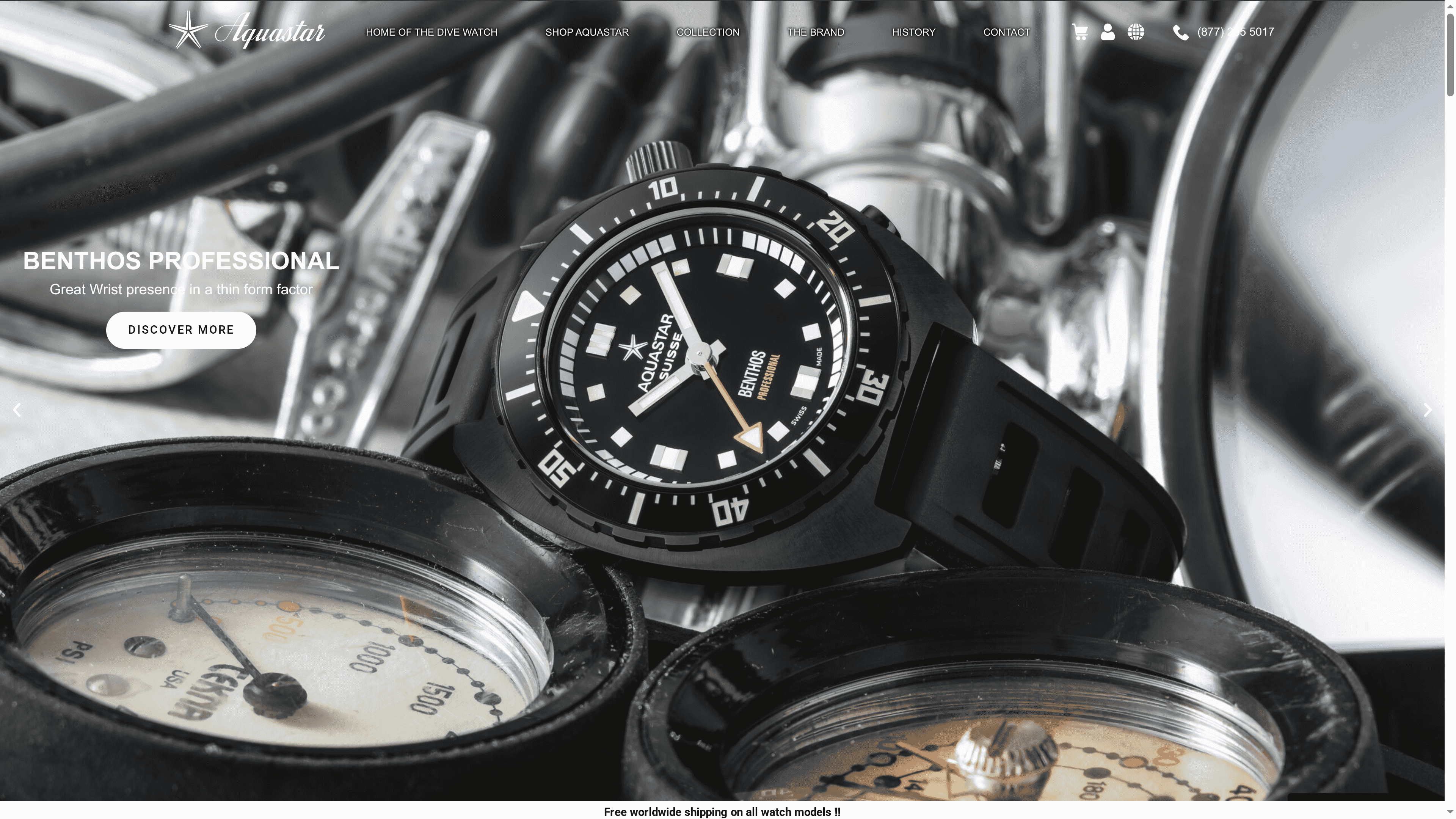
Aquastar

Product Screenshot

At a Glance

Aquastar is the clear leader for commercial divers who want a mechanical watch built by specialists. Its combination of heritage innovations and modern Swiss craft makes it the top choice when reliability and proven design matter most.

Core Features

Aquastar pairs Swiss-made automatic movements with high water resistance up to 300 meters and robust materials like sapphire crystal and ceramic. The brand ships ISOfrane style rubber straps and builds heritage inspired cases with modern durability for daily work underwater.

Pros

  • Deep heritage and authenticity: Aquastar traces back to 1962 and carries real-world dive credentials that show in design and function.
  • Robust build quality: High grade materials and sturdy construction stand up to harsh marine conditions without compromise.
  • Patented innovation lineage: Early patents and inventions such as the first analog dive computer and the skindiver case inform today’s practical features.
  • Competitive Swiss pricing: Aquastar delivers superior materials and craft at price points that undercut many luxury Swiss dive makers.
  • Collector appeal and limited editions: Heritage reissues and limited runs preserve value and interest for professional buyers who also collect.

Who It’s For

Serious commercial divers, marine technicians, and professional underwater contractors who want a mechanical watch as a reliable backup to their dive computer will favor Aquastar. Watch collectors who prize engineering history and utility will also find these models compelling.

Unique Value Proposition

Aquastar was born to make only dive watches and that focus shows. The brand filed numerous patents in the 1960s that shaped modern dive watch design. Aquastar made the first analog dive computer called the Navigator and introduced the first skindiver case watch. Those milestones create a product line that blends historical breakthroughs with current Swiss craftsmanship. For a commercial diver this means a timepiece engineered by people who understand decompression, legibility, and underwater wear. The result is a watch that outperforms mass market dive pieces in purpose built details and durability while remaining more accessible than many high end Swiss alternatives.

Real World Use Case

A professional diver straps on an Aquastar prior to a deep sea assignment because the watch offers clear legibility, reliable water resistance, and proven mechanical movement. The watch serves as a mechanical backup to electronic instruments and performs consistently during long field deployments and repetitive exposure to salt water.

Pricing

Models generally range from about $1,290 to $3,590 depending on model and edition. That range places Aquastar as a top tier professional choice that remains more affordable than many competing Swiss dive brands while delivering dedicated dive features and durable materials.

Website: https://aquastar.ch

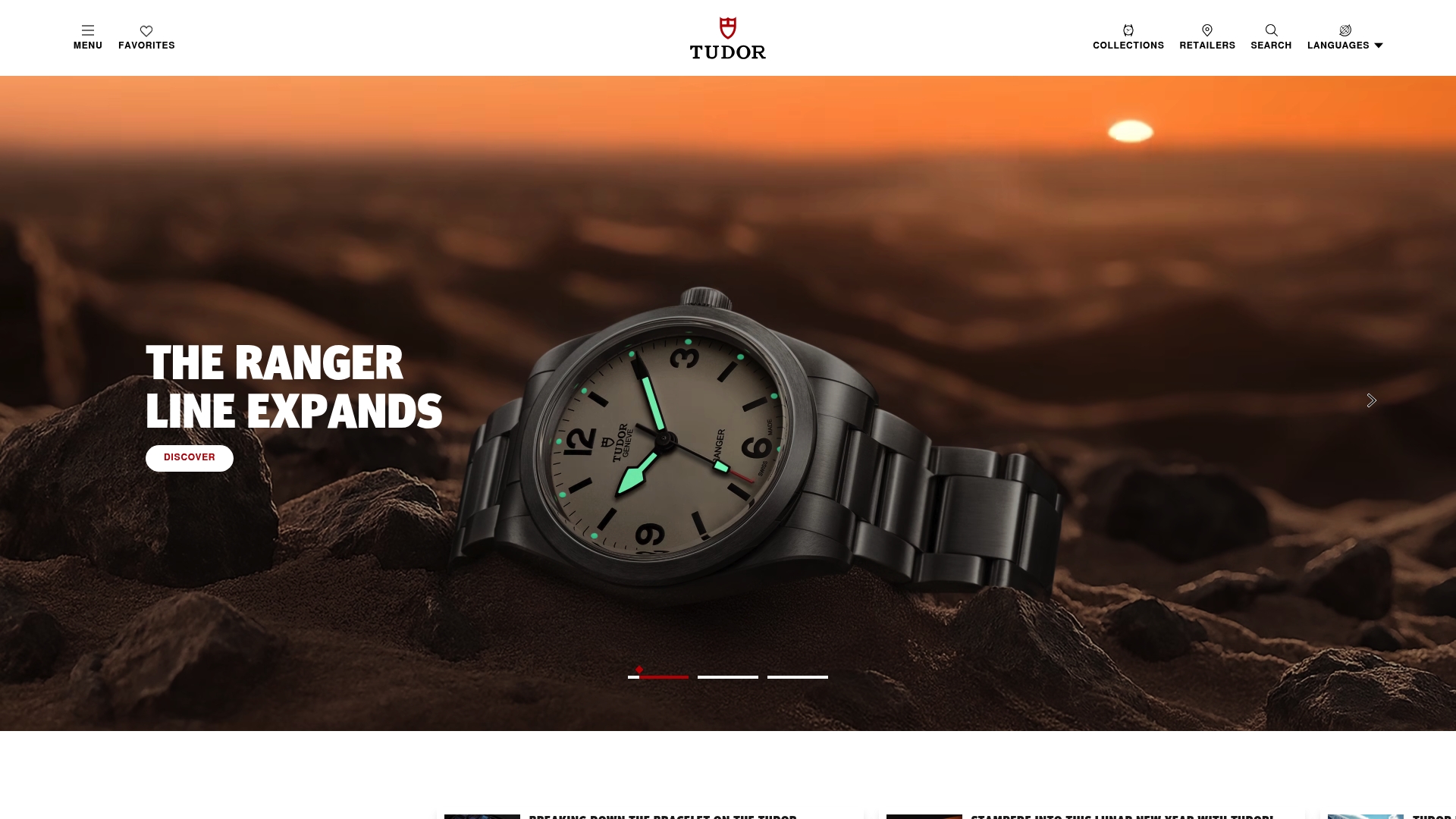
Product Screenshot

At a Glance

Tudor watches present a blend of luxury styling and practical durability that appeals to professionals who value looks and performance. The collection emphasizes Swiss movement reliability and water resistance suitable for regular exposure to wet environments.

Core Features

The line focuses on elegant design and high quality materials with a clear emphasis on classic wristwatch craftsmanship. Key capabilities listed include water resistance, a Swiss mechanical movement, and a build meant to withstand everyday use while remaining a formal accessory.

Style with substance.

Pros

  • Beautiful aesthetic: The watches deliver a refined appearance that works well at work events and formal settings.
  • Durable build quality: High quality materials support daily wear and resist surface wear common to active professionals.
  • Reliable Swiss movement: The movement provides consistent timekeeping that professionals can depend on for punctuality.
  • Suitable for various occasions: The design transitions easily from business meetings to evening events without feeling out of place.
  • Water resistant: The watches tolerate water exposure which adds practical protection for users who encounter humidity or splashes.

Cons

  • Premium priced: The watches carry luxury pricing which raises the entry cost for professionals who want a quality timepiece.
  • Limited availability: Certain models may be hard to find which can delay purchase or replacement needs.
  • Requires regular servicing: The Swiss movement requires periodic servicing to maintain accuracy and long term reliability which adds maintenance expense.

Who It’s For

This collection fits fashion conscious professionals who want a reliable mechanical watch that also serves as a statement piece. If you attend client dinners, industry events, and need a durable daily watch, this line matches that balance of style and function.

Unique Value Proposition

Tudor blends classic styling with dependable mechanical engineering so the watch functions as a practical tool and a status accessory. The combination of Swiss movement and water resistant construction gives you a timepiece built for daily professional life and occasional wet conditions.

Real World Use Case

A professional wears a Tudor watch to work events and client meetings while relying on it as a daily timekeeper. The watch handles commuting, office wear, and occasional rain while still presenting a polished look at formal gatherings.

Pricing

The collection is offered at luxury pricing with specific model prices listed on the website. Expect model dependent price ranges and consult the site for current availability and exact figures.

Website: https://tudorwatch.com

OMEGA Watches

Product Screenshot

At a Glance

OMEGA delivers Swiss-made luxury with a clear focus on precision and heritage, backed by a 5-year warranty that supports long-term ownership. For professionals who value craftsmanship and proven dive lineage, OMEGA is a premium choice worth inspection.

Actionable takeaway: Compare specific Seamaster models against your dive depth and certification before buying.

Core Features

OMEGA combines traditional watchmaking with professional-grade features across several hallmark collections. The brand pairs high precision with broad after-sales support and secure online purchasing.

  • Multiple Collections: Seamaster, Speedmaster, Constellation, De Ville offer specialized options for different uses.
  • High Precision: Swiss-made movements emphasize timekeeping reliability and long-term durability.
  • Five-Year Warranty: Coverage on all watches provides a predictable service window for professionals.
  • Secure Shopping: SSL encryption and multiple payment options protect online purchases.

Actionable takeaway: Review the Seamaster line first if you need a watch for diving tasks.

Pros

  • Long-standing Reputation: OMEGA has operated since 1848, which signals consistent quality and industry recognition.

  • Wide Selection: The brand offers diverse luxury watches and accessories that suit collectors and active professionals.

  • Comprehensive Warranty and Service: A five-year warranty and customer service network reduce long-term ownership risk.

  • Global Sales Options: Global shipping and boutique pickup give flexible purchase and service paths.

  • Trusted Online Experience: Secure payment methods and SSL encryption make buying direct from the site straightforward.

Actionable takeaway: Use boutique pickup for hands-on inspection when available.

Cons

  • Premium pricing reflects the brand’s luxury positioning, which raises upfront investment for working divers.

  • Limited focus on high-end pieces means there are no lower-cost OMEGA options for budget constrained buyers.

Actionable takeaway: Set a clear budget and check preowned markets if new pricing is prohibitive.

Who It’s For

OMEGA suits individuals seeking luxury Swiss watches, collectors, and gift buyers who prioritize heritage, precision, and warranty support. Professionals who want a prestige timepiece that doubles as a reliable tool will find the brand attractive.

Actionable takeaway: If you require a workhorse tool at lower cost, evaluate alternative professional dive-focused suppliers.

Unique Value Proposition

OMEGA pairs a centuries-old manufacture history with professional watch collections such as the Seamaster and Speedmaster. That blend of heritage, precision, and an industry standard warranty positions OMEGA as a premium provider for those who want both performance and prestige.

Actionable takeaway: Match a model’s water resistance and service plan to your operational requirements.

Real World Use Case

A professional uses an Omega Seamaster for timekeeping during diving operations, relying on its legible dial and robust construction for routine underwater tasks. At public events, a Speedmaster functions as a statement piece that reflects professional success.

Actionable takeaway: Test a Seamaster under suit and hood conditions to confirm visibility and fit.

Pricing

Pricing details are provided on individual product pages, so final cost depends on model, materials, and configuration. Visit the product pages for exact pricing and available options.

Actionable takeaway: Check the specific model page for up to date pricing and available financing.

Website: https://omegawatches.com

Oris Swiss Watches

Product Screenshot

At a Glance

Oris Swiss Watches blends more than a century of Swiss watchmaking with a clear focus on mechanical quality and purposeful design. For commercial divers seeking a mechanical backup to their dive computer, Oris offers robust craftsmanship though not every model targets professional dive specifications.

Core Features

Oris presents an extensive collection that includes Aquis, Divers, Big Crown, ProPilot, and Artelier series. The brand emphasizes limited editions and thematic designs alongside a global boutique network, strong craftsmanship, and stated sustainability efforts that support long term ownership and service.

Pros

  • Swiss craftsmanship: Oris produces mechanically driven movements with a strong reputation for build quality that appeals to professionals who value reliability and serviceability.
  • Model variety: The wide range from Divers to ProPilot provides multiple case sizes, dial layouts, and bezel options so you can choose a watch that matches dive rigging and personal preference.
  • Limited editions: Special models offer unique design cues and potential collector value for professionals who also collect equipment and memorabilia.
  • Global support network: Boutiques and authorized dealers worldwide simplify purchase, warranty service, and repairs when you need professional maintenance.
  • Sustainability focus: Oris communicates community and environmental initiatives that underline long term brand commitment and responsible manufacturing.

Cons

  • Premium pricing: Many Oris models sit in a higher price bracket which may put them beyond reach for divers looking for a purely utilitarian backup watch.
  • Technical detail gaps: The public website provides limited technical specifications for some models, which makes direct comparison against commercial dive requirements harder.
  • Market focus: Oris primarily serves Swiss and international markets which can leave regional servicing or spare part availability uneven in distant work locations.

Who It’s For

Oris suits watch enthusiasts, professional divers who value mechanical watches as a secondary instrument, and collectors seeking craftsmanship and heritage. If you prioritize a durable mechanical watch with serviceable movement and brand support, Oris fits that profile.

Unique Value Proposition

Oris combines a century of watchmaking heritage with accessible limited editions and a clear commitment to craftsmanship. That mix gives professional divers a mechanically credible backup that carries historical value and practical service channels.

Real World Use Case

A commercial diver purchases an Oris Aquis as a secondary timing instrument to complement a digital dive computer. The diver relies on the mechanical bezel and clear dial for surface interval timing and routine checks while keeping the digital computer as the primary decompression tool.

Pricing

Prices vary by model and edition. Limited editions range approximately from USD 2,700 to USD 8,100 which places Oris in the luxury segment for professional secondary watches.

Website: https://oris.ch

Panerai

Product Screenshot

At a Glance

Panerai pairs Italian design with Swiss craftsmanship and a clear maritime and military heritage. The brand serves commercial divers who value a luxury timepiece that can also perform as a reliable dive-capable watch.

Core Features

Panerai offers a wide range of collections including Luminor, Submersible, and Radiomir, plus limited editions and high complications such as Tourbillon and Perpetual Calendar. The brand also provides straps, bracelets, care programs, warranty extensions, and boutique consultations.

Pros

  • Heritage and identity: Panerai’s military and maritime history gives the watches authentic provenance that appeals to professional divers and collectors alike.

  • High quality construction: The watches reflect Swiss watchmaking standards and include innovative materials that improve durability and long term performance.

  • Diverse lineup: The variety of collections and exclusive limited editions allows you to choose a model for daily work use or for collecting and display.

  • Aftercare and service: Panerai’s watch care programs and warranty options reduce long term maintenance risk for professionals who depend on reliable gear.

  • Prestige factor: The brand’s luxury appeal supports resale and collector interest when you later trade or sell a limited edition model.

Cons

  • High price point: Panerai models sit firmly in the luxury range, with many options costing several thousand USD which places them beyond typical equipment budgets.

  • Limited availability: Certain models are boutique exclusive or produced in small batches which makes obtaining specific references difficult for working divers who need immediate replacements.

  • Complex model selection: The range of complications and editions can overwhelm buyers and may require expert guidance before purchase.

Who It’s For

Panerai fits luxury watch enthusiasts, collectors, and professionals who want a timepiece that reflects heritage while offering dive capable performance. Choose Panerai if you value brand prestige, strong build quality, and access to exclusive boutique services.

Unique Value Proposition

Panerai combines distinctive Italian styling with robust Swiss movement and marine roots to deliver watches that function in harsh environments while signaling status. The brand’s limited editions and comprehensive services make ownership both practical and collectible.

Real World Use Case

A professional diver can rely on a Submersible model for water resistance and robustness during commercial operations while wearing a timepiece that also serves as a collectible investment. Collectors buy limited editions for display and long term value.

Pricing

Pricing varies widely by collection and complication and generally starts in the luxury range above several thousand USD, with limited editions commanding a premium.

Website: https://panerai.com

Professional Dive Watches Comparison

Below is a comprehensive comparison of professional dive watches discussed in the article. Use this table to quickly review and identify the best watch for your specific diving needs and preferences.

BrandCore FeaturesProsConsPricing
AquastarSwiss-made movements, 300m water resistance, heritage innovationsAuthentic heritage, robust quality, competitive Swiss pricingLimited editions may not suit mass availability$1,290–$3,590
TudorSwiss precision, elegant design, water resistanceAesthetic appeal, functional durability, multi-occasion suitabilityHigher pricing, limited model availabilityLuxury pricing, varies by model
OMEGASwiss luxury, high precision, comprehensive warrantyRenowned reputation, extensive selection, reliable performancePremium price range, not budget-friendlyModel-dependent, consult website
OrisCenturies of craftsmanship, range of collections, limited editionsSwiss engineering, sustainable manufacturing, collectible componentsTechnical details may vary, servicing could be challenging regionally$2,700–$8,100 (limited editions)
PaneraiItalian design, Swiss movement, military and diving historyIdentity-driven design, luxury appeal, comprehensive aftercareHigh price point, potentially complex model selectionStarts at several thousand USD

Discover the Ultimate Dive Watch Built for Commercial Pros

Choosing the right dive watch to support your professional underwater missions is crucial. The article highlights key challenges such as ensuring mechanical reliability, superior legibility, and dependable water resistance during demanding commercial diving operations. You need a watch engineered with deep heritage and proven innovations designed to perform when your dive computer might not be enough.

Aquastar stands out as the only Swiss watchmaker born exclusively to create professional dive watches. With patented breakthroughs like the first analog dive computer and skindiver case, Aquastar delivers specialized timepieces made for divers who demand resilience and precision. Explore our range if you want a trusted mechanical backup designed by pioneers who understand your environment.

https://aquastar.ch

Experience why commercial divers worldwide rely on Aquastar. Visit Aquastar watches today to find a mechanical dive watch that guarantees performance beneath the waves. Make your next dive safer and more confident by selecting a watch crafted to meet your professional standards.

Frequently Asked Questions

What should I look for in a dive watch for commercial use?

A quality dive watch for commercial use should have high water resistance, ideally up to 300 meters, a durable build with materials like sapphire crystal, and clear legibility for reading underwater. Start by verifying that the watch meets ISO standards for diving to ensure reliability during deep-sea operations.

How do I ensure my dive watch is suitable for deep-sea conditions?

To ensure your dive watch is suitable for deep-sea conditions, check its water resistance rating and confirm that it is designed specifically for professional diving activities. Evaluate watches that feature practical functionalities like a rotating bezel for timing dives to support your underwater tasks.

What maintenance is required for a dive watch?

Regular maintenance of a dive watch includes washing it with fresh water after exposure to saltwater, checking gaskets for wear, and getting the movement serviced as needed. Schedule a professional service every 3 to 5 years to keep the watch functioning optimally and to extend its lifespan.

Are there any specific brands known for reliability in dive watches?

While various brands offer reliable dive watches, focus on established watchmakers that specialize in underwater instruments and have a proven track record in the industry. Research brand histories and customer reviews to assess the reliability and performance of specific models before purchasing.

How can I compare dive watches effectively?

To compare dive watches effectively, create a checklist of key features such as water resistance, movement type, durability, and price. Focus on obtaining specific measurements and features that align with your diving needs, allowing you to make an informed decision on the best model for your requirements.

What is the typical price range for professional dive watches?

The typical price range for professional dive watches varies widely, with quality options starting around $1,290 and reaching over $8,000 for limited editions. Set a budget based on your needs and consider the long-term value and durability of the watch to guide your purchase decision.

Posted on

Dive watch engineering: how innovation shapes performance

Dive watch engineering: how innovation shapes performance - role of engineering in dive watches

Role Of Engineering In Dive Watches: at a glance

Role of engineering in dive watches: pressure resistance, helium escape valves, ISO 6425 testing and the breakthroughs that defined the category. Use this guide on role of engineering in dive watches to weigh design choices, engineering trade-offs and how the category translates to real Aquastar dive watches.

TopicRole of engineering in dive watches
Read time5-8 min
SourceAquastar editorial

Dive watch engineering: how innovation shapes performance - role of engineering in dive watches

Most collectors assume Rolex wrote the rulebook on dive watch engineering. That assumption deserves a closer look. Doxa tested a helium escape valve before Rolex brought its version to market, a fact that reframes the entire origin story of professional dive watch technology. Dive watches are not accessories that happen to be waterproof. They are purposeful mechanical instruments, each feature a direct engineering response to a real underwater challenge. Understanding that distinction changes how you evaluate, collect, and appreciate every piece in your collection.

Table of Contents

Key Takeaways

PointDetails
Engineering solves real dive risksPurposeful innovations address pressure, legibility, and reliability, transforming watches from tools to collector icons.
Breakthroughs define collectabilityFeatures like compressor cases and helium valves drive both technical performance and collector demand.
Standards ensure trustISO 6425 formalizes requirements so buyers and divers can rely on dive watch engineering in every scenario.
Rivalry accelerates innovationCompetition among manufacturers leads directly to the landmark breakthroughs prized by enthusiasts.

Why engineering matters: The core challenges of underwater timekeeping

The underwater environment is hostile to mechanical precision in ways that are easy to underestimate. Pressure increases by roughly one atmosphere for every 10 meters of depth, and that force acts on every seal, crystal, and crown of a watch simultaneously. Temperature shifts between surface and depth can cause metal components to contract and expand, compromising tolerances that were set in a controlled workshop environment.

Salinity adds another layer of complexity. Saltwater accelerates corrosion on any exposed metal, and it can infiltrate even microscopic gaps in a case. Visibility underwater is often poor, which means dial legibility is not a stylistic preference but a functional requirement that can affect diver safety.

Engineers responded to these challenges with specific, measurable solutions:

  • Watertight cases with multiple redundant sealing points
  • Anti-magnetic shielding to protect the movement from interference
  • High-contrast dials with luminous indices for low-visibility conditions
  • Unidirectional bezels to prevent accidental extension of dive time
  • Screw-down crowns to eliminate the most common point of water ingress

These are not design flourishes. Each one addresses a documented failure mode. Today, ISO 6425 mandates minimum standards for dive watches, covering water resistance, shock protection, thermal resistance, and legibility, giving collectors and professionals a reliable baseline for evaluation.

“A watch that meets ISO 6425 has passed tests that simulate real diving conditions, not just a static pressure check in a factory.”

Pro Tip: When evaluating any dive watch, look for explicit ISO 6425 certification rather than a simple depth rating. A depth rating alone does not confirm the watch has passed dynamic pressure, legibility, or corrosion testing. Learn more about essential dive watch features to build a sharper eye for what separates a genuine tool watch from a lookalike.

Key engineering breakthroughs: Airtight cases and beyond

With the core challenges established, the landmark innovations that followed make much more sense as deliberate engineering solutions rather than marketing differentiators.

The compressor case was one of the most ingenious early solutions. Developed and patented by brands including Longines, Enicar, and EPSA, the compressor case used the pressure of the surrounding water to press the caseback more firmly against its seal. The deeper you went, the tighter the seal became. EPSA’s compressor case used external pressure to enhance watertightness, a genuinely clever inversion of the problem. It was eventually phased out as screw-down technologies proved more reliable and easier to service.

Close-up of vintage compressor dive watch

The helium escape valve solved a problem specific to saturation divers, professionals who live in pressurized habitats for days or weeks at a time. Helium atoms are small enough to migrate through watch seals during long exposures at depth. Without a release valve, those atoms become trapped inside the case during decompression, building pressure that can blow the crystal off the watch. The valve allows controlled release during ascent.

Screw-down crowns and casebacks addressed the most statistically common failure point in dive watch water resistance. A push-pull crown, no matter how well gasketed, is vulnerable to accidental displacement. Screw-down designs require deliberate action to open, adding a layer of protection that is both mechanical and behavioral.

FeatureProblem solvedEngineering approach
Compressor casePressure-induced leakageUsed depth pressure to tighten seals
Helium escape valveCrystal blow-off during decompressionControlled one-way gas release
Screw-down crownAccidental water ingressThreaded locking mechanism
Unidirectional bezelAccidental dive time extensionMechanical rotation restriction

Pro Tip: If you are examining a vintage compressor case watch, check whether the inner rotating bezel still functions smoothly. Stiff or seized inner bezels are common on unserviced examples and can affect the watch’s usability as a tool piece. Explore dive watch case designs for a deeper look at how case architecture evolved, and review spotting genuine engineering to sharpen your authentication skills.

The Rolex Sea-Dweller development illustrates how saturation diving demands pushed the helium valve from a niche solution into a recognized standard feature for professional-grade watches.

The evolution of standards: ISO 6425 and real-world testing

Engineering innovations only carry weight when they can be independently verified. That is precisely what ISO 6425 provides. Introduced to formalize what a professional dive watch must withstand, the standard goes well beyond a simple pressure test.

Infographic of dive watch innovations and standards

ISO 6425 includes specific tests covering water resistance, legibility, impact resistance, magnetic and thermal shock, and saltwater corrosion. Each test has defined thresholds, not general guidelines.

Here is what those requirements look like in practical terms:

ISO 6425 testMinimum requirementWhat it means in practice
Water resistance100 meters minimumTested dynamically, not just statically
LegibilityReadable at 25cm in darknessLuminous indices must meet lux thresholds
Shock resistance5,000 Gauss magnetic fieldMovement must keep running under field exposure
Thermal shock40°C to 5°C rapid changeSeals must hold through temperature extremes
Saltwater corrosion24-hour salt spray exposureNo corrosion affecting function

The numbered sequence of ISO 6425 testing matters because each stage builds on the last:

  1. Water resistance is tested first under dynamic conditions, simulating actual movement through water.
  2. Legibility is assessed under controlled low-light conditions to confirm real-world readability.
  3. Shock and impact resistance tests follow, using standardized drop and impact protocols.
  4. Magnetic resistance is evaluated against a defined field strength.
  5. Thermal shock testing confirms seal integrity across rapid temperature changes.
  6. Saltwater corrosion testing closes the sequence, confirming material durability.

For collectors, ISO 6425 compliance is more than a technical checkbox. It is a form of independent validation that the watch performs as claimed, which directly supports long-term value and insurance assessments. Reviewing top dive watch brands through the lens of standards compliance reveals which manufacturers treat certification as a genuine engineering commitment rather than a marketing claim.

Different engineering philosophies: Competition and innovation

Standards define the floor. Competition raises the ceiling. The history of dive watch engineering is inseparable from the rivalries between brands that pushed each other toward better solutions.

The Doxa and Rolex contest over the helium escape valve is the clearest example. Doxa’s earlier helium release valve and the subsequent evolutionary contest with Rolex demonstrate how competing engineering strategies advanced the entire field, not just the products of the competing brands. Both companies were responding to the same real-world problem, but their approaches differed in mechanism and execution.

The compressor versus screw-down debate represents a broader philosophical divide. Compressor cases were elegant in concept, using the environment itself as part of the sealing system. Screw-down cases prioritized user-controlled reliability and serviceability. Compressor cases were ingenious but made obsolete by screw-down technology, illustrating how shifting engineering philosophies can render even clever solutions obsolete.

Key brands that shaped these competing philosophies include:

  • Doxa: Pioneered the helium escape valve and the distinctive orange dial for underwater visibility
  • Rolex: Refined the screw-down crown and developed the Sea-Dweller for saturation diving
  • Blancpain: Established the Fifty Fathoms as an early benchmark for military-grade dive watch standards
  • Aquastar: The only Swiss watchmaker founded exclusively to produce dive watches, filing multiple patents in the 1960s that shaped the trajectory of the entire category, including the first analog dive computer and the first skindiver case watch

For collectors, watches that represent a turning point in engineering philosophy carry a premium that goes beyond aesthetics. They are physical evidence of a problem being solved. Explore the automatic vs manual dive engineering debate to see how movement philosophy intersects with tool watch design.

Engineering’s lasting legacy: How it shapes collecting and ownership today

Engineering details are not just historical footnotes. They are active drivers of collector value, authentication, and long-term ownership satisfaction.

Engineering innovations like Super Compressor refinement and helium valves remain central to a watch’s reputation and collectability. A watch with a documented engineering pedigree, whether a genuine compressor case, a period-correct helium valve, or a verifiable ISO 6425 certification, commands more confidence in the market than one with only aesthetic appeal.

When evaluating a dive watch for your collection, work through this sequence:

  1. Identify the case type: Compressor, screw-down, or integrated? Each has specific service requirements and authentication markers.
  2. Inspect the crown: Is it screw-down? Does it engage and disengage cleanly? A worn crown thread is a common service indicator.
  3. Check the bezel: Unidirectional rotation should be positive and consistent. Loose or bidirectional bezels on watches claiming ISO 6425 compliance are a red flag.
  4. Verify standards compliance: Look for explicit ISO 6425 documentation, not just a depth rating on the dial.
  5. Research the movement: Know whether the caliber inside matches the production period of the case. Mismatched movements are common in the vintage market.

Pro Tip: For vintage compressor case watches, always request service records or budget for a full service before purchase. The inner bezel mechanism and the pressure-activated seals require specific expertise that not every watchmaker has. A thorough guide to collecting dive watches can help you build a framework for evaluating both vintage and modern pieces with confidence.

Explore expertly engineered dive watches

Aquastar’s history is built on exactly the kind of engineering commitment this article describes. As the only Swiss watchmaker founded exclusively to produce dive watches, Aquastar filed multiple patents in the 1960s that helped define the category, from the first analog dive computer to the first skindiver case watch. That legacy is not decorative. It is structural, informing every design decision in Aquastar’s current lineup of professional mechanical dive watches.

https://aquastar.ch

For enthusiasts ready to go deeper, Aquastar’s resources cover the full spectrum of tool watch knowledge. Explore tool watch engineering to understand the design principles behind professional instruments, review professional diver features to sharpen your evaluation criteria, and use the diver watch collecting guide to build a collection grounded in genuine mechanical heritage.

Frequently asked questions

What is a helium escape valve and why does it matter in dive watches?

A helium escape valve allows helium atoms that accumulate inside a watch during saturation diving to exit in a controlled way during decompression, preventing dangerous pressure buildup that can damage the crystal. Helium escape valves release helium that accumulates at depth, protecting the watch during ascent.

How does ISO 6425 certification affect a dive watch’s reliability?

ISO 6425 sets specific requirements for depth, legibility, and robustness, ensuring the watch has been independently tested against real diving conditions rather than relying solely on manufacturer claims. This makes it a meaningful reliability indicator for both working divers and collectors.

What made compressor cases unique compared to other dive watch cases?

Compressor cases used the pressure of the surrounding water to press the caseback more firmly against its seal, meaning the watch became more watertight as depth increased. Compressor cases increased sealing effectiveness with depth, a major innovation that was later surpassed by screw-down designs.

Do historic engineering features still matter for modern dive watch collectors?

Absolutely. Engineering details define desirability and credibility for both vintage and modern collector watches, with features like compressor cases and helium valves directly influencing market value and authentication confidence.

Yes. Doxa-Rolex competition led to advances like the helium escape valve, and the broader rivalry between brands pursuing different engineering philosophies accelerated the development of features that are now considered standard in professional dive watches.

Posted on

Patented dive bezel innovations: history and collector insights

Patented dive bezel innovations: history and collector insights - patented dive bezel explained

Patented Dive Bezel Explained: at a glance

Patented dive bezel innovations: from Blancpain's 1953 unidirectional patent to Aquastar's decompression bezel — history and collector insights. Use this guide on patented dive bezel explained to weigh design choices, engineering trade-offs and how the category translates to real Aquastar dive watches.

TopicPatented dive bezel explained
Read time5-8 min
SourceAquastar editorial

Patented dive bezel innovations: history and collector insights - patented dive bezel explained

The rotating bezel on a dive watch looks deceptively simple. Twist it, align the marker, and track your bottom time. Yet behind that ring of metal lies a saga of competing patents, engineering rivalries, and safety-driven ingenuity that stretches back to 1953, when Blancpain patented the unidirectional bezel for the Fifty Fathoms and changed underwater timekeeping forever. For collectors and enthusiasts who care about what a dive watch actually does, understanding these patented innovations is not optional. It is the difference between appreciating a tool and truly knowing one.

Table of Contents

Key Takeaways

PointDetails
Legacy of patented bezelsPatented dive bezels pioneered by brands like Blancpain fundamentally shaped dive safety and set the standard for all modern dive watches.
Engineering and safetyUnidirectional, ratcheting, and internal bezels arose from patented designs to maximize diver safety and timing reliability.
Collector significanceOriginal patented bezel features dramatically improve a watch’s authenticity, value, and desirability for collectors.
Modern standards originToday’s ISO 6425 dive watch certification requirements trace directly to innovations established by early patent holders.

What is a dive bezel? Function, purpose, and origins

A dive bezel is the graduated ring surrounding a watch dial, used to measure elapsed time underwater. Its primary job is safety: a diver sets the zero marker at the current minute hand position, then reads elapsed time at a glance without doing mental arithmetic under pressure. That simplicity is the point. When nitrogen narcosis or cold water impairs judgment, a clear elapsed-time reading can be the difference between a safe ascent and a decompression incident.

The concept did not originate underwater. Rotating bezels trace back to Philip Van Horn Weems, whose 1929 aviation patent used a rotating ring for navigation calculations. Watchmakers adapted that idea for diving in the early 1950s, recognizing that pilots and divers shared a common need: precise, readable elapsed time in high-stakes environments. The transition from cockpit to ocean floor required new engineering, particularly around water resistance and accidental rotation.

Understanding dive watch case construction is essential context here, because the bezel does not function in isolation. It is part of an integrated system where case, crown, crystal, and bezel all contribute to water resistance and operational reliability. The bezel’s mechanical design had to evolve alongside the case itself.

“The dive bezel is not decoration. It is a timing instrument, and its mechanical integrity is as critical as the movement inside.”

Key functions a dive bezel must perform:

  • Elapsed time measurement without requiring mental calculation
  • Resistance to accidental rotation to prevent false time readings
  • Legibility under low-visibility conditions at depth
  • Durability against corrosion, impact, and pressure

Historic patented breakthroughs: The foundation of modern dive bezels

The year 1953 stands as the pivotal moment in dive bezel history. Jean-Jacques Fiechter of Blancpain filed three patents for the Fifty Fathoms: a double-sealed crown, a unidirectional bezel locking mechanism, and an enhanced screw-down case back. Together, these patents defined what a professional dive watch needed to be. The unidirectional bezel patent was particularly consequential because it addressed a specific danger: a bezel that could rotate in either direction might accidentally show more remaining dive time than actually existed, leading a diver to stay down too long.

Three years later, EPSA introduced a radically different approach. Their 1956 Super Compressor patent created a case architecture where water pressure itself improved the seal, and the bezel moved to the inside of the watch, operated by a second crown. This was not an incremental improvement. It was a competing philosophy about how to solve the same safety problem.

PatentYearInnovatorKey feature
Unidirectional bezel lock1953Blancpain / FiechterPrevents accidental time extension
Double-sealed crown1953Blancpain / FiechterEnhanced water resistance
Super Compressor case1956EPSAPressure-activated sealing, internal bezel
Screw-down case back1953Blancpain / FiechterStructural water resistance

For collectors exploring the best dive watch brands, these patents are not trivia. They are the technical DNA of every serious dive watch produced since. Aquastar, founded as the only Swiss watchmaker dedicated exclusively to dive watches, built its own patent portfolio in the 1960s on this same foundation, including the first analog dive computer and the first skindiver case watch. Understanding dive watch collecting at a serious level means tracing these lineages.

By 1960, at least six major Swiss manufacturers held active patents related to dive bezel mechanisms, case sealing, or both. The competitive intensity of that decade produced more functional innovation in dive watch engineering than any period before or since.

Notable engineering: Unidirectional, internal, and ratcheting bezel advances

Patented breakthroughs led to constant innovation. Here is how the engineering details progressed and why they matter to serious enthusiasts.

The unidirectional bezel works through a spring-loaded ratchet that allows rotation in only one direction, typically counterclockwise. If the bezel is accidentally bumped, it moves backward, showing less remaining time rather than more. This is a conservative failure mode: the diver surfaces earlier than necessary rather than later. It is a small mechanical decision with significant safety consequences, and it is now codified in the ISO 6425 standard for dive watches.

Hands adjusting unidirectional dive bezel

The Super Compressor internal bezel took a different path. EPSA’s pressure-activated sealing system used a spring-loaded case back that compressed gaskets more tightly as depth increased. The internal bezel, protected inside the case, was immune to external impact and corrosion. Two crowns controlled the watch: one for the movement, one for the bezel. This dual-crown architecture became a visual signature that collectors now recognize instantly.

FeatureExternal unidirectional bezelInternal Super Compressor bezel
Bezel locationOutside caseInside, under crystal
Rotation directionOne way onlyBidirectional (protected internally)
Operated byBezel ringSecond crown
Collector appealHigh (ISO standard origin)Very high (rarity, engineering)
Water resistance mechanismCase gasketsPressure-activated spring back

The ratcheting mechanism deserves its own attention. 60-click and 120-click bezels represent a genuine trade-off. A 60-click bezel provides one-minute resolution and strong tactile feedback per click. A 120-click bezel doubles the precision, allowing 30-second increments, but each click feels lighter. Neither is objectively superior. Professional divers often prefer the positive feel of 60 clicks. Collectors who prioritize precision frequently favor 120.

Infographic showing dive bezel innovation timeline

Pro Tip: When examining a vintage dive watch, count the bezel clicks before purchasing. A watch advertised as original that has the wrong click count for its reference year is a red flag for case or bezel replacement, which significantly affects value.

For a full breakdown of what separates a genuine tool from a fashion piece, the guide on professional diver watch features covers the technical requirements in detail. Collectors focused on authenticity will also benefit from resources on identifying genuine dive watches.

Patented dive bezels in the ISO 6425 era: Standards and certifications

Earlier inventions did not disappear when standards arrived. They became the standards. ISO 6425, the international specification for dive watches, essentially codified what the best patents of the 1950s and 1960s had already proven in practice. The unidirectional ratcheting bezel is a mandatory requirement under ISO 6425, not a suggestion.

“ISO 6425 does not invent new requirements. It formalizes what decades of dive watch engineering already demonstrated was necessary for diver safety.”

Here is what ISO 6425 requires of a compliant dive bezel:

  1. Unidirectional rotation only, with no possibility of accidental forward movement
  2. Elapsed time graduation clearly marked, with the first five minutes distinctly indicated
  3. Resistance to accidental rotation under a minimum torque threshold
  4. Legibility at 25 centimeters in total darkness (luminous markings required)
  5. Corrosion resistance verified through salt water immersion testing

Every one of these requirements maps directly to a problem that early patent holders identified and solved. The double-sealed crown addressed water ingress. The unidirectional lock addressed accidental rotation. The luminous markers addressed low-visibility legibility. Patents and standards are not separate histories. They are the same story told in two different languages.

For collectors, ISO 6425 certification is a meaningful signal, but it is not the only one. A watch can be ISO 6425 compliant and still lack the historical depth of a piece with genuine patented heritage. Understanding the tool watch explained framework helps contextualize where certification ends and collecting significance begins.

Patented dive bezel significance for collectors and enthusiasts

With technical and historical details in view, the practical question becomes: how do patented bezels affect collecting strategy and market value?

The answer is direct. Patented features add authenticity, rarity, and provenance. A Super Compressor case with its original internal bezel mechanism intact is a collector favorite precisely because the engineering is unusual, the patent history is documented, and the condition of the mechanism tells a story about how the watch was used and maintained. These are not interchangeable parts. They are historical artifacts.

Key considerations for collectors evaluating patented dive bezels:

  • Patent documentation: Original patent filings are publicly accessible and provide exact dates, inventors, and technical specifications for verification
  • Mechanism integrity: A Super Compressor’s dual-crown operation should be smooth; a seized second crown indicates neglect or damage that affects both function and value
  • Bezel insert condition: Original inserts, whether aluminum, ceramic, or acrylic, carry significant premium over replacements, even correct-era replacements
  • Click count consistency: As noted, the number of clicks must match the reference specification for the production year
  • Case back markings: Many patented cases carried patent numbers stamped on the case back, providing direct authentication evidence

Pro Tip: Cross-reference any vintage dive watch against period catalog scans before purchasing. Aquastar and other manufacturers published detailed technical catalogs in the 1960s and 1970s that specify bezel type, click count, and case patent numbers by reference. Discrepancies between catalog spec and physical watch are immediate authenticity concerns.

For those beginning or deepening a collection, the guide on collecting dive watches provides a structured framework for evaluating pieces across eras and manufacturers. The patented bezel is one of the most reliable indicators of a watch’s genuine professional heritage.

Discover more about dive watch expertise with Aquastar

Aquastar has spent decades at the intersection of professional diving and precision watchmaking, filing patents in the 1960s that shaped the modern dive watch, producing the first analog dive computer, and continuing today to manufacture professional mechanical watches for commercial and recreational divers who use them alongside modern dive computers.

https://aquastar.ch

If this history of patented bezels has deepened your appreciation for what a serious dive watch represents, Aquastar’s educational resources are built for exactly this level of engagement. The tool watch explained guide clarifies what separates a genuine instrument from an aesthetic piece. The genuine dive watch guide walks through authentication in practical terms. And for those focused on what professional reliability actually requires, the breakdown of essential diver watch features covers every specification that matters.

Frequently asked questions

Why are unidirectional dive bezels considered safer than bidirectional ones?

Unidirectional bezels only allow the timer to move in a direction that reduces apparent remaining dive time, so an accidental knock never misleads a diver into staying underwater longer than planned. This safety principle is now a mandatory requirement under ISO 6425.

What makes the Super Compressor case unique among patented dive bezels?

The Super Compressor design uses water pressure to actively improve its own seal via a spring-loaded case back, and it moves the rotating bezel inside the watch where it is protected from external impact, operated by a dedicated second crown.

How can collectors verify the authenticity of a patented dive bezel feature?

Collectors should cross-reference patent numbers stamped on case backs against historical filings, consult period manufacturer catalogs for reference-specific specifications, and use established collector guides to confirm that mechanisms match documented production standards.

Why is the number of bezel clicks (60 vs. 120) important to watch enthusiasts?

A 120-click bezel offers 30-second timing increments for finer precision, while a 60-click provides stronger tactile feedback per step. Beyond function, the click count is a reference-specific detail that collectors use to verify originality and detect case or bezel replacements.

Posted on

Master vintage dive watch buying: expert collector guide

Master vintage dive watch buying: expert collector guide - vintage watch buying process

Vintage Watch Buying Process: at a glance

Vintage watch buying process for Swiss dive watches: condition checks, configuration verification and how to avoid frankenwatch traps. Use this guide on vintage watch buying process to weigh design choices, engineering trade-offs and how the category translates to real Aquastar dive watches.

TopicVintage watch buying process
Read time5-8 min
SourceAquastar editorial

Master vintage dive watch buying: expert collector guide - vintage watch buying process

Buying a vintage dive watch can feel overwhelming when you face the risk of counterfeit parts, mismatched components, and sellers who obscure critical details. Authenticity concerns plague even experienced collectors, and a single mistake can cost thousands while damaging your collection’s credibility. This guide walks you through the verified buying process for Swiss mechanical dive watches, focusing on historical innovations and practical authentication steps. You will learn how to evaluate condition, verify configuration, and avoid common pitfalls that trap uninformed buyers.

Table of Contents

Key takeaways

PointDetails
Verify reference numbers and period-correct partsConfirm every component matches the era and model to avoid frankenwatches
Authenticate through hallmarks and movement checksInspect dial originality, case serials, and caliber consistency for genuine provenance
Recognize red flags earlyWatch for redials, mismatched lume, seller pressure, and missing documentation
Understand historical innovationsKnowledge of Swiss dive watch evolution helps you spot authentic features and rare models
Use trusted dealers and demand imageryHigh-resolution photos and reputable sources reduce fraud risk significantly

Prepare for buying vintage dive watches: what you need to know

Vintage dive watches represent a specialized collecting category where Swiss mechanical models dominate the market. Iconic references like the Rolex Submariner 5513, Omega Seamaster 300, and Blancpain Fifty Fathoms set the standard for authenticity and value. These watches embody historical innovations in Swiss dive watches that shaped modern diving timepieces. Before you start your search, you need foundational knowledge about configuration verification, which means confirming that every component belongs to the correct era and model.

Configuration checks involve verifying reference numbers against factory records and ensuring period-correct parts throughout the watch. A 1960s Submariner should not have a later-generation crown or a dial from a different decade. Understanding configuration verification prevents costly mistakes and protects your investment. You must also recognize common dial markings, lume types, and case finishes that define authentic examples. Radium lume turned creamy over decades, while tritium aged differently, and modern luminova has no place in vintage pieces.

Before making any purchase, build a trusted dealer list and set a realistic budget that accounts for servicing costs. Study reference materials, join collector forums, and examine authenticated examples to train your eye. Compare your findings with resources like best dive watch brands comparison and must have diver watch features professional reliability to understand what separates genuine models from questionable examples.

Pro Tip: Familiarize yourself with the specific dial fonts, hand shapes, and case proportions for your target model by studying multiple confirmed authentic examples side by side.

Essential knowledge checklist

  • Reference number databases for your target brands
  • Period-correct component guides with photos
  • Lume aging patterns for radium, tritium, and early luminova
  • Case serial number ranges by production year
  • Movement caliber specifications and evolution timelines

Common vintage dive watch models and key features

ModelProduction EraKey Authentic Features
Rolex Submariner 55131962-1989Matte dial, pointed crown guards, caliber 1520/1530
Omega Seamaster 3001957-1970sBroad arrow hands, naiad crown, caliber 501/552
Blancpain Fifty Fathoms1953-1960sMoisture indicator, rotating bezel, caliber AS 1700

Understanding automatic vs manual dive watches also helps you evaluate whether the movement matches the model’s historical specifications. This preparation phase builds the expertise you need to execute purchases confidently.

Comparing automatic and manual dive watch features

Step-by-step vintage watch buying process: executing your purchase confidently

Once you have built foundational knowledge, follow these verification steps to authenticate and purchase vintage dive watches safely. Each step addresses a specific risk area where fraudulent sellers exploit uninformed buyers.

  1. Confirm the watch reference and check for period-correct parts. Start by verifying the reference number stamped between the lugs matches the model advertised. Cross-reference this number with factory records and collector databases. Inspect every visible component for era consistency, watching for anachronistic parts that signal a frankenwatch. A date window on a no-date model or modern hands on a 1960s dial are immediate red flags.

  2. Examine the dial and hands for originality and matching patina. Original dials show consistent aging patterns across all printed elements and lume plots. The hands should display patina that matches the dial’s lume in color and texture. Redials often feature incorrect fonts, misaligned printing, or lume that looks too fresh. Checking hallmarks and dial originality confirms authenticity before you commit funds.

  3. Inspect case serial numbers and hallmarks for era consistency. Remove the bracelet or strap to examine serial numbers and hallmarks stamped on the case. These markings should align with the production year and brand standards for that era. Inconsistent stamping depth, font variations, or numbers outside the known range indicate potential forgery or case swaps.

  4. Verify the movement caliber matches the reference specifications. Request clear photos of the movement through the caseback. The caliber should match factory specifications for that reference number, with no modern replacement parts or incorrect jewel counts. Movement serials can often be cross-referenced to production dates, providing another authentication layer.

  5. Assess condition honestly, favoring original wear over excessive polishing. Collectors value original surfaces with honest wear over aggressive refinishing that removes metal and destroys case lines. Sharp edges, visible hallmarks, and intact lug shapes indicate minimal polishing. Over-polished cases lose definition and can reduce value by 30 to 40 percent.

  6. Confirm the complete set with original box, papers, and service history. Documentation adds significant value and provides provenance. Original boxes, warranty papers, and service records from authorized centers or reputable independents verify the watch’s history. Empirical price benchmarks show complete sets command premiums of 20 to 50 percent over watch-only examples.

Pro Tip: Always request high-resolution close-ups of the dial, hands, case serials, movement, and any damage before making an offer, and compare these images with known authentic examples.

Authentication checklist summary

Red FlagAuthentic Feature
Mismatched lume colors between dial and handsConsistent patina across all luminous elements
Incorrect font or spacing on dial textFactory-correct typography matching era standards
Modern replacement parts in vintage movementPeriod-correct caliber with original components
Over-polished case with soft edgesSharp case lines and visible hallmarks
Seller refuses detailed photos or rushes saleTransparent seller providing comprehensive imagery

By following these steps systematically, you protect yourself from common fraud schemes. Resources like how to identify genuine dive watches and how to collect dive watches guide provide additional verification frameworks.

Common mistakes and troubleshooting in vintage dive watch buying

Even prepared buyers fall victim to sophisticated fakes and seller manipulation. Recognizing these pitfalls protects your investment and reputation as a collector.

Infographic listing dive watch buying pitfalls

Frankenwatches combine parts from different eras or models to create watches that appear authentic at first glance. Red flags include frankenwatches and redials that feature date windows on no-date models, hands from later generations, or bezels that never appeared on the reference. These assembled watches lack collector value and can be nearly impossible to resell honestly. Always verify that every component belongs to the specific reference and production period.

Redialed watches present another major risk. Refinished dials often use incorrect fonts, improper lume application, or colors that do not match factory standards. The printing may appear too crisp for a decades-old watch, or the lume plots show inconsistent aging. Examine dial texture under magnification, watching for signs of repainting or aftermarket printing. Original dials show subtle imperfections and aging that refinishers cannot perfectly replicate.

Mismatched lume between the dial and hands signals component swaps or replacement parts. Authentic watches age uniformly, so radium lume on both elements should display the same creamy patina. If the dial shows aged tritium but the hands look fresh, someone replaced the hands without matching the patina. This mismatch destroys originality and significantly reduces value.

High-pressure sales tactics should trigger immediate skepticism. Sellers who rush you, refuse additional photos, or claim other buyers are waiting often hide problems. Experts warn against auctions because they carry higher fraud risk and limited buyer protection. Auction houses rarely guarantee authenticity beyond basic descriptions, and once the hammer falls, recourse becomes difficult. Stick with dealers who offer return periods and stand behind their authentication.

“The vintage market rewards patience and skepticism. Rush a purchase, and you will likely regret it. Take time to verify every detail, seek expert opinions, and walk away from any deal that feels wrong.”

Pro Tip: Always seek second opinions from watch forums or expert communities before finalizing purchases, especially for watches priced above $5,000.

Common pitfalls to avoid

  • Trusting seller descriptions without independent verification
  • Buying based on a single photo or incomplete documentation
  • Ignoring gut feelings when details do not align
  • Skipping movement inspection to save time
  • Overlooking service history and maintenance records

By staying alert to these mistakes and consulting resources like how to identify genuine dive watches, you minimize risk and build a collection of verified authentic pieces.

What to expect after purchase: servicing and maintaining your vintage dive watch

Acquiring an authentic vintage dive watch marks the beginning of long-term ownership responsibilities. Proper maintenance preserves function, value, and historical integrity.

Regular servicing every five to seven years keeps your watch running accurately and prevents catastrophic failures. Service vintage Rolex and Omega models on this schedule if you wear them regularly. Skipping maintenance allows lubricants to dry out, increasing friction and accelerating wear on irreplaceable vintage components. The cost of servicing typically ranges from $500 to $1,200 depending on the brand and complexity.

Use independent master watchmakers rather than official service centers to preserve originality. Brand service centers often replace aged parts with modern equivalents, refinish dials, and polish cases aggressively. These interventions destroy collector value even as they restore function. Independent specialists experienced in vintage work understand the importance of preserving original components and patina. They clean and regulate movements without unnecessary replacements.

Maintain original parts whenever possible, even if they show wear. Collectors prize originality above cosmetic perfection, so a worn original dial commands higher value than a refinished replacement. Keep detailed service records documenting all work performed, parts replaced, and watchmaker credentials. This provenance adds value and reassures future buyers about the watch’s history and care.

Avoid over-restoration that can decrease collector value by 40 to 60 percent. Aggressive polishing, dial refinishing, and part replacements might create a watch that looks new, but collectors seek honest examples with original surfaces. A watch with its original finish and honest wear will always outperform an over-restored example in the collector market.

Store your watch properly when not wearing it. Keep it in a cool, dry environment away from magnetic fields and direct sunlight. Use a watch box with cushioned slots to prevent scratches and impacts. If you own multiple vintage pieces, consider a watch winder for automatic models, but set it to minimal rotations to reduce unnecessary wear.

Post-purchase maintenance guidelines

  • Schedule servicing every five to seven years with a trusted independent
  • Document all service work with receipts and detailed notes
  • Store in controlled environment with stable temperature and humidity
  • Avoid water exposure unless gaskets have been recently replaced and tested
  • Handle with clean hands to prevent oils from degrading dial and case finishes

By following these maintenance practices and consulting guides like how to collect dive watches guide, you ensure your vintage dive watch remains functional and valuable for decades.

Explore trusted dive watch selections and resources at Aquastar

Now that you understand the vintage buying process, you need trusted resources to sharpen your collector skills and access quality timepieces. Aquastar offers expert guides and authoritative dive watch collections ideal for enthusiasts who value historical accuracy and professional reliability. Our heritage includes filing numerous patents in the 1960s that paved the road for modern dive watches, and we remain the only Swiss watchmaker born to make exclusively dive watches.

https://aquastar.ch

Explore detailed resources like how to identify genuine dive watches to refine your authentication skills and must have diver watch features professional reliability to understand what separates professional tools from fashion pieces. Aquastar created the first analog dive computer, the Navigator, and introduced the first skindiver case watch. Today, we continue manufacturing professional dive watches for commercial and recreational divers who demand backup reliability.

Benefit from Aquastar’s commitment to quality in both vintage and modern dive watches. Our collections honor the innovations that defined the golden era while incorporating contemporary reliability. Start your collection confidently by leveraging resources like how to collect dive watches guide and connecting with a brand that understands the collector mindset.

Frequently asked questions about buying vintage dive watches

What is the difference between a redial and an original dial?

A redial is a refurbished dial that often features altered fonts, incorrect spacing, and fresh lume application that does not match the watch’s age. Original dials show consistent vintage wear, factory-correct typography, and patina that matches the hands. Collectors can spot redials by examining printing quality under magnification and comparing details with confirmed authentic examples.

How can I verify a watch’s authenticity without physical inspection?

Request detailed high-resolution photos of the dial, movement, caseback, serial numbers, and any visible wear or damage. Compare these images with known references on trusted collector forums and authentication guides. Look for period-correct components, consistent patina, and proper hallmarks. Reputable sellers will provide comprehensive imagery without hesitation.

Are vintage dive watches a good investment?

Early iconic models from Rolex, Omega, and Blancpain often appreciate 10 to 15 percent annually if they remain original and well-maintained. However, you should always buy for passion first and investment potential second. The market rewards rarity, condition, and provenance, but it also punishes restored or frankenwatch examples severely.

Is it safer to buy from dealers or auctions?

Trusted dealers with return policies and authentication guarantees reduce risk compared to auctions, which often have higher fraud risk and limited recourse. Auction houses rarely provide comprehensive guarantees beyond basic descriptions. Dealers who specialize in vintage watches stake their reputation on authenticity and typically offer better buyer protection.

How often should vintage dive watches be serviced?

Service vintage dive watches every five to seven years if you wear them regularly. Use independent specialists experienced in vintage work to preserve originality rather than brand service centers that often replace original parts. Proper maintenance prevents catastrophic failures and preserves both function and collector value over decades of ownership.

Posted on

Dive watch certification list: certified models guide

Dive watch certification list: certified models guide - dive watch certification list

Dive Watch Certification List: at a glance

Dive watch certification list: ISO 6425 standard, what each certification covers and a model guide that includes Aquastar professional dive watches. Use this guide on dive watch certification list to weigh design choices, engineering trade-offs and how the category translates to real Aquastar dive watches.

TopicDive watch certification list
Read time5-8 min
SourceAquastar editorial

Dive watch certification list: certified models guide - dive watch certification list

Selecting a certified dive watch isn’t just about style or brand prestige. For serious divers and collectors, certification marks the difference between a reliable underwater tool and a timepiece that merely looks the part. ISO 6425 standard defines rigorous requirements including water resistance testing, readability under low light, and resistance to saltwater corrosion. This guide delivers a comprehensive certification framework and detailed model list to help you identify genuinely certified dive watches, with special focus on Aquastar’s pioneering contributions to professional dive watch design and innovation.

Table of Contents

Key Takeaways

PointDetails
ISO 6425 standardThe ISO 6425 standard defines strict criteria for dive watches including a minimum water resistance of 100 meters and readability in darkness.
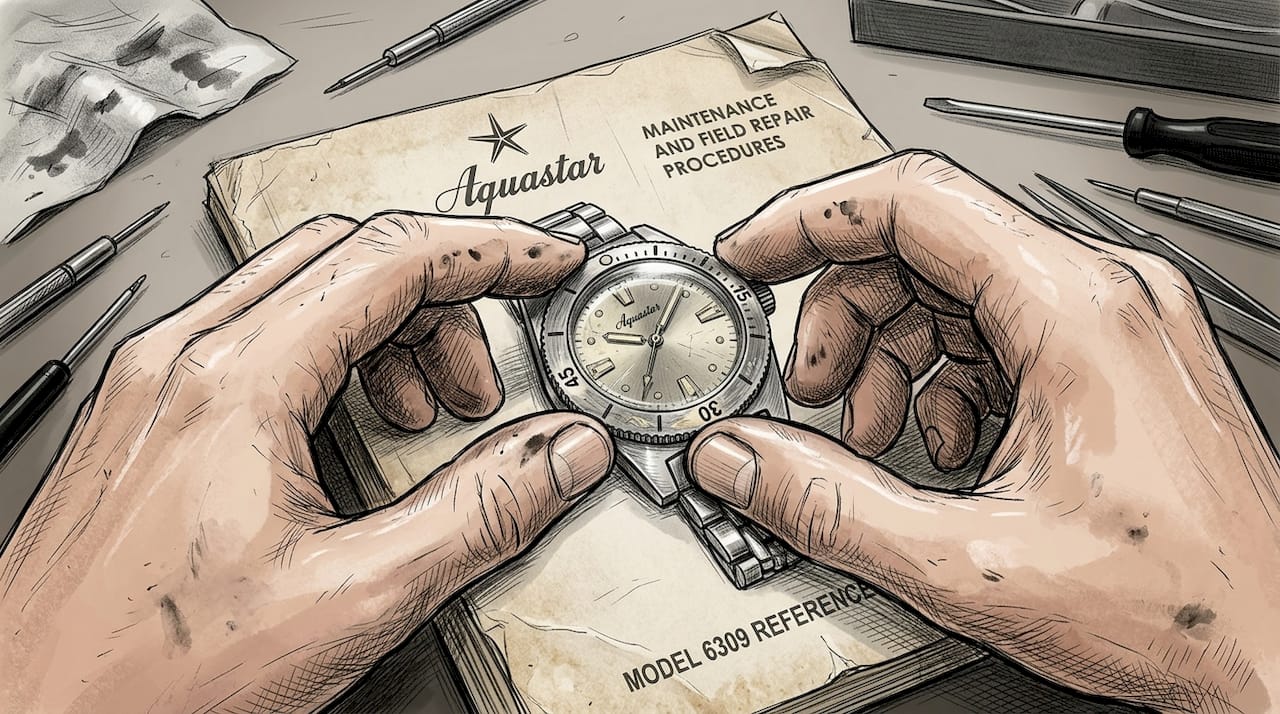
Independent testingEach certified watch undergoes independent testing rather than batch approval to ensure performance on a per model basis.
Required featuresCertification mandates a unidirectional bezel with minute markers, secure crown and pushers, and clear time indication in low light.
Aquastar modelsAquastar offers certified options like Deepstar 39mm Chronograph and Benthos 500 Chronograph that emphasize professional design and reliability.

Understanding dive watch certification standards

Certification transforms a water-resistant watch into a genuine dive instrument. The ISO 6425 standard defines rigorous requirements for dive watch certification including water resistance to at least 100 meters, luminous markings visible from 25 centimeters in darkness, and resistance to saltwater and thermal shock. These aren’t marketing claims but measurable performance benchmarks verified through controlled testing.

Certified dive watches undergo pressure testing at 125% of their rated depth. Manufacturers must verify timing device functionality, secure all moving parts against accidental operation underwater, and demonstrate magnetic resistance. The bezel must rotate counterclockwise only with clear minute markings for the first 15 minutes of dive time. Each watch receives individual testing rather than sample batch approval.
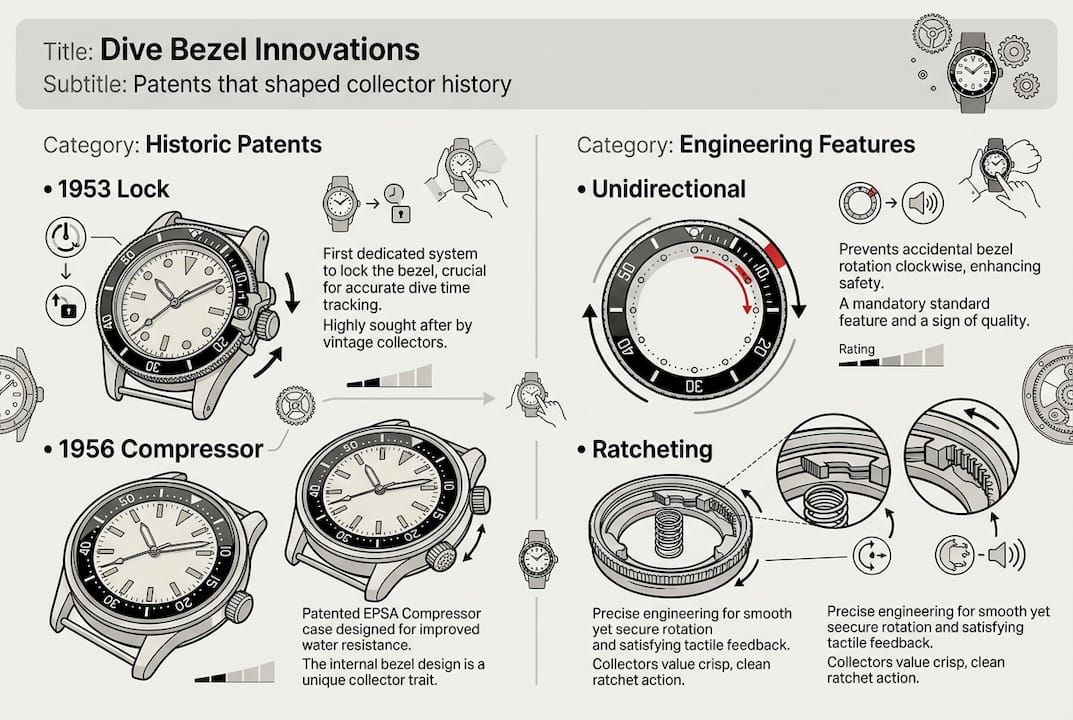
Key features mandated by certification include:

  1. Minimum 100-meter water resistance with testing at 125% rated depth
  2. Unidirectional rotating bezel with minute markers for elapsed time tracking
  3. Clearly visible time indication in total darkness at 25 centimeters distance
  4. Resistance to saltwater corrosion and magnetic fields
  5. Secure crown and pushers preventing accidental operation underwater
  6. Indication of function status through running seconds hand or alternative mechanism

These requirements ensure your watch functions as intended when your safety depends on accurate timekeeping. Certification validates that a timepiece can withstand rapid pressure changes, temperature fluctuations between surface and depth, and the corrosive effects of saltwater over extended periods. For professional and recreational divers, certification provides confidence that their tool watch meets internationally recognized safety standards rather than manufacturer marketing claims alone.

Comprehensive list of certified dive watches including Aquastar models

The certified dive watch market spans multiple price points and feature sets. Aquastar’s Deepstar and Benthos lines are historically certified dive watches recognized for innovation and professional reliability. These models represent the brand’s commitment to functional design driven by actual diving requirements rather than fashion trends.

Aquastar Certified Models:

  • Deepstar 39mm Chronograph features 200-meter certification with integrated chronograph function for timing multiple dive phases
  • Benthos 500 Chronograph extends depth rating to 500 meters with enhanced case construction
  • Deepstar Silverline combines classic aesthetics with modern certification standards
  • Navigator models introduced analog dive computer functionality in mechanical format

Comparison of Key Certified Dive Watch Features:

Brand/ModelCertificationDepth RatingKey InnovationMovement Type
Aquastar DeepstarISO 6425200mIntegrated chronographAutomatic
Aquastar Benthos 500ISO 6425500mEnhanced case pressure resistanceAutomatic
Aquastar NavigatorProfessional200mFirst analog dive computerAutomatic
Rolex SubmarinerISO 6425300mDate complicationAutomatic
Omega Seamaster ProISO 6425300mHelium escape valveAutomatic
Blancpain Fifty FathomsISO 6425300mUnidirectional bezel pioneerAutomatic

Aquastar holds particular significance for collectors because the brand was founded exclusively for dive watch production. While other manufacturers added dive watches to existing catalogs, Aquastar’s entire heritage centers on underwater timekeeping. The brand filed numerous patents in the 1960s for innovations including the skindiver case design that reduced profile while maintaining pressure resistance. These patents established design principles still used across the industry today.

When evaluating certified dive watch brands, consider both current certification status and historical contributions to dive watch development. Aquastar models offer collectors the opportunity to own watches that influenced modern diving instrument design while meeting contemporary certification standards.

Certifications’ impact on dive watch features and innovations

Certification requirements drive meaningful innovation rather than superficial design changes. Aquastar’s technological innovations in case design and chronograph integration were responses to certification-driven performance demands. When standards required pressure testing at 125% rated depth, manufacturers developed new case construction methods, gasket materials, and crown sealing systems.

Key feature developments driven by certification include:

  • Helium escape valves allowing gas to exit during decompression without crystal blowout
  • Screw-down crowns with multiple gasket seals preventing water ingress at depth
  • Sapphire crystals with anti-reflective coating maintaining readability underwater
  • Luminous compounds providing extended visibility in zero-light conditions
  • Unidirectional bezels with positive click mechanisms preventing accidental time adjustment

Aquastar pioneered the skindiver case concept, creating slimmer profiles without compromising water resistance. Traditional dive watch cases used thick construction to withstand pressure. Aquastar’s patented design redistributed stress points, allowing reduced thickness while meeting certification standards. This innovation made dive watches more comfortable for extended wear both underwater and on surface.
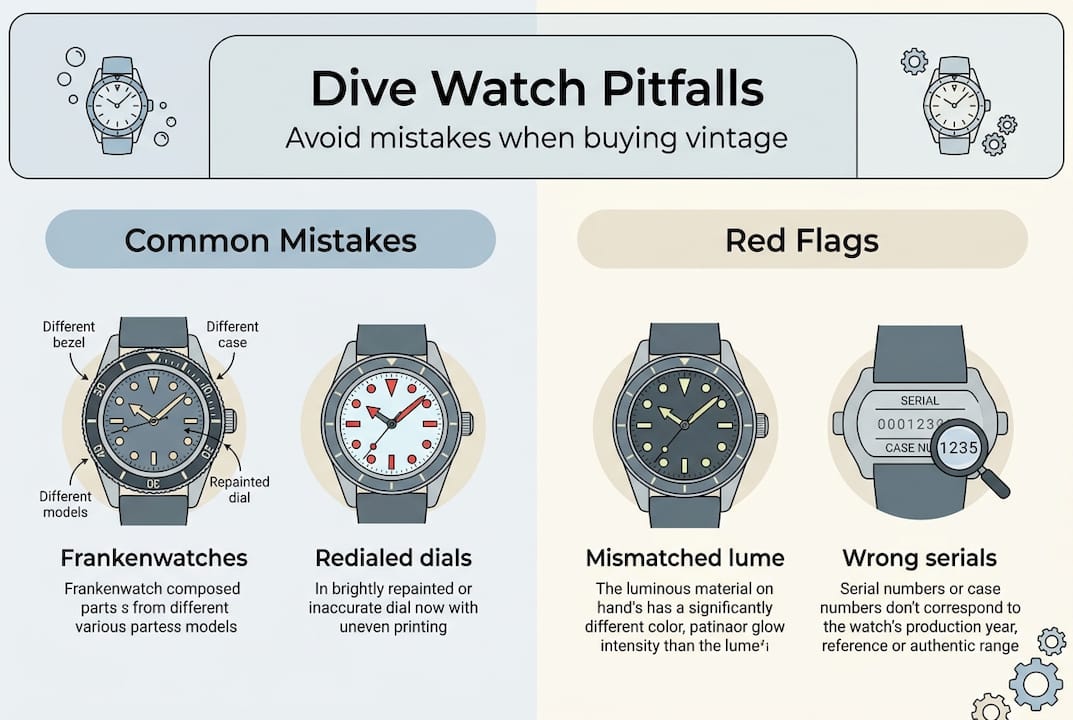
Certified dive watches displayed for comparison

The integration of chronograph complications into certified dive watches presented significant engineering challenges. Pushers create potential water entry points, requiring specialized sealing systems. Aquastar addressed this through case designs that maintained pusher functionality while preventing moisture ingress. The Benthos chronograph exemplifies this approach with sealed pushers operational at rated depth.

Pro Tip: When examining a certified dive watch, check for multiple indicators of genuine certification beyond marketing claims. Look for detailed depth ratings engraved on the case back, unidirectional bezel operation with distinct clicks, and luminous markers that glow brightly after brief light exposure. Authentic dive watch cases show thoughtful engineering in crown guards, case back construction, and crystal mounting methods.

Certification standards continue evolving with diving technology. Modern dive computers provide primary timing and depth information, but mechanical dive watches serve as essential backup instruments. Aquastar recognizes this role, designing watches that complement electronic dive computers rather than attempting to replace them. This practical approach ensures certified mechanical watches remain relevant tools for contemporary divers.

How to choose the right certified dive watch for your needs

Selecting your ideal certified dive watch requires matching certification specifications to your actual diving profile and collecting goals. Understanding certification levels and watch functions is crucial for selecting a dive watch that fits professional or casual diving activities. A recreational diver exploring reefs at 30 meters has different requirements than a technical diver conducting decompression stops at 60 meters.

Follow this evaluation framework:

  1. Determine your maximum diving depth and add 50% safety margin for certification rating
  2. Assess whether you need additional complications like chronograph or date functions
  3. Consider movement preference between automatic and manual wind mechanisms
  4. Evaluate case size and weight for comfort during extended dive sessions
  5. Review brand heritage and innovation history if collecting for investment value
  6. Set realistic budget accounting for certification level and feature complexity

For recreational diving to 40 meters, a 200-meter certified watch provides adequate safety margin. Professional diving beyond 50 meters warrants 300-meter or greater certification. Technical divers using helium-based gas mixtures should prioritize models with helium escape valves preventing crystal damage during decompression.

Movement type affects maintenance requirements and accuracy. Automatic movements offer convenience through wrist motion winding but require regular servicing every 5-7 years. Manual wind movements provide thinner case profiles and longer service intervals but demand daily winding discipline. Both types achieve certification when properly designed and manufactured.

Case materials impact durability and weight. Stainless steel offers excellent corrosion resistance at moderate cost. Titanium reduces weight by 40% while providing superior strength, ideal for extended dive trips. Bronze develops unique patina over time, appealing to collectors seeking distinctive aesthetics alongside certification.

Pro Tip: Before purchasing, research the specific features required for professional reliability at your diving depths. Test the bezel action, crown operation, and clasp adjustment while wearing a wetsuit or drysuit glove. A watch that operates smoothly with bare hands may prove difficult to adjust with neoprene gloves during actual dives. Consider starting a dive watch collection with a versatile 200-meter model before expanding to specialized high-depth pieces.

Budget considerations should account for long-term value rather than initial purchase price alone. Certified dive watches from established manufacturers retain resale value better than fashion-oriented water-resistant models. Aquastar watches offer particular value for collectors because limited production numbers and historical significance create appreciation potential alongside functional utility.
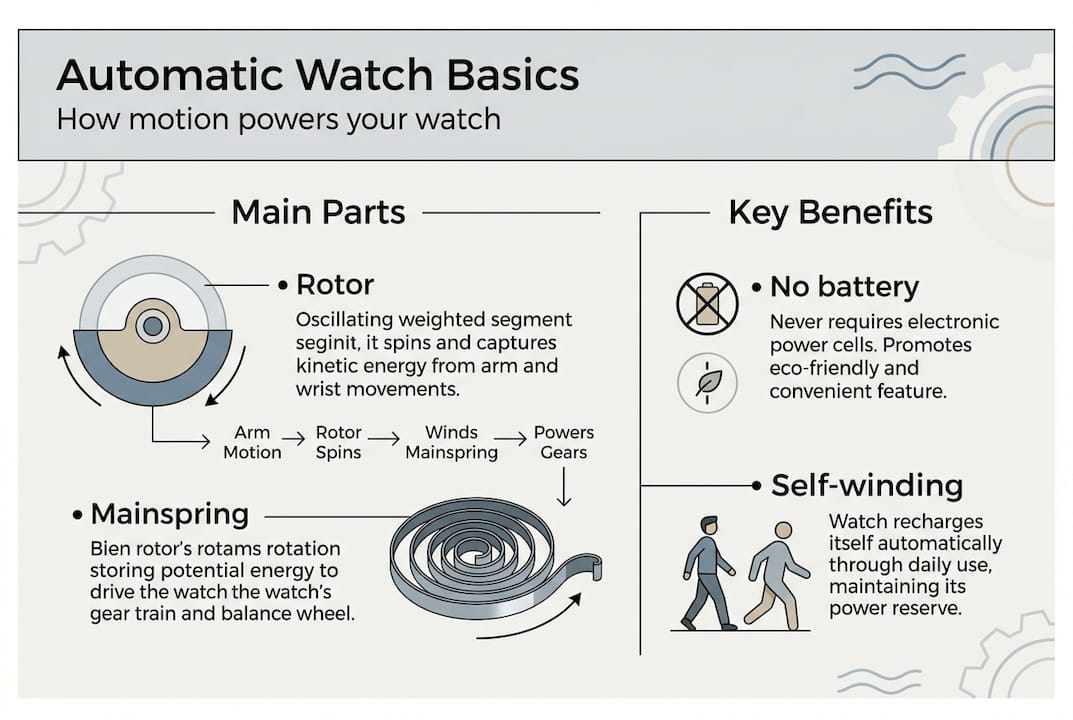


Explore Aquastar’s certified dive watch collection

Aquastar continues its heritage of producing professional dive watches that serve as reliable backup instruments for modern divers. The brand’s certified collection reflects decades of innovation in underwater timekeeping, from pioneering the analog dive computer concept to developing the skindiver case design now used industry-wide. Each Aquastar model combines historical design principles with contemporary certification standards.

https://aquastar.ch

Whether you’re outfitting yourself for professional diving expeditions or building a collection of significant dive watch innovations, Aquastar offers models spanning recreational to technical diving requirements. Explore detailed guides on tool watch fundamentals, compare automatic versus manual movements for your preferences, and review the essential features for professional reliability. Aquastar’s commitment to functional design ensures every certified model serves as a genuine diving instrument rather than merely resembling one.

FAQ

What is the ISO 6425 certification for dive watches?

ISO 6425 establishes international standards ensuring dive watches meet specific water resistance, durability, and readability requirements for underwater use. Certification confirms a watch has passed individual testing at 125% of its rated depth, demonstrates clear time indication in darkness, features a secure unidirectional bezel, and resists saltwater corrosion and magnetic fields. This standard separates genuine dive instruments from water-resistant fashion watches.

Are all certified dive watches suitable for professional diving?

Not all certified watches meet professional depth or feature requirements for technical or commercial diving. While ISO 6425 certification begins at 100 meters, professional divers typically require 300-meter or greater ratings plus additional features like helium escape valves for saturation diving. Recreational certification proves adequate for sport diving within depth limits, but professional applications demand higher specifications and redundant safety features.

How can I verify the authenticity of a dive watch’s certification?

Check official manufacturer documentation and warranty cards stating specific certification standards met. Examine the case back for depth rating engravings and certification marks rather than printed dial text alone. Test the unidirectional bezel operation and verify luminous markers glow brightly after light exposure. Consult trusted resources on identifying genuine dive watches and compare your watch’s features against known certified model specifications from the manufacturer.

Why does Aquastar focus exclusively on dive watches?

Aquastar was founded specifically for dive watch production, making it unique among Swiss manufacturers that typically produce diverse watch categories. This singular focus allowed concentrated innovation in underwater timekeeping, resulting in pioneering developments like the first analog dive computer and skindiver case design. The brand’s numerous 1960s patents established design principles still used industry-wide, and today Aquastar continues producing professional dive watches as backup instruments for divers using electronic dive computers.

What depth rating should I choose for recreational diving?

Recreational divers should select watches rated to at least double their maximum planned diving depth. For typical recreational limits of 30-40 meters, a 200-meter certified watch provides adequate safety margin accounting for pressure testing standards and aging gasket performance. This margin ensures the watch maintains water resistance even as seals gradually degrade over years of use and exposure to saltwater, sunlight, and temperature variations.

Further reading: Wikipedia on diving watches.

Posted on

What do you mean by automatic watch: a detailed guide

What do you mean by automatic watch: a detailed guide - what do you mean by automatic watch

What Do You Mean By Automatic Watch: at a glance

What do you mean by automatic watch? Rotor mechanics, winding systems and the trade-offs vs manual watches — collector-focused, no jargon. Use this guide on what do you mean by automatic watch to weigh design choices, engineering trade-offs and how the category translates to real Aquastar dive watches.

TopicWhat do you mean by automatic watch
Read time5-8 min
SourceAquastar editorial

What do you mean by automatic watch: a detailed guide - what do you mean by automatic watch

Many watch enthusiasts assume automatic watches wind themselves forever without any intervention. While automatic watches do harness wrist motion to power themselves, they’re not entirely maintenance-free. Understanding what makes an automatic watch tick reveals a fascinating blend of mechanical ingenuity and practical limitations. This guide explores the mechanics behind automatic movements, clarifies how rotors and winding systems work, examines the trade-offs between automatic and manual watches, and offers collector perspectives on integrating these timepieces into your rotation.

Table of Contents

Key Takeaways

PointDetails
Wrist powered windingAutomatic watches use a weighted rotor that spins with your wrist to wind the mainspring, storing energy for timekeeping.
Core movement componentsThe main parts include the rotor, mainspring, gear train, escapement, balance wheel, and jewel bearings.
Inactivity stops movementIf you do not wear or wind it, automatic watches stop and may require manual winding or a watch winder to restart.
Better accuracy when wornWearing the watch regularly maintains near maximum mainspring tension, supporting steadier timekeeping than an unpowered manual watch.

Understanding the mechanics of an automatic watch

An automatic watch is powered by the wearer’s wrist motion via a rotor that winds the mainspring. The rotor is a weighted semi-circular disc mounted on a pivot that spins 360 degrees as your wrist moves. Manufacturers typically use tungsten or brass for rotor weight, maximizing inertia while minimizing size. This spinning motion transfers energy through a gear train to wind the mainspring, which stores potential energy for powering the watch.

The mainspring sits coiled inside a barrel and gradually unwinds to release energy. This energy flows through the gear train, a series of interconnected wheels that transmit power while reducing speed. Key components include mainspring, gear train, escapement, and balance wheel regulating time at approximately 28,800 beats per hour. The escapement acts as a gatekeeper, releasing energy in controlled pulses to the balance wheel, which oscillates back and forth at a precise frequency.

Jewel bearings, typically synthetic rubies, reduce friction at critical pivot points throughout the gear train. Higher jewel counts often indicate more refined movements, though 17-25 jewels suffice for most automatic watches. The balance wheel’s oscillation rate determines the watch’s beat rate. A typical 28,800 vibrations per hour translates to four beats per second, creating the smooth sweeping motion automatic watches are known for.

Pro Tip: When examining an automatic watch, observe the seconds hand sweep. A smooth glide indicates a higher beat rate movement, while visible ticking suggests a lower frequency or quartz movement.

The interplay between these components creates a self-sustaining system as long as you wear the watch regularly. The rotor’s continuous motion keeps the mainspring wound near maximum capacity, ensuring consistent power delivery. This constant tension improves accuracy compared to manual watches, where power gradually decreases throughout the day. Understanding these mechanics helps you appreciate why automatic watches command premium prices and require specialized servicing. For divers and professionals, this reliability makes automatic movements essential in automatic vs manual dive watches, where consistent timekeeping can be critical underwater.

Infographic showing automatic watch basics and components

Modern automatic movements often incorporate column wheel mechanisms in chronograph complications, adding layers of sophistication to the basic automatic architecture.

Rotor designs and winding mechanisms explained

The central semi-circular rotor remains the most common design in automatic watches. This half-moon shaped weight pivots from the movement’s center, spinning freely as your wrist moves. Its simplicity and efficiency have made it the industry standard since the mid-20th century. The rotor’s weight and diameter directly affect winding efficiency, with larger rotors generating more momentum per movement.

Watchmaker inspecting automatic watch rotor mechanics

Peripheral rotors reduce thickness by placing the weighted element around the movement’s edge rather than layering it on top. This design allows watchmakers to create slimmer automatic watches, though it increases movement diameter and manufacturing complexity. Brands pursuing ultra-thin profiles often adopt peripheral rotors despite higher production costs. The weight distribution differs from central rotors, requiring careful engineering to maintain winding efficiency.

Micro rotors embed a small weighted disc within the movement’s architecture rather than mounting it on top. This approach achieves minimal thickness while preserving automatic functionality. However, micro rotors typically wind less efficiently than full-size rotors due to reduced mass and momentum. Watchmakers compensate by using denser materials like platinum or tungsten to maximize the weight-to-size ratio.

Modern movements use bidirectional winding via a reverser system pioneered by Rolex Perpetual in 1931. Earlier automatic watches only wound in one rotor direction, wasting half of the rotor’s motion. Bidirectional systems employ a reverser mechanism with clutch wheels that convert both clockwise and counterclockwise rotor spins into mainspring winding. This doubles winding efficiency, allowing the watch to maintain power reserve with less active wear.

Pro Tip: If you have a desk job with minimal wrist movement, choose watches with bidirectional winding and efficient rotor designs to ensure adequate power reserve throughout the workday.

Rotor types include central semi-circle, peripheral, and micro-rotor designs, each offering distinct advantages. Central rotors provide proven reliability and serviceability. Peripheral rotors enable slim cases while maintaining large diameters. Micro rotors create compact movements ideal for dress watches. Your choice depends on priorities like case thickness, movement visibility through exhibition casebacks, and intended use. For dive watches requiring robust construction, central rotors typically offer the best balance of durability and winding efficiency, as explored in automatic vs manual dive watches comparisons.

Pros, cons, and practical care of automatic watches

Automatic watches eliminate the daily winding ritual required by manual movements. You simply wear the watch, and wrist motion keeps it running. This convenience appeals to people who want mechanical watches without the discipline of daily maintenance. The constant winding also maintains optimal mainspring tension, supporting more consistent timekeeping than manual watches that gradually lose power throughout the day.

However, automatics offer convenience but add thickness, complexity, and require occasional manual winding or watch winders. The rotor mechanism adds 2-3mm to movement thickness compared to equivalent manual calibers. This extra height may push case dimensions beyond comfortable proportions for smaller wrists. The additional components also increase servicing complexity and cost, as watchmakers must disassemble and clean the entire winding system during overhauls.

Power reserve ranges from 40 to 80 hours, with accuracy approximately ±25 seconds per day under optimal conditions. If you don’t wear the watch for a day or two, it stops running. Restarting requires manual winding or shaking to engage the rotor, then setting the time. This limitation frustrates owners who rotate multiple watches, as each unworn piece needs resetting before wear.

Watch winders solve this problem by keeping automatic watches running during storage. These devices rotate watches at programmed intervals, simulating wrist motion to maintain power reserve. Quality winders offer adjustable turns per day and bidirectional rotation patterns matching your watch’s winding direction. However, some watchmakers debate whether constant winding accelerates wear on movement components.

Pro Tip: For watches with complications like perpetual calendars, a watch winder prevents the tedious process of resetting complex functions after the watch stops. For simple time-only pieces, manual winding when needed often suffices.

Regular wear provides the best care for automatic watches. Daily wrist motion keeps lubricants distributed and prevents components from settling. If storing a watch long-term, wind it fully and let it run down naturally rather than stopping it mid-cycle, which can stress the mainspring. Service intervals typically range from 5-7 years, though this varies by manufacturer and wear conditions.

Constant power delivery from automatic winding supports better accuracy stability. Manual watches start each day at maximum mainspring tension and gradually lose amplitude, affecting rate consistency. Automatics maintain tension within a narrow range, minimizing rate variation throughout the power reserve. This advantage matters most for precision-focused applications like professional diving, where reliable timekeeping supports safety protocols detailed in tool watches explained guide.

When evaluating automatic watches for professional use, consider features beyond the movement itself. Must have diver watch features professional reliability outlines essential specifications, while how to identify genuine dive watches helps verify authenticity and build quality.

Automatic watches in the watch enthusiast’s collection

Collectors favor automatic watches for daily wear due to winding convenience. Grabbing an automatic from your watch box means it’s likely running or needs only brief shaking to restart. This practicality makes automatics ideal for rotation schedules where you switch watches every few days. The self-winding mechanism removes friction from spontaneous watch choices, letting you select based on mood or outfit rather than which piece needs winding.

Manual watches appeal to collectors valuing tradition, minimalism, and daily winding ritual. The thinner profiles of manual movements create more elegant proportions, particularly in dress watches where every millimeter matters. Some enthusiasts appreciate the meditative quality of winding their watch each morning, viewing it as a connection to horological heritage. Manual movements also offer transparency, as the absence of a rotor provides unobstructed views of finishing and decoration through exhibition casebacks.

Collector strategies often balance automatic and manual pieces based on use cases:

  1. Daily wear automatics for convenience and consistent timekeeping
  2. Manual dress watches for formal occasions requiring slim profiles
  3. Automatic dive watches for active use and professional applications
  4. Manual vintage pieces for historical significance and collecting appeal
  5. Automatic travel watches for crossing time zones without winding concerns

Automatics maintain optimal power through constant winding improving accuracy over manuals that unwind daily. This advantage becomes evident when comparing rate performance across a week of wear. Automatic watches show tighter rate distribution, while manual pieces often exhibit morning-to-evening variation as mainspring tension decreases. For collectors prioritizing chronometric performance, automatics deliver more predictable results.

Storage and rotation require different approaches for automatic versus manual collections. Automatic watches benefit from regular wear or winder rotation to prevent lubricant settling. Manual watches tolerate longer storage periods without running, though periodic winding maintains lubricant distribution. Some collectors dedicate specific automatics to daily rotation while reserving manuals for occasional wear, balancing maintenance needs with collecting enjoyment.

Pro Tip: Track your watches’ performance using a timegrapher or smartphone app. This data reveals which pieces maintain accuracy best and helps optimize your rotation schedule around each watch’s strengths.

Building a diverse collection means understanding how automatic and manual movements complement each other. Automatics handle daily demands while manuals satisfy aesthetic and traditional preferences. This balance creates a well-rounded collection serving practical needs and collecting passions. Resources like how to collect dive watches guide and best dive watch brands comparison help collectors make informed decisions when expanding their holdings.

Explore Aquastar’s expert dive watches and guides

Now that you understand automatic watch mechanics and their role in collecting, exploring purpose-built timepieces brings this knowledge to life. Aquastar manufactures professional dive watches combining automatic reliability with proven underwater performance. Our heritage includes pioneering patents from the 1960s that shaped modern dive watch design, including the first analog dive computer and the original skindiver case.

https://aquastar.ch

Whether you’re drawn to automatic convenience or manual tradition, our collection offers Swiss-made mechanical watches engineered for commercial and recreational divers. Explore detailed guides covering everything from tool watches explained guide to automatic vs manual dive watches comparisons. Visit Aquastar to discover how our timepieces translate horological expertise into reliable instruments for underwater exploration.

Frequently asked questions about automatic watches

How long does an automatic watch run if not worn?

Most automatic watches run 40-80 hours on a full wind, depending on the movement design. Higher-end calibers often feature extended power reserves reaching 80 hours or more, while standard movements typically offer 40-48 hours. Once the power reserve depletes, the watch stops until you wear it again or manually wind it.

Can you manually wind an automatic watch and should you?

Yes, most automatic watches accept manual winding through the crown, though some budget movements lack this feature. Manual winding helps restart a stopped watch or top up power reserve before storage. Wind gently until you feel resistance, avoiding excessive force that could damage the mainspring. Regular manual winding won’t harm the movement and provides a backup when wrist motion proves insufficient.

What causes an automatic watch to lose or gain time?

Multiple factors affect automatic watch accuracy including mainspring tension, temperature changes, position variations, and magnetization. Watches run faster when fully wound and slower as power depletes. Temperature swings alter metal components’ dimensions, affecting the balance wheel’s oscillation rate. Magnetic fields from electronics can magnetize the hairspring, causing significant rate deviation. Regular servicing and demagnetization maintain optimal performance.

Is it necessary to service automatic watches more frequently?

Automatic watches typically follow the same 5-7 year service intervals as manual watches. The additional rotor mechanism doesn’t significantly accelerate wear if properly lubricated. However, automatics contain more components requiring cleaning and lubrication during service, potentially increasing service costs. Watches experiencing heavy daily wear or exposure to shocks may benefit from more frequent inspection.

Do automatic watches work for people with low wrist movement?

Automatic watches require sufficient daily motion to maintain power reserve. Desk workers or people with sedentary lifestyles may find their automatics stop regularly. Solutions include choosing highly efficient movements, manually winding daily, or using a watch winder. Some collectors with low activity levels prefer manual watches, eliminating winding uncertainty. Evaluate your lifestyle against the watch’s winding efficiency before purchasing. Learn more about choosing the right movement type in automatic vs manual dive watches.