
If you have ever looked closely at a dive watch, you may have noticed that the crown does not simply pull out. It has to be unscrewed first, with a few turns counter-clockwise, before you can set the time. That small piece of engineering is the screw-down crown, and it is one of the quiet reasons a dive watch can survive depths that would flood an ordinary timepiece. This article explains what a screw-down crown is, how it seals the case, and why every serious dive watch uses one.
What Is a Screw-Down Crown?
The crown is the small knurled knob on the side of a watch case. You use it to wind the mainspring, set the time, and on many watches adjust the date. On a standard dress watch, the crown is held in place only by the friction of a tube and a gasket. It can be pulled out to set the time and pushed back in, and that push-fit seal is enough for everyday splashes and rain.
A screw-down crown works differently. Instead of relying on friction alone, it threads onto a matching tube that is fixed to the case. When you screw it fully home, the crown is mechanically locked against the case and compresses one or more rubber gaskets into a tight, continuous seal. To set the time you first unscrew it, and after setting you screw it back down. This deliberate two-step action is the price of admission for true water resistance, and most divers come to appreciate the reassurance of feeling the crown seat firmly before they enter the water.
How the Gasket Seal Actually Works
The seal at the crown is created by gaskets, small rings usually made of synthetic rubber such as nitrile or, in higher specification watches, fluorocarbon compounds that resist heat and chemicals. When the crown is screwed down, the threads draw it tight and the gasket is squeezed into a groove. Because rubber is slightly compressible but cannot escape the channel it sits in, it forms a barrier that water cannot pass.
Counterintuitively, water pressure helps rather than hinders this seal. As a diver descends, the surrounding pressure rises by roughly one atmosphere for every ten meters of depth. That pressure pushes the gasket harder against its sealing surfaces, so a well-designed crown actually seals more tightly the deeper it goes. The real enemies of a gasket are not depth but time and neglect: rubber dries out, hardens, and cracks over the years, which is why periodic gasket replacement is part of routine watch servicing.
Why the Crown Is the Weak Point
A watch case has three main openings where water can enter: the crystal at the front, the caseback at the rear, and the crown on the side. The crystal and caseback are static, sealed once at the factory and left alone. The crown is the only opening that the owner operates regularly, pulling it out and pushing it back every time the watch is set or wound. That repeated movement is exactly why the crown receives the most engineering attention on a dive watch, and why the screw-down mechanism exists at all.
The Dual-Gasket Breakthrough of the Late 1960s
Early screw-down crowns used a single gasket, which sealed well at moderate depths but left a single point of failure. As saturation diving and deeper exploration pushed the demands on watches through the 1960s, watchmakers looked for ways to seal crowns against far greater pressure. One of the important advances was the move to a dual-gasket, or twin-seal, crown system. Instead of one rubber ring doing all the work, two gaskets were arranged in series so that if one was compromised, the second still held back the water.
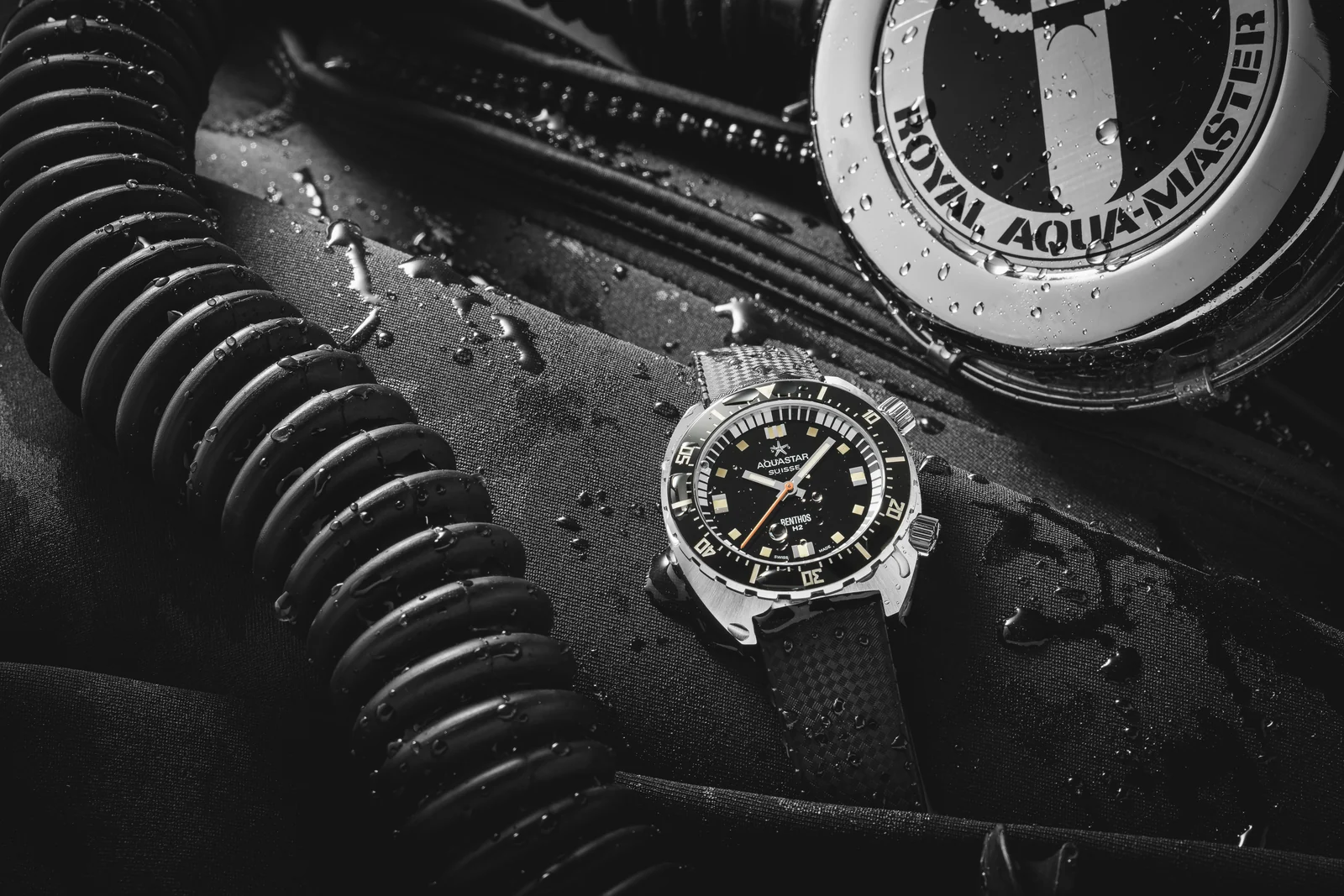
This twin-seal thinking, combined with sturdier case construction, is part of what allowed Swiss makers to build watches rated well beyond the recreational range. By 1970 Aquastar introduced the Benthos 500, recognised as the first Swiss dive watch rated to 500 meters, an advertised depth that reflected exactly this generation of sealing and case engineering. The lesson that carried forward was simple: redundancy at the crown is cheap insurance against the one failure mode that matters most underwater.
Screw-Down Crown vs Push-Pull Crown
A push-pull crown is faster and more convenient. There is nothing to unscrew, so setting the time takes a moment. For a dress watch or a watch rated for everyday water contact only, that convenience is perfectly sensible. The trade-off is that a push-pull crown relies on a single friction-held gasket and is not designed for sustained pressure.
- Screw-down crown: mechanically locked to the case, compresses one or more gaskets, designed for diving and sustained pressure. Requires unscrewing before use.
- Push-pull crown: friction-held, quick to operate, suitable for splash resistance and light water contact, not for diving.
There is one habit that matters more than which type you own. A screw-down crown only protects the watch when it is fully screwed down. If you set the time and forget to thread the crown home before entering the water, the watch is no better sealed than one with an open crown. Building the habit of checking that the crown is seated is the single most useful thing a dive watch owner can do.
Caring for a Screw-Down Crown
A screw-down crown rewards a little care. Never force it. The threads are fine and can cross-thread if you push while turning at the wrong angle, so let the crown find its start and turn gently until it seats. Rinse the watch in fresh water after swimming in salt water or chlorinated pools, because salt crystals and chemicals shorten gasket life. And because the gaskets are consumable parts, have them inspected and replaced during a full service, typically every five to seven years, or sooner if you dive often.
If water resistance genuinely matters to you, ask a watchmaker to pressure-test the watch after any crown or gasket work. A pressure test confirms the seal under real conditions rather than relying on the rating printed on the dial, which describes the watch as designed rather than the watch as it stands after years of wear.
The Takeaway
The screw-down crown is a small mechanism that does an outsized job. By threading the crown to the case and compressing rubber gaskets into a sealed channel, it turns the most frequently handled opening on a watch into one of its most secure. The dual-gasket designs that matured in the late 1960s pushed that idea further, enabling the deep-rated Swiss dive watches that followed. If you are exploring purpose-built dive watches with serious sealing and advertised depth ratings to match, the Aquastar Benthos family is a natural place to start.