
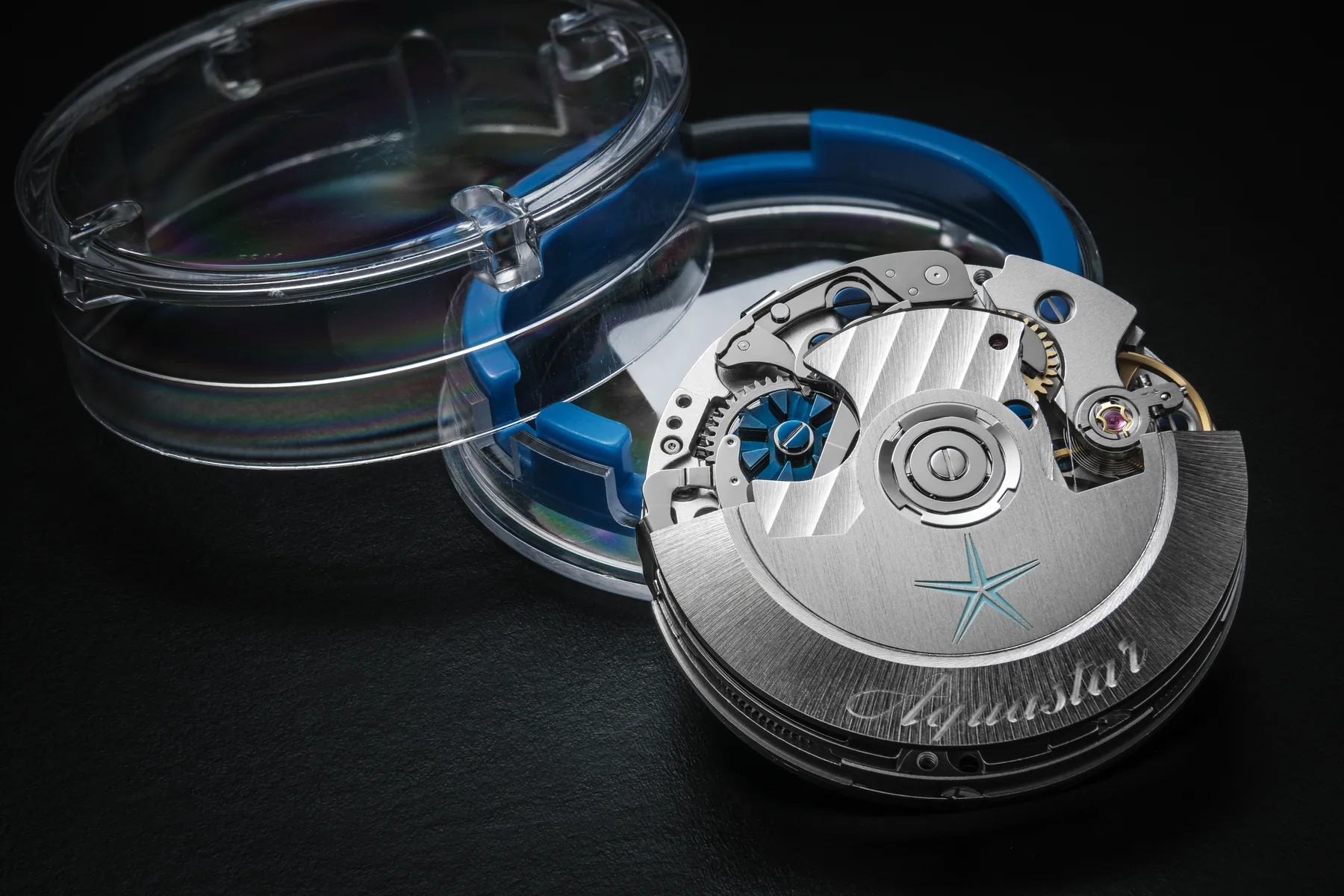
What Is A Swiss Movement Watch: at a glance
What is a Swiss movement watch? Origin requirements, Aquastar's dive caliber innovations and why the label matters less than design discipline. Use this guide on what is a swiss movement watch to weigh design choices, engineering trade-offs and how the category translates to real Aquastar dive watches.
| Topic | What is a swiss movement watch |
| Read time | 5-8 min |
| Source | Aquastar editorial |

When you hear ‘Swiss Movement,’ you might assume the entire watch was crafted in Switzerland. That’s rarely true. Many watches labeled ‘Swiss Movement’ contain non-Swiss components or undergo final assembly elsewhere. This guide clarifies what defines a Swiss movement watch, traces the evolution of Swiss dive watches from Blancpain to Rolex, and showcases Aquastar’s innovations in professional dive timepieces with verified Swiss movements.
Table of Contents
- Understanding What Makes A Watch Movement ‘Swiss’
- Key Milestones In The History Of Swiss Dive Watches
- Aquastar’s Swiss Movement Dive Watch Innovations: Benthos And Deepstar Series
- Why Swiss Movement Watches Matter To Divers And Collectors
- Explore Aquastar’s Swiss Movement Dive Watch Collection
Key takeaways
| Point | Details |
|---|---|
| Swiss Made criteria | Requires development, majority Swiss parts (60% value), and assembly plus inspection in Switzerland. |
| Swiss Movement distinction | Movement meets Swiss standards but watch assembly or parts may originate elsewhere, affecting quality perception. |
| Historic dive watch milestones | Blancpain Fifty Fathoms reached 100m in 1953, Rolex Submariner doubled to 200m in 1959, setting industry benchmarks. |
| Aquastar innovations | Benthos 500 achieved 500m depth rating with US Navy approval, Deepstar introduced mono-compax chronograph design in 1965. |
| Collector value | Swiss Made watches retain higher resale value due to craftsmanship, heritage, and global serviceability networks. |
Understanding what makes a watch movement ‘Swiss’
The Swiss Made label is legally protected under federal law, requiring strict criteria. To earn Swiss Made status, a watch must meet four conditions. First, the movement must be developed in Switzerland with technical plans and prototypes created by Swiss engineers. Second, at least 60% of the watch’s manufacturing value must originate from Swiss components and labor. Third, the movement must be assembled within Switzerland by certified watchmakers. Fourth, final inspection and quality control must occur on Swiss soil.
Swiss Movement watches follow looser rules. The movement itself qualifies as Swiss if it meets assembly and inspection standards, but the case, dial, or hands might come from Asia or Europe. Final watch assembly could happen anywhere. This distinction matters because a Swiss Movement watch may lack the full traceability and quality assurance of a Swiss Made piece.
“A Swiss Movement watch guarantees movement quality but leaves room for non-Swiss components in the case, bracelet, or final assembly stages.”
Practical implications affect buyers directly:
- Serviceability: Swiss Made watches use standardized Swiss parts, making repairs easier through authorized service centers worldwide.
- Resale value: Collectors pay premiums for verified Swiss Made pieces due to documented provenance and craftsmanship.
- Durability: Stricter component tolerances in Swiss Made watches improve long-term reliability under harsh conditions like deep diving.
For dive watch enthusiasts, understanding these distinctions helps evaluate whether a timepiece will perform reliably at depth and maintain value over decades of use.
Key milestones in the history of Swiss dive watches
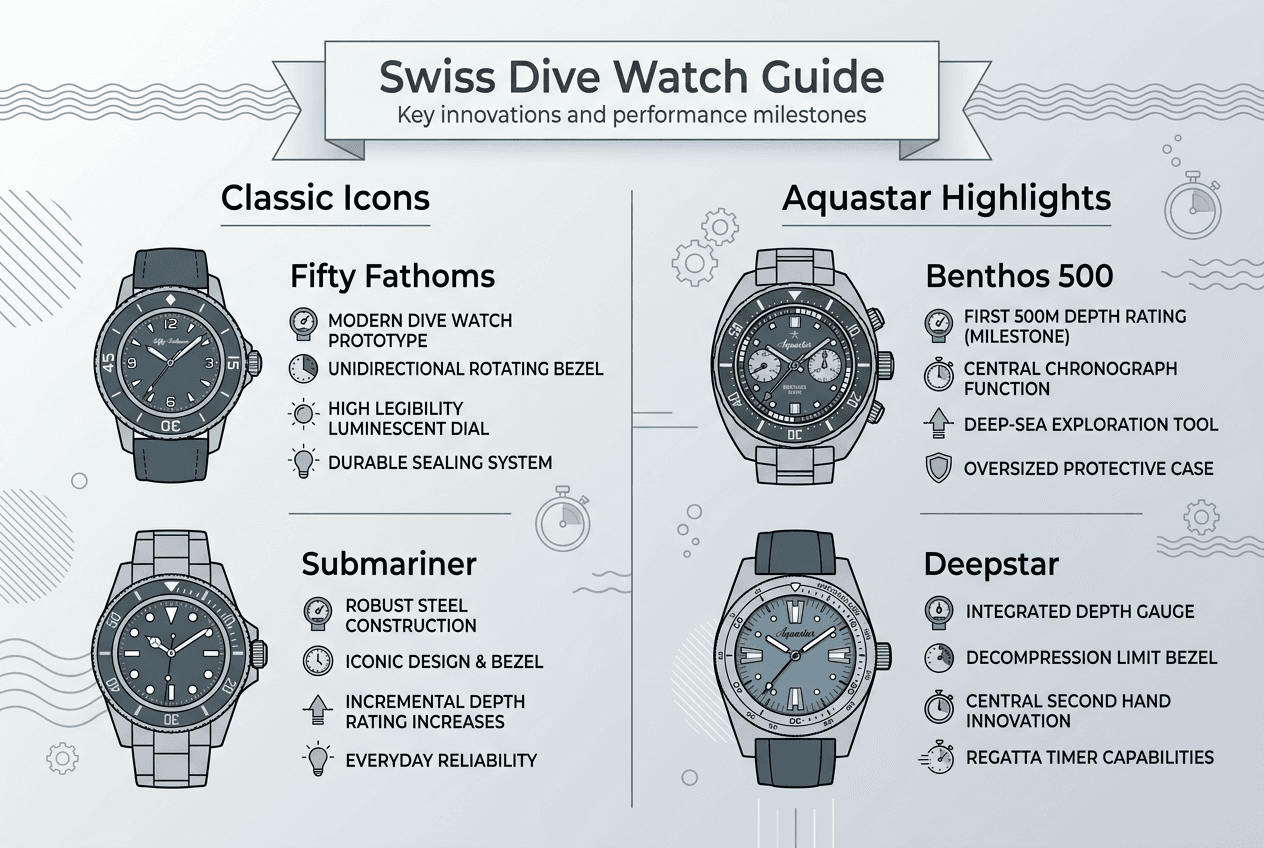
Swiss manufacturers defined modern dive watch standards through groundbreaking innovations in the 1950s. Blancpain Fifty Fathoms was the first dive watch rated to 100m in 1953, featuring a rotating bezel to track dive time and a moisture-resistant case. French Navy combat swimmers adopted it immediately, validating its professional capabilities.
Rolex Submariner doubled the depth rating to 200 meters in 1959, introducing the Triplock crown system that sealed the case more effectively. This innovation became the blueprint for recreational and military dive watches worldwide. The Submariner’s combination of legibility, crown protection, and robust automatic movement set expectations that persist today.
These milestones established design principles that Swiss watchmakers still follow:
- Rotating bezels with minute markers for tracking elapsed dive time without moving watch hands.
- Luminous markers using tritium or Super-LumiNova for visibility in zero-light environments below 30 meters.
- Screw-down crowns preventing water intrusion through the winding stem during pressure changes.
- Automatic movements eliminating battery changes that could compromise water resistance during servicing.
| Model | Year | Depth Rating | Key Innovation |
|---|---|---|---|
| Blancpain Fifty Fathoms | 1953 | 100m | First rotating bezel with dive scale |
| Rolex Submariner | 1954 | 100m (200m by 1959) | Triplock crown, doubled depth rating |
| Omega Seamaster 300 | 1957 | 200m | Naiad crown lock system |
| Aquastar Benthos 500 | 1960s | 500m | First 500m Swiss dive watch |
These Swiss innovations weren’t just technical achievements. They created a culture of reliability that professional divers and military units demanded, pushing watchmakers to engineer beyond recreational diving depths.
Aquastar’s Swiss movement dive watch innovations: Benthos and Deepstar series
The Aquastar Benthos 500 was one of the first dive watches capable of surviving at depths of up to 500 meters, earning US Navy approval for combat diving operations. Unlike competitors focusing on 200m ratings, Aquastar engineered the Benthos with a thicker case, reinforced crystal, and enhanced gasket system to withstand extreme pressure. This made it a tool watch for saturation divers working on offshore oil rigs and military special operations units.
Modern Benthos reissues like the Benthos H1 Blue Edition preserve the original’s functional design while upgrading to contemporary Swiss movements. The H1 uses an ETA 2824-2 automatic movement, a proven Swiss caliber with 38-hour power reserve and 28,800 vph beat rate. The case maintains period-correct proportions with a 40mm diameter and domed sapphire crystal. The unidirectional bezel features a 60-minute dive scale with luminous pip at 12 o’clock for low-light timing.
The Aquastar Deepstar Chronograph, launched in 1965, was designed as a mono-compax dive chronograph with a single subdial at 3 o’clock. This layout maximized dial legibility underwater by eliminating visual clutter from multiple registers. Divers could track elapsed time via the chronograph hand while monitoring dive duration on the rotating bezel, a dual-timing system no other Swiss manufacturer offered at the time.

Contemporary Deepstar editions like the 2022 Deepstar 39mm Chronograph Silverline upgrade to La Joux-Perret automatic column-wheel chronograph movements. Column-wheel mechanisms deliver smoother pushbutton actuation and more precise start/stop functions than cam-actuated chronographs. The 39mm case suits smaller wrists without sacrificing water resistance, maintaining 200m depth rating suitable for recreational diving.
Pro Tip: When evaluating dive chronographs, check if the movement uses a column-wheel or cam system. Column-wheel movements like La Joux-Perret offer superior longevity and serviceability, though they cost more to manufacture.
| Model | Movement | Depth Rating | Key Feature |
|---|---|---|---|
| Benthos 500 Chronograph | ETA Valjoux 7750 | 500m | US Navy approved, chronograph complication |
| Benthos 500 II Founder’s Edition | ETA 2824-2 | 500m | Heritage reissue, date display |
| Benthos H1 Blue Edition | ETA 2824-2 | 300m | Modern proportions, sapphire crystal |
| Deepstar Silverline | La Joux-Perret | 200m | Column-wheel chronograph, 39mm case |
Aquastar’s focus on functional design over fashion trends makes these watches appealing to working divers who need backup timing devices when dive computers fail. The Swiss movements ensure parts availability and servicing through authorized watchmakers worldwide, critical for professionals operating in remote locations.
Why Swiss movement watches matter to divers and collectors
Swiss movement watches deliver tangible benefits beyond brand prestige. Superior craftsmanship translates to tighter tolerances in escapement components, improving timekeeping accuracy to +/- 5 seconds per day versus +/- 20 seconds in non-Swiss movements. For divers tracking decompression stops, this accuracy prevents dangerous errors in ascent timing.
Serviceability advantages stem from Switzerland’s network of certified watchmakers and parts suppliers. If your Aquastar needs a new mainspring or balance wheel in Singapore or Miami, authorized service centers can source genuine Swiss components within days. Non-Swiss movements often require shipping watches back to the manufacturer, leaving divers without backup timing for weeks.
Swiss Made watches generally retain value better in secondary markets because collectors trust the verified manufacturing process. A 1960s Aquastar Benthos 500 with original Swiss movement commands premium prices at auction due to documented heritage and rebuildability. Comparable depth-rated watches with unknown movements sell for fractions of that value.
Professional divers rely on mechanical watches as dive computer backups because electronics fail under pressure or battery depletion. A Swiss automatic movement like the ETA 2824-2 runs indefinitely with regular servicing, providing fail-safe timing when digital devices malfunction during deep or extended dives. This redundancy has saved lives in saturation diving operations where decompression miscalculations prove fatal.
Pro Tip: Before buying a vintage Swiss dive watch, verify the movement serial number matches the case serial to confirm originality. Frankenwatch assemblies mixing non-Swiss movements into Swiss cases destroy collector value and reliability.
Practical buyer advice:
- Inspect the caseback for “Swiss Made” engraving, not just “Swiss Movement,” to confirm full manufacturing compliance.
- Request service history documenting Swiss parts used in previous overhauls.
- Check if the brand maintains authorized service centers in your region for accessible maintenance.
- For investment purposes, prioritize models with documented depth rating certifications from testing labs like COSC or NASA.
Understanding these factors helps you choose dive watches that perform reliably underwater while maintaining value as collectible timepieces. Consult the complete dive watch collector’s guide for deeper evaluation criteria.
Explore Aquastar’s Swiss movement dive watch collection
If you’re serious about Swiss movement dive watches that combine heritage with modern reliability, Aquastar’s current lineup delivers professional-grade tools for recreational and commercial divers. The Aquastar dive watch models range from vintage reissues like the Benthos 500 to contemporary iterations with upgraded movements and materials.
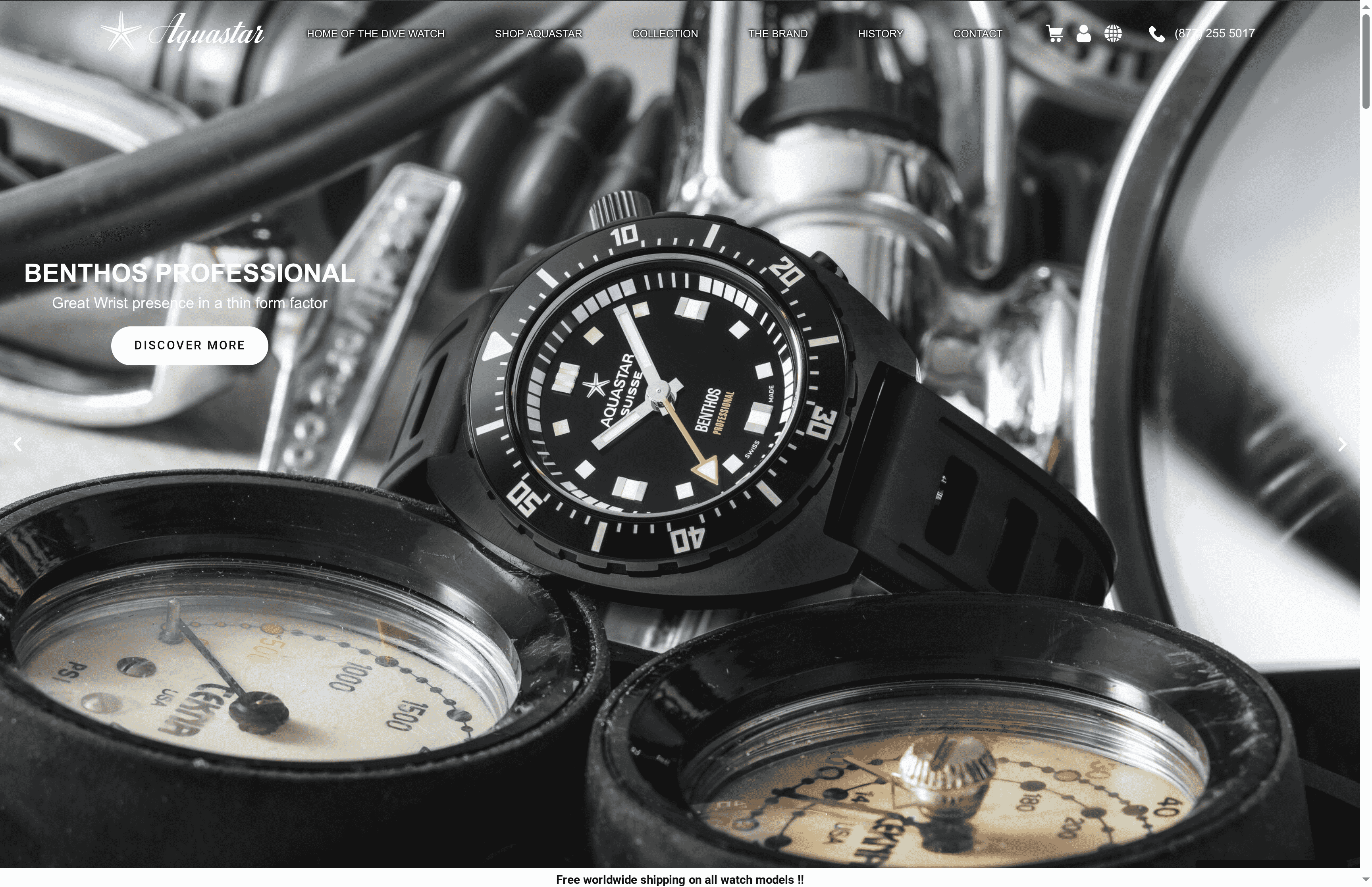
Explore how tool watches prioritize function over decoration, a philosophy Aquastar pioneered in the 1960s when designing for Navy dive teams. The Benthos H1 Blue Edition exemplifies this approach with its ETA 2824-2 movement, 300m depth rating, and high-contrast dial optimized for underwater legibility. Whether you’re building a collection or need a reliable dive computer backup, these Swiss movement pieces offer proven performance backed by decades of professional use.
FAQ
Is a Swiss movement watch always made in Switzerland?
No, a Swiss movement watch only guarantees the movement meets Swiss manufacturing standards. The case, dial, hands, or final assembly may occur outside Switzerland. For full Swiss manufacturing, look for the Swiss Made designation, which requires 60% Swiss components by value and complete assembly in Switzerland.
What makes the Aquastar Benthos stand out among dive watches?
The Benthos 500 Chronograph achieved a 500m depth rating in the 1960s when competitors maxed out at 200m, earning US Navy approval for combat diving. Modern reissues preserve this heritage while upgrading to robust ETA automatic movements. The distinctive case design and proven reliability make it a collector favorite among dive watch enthusiasts.
How do modern Aquastar Deepstar re-editions enhance the original design?
Contemporary Deepstar models like the 2022 Silverline use La Joux-Perret automatic column-wheel chronograph movements instead of the original manual-wind calibers. This upgrade provides smoother pushbutton operation and eliminates manual winding requirements. Improved lume compounds and sapphire crystals enhance legibility and scratch resistance while maintaining the mono-compax dial layout that defined the 1965 original.
Why do Swiss movement watches generally have higher resale value?
Collectors pay premiums for Swiss watches because verified manufacturing processes ensure quality, parts availability, and serviceability. The Swiss Made label provides documented provenance that buyers trust when investing thousands in vintage or contemporary pieces. Non-Swiss movements lack standardized parts networks, making long-term ownership riskier and reducing secondary market demand.