
The words “Swiss Made” on a dial carry more weight than almost any other two words in watchmaking, yet most buyers have only a vague sense of what they actually guarantee. The label is not a marketing flourish. It is a legal designation governed by Swiss federal law, with measurable thresholds a watch must meet before a brand is allowed to print it. This article explains what makes a Swiss Made watch, what the ordinance does and does not promise, and why the distinction matters when you are deciding where to put your money.
The legal basis: a federal ordinance, not a slogan
The right to use “Swiss” or “Swiss Made” on a watch is regulated by a dedicated federal ordinance, sitting underneath Switzerland’s wider trademark and “Swissness” legislation. The current rules were tightened in a revision that came into force on 1 January 2017, raising the bar specifically because the previous, looser definition had allowed watches with a relatively thin Swiss contribution to wear the label.
Enforcement is taken seriously. The Federation of the Swiss Watch Industry, the trade body that represents most of the sector, actively monitors misuse and pursues legal action against products that claim Swiss origin without meeting the criteria. Because the designation is anchored in law rather than industry self-policing, a watch that prints “Swiss Made” without qualifying is committing an offence, not merely bending a convention.
The four core requirements for a Swiss Made watch
Under the post-2017 rules, a watch may only be described as Swiss when it satisfies several conditions at once. The headline criteria are as follows.
- The movement is Swiss. The heart of the watch must itself qualify as a Swiss movement under a separate set of rules (covered below).
- The movement is cased up in Switzerland. The act of fitting the movement into its case must take place on Swiss soil.
- Final inspection by the manufacturer happens in Switzerland. The maker’s last quality check is carried out in the country.
- At least 60 percent of the manufacturing costs are generated in Switzerland. This value threshold applies to the whole watch, not just the movement.
There is a fifth, easily overlooked requirement: the technical development of the watch must also be carried out in Switzerland. In other words, the design and engineering work that defines the product, not only its physical assembly, has to be Swiss. Together these conditions mean a genuine Swiss Made watch represents real economic and intellectual activity inside the country, not a foreign product given a Swiss veneer at the final step.
What counts as a “Swiss movement”?
Because the whole watch can only be Swiss if its movement is Swiss, the definition of a Swiss movement does a lot of the work. A movement qualifies when three things are true at the same time.
- It is assembled in Switzerland.
- It is inspected by the manufacturer in Switzerland.
- At least 60 percent of the value of its components is of Swiss manufacture.
That 60 percent component-value rule is the part that changed most in the 2017 revision. The older standard counted only the value of the parts without a meaningful percentage floor on the whole, which made it possible to assemble a movement in Switzerland from a high proportion of foreign components and still call it Swiss. The current rule forces a majority of the movement’s component value to be genuinely Swiss before the label applies.
What Swiss Made does not guarantee
This is where buyers most often misread the label. “Swiss Made” is a statement about origin and value distribution. It is not, on its own, a statement about quality, accuracy, or water resistance. A watch can be fully Swiss Made and still use an industrial, mass-produced movement, while another watch with extraordinary finishing might fall just short of the threshold for reasons of sourcing rather than craft.
It is also worth being clear about what the ordinance does not require. It does not demand that 100 percent of the watch be made in Switzerland. A qualifying watch can legitimately contain foreign components, including parts of the case, dial, hands, or bracelet, provided the overall 60 percent cost threshold and the movement rules are met. The label tells you that the majority of the watch’s value and its core engineering are Swiss. It does not tell you that every screw was turned in a Jura workshop.
For dive watches specifically, the Swiss Made label says nothing about depth rating or whether a watch has been tested to a recognised diving standard. Those are separate questions answered by a maker’s own specifications and testing, not by the country-of-origin mark. A 200 meter or 300 meter rating and the “Swiss Made” line on a dial are two independent claims, and a careful buyer reads them as such.
Why the label still matters
Given those caveats, is “Swiss Made” worth caring about? For most serious buyers, yes. The designation guarantees that the technical development and a majority of the value were created within an ecosystem of specialist suppliers, movement makers, and finishing workshops that has been refined over more than a century. That ecosystem is precisely why independent movement specialists such as La Joux-Perret and ETA, and assemblers such as Sellita, can supply high-quality calibres to brands of every size.
The label also offers a degree of consumer protection. Because it is legally defined and actively enforced, it is far harder to fake than a vague claim like “Swiss design” or “Swiss heritage,” phrases that carry no legal weight at all. When you read “Swiss Made” on a dial, you are reading a claim the maker can be held to in court.
How to use this when buying
Treat “Swiss Made” as a meaningful baseline rather than a finish line. Confirm the exact movement a watch uses and look it up, since the calibre tells you far more about long-term reliability and serviceability than the country mark alone. Read the depth rating and any testing claims separately. And be wary of softer phrases that imitate the official label without meeting it, since those are exactly the wording a brand reaches for when it cannot qualify for the real thing.
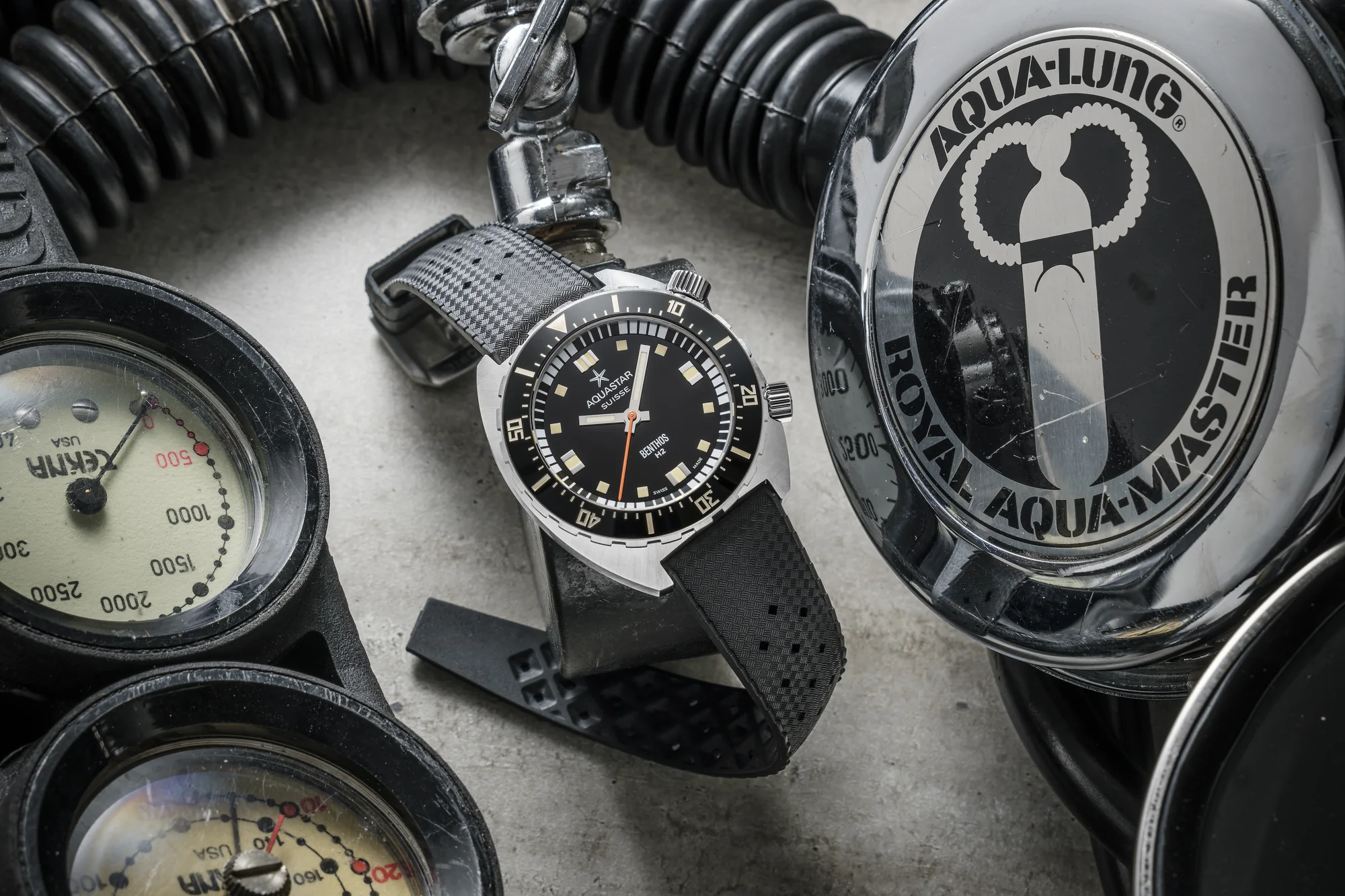
Swiss dive watchmaking has a particularly deep version of this heritage, built around makers who developed genuine diving instruments rather than dress watches dressed up as tools. Aquastar belongs to that lineage, with a history in Swiss dive watches that runs back to the late 1950s and a current collection built on Swiss movements. If the ideas in this article are useful to you, exploring the Benthos family is a natural next step to see how the Swiss Made baseline translates into an actual modern dive watch.