Posted on

Sapphire Crystal Dive Watch Benefits

Sapphire Crystal Dive Watch Benefits - sapphire crystal dive watch benefits

Sapphire Crystal Dive Watch Benefits: at a glance

Sapphire crystal dive watch benefits: scratch resistance, optical clarity, AR coatings and why it belongs on a serious underwater instrument. Use this guide on sapphire crystal dive watch benefits to weigh design choices, engineering trade-offs and how the category translates to real Aquastar dive watches.

TopicSapphire crystal dive watch benefits
Read time5-8 min
SourceAquastar editorial

A dive watch earns its keep the hard way. Salt, sand, steel ladders, tank buckles, deck hardware, and daily wear punish the crystal more than most buyers expect. That is where sapphire crystal dive watch benefits become more than a line on a specification sheet. On a serious underwater instrument, the crystal is not trim. It is part of the watch’s working structure, and the material choice matters.

Sapphire Crystal Dive Watch Benefits - sapphire crystal dive watch benefits

For collectors and divers alike, sapphire sits at the point where modern engineering improves a traditional tool without compromising its purpose. Acrylic has vintage warmth. Mineral crystal can keep costs down. But when a watch is built for repeated use, long ownership, and a life that moves between open water and everyday wear, sapphire usually makes the strongest case.

Why sapphire belongs on a serious dive watch

A dive watch is expected to remain legible, sealed, and dependable under conditions that expose weak points quickly. The crystal is one of those points. It must resist impact, maintain clarity, and work as part of the case architecture under pressure.

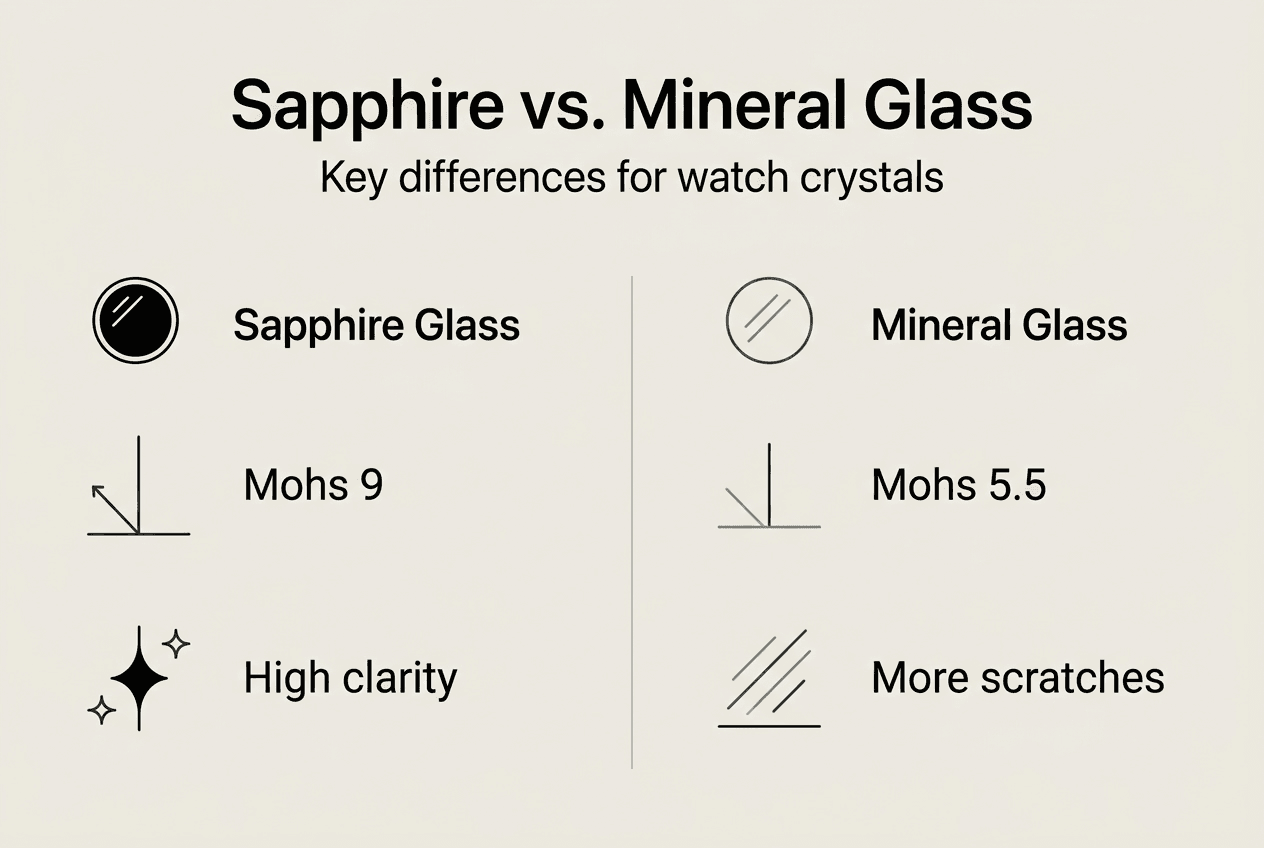
Sapphire crystal is a synthetic form of corundum. On the Mohs scale of hardness, it sits at 9, just below diamond. In practical terms, that means it resists scratches from almost anything a watch will encounter in daily use. Door frames, zippers, desk surfaces, aluminum gear, and gritty debris may mark a softer crystal. Sapphire shrugs off most of it.

That hardness matters even more on a dive watch than on a dress piece. A scratch across the dial side of the crystal is not just cosmetic. It can interfere with fast reading in glare, wash out lume at an angle, and make a watch look tired long before the case or movement actually are.

The real sapphire crystal dive watch benefits in daily wear

The most obvious advantage is scratch resistance, but the value goes deeper than surface appearance. A dive watch is often the one watch an owner wears across every setting – in the water, in transit, at work, and off duty. That kind of use exposes the crystal to constant friction and incidental contact.

Acrylic crystals pick up character quickly, which some vintage collectors genuinely enjoy. Mineral crystals tend to fare better, but they still show wear over time. Sapphire preserves the look of the watch far longer. The dial stays crisp. The bezel appears sharper against an unmarked crystal edge. The whole watch retains the visual discipline that the designer intended.

There is also a practical ownership benefit here. A crystal that resists wear helps the watch age on its terms. You see the patina of use where it belongs – on the strap, the bezel insert, or the case flanks – not as a cloudy barrier over the dial.

Clarity where it counts

A high-quality sapphire crystal can deliver excellent transparency, especially when paired with anti-reflective treatment. That is not a minor point on a dive watch. Legibility is the product.

Underwater, visibility is already compromised by depth, particles, and shifting light. On land, bright sun or overhead glare can be just as disruptive. A well-executed sapphire crystal helps preserve contrast between the dial, hands, and markers. That means less hunting for the minute hand and faster reading at a glance.

Of course, not all sapphire crystals are equal. Thickness, shape, coatings, and edge finishing all affect performance. A poorly treated crystal can reflect too much light. An overly boxy design may create distortion from certain angles. Sapphire is the superior material, but execution still separates a proper tool watch from one that simply lists sapphire on the spec sheet.

Pressure, sealing, and structural confidence

The crystal is a load-bearing component in a dive watch case. It must remain secure under pressure and integrate properly with gaskets, tolerances, and the mid-case design. Sapphire’s hardness and stability make it highly suitable for this role when engineered correctly.

This is where serious brands distinguish themselves. It is not enough to use sapphire. The crystal must be matched to the case diameter, thickness, water-resistance target, and intended use profile. On a genuine dive watch, that means a crystal designed as part of the whole system, not as a decorative upgrade.

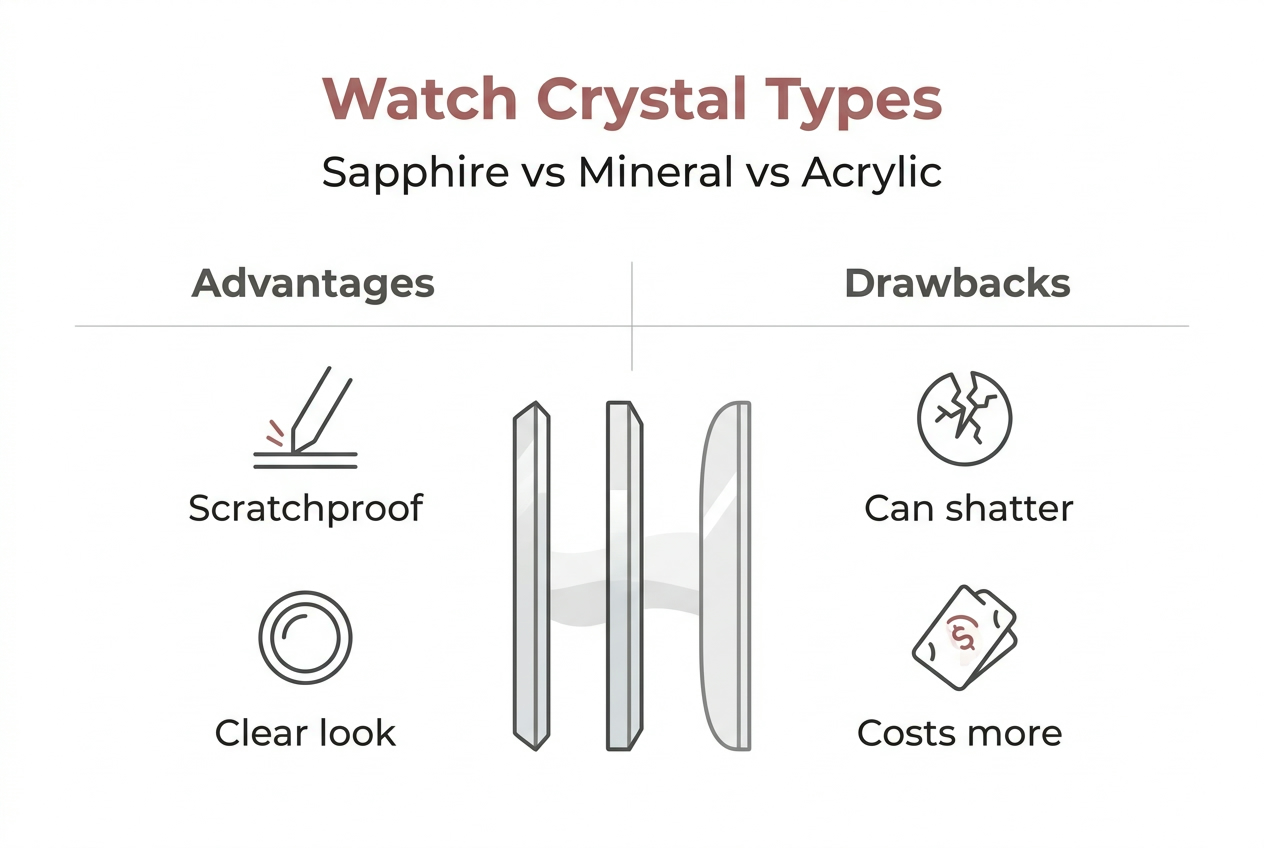
There is one trade-off worth stating clearly. Sapphire is extremely hard, but hardness is not the same as toughness. Compared with acrylic, sapphire is less forgiving under a sharp, concentrated impact. In plain terms, acrylic is easier to scratch but harder to shatter. Sapphire is far more scratch resistant, but a severe edge strike can damage it.

For most modern owners, this trade still favors sapphire decisively. Severe crystal impacts are rare. Surface abrasion is common. A watch worn every day benefits more from resisting thousands of minor insults than from surviving one unlikely hit that would probably mark the case and bezel as well.

Heritage look, modern standard

Among enthusiasts, the strongest objections to sapphire usually come from the world of vintage purity. That position is understandable. Acrylic was historically correct on many original dive references, and it has a softness and distortion that collectors know well.

But a modern mechanical dive watch built for real use lives under a different expectation. Buyers want period-faithful proportions and design language, yet they also expect contemporary durability. Sapphire answers that without changing the fundamental identity of the watch when used with restraint.

That balance matters. A heritage reissue should not feel over-modernized or sterile. At the same time, it should not ask the owner to accept every weakness of the past in the name of romance. A correctly profiled sapphire crystal preserves the spirit of an archival diver while bringing the watch into current service standards.

For a brand rooted in underwater instrument history, that choice is not cosmetic. It reflects a clear philosophy: preserve what made the original significant, improve what modern engineering can improve, and leave fashion thinking out of it.

Sapphire and long-term collector value

Collectors rarely discuss crystal material in isolation, but they feel its effects over time. A watch with a clean sapphire crystal simply presents better after years of wear. Dial printing remains visually crisp. Lume plots are viewed through a clear surface rather than a polished-but-still-marked one. Photography, resale presentation, and day-to-day satisfaction all benefit.

That does not mean sapphire automatically makes a watch more collectible. Provenance, production numbers, design integrity, movement quality, and brand relevance still carry more weight. But sapphire does help preserve the condition that collectors pay attention to.

There is also a maintenance angle. Acrylic can often be polished, which is useful. Mineral usually cannot be restored as effectively once badly marked. Sapphire generally needs no attention because it resists the damage in the first place. Over years of ownership, that low-drama durability has real value.

When sapphire is not the whole story

A sapphire crystal does not redeem a poorly conceived dive watch. If the bezel action is vague, the crown tube is weak, the dial lacks contrast, or the case proportions are off, sapphire will not fix it. It is one component in a broader system of performance and design.

The best dive watches use sapphire as part of a disciplined specification. The crystal works with a high-visibility dial, secure crown architecture, proven water resistance, and a case built to handle actual wear. When those pieces align, sapphire stops being a marketing term and becomes what it should be – a serious material choice for a serious watch.

This is especially true in the premium mechanical segment, where buyers are not looking for disposable ruggedness. They are buying permanence. They want a watch that can take use, hold its appearance, and still feel mechanically and visually relevant a decade from now. Sapphire supports that brief exceptionally well.

Choosing with your eyes open

If you are deciding between two dive watches and one uses sapphire while the other uses mineral, sapphire is almost always the better choice. If the comparison is sapphire versus acrylic, the answer depends more on what you value. Acrylic offers vintage charm and impact forgiveness. Sapphire offers superior scratch resistance, stronger day-to-day clarity, and a more enduring sense of precision.

For most enthusiasts, divers, and collectors, that is the decision point. Do you want a watch to age with visible softness, or do you want it to retain a cleaner, more exact presence through years of hard wear? On a purpose-built dive watch, sapphire usually aligns more closely with the instrument’s mission.

The right dive watch should still look ready for service after the honeymoon period is over. Sapphire helps make that possible. Not because it is flashy, but because it does its job quietly, every single day.

Related from Aquastar: the Aquastar Benthos collection, the Aquastar Deepstar.

Further reading: Wikipedia on sapphire glass.

Posted on

Ceramic Bezel Dive Watch: What Matters

Ceramic Bezel Dive Watch: What Matters - ceramic bezel dive watch

Ceramic Bezel Dive Watch: at a glance

Ceramic bezel dive watch: why ceramic became the standard for durability, legibility and resistance to salt, sand and hardware abuse on real dives. Use this guide on ceramic bezel dive watch to weigh design choices, engineering trade-offs and how the category translates to real Aquastar dive watches.

TopicCeramic bezel dive watch
Read time5-8 min
SourceAquastar editorial

A bezel tells you quickly whether a dive watch was built for surface-level styling or real underwater use. On a serious instrument, it must resist knocks, stay legible in poor light, grip well with wet hands, and keep its markings sharp after years of salt, sand, and hard wear. That is why the ceramic bezel dive watch has become such a defining modern format. Done properly, it delivers a meaningful upgrade in durability without compromising the purpose that made the dive watch essential in the first place.

Ceramic Bezel Dive Watch: What Matters - ceramic bezel dive watch

Why a ceramic bezel dive watch became the modern standard

The bezel insert takes abuse. It is the part most likely to scrape against tanks, ladders, boat rails, desk edges, and stone. Aluminum served the category well for decades, and it still has a certain period-correct charm, but it shows wear quickly. Fading, dents, and scratches are part of its character. For some collectors, that patina is the point. For a modern tool watch, it is often a compromise.

Ceramic changed that equation. It is dramatically more scratch-resistant than aluminum, and it holds color exceptionally well. A black insert stays black. A blue insert stays blue. Numerals and minute markings remain crisp rather than slowly softening into age. On a watch built to endure, those are not cosmetic trivialities. They protect legibility, and legibility is function.

This is also why ceramic suits the current generation of heritage-inspired professional watches. Collectors want the proportions and restraint of a historically important diver, but they also expect contemporary resilience. A well-executed ceramic bezel lets a watch preserve the visual discipline of a classic tool while meeting modern standards of daily use.

The real advantages of a ceramic bezel dive watch

Scratch resistance is the headline feature, but it is not the only one worth paying for. Ceramic brings a kind of visual permanence that matters on a watch meant to age with dignity. The insert does not pick up the same casual scarring that can make a heavily worn bezel look tired long before the case or movement deserves it.

It also allows for very precise finishing. Depending on how it is made, ceramic can present a deep gloss, a subtle sheen, or a more technical matte effect. That means brands can tune the look carefully. On the right watch, the bezel feels sharper, cleaner, and more exact. For buyers who appreciate the difference between generic luxury treatment and true instrument design, that precision counts.

There is another practical benefit. Engraved or molded numerals filled with contrasting material tend to remain highly defined over time. On a timing bezel, where the first 15 or 20 minutes are especially important, this helps preserve quick readability. Underwater, or simply in bad weather, the fewer visual ambiguities the better.

None of this means ceramic is automatically superior in every respect. It means it solves some longstanding weaknesses of older bezel materials, especially for owners who actually wear their watches hard.

Where ceramic can fall short

Ceramic is hard, but hardness and toughness are not the same thing. A quality ceramic insert shrugs off ordinary scratching, yet under a sharp enough impact it can chip or crack. That does not happen often in normal wear, and on a properly engineered watch the bezel assembly offers some protection, but it is the trade-off that deserves honesty.

That matters most for buyers who assume “scratch-proof” means indestructible. It does not. If your watch lives around compressed gas cylinders, steel ladders, and repeated edge impacts, bezel construction matters as much as material choice. The fit of the insert, the protective geometry of the bezel, and the overall case design all influence how vulnerable the ceramic actually is.

There is also a stylistic trade-off. Some ceramic inserts can look too glossy or too perfect on a watch that otherwise speaks the language of mid-century underwater instruments. The best executions avoid that conflict. They respect the original design and use ceramic to improve longevity, not to make the watch look overly polished or fashion-driven.

What separates a good ceramic bezel from a mediocre one

Material alone does not make a bezel excellent. The first thing experienced buyers notice is action. A dive bezel should rotate with crisp, deliberate clicks and no cheap-feeling play. Tension matters. So does alignment. If the pip misses 12 o’clock, the watch has already failed a basic test.

Grip is next. Deep knurling or a properly scalloped edge matters more than brochure language ever will. A bezel must be easy to manipulate with wet fingers, cold hands, or light gloves. Some brands become so focused on clean case lines that they forget the bezel is a control surface. That is a mistake.

Lume is another dividing line. On a serious diver, the bezel pip should be bright enough to confirm orientation at a glance. If the dial glows and the pip disappears, the specification sheet may still look good, but the watch is not fully resolved.

Then there is scale design. A ceramic bezel dive watch should not rely on material sophistication to excuse clutter. Minute hashes must be clear. Numerals must be proportionate. Contrast must remain high in daylight and low light alike. The best bezels are immediate. You do not study them. You read them.

Heritage and modern materials are not in conflict

Among enthusiasts, there is still a false divide between purity and progress. One side argues that a true re-edition should remain faithful to older materials. The other insists every modern watch should adopt the latest available solution. In practice, the answer depends on what the watch is trying to be.

If the goal is a near-archival object, aluminum may be the correct choice. It will age in a more historically familiar way. It may also preserve the exact visual softness of the original reference. But if the goal is a watch with authentic lineage and genuine daily utility, ceramic often makes more sense.

That is particularly true for brands working within real dive-watch heritage rather than generic retro styling. A historic tool can be respectfully modernized without losing its identity. In many cases, improved water resistance, sapphire crystals, modern luminous compounds, and ceramic bezel inserts all serve the same principle – preserve the design, strengthen the instrument.

Aquastar has long understood that balance. A professional watch does not need to become decorative to feel premium. It needs to become more capable while remaining honest to its original mission.

Who should actually buy a ceramic bezel dive watch

If you wear your watches often, travel with them, and expect one piece to move from water to daily life without looking worn out after a season, ceramic is easy to justify. It is especially appealing for buyers who dislike the fragile appearance that aluminum can develop with regular contact.

It also suits collectors who want one modern diver in the rotation that keeps its sharpness over time. Not every watch needs to patinate. Some are better when they hold the line visually and mechanically.

On the other hand, if you are drawn to the romance of age, the fading insert, and the roughened edges that vintage divers earn honestly, ceramic may feel too controlled. That is not a flaw. It is simply a preference. The right choice depends on whether you want your watch to record wear visibly or resist it for as long as possible.

What to look for before you buy

Start with the bezel itself, not the marketing. Rotate it. Check the click feel, the resistance, and the alignment. Look closely at the insert under direct light. Cheap ceramic can still look cheap if the printing, filling, or finishing lacks precision.

Then consider the whole watch. A ceramic bezel on an oversized, over-designed case does not make the piece more serious. Case proportions, dial legibility, crystal height, and bracelet or strap quality all shape how useful the watch will be. A dive watch is a system, not a single specification.

Finally, think about your own use. If this will be your regular companion around water, on boats, in summer heat, and through daily wear, ceramic offers real value. If you want an almost museum-faithful vintage experience, a more traditional insert may better match your priorities.

A ceramic bezel dive watch earns its place when the material serves the watch rather than the sales pitch. Get the fundamentals right – bezel action, grip, legibility, and historical discipline – and ceramic becomes more than a modern flourish. It becomes exactly what a proper dive watch should be: harder wearing, longer lasting, and ready for the job every time you reach for it.

Related from Aquastar: the Aquastar Benthos Heritage MKII with its ceramic bezel, the Benthos collection.

Further reading: Wikipedia on dive bezel materials.

Posted on

Benthos Professional Review

Benthos Professional Review - Benthos Professional review

Benthos Professional Review: at a glance

Benthos Professional review: case architecture, dial logic, bezel feel and how Aquastar's heritage diver carries its professional lineage today. Use this guide on Benthos Professional review to weigh design choices, engineering trade-offs and how the category translates to real Aquastar dive watches.

TopicBenthos Professional review
Read time5-8 min
SourceAquastar editorial

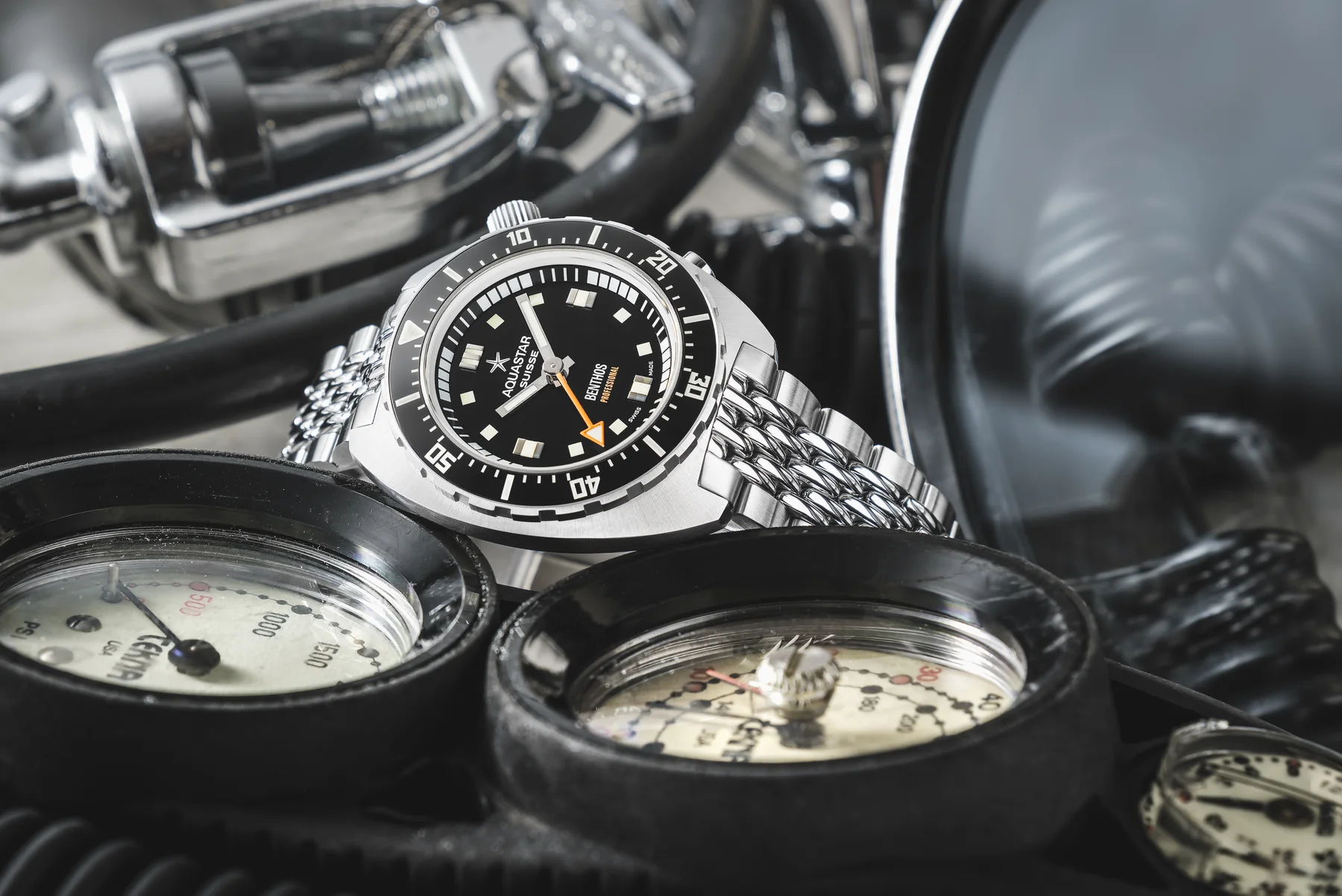
A dive watch earns its place quickly. Put it on the wrist, turn the bezel, check the legibility in low light, and the truth shows itself fast. This Benthos Professional review looks at the watch the same way serious buyers do – not as nostalgia alone, but as a purpose-built instrument judged by design integrity, mechanical credibility, and how convincingly it carries professional lineage into the present.

Benthos Professional Review - Benthos Professional review

The Benthos name matters because it was never about styling first. It came from a period when dive watches were expected to solve real underwater problems, and the original Benthos Professional stood apart with one of the most distinctive cases in the category. Any modern return, then, faces a high bar. It has to respect the architecture that made the watch memorable while delivering the reliability, materials, and finishing expected by contemporary collectors.

Benthos Professional review: why this watch stands out

At a glance, the Benthos Professional does not look like a generic vintage-inspired diver. That is its first strength. The case shape is assertive, angular, and functional, with the broad-shouldered profile of a watch designed around underwater use rather than boardroom versatility. It has presence, but it is not presence for its own sake. The geometry serves the watch’s identity.

That matters in a market crowded with soft tributes and familiar formulas. Too many heritage divers smooth out the very features that gave the originals character. The Benthos Professional does the opposite. It embraces the bold proportions and instrument-first attitude that made the historical reference significant. For collectors, that restraint is rare. For divers, it means the watch still reads as a tool rather than a costume.

The dial layout follows the same logic. Legibility comes first. The handset is clear, the markers are high-contrast, and the overall visual hierarchy is easy to process at a glance. This is where a lot of modern dive watches overreach. They add texture, color, or decorative elements that look good in product photography but weaken clarity in actual use. Here, the priorities remain disciplined.

There is also a deeper appeal at work. The Benthos Professional occupies a narrower, more enthusiast-driven lane than mainstream luxury dive watches. It speaks to buyers who know the category and want something grounded in authentic underwater instrument history, not a broad lifestyle proposition. That focus gives the watch sharper identity and stronger collector credibility.

Case, bezel, and wrist presence

The case is the defining feature, and it will likely determine whether this watch is right for you. If you prefer compact, understated divers that disappear under a cuff, this is not that. The Benthos Professional is unapologetic on the wrist. It wears with visual mass and intent.

That said, size alone does not tell the whole story. The proportions are purposeful, and the watch tends to wear better than a simple measurement sheet might suggest because the design distributes its bulk with coherence. There is a difference between a watch that feels large because it is clumsy and one that feels substantial because it was conceived as professional equipment. The Benthos Professional leans toward the latter.

Bezel action is especially important on any serious diver, and it is one of the tactile moments that separates a convincing tool watch from an average one. The impression here is of precision and authority. Buyers in this category expect a bezel that feels deliberate, not loose or overly light, and that expectation is fair. The watch should communicate mechanical certainty before it ever sees water.

Materials and finishing also strike the right balance. This is not a mirror-polished showpiece pretending to be rugged. The surface treatment and detailing support the watch’s professional identity. Finishing is refined enough to justify its premium positioning, but it does not weaken the impression that this piece was built for hard use.

Dial execution and underwater clarity

A dive watch lives or dies by clarity. The Benthos Professional understands that. The dial is not chasing faux-aged cues or decorative excess. It is built around immediate readability, with strong contrast and lume presence that serve the watch’s intended role.

That is where heritage and modern expectations meet best. Enthusiasts want the emotional weight of the historical design, but they also want sapphire, reliable lume, and contemporary standards of everyday durability. The watch answers that brief well. It preserves the visual DNA without trapping the wearer in vintage compromises.

There is a particular satisfaction in a dial that looks resolved. Nothing feels added for marketing. Nothing disrupts the reading of time. On a crowded market of dive watches that often over-style themselves, that restraint feels confident.

Movement and what buyers should realistically expect

For most buyers considering a watch like this, movement choice is not just about specifications. It is about suitability. A professional-leaning dive watch should use a dependable Swiss mechanical caliber that can be serviced sensibly and trusted for long-term ownership. That is usually the smarter path than chasing novelty for its own sake.

In that respect, the Benthos Professional makes sense. The emphasis is on proven mechanical reliability rather than theatrical complication. That aligns with the watch’s identity. This is not a piece that needs an exotic movement architecture to justify itself. Its value is in execution, design faithfulness, and the confidence that it was built to be worn, not merely admired in rotation.

Collectors should also be honest about what drives value here. If you are buying purely for movement finishing or haute horlogerie spectacle, there are other categories built around that pursuit. If you want a historically grounded Swiss dive watch with serious specifications and credible engineering, this is much closer to the mark.

Benthos Professional review: heritage versus modern use

The strongest re-editions solve a difficult problem. They preserve what mattered in the original while correcting what no longer makes sense for modern owners. The Benthos Professional gets much of that equation right.

It retains the distinctive architecture and underwater-instrument character that gave the historical model its reputation. At the same time, it benefits from modern manufacturing tolerances, current materials, improved water resistance, stronger crystals, and more dependable luminous performance. Those changes are not cosmetic upgrades. They are what allow a heritage watch to function as a contemporary tool.

There are trade-offs, of course. A watch this bold will not be as universally wearable as a slimmer, more conventional dive watch. It is less of a one-watch-fits-all proposition. It asks the buyer to appreciate a more specialized silhouette and a stronger point of view. For many enthusiasts, that is precisely the appeal. For others, especially those wanting maximum versatility with dress shirts and formal wear, it may be a step too far.

Price positioning also depends on what you value. If you compare only by broad specs on paper, you can find less expensive dive watches with capable movements and solid water resistance. But the Benthos Professional is not competing on commodity terms. Its case design, historical significance, enthusiast focus, and low-volume character place it in a different conversation.

Who this watch is really for

The ideal buyer is not shopping casually. He likely knows the outlines of dive-watch history, has handled enough modern divers to recognize recycled design language, and wants something with more backbone than a luxury status symbol. He values the fact that the watch traces to a real professional lineage.

It also suits the collector who already owns more conventional icons and wants a piece with stronger personality. In a watch box full of familiar forms, the Benthos Professional does not disappear. It has the kind of shape and history that start conversations with people who actually know what they are looking at.
For active wear, it makes sense for the buyer who wants genuine tool-watch energy, not just water resistance as a marketing phrase. Whether or not the owner is a professional diver is almost beside the point. What matters is that the watch still feels engineered around that world.

If there is a final test in any Benthos Professional review, it is simple: does the watch feel necessary, or merely referential? This one feels necessary. It does not sanitize its origins, and it does not chase mainstream approval. It carries the weight of a true underwater instrument into modern Swiss watchmaking with conviction. For the buyer who values heritage with sharp edges still intact, that makes it far more compelling than a safer watch ever could.

The right dive watch should leave no doubt about what it was built to do. This one does exactly that, and that is why it stays with you after the wrist check is over.

Related from Aquastar: the Aquastar Benthos H1, the Benthos family.

Further reading: Wikipedia on diving watches.

Posted on

Vintage vs Modern Dive Watches

Vintage vs Modern Dive Watches - vintage vs modern dive watches

Vintage Vs Modern Dive Watches: at a glance

Vintage vs modern dive watches: character against certainty, romance against readiness — how to choose between preserved heritage and modern engineering. Use this guide on vintage vs modern dive watches to weigh design choices, engineering trade-offs and how the category translates to real Aquastar dive watches.

TopicVintage vs modern dive watches
Read time5-8 min
SourceAquastar editorial

A gilt dial with faded lume can stop a seasoned collector in his tracks. So can a modern ceramic-bezel diver with perfect tolerances, 300 meters of water resistance, and lume that burns through the night. That is the real tension in vintage vs modern dive watches: not old against new, but character against certainty, romance against readiness, and rarity against daily usability.

Vintage vs Modern Dive Watches - vintage vs modern dive watches

For serious buyers, this is not a style question alone. It is a question of engineering, maintenance, wear profile, and purpose. The right choice depends on whether you want a historic instrument to preserve, a contemporary tool to rely on, or a watch that captures the best of both.

Vintage vs modern dive watches – what actually separates them?

At a glance, the difference seems obvious. Vintage dive watches carry the design language of their era – smaller cases, thinner profiles, acrylic crystals, tritium lume, and bezels that often feel charmingly imprecise by modern standards. Modern dive watches are typically larger, brighter, more shock-resistant, and built around current expectations for water resistance, materials, and service support.

But the deeper separation is philosophical. A vintage dive watch was usually built to the practical standards of its time, often for military, commercial, or recreational underwater use, without the benefit of current metallurgy, gasket systems, anti-corrosion treatments, or sapphire crystals. A modern dive watch benefits from decades of hard-earned technical progress. Better seals, tougher coatings, improved luminous compounds, more stable movements, and more consistent manufacturing have changed what a dive watch can be on the wrist and under pressure.

That does not make vintage inferior. It makes it specific. A true vintage diver is a surviving artifact of purpose-built watchmaking. It carries the proportions, constraints, and solutions of its period. A modern diver carries the advantages of refinement.

Why vintage dive watches still command respect

Collectors do not pursue vintage dive watches because they are easier. They pursue them because they are irreplaceable. The appeal starts with originality. A correct dial, untouched hands, honest case edges, and period-correct bezel insert create a level of authenticity no newly manufactured watch can replicate, however faithful the tribute.

Patina matters because it records time in a way modern finishing cannot. Tropical dials, creamy lume, ghost bezels, and softened case lines tell the truth about use. For an enthusiast who values lineage, that wear is not damage alone. It is evidence.

Vintage dive watches also tend to wear differently. Many historic references sit closer to 36 to 40 mm, with slimmer mid-cases and restrained lug spans. On the wrist, that can feel more balanced and more elegant than the oversized dive watch trend that dominated for years. The proportions are often the product of necessity rather than marketing.

Then there is design discipline. The best vintage divers were not trying to look historic. They were simply current in their own time, which gives them a directness many collectors find hard to resist. Nothing feels forced. Every hand shape, minute track, and bezel marking exists for a reason.

The trade-off is obvious. Vintage charm comes with vintage fragility.

Where modern dive watches take the lead

A modern dive watch is engineered for confidence. Sapphire crystals shrug off daily abuse that would scar acrylic. Ceramic bezels resist fading and scratching. Super-LumiNova outperforms aged tritium by a wide margin. Screw-down crowns, improved case machining, and modern gasket systems make contemporary water resistance far more dependable than what most original vintage pieces can honestly deliver today.

For anyone who intends to swim, travel, or wear a watch hard, these are not minor advantages. They define the ownership experience.

Serviceability is another dividing line. A modern Swiss mechanical diver generally comes with accessible parts, clear specifications, and manufacturer-backed support. With vintage, that picture changes fast. Replacement components may be scarce, expensive, or undesirable if originality is a priority. Even a routine service can become a delicate negotiation between mechanical reliability and collector value.

Accuracy and consistency are also stronger on the modern side. Not every vintage movement performs poorly, and many are remarkably capable when properly serviced. But modern tolerances, lubricants, and shock protection systems deliver a level of stability better suited to daily wear.

This is where many serious enthusiasts arrive at a hard truth. If the watch must perform first and charm second, modern usually wins.

The hidden cost of vintage ownership

The purchase price is only part of the story. In vintage dive watches, the real cost often lies in verification, restoration risk, and long-term stewardship.

Condition drives everything. Polished cases can erase collector appeal. Relumed dials and hands may improve appearance in photos but damage originality. Incorrect bezels, service crowns, replacement bracelets, and swapped movement parts can materially change value. A buyer is not simply acquiring a watch. He is evaluating a chain of decisions made over decades.

Water resistance is another area where wishful thinking causes problems. A vintage case may have been rated for serious underwater use when new, but age changes the equation. Corrosion, case wear, gasket degradation, and uncertain service history make original depth ratings unreliable in practical terms. Some collectors never expose vintage pieces to water at all, which is sensible but worth acknowledging. A dive watch that no longer dives is a different ownership proposition.

Insurance, servicing, and sourcing reputable examples also take time. That effort can be rewarding, but it is effort all the same.

Why the best modern divers borrow from the past

The strongest contemporary dive watches are rarely the ones chasing novelty for its own sake. They are the ones that understand why the originals mattered.

That means preserving the right case profile, the right handset, the right dial balance, and the right sense of purpose, while upgrading what history would have improved if given access to modern materials. A well-executed heritage diver does not flatten the original into nostalgia. It respects the architecture, then reinforces it with better execution.

This is where the vintage vs modern dive watches debate becomes more interesting than a simple either-or choice. For many buyers, the answer is neither a fragile vintage survivor nor an overbuilt modern watch with no historical grounding. It is a watch rooted in authentic underwater instrument history, but built for current standards of reliability.

That middle ground is not compromise. Done properly, it is evolution.

Choosing between vintage vs modern dive watches

If your priority is collectability, historical texture, and the thrill of owning an original reference from a meaningful period of dive-watch development, vintage remains unmatched. You buy it for the dial, the story, the scarcity, the feeling that this exact object has survived the decades intact.

If your priority is frequent wear, dependable performance, and the freedom to use the watch without constant second-guessing, modern is the stronger choice. You gain better lume, stronger crystals, more dependable sealing, and a much cleaner path to service.

Wrist size and wearing habits matter too. Some collectors prefer the compact, balanced fit of older proportions. Others want the legibility and presence of a modern case. There is no universal right answer here. A watch can be technically excellent and still wrong for the way you live with it.

Budget changes the picture as well. Truly desirable vintage dive watches with strong originality are rarely bargains anymore. Modern watches can offer exceptional specification for the money, especially when a brand is focused on substance rather than broad luxury theater. In many cases, a serious heritage-based modern diver delivers more actual watch per dollar than a compromised vintage example.

For that reason, many informed buyers build in stages. They wear a modern dive watch as the dependable instrument, then add vintage once they understand the market well enough to buy carefully. That is often the smarter path than forcing a first purchase based on image alone.

A brand like Aquastar sits in this conversation for a reason. The appeal is not imitation vintage styling. It is the continuation of real dive-watch history through faithful proportions, mechanical substance, and modern engineering where it counts.

The most satisfying choice is the one that matches your intentions. If you want to preserve a piece of underwater history, buy vintage with patience and discipline. If you want a watch made to endure hard wear, choose modern with no apology. If you want heritage reborn in a form you can trust daily, look for a diver that respects the past without being trapped by it. That is usually where long-term ownership gets interesting.

Related from Aquastar: the heritage-styled Aquastar Model 60, the modern Aquastar Benthos collection.

Further reading: Wikipedia on diving watches.

Posted on

Swiss Dive Chronograph Guide

Swiss Dive Chronograph Guide - Swiss dive chronograph guide

Swiss Dive Chronograph Guide: at a glance

Swiss dive chronograph guide: how to judge a chronograph designed as an underwater instrument first — legibility, decompression timing and pressure use. Use this guide on Swiss dive chronograph guide to weigh design choices, engineering trade-offs and how the category translates to real Aquastar dive watches.

TopicSwiss dive chronograph guide
Read time5-8 min
SourceAquastar editorial

A dive chronograph earns its place the hard way. It has to do more than look correct under a cuff or echo a famous reference. In any serious Swiss dive chronograph guide, the real question is whether the watch was conceived as an underwater instrument first, then refined into something worthy of long-term ownership.

Swiss Dive Chronograph Guide - Swiss dive chronograph guide

That distinction matters because the category is narrower than many buyers assume. Plenty of watches combine a rotating bezel, screw-down pushers, and a tachymeter-free dial, then market themselves as aquatic chronographs. Far fewer were designed around legibility, decompression timing, elapsed dive tracking, and pressure resistance without compromising the function of the chronograph itself. When a chronograph goes underwater, every design choice becomes more demanding.

What makes a Swiss dive chronograph legitimate

A true dive chronograph starts with purpose-built architecture. Water resistance on paper is only one part of the equation. The more difficult task is preserving usability and clarity while housing a more complex movement than a standard time-only diver. Additional pushers create more potential points of failure. A busier dial creates more chances for confusion. Greater movement height can upset case proportions and wearability.

That is why the best examples tend to show discipline rather than excess. Case construction must be tight, with proper gasket engineering, secure crown operation, and pushers that inspire confidence rather than hesitation. The dial should prioritize elapsed time reading over decorative symmetry. Hands and markers must remain distinct in poor light, with enough contrast that the chronograph display does not fight the time display.

Swiss manufacturing matters here because the category depends on precision case tolerances and movement reliability, not just on a label. A well-executed Swiss dive chronograph is usually the product of watchmaking restraint – a refusal to let complexity dilute function.

Swiss dive chronograph guide to the core design choices

Start with the bezel and dial as a system, not as separate features. On a serious dive watch, the bezel remains the fastest and safest timing reference. The chronograph adds another layer of utility, but it should never make the primary timing function harder to use. If the bezel markings are too fine, the insert is overly reflective, or the dial is crowded by multiple scales, the watch may impress in a display tray and disappoint in the water.

Subdial layout deserves more attention than most buyers give it. A bicompax register arrangement often delivers better balance and cleaner reading than a tri-compax format on a dive chronograph, simply because there is less visual clutter. Larger subdials with restrained printing are easier to scan than a dial packed with information. A decompression scale, minute counter, and running seconds can coexist well, but only when each has hierarchy.

Case size is another area where numbers alone can mislead. Chronographs naturally run thicker than simple divers, so diameter has to be judged alongside lug-to-lug length, bezel width, and caseback profile. A 40 to 41mm case with compact lugs may wear more like a purpose-built instrument than a broader case chasing visual presence. Underwater, bulk is not a virtue. Secure fit, stable balance, and easy operation matter more.

Then there are the pushers. Screw-down pushers offer reassurance and help support water resistance, but they also slow operation. Non-screw-down pushers can be more immediate, yet they demand absolute confidence in engineering and intended use. Some owners like the visual seriousness of screw-down construction. Others value cleaner functionality. Neither choice is automatically superior. It depends on whether the watch was designed around active timing use or around maximum protection when not engaged.

The movement question

No Swiss dive chronograph guide is complete without movement trade-offs. Automatic calibers remain the natural fit for this category because they align with daily wear practicality and professional-tool lineage. A good automatic chronograph movement should deliver stable amplitude, serviceable parts support, and sensible long-term maintenance, not just a headline power reserve.

Column-wheel and cam-actuated systems each have their place. Column-wheel chronographs often deliver a more refined pusher feel, which collectors appreciate. Cam systems can be just as dependable and, in some cases, easier to service broadly over time. For a dive chronograph, reliability under real wear matters more than romantic movement mythology.

Thickness is the hidden cost of the complication. Some movements produce elegant pusher action but force a taller case. Others allow tighter packaging while giving up some tactile finesse. That is not a flaw. It is engineering prioritization. Buyers should assess the movement in the context of the finished watch, not in isolation.

Heritage matters, but only if the watch earns it

Dive chronographs have one of the strongest historical identities in tool-watch design. The best heritage references were not nostalgic exercises. They were solutions to a professional problem: timing underwater events in low-visibility, high-pressure environments with minimal ambiguity. That history still matters because it explains why certain design traits endure.

Large minute hands, high-contrast subdials, no-nonsense bezels, and compact, wearable cases were not styling cues borrowed from a mood board. They were field-tested decisions. When a modern Swiss dive chronograph revisits those forms faithfully, it preserves more than appearance. It preserves logic.

This is also where many contemporary releases miss the mark. Some lean too far into luxury finishing, polishing every surface until the watch loses its instrument character. Others over-modernize, inflating dimensions and adding textures, colors, and scales that weaken the original purpose. Heritage should sharpen a watch. It should not excuse bloat or theatrics.

For collectors, authenticity is rarely about reproducing every historical limitation. It is about respecting the old proportions, preserving the dial logic, and improving the failure points with modern materials and manufacturing. A sapphire crystal, ceramic or hardened bezel insert, modern luminous compound, and improved sealing are welcome upgrades when they do not distort the original intent.

What to inspect before buying

Look closely at the minute counter. On a dive chronograph, it should be instantly readable, because minutes matter most underwater. If the chronograph minutes are too small, share visual weight with secondary scales, or disappear under highly stylized hands, that is a warning sign.

Examine the relationship between the central hands and the subdials. The main time display should remain dominant. If the chronograph seconds hand is too thin to track or too similar in color to the minute hand, actual use becomes slower than it should be.

Check the lume strategy. Strong lume is not enough if it is applied without hierarchy. The minute hand and bezel pip should stand out. Hour markers must remain legible, but the watch should tell you elapsed dive time at a glance. Uniform brightness can still produce a poor reading if everything glows with the same visual weight.

Assess the bracelet or strap with equal seriousness. A heavy chronograph head can turn unstable on a weak strap design. A proper tropic-style rubber strap, well-engineered steel bracelet, or secure textile option can transform wearability. Tool watches live or die by how they stay planted on the wrist.

The collector’s view versus the diver’s view

Collectors often pursue rarity, historical faithfulness, and movement pedigree. Divers and active owners focus more quickly on grip, clarity, comfort, and service confidence. The best watches satisfy both, but not always in equal measure.

A highly faithful re-edition may win on proportions and period-correct character while giving up some conveniences expected in modern luxury sports watches. A more contemporary interpretation may improve water resistance, bezel durability, and bracelet execution while softening the exact historical profile. Neither approach is wrong. The better choice depends on why you are buying.

If the watch is primarily for collecting, nuance in case form, dial typography, and archival accuracy will carry more weight. If it will see regular time in salt water, heat, travel, and rotation with other tool watches, serviceability and practical durability may matter more. Aquastar has long understood that a dive chronograph should not have to choose between provenance and use. That balance is where the category becomes interesting.

Why this category remains hard to fake

The market is full of watches that borrow the visual grammar of vintage dive chronographs. Much fewer capture the authority of the real thing. It is easy to copy a reverse panda dial or a compact steel case. It is far harder to build a watch where every component feels disciplined by function.

That is why experienced buyers look beyond broad specifications. Two watches may both offer Swiss automatic movements, 200 meters of water resistance, sapphire crystals, and lumed bezels. One will still feel more coherent on the wrist and more convincing in the hand. The difference usually comes down to proportion, legibility, and whether the design team understood how a dive chronograph should behave, not just how it should photograph.

The right watch in this category carries a certain tension. It has to be handsome enough for daily wear, serious enough for harsh conditions, and honest enough to show where history still has the better answer. If you find one that manages all three, hold onto it. Good dive chronographs are rare because genuine purpose always is.

Related from Aquastar: the Aquastar Deepstar III, a Swiss dive chronograph, the Aquastar Airstar.

Further reading: Wikipedia on the chronograph.

Posted on

Deepstar Watch Review: Still Built to Dive

Deepstar Watch Review: Still Built to Dive - Deepstar watch review

Deepstar Watch Review: at a glance

Deepstar watch review: distinctive compact chronograph layout, professional dive heritage and why the architecture still matters today. Use this guide on Deepstar watch review to weigh design choices, engineering trade-offs and how the category translates to real Aquastar dive watches.

TopicDeepstar watch review
Read time5-8 min
SourceAquastar editorial

There are plenty of vintage-inspired dive watches on the market. Very few carry the weight of a design that mattered underwater when timing equipment was not a styling exercise but a professional necessity. That is what makes any Deepstar watch review worth reading closely. This is not simply a handsome retro chronograph. It is a watch built around one of the most distinctive and historically relevant dive chronograph layouts ever produced.

Deepstar Watch Review: Still Built to Dive - Deepstar watch review

The Deepstar occupies a rare place in watchmaking. Most dive watches are time-only instruments with rotating bezels and broad claims about adventure. The Deepstar came from a more specialized tradition – a compact professional chronograph designed with actual underwater legibility and elapsed-time use in mind. That pedigree changes how the watch should be judged. The right question is not whether it looks vintage. The question is whether the modern Deepstar preserves the original instrument logic while meeting the expectations of a serious contemporary mechanical watch.

Deepstar watch review: what stands out first

The first impression is focus. The Deepstar does not try to be everything at once. Its case shape, dial architecture, and broad visual surfaces are all organized around clarity and identity. You notice the saucer-style case immediately. It is compact by the numbers, but it wears with more presence than a conventional round case because of its wide stance and disciplined profile.

That profile matters. On many heritage reissues, the case is where compromise begins. Thickness creeps up, proportions drift, and the original watch becomes little more than a reference point. The Deepstar is stronger than most because its dimensions feel considered rather than inflated. It has enough mass to feel substantial, but not so much height that it turns into a desk-bound collector piece pretending to be a diver.

The dial is the real signature. The minute register dominates the visual field for a reason. Underwater, elapsed minutes are what matter most. The Deepstar’s oversized chronograph minute scale is not a decorative eccentricity. It is the functional heart of the watch. Even for buyers who will never descend with compressed air on their back, that single design choice gives the watch uncommon purpose.

The design works because the history is real

A good heritage watch does more than quote old styling cues. It keeps the original intent intact. The Deepstar succeeds because the design language was born from underwater utility, not from an after-the-fact marketing brief.

That is evident in the dial balance, the broad hands, and the way the chronograph display privileges legibility over visual clutter. There is character here, but it is disciplined character. The watch does not lean on faux patina or theatrical aging to signal authenticity. It trusts the original architecture.

For collectors, this matters. The market is crowded with watches that borrow the look of mid-century tool instruments while abandoning the details that made those instruments compelling in the first place. The Deepstar avoids that trap. Its appeal comes from being unusual for the right reasons.

There is also a practical advantage to that faithfulness. The watch has a silhouette that stands apart from mainstream Swiss dive chronographs. From across a room, it does not read like a generic luxury sports watch. It reads like a Deepstar.

Wearing the Deepstar day to day

This is where nuance matters. The Deepstar is compact, but it is not shy. The case shape gives it visual breadth on the wrist, and the dial opening makes it feel larger than a narrow-bezel diver of similar dimensions. That is generally a strength. The watch feels purposeful and planted without becoming oversized.

On an average wrist, comfort is usually excellent because the case sits low and spreads contact well. The short overall length helps, and the ergonomic shape prevents the watch from feeling top-heavy. For collectors accustomed to vintage dimensions, the Deepstar feels refreshingly honest. For buyers who prefer large modern sports watches, it may initially seem restrained on paper but more substantial in real wear.

Strap choice changes the personality more than it does on many dive watches. On rubber, the Deepstar is all business. On beads-of-rice style steel, it leans harder into its period-correct identity. Neither approach feels wrong. It depends on whether the buyer wants a professional instrument tone or a stronger heritage statement.

One trade-off is that the Deepstar is distinctive enough to resist disappearing into a rotation. This is not the kind of chronograph that behaves like a neutral everyday piece for every wardrobe. It can be worn daily, certainly, but it always announces a point of view.

Deepstar watch review: chronograph utility and dial legibility

The Deepstar’s chronograph is its defining complication, and it deserves to be judged by usability, not just movement pedigree. Here the watch performs very well because the display has been conceived around elapsed minutes first. That sounds simple, but it is rare. Many chronographs look attractive in macro photography and become busy in actual use. The Deepstar remains easy to read at a glance.

The contrast is strong, the handset is appropriately bold, and the layout avoids the compressed feeling that can make compact chronographs visually tiring. Lume, crystal execution, and overall finishing all contribute to a watch that feels built for real conditions rather than showroom theatrics.

Pushers and crown action are equally important in a watch like this. Buyers in this segment tend to notice tactile quality immediately. A chronograph can look impressive and still disappoint if the controls feel vague or overly delicate. The Deepstar generally avoids that issue by delivering a mechanical experience that feels firm, deliberate, and in line with a serious tool watch.

If there is a caveat, it is that not every buyer truly needs a dive chronograph. A simple three-hand diver is easier to live with, often slimmer, and usually less expensive. The Deepstar makes its case by offering a specific form of utility tied to a specific historical lineage. If that proposition resonates, the chronograph becomes an asset rather than a complication for its own sake.

Movement, build quality, and modern expectations

A modern heritage watch lives or dies by how well it translates archival design into present-day reliability. The Deepstar’s appeal would fade quickly if it felt fragile or compromised in construction. It does not.

Case finishing is strong where it should be strong. Surfaces are crisp, transitions feel intentional, and the watch carries the kind of build discipline expected in a premium Swiss mechanical piece. The crystal, water resistance, and material choices reflect contemporary standards rather than nostalgic excuses. That balance is exactly what this category demands.

Movement choice is part of the same conversation. Enthusiasts often split into camps here. Some want absolute historical purity, even at the expense of convenience or serviceability. Others want a dependable Swiss caliber that supports daily wear and long-term maintenance. The Deepstar sensibly favors the latter without losing the spirit of the original watch.

That is the right call for most buyers. A watch intended to honor a professional underwater instrument should be ready to perform, not merely ready to be admired. Aquastar has generally understood that point better than brands that treat heritage as costume.

Who the Deepstar is really for

The Deepstar is not aimed at someone buying a first Swiss watch on logo recognition alone. It speaks more directly to collectors who understand why a dive chronograph is unusual, why proportion matters, and why a historically faithful case profile is worth preserving.

It also suits buyers who have grown tired of oversized ceramic sports watches that feel engineered by committee. The Deepstar has conviction. Every major design decision traces back to a coherent use case and a real model lineage. That gives it authority.

For divers, the appeal is different. Plenty of modern dive tools offer greater raw practicality at lower cost, especially if quartz enters the discussion. But that misses the point. The Deepstar offers professional watchmaking heritage, mechanical engagement, and underwater-born design logic in one package. That combination is rare.

For pure dress use, there are easier options. For a one-watch collection, it depends on the owner. If you want versatility above all else, a simpler diver may make more sense. If you want a watch with technical identity and collector depth, the Deepstar is much harder to outgrow.

The verdict

The Deepstar earns its reputation because it understands what should and should not be modernized. It preserves the architecture that made the original important, while delivering the material quality, reliability, and wearability expected today. That is not easy to do well.

Its strongest quality is not nostalgia. It is discipline. The watch knows exactly what it is: a heritage dive chronograph with genuine professional roots and a design language that still feels purposeful. That focus gives it an edge over more generic luxury divers and over many reissues that mistake sentiment for substance.

If you are drawn to historically significant tool watches, the Deepstar is more than an attractive re-edition. It is a rare example of a watch that still feels connected to the conditions that first shaped it. And in a market crowded with borrowed stories, that kind of legitimacy remains hard to fake and even harder to replace.

Related from Aquastar: the Aquastar Deepstar III chronograph, the Aquastar Deepstar family.

Further reading: Wikipedia on diving watches.

Posted on

Mechanical vs Quartz Dive Watch

Mechanical vs Quartz Dive Watch - mechanical vs quartz dive watch

Mechanical Vs Quartz Dive Watch: at a glance

Mechanical vs quartz dive watch: how power source, accuracy, serviceability and ownership feel separate two very different underwater timing philosophies. Use this guide on mechanical vs quartz dive watch to weigh design choices, engineering trade-offs and how the category translates to real Aquastar dive watches.

TopicMechanical vs quartz dive watch
Read time5-8 min
SourceAquastar editorial

If you are weighing a mechanical vs quartz dive watch, you are not choosing between a good watch and a bad one. You are choosing between two very different philosophies of underwater timing. One is driven by springs, gears, and centuries of watchmaking discipline. The other is powered by a battery and regulated by a quartz crystal for near-effortless precision. Both can perform. Only one may suit the way you dive, collect, and wear a watch.

Mechanical vs Quartz Dive Watch - mechanical vs quartz dive watch

Mechanical vs quartz dive watch – what really separates them

At a glance, the distinction seems simple. A mechanical dive watch uses a mainspring, gear train, escapement, and balance assembly to measure time. A quartz dive watch uses an electronic circuit and a vibrating quartz crystal. In practice, the gap runs deeper than the power source.

A mechanical dive watch is a compact machine built to perform through physical engineering alone. The attraction is not just romance, although that matters. It is the visible logic of the mechanism, the tactile quality of winding and setting, and the fact that a properly built Swiss mechanical diver remains serviceable for decades. It has a heartbeat. For many enthusiasts, that is the point.

Quartz takes a different route. It prioritizes convenience, shock tolerance, lower maintenance, and a level of accuracy that most mechanical calibers do not match in daily wear. If your watch is first and foremost a practical timing instrument, quartz makes an extremely strong case.

Accuracy is easy to measure, but harder to interpret

Quartz wins on raw accuracy. There is no serious debate here. A typical quartz movement may drift only a few seconds per month, while a mechanical movement may vary by several seconds per day depending on regulation, position, temperature, and wear.

For actual diving, though, that advantage means less than many assume. Recreational divers are not navigating decompression tables with a wristwatch alone. Dive computers dominate modern underwater practice, and the bezel on a dive watch serves as a backup timing reference or a straightforward elapsed-time marker. In that role, both systems can do the job.

Where accuracy matters more is in everyday ownership. If you want to pick up a watch, set it once, and trust it for weeks, quartz is more convenient. A mechanical watch asks a bit more of its owner. If it is not worn regularly and has a modest power reserve, it will stop and need resetting. For some, that is friction. For others, it is part of the relationship.

Reliability underwater depends on more than the movement

Serious buyers know that water resistance is not determined by whether a watch is mechanical or quartz. Case construction, gasket quality, crown system, crystal fitment, and quality control matter far more. A poorly executed mechanical diver is inferior to a well-engineered quartz diver. That should be stated plainly.

Still, there are movement-specific considerations. Quartz movements are generally less sensitive to positional variation and can be very resilient in harsh conditions. They also avoid the rate fluctuations that a mechanical movement may show after shocks or magnetism. If your priority is grab-and-go dependability with minimal input, quartz has a practical edge.

Mechanical dive watches answer in a different language. High-quality calibers are built for longevity, repairability, and independence from battery changes. There is value in a sealed watch that does not need to be opened periodically for a battery replacement, provided regular pressure testing and proper service are respected. For a tool intended to endure, fewer routine intrusions into the case can be a meaningful advantage.

Service, battery changes, and long-term ownership

This is where the ownership experience starts to diverge.

Quartz is usually cheaper to maintain in the short term. Battery replacements are straightforward, and many quartz movements are affordable to replace if they fail. That practicality appeals to buyers who want performance without ritual.

Mechanical watches demand more. They require periodic servicing, and proper service is neither quick nor inexpensive. Oils degrade, seals age, and tolerances matter. But when the movement is a quality mechanical caliber, service is preservation rather than disposal. The watch is maintained, not merely kept running. To collectors and enthusiasts, that distinction carries real weight.

There is also the matter of lifespan. A mechanical movement from a serious Swiss manufacturer can remain viable for generations if parts and service expertise endure. Quartz can be extremely durable, but some quartz watches become harder to support when proprietary electronics or specific circuit components are no longer available. Not every quartz watch is disposable, but many are less future-proof than a traditional mechanical architecture.

Heritage favors mechanical, and not by accident

The modern dive watch was not born as a lifestyle accessory. It was an instrument. Early professional and military dive watches were mechanical because that was the available technology, but their significance goes beyond chronology. The design language, case profiles, bezel formats, and dial layouts collectors value today were shaped around mechanical watchmaking.

That matters if you care about authenticity. A heritage-driven diver with a mechanical movement preserves the experience closer to the original purpose-built tool. The weight of the rotor, the sweep of the seconds hand, the architecture of the caseback, and the proportions required by the caliber all contribute to the character of the watch.

For brands grounded in true underwater instrument history, mechanical construction is not nostalgia for its own sake. It is continuity. The watch feels connected to the era and the professionals who relied on such instruments beneath the surface. That is difficult to replicate with a battery-powered movement, no matter how capable it may be.

The wearing experience is not a minor detail

Collectors often reduce the discussion to specs, then buy with their wrist and instincts.

A mechanical dive watch tends to feel more alive. The seconds hand advances with a sweep rather than a one-second tick. The crown action is usually more satisfying. The movement gives the case a certain physicality, and the watch often carries more emotional presence. If you rotate through a collection, mechanical watches reward engagement.

Quartz is cleaner and quieter in use. It is ideal for someone who wants certainty over ceremony. Set it, leave it, wear it hard. There is no need to keep it wound, and no guilt if it sits untouched for a week. For a dedicated beater diver, travel watch, or true utility piece, those are convincing strengths.

The trade-off is that many enthusiasts eventually find quartz less compelling over time unless the watch has exceptional design, historical relevance, or specialized functionality. Precision alone rarely creates attachment.

Cost, value, and what you are really paying for

Quartz almost always offers better performance per dollar if accuracy is your main metric. You can buy a highly capable quartz dive watch for far less than a Swiss mechanical diver with comparable case quality and finishing.

Mechanical pricing reflects more than utility. You are paying for movement construction, assembly complexity, finishing, serviceability, and often a deeper relationship to watchmaking history. In the premium segment, you are also paying for thoughtful proportions, dial execution, bezel quality, and the integrity of the overall package. A serious mechanical diver should justify its price through substance, not branding alone.

This is why the mechanical vs quartz dive watch debate cannot be settled by specs on a table. Value depends on what you value. If the watch is a disposable tool, quartz is hard to beat. If it is also an object of craft, lineage, and long-term ownership, mechanical starts to make more sense.

Who should buy which

If you dive occasionally, want maximum accuracy, dislike resetting watches, and prefer low upkeep, quartz is a rational choice. It is especially sensible if your watch serves as a backup to modern dive electronics and sees rough treatment.

If you care about horological substance, collector appeal, movement architecture, and the continuity of the classic dive-watch tradition, mechanical is the stronger choice. It asks more from the owner, but it gives more back in character.

For many enthusiasts, the answer is not either-or. Quartz can make sense as a pure utility watch. Mechanical is the one you choose when the watch itself matters beyond timing.

Mechanical vs quartz dive watch – the better question

The better question is not which technology is superior in the abstract. It is what you expect from a dive watch when it is on your wrist, on your desk, and still in your collection ten years from now.

A quartz diver is efficient, accurate, and easy to live with. A mechanical diver offers craftsmanship, heritage, and a deeper connection to the instrument tradition that built this category in the first place. For buyers who want a watch that does more than tell time underwater, that difference is not sentimental. It is fundamental.

Choose quartz if you want the least complicated path to performance. Choose mechanical if you want performance with memory, architecture, and staying power. A serious dive watch should earn its place through function. The right one also earns it every time you fasten it to your wrist.

Related from Aquastar: the Aquastar collection (all mechanical), the Aquastar Deepstar.

Further reading: Wikipedia on diving watches.

Posted on

How to Buy Heritage Reissues Right

How to Buy Heritage Reissues Right - how to buy heritage reissues

How To Buy Heritage Reissues: at a glance

How to buy heritage reissues right: separate real lineage from costume styling, judge case, dial, movement and engineering before paying up. Use this guide on how to buy heritage reissues to weigh design choices, engineering trade-offs and how the category translates to real Aquastar dive watches.

TopicHow to buy heritage reissues
Read time5-8 min
SourceAquastar editorial

The mistake is usually made in the first five minutes. A buyer sees gilt text, a domed crystal, a faded-color bezel insert, and decides the watch has heritage because it looks old. That is not how to buy heritage reissues. If you care about real tool-watch lineage, the question is not whether a watch feels vintage. The question is whether it preserves something worth reviving.

How to Buy Heritage Reissues Right - how to buy heritage reissues

A proper heritage reissue stands on two legs at once. One is historical legitimacy – a real reference, a documented design language, a case shape, dial layout, or purpose-built function that mattered in its original era. The other is modern execution – reliability, materials, wearability, and serviceability that make sense for how a serious owner actually lives with a watch now. If either leg is weak, the watch becomes costume instead of continuation.

How to buy heritage reissues without buying nostalgia

The strongest heritage reissues do not merely quote the past. They translate it. That distinction matters, especially in dive watches and chronographs, where original designs were often driven by professional use rather than fashion. A compressor-style case, a no-nonsense minute track, a decompression scale, a high-legibility handset – these details should exist for a reason rooted in the original watch, not because they photograph well.

Start by asking a blunt question: what exactly is being reissued? If the answer is vague, you should slow down. A serious brand should be able to point to a specific historical model or family, explain what made it important, and show where the modern watch remains faithful. That does not mean every dimension must be identical. It does mean the core identity should survive intact.

A good reissue often preserves proportions better than it preserves raw measurements. This is where inexperienced buyers get trapped. They fixate on diameter and ignore thickness, lug-to-lug, bezel width, crystal profile, and dial opening. A 40 mm watch can wear larger than a 42 mm watch if the bezel is thin and the dial is broad. A faithful reissue should capture the stance of the original on the wrist, not just its spec sheet headline.

Judge the history, then judge the engineering

Historical credibility comes first, but modern engineering decides whether the watch deserves daily use. If you are evaluating how to buy heritage reissues intelligently, read the specifications as seriously as you read the backstory.

A dive-watch reissue should have contemporary fundamentals. Sapphire crystal, modern gasket architecture, credible water resistance, strong lume, and a movement with stable parts support are not indulgences. They are the difference between a watch that honors an underwater instrument and one that simply romanticizes it. A heritage model that copies acrylic, weak lume, or fragile construction without a compelling reason is mistaking inconvenience for authenticity.

That said, there is always a trade-off. Excessive modernization can strip the watch of its original character. Enlarged cases, overbuilt crown guards, glossy ceramic where aluminum once made visual sense, or a movement thickness that distorts the profile can all push a reissue away from its source material. The best examples know where to improve and where to hold the line.

This is especially true with bezels, dials, and handsets. These are not decorative surfaces. On a proper tool watch, they are the face of the watch’s purpose. If a reissue changes the handset shape, compresses the dial layout, or swaps a functional bezel style for something more marketable, it may still be a fine modern watch. It may no longer be a convincing heritage reissue.

Fit matters more than romance

Collectors often buy heritage reissues emotionally and then justify them technically. That is backwards. You should first determine whether the watch fits your wrist, your use, and your tolerance for visual presence.

Case profile is critical. Vintage-inspired watches often have dramatic crystals, slab sides, or long lugs that look excellent in product photography and wear very differently in real life. Pay attention to the total height and where that height sits. A tall domed crystal can be charming if the mid-case is controlled. A thick automatic module stacked into a compact case can make the watch feel top-heavy and clumsy.

Bracelet and strap execution matter too. Many heritage reissues are sold on tropic-style rubber, beads-of-rice bracelets, or vintage-inspired leather. Each choice changes the watch. Rubber may be truest to a dive-watch mission. A bracelet may make more sense for daily wear. Leather can look good on a chrono but may undercut the original instrument intent. None of these choices is universally right. The point is to buy the watch in the form you will actually wear, not the form that best supports a fantasy version of yourself.

How to buy heritage reissues as a collector, not a tourist

Collectors buy lineage. Tourists buy styling. The difference becomes obvious when you compare the dial and case details that most brands hope you will ignore.

Look closely at typography, sub-dial spacing, date placement, chapter ring depth, bezel font, and crown shape. These details are often where a watch reveals whether it was built from archives or from a mood board. A serious reissue tends to show discipline. The logo is where it should be. The scales are balanced. The dial breathes like the original. The case sides, lug taper, and bezel edge have a logic that feels inherited rather than invented.

Movement choice deserves the same level of scrutiny. Purists sometimes want a movement architecture close to the original, but that is not always the smartest choice. In a modern reissue, a dependable Swiss caliber with easier service access may be the better answer, especially if it preserves the intended dial layout and case proportions. The key is honesty. If a watch uses a modern movement that changes the sub-dial placement or date position, the brand should not pretend otherwise.

Limited production is another area where discipline matters. Scarcity alone does not create collector value. A small run can support quality control, preserve exclusivity, and reflect the economics of niche Swiss watchmaking. It can also be used to inflate urgency around a weak product. Buy the watch because the watch is right, not because the countdown timer says so.

For enthusiasts focused on true underwater heritage, brands such as Aquastar have an advantage when the archive is tied to real professional use rather than generic vintage aesthetics. That kind of lineage tends to show up in the details.

Price, value, and the question of what you are really paying for

A heritage reissue should not be judged by price alone. It should be judged by price in relation to execution, historical significance, production scale, and long-term ownership experience.

A lower-priced reissue may look appealing until you factor in generic case architecture, weak bracelet quality, shallow historical research, or a movement chosen purely for margin. A more expensive piece may justify itself through faithful case construction, superior finishing, better lume application, tighter tolerances, and a more coherent relationship to the original reference.

There is also the simple question of alternatives. Sometimes the original vintage model is still obtainable. That does not automatically make it the better buy. Vintage brings charm, but it also brings moisture risk, parts scarcity, compromised water resistance, and fragile dials or bezels that do not tolerate hard use. If you want the experience of a historic design with modern confidence, a well-executed reissue can be the more rational purchase.

If, however, the reissue is priced so close to a strong vintage example that it loses its practical advantage, you should pause. At that point, your decision becomes less about utility and more about whether you value modern reliability over original-era substance.

What to check before you commit

Before buying, spend time with the dimensions, movement, case materials, crystal, water-resistance rating, and warranty terms. Read the brand’s own explanation of the watch’s origin. Study side-profile photos, not just front-facing glamour shots. If the watch is a chronograph, check sub-dial balance and pusher feel. If it is a dive watch, examine bezel grip, minute legibility, and crown ergonomics.

Also ask yourself one question that cuts through marketing quickly: would this still be a compelling watch if no one called it heritage? If the answer is no, the design is probably leaning too hard on nostalgia. The right reissue should work on two levels. It should satisfy the historian and the owner who expects strong daily performance.

That is the standard worth keeping. Heritage should be earned in the archive, then proven on the wrist. Buy the watch that does both, and you will not need the story to justify the purchase.

Related from Aquastar: the Aquastar Model 60, Aquastar heritage.

Further reading: Wikipedia on dive-watch history.

Posted on

Heritage Diver vs Modern Diver

Heritage Diver vs Modern Diver - heritage diver vs modern diver

Heritage Diver Vs Modern Diver: at a glance

Heritage diver vs modern diver: proportions, restraint and instrument-first clarity vs durability, lume and everyday wear — how to choose. Use this guide on heritage diver vs modern diver to weigh design choices, engineering trade-offs and how the category translates to real Aquastar dive watches.

TopicHeritage diver vs modern diver
Read time5-8 min
SourceAquastar editorial

Put a 1960s professional dive watch next to a current production diver and the difference is obvious before you even read the dial. One was shaped by the demands of working underwater at a specific moment in history. The other reflects what buyers expect now – greater durability, more luminous performance, larger dimensions, and everyday versatility. That tension is exactly what makes the heritage diver vs modern diver debate worth having.

Heritage Diver vs Modern Diver - heritage diver vs modern diver

For serious enthusiasts, this is not just a matter of vintage styling versus contemporary taste. It is a question of intent. Does the watch preserve the proportions, restraint, and instrument-first clarity that made dive watches important in the first place? Or does it improve the concept with modern engineering in a way that makes it more capable on the wrist and underwater? The right answer depends on what you value most, because these two categories overlap more than most marketing suggests.

What defines a heritage diver

A heritage diver is not simply an old-looking watch. At its best, it is a watch rooted in a real historical reference, with design language carried forward from a model that mattered. That means authentic case geometry, correct dial architecture, period-correct hand shapes, and a layout that reflects the original watch’s purpose.

The strongest heritage divers preserve restraint. Cases tend to be slimmer and more compact than many modern counterparts. Bezels are usually less aggressive. Dial text is cleaner. The watch wears like a tool, not a statement piece. That matters because many of the great dive watches were never designed to impress across a room. They were designed to deliver legibility, timing utility, and reliability under pressure.

A proper heritage piece also carries emotional weight. Collectors respond to lineage because lineage brings credibility. A watch tied to actual underwater use, professional timing functions, or historically important case design has a very different presence than a modern watch dressed in generic faux-vintage cues.

What defines a modern diver

A modern diver is shaped by current expectations as much as underwater function. Buyers want sapphire crystals, ceramic bezels, stronger lume, tighter tolerances, improved corrosion resistance, and movements built for contemporary service intervals. They also tend to expect more substantial wrist presence.

That has changed the category. Many modern dive watches are larger, thicker, brighter, and more impact-resistant than their predecessors. They are often designed to move between environments with ease – boardroom, travel, weekend wear, and the occasional actual dive. In practical terms, that makes sense. Most dive watches now spend far more time above sea level than below it.

Modern divers can also offer genuine performance advantages. Better gasket systems, more stable bezel action, anti-reflective sapphire, advanced luminous compounds, and stronger bracelets all contribute to a watch that feels more secure and less fragile in daily use. For many owners, that confidence matters more than historical purity.

Heritage diver vs modern diver in design

This is where the debate becomes real. In a heritage diver vs modern diver comparison, design is not superficial. Design determines how the watch wears, how quickly it reads, and whether it feels honest to its purpose.

Heritage divers tend to favor proportion over spectacle. Their dials breathe. Their bezels do not dominate the watch. Their hands and markers are often highly distinctive because original manufacturers solved legibility problems with shape, not with sheer size or excessive luminous paint. That gives many heritage pieces a stronger identity than modern watches that follow a familiar template.

Modern divers often lean harder into presence. Broader cases, chunkier guards, deeper bezel knurling, larger applied markers, and bolder finishing cues create visual impact. Sometimes that works. Sometimes it pushes the watch away from instrument logic and toward lifestyle positioning. The trade-off is clear: modern divers can feel tougher and more substantial, but heritage divers often feel more coherent.

That coherence is why a well-executed re-edition can be so compelling. If the original proportions were right, changing them too aggressively usually weakens the watch rather than improving it.

Materials and engineering change the equation

This is where the modern diver gains ground. Acrylic crystals had charm, but sapphire is harder, clearer, and more practical for most owners. Aluminum bezels may age beautifully, but ceramic resists scratches far better. Radium and tritium belong to their eras; Super-LumiNova belongs to ours.

Water resistance tells a similar story. Many vintage divers were capable for their time, but age complicates trust. Even a beautifully preserved original is now a machine from another period, with all the caution that implies. A modern diver with contemporary seals, tested construction, and reliable manufacturing standards is simply easier to wear without hesitation.

Still, raw specification does not always make a better watch. Excessive thickness, oversized helium valves, and inflated depth ratings can produce a diver that looks serious on paper but feels clumsy in use. The best modern dive watches improve the old formula without losing the clarity and balance that made it successful in the first place.

Wearing experience matters more than spec sheets

Collectors often talk about dimensions, but what they really mean is character on the wrist. A heritage diver frequently wears smaller, lower, and closer to the arm. That brings comfort and agility. It also preserves the understated confidence that defined many historic tool watches.

A modern diver often feels denser and more planted. If executed well, that can be reassuring. If overdone, it becomes fatiguing. Plenty of contemporary divers offer impressive specifications but sit like equipment rather than a watch.

This is why case shape matters as much as diameter. Lug-to-lug length, bezel width, case side profile, and crystal height all affect how a diver wears. Heritage-inspired models often excel here because they come from an era when every millimeter had to serve a purpose. There was less room for excess.

Who should choose a heritage diver

Choose a heritage diver if you care about historical continuity, collector legitimacy, and design discipline. It makes sense for the buyer who wants a watch with roots – not just retro aesthetics, but a direct connection to an important reference or underwater instrument tradition.

It also suits the enthusiast who notices details. Correct handset proportions, faithful bezel typography, restrained dial text, and archival case architecture are not minor things in this segment. They are often the difference between a watch that feels authentic and one that feels manufactured for trend value.

There is also the simple fact that many heritage divers age better stylistically. They do not chase size, color, or aggression. They rely on form that has already survived decades of changing taste.

Who should choose a modern diver

Choose a modern diver if your priorities are convenience, durability, and maximum utility with minimal compromise. If you want the easiest ownership experience, contemporary engineering is hard to argue against.

That is especially true if you plan to wear the watch hard. A modern diver is better suited to repeated water exposure, travel, impacts, and the realities of everyday use. You are less likely to baby it. You are more likely to trust it.

Modern divers also make sense for buyers who prefer stronger wrist presence or broader versatility. Some want a watch that reads instantly in low light, stands up to abuse, and feels substantial every time it goes on the wrist. There is nothing inauthentic about that preference.

The strongest watches sit between the two

The most convincing answer to heritage diver vs modern diver is often neither extreme. The best watches in the category take the architecture, proportions, and purpose of serious historical dive instruments and update them with materials and manufacturing that meet current expectations.

That means preserving what should not be lost – original stance, dial integrity, functional layout, and true tool-watch character – while improving what should be improved. Sapphire instead of acrylic. Better luminous performance. Modern water resistance. More reliable calibers. Tougher finishing. This is where brands with real underwater heritage have an advantage. They are not inventing a past. They are refining one.

For a brand like Aquastar, that middle ground is the point. A heritage watch should not feel fragile, and a modern watch should not feel generic. When the balance is right, you get the clarity of the original concept with the confidence of contemporary engineering.

The better question, then, is not which category wins. It is what kind of satisfaction you want from the watch. If you want a piece of dive-watch history made wearable now, choose heritage done properly. If you want modern capability first, choose a diver built without apology for current use. If you want the watch that stays with you longest, look for the one that remembers why dive watches mattered before they became luxury objects.

Related from Aquastar: the heritage Model 60, the modern Benthos H1.

Further reading: Wikipedia on dive-watch history.

Posted on

How to Size Dive Watch for the Right Fit

How to Size Dive Watch for the Right Fit - how to size dive watch

How To Size Dive Watch: at a glance

How to size a dive watch for the right fit: case diameter, lug-to-lug, thickness and bezel architecture — the relationships that decide wrist feel. Use this guide on how to size dive watch to weigh design choices, engineering trade-offs and how the category translates to real Aquastar dive watches.

TopicHow to size dive watch
Read time5-8 min
SourceAquastar editorial

A dive watch can be technically perfect on paper and still feel wrong the moment it hits the wrist. That usually comes down to proportion. If you are wondering how to size dive watch dimensions correctly, the answer is not a single millimeter measurement. It is the relationship between case diameter, lug-to-lug length, thickness, bezel architecture, and the way the strap or bracelet anchors the watch under load.

How to Size Dive Watch for the Right Fit - how to size dive watch

Serious dive watches were never meant to be delicate objects. They were built as instruments for timing underwater work, often with oversized bezels, high-contrast dials, and cases engineered for pressure resistance. But instrument credibility does not excuse poor fit. A watch that overhangs the wrist, shifts under a wetsuit, or sits top-heavy will never wear like a proper tool.

How to size dive watch dimensions properly

Most buyers start with case diameter, and that is where mistakes begin. Diameter matters, but on a dive watch it can be misleading. A 40mm skin diver with short curved lugs may wear compact, while a 40mm compressor-style case with a broad bezel opening and long straight lugs can feel substantially larger.

To size a dive watch well, look at five dimensions together: case diameter, lug-to-lug, thickness, lug width, and bezel-to-dial ratio. The last point gets less attention than it should. A wide dial opening gives the watch more visual mass. A broader bezel with a tighter dial aperture can make the same diameter feel more disciplined and compact.

As a baseline, wrists under about 6.5 inches usually wear best with dive watches in the 36mm to 40mm range, provided lug-to-lug stays controlled. Wrists from 6.5 to 7.25 inches can typically carry 39mm to 42mm comfortably. Above that, 42mm to 44mm becomes more realistic, especially if the case profile is balanced. These are only starting points. The deciding factor is still geometry.

Case diameter is only the first filter

On a dive watch, diameter tells you broad stance, not actual wearability. A 41mm watch with slim crown guards and a narrow bezel may present larger than a 42mm model with a thick timing bezel and compact dial. Vintage-inspired divers often prove this point well. Their measured size can sound modest, but because the dial is open and legibility is prioritized, they carry more wrist presence than expected.

That is not a flaw. It simply means you should treat diameter as the first filter, not the final answer. If your wrist is modest and you like classic professional proportions, 38mm to 40mm is often the sweet spot. If you want more presence, 41mm to 42mm can remain disciplined if the lugs are short and the case sides are well contained.

Lug-to-lug decides whether the watch belongs on your wrist

If one measurement deserves top billing, it is lug-to-lug. This is the distance from the tip of the top lugs to the tip of the bottom lugs. It determines whether the watch sits within the flat surface of your wrist or hangs over the edges.

For most people, lug-to-lug should stay at or below the width of the wrist where the watch sits. If your wrist measures around 50mm across on top, a watch with a 48mm to 50mm lug span will usually fit with authority. Push past that and the watch can begin to look unstable, even if the diameter sounds reasonable.

This is particularly important with dive watches because their cases tend to be thicker and heavier than dress or field watches. Overhang combined with height creates leverage. The result is rotation, pressure points, and a watch that never settles.

Thickness matters more on a diver than on almost anything else

A dive watch is expected to have more vertical mass. Gaskets, caseback construction, crystal thickness, bezel assembly, and water resistance all add substance. But there is a meaningful difference between solid and cumbersome.

Around 11mm to 13mm can feel impressively balanced for a modern dive watch, depending on diameter and case shape. Once you move beyond that, the watch needs strong design discipline to avoid feeling top-heavy. Mid-case contouring helps. A sloped caseback helps. So does a bracelet or strap that drops sharply from the lugs rather than extending straight out.

Collectors sometimes tolerate extra thickness in exchange for movement architecture, depth rating, or historical fidelity. Fair enough. But daily wear is unforgiving. If the watch catches cuffs, tips outward, or feels perched instead of planted, the spec sheet has already lost the argument.

Bezel, dial opening, and visual weight

Dive watch sizing is not just physical. It is visual. Two watches can have the same measurements and wear differently because one has a larger dial opening, brighter contrast, and stronger rehaut presence. The eye reads that as larger.

A broad rotating bezel can make a watch feel more compact and instrument-focused. A thinner bezel with an expansive dial can give it more apparent scale. If you prefer classic underwater tool-watch character, a prominent bezel often creates the most balanced result. It frames the dial, reduces visual spread, and reinforces the purpose of the watch.

This is one reason some heritage divers wear so well. Their proportions were developed around utility, not showroom inflation. They often have compact diameters, disciplined lug spans, and bezel architecture that keeps the watch visually concentrated.

Strap and bracelet fit change the entire equation

Anyone learning how to size dive watch cases should understand that the head of the watch is only half the story. The attachment system changes wear dramatically. A heavy steel bracelet can stabilize a substantial case, but it can also exaggerate the footprint if the end links are long or rigid. A supple rubber strap may reduce visual mass and improve comfort, especially on smaller wrists.

For diving, this gets even more specific. If you plan to wear the watch over a wetsuit, you need usable extension and enough strap length to secure the case without shifting. If you will mostly wear it on land, a shorter, more tapered rubber strap or a properly sized bracelet may give the watch better daily balance.

Lug width also matters. A 20mm strap on a compact 39mm diver usually looks proportionate. A 22mm strap adds stance and can make the same watch feel more planted. Neither is universally better. It depends on whether you want restraint or more overt tool-watch presence.

Crown position, caseback shape, and wrist anatomy

Not all wrists are round, and not all discomfort comes from size alone. Some dive watches sit beautifully until the crown digs into the hand. Others look balanced but wobble because the caseback is too flat for a narrow wrist.

If your wrist is flatter on top, you can often wear a larger diver than expected, provided the lugs do not overrun the edges. If your wrist is rounder and smaller, compact lug geometry and a curved caseback become much more important. Crown guards, left-side crown placement, and downward-turning lugs can all improve wear, especially on thicker professional cases.

This is where trying on a watch, or at least studying side-profile measurements carefully, makes a real difference. A case can have excellent diameter and lug length numbers and still fail because its mass sits too high or too rigidly.

How to size dive watch fit before you buy

Start with your wrist measurement, but do not stop there. Measure circumference and also the flat width across the top of the wrist. That second figure is often more useful. Then compare it to the watch’s lug-to-lug.

Next, study the full case profile. Look for bezel width, dial opening, thickness, and whether the lugs turn downward. If the brand provides exact dimensions, that is a strong sign it understands serious buyers. Technical transparency usually correlates with better real-world wear.

Then consider use. If this is a true daily dive watch, moderate diameter and controlled thickness will serve you better over time than brute size. If it is part of a rotation and you want stronger vintage-professional character, a slightly bolder case can make sense. The trade-off is versatility.

Finally, be honest about what you want the watch to do visually. Some divers should wear with quiet authority. Others are meant to project more mass and instrument presence. Neither approach is wrong, but the right size is the one that aligns physical comfort with the design language of the watch itself.

A well-sized dive watch should feel like a purpose-built instrument, not a compromise. When the proportions are right, the watch disappears in use and asserts itself only when you need it to.

Related from Aquastar: the Aquastar collection, the Aquastar size guide.

Further reading: Wikipedia on diving watches.