Posted on

12 Best Swiss Mechanical Chronographs

12 Best Swiss Mechanical Chronographs - best Swiss mechanical chronographs

Best Swiss Mechanical Chronographs: at a glance

12 Best Swiss mechanical chronographs: engineering substance, historical legitimacy and lasting wearability — Aquastar's collector picks. Use this guide on best Swiss mechanical chronographs to weigh design choices, engineering trade-offs and how the category translates to real Aquastar dive watches.
TopicBest Swiss mechanical chronographs
Read time5-8 min
SourceAquastar editorial

A mechanical chronograph earns its place on the wrist differently than a simple three-hander. It asks more of the movement, more of the case, and more of the owner. That is why any honest conversation about the best Swiss mechanical chronographs cannot stop at brand prestige or resale chatter. The real question is simpler – which chronographs combine engineering substance, historical legitimacy, and lasting wearability.

12 Best Swiss Mechanical Chronographs - best Swiss mechanical chronographs

In Swiss watchmaking, the chronograph has always been a proving ground. It is where movement architecture becomes visible in daily use, where pushers reveal whether a watch was designed as an instrument or merely styled as one, and where proportions matter because the complication adds thickness, weight, and visual density. The best examples are not just attractive. They are coherent.

What separates the best Swiss mechanical chronographs

A strong Swiss mechanical chronograph starts with movement quality, but caliber alone is not enough. Collectors often fixate on column wheel versus cam switching, or manual-wind versus automatic, and those distinctions do matter. A column-wheel chronograph usually delivers a more precise, refined pusher feel. A cam-actuated system can be tougher, simpler to service, and entirely valid in a serious tool watch. Manual-wind movements tend to preserve thinner profiles and stronger visual ties to mid-century chronographs, while automatics offer convenience and often better everyday practicality.

Case design matters just as much. A chronograph is a control interface, not a blank dial with extra hands. Legibility under changing light, pusher spacing, bezel usefulness, and the relationship between dial openings and sub-register balance all define whether a piece works in the real world. Water resistance is another dividing line. Plenty of celebrated chronographs remain desk-bound. Far fewer are built to perform under genuine adverse conditions.

Then there is heritage. Not marketing heritage – actual lineage. The strongest chronographs are tied to a function, a professional context, or a historically important design language. Motorsport, aviation, regatta timing, and diving each shaped chronograph design in different ways. When that purpose remains visible in the modern watch, the result usually has far more integrity.

12 best Swiss mechanical chronographs worth knowing

Omega Speedmaster Professional

No serious list excludes the Speedmaster Professional. Its reputation can make it seem obvious, but that should not count against it. The formula still works because the watch remains disciplined: manually wound, highly legible, restrained in diameter, and anchored by one of the strongest design identities in Swiss watchmaking. The current movement architecture and finishing are stronger than many buyers realize, especially for a watch so often reduced to its Moonwatch story.

The trade-off is equally clear. It is not a rugged all-terrain chronograph in the dive-watch sense. It is versatile, historically loaded, and mechanically satisfying, but not every collector wants a chronograph whose reputation is bigger than its day-to-day personality.

Zenith Chronomaster Original

Zenith occupies a different lane. The El Primero matters because it was one of the foundational automatic chronograph movements, and because it remains technically compelling rather than merely famous. High-beat operation, strong visual identity, and excellent dial execution make the Chronomaster Original one of the most convincing modern chronographs available.

It suits buyers who want movement significance without surrendering style. The only caution is that the more polished variants lean dressier than many tool-watch enthusiasts prefer.

Breitling Navitimer B01

The Navitimer is one of the rare icons that still looks like itself. Busy, yes, but intentionally so. Its slide rule bezel, twin-register or tri-register layouts, and aviation roots give it a distinct purpose. In-house B01-powered versions deliver modern credibility to a watch long carried by design alone.

What you gain is presence and history. What you give up is simplicity. For some collectors, the Navitimer is wonderfully complex. For others, it is too much watch, too much dial, too much polished surface.

TAG Heuer Carrera Chronograph

The Carrera succeeds when it stays close to the Jack Heuer formula: clean tension ring, disciplined dial, clear sub-register hierarchy, and motorsport intent without unnecessary decoration. The best modern references preserve that balance and remind collectors why the Carrera became a benchmark in the first place.

This is not the most romantic chronograph on the market, nor the most niche. That is partly the point. A good Carrera is honest, wearable, and technically competent. It works particularly well for buyers who want a historically grounded chronograph that still fits modern daily wear.

Tudor Black Bay Chrono

Tudor’s Black Bay Chrono is a more divisive watch than its popularity suggests. On paper, the appeal is obvious: strong movement base, practical dimensions by modern standards, screw-down pushers, and real sports-watch toughness. It also merges dive and motorsport cues in a way that should not work as well as it does.

The caveat is visual density. Some collectors will always prefer a dedicated dive chronograph or a purer racing chronograph. Still, as a robust modern Swiss mechanical chronograph with broad appeal, it is difficult to dismiss.

Longines Avigation BigEye

Longines is especially strong when it mines its archive with restraint. The Avigation BigEye feels legitimate because it does not over-polish the past. Its oversized minute counter, matte surfaces, and military-pilot character give it substance many competitors lack.

It is a reminder that value in Swiss chronographs is not limited to the usual prestige tier. For buyers who care more about visual conviction and wearability than brand hierarchy, this is a serious contender.

IWC Pilot’s Watch Chronograph

IWC’s pilot chronograph has long been one of the cleanest expressions of instrument-first design. The dial logic is excellent, the cases are typically well proportioned, and the overall presentation remains masculine without becoming theatrical.

Its strength lies in restraint. It does not try to be everything at once. If your definition of the best Swiss mechanical chronographs leans toward cockpit clarity and everyday usability, IWC remains hard to fault.

Breguet Type XX or Type 20

For collectors with a deeper interest in military aviation history, the Breguet Type XX and Type 20 family offers something more nuanced than mainstream icons. The best versions carry real lineage, elegant case profiles, and a flyback identity that sets them apart mechanically and historically.

They are not brute-force tool watches in the modern sense. They are more refined, more specialized, and often more emotionally rewarding for buyers who understand the category.

Jaeger-LeCoultre Polaris Chronograph

Not every great chronograph needs to look like a pure instrument. The Polaris Chronograph earns its place through balance. It combines JLC movement credibility, strong finishing, and enough sporting intent to avoid feeling precious.

For a collector who wants one chronograph that can move from casual wear to a more formal setting, it offers a broader range than many traditional tool-watch designs. The trade-off is that it gives up some of the hard-edged character that makes dedicated chronographs so compelling.

Blancpain Air Command

The Air Command is one of the more interesting modern revivals because it resists the temptation to over-modernize. The bezel, dial depth, and vintage military-pilot cues are executed with real confidence, and Blancpain’s movement standards support the price point better than skeptics often admit.

It remains a more collector-driven choice than a mainstream one. That is part of its appeal. You buy it because you want this watch, not because a ranking told you to.

A true dive chronograph belongs in this conversation

Dive chronographs deserve more respect than they usually receive. They are harder to execute than standard chronographs because the demands fight each other. Pushers, seals, bezel operation, underwater legibility, and case thickness all become more complicated once timing functions enter the equation.

That is precisely why historically grounded marine chronographs matter. When a watch is built around actual underwater utility rather than generic sports-watch styling, the result is rarer and more serious. The best examples preserve compact proportions, maintain dial clarity, and treat water resistance as a baseline rather than a brochure line. In that narrow and demanding field, the category becomes less about prestige and more about credibility.

Patek Philippe 5172 and the high-end ideal

At the upper end, Patek Philippe’s manually wound chronographs remain benchmarks for traditional movement beauty and case refinement. The 5172 in particular shows how a chronograph can feel both classically rooted and fully alive on the wrist. The movement finishing is exceptional, of course, but the real achievement is how naturally the watch wears despite its level of detail.

Still, this is the point where collecting priorities split. If your taste runs toward performance-first chronographs, the Patek may feel too elevated, too precious, or simply too expensive for what you want from the complication.

Vacheron Constantin Overseas Chronograph

The Overseas Chronograph is less doctrinaire than the Patek and more overtly modern. It brings high horology into a sports-watch format without losing technical seriousness. Integrated-bracelet appeal, strong finishing, and daily-wear versatility make it attractive to collectors who want one watch to cover a wide range of use.

Its weakness, if there is one, is that it can feel more like a luxury sports watch with chronograph capability than a dedicated chronograph instrument. That distinction matters to purists.

How to choose among the best Swiss mechanical chronographs

The right choice starts with use, not price. If you want a chronograph as a historical object, a Speedmaster, El Primero, or Type XX makes immediate sense. If you want one as a daily instrument, IWC, Tudor, or a purpose-built dive chronograph will likely prove more satisfying over time.

Movement romance should also be kept in proportion. Enthusiasts love caliber debates, but pusher feel, thickness, serviceability, and dial legibility often shape long-term ownership more than architecture alone. A beautifully engineered movement means less if the case sits high, the sub-dials feel crowded, or the watch loses clarity in low light.

Above all, the best chronograph is the one whose purpose still shows. That is what separates a watch with substance from one that simply borrows the look. In a category crowded with nostalgia and noise, the enduring pieces are the ones that still feel like instruments first.

Related from Aquastar: the Aquastar Deepstar III, the Aquastar Airstar Chronograph.

Further reading: Wikipedia on the chronograph.

Posted on

Best Mechanical Diver Under 3000

Best Mechanical Diver Under 3000 - best mechanical diver under 3000

Best Mechanical Diver Under 3000: at a glance

Searching for the best mechanical diver under 3000? Here’s what matters most in real-world performance, heritage, movement quality, and value. Use this guide on best mechanical diver under 3000 to weigh design choices, engineering trade-offs and how the category translates to real Aquastar dive watches.

TopicBest mechanical diver under 3000
Read time5-8 min
SourceAquastar editorial

Price pressure has changed this category. A decade ago, the best mechanical diver under 3000 often meant compromises hidden beneath good photography – oversized cases, generic movements dressed up as luxury, or heritage claims with no real lineage behind them. Today, buyers are sharper. They expect legitimate water resistance, a credible movement, disciplined case design, and a watch that feels like an instrument rather than a costume.

Best Mechanical Diver Under 3000 - best mechanical diver under 3000

That shift is healthy. At this level, a diver is no longer an entry point and not yet a trophy purchase. It sits in the most demanding part of the market, where enthusiasts know exactly what they are looking at. If a watch asks for serious money, it needs to earn it on the wrist and on the spec sheet.

What makes the best mechanical diver under 3000?

The answer is not a single specification. Water resistance alone does not make a serious diver, just as a Swiss automatic movement alone does not make a watch worth owning. The strongest watches under this mark combine four things: authentic design intent, sound engineering, usable proportions, and finishing that respects the tool-watch brief.

Design intent matters more than most brands admit. A proper diver should look resolved. The bezel should be easy to grip, the dial should prioritize legibility, and the case should feel built around purpose. When a watch borrows the broad outline of a dive watch but adds polished excess, decorative clutter, or awkward dimensions, it usually reveals itself quickly in daily wear.

Engineering is where the category separates. A screw-down crown, reliable gasket system, sapphire crystal, and a unidirectional bezel are baseline requirements. Strong lume, stable timing, and a bracelet or strap system that suits wet use are what make the watch credible. Beyond that, details matter – bezel action with no slop, a crown that threads cleanly, and a caseback that inspires confidence instead of meeting a price target.

Then there is proportion. Some of the most disappointing watches in this range are not poorly made. They are simply too large, too thick, or too top-heavy to wear well. A diver can be substantial without becoming a burden. The best examples understand that underwater utility and everyday comfort are not competing values.

Heritage versus marketing

In the search for the best mechanical diver under 3000, heritage gets thrown around with little discipline. Real heritage is not a retro font and a faded lume color. It is continuity of design logic. It is a case shape, dial layout, or functional feature with roots in actual underwater use.

That distinction matters because many buyers in this segment are not looking for generic luxury. They want a watch with a reason to exist. A diver tied to professional or sporting underwater history carries a different weight than one built from trend forecasting. You can feel it in the restraint of the design. The watch does not need to perform nostalgia. It already has a point of view.

This is why heritage-driven brands often feel stronger under $3,000 than broad luxury names trying to fill every category at once. Focus produces better watches. A brand centered on underwater instruments tends to make better decisions about hand shape, bezel scale, dial contrast, and case architecture than one treating the diver as a mandatory SKU.

Movement quality is important, but context matters

Collectors love to reduce value to the movement. That is understandable, but incomplete. In this bracket, you are generally looking at proven Swiss automatics or similarly established calibers with parts availability and service familiarity. That is good news. Reliability matters more than novelty in a watch meant to be worn hard.

A strong movement in this class should offer stable daily performance, efficient winding, and sane serviceability. Power reserve helps, but not at the expense of durability. Decorative finishing is pleasant, though it matters less on a solid caseback tool watch than brands would like you to believe.

What matters more is how the movement fits the watch. Does the case thickness stay under control? Does the crown action feel precise? Is the date placement, if there is one, integrated cleanly? A technically respectable caliber can still feel disappointing if the watch around it is poorly resolved.

The case for smaller, disciplined divers

Bigger is not more professional. One of the clearest signs of maturity in this segment is the return to restrained sizing. A diver in the high-30mm to low-40mm range, with sensible lug-to-lug length and balanced thickness, often wears better and performs more honestly than a bloated 44mm statement piece.

Collectors who actually use their watches understand this. A dive watch has to sit securely, remain legible at a glance, and avoid becoming dead weight over a full day. That applies on land as much as in the water. The best cases under $3,000 usually show discipline rather than aggression.

Thinness is not everything, but balance is. A domed crystal, solid bezel assembly, and proper water resistance add height. That is acceptable. The question is whether the watch feels compact and planted, or tall and unstable. The latter gets old fast.

Where value really shows up

Value in this category is not about the cheapest path to Swiss mechanical ownership. It is about how much substance you get before the pricing turns aspirational. The best-value diver under $3,000 should make you feel that the money went into the watch – not into sponsorships, inflated distribution layers, or borrowed prestige.

That usually shows up in materials and execution. Hardened or DLC-treated steel can be meaningful if applied with purpose. Ceramic bezels are useful when their insert design remains readable and not overly glossy. A well-executed beads-of-rice bracelet, a properly vented rubber strap, or thoughtful micro-adjustment can matter more in practice than another paragraph of marketing copy.

This is also the range where limited production and enthusiast-focused brands can become especially compelling. Without the burden of mass-market positioning, they can invest in details larger companies reserve for higher tiers. When done properly, the result is a watch with collector appeal and real use-case credibility.

Aquastar is one example of that focused approach – a brand rooted in historic underwater instruments rather than generic luxury storytelling. That difference tends to show up where serious buyers notice it first: proportions, legibility, purpose-built design, and a clear respect for the professional dive watch as a category rather than a style exercise.

What to watch out for

Not every attractive diver under $3,000 is a smart buy. Faux-aged design can quickly date itself. Excessive polishing may look impressive in product shots but undercuts the tool-watch character. Helium escape valves are often unnecessary at this level and can feel like spec-sheet theater unless the rest of the watch supports that professional claim.

Bracelets deserve close scrutiny. A capable watch can be let down by stamped-feeling clasps, sharp edges, or weak integration with the case. Likewise, bezels should not just look good. They should align cleanly and operate with certainty. A vague or gritty bezel is hard to forgive on a dive watch at this price.

Another trap is overemphasis on movement branding. If the case finishing is mediocre, the proportions are off, and the dial lacks clarity, a known caliber will not save the watch. The whole object needs cohesion.

How to choose the best mechanical diver under 3000 for you

Start with use, not fantasy. If this watch will be your daily wearer, comfort and versatility should rank above extreme depth ratings. A 200m or 300m diver with excellent dial contrast and balanced dimensions is usually the smarter choice than a much thicker watch built to advertise capability you will never need.

If you are buying as a collector, look harder at design integrity and lineage. Ask whether the watch reflects a real chapter of dive-watch history or simply imitates familiar cues. Enthusiasts tend to keep the former and flip the latter.

If strap changes matter to you, consider lug design and case profile. Some watches come alive on rubber, fabric, or beads-of-rice steel. Others only work in their original configuration. That flexibility can affect long-term satisfaction more than a marginal spec advantage.

Finally, trust the feeling of resolution. The best dive watches in this class feel complete. Nothing looks forced. The handset belongs to the dial, the bezel belongs to the case, and the overall silhouette makes sense from every angle. That coherence is hard to fake and easy to recognize once you have handled enough watches.

A good mechanical diver under $3,000 should not feel like a compromise dressed up as ambition. It should feel exact – built with purpose, backed by real watchmaking logic, and ready to justify its place every time you fasten it on.

Further reading: Wikipedia on diving watches.

Posted on

10 Best Reissue Chronograph Watches

10 Best Reissue Chronograph Watches - best reissue chronograph watches

Best Reissue Chronograph Watches: at a glance

A closer look at the best reissue chronograph watches, from faithful heritage revivals to modern tool-ready builds with real collector appeal. Use this guide on best reissue chronograph watches to weigh design choices, engineering trade-offs and how the category translates to real Aquastar dive watches.

TopicBest reissue chronograph watches
Read time5-8 min
SourceAquastar editorial

Some chronographs wear their history like a marketing line. Others carry it in the case shape, the dial layout, the pushers, the bezel, and the way the watch still makes sense on the wrist. That distinction matters when discussing the best reissue chronograph watches, because a true reissue is not simply vintage styling with faux patina. It is a disciplined return to a reference that earned its place.

10 Best Reissue Chronograph Watches - best reissue chronograph watches

For collectors, that changes the entire calculation. A good reissue should preserve the original watch’s purpose while correcting the compromises that age imposes – fragile crystals, poor water resistance, difficult servicing, or dimensions that no longer suit daily wear. The strongest examples do not modernize for the sake of novelty. They modernize where it counts.

What separates the best reissue chronograph watches from retro-inspired releases

The market is full of watches that borrow old fonts, old colors, and old handsets. That does not make them reissues. The best reissue chronograph watches are tied to specific historical models with a clear design lineage and a reason to exist beyond trend.

A proper reissue usually gets four things right. First, the proportions feel honest. That does not mean every case must be a millimeter-for-millimeter duplicate, but the stance on the wrist should respect the original. Second, the dial architecture remains intact. If the original had a distinctive register balance or timing scale, those traits should survive. Third, the technical updates should improve actual use. Sapphire, stronger lume, better sealing, and more dependable calibers are worthwhile. Finally, the watch should still express the same mission as the historical reference, whether that mission was motorsport, aviation, or underwater timing.

That last point is where many reissues fail. A vintage racing chronograph with bloated dimensions and polished luxury treatment can lose the taut, functional character that made the original compelling. Heritage only works when the watch still feels like a tool first and a collectible second.

10 best reissue chronograph watches worth serious attention

1. Omega Speedmaster Calibre 321

Few reissues are judged under harsher light than a Speedmaster tied to the 321. Omega handled that pressure the right way by treating the movement as the center of the project rather than a decorative throwback. The case profile, dial execution, and bracelet details work because they support the historical reference instead of overpowering it.

It is expensive, and that is the trade-off. For many buyers, the standard Moonwatch offers stronger value. But as a reissue exercise, this one succeeds because it restores a specific mechanical identity rather than merely revisiting a famous name.

2. Heuer Carrera 160 Years Silver Limited Edition

This is one of the cleaner examples of why restraint matters. The original Carrera formula was always about clarity – thin bezel, balanced registers, strong legibility. The 160 Years model preserved that spirit with a crisp monochromatic dial and restrained case design.

Its limitation is also its appeal. It is not the most adventurous choice, but that is exactly why collectors responded to it. The watch understood the purity of the early Carrera and avoided overworking it.

3. Zenith Chronomaster Original

Zenith had an advantage here because the A386 was already so complete as a design. The modern Chronomaster Original benefits from near-perfect source material, but it still deserves credit for not missing the mark. The case size remains wearable, the tri-color registers are untouched, and the high-frequency El Primero lineage remains central.

The compromise is that the modern movement architecture and date execution make it slightly less pure than a strict archival recreation. Even so, it stands among the best because it feels alive rather than embalmed.

4. Breitling AVI Ref. 765 1953 Re-Edition

Breitling’s better heritage work has come from respecting military and aviation roots without drowning them in polish. The AVI 765 re-edition did that well. Its black dial, rotating bezel, and purposeful case presence deliver the right kind of authority.

This is not a compact chronograph, and it should not be. The original had presence, and the reissue preserves that. For buyers who want old-school pilot instrument character with modern reliability, it is one of the stronger executions in the field.

5. Tudor Black Bay Chrono

Purists will argue that this is not a strict reissue, and they are not wrong. It is more accurately a heritage synthesis, drawing on multiple Tudor chronograph eras rather than reproducing one exact reference. Still, it earns a place because it captures the brand’s mid-century sport-tool language with conviction.

The reason it works is balance. Screw-down pushers, useful water resistance, a strong movement base, and a dial that still reads like a serious instrument give it legitimacy. It is less archival than others here, but more versatile for daily wear.

6. Nivada Grenchen Chronomaster Aviator Sea Diver

This is a reminder that the best reissue chronograph watches do not have to come from the largest brands. The Chronomaster’s appeal has always been its multi-role personality – part dive watch, part racing chronograph, part travel tool. In modern form, it keeps that slightly eccentric charm intact.

Its strength is authenticity without excessive luxury treatment. The watch still feels like a compact mid-century instrument. For enthusiasts who want vintage character without vintage fragility, it is unusually compelling.

7. Hamilton Intra-Matic Chronograph H

Hamilton approached this from a slightly different angle. The Intra-Matic is less about one-to-one historical restoration and more about preserving the emotional impact of a late 1960s chronograph. The reverse panda dial, compact profile, and manual-wind format give it the right tactile character.

It lacks the niche gravitas of some rarer reissues, but that is also part of its appeal. This is an accessible entry into the category and one of the few modern chronographs that genuinely captures the lean, mechanical feel collectors want.

8. Longines Heritage Classic Chronograph 1946

Longines can sometimes be uneven in its heritage line, but this model got the fundamentals right. The stepped dial, leaf hands, and two-register layout preserve period elegance without becoming delicate or precious.

This is the option for buyers who want a reissue chronograph with dressier proportions and less overt tool-watch aggression. It is not built for the harshest environments, but not every chronograph needs to be. Purpose matters, and this one understands its lane.

9. Aquastar Airstar Chronograph

When a heritage chronograph comes from a brand with genuine underwater instrument history, the details carry more weight. The Airstar Chronograph succeeds because it does not treat the archive as a costume department. It respects the original design language while delivering modern mechanical reliability, contemporary build quality, and the kind of usability collectors expect from a watch meant to work, not merely pose.

That is the difference between nostalgia and continuity. The case proportions remain disciplined, the dial stays focused, and the overall execution preserves the hard-edged credibility that made vintage tool chronographs worth reviving in the first place.

10. TAG Heuer Monaco Gulf Special Edition

The Monaco is a difficult watch to handle because its identity is so culturally loaded. Every reissue or tribute risks becoming theatrical. The Gulf editions work when they remain faithful to the square-case audacity and motorsport timing heritage that define the model.

This choice is more polarizing than the others. If you want understatement, this is not it. But among bold reissued chronographs, it remains one of the most recognizable and historically anchored designs in the category.

How to judge a reissue chronograph before you buy

A collector should look beyond the headline. Start with the case. Diameter matters, but thickness and lug-to-lug matter more in a chronograph. Many historical designs were compact and tight on the wrist. If a reissue adds too much bulk, the entire watch can lose its original discipline.

Then examine the dial. This is often where brands betray the archive. Subdials that drift from the original spacing, lume that feels theatrically aged, or text that crowds the design can turn a strong concept into a weak execution. A chronograph dial should feel organized at a glance. If it looks busy in photos, it usually looks worse in person.

Movement choice is another place where trade-offs become real. An in-house caliber sounds impressive, but it is not automatically the better choice if it increases thickness, service complexity, or cost without improving the ownership experience. A well-proven Swiss movement with thoughtful regulation can be the smarter solution, especially in a watch built around faithful proportions.

Finally, ask whether the watch still honors the original use case. A dive-related chronograph should have legibility, water resistance, and tactile controls that support real timing duty. A racing reissue should prioritize clarity and speed of reading. Reissues become convincing when function and heritage point in the same direction.

Why this category matters now

Collectors have become more demanding. They can spot invented heritage quickly, and they are increasingly drawn to watches with real archival legitimacy. That is good for the category. It forces brands to do the harder work – studying old case forms, preserving correct dial structures, and building modern watches that deserve the names on their dials.

The result is a stronger generation of chronographs. Not all of them are perfect. Some are too expensive. Some are too polished. Some mistake nostalgia for design discipline. But the best ones prove that a reissue can be more than a tribute. It can be the clearest expression of what made the original worth remembering.

If you are choosing one, buy the watch that still feels like it has a job to do. That is usually where real heritage lives.

Related from Aquastar: the Aquastar Deepstar III, a Swiss mechanical reissue chronograph, the Aquastar Airstar 60th Anniversary.

Further reading: Wikipedia on the chronograph.

Posted on

10 Best Heritage Chronograph Watches

10 Best Heritage Chronograph Watches - best heritage chronograph watches

Best Heritage Chronograph Watches: at a glance

The best heritage chronograph watches combine archival design, mechanical credibility, and modern durability for collectors who value purpose-built history. Use this guide on best heritage chronograph watches to weigh design choices, engineering trade-offs and how the category translates to real Aquastar dive watches.

TopicBest heritage chronograph watches
Read time5-8 min
SourceAquastar editorial

Some chronographs wear history like a costume. The best heritage chronograph watches carry it in their case architecture, dial layout, bezel design, and movement choices. That distinction matters, especially to collectors who know the difference between a nostalgic styling exercise and a watch with real instrument lineage.

10 Best Heritage Chronograph Watches - best heritage chronograph watches

A proper heritage chronograph is not simply old-looking. It should preserve the visual logic and functional intent that made the original relevant in the first place. Case proportions should feel disciplined, not inflated. Dial furniture should respect legibility. Pushers, bezels, crystals, and scales should serve the same purpose they served decades ago, even when upgraded with modern materials and manufacturing.

For serious buyers, the category is compelling because it sits at the intersection of history and usability. You get the emotional pull of a proven design language with the reliability expected from a modern Swiss mechanical watch. The trade-off is that not every reissue strikes the balance correctly. Some become too precious. Others lose the original character under oversized cases, glossy finishing, or generic movements with no meaningful connection to the watch’s past.

What makes the best heritage chronograph watches stand out

The strongest examples begin with authenticity. That does not always mean one-to-one reproduction, but it does mean respecting the original watch’s purpose. A motorsport chronograph should still feel fast, legible, and compact. A dive chronograph should still read as a professional underwater tool, with timing utility that makes sense in wet conditions and low light.

Proportion is usually the first test. Many historic chronographs wore smaller than modern tastes expect, but enlarging them carelessly ruins the design. A good heritage re-edition preserves the tension between bezel width, dial opening, lug span, and thickness. If one element drifts too far from the original logic, the whole watch starts to feel synthetic.

Then there is the movement question. Purists often prefer manually wound calibers for historical accuracy, while daily wearers may favor modern automatics for convenience. Neither camp is wrong. What matters is whether the movement fits the watch. A thick automatic can compromise a slim mid-century profile. A manual-wind caliber can be exactly right for a compact racing chronograph but less convincing in a modern tool watch expected to handle rough daily use.

10 best heritage chronograph watches worth knowing

1. Omega Speedmaster Professional

No serious discussion begins elsewhere. The Speedmaster is one of the few chronographs whose heritage is inseparable from its identity. The twisted lugs, tachymeter bezel, tri-compax layout, and manually wound architecture still feel coherent because the watch never abandoned its core form.

Its strength is continuity. The modern model gives you a refined movement and contemporary finishing without diluting what made the original important. The only caveat is that its fame can overshadow more specialized choices, and some collectors prefer a heritage chronograph with a narrower, less universal story.

2. Heuer Carrera Glassbox

The Carrera remains one of the cleanest expressions of chronograph design. Its heritage comes from restraint – open dial space, sharp faceting, and a case profile that reads as purposeful rather than decorative. The newer Glassbox models interpret that language with more depth and a stronger modern presence.

For many buyers, that is the appeal. It respects the Carrera’s DNA without pretending the last sixty years never happened. If you want strict period fidelity, it may feel too updated. If you want vintage discipline with current wearability, it is a strong contender.

3. Breitling Navitimer

The Navitimer has one of the most recognizable dial architectures in watchmaking, and that matters in the heritage conversation. Its identity is not generic. The circular slide rule, beaded bezel, and dense visual layout are instantly tied to aviation use.

It is less of a pure tool for modern owners than it once was, but the design still has authority. The compromise is obvious: it can feel busy, and not every wrist suits its visual intensity. For collectors who appreciate historic pilot chronographs, that density is part of the point.

4. Zenith Chronomaster Original

Zenith has a legitimate claim to chronograph royalty, and the Chronomaster Original proves how well heritage can be modernized. The classic A386-style case, overlapping tricolor registers, and balanced dial geometry are preserved with unusual discipline.

Where it separates itself is movement credibility. The high-beat El Primero lineage gives the watch technical legitimacy beyond aesthetics. Some buyers may prefer the purity of a more strictly vintage execution, but few heritage chronographs offer this mix of historical importance and contemporary performance.

5. Longines Avigation BigEye

Longines understands archive-driven design better than most large Swiss brands, and the Avigation BigEye works because it does not try too hard. The oversized minute counter, matte textures, and military-influenced layout give it real character.

It is not a polished, metropolitan chronograph. That is precisely why it succeeds. For collectors who want heritage with a rougher field-and-flight sensibility, it feels more honest than many overfinished alternatives.

6. Tudor Black Bay Chrono

The Black Bay Chrono is a more interpretive example of heritage. It blends the brand’s dive-watch language with a motorsport chronograph format, so it is not a pure reissue in the strictest sense. Even so, it deserves a place here because it channels period design codes with conviction.

Snowflake hands remain divisive in a chronograph context. Some collectors never fully accept them. But the watch offers strong specifications, muscular case construction, and a vintage-inspired visual identity that works well if you want heritage tone without museum-level literalism.

7. Hamilton Intra-Matic Chronograph

This is one of the cleanest value propositions in the category. The panda and reverse panda executions capture the spirit of late-1960s chronograph design with pleasing simplicity. The dial is legible, the case shape is faithful, and the overall watch feels less compromised than its price point suggests.

Its limitations are mostly about finishing depth and movement prestige when compared with higher-end competitors. Still, it proves that heritage chronograph appeal does not need inflated luxury positioning to feel authentic.

8. Universal Genève Polerouter-inspired revival prospects aside, the Nina and Compax legacy matter

For purists, Universal Genève’s historic chronographs remain reference points even without a fully established modern revival line in this exact segment. Vintage Compax models, including the so-called Nina Rindt configuration, show what true period proportion and dial elegance look like.

This is the only entry here that leans heavily vintage rather than current production, and that comes with obvious risks – service complexity, replacement parts, and condition sensitivity. But heritage means little if there is no respect for the original benchmarks that shaped the category.

9. Breguet Type XX

The Type XX occupies a different corner of the market: military aviation, flyback capability, and old-world refinement. Its appeal lies in restraint. It does not shout heritage. It carries it through numerals, bezel form, and an established pilot-watch silhouette.

Modern versions vary in how closely they align with historic military references, so buyers should look carefully at generation and specification. Done right, the Type XX offers one of the most complete heritage stories in chronographs, especially for those who prefer technical understatement over celebrity status.

10. Aquastar Airstar Chronograph

A heritage chronograph earns more respect when its origins are tied to actual instrument use rather than broad lifestyle mythology. The Airstar Chronograph stands out for that reason. It comes from a brand with real professional timing history, and its design language feels grounded in purpose – sharp legibility, disciplined proportions, and a profile that respects vintage logic instead of inflating it for showroom effect.

What makes it compelling is the balance. You get the character collectors want from a period chronograph, but with modern manufacturing standards and the kind of engineering discipline expected from a serious Swiss tool-watch maker. For enthusiasts who are tired of generic retro styling, that distinction is not cosmetic. It is the whole point.

How to choose among the best heritage chronograph watches

The right choice depends on what kind of heritage you actually value. Some buyers want direct continuity and broad recognition. Others want archival purity, smaller production, or a stronger connection to professional use. Those are not the same buying motivations, and they should not lead to the same watch.

Start with use case. If this is a daily wearer, thickness, winding convenience, and water resistance matter more than forum-approved historical trivia. If it is a collector’s piece, then dial accuracy, case fidelity, and movement appropriateness move higher on the list.

You should also decide how much modernization you will accept. Sapphire crystals, improved lume, stronger gaskets, and upgraded calibers make ownership easier. At the same time, too many modern interventions can flatten the charm that made the original worth reviving. The best brands understand where to update and where to leave well enough alone.

Finally, study the watch as an object, not just a name. Heritage is often abused as a marketing shortcut. A watch should prove its lineage in the details – subdial spacing, hand shape, bezel execution, pushers, lug profile, and the way the entire design resolves on the wrist. If those fundamentals are right, the watch will feel convincing long after the initial nostalgia fades.

The strongest heritage chronographs do not ask you to admire the past from a distance. They put it back to work, with the integrity to handle modern wear and the discipline to remember why the original mattered at all.

Related from Aquastar: the Aquastar Deepstar collection, the Aquastar Airstar.

Further reading: Wikipedia on the chronograph.

Posted on

How to Spot Faithful Reissues

How to Spot Faithful Reissues - how to spot faithful reissues

How To Spot Faithful Reissues: at a glance

Learn how to spot faithful reissues by reading the details that matter most – proportions, dial layout, movement logic, and real tool-watch intent. Use this guide on how to spot faithful reissues to weigh design choices, engineering trade-offs and how the category translates to real Aquastar dive watches.

TopicHow to spot faithful reissues
Read time5-8 min
SourceAquastar editorial

A reissue can look right from across the room and still miss the point entirely. For collectors who care about lineage, purpose, and correct execution, learning how to spot faithful reissues comes down to more than vintage-colored lume and a familiar handset. The real test is whether the watch preserves the original model’s function, proportions, and design logic while meeting modern expectations for durability and reliability.

How to Spot Faithful Reissues - how to spot faithful reissues

What faithful reissues get right

A strong reissue does not simply quote the past. It respects the original watch as a complete instrument. That means the case shape, dial architecture, bezel profile, lug geometry, crystal style, and overall wrist presence should feel like a direct continuation of the historic reference, not a modern watch wearing vintage costume.

This is where many brands lose the plot. They borrow a handset, print an old logo, and call it heritage. But heritage is not a graphic treatment. It is the sum of engineering choices that made the original matter in the first place.

For a serious dive watch, that usually starts with intent. Was the original built as a genuine underwater tool, or has the reissue turned it into a desk-diver luxury object with inflated dimensions, polished excess, and generic movement packaging? A faithful reissue preserves the professional logic of the original even when materials and tolerances improve.

How to spot faithful reissues in the case

The case is usually the first place compromise shows up. Diameter gets enlarged, thickness grows without discipline, and lug-to-lug stretches to satisfy modern market trends rather than historical accuracy. That may broaden appeal on paper, but it often destroys the compact, purposeful stance that gave the original watch its identity.

Look past the headline diameter. Two watches can both measure 40mm and wear completely differently. Mid-case shape, bezel width, caseback height, lug drop, and crystal profile all matter. Vintage dive watches often had clever visual balance – narrow mid-cases, steeply sloped lugs, thin bezels or high domed crystals that created a very specific silhouette. A faithful reissue preserves those relationships.

Finishing matters too. If the original was a hard-use instrument, broad polished surfaces may be a warning sign. Tool watches should read as tools first. That does not mean crude. It means the finishing should support the watch’s character rather than chase showroom flash.

Proportion matters more than size alone

One of the easiest ways to judge authenticity is to compare the watch’s visual weight to archival examples. Does the bezel dominate too much? Are the lugs thicker and blunter? Has the crown grown for marketing rather than utility? Small distortions add up quickly.

A reissue does not have to be dimensionally identical to be faithful. Sometimes sapphire crystals, modern gaskets, or stronger case construction require slight adjustments. The key question is whether those adjustments preserve the original stance on the wrist. If they do, the watch still feels honest. If they do not, it is heritage-inspired, not heritage-faithful.

Dial execution separates the serious from the superficial

The dial is where brand discipline is easiest to test. Fonts, text placement, minute track spacing, sub-register size, lume plots, hand length, and color tone all reveal whether a brand studied the original closely or simply recreated a mood.

Many reissues fail by over-cleaning the dial. They remove the tension that made the vintage version interesting. Depth ratings get resized, logos move upward, date windows are inserted where none belonged, and oversized applied markers replace printed details that were more historically correct. The watch may look more expensive, but less true.

Handset accuracy is especially important. A hand shape can be technically similar and still feel wrong if its length, width, or counterweight is off. The seconds hand should hit the scale correctly. Minute hands should reach where they are supposed to reach. On a dive watch, legibility is not decoration. It is part of the design brief.

Lume deserves a hard look as well. Faux-aged lume can work if handled with restraint, but often it is used to signal vintage charm without earning it. If the original model was known for stark utility, a heavy cream tone may feel artificial. Modern lume performance is a welcome improvement, but the color and application should still respect the period character.

A faithful reissue should make movement choices that make sense

Collectors often fixate on whether a movement is identical to the original caliber. In practice, that is not always realistic or even desirable. Parts availability, serviceability, shock resistance, and water-resistance goals matter. What matters more is whether the chosen movement supports the architecture and spirit of the watch.

If an original bi-compax chronograph becomes a tri-compax layout because it is easier to source, that is a major break from the source material. If a no-date diver gains a date at 4:30 because the movement dictates it, that is another compromise with visible consequences. The movement should serve the watch, not force the watch into a new identity.

Thickness is another tell. Modern automatic calibers can add bulk that changes the watch dramatically. A reissue may offer better reliability but lose the low, compact profile that defined the original. There is always a trade-off. The best brands are honest about it and engineer around it rather than pretending nothing changed.

How to spot faithful reissues beyond the obvious details

The strongest reissues get the less glamorous details right. Caseback engravings should feel period-correct rather than overdesigned. Bezel action should reflect the watch’s role, with clear indexing and secure operation. Strap or bracelet options should complement the watch’s era and function rather than chase trend-driven styling.

Pay attention to typography on the bezel and dial. Look at the shape of the crystal. Check whether the pushers, crown guards, or bezel insert material alter the visual balance. Even the color of the steel, the choice between matte and gloss dial surfaces, or the edge profile of applied markers can change the watch’s historical credibility.

There is also the question of restraint. Faithful brands know what not to modernize. A ceramic bezel may improve scratch resistance, but if it makes the watch look too glossy or too contemporary, the benefit comes with a cost. The same is true for exaggerated case polishing, oversized logos, or display backs on watches that were never about exhibition.

That balance is where serious heritage work lives. Aquastar, for example, has built credibility by treating classic dive references as professional instruments first, then upgrading them where modern use demands it. That is a far better approach than using history as marketing skin over a generic contemporary watch.

The brand’s relationship to its own history matters

Not every brand reviving an old design has equal authority to do it. Some have direct archival continuity. Others purchase naming rights and rebuild a story from fragments. That does not automatically disqualify a reissue, but it should change how you evaluate the result.

A brand with real roots in the category usually understands the original model’s purpose more deeply. It is more likely to preserve details that outsiders might miss because those details were part of the watch’s identity, not just its look. A faithful reissue should feel informed by records, surviving examples, and technical understanding – not by mood boards.

This is why launch language can be revealing. If the story centers on celebrity, lifestyle, or generalized nostalgia, caution is warranted. If it centers on archival reference points, engineering decisions, and functional continuity, you are probably looking at a more serious effort.

Faithful does not mean frozen in time

There is a persistent myth that a faithful reissue must recreate every limitation of the original watch. That is not the standard. Nobody needs acrylic fragility, weak lume, poor seals, or difficult servicing for authenticity’s sake. Better materials, tighter machining, stronger water resistance, and improved movements can all be welcome.

The question is whether those improvements preserve the watch’s identity. A sapphire crystal that keeps the original profile makes sense. Super-LumiNova that respects the dial layout makes sense. A refined case construction that improves underwater reliability makes sense. But if modernization erases the reason collectors admired the original, the watch has crossed into reinterpretation.

That distinction matters because the best reissues do not merely look old. They feel inevitable, as if the original model had continued to evolve without losing its purpose.

A good rule is simple: if you can see the design decisions, the brand probably tried too hard. The finest reissues feel coherent enough that the modern upgrades disappear into the whole. That is what serious collectors notice, and it is what keeps a revival worth owning long after the launch excitement fades.

Related from Aquastar: the Aquastar Model 60, Aquastar heritage.

Further reading: Wikipedia on dive-watch history.

Posted on

How to Maintain a Mechanical Diver Watch

How to Maintain a Mechanical Diver Watch - how to maintain mechanical diver

How To Maintain Mechanical Diver: at a glance

Learn how to maintain mechanical diver watch performance with proper rinsing, winding, storage, service timing, and water resistance care. Use this guide on how to maintain mechanical diver to weigh design choices, engineering trade-offs and how the category translates to real Aquastar dive watches.

TopicHow to maintain mechanical diver
Read time5-8 min
SourceAquastar editorial

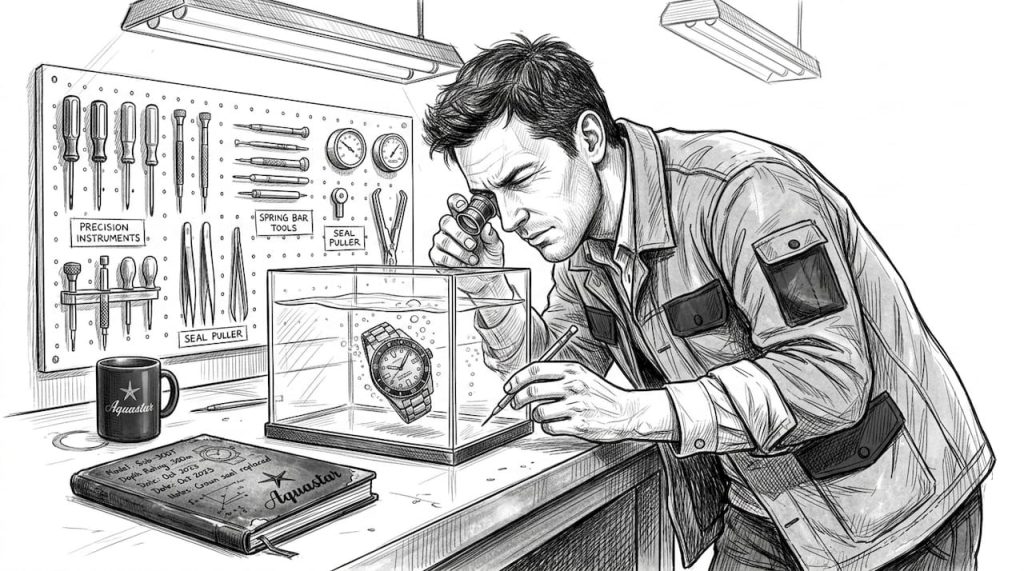
A mechanical diver earns its keep in salt, pressure, heat, shock, and neglect. That is precisely why owners ask how to maintain mechanical diver watch performance without compromising the case, movement, seals, or finish. The answer is not complicated, but it does require discipline. A true dive watch is built to endure harsh conditions. Keeping it that way means treating it like the instrument it is.

How to Maintain a Mechanical Diver Watch - how to maintain mechanical diver

How to maintain mechanical diver watch performance

The first rule is simple: maintenance starts the moment the watch leaves the water. Salt is relentless. Chlorine is no better. Even if your diver is rated for serious depth, residue left on the case, bezel, crown, and caseback will shorten the life of gaskets and wear on moving external parts.

Rinse the watch in fresh water after every swim or dive. Use moderate water flow, not a high-pressure jet. If the bezel feels gritty, rotate it gently while rinsing to flush away salt and sand. Dry the watch with a soft microfiber cloth and let any remaining moisture evaporate before storage.

If the watch has seen sunscreen, sweat, or sea spray all day, a more thorough clean is worth the effort. A soft toothbrush and a little mild soap can lift residue from the bezel edge, lug gaps, and bracelet links. The crown must be fully screwed down before any washing begins. That point sounds obvious, but many water-resistance failures begin with simple oversight rather than dramatic impact.

Crown, gaskets, and water resistance

Most mechanical dive watches fail at the entry points, not at the crystal or case walls. The crown, caseback, crystal gasket, and any chronograph pushers are where water resistance is won or lost. If you want to know how to maintain mechanical diver reliability over years rather than months, start there.

Never unscrew or operate the crown when the watch is wet. Never adjust the time or date poolside, on a boat, or right after a dive. Water trapped around the crown tube can be drawn inward when the crown is pulled. The same logic applies to chronograph pushers on models that are not specifically engineered for underwater operation.

Gaskets are consumable components. They harden, compress, and age. Heat accelerates that process. So does exposure to chemicals. If your diver sees regular water use, have its water resistance checked before a major dive trip and at the recommended service interval (every 5 to 10 years). Annual testing is not necessary. A pressure test is fast, inexpensive compared with movement repair, and far more valuable than assuming a case is still sealed because it was last summer.

There is a trade-off here. Some owners avoid routine testing because they do not want a watch opened unnecessarily. That concern is reasonable, especially with vintage pieces. But a proper dry pressure test does not require opening the watch, and it can reveal a problem before moisture reaches the dial and movement.

Daily wear habits that protect the movement

A Swiss mechanical diver is designed for active use, but it is not immune to bad habits. Repeated hard shocks, exposure to strong magnetism, and careless setting routines can all undermine accuracy and longevity.

If your watch is automatic, regular wear usually provides sufficient winding. If it has been off the wrist for a day or two, give it a controlled manual wind before setting it. Do not force the crown at the end of the winding range. A well-made movement communicates resistance clearly. Respect it.

Set the time with steady, deliberate motion. If your watch includes a date, avoid changing it during the movement’s date-change window, typically late evening through early morning. The exact period depends on the caliber, but as a rule, if the watch is near midnight, move the hands away from that zone before adjusting the date. It is a small step that prevents unnecessary stress on the calendar mechanism.

Magnetism remains one of the most overlooked threats to modern watch accuracy. Tablet covers, speakers, induction cooktops, phone accessories, and magnetic clasps can all affect rate performance. A magnetized movement may start running dramatically fast even though nothing appears physically wrong. The good news is that demagnetizing is usually quick. The better news is that simple awareness prevents most of these issues.

Bracelet, strap, and external components

Collectors tend to focus on the movement, but the parts you touch every day deserve equal attention. A dive watch bracelet works in a hostile environment. Salt crystals settle between links. Fine sand acts like abrasive paste. Clasps take repeated impact against desks, tanks, ladders, and railings.

Clean the bracelet regularly, especially after ocean use. If the watch is fitted on rubber, rinse and dry it thoroughly because salt trapped beneath the strap can abrade the underside of the lugs and irritate the wrist. If you alternate between steel and rubber, inspect the spring bars during every strap change. They are inexpensive, critical, and too often ignored until one fails.

The bezel also deserves a closer look. A unidirectional dive bezel should turn with clean, positive action. If it becomes stiff, gritty, or uneven, do not force it. Debris may be trapped beneath the mechanism. In some cases a careful rinse solves the problem. In others, the watchmaker needs to remove and clean the assembly. Forcing a bezel can damage the click spring or mar the insert.

Cosmetic wear is more subjective. Hairline scratches on a steel case are honest signs of use. Deep impact marks near the crown guards or crystal edge are different because they may indicate stress to sealing surfaces. That is where appearance and function intersect.

Storage matters more than most owners think

How you store a diver between wears affects its condition over time. A watch left on a windowsill, in a humid bathroom, or loose in a drawer will age faster than one stored properly. Heat is the enemy of oils and gaskets. Moisture is the enemy of everything.

Store the watch in a cool, dry place away from direct sunlight and strong magnetic fields. If you rotate several watches, keep each one separate to avoid case and bracelet contact. A soft watch pouch or lined box is enough. You do not need a theatrical setup.

Watch winders are a matter of preference, not necessity, for most divers. They can be useful for complicated calendars, less so for simple time-and-date tool watches. Constant motion also means constant wear on the winding system. For many owners, letting the watch stop and restarting it properly is the better choice.
If the watch will be stored for an extended period, make sure it is clean and completely dry first. For vintage-style divers with leather accessories, keep the leather separate from prolonged damp conditions. The watch may be built for depth, but a damp storage environment is still poor stewardship.

Service intervals and what a full service actually means

The question is not whether a mechanical diver needs service. It does. The question is when. Manufacturer guidance varies by movement and use, but a practical interval for many modern Swiss mechanical dive watches is around five to seven years. Heavy water use, harsh conditions, or obvious changes in performance can shorten that timeline.

Do not wait for the movement to fail outright. Warning signs tend to arrive first: reduced power reserve, erratic amplitude, poor timekeeping, moisture under the crystal, rotor noise that seems abnormal, or difficulty winding and setting. Any of those justify inspection.

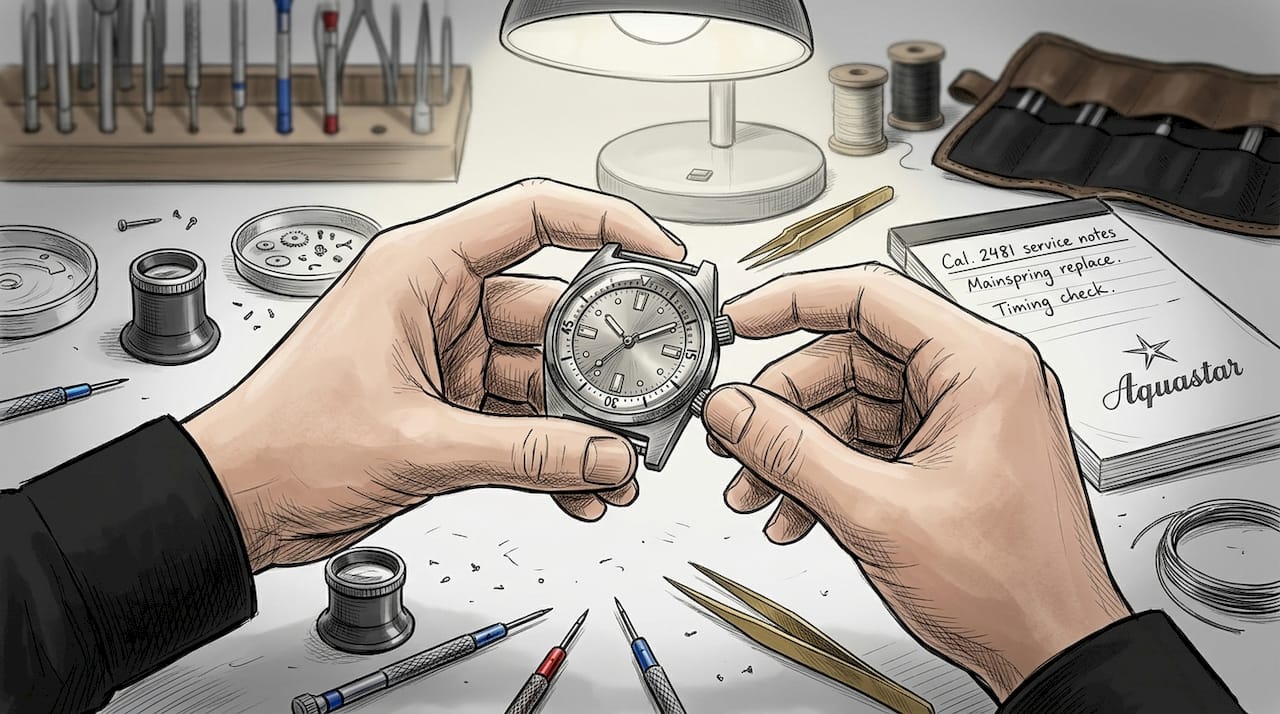
A proper service is more than oiling a few parts. The movement is disassembled, cleaned, inspected, re-lubricated, regulated, and reassembled. Worn components are replaced. Case gaskets are renewed. Water resistance is tested. The case and bracelet may be refinished depending on owner preference, though collectors often prefer a light hand here. Over-polishing can erase the sharp geometry that gives a professional dive watch its character.

That is where brand expertise matters. A historically faithful diver with specific bezel construction, case finishing, or dial furniture should be handled by a watchmaker who understands both modern sealing standards and the architectural details that define the watch. Aquastar owners, in particular, tend to value those details because they are part of the watch’s legitimacy, not decoration.

When vintage rules differ from modern rules

Not every mechanical diver should be treated the same. A modern dive watch with fresh seals and tested water resistance is one thing. A vintage piece, even one with a screw-down crown and serious original specifications, is another.

If you own a vintage diver, assume nothing about water resistance until it has been evaluated by a specialist. Original crowns, old crystal gaskets, aged caseback seals, and decades of unseen wear all change the equation. In some cases the correct decision is to keep the watch dry and preserve it as a historical instrument rather than force it back into aquatic duty.

That is not a contradiction. It is good judgment. Mechanical dive watches were built as tools, but heritage also deserves respect. The right maintenance plan depends on whether the watch is an active underwater instrument, a daily wearer, or a collector’s piece with finite originality.

A serious diver does not ask for much. Keep it clean, keep it sealed, keep it serviced, and pay attention when it starts telling you something has changed. Do that, and the watch on your wrist remains what it was built to be – a dependable instrument with the substance to outlast trends.

Related from Aquastar: Aquastar service & repair, the Aquastar collection.

Further reading: Wikipedia on diving watches.
Posted on

Model 60 MKII Review: A Diver’s Classic

Model 60 MKII Review: A Diver’s Classic - Model 60 MKII review

Model 60 MKII Review: at a glance

Model 60 MKII review for collectors and divers – heritage proportions, Swiss mechanical integrity, modern water resistance, and real tool-watch purpose. Use this guide on Model 60 MKII review to weigh design choices, engineering trade-offs and how the category translates to real Aquastar dive watches.

TopicModel 60 MKII review
Read time5-8 min
SourceAquastar editorial

The best heritage dive watches usually fail in one of two ways. They either lean too hard on nostalgia and wear like compromised relics, or they modernize the original so aggressively that the character disappears. This Model 60 MKII review matters because the watch sits precisely in that narrow space where archival fidelity and modern utility must coexist – and where experienced buyers notice every shortcut.

Model 60 MKII Review: A Diver’s Classic - Model 60 MKII review

The Model 60 line has genuine underwater credibility behind it. That matters. In a market crowded with retro-styled divers that borrow the language of the 1960s without carrying any real lineage, a faithful revival has to do more than quote a handset or mimic a bezel font. It has to preserve proportions, preserve intent, and still perform to contemporary expectations. The MKII is strongest when judged by that standard.

Model 60 MKII review – what it gets right

At first glance, the watch does not beg for attention. That restraint is part of the appeal. The case profile, dial balance, and bezel execution are disciplined rather than theatrical, which is exactly what many collectors want from a serious dive instrument with historic roots. It looks like a watch designed for work first, and admiration second.

The case proportions are one of the most persuasive parts of the package. A dive watch can carry excellent specifications and still miss the mark on the wrist if the shape feels bloated or the lugs lose the original geometry. Here, the sizing feels considered. It wears with the compact authority expected from a proper mid-century inspired diver, without slipping into the undersized territory that can make some vintage reissues feel more collectible than usable.

That balance has practical consequences. A watch with controlled dimensions sits lower, catches less, and remains credible as an everyday tool. For buyers who rotate between larger modern divers and more restrained vintage pieces, the MKII lands in a sweet spot. It does not need oversized presence to project confidence.

The dial design follows the same logic. Legibility comes first. The markers are clear, the handset is purposeful, and the overall layout avoids the clutter that often creeps into modern heritage releases trying to add visual complexity. The result is not sterile. It is focused. On a dive watch, that distinction matters.

Lume and contrast are part of that equation. A true tool watch should read quickly in compromised light, not merely photograph well under studio conditions. The MKII embraces modern luminous material and contemporary finishing where it improves function, but it does so without breaking the period-correct character of the watch. That is harder to achieve than it sounds.

Heritage, without the costume

What separates a serious re-edition from a themed product is intent. The Model 60 MKII does not feel like a watch wearing vintage style as decoration. It feels like an effort to continue the original design language with respect for the constraints that shaped it in the first place.

That includes the bezel, crystal, and surface treatment choices. Enthusiasts tend to scrutinize these areas because they reveal whether a brand understood the source material or merely referenced it. The MKII benefits from modern production quality and contemporary durability, but the visual discipline remains intact. You get the clarity and dependability expected from a current Swiss mechanical diver, without the overbuilt aesthetic that often overwhelms heritage casework.

This is where many modern dive watches lose their footing. They become thicker, shinier, and more inflated than the design needs, usually in pursuit of market trends rather than underwater logic. The MKII resists that drift. It retains the compact seriousness of a watch built with purpose.

For collectors, that authenticity has weight. It means the watch can sit comfortably beside vintage references without feeling like a tribute piece. For newer buyers, it means the design feels resolved rather than forced. Good heritage does not need explanation on the wrist.

The wearing experience

A dive watch may look convincing in product photography and still disappoint in daily use. This one is more persuasive after a week on the wrist than it is in a single glamor shot.

The case shape helps immediately. There is enough substance to remind you that this is a mechanical instrument, but not so much that it becomes tiresome by late afternoon. Wrist presence is strong, though not aggressive. The watch wears like a piece designed by people who understand that professional credentials and comfort are not opposing ideas.

Strap pairing matters more here than it does on many modern divers. On a proper rubber strap, the MKII feels closest to its intended purpose – direct, capable, and ready for water. On a bracelet, if configured that way, it shifts slightly toward a more versatile everyday proposition without losing its tool-watch identity. That flexibility broadens the appeal, especially for buyers who want one watch to cover desk, travel, and weekend use.

There is also a tactile quality to well-executed dive watches that is difficult to fake. Bezel action, crown feel, and the general sense of mechanical precision all contribute to whether a watch feels convincing. The MKII’s strength is that it communicates seriousness without drama. Nothing about it needs exaggeration.

Movement, build quality, and modern expectations

Any honest Model 60 MKII review has to address the tension at the center of all heritage tool watches. Buyers want vintage character, but they expect modern reliability, serviceability, and water resistance. They should.
The MKII is compelling because it does not ask the wearer to accept old-world compromises in exchange for old-world aesthetics. The movement choice supports the watch’s broader purpose – dependable Swiss mechanical performance, practical ownership, and the sort of consistency expected from a modern instrument. Purists may always debate whether one caliber would be more romantic than another, but romance is not the same thing as suitability.

Build quality is where the modern advantages become harder to ignore. Sapphire crystal, strong water resistance, and contemporary luminous material are not marketing embellishments. They are the baseline requirements for a premium mechanical dive watch that intends to be worn hard. If a brand claims professional heritage, those features should not be optional.

The MKII meets that standard without advertising itself like an over-engineered concept piece. That restraint is part of its confidence. It knows what kind of watch it is.

Where the trade-offs are

No serious watch deserves unqualified praise, and the Model 60 MKII is no exception. Its strongest qualities will also limit its audience.

First, this is not a maximalist dive watch. If you want oversized dimensions, conspicuous luxury finishing, or a design that announces itself from across the room, the MKII may feel too controlled. That is not a flaw in the watch. It is a matter of taste. This piece is aimed at buyers who value proportion, lineage, and utility over visual volume.

Second, heritage accuracy can be a double-edged sword. The very discipline that makes the watch credible may leave some buyers wanting more overt modern flair. There are plenty of contemporary divers with ceramic-heavy, aggressively angular cases and louder dial treatments. The MKII takes a different path. It trusts the original architecture. Not everyone will.

Third, this is a watch for people who notice nuance. That means part of its value is lost on buyers who shop only by headline specs. A thicker case, a larger diameter, or a more elaborate dial can look more impressive on paper. On the wrist, though, those gains often come with penalties the spec sheet never mentions.

Who this watch is really for

The ideal owner is not chasing a generic luxury diver. He wants a watch with historical legitimacy, practical engineering, and the kind of design discipline that usually comes from real archival grounding. He may already own larger modern pieces and now wants something with more character and less noise. Or he may be a vintage enthusiast who appreciates period-correct proportions but has no interest in babying an original example.

That is where the Model 60 MKII stands out. It offers the emotional pull of a true heritage design with the everyday confidence of a current Swiss-made tool watch. For many collectors, that combination is more compelling than either a fragile vintage original or a modern diver bloated beyond recognition.

Aquastar understands this territory well. The brand’s strength has always been treating dive-watch heritage as engineering history rather than costume design, and the MKII benefits from that approach.

Final take on the Model 60 MKII review

The Model 60 MKII succeeds because it remains disciplined. It does not chase trends, inflate the case, or smother the original design in modern theatrics. Instead, it delivers what a proper heritage diver should deliver – authentic proportions, functional clarity, modern durability, and the quiet confidence of a watch that knows its own purpose.

For collectors and divers alike, that makes it more than an attractive reissue. It makes it a convincing continuation of a serious underwater instrument. If your taste runs toward compact authority rather than exaggerated presence, this is the kind of watch that tends to earn more respect the longer you wear it.

Related from Aquastar: the Aquastar Model 60 MKII Re-Edition, the Model 60 family.

Further reading: Wikipedia on diving watches.
Posted on

Do Mechanical Watches Hold Value?

Do Mechanical Watches Hold Value? - do mechanical watches hold value

Do Mechanical Watches Hold Value: at a glance

Do mechanical watches hold value? Learn what drives resale strength, from brand heritage and rarity to condition, originality, and demand. Use this guide on do mechanical watches hold value to weigh design choices, engineering trade-offs and how the category translates to real Aquastar dive watches.

TopicDo mechanical watches hold value
Read time5-8 min
SourceAquastar editorial

A mechanical watch can lose 30 percent the moment it leaves the dealer, or quietly become a reference collectors chase for years. That is why the question do mechanical watches hold value is worth asking with precision, not wishful thinking. In this category, value is never guaranteed. It is earned through heritage, specification, rarity, condition, and sustained demand.

Do Mechanical Watches Hold Value? - do mechanical watches hold value

Do mechanical watches hold value in the real market?

The short answer is yes, some do. Many do not. Mechanical watches are not a uniform asset class, and treating them that way is where buyers get into trouble.

A mass-produced watch from a brand with weak identity and no collector following will usually depreciate like most consumer goods. A purpose-built Swiss mechanical watch with strong design continuity, disciplined production, and real enthusiast demand has a better chance of holding value over time. The difference is not marketing language. It is market behavior.

Collectors tend to reward watches that stand for something specific. Tool watches with genuine lineage, proven use cases, and recognizable design codes often perform better than pieces built around trend cycles. A watch rooted in diving, aviation, or motorsport history carries a stronger narrative than a generic luxury product with polished surfaces and little substance behind it.

What actually drives value retention

Value retention in mechanical watches usually comes down to a few forces working together. Heritage matters because collectors buy stories backed by facts. A reference with a documented place in horological history will always have more staying power than a watch invented by a marketing department.

Scarcity matters too, but only when paired with demand. Low production alone is not enough. Thousands of obscure watches are rare because nobody wanted them in the first place. The stronger formula is limited supply combined with a clear identity, faithful execution, and an audience that understands what the watch represents.

Specification also plays a role, especially with modern tool watches. Serious buyers notice movement quality, case construction, bezel material, water resistance, lume performance, and finishing. A watch built to endure harsh conditions tends to hold credibility longer than one built to photograph well on launch day.

Then there is design durability. Some watches age out quickly because they lean too hard on fashion. Others remain relevant because the proportions are disciplined, the dial is legible, and the case architecture is tied to function. In collector markets, timeless usually beats trendy.

Brand strength is not the same as hype

Well-known brands often hold value better because they have established secondary markets, broad recognition, and service infrastructure. But hype can distort that picture. A watch that spikes because of short-term social media demand can fall just as fast when attention moves on.

Collectors usually place more trust in brands with a coherent identity than brands chasing every trend at once. A specialist maker with authentic roots in one category can sometimes produce stronger long-term value retention than a larger name expanding into every possible segment.

That is especially true in dive watches. Buyers in this space tend to be more technically literate. They care about bezel action, case geometry, movement choice, dial execution, underwater legibility, and whether the watch has any real connection to professional use. Empty luxury signaling does not carry the same weight here.

Why some dive watches hold value better than others

Dive watches occupy a special place in mechanical collecting because they combine utility, history, and design clarity. The category includes true professional instruments, military-adjacent references, and commercial diving icons. That depth of purpose gives the best models a stronger foundation in the resale market.

But not every dive watch benefits equally. Pieces that simply borrow the look of a classic diver without preserving the logic behind it often struggle. Serious buyers can tell when a watch is built from archival knowledge and when it is just styled to appear vintage.

The models that tend to hold value better are the ones that respect original proportions, preserve historically important cues, and update only where modern reliability demands it. Sapphire crystal, improved seals, stronger lume, and dependable Swiss calibers add value when they support the original character rather than erase it.

This is where heritage re-editions can become compelling. When executed correctly, they offer the visual authority of a proven historic reference with the usability expected from a modern watch. For enthusiasts who want authenticity without vintage fragility, that balance can create durable demand.

Condition, originality, and completeness still rule

Even the strongest reference can lose value if it is poorly kept. Condition remains one of the hardest drivers in watch pricing because it cannot be reverse engineered once lost.

An overpolished case softens the edges that gave the watch its character. A relumed dial or replaced hands may improve appearance to a casual eye but weaken collector confidence. Incorrect bezels, service parts that change the watch’s visual identity, or paperwork gaps can all affect resale strength.

For modern mechanical watches, full sets still matter. Box, warranty card, manuals, spare links, and original strap hardware all help support buyer trust. Service history matters as well, especially when it comes from a respected watchmaker or authorized center. Buyers pay more when they know exactly what they are getting.

Originality means more than untouched

There is nuance here. In a true tool watch, honest wear can be acceptable, even appealing. A diver with light case marks and strong original geometry may be more desirable than one that has been heavily refinished. Collectors often prefer integrity over cosmetic perfection.

That principle matters for modern purchases too. If you are buying with future value in mind, preserve what makes the watch itself. Keep the original bracelet or tropic-style strap if one is supplied. Save all packaging. Avoid unnecessary polishing. Treat the watch like a serious instrument, not a disposable accessory.

Price discipline at purchase matters more than people admit

A watch can be excellent and still be a poor value purchase if bought at the wrong price. This is where many buyers confuse product quality with investment quality.

The question is not only whether the watch is good. It is whether the market already reflects every positive attribute in the price. If you buy into peak enthusiasm, upside can be limited. If you buy a strong reference with enduring appeal at a sensible level, value retention becomes much more realistic.

This is one reason direct-to-consumer enthusiast brands can be interesting. When pricing is not burdened by excessive retail structure and the watch itself delivers strong technical and historical content, the value proposition can be sharper from day one. That does not guarantee appreciation. It simply gives the watch less distance to fall.

Are mechanical watches an investment?

Usually, no. They are first and foremost objects of engineering, heritage, and use. Some appreciate. Many merely retain part of their purchase price. Others decline and stay there.

The healthiest approach is to buy a mechanical watch because it deserves a place on the wrist, then consider value retention a secondary discipline. If the watch has real lineage, restrained production, enduring design, and collector credibility, you are stacking the odds in your favor. If it also gives you years of use, the equation becomes more compelling.

That is particularly true for serious dive watches. A well-made diver offers something beyond speculation. It gives you tactile mechanics, underwater legibility, and a direct line to an era when watches were built as instruments first. That kind of authenticity tends to age well.

So, do mechanical watches hold value over time?

They can, but only when the fundamentals are there. The strongest candidates usually come from brands with a clear identity, references with historical legitimacy, production that is disciplined rather than inflated, and specifications that support real-world use. In other words, substance before status.

For buyers who care about long-term value, the best move is not chasing noise. It is choosing watches with purpose, documented heritage, and design integrity that will still make sense ten years from now. In a market crowded with short-lived luxury messaging, that kind of mechanical honesty remains one of the safest places to put your attention.

Further reading: Wikipedia on mechanical watches.

Posted on

What Is a Helium Escape Valve, and When Do You Actually Need One?

What Is a Helium Escape Valve, and When Do You Actually Need One? - helium escape valve

Helium Escape Valve: at a glance

A helium escape valve vents trapped helium after saturation dives. Learn how it works, the two valve types, and why most divers never actually need one. Use this guide on helium escape valve to weigh design choices, engineering trade-offs and how the category translates to real Aquastar dive watches.

TopicHelium escape valve
Read time5-8 min
SourceAquastar editorial

If you have shopped for a dive watch, you have probably seen “helium escape valve” listed in the specifications, sometimes abbreviated as HEV or HRV (helium release valve). It sounds like a serious piece of safety equipment, and in the right context it is. The honest answer, though, is that the helium escape valve solves a very specific problem faced by a tiny group of professional divers, and almost no recreational diver will ever need one. This article explains what the valve actually does, the saturation diving world it was built for, how the two main types work, and why the feature matters less for the average buyer than the marketing might suggest.

What Is a Helium Escape Valve, and When Do You Actually Need One? - helium escape valve

What a Helium Escape Valve Actually Does

A helium escape valve is a small one-way valve set into the side of a dive watch case. Its job is to let gas out of the watch, not to keep water out. That is the part most people get backwards. A watch case is sealed against water by gaskets at the crown, caseback, and crystal, and those gaskets do their job in the direction that matters for diving: keeping pressurized water from getting in.

The valve addresses a different and much rarer situation, where gas has already worked its way inside the case and now needs a controlled way back out. It is a release mechanism for a pressure imbalance that builds up over days, not a defense against the pressure of a single dive. Understanding why that imbalance happens means looking at how saturation divers actually work.

The Saturation Diving Problem It Was Built to Solve

Commercial saturation divers, the people who service oil rigs, pipelines, and other deep installations, do not surface between dives. Instead they live for days or weeks inside a pressurized habitat or diving bell, breathing a helium-oxygen mixture known as heliox. Because their bodies and their living space are already saturated with gas at depth, they can work for extended periods and then decompress once, slowly, at the end of the whole assignment rather than after every dive.

Helium is the smallest practical gas molecule used in breathing mixtures, and over the long hours spent in a pressurized heliox environment, those tiny atoms gradually migrate past the watch gaskets and into the case. This is slow seepage, not a leak, and it does no harm while the diver stays at pressure because the gas inside the case and the gas outside are roughly in balance.

The trouble comes during decompression. As the habitat’s pressure is lowered over many hours, the helium trapped inside the watch case suddenly finds itself at a higher pressure than the surrounding atmosphere. If it cannot escape quickly enough through the gaskets, that internal pressure can push the crystal right off the case. Early saturation programs in the 1960s saw exactly this happen: crystals popping during the long ascent. The helium escape valve was the engineering answer, giving the trapped gas a controlled exit before it could force its way out destructively.

How the Valve Works: Automatic vs Manual

There are two designs in common use, and they differ in how the valve is triggered.

The automatic valve

An automatic helium escape valve is a spring-loaded one-way valve. It stays sealed under normal conditions and only opens when the pressure inside the case exceeds the pressure outside by a set threshold. During decompression, as the cabin pressure drops, the trapped helium pushes the valve open, vents, and the valve reseats itself once the pressures equalize. The diver does nothing. This is the design most associated with the feature’s origins, developed for professional saturation work in the late 1960s.

The manual valve

A manual valve is a small screw-down crown on the side of the case, usually at the nine o’clock position. The diver, or more often the dive supervisor, unscrews it during the decompression phase to let helium bleed out, then screws it back down. A manual valve must never be opened underwater, since unscrewing it at depth would breach the case seal. It is strictly a surface or chamber operation, performed in the controlled environment of the decompression schedule.

Both approaches achieve the same result. The automatic version is more convenient and removes the risk of human error, while the manual version is mechanically simpler and gives an operator direct control. Neither has any effect on how deep the watch can be taken or how well it resists water.

Why Most Divers Will Never Need One

Here is the key point that gets lost in product listings: the helium escape valve is only relevant if helium has accumulated inside your watch case, and that only happens inside a pressurized heliox saturation environment. Recreational scuba divers breathe compressed air or nitrox, not heliox, and they surface after every dive rather than living at pressure for days. There is no slow helium build-up to vent, so there is nothing for the valve to do.

Even most technical and deep divers fall outside the valve’s use case. Unless you are working as a commercial saturation diver living in a pressurized chamber, the feature is inert on your wrist. It is a tool built for a profession that very few people practice, and it was never designed to make an ordinary dive watch safer or more capable in the water.

That does not make the valve a bad thing to have. It adds no real drawback beyond a small amount of complexity and one more sealed component that, in principle, could need service over the very long term. But it should not sit at the top of a buyer’s priority list, and a watch without one is not less of a dive watch.

Does an HEV Make a Watch “Better”?

For the overwhelming majority of buyers, a helium escape valve is a signal of heritage and a nod to professional saturation diving rather than a functional necessity. It tells you a watch belongs to a lineage of serious deep-diving tools. What it does not tell you is anything about the watch’s water resistance, build quality, or suitability for actual recreational diving.

When you are evaluating a dive watch, the specifications that genuinely affect performance underwater are the ones worth weighing first: a sensible depth rating with a healthy safety margin, a screw-down crown and well-engineered gaskets, strong luminous markers for reading the dial in dark water, and a unidirectional bezel for tracking elapsed time. A helium escape valve sits well below all of those for a diver who is not living in a saturation chamber.

If your interest is in genuinely deep-capable dive watches built around robust sealing and high depth ratings rather than a feature you are unlikely to use, the Aquastar Benthos family is worth a look. Aquastar introduced the Benthos 500 in 1970 as the first Swiss dive watch rated to 500 meters, a depth figure achieved through case and gasket engineering rather than a single headline feature. You can explore the current range on the Benthos collection page. For most divers, sound sealing and an honest depth rating will always matter more than a valve built for a job they will never do.

Further reading: Wikipedia on helium release valves.

Posted on

How Does a Unidirectional Bezel Work on a Dive Watch?

Dive Watch Timing Bezels: Safety, Use, and Pro Tips - dive watch timing bezels

Unidirectional Bezel: at a glance

How a unidirectional dive watch bezel works, why it rotates one way, how to read elapsed dive time, and the Aquastar 1962 no-decompression patent. Use this guide on unidirectional bezel to weigh design choices, engineering trade-offs and how the category translates to real Aquastar dive watches.

TopicUnidirectional bezel
Read time5-8 min
SourceAquastar editorial
Aquastar Deepstar Chronograph showing the no-decompression rotating bezel

The rotating bezel on a dive watch is one of the most recognizable features in watchmaking, and one of the least understood. People know it spins. Fewer know that on every proper dive watch, it spins in only one direction, and that this is a safety mechanism with a specific job underwater. This article explains how a unidirectional bezel actually works, why it rotates counter-clockwise, how a diver uses it on a real dive, and what to look for when you are choosing one.

How Does a Unidirectional Bezel Work on a Dive Watch? - unidirectional bezel

What a Unidirectional Bezel Is

A bezel is the ring around the dial of a watch. On a dive watch, the bezel is a separate component, machined to rotate, with engraved or inlaid numerals marking minutes from 0 to 60. Under the bezel sits a click spring, also called a ratchet. The spring locks the bezel into discrete positions, normally either 60 or 120 of them per full rotation, so the diver can feel each click and align the bezel reliably even with gloved hands or in low visibility.

The word “unidirectional” describes the direction of allowed rotation. On a dive watch, the bezel can be turned in only one direction, almost always counter-clockwise. Turn it the other way, and it does not move. The mechanism is mechanical and deliberate. Every detent of the click spring engages a tooth on a ratchet wheel that has an asymmetric profile: easy to push in one direction, blocked in the other.

This is the first thing to know. The unidirectional bezel is not a styling choice. It is a one-way clutch built into the watch.

Why It Only Rotates One Way

The reason is decompression safety, and the logic is elegant.

When a scuba diver descends, the body absorbs nitrogen from the breathing gas. The deeper and longer the dive, the more nitrogen dissolves into tissue. If the diver returns to the surface too quickly, that nitrogen comes out of solution as bubbles, causing decompression sickness, known to divers as “the bends.” The condition is serious. It can cause joint pain, neurological damage, and death.

To avoid it, divers stay within depth-time limits. The bezel is the simplest way to track elapsed time underwater. Before submerging, the diver rotates the zero marker on the bezel to align with the minute hand. From that moment, the minute hand sweeps across the engraved bezel numerals and shows, at a glance, how long the diver has been below. No calculation. No display to read. Just elapsed time, visible against the dial.

The one-way mechanism exists because the bezel can be bumped during a dive. A diver crawls through a wreck, brushes a tank against the watch, or knocks the bezel against equipment. If the bezel could rotate either way, a bump could shorten the displayed elapsed time, fooling the diver into thinking they have more bottom time than they actually do. The diver would stay down longer than safe, with consequences.

With a unidirectional bezel, the only direction a bump can move it is the wrong one for the diver, which is also the right one for safety. If the bezel rotates accidentally, it increases the displayed elapsed time. The diver believes they have less bottom time than they actually do. They surface early. Conservatism beats optimism every time underwater.

How to Use a Dive Watch Bezel on a Real Dive

The procedure is straightforward. At the start of a dive, align the lumed zero pip on the bezel with the minute hand. Submerge. As the dive progresses, the minute hand advances around the dial. Read the elapsed time directly from the bezel scale. When the hand reaches the planned bottom time, ascend.

This works because dive watch bezels are marked in minutes, not hours. The full rotation of the minute hand, which takes 60 minutes, sweeps across the entire bezel. There is no math.

Most planned recreational dives run 30 to 50 minutes within no-decompression limits, well inside what one bezel rotation covers. For longer technical dives, divers use the bezel together with a dive computer for redundancy. If the computer fails, the bezel is the analog backup that needs no battery, no menu, and no input besides the rotation at the start.

The Aquastar No-Decompression Bezel

Three Aquastar Deepstar Chronograph variants showing the patented two-scale no-decompression bezel

Most dive watch bezels work as described above, with a simple 60-minute count-up scale. Aquastar built something different.

In 1962, Aquastar S.A. of Geneva filed Swiss patent CH 436 140 for a unidirectional bezel that did not just count elapsed time, it encoded decompression-table coefficients directly into a two-scale design. The inner scale is the conventional 60-minute count-up. The outer scale carries the coefficients a diver needs for surface intervals and second dives. The bezel lets the diver calculate repeat-dive timing on the wrist, without referring to a printed table, without surfacing to check a manual.

The inventor of record was Marc Jasinski. The mechanism is the technical foundation of the Aquastar Deepstar, then and now. When the Deepstar Chronograph was relaunched in 2020 and refined again as the 2022 39mm and the Deepstar III, the bezel kept its original geometry. The same two-scale layout sits on the watches today. The French Navy issued Aquastar Deepstar watches to combat divers through the 1970s, and the bezel is one of the reasons.

What to Look For When Buying

Once you understand what the bezel does, evaluating one becomes easier. A few things matter on the wrist and underwater.

Click count

A 120-click bezel allows positioning to within 30 seconds. A 60-click bezel positions to one minute. For dive timing, 120 clicks is more useful. The half-minute precision matters when planning a tight no-decompression dive.

Click feel

A good bezel has firm, distinct detents with no slop between positions. You should feel each click crisply through the fingertip, gloved or not. Spongy or vague clicks suggest a worn or low-grade click spring, both of which can fail at depth.

Insert material

Older dive watches used aluminum inserts that scratched easily and faded under UV light. Modern dive watches typically use ceramic inserts, which are nearly scratch-proof and hold colour indefinitely. Steel inserts split the difference: not as scratch-resistant as ceramic, more durable than aluminum, classic in appearance.

Lume on the zero pip

A luminous pip at the 12 o’clock position lets the diver see the reference point in low visibility. Look for a high-grade compound, such as X1 Super-LumiNova in BGW9 or C3, with a charge that lasts hours after a single light exposure.

Reverse stop

With the bezel turned clockwise, it should not move. Period. If you can rotate it slightly the wrong way, the mechanism is failing.

Why It Still Matters Above Water

Most dive watches today never see water past a shower. The bezel still earns its place on the wrist. It is the simplest analog timer ever built into a wristwatch. Parking timer, espresso steep, pasta countdown, oven timer, anything that needs a clear elapsed-time readout works on it. Once you start using a bezel for daily timing, you stop reaching for your phone for short intervals.

The unidirectional design that protects a diver from a fatal bump also protects the desk-bound owner from an accidental nudge that resets a timer mid-task. The engineering is the same. The safety logic carries over without you having to think about it.

If you are looking for a dive watch that honours the original bezel function, the Aquastar Deepstar family is the lineage. The patented no-decompression bezel that helped define the modern Swiss dive watch is the same bezel sitting on the watch today, in a timepiece built in Bienne, Switzerland.

Further reading: Wikipedia on diving watches.