
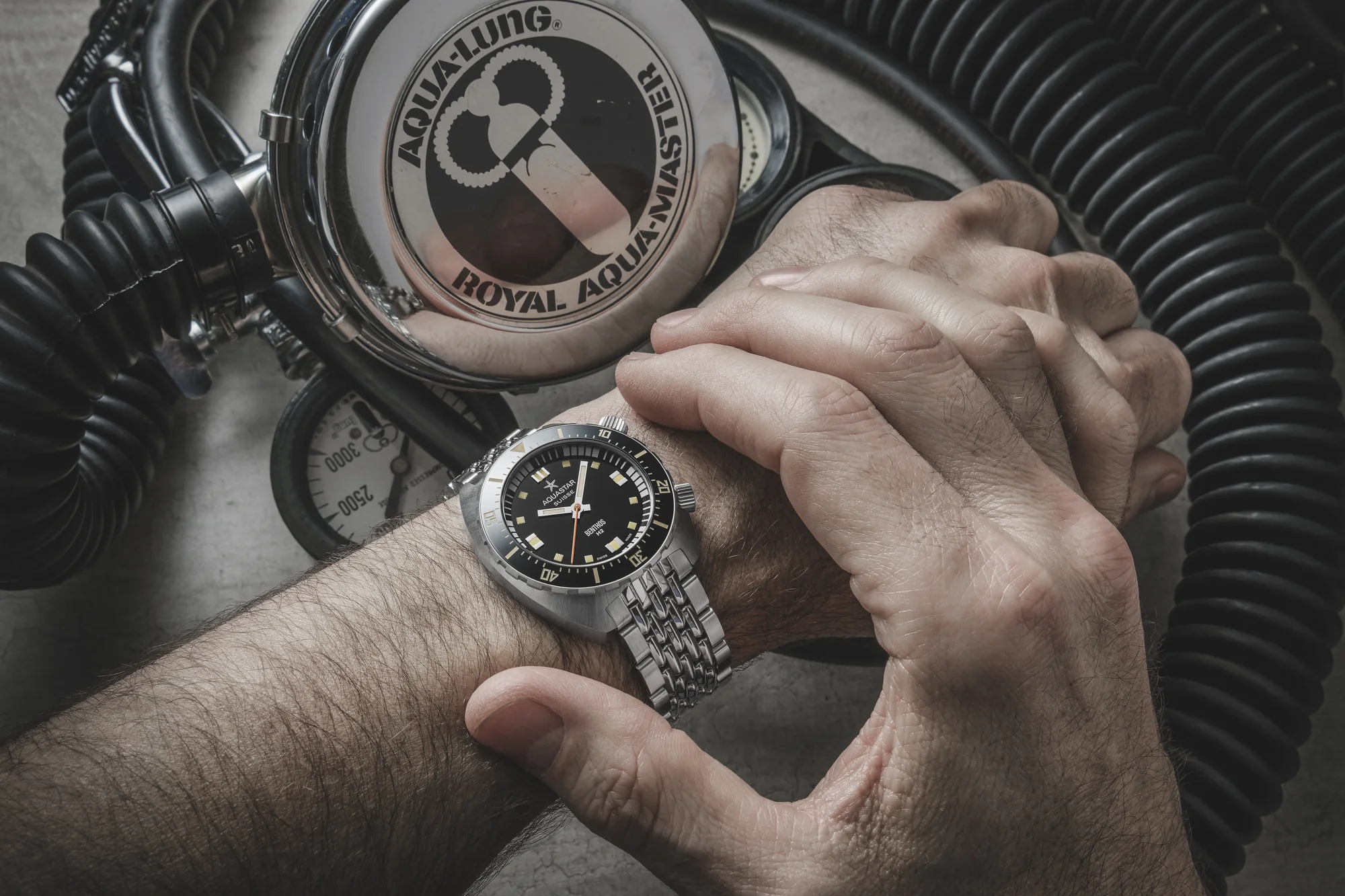
Choosing a strap for a dive watch is rarely about looks alone. The four options most divers and collectors weigh up, vulcanised rubber in the Tropic style, ISOfrane, the woven NATO, and a steel bracelet such as the beads-of-rice (BOR), each behave differently in salt water, under a wetsuit cuff, and across a working day at a desk. This guide compares the main dive watch strap types on the criteria that actually matter: water resistance, security, comfort, and how each ages. By the end you should know which strap suits real diving, which suits daily wear, and why many owners keep more than one.
Tropic rubber: the original tropical dive strap
The Tropic strap dates to the dive watch boom of the late 1950s and 1960s, when collectors and divers needed something that would not rot, stretch, or stink the way leather did in warm, wet conditions. The answer was a perforated vulcanised rubber strap with a distinctive basket-weave or tyre-tread surface texture. It is supple, light, and quick to dry, and the perforations let water and air move through rather than trapping moisture against the wrist.
For period-correct vintage divers and for anyone who likes the look of a 1960s tool watch, a Tropic strap is hard to beat. It sits close to the case, tapers cleanly, and pairs naturally with a cushion case or a skin-diver profile. Modern reissues of the material use more stable rubber compounds than the originals, so the brittleness that plagued decades-old straps is largely a thing of the past.
Where the Tropic style asks for care is fit over a wetsuit. Because it is relatively thin and not especially long, a Tropic strap is happiest on bare skin or over a thin neoprene cuff. For deep cold-water diving in a thick suit you may run out of strap length, which is exactly where the next two options earn their place.
ISOfrane: thick, secure, built for the dive
ISOfrane is a heavier vulcanised rubber strap with a ribbed underside and a longer, more generous length than a typical Tropic. It was developed as a purpose-built diving strap, and the design priorities show: the ribbed channels lift the strap slightly off the skin so sweat and water clear quickly, the extra length accommodates a wetsuit cuff, and the thicker rubber resists nicks and tears.
On the wrist an ISOfrane feels substantial and planted. It is the strap many divers reach for when they actually intend to get the watch wet, because it combines the corrosion-immunity of rubber with security and a comfortable stretch under load. The trade-off is bulk: an ISOfrane adds visual and physical heft, which suits a larger 42mm-plus diver more than a slim 38mm dress-diver.
For saltwater use, rubber straps in general have one decisive advantage over fabric and, in some respects, over steel: there is nothing for salt crystals or grit to lodge into. A quick rinse under fresh water and the strap is clean. That simplicity is why rubber remains the default for serious diving.
NATO: the woven nylon all-rounder
The NATO strap is a single length of woven nylon that passes under the watch and back through a series of keepers, so the case is held against a continuous band of fabric. Its origin is military: a one-piece strap means that if one spring bar fails, the watch stays on the wrist rather than falling away. That redundancy is the NATO’s signature safety feature and the reason it earned a permanent place in tool-watch culture.
NATOs are cheap, endlessly interchangeable, and infinitely adjustable, which makes them the natural choice for casual daily wear and for changing a watch’s character in seconds. They also lift the case a couple of millimetres off the wrist because of the extra layer of fabric under the caseback, which some wearers love and others find sits too tall.
For actual diving, the NATO is a compromise. Nylon soaks up water and is slow to dry, salt and sand work their way into the weave, and a wet fabric strap against neoprene can shift around. It is a superb everyday and travel strap, and a genuinely safer option than a two-piece strap with marginal spring bars, but for repeated saltwater immersion most divers prefer rubber.
The steel bracelet: BOR and the daily-wear case
A well-made stainless steel bracelet, such as a beads-of-rice (BOR) design, is the most formal and arguably the most durable option. Steel does not perish, does not absorb water, and shrugs off years of wear in a way no rubber or fabric strap can match. A BOR bracelet in particular drapes well because its many small links flex around the wrist, giving a comfortable, almost liquid fit.
The considerations with steel are weight, sizing, and salt. A bracelet adds noticeable mass, it needs to be sized correctly with links removed for a proper fit, and after diving in salt water it should be rinsed thoroughly because brine can sit in the gaps between links and around the clasp. Good bracelets in marine-grade 316L stainless steel resist that corrosion well, but the rinse is still worth the minute it takes.
For a watch that has to move from the water to the office without a strap change, a steel bracelet is the most versatile single choice. It is the reason so many vintage and modern divers ship on a bracelet as the default and offer rubber as the dive-day alternative.
Which strap for which job?
There is no single best strap, only the right strap for what you are doing. A rough framework:
- Actual diving, especially salt water: ISOfrane or another thick rubber strap, for length, security, and easy rinsing.
- Vintage looks and warm-weather daily wear: a Tropic-style rubber strap, light and period-correct.
- Casual everyday, travel, and quick character changes: a NATO, for redundancy, adjustability, and low cost.
- Office-to-weekend versatility and maximum longevity: a steel bracelet such as a BOR.
Most owners settle on two: a bracelet or Tropic for daily life, and a longer rubber strap kept ready for the water. Because dive watches use standard lug widths and spring bars, swapping between them takes a couple of minutes and changes the watch completely.
If you are choosing a watch to build that small strap collection around, it helps to start with a true tool diver designed for the water in the first place. The Aquastar Benthos family carries the proportions and lug geometry that suit all four strap styles, from a clean rubber Tropic to a beads-of-rice bracelet, so you can match the watch to the dive or the day without compromise.