
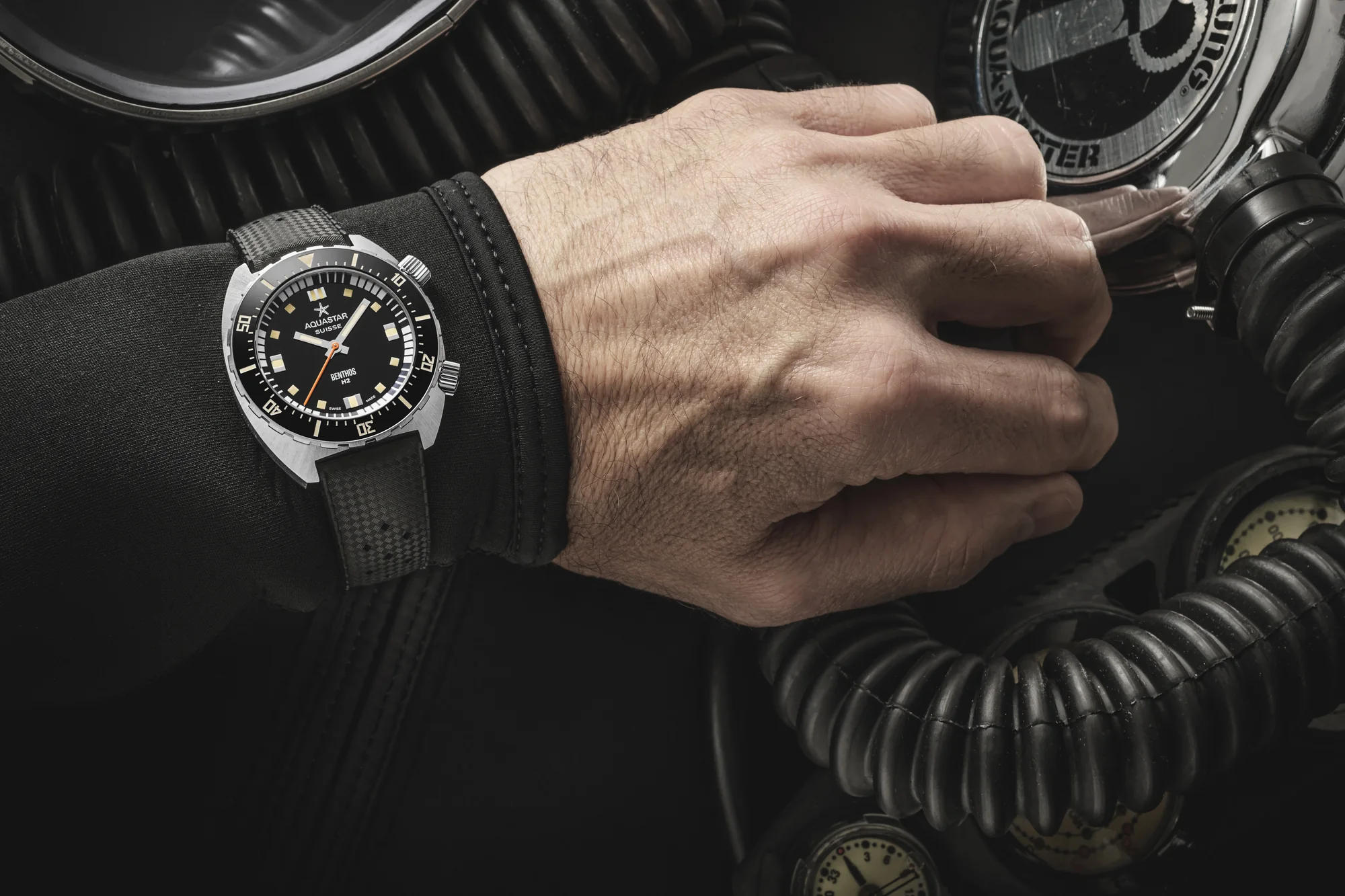
If you have spent any time looking at vintage dive watches, you have almost certainly come across the term “cushion case” without anyone stopping to explain it. A cushion case watch has a squarish case with softly rounded corners, a shape that sits somewhere between a circle and a square and looks a little like a pillow seen from above. This article explains what a cushion case is, where the design came from in the 1920s, why it returned on dive watches in the 1950s, and how it actually feels on the wrist. If you are trying to understand the shape or decide whether one suits you, this is the place to start.
What Is a Cushion Case?
A cushion case is a watch case whose outline is broadly square or rectangular but with the corners rounded off so generously that the overall silhouette swells outward like a cushion. The dial inside usually stays round, which means the case metal is thickest at the four corners and tapers in along the flanks. That extra metal in the corners is the defining visual signature, and it is also the reason the shape behaves the way it does on the wrist.
It helps to contrast the cushion case with the two shapes it sits between. A fully round case is the default for most watches and reads as classic and neutral. A tonneau case (French for “barrel”) bulges at the sides and is taller than it is wide. The cushion case is closer to a softened square: roughly equal in width and height, flat-sided enough to feel solid, but with no sharp corners to catch on a cuff. Because the corners carry more material, a cushion case often wears larger and more substantial than its dial diameter alone would suggest.
The shape is sometimes confused with the “TV case” or the pure square, but those have straighter edges and tighter corner radii. A true cushion case keeps the corners soft and continuous, so the eye reads one flowing outline rather than four distinct sides meeting at points.
Where the Cushion Case Came From in the 1920s
The cushion shape belongs to the first great era of the wristwatch. In the 1910s and 1920s, watchmaking was moving the watch off the chain and onto the wrist, and designers were free to experiment with case shapes in a way the round pocket watch had never allowed. Art Deco taste favoured geometry, symmetry, and bold outlines, and the cushion case fit that mood perfectly. It was square enough to feel modern and architectural, yet rounded enough to be comfortable and easy to manufacture.
Through the 1920s and into the 1930s, the cushion case became one of the signature silhouettes of the period, appearing on dress watches and early sports models alike. It then faded somewhat as round cases reasserted their dominance in the post-war years. For a couple of decades the shape was more of a historical footnote than a live design language, which makes its later revival all the more interesting.
The 1950s Dive Watch Revival
When recreational scuba diving took off in the 1950s, watchmakers needed cases that could do new jobs: hold a thick crystal, seal tightly against water, anchor a rotating bezel, and protect the crown. The cushion case turned out to be a surprisingly good answer. Those generous, metal-rich corners gave designers somewhere to place crown guards and to build up the wall thickness needed for water resistance, all without making the watch look bloated.
This is the period when the cushion case became closely associated with the skindiver category, the compact, robust dive watches that defined the late 1950s and 1960s. The shape gave a skindiver a purposeful, tool-like stance on the wrist. It looked engineered rather than decorative, which suited a watch meant to be taken underwater rather than admired across a dinner table.
The Aquastar Model 60
A documented example from this era is the Aquastar Model 60, introduced in 1957. It belongs squarely to the early skindiver tradition, and its case design reflects the practical thinking that made the cushion silhouette so useful for diving instruments of the period. The Model 60 name still anchors a collection in the current Aquastar range, which traces a direct line back to the brand’s earliest dive watches. We will not embellish the history beyond what is documented: the Model 60 dates to 1957, and it sits at the root of Aquastar’s dive-watch lineage.
How a Cushion Case Wears on the Wrist
Numbers on a spec sheet can be misleading with a cushion case, because the shape changes how those numbers translate to the wrist. A 38mm cushion case can wear like a larger watch because the corners push the metal out past where a round 38mm case would end. If you are used to reading case diameter as the whole story, a cushion case asks you to pay attention to two other measurements instead.
- Lug-to-lug distance: the length from the top lug tip to the bottom lug tip. This determines whether the watch fits between the two edges of your wrist, and it matters far more than diameter on a cushion case.
- Width across the corners: because the corners carry extra metal, the true width of a cushion case is greater than the dial would suggest, so the watch covers more of the wrist.
- Case height: dive cushion cases are often tall to accommodate the movement, gaskets, and a thick crystal, which adds to the substantial feel.
The trade-off is comfort against presence. Because the corners are rounded rather than sharp, a well-made cushion case tucks under a shirt cuff more easily than a hard-edged square of the same footprint, and the soft corners do not dig into the back of the hand. At the same time, the shape gives the watch a planted, confident look that many enthusiasts associate specifically with vintage and vintage-inspired dive watches. If you have a smaller or flatter wrist, check the lug-to-lug figure carefully before buying, since that is where a cushion case is most likely to overhang.
Is a Cushion Case Right for You?
The cushion case is a deliberate aesthetic choice rather than a performance feature. It will not make a watch more water resistant on its own, and a round case can be every bit as capable underwater. What the cushion shape offers is character: a link to the Art Deco wristwatches of the 1920s and to the golden age of the skindiver, plus a wrist presence that round cases rarely match at the same diameter.
If you are drawn to vintage dive-watch design and want something with a distinctive silhouette, a cushion case is well worth seeking out. If you prefer a watch that disappears on the wrist and reads as conventionally elegant, a round case may suit you better. For a closer look at the cushion shape in a current Swiss dive watch with a documented heritage reaching back to 1957, explore the Aquastar Model 60 collection and see how the silhouette has carried from the early skindiver era into the present day.