Posted on

What Is a Dive Watch? A Complete Guide

What Is a Dive Watch? A Complete Guide - what is a dive watch

What Is A Dive Watch: at a glance

What is a dive watch? Aquastar Watches, a Swiss dive watch pioneer since 1962, breaks down everything you need to know: features, standards, and history. Use this guide on what is a dive watch to weigh design choices, engineering trade-offs and how the category translates to real Aquastar dive watches.

TopicWhat is a dive watch
Read time5-8 min
SourceAquastar editorial

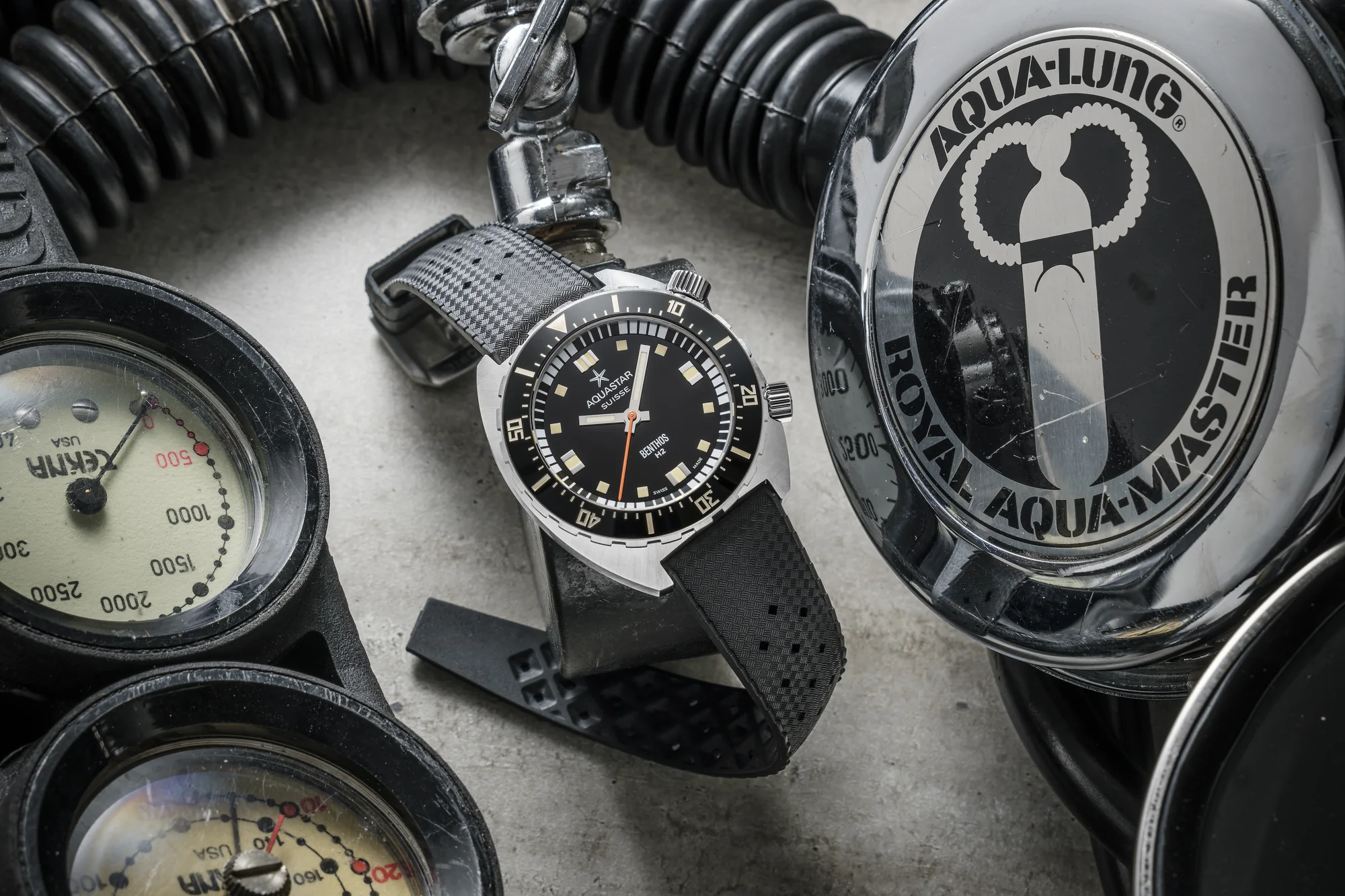
So, what is a dive watch? It’s a purpose-built instrument engineered to withstand underwater pressure, maintain legibility in low-visibility conditions, and help divers track elapsed time safely, a very different engineering standard from a watch that is merely water-resistant. This article covers what qualifies a watch as a true dive watch, why those specifications exist, and how to choose one that fits your needs.

What Is a Dive Watch? A Complete Guide - what is a dive watch

What Is a Dive Watch?

A dive watch is a precision instrument designed specifically for underwater use, built to survive significant water pressure and keep divers informed of elapsed time when visibility is poor, and errors are dangerous. That’s a very different brief than “water-resistant”; a watch rated to 30m can handle rain and splashing, but it’s not engineered for submersion.

A true dive watch must meet ISO 6425 (the international dive watch certification standard) requirements, not just survive incidental moisture. That’s what separates a genuine dive watch from a dive-styled watch wearing the aesthetic without the engineering.

The Key Characteristics of a Dive Watch

Every essential dive watch feature traces back to a specific engineering requirement, not a styling choice. What constitutes a dive watch is specific, not approximate.

Water Resistance: Why 100m Is the Floor, Not the Goal

ISO 6425 requires a minimum of 100m of water resistance, but most professional-grade dive watches reach 200–300m. The certification also requires a 125% depth test, so a watch rated to 200m must survive 250m in controlled testing. That safety margin exists because real-world conditions introduce pressure variables that still water in a lab does not.

The Unidirectional Rotating Bezel: A Safety Mechanism by Design

Understanding the timing bezel’s functionality reveals why it is a safety mechanism, not a design flourish. The bezel rotates only counterclockwise, so any accidental knock extends the displayed time rather than shortening it. An overestimate prompts a diver to surface sooner than planned. An underestimate could prove fatal.

Legibility and Accuracy Standards That Matter in the Dark

As watch expert and author Jason Heaton has observed, “The dial and hands should focus on legibility above all else, as a dive watch really only needs a minute hand and a timing bezel to time underwater intervals.” ISO 6425 enforces this through luminosity requirements and mandates accuracy within ±30 seconds per day. The standard also requires resistance to shock, magnetism, and chemical exposure.

Why Timing Matters Underwater: The Safety Function Behind the Watch

The core function of a diver’s watch is decompression safety. When a diver ascends too quickly, dissolved nitrogen forms bubbles in the bloodstream, causing decompression sickness, commonly called “the bends.” Symptoms range from joint pain to paralysis to death. Staying within safe depth-time limits requires knowing precisely how long you have been underwater.

The bezel solves this simply: align it with the minute hand at dive start, then read elapsed time at a glance without calculation. Dive computers now handle much of this automatically. But computers fail, and batteries die.

A mechanical dive watch is a failsafe that requires no power source and no menu navigation. According to the Business of Diving Institute, scuba diving participation in the USA grew at an average annual rate of 1.8% over five years. That means more divers than ever depend on reliable instrumentation.

Dive Watches Above Water: Why Most Owners Never Dive

The majority of dive watch owners never use their dive watch underwater, and the engineering still earns its place on their wrist every day.

The same construction that survives 200m of pressure translates directly to everyday resilience. Scratch-resistant crystals, corrosion-resistant steel cases, and screw-down crowns make a diver’s watch one of the most durable options for daily wear. Luminous dials readable at depth are equally readable in a dim conference room. Watch enthusiasts call this “desk diving,” and the durability advantages are real, not merely aesthetic.

Jacques Cousteau’s legendary diving teams, who trusted Aquastar instruments for professional underwater operations, validated that trust through proven performance under extreme conditions rather than branding. That professional heritage is why dive watch pedigree commands genuine respect among enthusiasts and professionals alike.

So, Is a Dive Watch Right for You?

The right choice depends on how you’ll use it, but the certification threshold applies regardless.

Active scuba divers should prioritize ISO 6425 certification, a 200m-plus depth rating, and mechanical reliability as a backup to their dive computer. Saturation divers should look for a helium escape valve. Casual water sports enthusiasts will find 100–200m sufficient. Everyday wear buyers should focus on build quality, case size, and dial legibility.

Learning to identify genuine dive watches is especially important because some watches use “ISO tested” marketing language without holding actual certification, a meaningful distinction for anyone treating the watch as a safety instrument.

A true dive watch is not a water-resistant watch with a bezel attached. It’s a tested, certified instrument built to professional standards that exist for serious reasons.

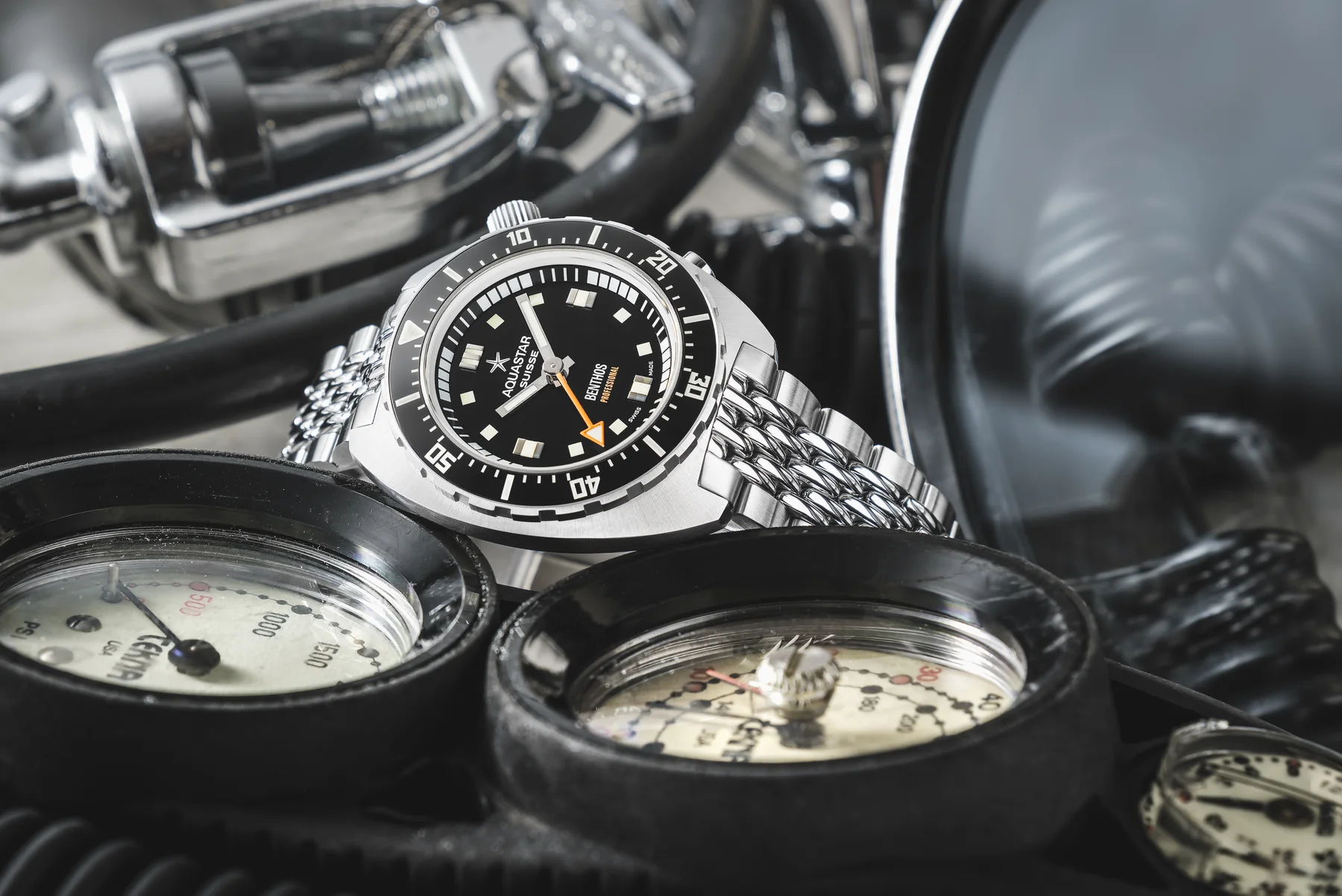
Explore the Aquastar Benthos 500, a certified dive watch with over 60 years of professional heritage behind every component.

Aquastar: The Brand That Invented the Tool Dive Watch

Understanding what a dive watch is requires understanding where the category came from. And that origin traces directly to Aquastar.

Founded in 1962 in Geneva by Frédéric Robert, a watchmaker, scuba diver, and skipper, Aquastar was the first Swiss watch company dedicated entirely to producing professional-grade instruments for diving and other aquatic uses.

Within a decade, the brand had been awarded patents that define how dive watches function to this day:

Our Industry Firsts

InventionWhat It Did
Deepstar, the world’s first dive chronographCalculated multi-dive decompression parameters from the wrist
Navigator, the world’s first analog dive computerCombined a dive watch, depth gauge, compass, thermometer, and decompression table into a single wrist-worn panel

Legends That Wore Our Watches

  • Jacques Cousteau’s crew aboard the Calypso wore Aquastar instruments beginning in 1965
  • Jacques Mayol trusted an Aquastar Benthos 500 for his record-breaking 101-meter free-dive in 1976
  • The French Navy selected the Benthos II for official issue

The Legacy Continues Today

Aquastar’s modern lineup carries forward that same engineering DNA:

  • Swiss-made mechanical movements
  • 316L stainless steel cases
  • Domed triple-coated sapphire crystals
  • Specifications-per-dollar value that competes with brands far more widely known

This is not a revival. Not a homage. It is an authentic continuation of the brand that defined the tool dive watch, 62 years and counting. If you are researching dive watches, you are researching Aquastar’s category.

Browse and shop the Aquastar Watch Collection today!

Posted on

Essential materials for cleaning dive watches: expert guide

Essential materials for cleaning dive watches: expert guide - cleaning dive watches

Cleaning Dive Watches: at a glance

Essential materials for cleaning dive watches: expert guide to brushes, cloths, ultrasonic baths and what NOT to use on your Aquastar watch. Use this guide on cleaning dive watches to weigh design choices, engineering trade-offs and how the category translates to real Aquastar dive watches.

TopicCleaning dive watches
Read time5-8 min
SourceAquastar editorial

Essential materials for cleaning dive watches: expert guide - cleaning dive watches

TL;DR:

  • Using appropriate materials like mild soap, distilled water, and soft brushes is essential for dive watch care.
  • Avoid abrasives, harsh chemicals, hot water, and improper tools to prevent damage to seals and coatings.
  • Proper cleaning protects water resistance, preserves finish quality, and maintains the watch’s value over time.

Choosing the wrong cleaning material for a professional dive watch is not a minor oversight. A single use of an abrasive pad or ammonia-based cleaner can permanently degrade gaskets, strip protective coatings, and compromise water resistance ratings that divers depend on at depth. For collectors and working divers alike, the stakes are real: improper cleaning can void service warranties, accelerate wear on precision finishes, and reduce resale value. This guide covers the exact materials professionals rely on, the substances to avoid at all costs, and a step-by-step process built around the specific demands of high-performance mechanical dive watches.

Table of Contents

Key Takeaways

PointDetails
Know your case materialCleaning needs depend on whether your watch is stainless steel, titanium, or ceramic.
Use only safe materialsMild cleaners and soft tools protect your dive watch’s finish and function.
Avoid abrasives and heatHarsh substances or hot water can quickly cause permanent damage to your watch.
Watch for hidden risksCheck gaskets and seals each time—improper cleaning often causes water resistance failure.

Understanding your dive watch: Case materials and cleaning risks

Before selecting any cleaning product, you need to know exactly what your watch is made of. Dive watch case materials fall into four main categories: stainless steel, titanium, ceramic, and coated alloys. Each one reacts differently to cleaning agents, and what works perfectly on one material can cause irreversible damage to another.

Stainless steel is the most common case material in professional dive watches. It is durable, corrosion-resistant, and tolerates mild soap and water well. However, polished stainless surfaces scratch easily under abrasive contact, and certain household cleaners containing chlorine can cause pitting over time.

Titanium is lighter than steel and highly corrosion-resistant, making it popular for commercial diving applications. It is also more sensitive to chemical cleaners. Acidic substances, even mild ones, can discolor titanium’s surface layer and compromise its anodized finish.

Ceramic cases offer exceptional scratch resistance, but they are brittle. Sharp impacts during cleaning or the use of stiff brushes near ceramic edges can cause chipping. Chemical sensitivity is relatively low, but abrasive compounds will dull the surface permanently.

Coated alloys, including PVD (physical vapor deposition) and DLC (diamond-like carbon) coated cases, are the most delicate of all. The coating layer is thin, and even mild abrasives will wear through it, exposing the base metal underneath.

Matching dive watch case materials with appropriate cleaning substances prevents corrosion or wear, a principle that applies equally to recreational and commercial dive watches.

Case materialCompatible cleanersAvoid
Stainless steelMild soap, distilled waterBleach, chlorine, abrasives
TitaniumMild soap, soft brush onlyAcids, ammonia-based cleaners
CeramicMild soap, microfiber clothAbrasive pads, stiff brushes
Coated alloysDamp microfiber cloth onlyAny abrasive, solvent, or chemical

Key risks to keep in mind:

  • Abrasion strips polished and coated finishes permanently
  • Chemical exposure degrades rubber and silicone gaskets inside the case
  • Heat from hot water accelerates gasket deterioration
  • Pressurized water forces contaminants past seals

With cleaning material risks fresh in mind, let’s explore the actual substances you’ll need.

Essential cleaning materials for professional dive watches

A proper cleaning kit for a professional dive watch is simple, inexpensive, and highly specific. The goal is to remove salt, sediment, and biological residue without introducing any new risk to the case, crystal, or movement.

Here are the expert-approved materials you should have on hand:

  1. Soft-bristled brush: A dedicated watch brush or a soft toothbrush with natural bristles. Use this to work soap into bracelet links, lug grooves, and bezel edges.
  2. Microfiber cloth: Essential for drying and polishing. Lint-free and non-abrasive, it will not scratch polished or coated surfaces.
  3. Mild soap: A pH-neutral, fragrance-free dish soap diluted in water. Avoid anything with moisturizers, bleach, or ammonia.
  4. Distilled water: Tap water contains minerals that leave white spots on polished cases after drying. Distilled water eliminates this problem entirely.
  5. Wooden toothpick: For removing debris from tight spaces like bezel teeth or crown grooves without scratching metal.
  6. Watch caseback tool: Only relevant for deeper inspection, but useful for checking gasket condition during routine maintenance.

Products and techniques to avoid:

  • Abrasive pads or scouring sponges of any kind
  • Household cleaners containing ammonia, bleach, or acetone
  • Ultrasonic cleaning machines, unless the manufacturer explicitly states they are safe for that specific model
  • Paper towels, which contain wood fibers that can scratch fine finishes
  • Compressed air, which can force water or debris past seals

All reputable sources warn against using abrasives or heat, with some disagreement over baking soda for stainless steel specifically. Outside of explicit manufacturer guidance, baking soda should be treated as an abrasive and avoided.

Different dive watch cases and cleaning materials

MaterialStainless steelTitaniumCeramic
Mild soap + waterSafeSafeSafe
Microfiber clothSafeSafeSafe
Soft brushSafeSafeUse gently
Baking sodaCaution onlyNeverNever
Ammonia cleanerNeverNeverNever

Infographic of materials for cleaning dive watches

Pro Tip: Always use distilled water for the final rinse on polished stainless or ceramic cases. The absence of dissolved minerals means no water spots and a cleaner surface after drying.

Knowing how to identify genuine dive watches also helps when assessing which materials are present, since counterfeit watches often use lower-grade alloys that react unpredictably to cleaning agents. Understanding professional diver watch features gives further context for why material integrity matters so much during maintenance.

Armed with your essential supplies, it’s time to move step by step through the cleaning process.

Step-by-step: Safely cleaning your dive watch

A methodical approach protects the watch at every stage. Rushing any step, particularly drying or seal verification, introduces unnecessary risk.

  1. Prepare the watch: Remove the strap or bracelet if possible. Verify that the screw-down crown is fully tightened. This is the most critical step before any contact with water.
  2. Prepare your cleaning solution: Mix a small amount of pH-neutral soap into a bowl of lukewarm distilled water. The water should be at room temperature, never hot.
  3. Brush the case: Dip the soft-bristled brush into the solution and gently scrub the case, lugs, and bracelet links. Use the wooden toothpick to clear debris from bezel teeth and crown grooves.
  4. Clean the crystal: Use a damp microfiber cloth on the crystal. For sapphire crystals, this is sufficient. Avoid pressing hard on the crystal edges where it meets the case.
  5. Rinse thoroughly: Use fresh distilled water to rinse all soap residue from the case. Soap left in crevices can attract more debris and degrade rubber components over time.
  6. Dry carefully: Pat dry with a clean microfiber cloth. Allow the watch to air dry completely in a clean, dust-free environment before reattaching the strap.

Material-specific reminders:

  • Stainless steel: Safe with the full process above; use distilled water for the final rinse
  • Titanium: Skip any brushing on the case body; use cloth only on the case surface
  • Ceramic: Avoid applying lateral pressure with the brush near edges
  • Coated alloys: Use a damp microfiber cloth only; no brushing, no soaking

Manufacturers emphasize avoiding hot water and strong chemicals as these degrade gaskets and seals, potentially compromising water resistance ratings that professional divers rely on.

Understanding the difference between waterproof vs water resistant ratings is directly relevant here: a watch rated to 300 meters can lose that rating if its seals are compromised by improper cleaning. Similarly, timing bezel cleaning requires its own careful approach, since bezel inserts can be made from aluminum, ceramic, or sapphire, each with different tolerances.

Pro Tip: After every saltwater dive, rinse the watch under fresh lukewarm water before any soap cleaning. Salt crystals are abrasive when dry, and rinsing them off first prevents micro-scratches during the brushing stage.

Even the best materials and methods can go wrong if you fall into common traps. Let’s troubleshoot next.

Troubleshooting and avoiding damage: Mistakes to watch for

Even experienced collectors make cleaning errors. The consequences range from cosmetic damage to functional failure, and some are not reversible.

The most common mistakes include:

  • Using abrasive materials: Even a rough cloth or paper towel can leave fine scratches on polished surfaces. On coated cases, a single abrasive pass can expose the base metal.
  • Skipping gasket inspection: Gaskets are the rubber or silicone rings that seal the caseback, crown, and crystal. They degrade over time and must be inspected regularly. Cleaning a watch with compromised gaskets allows water and soap to enter the movement.
  • Cleaning with pressurized water: A kitchen faucet on full pressure or a shower head can force water past even healthy gaskets. Always use a gentle pour or a damp cloth.
  • Soaking the watch: Even water-resistant watches should not be soaked in cleaning solution. Extended exposure to soap can swell or degrade rubber components.
  • Ignoring the crown: The crown is the most common entry point for water and contaminants. Always verify it is fully screwed down before any wet cleaning.

Using the wrong material, even once, can permanently degrade a dive watch’s gaskets and finish, which is why discipline in material selection matters every single time.

Warning signs that something has gone wrong:

  • Fogging or condensation inside the crystal after cleaning
  • Discoloration or cloudiness on the case surface
  • Stiffness or gritty resistance in the crown or bezel rotation
  • Visible scratches or dull patches on previously polished areas

If you notice fogging inside the crystal, stop immediately and take the watch to a certified watchmaker. This indicates water has entered the movement, and continued use will accelerate internal corrosion. For collectors building a serious watch collecting guide approach, knowing when to hand the watch to a professional is as important as knowing how to clean it yourself. Professional tool watch care often requires service intervals every three to five years regardless of cleaning habits, and a watchmaker will replace gaskets and pressure-test the case as part of that process.

Now, let’s step back for a broader view: what do most guides overlook about cleaning materials, and what can only experience teach?

The overlooked truth about cleaning materials and dive watches

Most online guides treat dive watch cleaning as a simple household task. They list mild soap and a soft brush, warn against bleach, and call it done. What they consistently underestimate is the cumulative effect of even minor material choices made repeatedly over years.

Baking soda is a useful example. It appears on many “safe” lists for stainless steel, and in controlled, one-time use it may cause no visible damage. But baking soda is a mild abrasive. Used regularly, it will dull polished surfaces and, more critically, can work into gasket grooves and accelerate seal degradation. The case material nuances that distinguish stainless from titanium from ceramic are exactly why generic web advice fails professional divers and serious collectors.

The lesson is straightforward: err on the side of conservatism. When in doubt, use less. A damp microfiber cloth handles more than most people realize.

Pro Tip: Schedule a caseback inspection every 18 to 24 months and use only manufacturer-approved or certified tools for any deeper cleaning. Branded tools are designed with the specific tolerances of professional watch cases in mind.

Dive deeper: Upgrade your collection and watch care

You now have the expert strategies for protecting your dive watch through precise, material-conscious cleaning. The next step is knowing which watches are worth that level of care and how to build a collection that holds its value over time.

https://aquastar.ch

At Aquastar, we have been engineering professional mechanical dive watches since the 1960s, filing patents that shaped the modern dive watch and building instruments trusted by commercial and recreational divers worldwide. Explore our expert breakdown of the best dive watch brands to make informed purchasing decisions, and use our detailed collect dive watches guide to develop a long-term maintenance and acquisition strategy worthy of serious instruments.

Frequently asked questions

What is the safest cleaning material for a stainless steel dive watch?

The safest method uses mild soap, a soft brush, and distilled water. All reputable sources warn against abrasives or heat on stainless steel, and this approach remains the professional standard.

Can I use baking soda to clean my dive watch?

Baking soda carries contrasting guidance for stainless only, and is a strict no for titanium, ceramic, and coated cases due to its abrasive properties. Manufacturer advice should always take priority.

How often should I clean my professional dive watch?

Clean after every saltwater dive and at least once a month with regular use. Deep cleaning and gasket replacement should align with the manufacturer’s recommended service intervals, typically every three to five years.

What should I avoid to keep the seals and water resistance intact?

Always avoid hot water and strong chemicals as these degrade seals and gaskets. High-pressure water and prolonged soaking carry the same risks and should be avoided entirely.

Posted on

Top vintage Aquastar watches: 3 essential models to collect

Top vintage Aquastar watches: 3 essential models to collect - top vintage aquastar watches

Top Vintage Aquastar Watches: at a glance

Top vintage Aquastar watches: 3 essential models to collect — the Benthos, the Deepstar and the Aquastar Navigator dive computer. Use this guide on top vintage aquastar watches to weigh design choices, engineering trade-offs and how the category translates to real Aquastar dive watches.

TopicTop vintage aquastar watches
Read time5-8 min
SourceAquastar editorial

Top vintage Aquastar watches: 3 essential models to collect - top vintage aquastar watches

TL;DR:

  • Aquastar is renowned for pioneering dive watch innovations like the skin-diver case and 500m depth rating.
  • Key vintage models include the Model 60, Benthos 500, and Regate, each representing different technical achievements.
  • Authenticity relies on original markings, design details, and historical provenance; modern re-editions cannot fully replicate vintage engineering.

For serious collectors, few names carry the same weight as Aquastar when it comes to vintage Swiss dive watches. As the only Swiss watchmaker founded exclusively to produce dive watches, Aquastar built a legacy rooted in genuine underwater innovation, filing patents in the 1960s that shaped the entire category. Identifying the landmark models matters because each one represents a specific technical breakthrough, from the world’s first skin-diver case to the deepest-rated mechanical dive watch of its era. This guide walks through the most significant vintage Aquastar references, the criteria that make them collectible, and a direct comparison to help you decide which belongs in your collection.

Table of Contents

Key Takeaways

PointDetails
Historical leadershipAquastar pioneered key design and technical benchmarks for dive watches in the 1950s–1970s.
Signature modelsThe Model 60, Benthos 500, and Regate are the most collectible, each breaking new ground.
Collector criteriaLook for originality, case details, movement types, and authentic accessories when buying.
Comparison guidanceUse side-by-side technical details to match watches to your collecting style or needs.

How to identify the best vintage Aquastar watches

Not every old dive watch is a collector’s prize. When evaluating vintage Aquastar pieces, experienced collectors apply a consistent set of criteria that goes well beyond surface aesthetics.

  1. Historical importance. The model’s role in advancing dive watch technology matters enormously. Aquastar introduced the world’s first skin-diver case, a development that redefined how professional dive watches were built and worn.
  2. Rarity and production numbers. Lower production runs, especially for professional-grade references, translate directly to collector demand and long-term value.
  3. Mechanical innovation. Look for movements and complications that were genuinely ahead of their time, such as central minute counters designed for dive timing or regatta countdown mechanisms.
  4. Provenance and documentation. Original boxes, papers, and service records add measurable credibility. A watch with a documented history of professional use carries a different kind of weight.
  5. Condition and originality. Unpolished cases, original dials, and period-correct hands are non-negotiable for serious collectors. Refinished cases or replaced bezels significantly reduce value.

Case design is one of the most telling indicators. Early Aquastar models feature case proportions and lug shapes that were purpose-engineered for diving, not adapted from dress watch forms. The bezel type, whether unidirectional or bidirectional, also helps date a reference accurately.

Pro Tip: Examine the caseback engravings carefully. Authentic vintage Aquastar pieces carry specific reference numbers and depth ratings stamped directly into the steel. Modern re-editions exist and are well-made, but the original production markings are distinct and verifiable.

Context also matters. Many Aquastar Model 60 features have been reinterpreted in contemporary releases, which means collectors must know exactly what details are unique to the original production years. Now that you know what makes a vintage Aquastar truly collectible, let’s look at the most significant models.

Aquastar Model 60: The pioneer of skin-diver design

Launched in 1957, the Aquastar Model 60 holds a foundational place in dive watch history. It was the world’s first skin-diver cased watch, a purpose-built professional diver’s case that set the template for an entire generation of Swiss dive watches.

The Model 60’s design language is unmistakable. Key features include:

  • 37mm 316L stainless steel case built to withstand the pressures of active diving
  • Rotating bezel for elapsed-time tracking, available in both unidirectional and bidirectional configurations depending on the reference
  • Signature dial markers with high-contrast indices designed for underwater legibility
  • Proportions specific to skin-diving with a slimmer profile than later deep-dive references

The Model 60 details reveal a case form that was genuinely engineered from the ground up for diving rather than adapted from existing watch architectures. That distinction matters. Most Swiss watchmakers of the era modified existing case designs to meet diver specifications. Aquastar started with the diver’s needs and built outward.

“The Model 60 established the skin-diver case as a professional standard, combining a rotating bezel with a purpose-built case construction that no other Swiss manufacturer had produced before 1957.”

For collectors, the difference between an original vintage Model 60 and a modern re-edition comes down to specific dial printing styles, early lug geometry, and the precise bezel click mechanism. Reviewing detailed Model 60 design documentation helps authenticate period examples. Among other Aquastar models, the Model 60 remains the most historically significant starting point for any collection. With the criteria in mind, the Model 60 stands as the archetype. Next, we’ll see how Aquastar broke records with the Benthos 500.

Collector examining Model 60 Aquastar watch details

Aquastar Benthos 500: The deep-diver legend

Released in 1970, the Aquastar Benthos 500 achieved something no other mechanical dive watch had done before: it reached 500m water resistance in a non-monobloc case construction. That engineering feat remains one of the most impressive achievements in professional dive watch history.

Key specifications and features of the Benthos 500 include:

  • AS 2162 automatic movement with a unique central minute counter optimized for dive timing
  • Non-monobloc construction allowing for greater serviceability compared to sealed-case competitors
  • Screw-down crown and pushers providing the water resistance necessary for saturation diving
  • Bold, high-contrast dial with luminous markers designed for deep-water visibility

The Benthos 500 also carries a remarkable piece of diving history. It was worn by Jacques Mayol, the legendary free-diver whose record-breaking descents inspired the film Le Grand Bleu. That association with one of diving’s most iconic figures adds a layer of provenance that few vintage watches can match.

Pro Tip: Authenticating an original Benthos 500 requires checking the pusher configuration and hand shape. Period-correct examples have a specific crown-and-pusher layout that differs from later variants. The Benthos 500 II features page provides useful reference points, and the Benthos 500 Chronograph shows how the platform evolved over time.

SpecificationModel 60Benthos 500Regate
Case size37mm42mm37.4mm
Water resistance60m500m30m
MovementManual/AutoAS 2162 AutoFelsa 4000N / Lemania 1345
Production era1957 onward1970sMid-1960s to 1970s
Primary functionSkin divingDeep saturation divingRegatta timing

From groundbreaking skin-diver to depth-defying engineering, the Benthos 500 set new records. But Aquastar also made its mark on the water’s surface with the Regate.

Aquastar Regate: The ultimate regatta timer

Produced from the mid-1960s through the 1970s, the Aquastar Regate occupies a unique position in the brand’s catalog. It was not designed for underwater use but for the equally demanding environment of competitive sailing, where precise countdown timing can determine race outcomes.

The Regate’s standout features include:

  • 37.4mm case with a distinctive pusher and crown layout optimized for one-handed operation
  • Felsa 4000N or Lemania 1345 movement depending on the reference, both known for reliability in demanding conditions
  • Regatta countdown windows displaying the critical 5-minute pre-start sequence required by sailing race rules
  • Reference 500141 as the most recognized and sought-after variant among collectors

The Regate’s regatta timing mechanism was a genuine innovation for competitive sailors. The 5-minute countdown window allowed helmsmen to track the pre-start sequence without complex mental calculations, a meaningful advantage in high-pressure racing situations.

“The Aquastar Regate brought the same precision engineering found in Aquastar’s dive watches to competitive sailing, giving professional crews a dedicated timing instrument built to the same standards as their underwater counterparts.”

Collectors are drawn to the Regate for its crossover appeal. It attracts both vintage watch enthusiasts and the sailing community, creating a broader collector base than most single-sport references. The distinctive pusher and crown layout is one of the easiest visual identifiers for authenticating a period example. Having seen Aquastar’s range beyond diving, it’s time to compare these icons directly.

Comparison: Model 60 vs. Benthos 500 vs. Regate

Choosing between these three references comes down to what you value most in a vintage collection. Each model represents a different chapter in Aquastar’s history and appeals to a distinct type of collector.

FeatureModel 60Benthos 500Regate
Collector appealHistorical firstTechnical achievementCrossover rarity
WearabilityVersatile daily sizeBold sport presenceSlim, elegant
RarityModerateHighHigh
ComplicationRotating bezelCentral minute counterCountdown windows
Best forHistory-focused collectorsTechnical/professional diving fansSailing and watch crossover collectors

The Benthos 500’s 500m depth rating was the best-in-class for any non-monobloc mechanical dive watch when it launched, a record that underscores why it commands strong collector interest today.

For collectors building a focused dive watch collection, the Model 60 is the essential starting point because of its foundational role in the category. Those drawn to extreme engineering and professional diving heritage will prioritize the Benthos 500. Collectors who want something genuinely different, a Swiss precision instrument that bridges sailing and horology, will find the Regate irreplaceable. With the core models compared, it’s time to reflect on what this all means for collectors today.

Why vintage Aquastar still sets the standard

There is a tendency among newer collectors to treat vintage re-editions as equivalent to original production pieces. That assumption deserves scrutiny. Modern Aquastar re-editions are well-executed and honor the original designs, but they cannot replicate the historical context or the specific technical decisions made under the constraints of their era.

The uncomfortable truth is that most collectors underestimate case construction. The engineering required to achieve 500m water resistance in a non-monobloc case in 1970 was not a cosmetic achievement. It required solving real mechanical problems with the materials and tolerances available at the time. That problem-solving is baked into every original Benthos 500 in a way that a modern re-edition, however faithful, simply cannot reproduce.

Aquastar’s legacy designs also reveal how interconnected the brand’s innovations were. The skin-diver case, the deep-dive engineering, and the regatta timer were not isolated products. They were expressions of a single design philosophy: build the most capable instrument for the specific demands of the user.

Always trace provenance and understand the evolution of each model before purchasing. A well-documented example with original components tells a richer story and holds its value far more reliably than a cosmetically perfect piece with an unclear history.

Explore Aquastar’s legacy and collector resources

If you want to go deeper into Aquastar’s history and build a more informed collection, the resources available through Aquastar’s official channels are genuinely useful. Whether you are authenticating a potential purchase or simply learning the category, starting with authoritative sources saves time and prevents costly mistakes.

https://aquastar.ch

Aquastar’s collector’s guide covers the fundamentals of evaluating and acquiring vintage pieces, while the dedicated page on what is a skin diver provides essential context for understanding why the Model 60 matters. For a broader view of the brand’s range across eras, the full Aquastar model lineup is the most complete reference available. These are your next steps toward building a collection grounded in real knowledge.

Frequently asked questions

How can I tell if an Aquastar watch is a true vintage model?

Check for unique case markings, movement references, and period-correct features like bezel style and hand shape tied to production years. Authentic vintage pieces carry specific rotating bezel configurations and caseback engravings that differ clearly from modern re-editions.

What makes the Benthos 500 special among diver watches?

It was the world’s first non-monobloc 500m mechanical dive watch, combining extreme depth resistance with a serviceable case construction that set it apart from sealed-case competitors of the same era.

Are Aquastar Regate watches practical for daily use or just sailing?

Vintage Regate models are primarily designed for regatta countdown timing but are entirely wearable daily by enthusiasts who appreciate their slim profile and crossover heritage.

How do vintage Aquastar watches compare to other Swiss dive watches?

Aquastar pioneered both the skin-diver case and deep-dive mechanical engineering before most mainstream Swiss brands addressed those challenges, giving their vintage references a technical and historical edge that is difficult to match.

Posted on

Essential guide to insuring luxury and dive watches

Essential guide to insuring luxury and dive watches - dive watches

Dive Watches: at a glance

Learn how to insure your luxury or dive watch with the right coverage, documents, and steps to protect your high-value timepiece from loss or damage. Use this guide on dive watches to weigh design choices, engineering trade-offs and how the category translates to real Aquastar dive watches.

TopicDive watches
Read time5-8 min
SourceAquastar editorial

Essential guide to insuring luxury and dive watches - dive watches

TL;DR:

  • Luxury watch insurance offers full, agreed, or replacement value coverage, unlike standard policies.
  • Proper documentation and appraisals are essential before applying for specialized watch coverage.
  • Active policy management and timely claims process protect both financial and sentimental value.

Imagine surfacing from a dive in the Coral Sea, reaching for your wrist, and finding your prized professional timepiece gone. Or picture opening your travel case to discover your collector-grade mechanical watch cracked beyond repair. For owners of high-value timepieces, these scenarios represent a financial and emotional loss that standard insurance rarely addresses. Luxury and dive watches occupy a unique category in the world of personal property, and securing the right coverage requires specific knowledge, precise documentation, and a clear understanding of how specialty insurers operate. This guide walks you through every step.

Table of Contents

Key Takeaways

PointDetails
Specialized insurance is crucialStandard homeowners policies rarely protect luxury watches adequately; specialty insurance secures true value and peace of mind.
Proper documentation mattersKeep all receipts, appraisals, and authenticity records safe for easy application and smooth future claims.
Step-by-step processFollow clear steps to research providers, prepare documents, and maintain your coverage for ongoing security.
Policy updates are essentialUpdate appraisals and documentation regularly to avoid gaps in protection if market values rise.

Understanding luxury watch insurance and why it matters

Luxury watch insurance is a specialized form of personal property coverage designed to protect high-value timepieces against risks that standard policies routinely exclude or underpay. Unlike a general homeowners or renters policy, a dedicated watch insurance plan accounts for the true market or agreed value of your watch, not a depreciated replacement figure that leaves you short.

Standard coverage for luxury watches often limits payouts for jewelry and watches to a sublimit of $1,500 to $5,000, regardless of what your timepiece is actually worth. For a professional dive watch or a vintage Swiss mechanical piece valued at $15,000 or more, that gap is significant. Standard homeowners insurance often limits coverage for luxury items or excludes them without scheduled additions, which is why specialty coverage exists.

Infographic on luxury and dive watch insurance essentials

Three terms define how specialty watch policies work. Agreed value means you and the insurer agree on a fixed payout amount upfront, with no depreciation applied at claim time. Replacement value means the insurer pays the cost to replace the watch with a comparable model at current market prices. A scheduled item is a specific watch listed by name, serial number, and appraised value on your policy, giving it its own coverage limits separate from your general property.

Understanding what defines a tool watch matters here, because professional dive watches often carry both collector and functional value, and insurers treat them differently depending on their classification.

Scenarios typically covered by specialty watch insurance include:

  • Theft, including from hotel rooms and vehicles
  • Accidental damage, such as impact, scratching, or water ingress beyond rated depth
  • Mysterious disappearance or loss
  • Damage during travel or transit
  • Partial loss, such as a broken crystal or damaged crown
FeatureStandard homeowners policySpecialty watch insurance
Coverage limit$1,500 to $5,000 sublimitFull appraised or agreed value
Depreciation appliedYesNo (agreed or replacement value)
Worldwide coverageRarelyCommonly included
Accidental lossUsually excludedOften covered
Scheduled itemsOptional add-onCore feature
Claims processGeneral property adjusterWatch-specialist adjuster

“A watch is not just a timekeeping instrument. It is a documented asset, and treating it as such from an insurance standpoint is the most responsible approach an owner can take.”

Proper insurance preserves both the financial and sentimental value of your collection, ensuring that a single incident does not erase years of careful acquisition.

What you need before applying: Documents and requirements

Once you grasp the why and what of insuring your timepiece, the next step is gathering the proper paperwork to make your application seamless. Insurers need to verify authenticity, establish current value, and confirm ownership before they extend coverage. Arriving prepared accelerates the process considerably.

Most insurers require proof of authenticity, recent appraisals, and clear documentation before activating a policy. The specific documents vary by watch type and region, but the core requirements are consistent across the USA, Canada, UK, and Australia.

Standard documents required for watch insurance applications:

  • Original purchase receipt or invoice showing price and retailer
  • Certificate of authenticity or manufacturer warranty card
  • Reference card or model specification sheet
  • Recent professional appraisal (typically within the last two years)
  • High-resolution photographs showing all angles, serial number, and case back
  • Serial number record, often stamped between the lugs or on the case back

For identifying genuine dive watches, serial numbers and manufacturer stamps are critical reference points that insurers use to verify the watch is what the owner claims it to be.

Woman checking serial number on dive watch

RequirementNew watchVintage or pre-owned watch
Purchase receiptRequiredHelpful but not always available
Manufacturer warranty cardStandardRarely available; service records substitute
Professional appraisalRecommendedRequired
Provenance documentationOptionalStrongly recommended
Service historyNot applicableImportant for valuation
PhotosRequiredRequired, with condition notes

Regional differences exist. In the USA, insurers commonly accept dealer appraisals from certified gemologists or horologists. In the UK and Australia, Lloyd’s-affiliated underwriters may request independent appraisals from accredited valuers. Canadian insurers often align with US standards but may require bilingual documentation in Quebec.

For collecting dive watches at a serious level, maintaining a dedicated watch portfolio with all documentation organized by reference number is a practice that pays dividends at claim time. Warranty and paperwork details for newer models are available directly from manufacturers and should be retained from the moment of purchase.

Pro Tip: Store both physical and digital copies of all watch documentation. Use a cloud-based service with strong encryption for digital backups, and keep physical copies in a fireproof safe. If your home is burglarized or damaged, you will still have everything needed to file a claim promptly.

How to get your luxury watch insured: Step-by-step

Armed with your documents, here’s how to navigate the insurance process from start to finish. The process is straightforward when approached methodically, and choosing the right insurer from the outset saves time and potential frustration later.

Specialist insurers often offer superior coverage for high-value watches compared to mainstream providers, including broader accidental loss provisions and watch-specific claims adjusters who understand horological value.

Step-by-step guide to insuring your luxury watch:

  1. Research insurers. Compare mainstream insurers offering scheduled item riders, jewelry specialists, and dedicated watch insurance providers. Look for worldwide coverage, agreed value policies, and a track record with high-value claims.
  2. Prepare your documents. Gather receipts, appraisals, photos, and serial number records before contacting any insurer. Incomplete applications delay coverage.
  3. Request quotes from at least three providers. Premiums vary significantly. Provide identical information to each insurer for a fair comparison.
  4. Submit photographs and appraisal. Most insurers require high-resolution images and a signed appraisal from a certified horologist or jeweler. Some accept dealer documentation for recently purchased watches.
  5. Review the policy terms carefully. Confirm coverage for accidental loss, worldwide protection, and the valuation method (agreed vs. replacement value).
  6. Activate your policy and confirm the scheduled item listing. Request written confirmation that your specific watch, by serial number and reference, is listed on the policy.

For watches with professional dive watch features such as helium escape valves, sapphire crystals, or integrated depth gauges, ensure the insurer understands the replacement cost of these specialized components, as they affect total repair or replacement value.

Common mistakes include undervaluing the watch to reduce premiums, skipping detailed photographs, and failing to disclose previous damage or repairs. These errors can result in partial payouts or denied claims.

Pro Tip: Whenever your watch undergoes servicing, modification, or significant repair, notify your insurer and update your appraisal. A watch that has been polished, fitted with a new movement, or upgraded with aftermarket components may have a different insured value than its original configuration.

Maintaining your policy and making a claim

Securing insurance is just the start. Staying protected and getting maximum peace of mind post-purchase requires active management of your policy and a clear understanding of the claims process before you ever need it.

Keeping your appraisals updated and records organized greatly expedites claims processing, and this is a discipline that separates collectors who recover smoothly from those who face prolonged disputes.

Policy maintenance involves annual reviews of your watch’s current market value, particularly for models where secondary market prices have risen. Notify your insurer of any changes to your collection, including new acquisitions, sales, or watches placed in long-term storage. Some policies require you to report changes within 30 days to maintain full coverage.

Steps to follow when making a claim:

  • Contact your insurer immediately after discovering the loss or damage
  • File a police report for theft or mysterious disappearance, as most insurers require this
  • Gather all documentation: photos, appraisal, purchase receipt, and serial number records
  • Submit a written claim with a detailed account of the incident and timeline
  • Cooperate with the insurer’s adjuster and provide any additional evidence requested
  • Retain any damaged components or packaging, as these may be required for assessment

Common mistakes that slow payouts include delayed reporting, incomplete documentation, and inconsistencies between the claim account and original policy records. The warranty vs. insurance differences are worth understanding clearly, because a manufacturer warranty covers defects, not loss or accidental damage, and confusing the two leads to costly assumptions.

“Prompt reporting and organized records are the two factors most within an owner’s control that directly determine how quickly and fully a claim is resolved.”

Periodic appraisals, ideally every two to three years, ensure your coverage keeps pace with market fluctuations. The secondary market for quality mechanical watches has shown consistent value appreciation, and an outdated appraisal can leave you underinsured at the worst possible moment.

Why luxury watch insurance matters more than you think

Most guides focus on the mechanics of coverage, and that information is essential. But there is a dimension of luxury watch ownership that insurance protects beyond the financial: the continuity of a collection’s story.

A professional dive watch worn on a record-setting dive, a timepiece passed from a parent to a child, a reference acquired after years of searching, these are not simply assets. They are milestones. Uninsured loss does not just erase dollars. It erases documented history that cannot be replicated at any price.

Insurance also changes how you engage with your collection. A properly insured watch can be worn confidently on a dive, carried through an airport, or shared with a fellow enthusiast without the anxiety that turns collecting into hoarding. The goal of watch collecting wisdom has always been informed, active engagement with exceptional instruments, not locking them in a drawer.

Yearly policy reviews and a careful reading of the fine print are not administrative chores. They are the discipline that ensures your coverage actually performs when it matters. The collectors who treat insurance as seriously as authentication are the ones who never face a gap between what they lost and what they recover.

Protect your luxury watches with expert guidance

At Aquastar, we have spent decades building professional dive watches that collectors and working divers trust with their safety and their investments. That same commitment to reliability extends to how we support our community of owners.

https://aquastar.ch

Whether you are building your first serious collection or adding a professional-grade timepiece to an established portfolio, our resources are built to help you make informed decisions at every stage. Explore our dive watch collecting guide for acquisition strategy, review our tool watch guide to understand what separates a true instrument from a fashion piece, and use our genuine dive watch identification resource to protect yourself from misrepresented pieces before you invest.

Frequently asked questions

Does luxury watch insurance cover accidental damage?

Specialty watch policies may cover a wider range of accidents than typical policies, but always review the fine print to confirm specific inclusions such as impact damage, scratched crystals, or water ingress.

How much does luxury watch insurance typically cost?

Premiums generally range from 1% to 2% of the insured watch’s appraised value annually, though rates vary by provider, region, and the specific risks covered.

Can vintage or pre-owned watches be insured?

Both new and vintage timepieces are eligible for coverage, but vintage watches typically require additional documentation such as service records, provenance history, and an independent expert appraisal.

Will insurance cover my watch while traveling abroad?

Many luxury watch insurance policies offer worldwide coverage, but confirm this feature explicitly before purchasing, as some policies restrict geographic coverage or require endorsements for international travel.

Do I need a new appraisal each year?

Regular appraisals help keep your policy accurate and claims smooth, and updating every two to three years is the recommended standard to ensure your coverage reflects current market values.

Posted on

Dial lume in dive watches: essential guide for collectors

Dial lume in dive watches: essential guide for collectors - dial lume

Dial Lume: at a glance

Learn what dial lume is, how it works, and why it matters for dive watch collectors. Compare lume types, history, and innovations in this expert guide. Use this guide on dial lume to weigh design choices, engineering trade-offs and how the category translates to real Aquastar dive watches.

TopicDial lume
Read time5-8 min
SourceAquastar editorial

Dial lume in dive watches: essential guide for collectors - dial lume

TL;DR:

  • Dial lume enhances watch legibility in darkness, crucial for divers and collectors alike.
  • Modern luminous compounds like Super-LumiNova glow brightly for hours after charging using photoluminescence.
  • Lume quality, type, and aging behavior reflect a watch’s craftsmanship and historical authenticity.

Not every glowing watch dial is built the same, and for divers, that distinction is not cosmetic. Dial lume, the luminescent material applied to a watch’s dial, hands, and indices, exists for one critical reason: legibility when your life may depend on a quick time check at depth. Yet the subject runs far deeper than a simple glow. From the chemistry of strontium aluminate to the collector premium on original factory lume, understanding dial lume separates a knowledgeable enthusiast from someone who simply owns a watch that glows. This guide covers what dial lume is, how it works, the key types, its historical evolution, and why it continues to define serious dive watch collecting.

Table of Contents

Key Takeaways

PointDetails
Dial lume basicsDial lume lets you read your watch easily in the dark by glowing after exposure to light.
Technology typesPhotoluminescent and radioluminescent lumes have different strengths—know which fits your needs.
Importance for collectorsLume quality, originality, and color influence collectibility and value.
Innovations matterFrom WWII to modern ceramics, lume technology keeps evolving for better legibility and design.

What is dial lume and why does it matter?

At its most functional level, dial lume refers to luminescent material applied to the dial, hands, markers, and indices of a watch to enable readability in low-light or dark conditions, which is particularly crucial for dive watches. That definition sounds straightforward, but the implications are significant for anyone who takes diving or horology seriously.

The original purpose was purely operational. Military personnel, commercial divers, and naval crews needed to read time and elapsed duration in complete darkness, whether inside a submarine, underwater at night, or in the chaos of combat. A watch that could not be read in the dark was not a tool at all. Lume solved that problem, and its presence on a dial became a baseline requirement for any instrument-grade timepiece.

Today, the function remains essential for working divers, but the collector dimension has grown equally important. Lume quality, application consistency, and aging characteristics all contribute to a watch’s perceived craftsmanship and authenticity. A poorly applied lume plot, uneven thickness, or inconsistent color across indices signals mass-market shortcuts. Conversely, a dial with perfectly uniform, richly applied lume signals precision manufacturing.

Several factors define lume quality on a dial:

  • Compound type: Strontium aluminate (Super-LumiNova) versus zinc sulfide versus tritium gas tubes
  • Application thickness: Thicker plots charge faster and glow longer
  • Consistency: Even application across all indices and hands
  • Color grade: C1 through C9 grades in Super-LumiNova, each with different brightness and hue
  • Aging characteristics: How the lume patinas over decades without cracking or discoloring unevenly

“A dive watch without reliable lume is not a dive watch. It is a fashion accessory with a water resistance rating.”

For collectors, understanding diver watch features starts with recognizing that lume is not decoration. It is a performance specification, and it should be evaluated with the same rigor as water resistance or bezel accuracy.

How does dial lume work? The science behind the glow

Understanding what dial lume is leads directly to the fascinating science behind its glowing performance. The mechanism differs depending on the compound, but modern watches rely almost entirely on photoluminescence.

Scientist examining dive watch lume performance

Photoluminescent lume absorbs light energy, exciting electrons within strontium aluminate or zinc sulfide pigments. Those excited electrons release stored energy as visible light, typically green or blue, over several hours after a charging period of 10 to 30 minutes. Peak brightness occurs in the first 30 to 60 minutes, with usable light lasting 8 to 10 hours under good charging conditions.

The process works in four stages:

  1. Charging: Expose the dial to UV or visible light for 10 to 30 minutes
  2. Peak glow: Maximum brightness in the first 30 to 60 minutes post-charge
  3. Gradual fade: Brightness decreases steadily over several hours
  4. Residual glow: Low-level visibility can persist up to 10 hours

Radioluminescent lume, most commonly tritium gas tubes, works differently. Tritium undergoes radioactive decay, and that decay energy excites a phosphor coating inside sealed glass tubes, producing a constant, self-powered glow that requires no external light source. The trade-off is brightness. Tritium glows continuously but at a lower intensity than a freshly charged photoluminescent dial.

CompoundMechanismPeak brightnessDurationRequires charging
Strontium aluminate (Super-LumiNova)PhotoluminescentVery high8 to 10 hoursYes
Zinc sulfidePhotoluminescentModerate2 to 4 hoursYes
Tritium gas tubesRadioluminescentLow to moderate10 to 25 yearsNo

Pro Tip: When identifying genuine dive watches, check lume consistency under UV light. Authentic factory lume glows uniformly. Relumed or counterfeit dials often show uneven patches or mismatched colors under UV exposure.

The choice of compound directly affects a watch’s performance profile. For divers who surface and descend repeatedly, a rechargeable photoluminescent system makes practical sense. For long-duration operations where recharging is impossible, tritium’s constant output offers reliability. Knowing which system a watch uses is essential when evaluating it for either best dive watch brands comparisons or practical use.

Types of dial lume: Photoluminescent vs radioluminescent

The science is fascinating, but all lume is not created equal. Knowing the types helps you make smarter collecting choices.

Infographic comparing dial lume types

Photoluminescent lume, particularly Super-LumiNova, is the preferred standard for modern dive watches because its peak glow is significantly brighter than tritium, making it ideal for short-duration low-light tasks like reading a decompression table at depth. The green C3 grade maximizes human eye sensitivity, which is why it appears on most professional dive watches.

Radioluminescent tritium offers a different value proposition. It glows constantly without any charging requirement, which is useful in prolonged scenarios where no ambient light is available. However, tritium tubes fade over decades and are considerably more expensive to manufacture and regulate due to their radioactive nature.

FactorPhotoluminescent (Super-LumiNova)Radioluminescent (Tritium)
Peak brightnessVery highLow to moderate
Requires chargingYesNo
Duration8 to 10 hours per charge10 to 25 years constant
Environmental impactEco-friendlyRegulated radioactive material
CostLowerHigher
Collector valueDepends on grade and applicationHigh for vintage pieces

When choosing between types, consider these practical factors:

  • Active diving: Photoluminescent is superior for recreational and commercial divers who can charge the dial before a dive
  • Military or extended operations: Tritium’s no-charge reliability has historically made it the choice for special operations timepieces
  • Vintage collecting: Original tritium dials from the 1960s and 1970s carry significant collector value, even as the tubes dim with age
  • Aesthetics: Blue lume grades offer a distinct visual character that some collectors favor, though green remains the functional standard

For collectors evaluating dive watch cases and overall specifications, the lume type is as important as case material or movement caliber. It speaks directly to the watch’s intended purpose and the manufacturer’s technical priorities.

Historical evolution and innovations in dial lume

Knowing the science and types, let’s look at how dial lume transformed through the decades and what innovations define today’s market.

Full-lume dials, where the entire dial surface is coated, originated in World War II German U-boat watches from makers like Stowa, using zinc sulfide with copper as the activator. The goal was purely pragmatic: maximum legibility in the near-total darkness of a submarine interior. Those early full-lume dials were rough by modern standards, but they set the functional template that would evolve over the following decades.

Post-war experimentation brought refinement. Enicar explored full-lume prototypes in the 1970s, and Heuer applied lume heavily on quartz divers in the 1980s. Microbrands in the 2000s and 2010s revived the full-lume aesthetic, combining it with modern Super-LumiNova grades for dramatically improved performance.

Modern innovations have pushed lume well beyond simple dial coating:

  • 3D lume plots: Raised, sculptural lume applications that increase surface area for better charging and a distinctive visual texture
  • Lume-infused ceramics: IWC’s Ceralume technology integrates luminescent material directly into ceramic case and dial components
  • Carbon-composite lume: Bell and Ross’s LM3D approach embeds lume within structural layers
  • Mechanical lume: Panerai’s Elux system uses a mechanical hand-wind mechanism to power electroluminescent panels, eliminating photoluminescent dependency entirely

Pro Tip: If you are considering a vintage full-lume dial piece, examine the lume under magnification. Factory-applied lume from the 1960s and 1970s shows a specific texture and aging pattern that is nearly impossible to replicate convincingly. That original patina is precisely what drives collector premiums on authentic examples.

Reluming vintage dials is technically possible but almost always diminishes collector value. The replacement lume, regardless of quality, lacks the period-correct compound, application method, and natural aging that authenticate an original dial. For luxury dial innovations, modern watchmakers continue exploring the intersection of luminescence and high-end materials, but the foundational principles established in those wartime German workshops remain the reference point.

A collector’s perspective: Why dial lume is more than a glow

Most discussions of dial lume stop at brightness comparisons and compound chemistry. That is useful, but it misses what experienced collectors actually look for when they examine a dial under a loupe.

Factory lume quality is one of the most reliable markers of overall watchmaking standards. A manufacturer that applies lume with precision and consistency is almost certainly applying the same discipline to movement finishing, case tolerances, and gasket specifications. Lume is visible evidence of invisible craftsmanship.

The color and patina of aged lume also carry historical information. Original zinc sulfide lume from the 1960s develops a characteristic cream-to-brown aging, often called “tropical” patina in collector circles. That aging is not degradation. It is documentation. It tells you the watch lived in a specific environment, was used by a real person, and survived decades without being tampered with.

Full-lume dials, despite their practical trade-offs in readability at certain angles, command premiums precisely because they represent a specific moment in watchmaking philosophy: function above all else. For those who want to collect dive watches with genuine historical significance, the lume on a dial is not a detail. It is the story.

Ready to experience the best dial lume?

Dial lume is a defining feature of any serious dive watch, and understanding it changes how you evaluate every piece in a collection. Aquastar has been at the center of dive watch innovation since the 1960s, filing patents that shaped the entire category and building instruments trusted by commercial and recreational divers alike.

https://aquastar.ch

If you want to go further, explore the full breakdown of must-have diver features to see how lume fits within a complete professional specification. You can also compare dive watch brands side by side to understand how lume quality varies across the market. And if you are deciding between movement types, the guide on automatic vs manual dive watches provides the technical context you need to choose with confidence.

Frequently asked questions

What is the difference between dial lume and hand lume?

Lume is applied to dials, hands, and indices for dark legibility. Dial lume specifically refers to the luminescent material on the watch face, while hand lume is the same material applied to the watch hands for coordinated visibility.

How long does dial lume typically glow after charging?

Photoluminescent dial lume peaks in brightness during the first 30 to 60 minutes after charging and remains visible at reduced levels for 8 to 10 hours, depending on the compound grade and application thickness.

Can old or vintage dials be relumed effectively?

Reluming vintage dials is inferior to factory application in both quality and collector value. Original factory lume, even aged, is preferred by serious collectors because it preserves authenticity and historical integrity.

Is green or blue lume better for dive watches?

Green C3 maximizes human eye sensitivity, making it the technically superior choice for dive watch legibility in low-light conditions. Blue lume is valued for aesthetics but is generally less bright under the same charging conditions.

Posted on

Dive timing explained: techniques, safety, and watch innovations

Dive timing explained: techniques, safety, and watch innovations - dive timing

Dive Timing: at a glance

Learn how ascent rates, safety stops, and surface intervals affect diver safety, and how modern dive watch technology supports precise, reliable timing…. Use this guide on dive timing to weigh design choices, engineering trade-offs and how the category translates to real Aquastar dive watches.

TopicDive timing
Read time5-8 min
SourceAquastar editorial

Dive timing explained: techniques, safety, and watch innovations - dive timing

Timing is one of the most safety-critical skills in diving, yet it remains one of the most misunderstood. Many divers assume that ascending quickly is fine as long as they feel no discomfort, or that a safety stop is optional when the dive was shallow. Both assumptions carry real risk. This article covers the science of ascent rates, how decompression works in practice, what modern dive computer algorithms actually do, and how professional dive watches serve as reliable timing backups. Whether you dive recreationally or commercially, understanding these principles will make every dive safer and more deliberate.

Table of Contents

Key Takeaways

PointDetails
Optimal ascent rateSafest ascent rates are 9–10 meters per minute according to latest studies and agency guidelines.
Importance of safety stopsPausing at 5 meters for at least 3 minutes greatly reduces decompression risks.
Algorithm-specific timingDifferent dive computers use distinct models, so timing recommendations may vary between devices.
Watches as timing toolsMechanical dive watches remain reliable and effective when used with proper dive timing strategies.
Critical surface intervalsAllow at least one hour between dives, and even longer after deep/extended dives before flying.

Understanding dive timing: The science behind safety

Dive timing refers to the precise management of how long you stay at depth, how fast you ascend, and how long you rest between dives. It is not a guideline to follow loosely. It is the foundation on which every safe dive is built.

When you breathe compressed air or nitrox underwater, nitrogen dissolves into your blood and tissues under pressure. The longer and deeper you stay, the more nitrogen accumulates. Ascend too fast, and that dissolved nitrogen forms bubbles inside your body, a condition known as decompression sickness (DCS). DCS ranges from joint pain and fatigue to paralysis and, in severe cases, death.

For decades, the U.S. Navy standard ascent rate was 18 meters per minute. That figure was later revised as research showed it was too aggressive for recreational divers. Today, the recommended ascent rate for recreational scuba diving is 9 to 10 meters (30 to 33 feet) per minute maximum. That is a significant change, and one that many divers trained under older standards have not fully internalized.

DAN (Divers Alert Network) research reinforced this shift. 10m/min produces fewer bubbles than the old 18m/min standard, reducing the physiological load on your body. Interestingly, ascending too slowly also carries risk, as it extends your nitrogen exposure time at depth.

Common misconceptions divers hold about ascent speed include:

  • Feeling fine means you ascended safely
  • Shallow dives do not require careful ascent timing
  • Faster ascents are acceptable if you do a safety stop
  • Dive computers will always warn you before DCS risk becomes real
  • Experienced divers can rely on feel rather than timing

Research consistently shows that controlled, metered ascents at 9 to 10 meters per minute significantly reduce venous gas emboli compared to faster rates, even when safety stops are performed.

Using a timing bezel safely gives you a mechanical, battery-independent method to track your ascent and bottom time with precision.

Ascent rates and safety stops: Techniques for safer diving

With those scientific underpinnings clear, let’s make dive timing concrete. Here is how top agencies and experienced divers approach ascent and safety stops.

Different training agencies publish slightly different guidelines, but the consensus is tighter than many divers realize. PADI lists a maximum of 18m/min but recommends 9 to 10m/min as ideal; SSI and CMAS cap at 10m/min; NAUI recommends 9m/min. The practical takeaway: aim for 9 to 10 meters per minute regardless of certification agency.

AgencyMaximum ascent rateRecommended rateSafety stop
PADI18 m/min9-10 m/min3 min at 5m
SSI10 m/min10 m/min3 min at 5m
CMAS10 m/min10 m/min3 min at 5m
NAUI9 m/min9 m/min3 min at 5m

A standard safety stop is 3 minutes at 5 meters (15 to 20 feet). Advanced divers performing deeper profiles may use multiple stops at different depths. Here is a step-by-step approach to timing your ascent correctly:

  1. Note your maximum depth and current bottom time before beginning ascent.
  2. Begin ascending at a controlled rate, targeting 9 to 10 meters per minute.
  3. At 15 meters, pause briefly to check your buoyancy and verify your rate.
  4. At 5 meters, begin your 3-minute safety stop and start your watch or timer.
  5. Ascend the final 5 meters slowly, taking at least 30 seconds.
  6. Log your total ascent time and surface time immediately.

Pro Tip: Without a dive computer, pace your ascent by watching your smallest exhaled bubbles. Rise no faster than those tiny bubbles. This real-world trick has been used by professional divers long before digital computers existed, and it remains a reliable cross-check today.

Skipping safety stops or rushing the final ascent is one of the most common errors recreational divers make. Even on dives within no-decompression limits, the safety stop provides a meaningful buffer. Knowing the must-have diver watch features that support accurate timing can make executing these steps far more consistent.

Dive computer algorithms and timing accuracy

Fundamental rules in mind, next we look at how modern technology, especially dive computers, is reshaping ascents and timing with complex algorithms.

Infographic about dive timing and watch features

Most dive computers today run on one of two major algorithm families: Bühlmann ZHL-16C or RGBM. Understanding the difference matters because it directly affects the no-decompression limits (NDLs) and ascent guidance your computer displays.

The Bühlmann ZHL-16C algorithm models dissolved gas across 16 theoretical tissue compartments, each with different nitrogen absorption and elimination rates. Users can adjust conservatism through gradient factors (GF), making it highly customizable for technical divers. RGBM (Reduced Gradient Bubble Model), used by Suunto and others, adds a bubble formation layer on top of dissolved gas modeling and automatically increases conservatism after rule violations.

The RGBM model adds conservatism when a diver ascends too fast or exceeds NDLs, while Bühlmann with gradient factors gives the diver more control but also more responsibility. Neither model is universally superior. Context, dive profile, and diver experience all determine which approach is more appropriate.

AlgorithmModel typeConservatism controlBest suited for
Bühlmann ZHL-16CDissolved gasUser-adjustable (GF)Technical divers
RGBMBubble + dissolvedAutomaticRecreational divers

What most divers get wrong about computer timing:

  • Assuming the computer’s NDL is a target, not a ceiling
  • Ignoring micro-bubble warnings as non-critical
  • Switching computers mid-trip without resetting nitrogen loading
  • Trusting a single algorithm without understanding its conservatism settings
  • Forgetting that computers calculate for average conditions, not your personal physiology

When choosing a timing device, consider whether you prefer user-adjustable conservatism or automated protection. Exploring the differences between automatic vs manual dive watches is also worthwhile, since mechanical watches remain a critical backup regardless of which computer algorithm you rely on.

Timing dives with watches: Features, advances, and pro strategies

With the tech landscape covered, it’s time to focus on hands-on timing strategies using dive watches and tactical tips drawn from professionals.

Dive watch tracking safety stop interval

A professional dive watch must deliver legibility, durability, and precise elapsed-time tracking under pressure. The core features that matter for timing accuracy include a unidirectional rotating bezel with clear minute markings, high-contrast lume on hands and indices, a screw-down crown, and a case rated to at least 200 meters. These are not aesthetic choices. They are functional requirements.

Practical ways real divers use their watches to manage timing:

  • Setting the bezel at dive entry to track total bottom time independently of the computer
  • Using elapsed time to cross-check the computer’s logged dive duration
  • Tracking safety stop duration at 5 meters when the computer’s display is hard to read
  • Monitoring surface interval time between dives without relying on a phone or tablet
  • Serving as the primary timing instrument when the dive computer fails or floods

Pro Tip: For buddy planning, synchronize your watches before the dive and agree on a turn-around time based on the rule of thirds for air. One third of your supply for the descent and bottom time, one third for the return, and one third held in reserve. This strategy, drawn from deep diving practice, applies equally well to recreational profiles and removes guesswork from the water.

The debate around deep stops adds another layer. Some technical divers incorporate additional stops at mid-water depths to further reduce bubble formation, though current evidence on their universal benefit is mixed. What is not debated is the value of a reliable mechanical watch as a backup. The Aquastar Navigator, the world’s first analog dive computer, demonstrated in the 1960s that mechanical precision and dive safety are not mutually exclusive. Understanding dive watch case designs helps divers select instruments built for real operational demands.

Surface intervals: The overlooked element of dive timing

Finally, dive timing isn’t just about ascents. Timing your surface intervals is equally crucial for safety and long-term health.

A surface interval is the time spent at the surface between two dives. During this period, your body continues to off-gas nitrogen absorbed during the previous dive. The longer and more thorough the interval, the lower your residual nitrogen loading entering the next dive.

For recreational divers, the minimum surface interval is generally 1 hour. Deep or long dives require 90 minutes or more. Before flying, the recommended wait is 12 to 18 hours after a single dive and longer after repetitive or decompression dives. These are not conservative suggestions. They are evidence-based minimums.

Key statistic: Flying within 12 hours of diving significantly increases DCS risk due to reduced cabin pressure, even if the dive itself was within all no-decompression limits.

Tips for tracking and optimizing your surface interval:

  • Log your exit time immediately upon surfacing, using your watch rather than memory
  • Avoid strenuous activity during the interval, as exercise can accelerate bubble formation
  • Stay hydrated, since dehydration is a recognized DCS risk factor
  • Use your dive computer’s surface interval tracking feature as a primary reference
  • Cross-check the computer’s nitrogen loading display against your planned next dive depth

Modern dive computers track surface intervals automatically and adjust NDLs for the next dive accordingly. A quality mechanical watch, used as described in our tool watch guide, provides a reliable parallel record that does not depend on battery life or software state.

Our perspective: What most divers miss about timing—and how to get it right

After years of working alongside commercial and recreational divers, one pattern stands out clearly. Divers who experience timing-related incidents rarely ignored the rules entirely. More often, they over-relied on a single instrument, trusted their computer without understanding its algorithm, or skipped manual cross-checks because nothing had gone wrong before.

Technology is a powerful aid, but it is not a substitute for understanding. A dive computer running RGBM does not know your hydration level, your fitness, or your stress. It calculates based on a model, not your physiology.

The divers with the strongest safety records treat timing as a layered practice. They know their agency guidelines, understand their computer’s conservatism settings, and carry a mechanical watch as a genuine backup, not a fashion accessory. Reviewing pro-level diver watch features reveals how much functional engineering goes into instruments built for this purpose.

The most reliable timing practice is one that does not depend on any single tool working perfectly.

The next step: Choosing the right dive watch for your timing needs

Precise dive timing and a professionally engineered watch are inseparable for divers who take safety seriously. Understanding ascent rates, safety stops, and surface intervals is only part of the equation. The instrument on your wrist must be equal to the demands of the dive.

https://aquastar.ch

Aquastar’s guides on professional diver watch features and the broader tool watch guide walk you through exactly what separates a reliable timing instrument from a decorative one. For a side-by-side look at leading manufacturers, the best dive watch brands comparison provides a structured reference. Choose based on function, depth rating, and timing precision. Your dive plan deserves nothing less.

Frequently asked questions

What is the safest ascent rate for recreational diving?

The safest ascent rate for recreational diving is 9 to 10 meters per minute (30 to 33 feet per minute) maximum, a standard now endorsed by all major training agencies.

How do I calculate my ascent time without a dive computer?

You can count 6 seconds per meter as a manual pacing method, while also watching that you rise no faster than your smallest exhaled bubbles as a real-time check.

What are safety stops and why are they important?

Safety stops are 3-minute pauses at 5 meters during ascent that allow dissolved nitrogen to leave your tissues gradually, reducing decompression sickness risk before you reach the surface.

Why are surface intervals important?

Surface intervals allow your body to eliminate residual nitrogen, and minimum intervals of 1 hour for recreational dives (and 12 to 18 hours before flying) are critical minimums to prevent decompression sickness on repetitive dives or during air travel.

Posted on

Waterproof vs water resistant watches: what collectors need to know

Waterproof vs water resistant watches: what collectors need to know - waterproof vs water resistant watches

Waterproof Vs Water Resistant Watches: at a glance

Waterproof vs water resistant watches: what collectors need to know about ratings, ISO 6425, depth markings and what your watch actually survives. Use this guide on waterproof vs water resistant watches to weigh design choices, engineering trade-offs and how the category translates to real Aquastar dive watches.

TopicWaterproof vs water resistant watches
Read time5-8 min
SourceAquastar editorial

Waterproof vs water resistant watches: what collectors need to know - waterproof vs water resistant watches

The words “waterproof” and “water resistant” appear on watch dials, spec sheets, and vintage advertisements with equal confidence, yet they carry fundamentally different meanings. For collectors and enthusiasts, treating them as interchangeable is not just a semantic error; it is a practical risk that can result in damaged movements, voided warranties, and ruined pieces. Understanding the distinction matters whether you are acquiring a vintage skindiver, a modern professional dive watch, or anything in between. This article covers the regulatory history behind both terms, how resistance ratings are measured and applied, a direct comparison of the two standards, and a practical framework for matching any watch to its intended environment.

Table of Contents

Key Takeaways

PointDetails
No true waterproof watchesThe term ‘waterproof’ is banned and misleading; only ‘water resistant’ is recognized in modern standards.
Lab ratings vs real useATM or meter ratings are tested in labs and may not reflect actual use during swimming or diving.
Select for your activityChoose your watch’s water resistance level based on your real-world activities, not just terminology.
Regular maintenance mattersRoutine servicing and seal checks are vital for preserving water resistance in any watch.

What does ‘waterproof’ really mean?

The short answer is that no modern watch is truly waterproof. The Federal Trade Commission banned the term in the 1960s after it became clear that the label created unrealistic expectations among consumers. Watches marketed as “waterproof” were regularly returned with water damage, and the gap between the claim and reality was impossible to close. Today, “waterproof” is banned in modern watch marketing, and reputable brands use “water resistant” instead.

The problem with “waterproof” was never just legal. It was psychological. Owners who saw that word on a dial assumed total protection under any condition, at any depth, for any duration. That assumption led to watches being worn during deep dives, high-pressure showers, and water sports far beyond any tested limit. The result was predictable.

“No watch can be guaranteed impervious to water under all conditions. Water resistance is always a matter of degree, not an absolute state.”

Vintage advertisements and original packaging from the 1950s and 1960s still use the term freely, which creates a specific hazard for new collectors. A piece described as “waterproof” in its original catalog does not meet any modern standard. The seals have aged, the gaskets have compressed, and the rating, whatever it once was, no longer applies. Collectors exploring spotting genuine dive watches quickly learn that original labeling is a historical artifact, not a functional guarantee.

High-end watchmakers now submit their pieces to standardized ISO testing protocols, which produce documented, reproducible resistance ratings. Those ratings are expressed in meters, ATM (atmospheres), or Bar, and each comes with specific test conditions. The shift from “waterproof” to “water resistant” was not just a regulatory compliance exercise. It was a move toward precision and honesty that serious collectors should appreciate.

Key reasons “waterproof” became obsolete in professional watchmaking:

  • No universal test existed to verify the claim
  • Seals degrade over time, making any permanent claim impossible
  • Dynamic water pressure during movement always exceeds static depth ratings
  • Consumer protection law required verifiable, testable standards
  • ISO 6425 established a rigorous benchmark that replaced subjective claims

How water resistance is measured

After dispelling the myth of “waterproof,” it is essential to understand how water resistance is properly defined and measured. The three units you will encounter are meters (m), ATM (atmospheres), and Bar. One ATM equals one Bar and roughly equals 10 meters of static water depth. These units are often used interchangeably on spec sheets, though meters remain the most intuitive reference for divers.

The critical word in that definition is static. Ratings measure static lab pressure, but real-world dynamic pressure from movement often exceeds the stated figure. A watch rated to 100m does not automatically survive the impact of a cannonball dive into a pool, because the instantaneous pressure spike at water entry can far exceed what the rating covers.

ActivityMinimum recommended rating
Handwashing, rain exposure30m / 3ATM
Swimming, snorkeling100m / 10ATM
Recreational scuba diving200m / 20ATM
Professional or saturation diving300m+ / 30ATM+

Think of the rating as a laboratory maximum, not a real-world ceiling. The test is conducted at room temperature with still water and controlled pressure application. Your wrist is not a laboratory.

The numbered steps below describe how a standard ISO 6425 pressure test works:

  1. The watch is placed in a pressure chamber filled with water
  2. Pressure is raised to 125% of the stated rating and held for a defined period
  3. The watch is inspected for any moisture ingress inside the crystal
  4. A condensation test is performed by placing the watch on a heated surface and applying a cold water drop to the crystal
  5. A passing result confirms the watch meets its stated resistance at the time of testing

For collectors investing in dive watch case construction, understanding the role of screw-down crowns, case back gaskets, and crystal seals is essential. Each is a potential point of failure.

Dive watch gaskets and components close-up

Pro Tip: Never expose a watch to water when the crown is unscrewed or in a pulled position. Even a 300m-rated professional dive watch will flood immediately if the crown is not fully secured. This is the single most common cause of water damage in high-rated watches, and it is entirely preventable. Watches built for professional diving reliability incorporate screw-down crowns precisely to eliminate this risk.

Waterproof vs water resistant: direct comparison

Now that you know how resistance ratings work, seeing the direct side-by-side differences clears up any lingering confusion. The core issue is that “waterproof” and “water resistant” are not interchangeable; only “water resistant” is regulated, with specific standards governing how the claim is tested and documented.

AttributeWaterproofWater resistant
Regulatory statusBanned in modern marketingRegulated by ISO 6425 and FTC
Testing standardNone (historical claim only)Standardized pressure and condensation tests
Warranty coverageNot applicableCovered under defined conditions
Real-world reliabilityUnknown, unverifiableDocumented to tested rating
Collector riskHigh, especially on vintage piecesLow when rating matches activity

Several practical points follow from this comparison:

  • A watch with a documented 200m water resistance rating is objectively more trustworthy than one labeled “waterproof” with no test data
  • Regulatory standards protect buyers by requiring manufacturers to back their claims with reproducible test results
  • Professional watches, sports watches, and dress watches use different resistance standards because their use cases differ significantly
  • Dress watches rated at 30m are not designed for swimming; professional dive watches rated at 300m+ are engineered for sustained underwater use
  • Collectors evaluating top dive watch brands should prioritize documented ratings over marketing language

The distinction also matters when insuring or reselling a piece. An insurer or buyer can verify a water resistance rating. They cannot verify a “waterproof” claim.

Choosing the right watch for your needs

After understanding what the ratings mean, it is time to apply this knowledge to make smart selections as a watch enthusiast or collector. The most common mistake is selecting a watch based on aesthetics or brand prestige without confirming that the resistance rating matches the intended use.

A 30m/3ATM watch handles splashes, 100m/10ATM suits swimming, and 200m or more is appropriate for diving. These are not arbitrary thresholds. They reflect the actual pressure demands of each activity.

Here is a practical selection sequence:

  1. Define your primary use case before evaluating any watch
  2. Identify the minimum resistance rating required for that activity using the table above
  3. Read the spec sheet carefully, confirming the rating is ISO-tested, not self-declared
  4. Check whether the crown is screw-down or push-pull, as this affects real-world reliability significantly
  5. Confirm the service interval for gasket replacement with the manufacturer or authorized service center
  6. For dive watches, verify the bezel is unidirectional and the crystal is mineral or sapphire

Pro Tip: Annual pressure testing is not optional for any watch used in water. Gaskets degrade with temperature changes, UV exposure, and chemical contact. A watch that passed its factory test three years ago may no longer meet its stated rating today. Collectors who take collecting dive watches seriously schedule pressure checks as part of routine maintenance, not as a response to problems.

For those drawn to purpose-built instruments, military dive watches represent the most demanding end of the specification range, where resistance ratings are tested under conditions that exceed recreational diving by a significant margin.

Common mistakes with water resistance

Equipped with the selection framework, beware of these hazards that even seasoned collectors sometimes overlook. Users often expose watches beyond rated limits, assume vintage “waterproof” means modern reliability, and neglect seals or crown position. Each of these errors is avoidable with the right habits.

The most frequent mistakes include:

  • Wearing a watch in a hot tub or sauna, where heat degrades gaskets far faster than cold water
  • Trusting a vintage “waterproof” label without having the watch pressure tested by a qualified watchmaker
  • Ignoring the crown position before water exposure, which is the leading cause of preventable flooding
  • Skipping service intervals and assuming a watch that passed last year will pass this year
  • Overestimating a rating by confusing static lab pressure with real-world dynamic pressure

“Even a watch rated to 300m can fail if the crown gasket has not been replaced during service. The rating reflects the watch as tested, not as aged.”

Servicing routines that prevent water ingress include replacing all gaskets at every service, pressure testing after any case opening, and avoiding temperature extremes immediately before or after water exposure. A watch moved from a cold environment into warm water experiences rapid thermal expansion that can compromise seals temporarily.

For collectors weighing automatic vs manual dive watches, note that automatic movements with exhibition case backs introduce an additional sealing surface that requires careful attention during service.

Why ‘waterproof vs water resistant’ is the wrong question for collectors

Veteran collectors understand something that newcomers often miss: the label on the dial is the least important factor in a watch’s long-term water performance. What matters is the maintenance history, the condition of the seals, and whether the watch has been used within its rated parameters.

The obsession with finding a “waterproof” watch is a distraction. No such thing exists in modern horology, and chasing the highest ATM rating without a corresponding commitment to regular pressure testing and servicing produces worse outcomes than owning a moderately rated watch that is properly maintained. A 200m watch serviced annually outperforms a 1000m watch with degraded gaskets every time.

The smartest approach is scenario-based selection combined with scheduled maintenance. Define the environment the watch will operate in, match the rating to that environment with appropriate margin, and build a service schedule around the manufacturer’s recommendations. Collectors who apply this framework, rather than focusing on label language, consistently report fewer failures and greater confidence in their pieces. Exploring tool watches through this lens reveals that the best instruments are defined by reliability under specific conditions, not by the most impressive number on the spec sheet.

Explore professional-grade dive watches and learning resources

For collectors and enthusiasts who want to go beyond label reading and understand the engineering behind reliable underwater performance, Aquastar provides both the timepieces and the technical knowledge to make informed decisions.

https://aquastar.ch

Aquastar has been engineering professional dive watches since the 1960s, filing patents that shaped the modern dive watch category and producing the first analog dive computer. The resources available cover everything from must-have diver watch features to a detailed comparison of automatic vs manual dive watches. For those ready to see what purpose-built professional dive watches look like in practice, the full Aquastar dive watch collection is the logical next step.

Frequently asked questions

Can I swim or dive with a watch labeled only as water resistant?

You can swim with a water-resistant watch if it carries at least a 100m/10ATM rating; for recreational diving, only use watches rated 200m or higher to ensure adequate pressure margin.

Why do some old watches say ‘waterproof’ but modern ones do not?

The FTC banned “waterproof” in watch marketing during the 1960s because the claim was unverifiable and misleading; current regulatory standards only recognize “water resistant” with documented test results.

How often should water resistance be tested?

Experts recommend testing at least annually and always after any case opening, battery change, or service, because neglecting pressure tests leads to failures even in high-rated watches.

Does a higher ATM rating always mean better protection?

A higher ATM reflects greater lab-tested resistance, but real-world dynamic pressure can exceed stated ratings, meaning seal condition, crown position, and maintenance history ultimately determine actual performance.

Posted on

Dive Watch Timing Bezels: Safety, Use, and Pro Tips

Dive Watch Timing Bezels: Safety, Use, and Pro Tips - dive watch timing bezels

Dive Watch Timing Bezels: at a glance

Learn how dive watch timing bezels work, their critical safety role, and proper usage techniques. Discover why professional divers rely on mechanical…. Use this guide on dive watch timing bezels to weigh design choices, engineering trade-offs and how the category translates to real Aquastar dive watches.

TopicDive watch timing bezels
Read time5-8 min
SourceAquastar editorial

Dive Watch Timing Bezels: Safety, Use, and Pro Tips - dive watch timing bezels

Most divers believe timing bezels track remaining air supply. This is a dangerous misconception. A timing bezel’s primary function is measuring elapsed time underwater, particularly for decompression and safety stops. Understanding how these mechanical instruments work can mean the difference between a safe ascent and decompression sickness. You’ll learn the true purpose of timing bezels, how to use them correctly during dives, and why professional divers still rely on this mechanical backup even with modern dive computers.

Table of Contents

Key Takeaways

PointDetails
Purpose of timing bezelThe timing bezel helps divers track elapsed time for decompression and safety stops, not air supply.
Backup safety toolTiming bezels remain essential mechanical backups even with modern dive computers.
Proper use mattersAlign the bezel at the start of a dive and check regularly to avoid miscalculations.
Choosing quality materialsSelect bezels made from materials like ceramic or steel for durability during frequent dives.

What is a timing bezel?

A timing bezel is a rotating ring mounted on a dive watch that allows you to monitor elapsed time during underwater activities. Unlike decorative bezels found on dress watches, dive watch bezels serve a critical safety function. The bezel features minute markings around its circumference, typically with the first 15 or 20 minutes highlighted for quick reference during safety stops.

Most professional diver watch features include unidirectional bezels that rotate only counterclockwise. This design prevents accidental bumps from extending your perceived dive time, which could lead to insufficient decompression. If the bezel moves during a dive, it can only reduce the displayed elapsed time, adding a margin of safety rather than risk.

The primary applications of timing bezels include:

  • Decompression stop timing: Monitoring required stops at specific depths based on dive tables
  • Safety stop tracking: Ensuring you complete the recommended 3-5 minute stop at 5 meters
  • Dive stage management: Tracking time spent at various depths during multi-level dives
  • Bottom time calculation: Recording total time spent below the surface

Timing bezels help divers make decompression stops using dive tables by aligning the bezel to depth and time parameters. This mechanical system requires no batteries, displays no error messages, and functions reliably in conditions where electronic devices might fail.

Infographic with dive bezel key safety points

The evolution and mechanics of bezels in dive watches

Timing bezels emerged in the 1950s when recreational diving gained popularity and divers needed reliable tools to manage underwater time. Before dive computers became standard equipment in the 1980s, mechanical timing bezels were the primary method for tracking elapsed time and calculating decompression obligations. Aquastar pioneered several innovations during this era, filing patents that established standards still used in modern dive watches.

The mechanical design of timing bezels incorporates several safety features:

  1. Ratcheting mechanism: Creates distinct clicks (typically 60 or 120 per rotation) that provide tactile feedback, allowing divers to adjust the bezel even with thick gloves
  2. Unidirectional rotation: A spring-loaded pawl engages with internal teeth, permitting only counterclockwise movement
  3. Friction fit: Sufficient resistance prevents accidental rotation while allowing intentional adjustment
  4. Luminous markers: Applied to the zero marker and key intervals for visibility in low-light conditions
EraBezel InnovationSafety Impact
1950sFirst rotating bezelsBasic elapsed time tracking
1960sUnidirectional mechanismsPrevention of time extension errors
1970sImproved ratchet systemsEnhanced tactile feedback
1980sLuminous marker standardsBetter low-visibility operation
2000sCeramic insertsScratch resistance and longevity

Modern dive computers provide comprehensive data including depth, temperature, ascent rate, and nitrogen loading. However, timing bezels offer mechanical backup in case electronic dive computers fail. Battery depletion, water ingress, or electronic malfunction can render a dive computer useless, but a mechanical bezel continues functioning regardless of conditions.

When identifying genuine dive watches, examine the bezel’s construction quality and rotation feel. Professional-grade watches like the Benthos 500 Chronograph feature precisely engineered bezels with consistent click spacing and zero play in the mounting system.

Hands inspecting dive watch bezel on table

How to use a timing bezel during a dive

Operating a timing bezel correctly requires understanding both the mechanism and your dive plan. The process is straightforward but demands attention to detail, particularly when wearing gloves or managing other equipment.

Follow these steps for proper timing bezel operation:

  1. Pre-dive setup: Before entering the water, rotate the bezel so the zero marker aligns with the minute hand of your watch. Some divers prefer aligning with the hour hand for longer dives, but minute hand alignment provides greater precision.

  2. Descent monitoring: As you descend, glance at your watch to confirm the bezel hasn’t shifted. The minute hand’s position relative to the bezel’s markings shows elapsed time since you started your dive.

  3. Bottom time tracking: Throughout your dive, the minute hand moves clockwise while the bezel remains stationary. The bezel marking aligned with the minute hand indicates total elapsed time.

  4. Safety stop timing: When you reach your safety stop depth (typically 5 meters), note the bezel position. Wait until the minute hand advances the required duration, usually 3-5 minutes, before ascending.

  5. Surface interval: After surfacing, you can leave the bezel in position to track surface interval time, or reset it for the next dive.

Pro Tip: Practice bezel operation in a pool or shallow water before relying on it during deeper dives. Familiarize yourself with the click spacing and rotation resistance while wearing your diving gloves, as the tactile experience differs significantly from bare-handed operation.

A common mistake is attempting to use the timing bezel for calculating remaining air supply. Divers use timing bezels for measuring elapsed time, not to estimate air supply. Your pressure gauge or dive computer provides accurate air consumption data. The bezel tracks time only, which you then reference against your dive tables or computer to determine decompression obligations.

When comparing automatic vs manual dive watches, remember that bezel operation remains identical regardless of movement type. The bezel’s mechanical independence from the watch movement ensures it functions even if the watch stops running.

Safety stops, decompression, and what most people get wrong

The relationship between timing bezels and dive safety centers on decompression management. When you breathe compressed air underwater, nitrogen dissolves into your tissues at rates determined by depth and time. Ascending too quickly without proper decompression allows this nitrogen to form bubbles in your bloodstream, causing decompression sickness.

Bezel timing is essential for 3-5 minute safety stops at 5 meters, not for air limit estimation. Even on no-decompression dives, this precautionary stop allows excess nitrogen to off-gas, significantly reducing decompression sickness risk. The timing bezel provides a simple, reliable method for tracking this critical safety interval.

Dive computers have largely replaced manual calculations using dive tables, but they haven’t eliminated the need for timing bezels. Consider these scenarios:

SituationDive ComputerTiming Bezel
Battery dies mid-diveNon-functionalContinues working
Water ingress damageDisplays errorsUnaffected
Accidental mode changeShows incorrect dataMaintains accuracy
Extreme cold conditionsMay freeze or slowMechanical reliability

Pro Tip: Set your timing bezel at the start of your dive even when using a computer. This redundancy costs nothing and provides peace of mind. If your computer fails, you can complete your dive using the bezel and conservative dive table estimates.

The most dangerous misconception about timing bezels is that they indicate when you’ll run out of air. This misunderstanding has led to accidents where divers focused on bezel time rather than monitoring their pressure gauges. Your air consumption rate varies based on depth, exertion level, breathing efficiency, and individual physiology. No timing bezel can account for these variables.

“A timing bezel tracks one thing: elapsed time. It cannot measure air consumption, calculate nitrogen loading, or determine safe ascent rates. These functions require either dive computers or manual calculations using pressure gauges and dive tables. The bezel’s simplicity is its strength, providing reliable time measurement without attempting to replace specialized instruments.”

Understanding professional dive watch features means recognizing that each component serves a specific purpose. The timing bezel handles elapsed time, the pressure gauge monitors air supply, and the depth gauge tracks your position in the water column. Using each tool for its intended function creates a comprehensive safety system.

Choosing and maintaining a reliable timing bezel

Selecting a dive watch with a dependable timing bezel requires evaluating materials, construction quality, and maintenance requirements. The bezel experiences constant exposure to saltwater, sand, and physical impacts, making durability a primary concern.

Material considerations for timing bezels:

  • Stainless steel: Corrosion-resistant, affordable, and easily serviced, though susceptible to scratches that can affect legibility over time
  • Ceramic: Extremely scratch-resistant and colorfast, maintaining appearance for decades, but more expensive and potentially brittle under severe impacts
  • Aluminum: Lightweight and traditional, found on vintage models, but prone to fading and wear
  • Titanium: Combines light weight with excellent corrosion resistance, though specialized tools may be required for servicing

The bezel insert, which carries the minute markings, deserves particular attention. Ceramic bezel inserts resist scratching and maintain legibility even after years of use. Luminous markers should use modern compounds that remain visible throughout a dive without requiring light exposure.

Maintenance practices extend bezel life and ensure reliable operation:

  • Freshwater rinse: After every dive, rinse the watch thoroughly, rotating the bezel under running water to flush out salt, sand, and debris
  • Rotation check: Weekly, rotate the bezel through its full range, feeling for consistent click spacing and smooth movement
  • Alignment verification: Confirm the zero marker aligns precisely with the 12 o’clock position when set
  • Professional servicing: Every 2-3 years, have a watchmaker inspect the bezel mechanism, replace gaskets, and verify water resistance

Sand ingress represents the most common bezel problem. Fine particles work their way between the bezel and case, creating grinding sensations and potentially damaging the ratchet mechanism. If you notice decreased rotation smoothness or inconsistent clicks, seek professional cleaning immediately rather than forcing the bezel.

Mechanical backup through timing bezels remains a best practice for serious divers. Models like the Benthos Professional incorporate bezels engineered to professional standards, with precise tolerances and materials selected for long-term reliability in demanding conditions.

When evaluating bezel quality, test the rotation yourself. A professional-grade bezel should rotate smoothly with consistent resistance throughout its range. Each click should feel distinct and evenly spaced. Excessive play or wobble indicates poor manufacturing tolerances that may worsen with use.

Discover top dive watches with professional-grade timing bezels

Aquastar has pioneered dive watch innovation since the 1960s, when the company filed patents that established standards for modern timing bezels and dive watch construction. As the only Swiss watchmaker founded exclusively to manufacture dive watches, Aquastar understands the critical role timing bezels play in diver safety.

https://aquastar.ch

The brand’s commitment to professional-grade equipment extends beyond historical significance. Today’s Aquastar models incorporate decades of field experience and feedback from commercial and recreational divers who rely on mechanical backups to complement their dive computers. Each timing bezel undergoes rigorous testing to ensure it meets the demands of professional diving environments.

Explore comprehensive resources to understand what separates professional dive watches from recreational models. The diver watch features guide details the specific characteristics that define reliable dive instruments, while the tool watch explained guide provides context for how dive watches fit within the broader category of purpose-built timepieces. For those comparing options across manufacturers, the best dive watch brands analysis offers objective evaluation criteria based on construction quality, heritage, and real-world performance.

Frequently asked questions

Why is the bezel on a dive watch unidirectional?

A unidirectional bezel rotates only counterclockwise, so accidental bumps can only shorten, not extend, elapsed dive time. This design prioritizes safety by ensuring timing errors favor caution rather than risk.

Can a timing bezel replace a dive computer?

A bezel serves as backup rather than replacement. While computers provide more data, bezels offer simple, reliable timing for critical dive stages if electronics fail.

Do all timing bezels use the same materials?

No, materials vary significantly. Ceramic and steel are popular for durability and underwater legibility, while aluminum and titanium offer different advantages in weight and corrosion resistance.

Is the bezel used to track air supply?

No, timing bezels measure elapsed time only. Use a pressure gauge or dive computer to monitor remaining air supply accurately.

Posted on

7 Must-Have Diver Watch Features for 300m+ Professional Use

7 Must-Have Diver Watch Features for 300m+ Professional Use - diver watch features

Diver Watch Features: at a glance

7 must-have diver watch features for 300m+ professional use: bezel, lume, water resistance, crown, crystal, movement and bracelet. Use this guide on diver watch features to weigh design choices, engineering trade-offs and how the category translates to real Aquastar dive watches.

TopicDiver watch features
Read time5-8 min
SourceAquastar editorial

7 Must-Have Diver Watch Features for 300m+ Professional Use - diver watch features

Choosing a professional dive watch means navigating claims about depth ratings, movements, and certifications that often confuse even experienced divers. Not every watch marketed as a “diver” meets the rigorous ISO 6425 standards that define true professional capability. This guide breaks down the seven essential features mechanical dive watches must deliver for reliable performance at depth, from 200m minimum water resistance to unidirectional bezels and luminous dials that function when your safety depends on them.

Table of Contents

Key Takeaways

PointDetails
ISO 6425 certification ensures minimum 200m water resistance and safety features like unidirectional bezels required for professional useProfessional divers typically choose 300m+ ratings for added safety margins during deep commercial work
Automatic mechanical movements eliminate battery failure risks and deliver smooth timing precision critical underwaterSwiss automatic calibers maintain accuracy within acceptable thresholds without electronic components vulnerable to pressure
Unidirectional rotating bezels with ceramic inserts prevent accidental dive time extension that could cause decompression sickness120-click mechanisms provide precise one-minute increments while ceramic resists scratching and fading better than aluminum
Super-LumiNova markers provide up to 8 hours of visibility in dark water conditions where timing accuracy prevents safety risksHigh contrast dials with large indices enable quick glances during task-loaded diving scenarios
Corrosion-resistant materials like 316L stainless steel, sapphire crystals, and ceramic bezels withstand saltwater exposureProfessional dive watches require annual servicing to maintain seal integrity and movement reliability

Water Resistance and Pressure Endurance Standards

Water resistance separates genuine dive watches from casual timepieces. The ISO 6425 standard establishes that professional dive watches must achieve a minimum 200 meters of water resistance, though commercial divers routinely prefer 300 meters or more for deeper work that pushes equipment limits. This rating directly correlates with pressure endurance, where each 10 meters of depth adds roughly one atmosphere of pressure to the watch case.

Manufacturers test water resistance by submerging watches in pressure chambers that simulate depth conditions, applying 25% overpressure to ensure safety margins. A 200m rated watch actually withstands testing at 250m equivalent pressure. This buffer accounts for dynamic pressure from arm movements underwater and aging gasket materials over time. Understanding these ratings helps you match watches to actual dive profiles rather than relying on marketing claims.

Technician tests diver watch in pressure chamber

Professional applications demand higher ratings because safety margins matter when equipment failure could prove fatal. Saturation divers working at 100m depths choose 300m watches not for the extra capability but for the redundancy that maintains function if seals degrade slightly. Recreational divers at 30m benefit from the same principle, where a 200m watch provides ample margin but a 300m model offers peace of mind.

Water resistance ratings translate to real-world capability:

  • 100m ratings suit snorkeling and surface swimming but lack professional certification
  • 200m represents the ISO 6425 minimum for certified dive watches used in recreational diving
  • 300m+ provides commercial diving capability with margins for saturation work
  • 500m+ serves specialized deep diving and identifying genuine dive watches built for extreme conditions

Critical specification: ISO 6425 requires more than depth rating. Watches must also feature visible timing bezels, luminous displays readable at 25cm in darkness, and resistance to magnetic fields and thermal shock.

Mechanical Movement and Reliability Advantages

Automatic mechanical movements form the heart of professional dive watches because they eliminate the single point of failure that plagues quartz alternatives: battery exhaustion. When you descend to depth with mission critical timing needs, knowing your watch operates purely through mechanical energy from wrist motion removes anxiety about electronic failure. The smooth sweeping second hand of an automatic movement provides precise timing reference points that quartz step motors cannot match.

Swiss automatic movements set the professional benchmark through decades of refinement and testing. Comparative evaluations demonstrate that Swiss-made automatic dive watches deliver superior accuracy, durability, and certified features compared to budget quartz alternatives when subjected to pressure cycling and temperature extremes. These movements typically maintain accuracy within a range of negative two to positive five seconds per day, which satisfies professional timing requirements for dive planning and decompression schedules.

While quartz movements initially appear more accurate on paper, their electronic components prove less resilient under repeated pressure cycling that characterizes professional diving. Crystal oscillators can drift under temperature changes, and moisture intrusion affects circuits more severely than mechanical components. Automatic movements feature fewer vulnerability points and can be serviced completely, whereas quartz modules often require full replacement.

Mechanical movement advantages for diving applications:

  • No battery replacement eliminates a failure mode and service requirement
  • Smooth second hand sweep aids precise timing for decompression stops
  • Mechanical components tolerate pressure cycling better than electronics
  • Full serviceability allows complete restoration rather than module replacement
  • Heritage Swiss calibers prove reliability through decades of professional use

Pro Tip: Before diving, verify your automatic watch has adequate power reserve by wearing it for at least 8 hours or manually winding the crown 20 to 30 rotations. Most quality automatics provide 38 to 48 hours of reserve, ensuring function through extended dive days.

Exploring the differences between automatic vs manual dive watches helps you understand winding mechanisms and power reserves. When comparing options, reviewing best dive watch brands reveals which manufacturers prioritize movement quality and certification standards.

Bezel Functionality for Safe Dive Timing

The unidirectional rotating bezel serves as your primary dive timing instrument and safety mechanism. This critical feature prevents accidental lengthening of dive duration, which could lead to decompression sickness if you miscalculate bottom time. The bezel rotates only counterclockwise, meaning any accidental bump shortens your perceived dive time rather than extending it, building in a safety margin that could save your life.

Modern professional bezels incorporate 120-click mechanisms that provide precise one-minute increments for timing. Each click represents a distinct detent you can feel through gloves, allowing adjustments without visual confirmation. This tactile feedback proves essential when task-loaded or in low visibility conditions where you cannot easily see the bezel position. The mechanism must resist accidental rotation from impacts while remaining easy enough to operate with cold, gloved fingers.

Ceramic bezel inserts have largely replaced aluminum in professional watches because they resist scratching and maintain legibility over years of hard use. Aluminum bezels fade and scratch easily, making timing marks difficult to read after exposure to rocks, boat decks, and gear. Ceramic maintains its finish and contrast indefinitely, ensuring the bezel remains functional throughout the watch’s service life. The material also resists corrosion from saltwater better than aluminum.

Essential bezel characteristics for professional use:

  • Unidirectional rotation that only moves counterclockwise for safety
  • 120-click mechanism providing one-minute increment precision
  • Ceramic insert material for scratch and fade resistance
  • High contrast luminous markers visible in low light conditions
  • Adequate grip texture for operation with gloves in cold water

Bezel Material Comparison:

MaterialScratch ResistanceFade ResistanceWeightCost
CeramicExcellentExcellentLightHigh
AluminumPoorPoorVery LightLow
SteelGoodExcellentHeavyMedium

Pro Tip: Before each dive, align the bezel’s zero marker with your minute hand to start timing. At a glance, the minute hand position on the bezel shows elapsed dive time without calculation. Always verify the bezel is properly set before descent.

Using your bezel correctly means aligning its zero or triangle marker with the minute hand at dive start. Reading elapsed time becomes instant, as the minute hand points directly to the minutes shown on bezel markings. Understanding safe bezel features helps you evaluate quality and functionality when selecting professional dive watches.

Dial Legibility and Lume Performance

Luminous dial elements separate functional dive watches from decorative pieces. Super-LumiNova provides up to 8 hours of visibility in complete darkness, allowing you to read time during night dives, in murky water, or inside wrecks where ambient light disappears. Professional watches apply thick layers of this phosphorescent material to hands, hour markers, and bezel indicators, creating redundant timing references that remain visible when natural light cannot penetrate.

Dial design impacts readability as much as lume quality. High contrast combinations like white markers on black dials or vice versa allow instant recognition of hand positions during quick glances. Large Arabic numerals or geometric indices at cardinal positions provide reference points that smaller markers cannot match. Your eyes must distinguish time information in a fraction of a second while managing other dive tasks, so dial clarity directly affects safety and efficiency.

Marker shapes and sizes vary by manufacturer, but professional models favor bold designs over decorative details. Rectangular or circular hour markers in substantial sizes catch your eye immediately, while thin lines or small dots require focused attention. Hands should be clearly differentiated in both shape and size, with the minute hand extending nearly to the chapter ring and the hour hand stopping well short to prevent confusion.

Critical dial legibility elements:

  • Super-LumiNova or equivalent long-lasting phosphorescent material
  • High contrast color combinations for instant visibility
  • Large, bold hour markers at key positions
  • Clearly differentiated hand shapes and lengths
  • Minimal dial clutter that could confuse quick readings

Pro Tip: Charge your watch’s lume before diving by exposing it to bright light for 30 seconds. LED flashlights work well for this purpose and ensure maximum brightness for the first hours underwater when you need it most.

The choice between different lume colors affects performance in specific conditions. Green typically appears brightest to human eyes and works well in most situations. Blue lume offers excellent visibility in shallow tropical water but may appear dimmer in deep or murky conditions. Some manufacturers use multiple lume colors on different elements for quick differentiation between hours and minutes. Learning about dial legibility features helps you evaluate watches for real-world underwater performance.

Case, Bezel, and Crystal Materials for Durability

Material selection determines whether your dive watch survives years of saltwater exposure or corrodes into failure. Stainless steel grades 316L and 904L provide maximum corrosion resistance in marine environments, with 904L offering superior performance but at higher cost. These alloys resist pitting and oxidation from salt, maintaining structural integrity and aesthetic appearance through thousands of dives. Lower grade steels may appear similar initially but develop surface corrosion and staining that compromises seals and function.

Sapphire crystal protects the dial while offering scratch resistance that mineral glass cannot approach. Sapphire ranks 9 on the Mohs hardness scale, second only to diamond, making it virtually impossible to scratch during normal use. Impacts against rocks, boat rails, or gear leave mineral glass scratched and clouded, reducing legibility and potentially compromising water resistance if cracks develop. Professional dive watches universally specify sapphire for this reason, accepting slightly higher cost for dramatically improved durability.

Ceramic bezel inserts complement sapphire crystals by providing similar scratch resistance on the most exposed component. Early dive watches used aluminum inserts that scratched easily and faded from UV exposure, rendering timing marks illegible within years. Modern ceramic maintains perfect clarity and contrast indefinitely, ensuring your bezel remains functional throughout decades of service. The material also resists chemical damage from sunscreen, fuel, and cleaning products that divers regularly encounter.

Professional dive watch material specifications:

  • 316L or 904L stainless steel cases and bracelets for corrosion resistance
  • Sapphire crystal with anti-reflective coating for scratch protection
  • Ceramic bezel inserts that maintain legibility permanently
  • Screw-down crowns with multiple gaskets for water resistance
  • Solid case backs or exhibition backs with sapphire windows

Case construction quality matters as much as material choice. Screw-down case backs, crowns, and bezels create compression seals that maintain water resistance under pressure. Snap-on components lack the sealing capability professional diving demands. Thread quality and gasket material determine long-term reliability, with silicone and fluoropolymer gaskets outperforming basic rubber. Understanding case and crystal materials helps you evaluate build quality when comparing dive watches at different price points.

Additional Safety Features for Saturation Diving

Helium escape valves serve a specialized but critical function for commercial saturation divers. During decompression from deep saturation diving, helium molecules accumulate inside watch cases and must be safely released to prevent crystal blowout. The valve allows gas to escape while maintaining water resistance, protecting both watch integrity and diver investment in professional equipment. Without this feature, pressure differentials during ascent can literally explode the crystal from the case.

Saturation diving involves living in pressurized environments for extended periods, allowing helium used in breathing mixtures to permeate watch seals. Standard recreational diving does not expose watches to this phenomenon because surface intervals allow trapped gases to equalize naturally. Commercial divers working from saturation habitats need the valve because their decompression happens much faster than gas can escape through seals alone.

The valve adds bulk and complexity to watch cases, typically appearing as a small crown at the 9 or 10 o’clock position. Some designs require manual operation while others activate automatically at specific pressure differentials. This feature appears primarily on watches rated for 300m or greater depth, as these models target the commercial diving market where saturation work occurs. Recreational divers gain no benefit from helium valves and may prefer simpler cases without the added complication.

Helium escape valve considerations:

  • Essential only for saturation diving in mixed gas environments
  • Automatic or manual operation depending on manufacturer design
  • Adds case thickness and weight compared to standard dive watches
  • Typically found on 300m+ rated professional models
  • Unnecessary complexity for recreational diving applications

If your diving involves technical deep dives but not saturation work, you can safely skip the helium valve feature. The valve serves a specific commercial application and adds cost without benefit for most users. Focus instead on core features like water resistance rating, movement quality, and bezel functionality that apply to all diving scenarios.

Maintenance and Care of Professional Dive Watches

Professional dive watches demand more frequent servicing than casual timepieces. Most professional divers service their mechanical dive watches annually rather than following the typical three to five-year interval recommended for daily wear watches. Repeated pressure cycling, saltwater exposure, and physical impacts accelerate seal degradation and movement wear that could compromise water resistance or timing accuracy.

After each dive, rinse your watch thoroughly in fresh water to remove salt, sand, and organic material that accelerates corrosion. Pay special attention to the bezel, crown, and case back areas where debris accumulates. This simple habit extends service intervals and prevents seal damage from crystallized salt deposits. Never operate the crown or bezel while the watch remains wet, as this can draw water past seals and flood the movement.

Complete maintenance routine for professional dive watches:

  1. Rinse thoroughly in fresh water after every saltwater dive
  2. Verify crown is screwed down completely before water exposure
  3. Check bezel rotation smoothness and alignment monthly
  4. Test water resistance annually at authorized service centers
  5. Replace gaskets and service movement every 12 to 18 months for professional use
  6. Store in a cool, dry location away from magnetic fields when not wearing
  7. Avoid extreme temperature changes that stress seals and lubricants

Pro Tip: Keep a dive log noting each time your watch enters saltwater. After 50 dives or one year, whichever comes first, schedule professional service. This proactive approach prevents water damage that costs far more to repair than routine maintenance.

During service, technicians disassemble the movement, clean all components, replace lubricants, and install fresh gaskets throughout the case. They pressure test the watch to verify water resistance meets original specifications. Skipping service to save money risks catastrophic water damage that destroys movements and costs multiples of routine maintenance. Proper care maintains the accuracy and reliability that justify investing in professional dive watches. Learning about tool watch maintenance and reviewing care procedures for professional dive watches ensures your investment delivers decades of reliable service.

Ergonomics and Usability Considerations

Case size affects both legibility and comfort during extended wear. Professional dive watches typically measure 40mm to 44mm in diameter, balancing dial visibility with wrist comfort. Larger cases provide more room for bold markers and longer hands but can snag on wetsuit sleeves or feel cumbersome during surface intervals. Smaller cases wear more comfortably but may sacrifice legibility, especially for divers with larger hands or those wearing thick gloves.

Strap selection impacts usability as much as case dimensions. Rubber and silicone straps integrate seamlessly with wetsuits, sliding easily over neoprene sleeves and adjusting quickly with wetsuit extension clasps. Metal bracelets look attractive but add weight, conduct cold, and prove difficult to size over changing exposure suit thicknesses. Professional divers overwhelmingly choose rubber straps for diving while keeping bracelet options for surface wear.

Screw-down crowns enhance water resistance by creating compression seals that push-pull crowns cannot match. The threading provides positive mechanical engagement rather than relying solely on gasket compression. This design requires deliberate action to operate, preventing accidental crown pull that could flood the watch during a dive. The minor inconvenience of unscrewing the crown for time adjustments pays off in dramatically improved reliability.

Ergonomic factors for professional dive watch selection:

  • 40mm to 44mm case diameter for balance of legibility and comfort
  • Rubber or silicone straps that integrate with wetsuit sleeves
  • Screw-down crown providing secure water resistance
  • Reasonable weight distribution for all-day wear
  • Crown guards protecting against accidental impacts and pulls

Consider how you will actually use the watch beyond diving. If you plan to wear it daily, weight and bulk matter significantly. A 200g watch feels substantial initially but becomes tiresome during office work or sleeping. Test different sizes on your wrist while simulating the arm positions you use during diving and daily activities. The best professional dive watch balances technical capability with real-world wearability for your specific needs.

Summary Comparison of Must-Have Diver Watch Features

Evaluating dive watches requires comparing multiple attributes against your specific requirements. This summary consolidates the essential features discussed throughout the guide into a reference framework for decision making. Use these criteria to objectively score watches you are considering, weighting each attribute by its importance to your diving profile and intended use cases.

Essential Professional Dive Watch Features:

FeatureMinimum SpecProfessional SpecPriority LevelKey Benefit
Water Resistance200m ISO 6425300m+CriticalSafety margin for depth and seal aging
Movement TypeAutomatic mechanicalSwiss certified automaticHighNo battery failure risk, serviceability
BezelUnidirectional 120-clickCeramic insert unidirectionalCriticalDive timing safety, durability
CrystalSapphireAR coated sapphireHighScratch resistance, clarity
Case Material316L stainless steel904L stainless steelMediumCorrosion resistance, longevity
LumeSuper-LumiNovaMulti-color Super-LumiNovaCriticalLow light legibility, safety
Helium ValveNot required recreationalRequired saturation divingSituationalPrevents crystal blowout in saturation

Critical features directly impact your safety and should never be compromised. A watch lacking adequate water resistance, a unidirectional bezel, or quality lume fails at its primary purpose regardless of other attributes. High priority features like sapphire crystals and certified movements separate professional-grade watches from consumer models but may accept minor compromises based on budget. Medium and situational priorities depend entirely on your specific diving applications.

When comparing specific models, create a scoring matrix using these attributes weighted by your priorities. A commercial saturation diver requires the helium valve and maximum water resistance, making those attributes critical. A recreational diver prioritizes movement reliability and bezel functionality while treating helium valves as unnecessary complexity. Match the watch to your actual needs rather than pursuing maximum specifications you will never use.

Situational Recommendations: Choosing the Right Dive Watch

Your ideal dive watch depends on the specific diving you perform and the environment where you operate. Commercial saturation divers working from offshore platforms need different capabilities than recreational divers exploring Caribbean reefs on vacation. Understanding these distinctions helps you invest appropriately without overpaying for features you will never use or underbuying and compromising safety.

For commercial saturation diving, prioritize models rated 300m or greater with helium escape valves. The Omega Seamaster Professional 300m represents the minimum serious commercial divers consider, offering proven reliability and the safety features deep technical work demands. Budget $4,000 to $8,000 for watches meeting these specifications from established manufacturers with service networks worldwide.

Deep recreational diving between 30m and 40m requires robust 200m to 300m rated watches with automatic movements and ceramic bezels. The Rolex Submariner sets the standard in this category, delivering exceptional build quality and movement accuracy that justifies its $9,000+ price for divers who demand the absolute best. More accessible options like the Seiko Prospex Marinemaster provide the same core functionality at $1,000 to $2,000 for divers prioritizing value.

Application-specific dive watch recommendations:

  • Saturation diving: 300m+ with helium valve, Swiss movement, ceramic bezel
  • Deep recreational: 200-300m, automatic movement, sapphire crystal, proven reliability
  • Casual diving: 200m ISO certified, quality automatic, good lume, comfortable sizing
  • Backup instrument: Simple time-only dial, maximum legibility, proven durability

Consider buying once properly rather than upgrading repeatedly. A quality professional dive watch serves reliably for decades with proper maintenance, making the initial investment insignificant when amortized over its service life. Cheap alternatives require replacement within years and lack the safety margins professional diving demands. Your life depends on timing accuracy and reliability, making this the wrong place to compromise on quality.

Explore High-Performance Mechanical Dive Watches at Aquastar

Aquastar pioneered professional dive watch development in the 1960s, filing patents that established standards still used industry-wide today. As the only Swiss manufacturer founded exclusively for dive watch production, Aquastar understands the demanding requirements commercial and recreational divers face. Our mechanical dive watches incorporate every essential feature discussed in this guide, from ISO 6425 certification to ceramic bezels and Swiss automatic movements.

https://aquastar.ch

Learn more about professional watch categories and their specific features through our comprehensive tool watch guide. Compare movement types and understand the operational differences with our detailed automatic versus manual dive watch analysis. When you’re ready to invest in proven professional capability, explore the Deepstar 39mm Chronograph, which combines heritage design with modern materials for exceptional underwater performance.

Frequently Asked Questions

What is the minimum water resistance required for a professional dive watch?

ISO 6425 certification requires at least 200 meters of water resistance for watches marketed as professional dive instruments. Commercial and serious recreational divers typically choose 300m or greater ratings to provide safety margins that account for seal aging and dynamic pressure from arm movements underwater.

Why are automatic mechanical movements preferred over quartz in dive watches?

Automatic movements eliminate battery failure as a potential breakdown mode, providing reliable timekeeping powered purely by wrist motion. The smooth sweeping second hand offers more precise timing reference than quartz step motors, and mechanical components tolerate repeated pressure cycling better than electronic circuits vulnerable to moisture and temperature extremes.

What makes a bezel safe for dive timing?

Unidirectional rotation ensures any accidental bezel movement shortens your perceived dive time rather than extending it, building in a safety margin that prevents decompression sickness from miscalculated bottom time. Quality bezels feature 120-click mechanisms for one-minute precision and ceramic inserts that resist scratching to maintain legibility throughout years of professional use.

How often should professional dive watches be serviced?

Professional divers typically service mechanical dive watches annually due to harsh underwater conditions that accelerate seal degradation and movement wear. Saltwater exposure, pressure cycling, and physical impacts demand more frequent maintenance than the three to five-year intervals appropriate for casual daily wear watches to ensure continued water resistance and timing accuracy.

Posted on

No Decompression Limit: Why It Matters for Divers

No Decompression Limit: Why It Matters for Divers - what is a no decompression limit

What Is A No Decompression Limit: at a glance

What is a no decompression limit (NDL)? How depth, time and breathing gases set your safe window — and the role of dive watches in tracking it. Use this guide on what is a no decompression limit to weigh design choices, engineering trade-offs and how the category translates to real Aquastar dive watches.

TopicWhat is a no decompression limit
Read time5-8 min
SourceAquastar editorial

Every diver knows the moment when your bottom time is ticking down and the margin for safe ascent grows thin. Understanding the meaning and mechanics of your no decompression limit (NDL) stays at the heart of safe dive planning, especially for professional divers in the USA and UK. This guide unpacks the core principles behind NDL, presenting how depth, time, and breathing gases determine your safe window and why dive computers and reliable watches are indispensable tools for advanced tracking.

No Decompression Limit: Why It Matters for Divers - what is a no decompression limit

Table of Contents

Key Takeaways

PointDetails
Importance of NDLUnderstanding and respecting your No Decompression Limit is vital for safe diving, as exceeding it can lead to severe health risks.
Use of Dive ComputersDive computers provide real-time NDL calculations and adjust limits dynamically, making them more reliable than static dive tables.
Role of Safety StopsAlways include safety stops in your diving routine, even on conservative dives, to mitigate the risk of decompression sickness.
Dive Watch UtilityDive watches are essential for tracking elapsed time but should not replace dive computers for decompression calculations.

No Decompression Limit Meaning and Basics

No decompression limit, often abbreviated as NDL or no-stop time, represents the maximum duration a diver can remain at a specific depth without requiring decompression stops on the way back to the surface. Think of it as your safety window for a particular dive profile.

When you stay within your NDL, your body eliminates inert gases (primarily nitrogen) at a safe rate during your controlled ascent. Exceed that limit, and you risk decompression sickness, commonly known as “the bends.” The relationship between depth and time is inverse—the deeper you go, the shorter your NDL becomes.

Decompression practices have evolved significantly with modern technology. Today’s dive computers calculate NDL in real-time based on your actual dive profile, replacing the old reliance on printed tables alone. These devices monitor your depth, time, and gas mixture to give you accurate no-stop limits throughout your dive.

Several factors determine your NDL for any given dive:

  • Depth – The primary variable; deeper dives allow less bottom time

  • Breathing gas composition – Air, nitrox, or other mixes affect nitrogen absorption rates

  • Individual physiology – Factors like fitness, age, and prior diving history may influence nitrogen uptake

  • Ascent rate – Controlling your rise speed affects safe gas elimination

  • Repetitive diving – Previous dives within 12-48 hours load your body with residual nitrogen

The NOAA No-Decompression Tables provide standardized maximum bottom times for recreational air dives at specific depths. These tables guide dive planning and ensure divers understand their limits before entering the water. Many professional and recreational divers still reference these tables as a backup to their dive computers.

Your dive computer’s NDL is your most reliable reference during a dive, but understanding the underlying physics ensures smarter dive planning.

NDL forms the foundation of safe recreational diving. Operating within these limits keeps decompression straightforward—your controlled ascent at 30 feet per minute allows your body to safely off-gas without stopping. Respect your NDL, and you stay in the realm of no-decompression diving.

Pro tip: Plan your dive using your dive computer’s precomputed NDL tables before entering the water, then reference your computer continuously during the dive to account for actual depth changes and residual nitrogen from previous dives.

Dive Tables, Computers, and NDL Tracking

Dive tables and dive computers are the two primary tools for monitoring your no-decompression limits. Understanding how each works helps you make safer dive decisions and choose the right tool for your diving style.

Dive tables are printed references that show maximum bottom times at various depths. The US Navy no-decompression tables remain the industry standard for recreational diving. Divers look up their planned depth, find the corresponding time limit, and stick to that window. Tables work well for straightforward, single-level dives at predictable depths.

Dive computers represent a technological leap forward. These wrist-mounted devices continuously track your depth and time, calculating your NDL in real-time. Unlike static tables, computers adjust your limits dynamically as conditions change. If you ascend to shallower water, your NDL extends. This flexibility makes computers ideal for recreational divers who encounter variable bottom profiles.

Dive computers enhance safety by monitoring depth, time, and decompression status throughout your dive. They account for residual nitrogen from previous dives and adjust limits accordingly. Many modern computers also provide audible and visual warnings before you exceed safe limits.

Key differences between the two approaches:

  • Tables – Static limits, simpler planning, backup option if technology fails

  • Computers – Dynamic calculations, accounts for complex profiles, real-time adjustments

  • Accuracy – Computers adapt to your actual dive; tables assume ideal conditions

  • Training – Understanding computer algorithms prevents misuse and reduces decompression risk

Aquastar recognized the importance of bridging these tools. The company manufactured the first analog dive computer, the Navigator, combining mechanical precision with decompression calculation capabilities. This innovation set the standard for professional divers who need reliable backup instruments alongside digital computers.

Both tables and computers require proper training and understanding to use effectively; misinterpretation of either tool increases decompression sickness risk.

Most recreational divers today rely primarily on dive computers, with printed tables serving as backup planning references. Technical divers often use tables for initial planning, then verify calculations with computers during execution. The best practice is understanding both systems and respecting the limits they establish.

Here’s a quick comparison of dive tables and dive computers for NDL tracking:

AspectDive TablesDive Computers
Data Update MethodStatic, pre-printed valuesReal-time calculation
Handling Depth ChangeSingle depth per planAdjusts for depth changes
Handling Repetitive DivesManual calculation requiredAutomatic tracking
Warning FeaturesNone, user interpretation onlyAudible and visual alerts
Best ForBackup and planningPrimary in-water reference

Pro tip: Before each dive, cross-reference your dive computer’s precomputed NDL with printed tables at your planned depth to catch any discrepancies and ensure you understand the limits from multiple perspectives.

How Depth, Time, and Gases Impact NDLs

Three variables control your no-decompression limit: depth, bottom time, and the gases you breathe. Mastering how each one affects your NDL transforms you from a cautious diver into a confident planner.

Depth is the dominant factor. As you descend, ambient pressure increases dramatically, forcing more nitrogen into your body’s tissues. At 60 feet, you absorb nitrogen roughly twice as fast as at 30 feet. This exponential relationship means deeper dives demand exponentially shorter bottom times. A 20-minute NDL at 40 feet shrinks to just 5 minutes at 100 feet.

Bottom time compounds the depth effect. Every minute you spend underwater loads additional nitrogen into your tissues. Longer dives accumulate greater nitrogen saturation, pushing you closer to decompression requirements. This is why dive planning always starts with your target depth, then works backward to find acceptable time limits.

Inert gas absorption varies with dive depth, time, and breathing gas composition. Understanding this relationship helps you make smarter equipment and gas choices before descending.

Infographic showing NDL influencing factors

Breathing gases offer a powerful tool for extending NDL. Standard compressed air contains 79 percent nitrogen. Enriched air nitrox replaces some nitrogen with oxygen, reducing nitrogen uptake and extending your bottom time significantly. At 40 feet, nitrox 32 might give you 40 minutes instead of 25 minutes on regular air. This flexibility appeals to recreational divers seeking longer exploration time.

How these three factors interact:

  • Depth increase – Halves your NDL with each 10-meter jump

  • Longer time – Accumulates nitrogen, reducing remaining NDL cushion

  • Nitrox breathing – Extends NDL by 30-50 percent depending on depth and mix

  • Residual nitrogen – Previous dives reduce current dive NDL

  • Ascent rate – Faster ascents shorten available bottom time safely

Professional divers using mechanical backup instruments like Aquastar watches rely on understanding these principles. Your dive computer calculates all three variables simultaneously, but comprehending the underlying physics prevents dangerous errors in judgment.

Depth and time work together to load your body with nitrogen; choosing a better breathing gas is often safer than pushing time limits at dangerous depths.

Your NDL is not fixed. It responds dynamically to every meter of depth change and every minute elapsed. Respect these variables, and you dive safely for decades.

Pro tip: Plan your dive using your target depth first, then select a breathing gas that provides adequate NDL margin, accounting for residual nitrogen from any prior dives within the past 48 hours.

The following table summarizes how depth, time, and gas choice impact your no-decompression limit:

FactorImpact on NDLReal-World Example
Increasing DepthDecreases NDL quickly5 min at 100 ft vs 20 min at 40 ft
Longer Bottom TimeReduces remaining NDL15 min at 60 ft leaves less safe time
Using NitroxExtends NDL by 30-50%40 min at 40 ft with nitrox 32
Poor Ascent RateCan shorten safe NDLFast ascent increases risk of bubbles

NDL Risks, Exceeding Limits, and Diver Safety

Exceeding your no-decompression limit is one of the most dangerous decisions a diver can make. The consequences range from mild discomfort to life-threatening injury, and no amount of luck changes the physics involved.

When you exceed your NDL, nitrogen bubbles form in your bloodstream and tissues during ascent. This condition is called decompression sickness, or “the bends.” Symptoms vary widely depending on bubble location and size. Some divers experience joint pain or skin rashes hours after surfacing. Others suffer neurological damage, paralysis, or death within minutes.

The risk is not theoretical. Exceeding NDLs increases decompression sickness risk as nitrogen bubbles form upon ascent, causing joint pain, neurological symptoms, or serious injury. Even conservative dive planning does not completely eliminate risk, which is why safety stops matter.

Symptoms of decompression sickness include:

  • Joint and limb pain – Often shoulders, elbows, knees

  • Neurological symptoms – Tingling, paralysis, loss of sensation

  • Skin manifestations – Rashes, mottled appearance

  • Cardiopulmonary issues – Breathing difficulty, chest pain

  • Loss of consciousness – Most severe form, often fatal without treatment

Technical divers manage this risk differently. They intentionally exceed recreational NDLs but mitigate danger through planned decompression stops, advanced gas mixtures, and meticulous dive profiles. This approach requires extensive training, specialized equipment, and redundant safety systems. Recreational divers should never attempt technical diving without proper certification.

NOAA recommends strict adherence to dive tables or computers and controlled ascent rates of no faster than 30 feet per minute. Safety stops at 15 feet for 3-5 minutes provide extra protection even on conservative dives.

Your dive computer will alert you before reaching NDL limits. Listen to those warnings. Backup instruments like an Aquastar mechanical dive watch provide visual confirmation of your time and depth, ensuring you never lose situational awareness.

Following NDL limits does not guarantee safety, but exceeding them virtually guarantees risk—the choice is yours at every depth.

Build a culture of conservatism in your diving. Plan dives well within limits, make safety stops regardless of depth, and surface with air remaining in your tank. Your body will thank you for decades of diving ahead.

Pro tip: Always make a 3-5 minute safety stop at 15 feet near the end of every dive, even on conservative no-decompression dives, and never ascend faster than 30 feet per minute regardless of how low your air pressure reaches.

Dive Watches’ Role in Monitoring NDL

Dive watches serve a critical but limited purpose in NDL monitoring. They are backup instruments, not replacements for dive computers. Understanding their proper role prevents dangerous overreliance on incomplete data.

Dive watches excel at one thing: tracking elapsed time underwater. A reliable mechanical or digital dive watch shows you exactly how many minutes you have spent at depth. This information is fundamental to NDL management. Without accurate timing, no decompression calculation is possible.

Most traditional diving watches function as timing devices for monitoring dive duration and depth but do not typically provide decompression information. They lack the ability to calculate nitrogen loading, adjust for repetitive dives, or account for depth changes during ascent. These limitations are why dive computers exist.

Where dive watches add real value:

  • Mechanical reliability – No batteries fail at depth

  • Simple operation – Glance at your wrist without menus or buttons

  • Redundancy – Backup timing when electronics malfunction

  • Depth awareness – Some models include analog depth gauges

  • Legal documentation – Mechanical watches create an immutable dive record

Aquastar pioneered this approach by manufacturing the first analog dive computer, the Navigator, combining mechanical precision with decompression tracking. This innovation demonstrated that mechanical instruments could manage complex diving data. Today, Aquastar continues producing professional dive watches that serve as reliable backups for divers who demand redundancy.

The proper workflow involves pairing your dive watch with appropriate dive tables or a primary dive computer. Your watch records time and depth; the tables or computer calculate whether you remain within NDL. Never rely solely on a watch for decompression decisions.

Dive watches paired with dive tables allow divers to track bottom time and ascent duration but lack capability to calculate nitrogen load or adjust for repetitive dives. Integration with appropriate tables remains essential for safe NDL monitoring.

A dive watch alone cannot tell you whether you are safe; it only tells you how long you have been underwater.

Professional divers understand this distinction. Your primary instrument is your dive computer. Your dive watch is your insurance policy. Treat them that way, and you maintain complete situational awareness throughout every dive.

Pro tip: Wear your dive watch on one wrist and your dive computer on the other, then cross-reference elapsed time between both devices before beginning your ascent to catch any timing discrepancies.

Stay Within Your No Decompression Limits with Aquastar Professional Dive Watches

Understanding your no decompression limit matters because it keeps you safe from decompression sickness during every dive. Your dive computer gives real-time data but having a reliable mechanical backup watch like those from Aquastar ensures you never lose track of your bottom time or depth. Aquastar watches are built specifically for divers who demand precision and durability when monitoring critical dive information such as elapsed time and ascent rates.

https://aquastar.ch

Elevate your dive safety with a professional dive watch designed by the pioneers of the analog dive computer. Discover the heritage and technology behind Aquastar that has empowered commercial and recreational divers since the 1960s. Visit Aquastar now to explore dive watches that are trusted to back up your dive computer and keep you confidently within your no decompression limits. Don’t wait—equip yourself with the precision tool that bridges timing accuracy and underwater reliability today.

Frequently Asked Questions

What does no decompression limit (NDL) mean for divers?

No decompression limit (NDL) is the maximum time a diver can spend at a specific depth without needing to perform decompression stops during ascent. Staying within the NDL helps prevent decompression sickness, commonly known as “the bends.”

How do dive computers calculate NDL in real-time?

Dive computers continuously track a diver’s current depth and dive time, adjusting the NDL dynamically based on those factors. They account for changes in depth and residual nitrogen from previous dives, providing more accurate and personalized data compared to static dive tables.

What factors can influence my NDL when diving?

Several factors can influence your NDL, including your depth, breathing gas composition, individual physiology, ascent rate, and whether you’ve done repetitive dives. These factors affect how quickly your body absorbs and eliminates nitrogen, impacting your dive limits.

Why should divers consider using both dive tables and computers?

While dive computers provide real-time, dynamic calculations of NDL, dive tables serve as a backup reference and planning tool. Understanding both can enhance safety, allowing divers to cross-reference limits, especially in case of technology failures or for simpler dive profiles.