Posted on

Profundidad máxima: Su impacto en relojes de buceo

Profundidad máxima: Su impacto en relojes de buceo - por qué la profundidad máxima importa

Por Qué La Profundidad Máxima Importa: at a glance

Profundidad máxima certificada en relojes de buceo: clases de resistencia, estándares internacionales y cómo afecta a tu seguridad en cada descenso. Use this guide on por qué la profundidad máxima importa to weigh design choices, engineering trade-offs and how the category translates to real Aquastar dive watches.

TopicPor qué la profundidad máxima importa
Read time5-8 min
SourceAquastar editorial

Profundidad máxima: Su impacto en relojes de buceo - por qué la profundidad máxima importa

Elegir el reloj perfecto para una inmersión en aguas profundas no es solo cuestión de estilo, sino de seguridad vital. Para buceadores profesionales y recreativos en Europa y América del Norte, comprender la profundidad máxima certificada cambia totalmente la forma en que planifican y viven cada descenso. Saber hasta qué punto tu reloj ha sido probado y aprobado bajo presión te ofrece confianza real y elimina riesgos innecesarios durante cualquier inmersión desafiante.

Por Qué La Profundidad Máxima Importa: Tabla de Contenidos

Conclusiones Clave

PuntoDetalles
Profundidad Máxima CertificadaUn reloj de buceo debe tener una profundidad máxima certificada para garantizar su funcionalidad en condiciones extremas. Verifica siempre esta certificación antes de sumergirte.
Norma ISO 6425Busca el marcado ISO 6425 en el reloj; este indica que ha sido verificado por organismos independientes y cumple con estándares internacionales.
Riesgos de Superar LímitesSuperar la profundidad máxima certificada puede provocar fallos en el reloj y poner en riesgo tu seguridad. Establece límites personales para evitar compromisos peligrosos.
Selección del Reloj AdecuadoElige un reloj cuya certificación de profundidad exceda tu límite de buceo planificado en al menos 50 a 100 metros para asegurar un margen de seguridad adecuado.

Qué significa profundidad máxima certificada

La profundidad máxima certificada es el límite verificado y garantizado al que un reloj de buceo puede funcionar sin perder sus propiedades de hermeticidad ni su precisión. No es una cifra aleatoria, sino el resultado de pruebas rigurosas bajo presión controlada.

Un reloj de buceo requiere resistencia mínima de 100 metros según la norma ISO 6425 para ser considerado adecuado para el buceo profesional y recreativo. Esta certificación es el respaldo técnico que necesitas antes de confiar en tu reloj a profundidades críticas.

La certificación implica dos aspectos clave:

  • Prueba de hermeticidad: El fabricante somete el reloj a presión equivalente a esa profundidad para confirmar que el agua no entra en la caja.
  • Verificación de precisión: Se comprueba que el movimiento del reloj mantiene su exactitud bajo presiones extremas.

Esta diferencia entre “resistencia al agua” y “profundidad certificada” es fundamental. Un reloj de 50 metros resiste salpicaduras, pero uno de 300 metros ha sido realmente testado en condiciones de buceo real.

Los límites fisiológicos y técnicos del buceo influyen directamente en las certificaciones. La presión parcial de oxígeno, el riesgo de narcosis por nitrógeno y la densidad del gas determinan a qué profundidad es seguro bucear, y el reloj debe soportar esas presiones.

Los organismos certificadores internacionales establecen protocolos específicos:

  • Presiones de prueba superiores a la profundidad certificada para crear un margen de seguridad.
  • Ciclos de compresión y descompresión que simulan descensos y ascensos reales.
  • Inspección de componentes críticos como los cristales, coronas y cierres de fondo.

No todos los relojes con “300 metros” en la esfera tienen la misma validez. Un reloj certificado por normas ISO 6425 ha pasado por verificaciones independientes. Uno sin certificación es solo un reclamo del fabricante.

Esta certificación también es tu respaldo en emergencias. Si algo falla bajo profundidad certificada, tienes garantía de que el fabricante cumplió con los estándares internacionales de seguridad.

La profundidad máxima certificada no es solo un número: es la promesa verificable de que tu reloj funcionará cuando más lo necesites bajo presión extrema.

Consejo profesional: Revisa siempre el certificado de tu reloj de buceo antes de usarlo en profundidades cercanas a su límite; busca sellos de organismos reconocidos como el ISO o certificadores suizos independientes.

Clases de resistencia y estándares internacionales

Los relojes de buceo no se crean todos de la misma manera. Existen clases de resistencia definidas internacionalmente que determinan exactamente para qué tipo de buceo es adecuado cada reloj. Estos estándares protegen tu seguridad bajo el agua.

Los relojes de buceo deben cumplir con la norma ISO 6425, que impone requisitos estrictos de resistencia al agua, legibilidad bajo el agua, resistencia a golpes y capacidad para soportar profundidades certificadas. Esta es la norma internacional que establece el mínimo aceptable para cualquier reloj de buceo profesional.

Las principales clases de resistencia son:

  • Hasta 100 metros: Resistencia básica para buceo recreativo superficial y snorkel.
  • 100-200 metros: Buceo recreativo estándar con equipamiento deportivo.
  • 200-300 metros: Buceo técnico ligero y profesional con equipamiento especializado.
  • Más de 300 metros: Buceo técnico profundo, expediciones y operaciones comerciales.

Cada clase tiene requisitos técnicos específicos que van más allá del simple sellado:

  • Válvulas de escape de helio para descompresiones prolongadas.
  • Coronas atornilladas que crean un cierre hermético adicional.
  • Biseles giratorios unidireccionales para medir tiempo de inmersión con seguridad.
  • Cristales de zafiro resistentes a presiones extremas.
  • Movimientos cronométricamente certificados para mantener precisión bajo presión.

La diferencia entre un reloj de 100 metros y uno de 300 metros no es cosmética. El primero puede fallar bajo presión real de buceo profundo. El segundo ha sido sometido a ciclos de compresión y descompresión que simulan descensos y ascensos del mundo real.
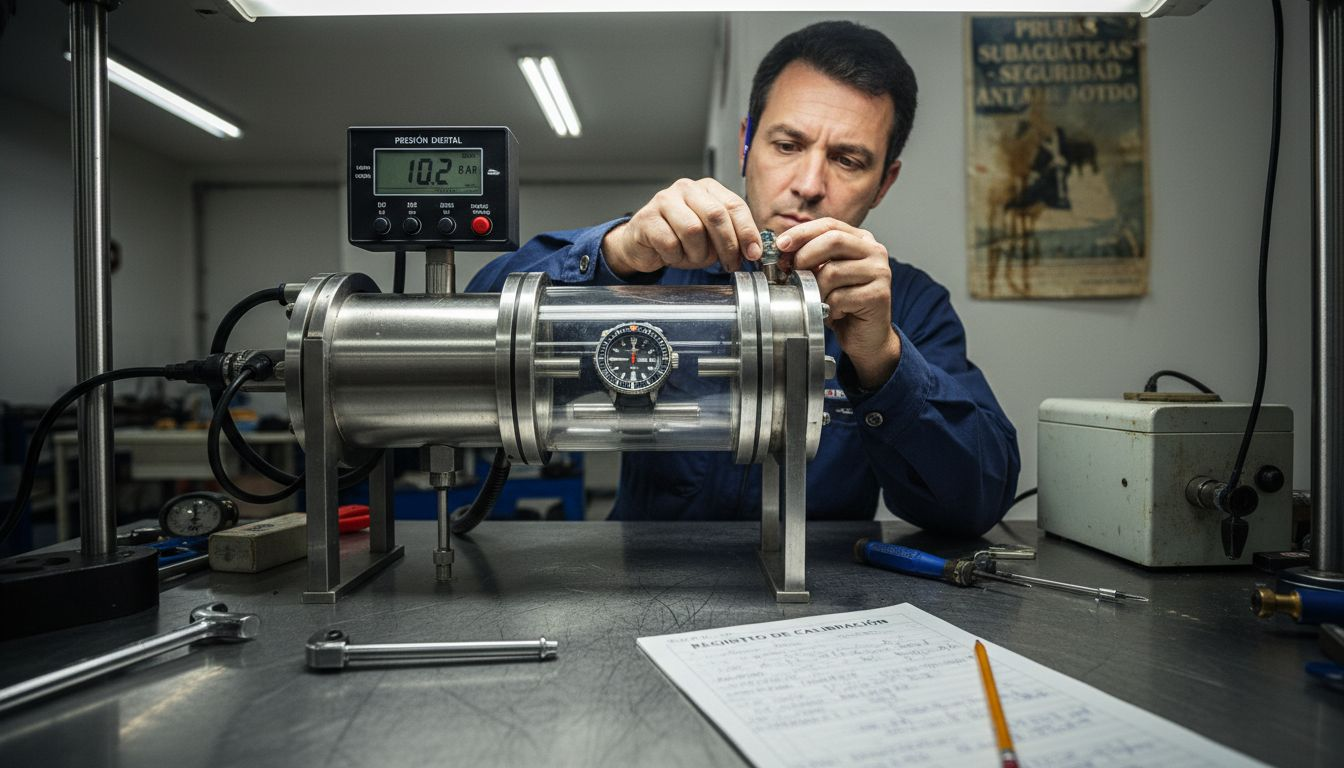
Un técnico realiza una prueba de presión a un reloj de buceo para asegurarse de que funcione correctamente bajo el agua.

No confundas la certificación ISO 6425 con simples certificaciones de resistencia al agua. ISO 6425 incluye pruebas de legibilidad bajo el agua, resistencia al impacto, hermeticidad de coronas y funcionamiento de biseles. Un reloj simplemente “resistente al agua” no tiene estas garantías.

Esta estandarización internacional también te protege como buzo. Sabes exactamente a qué profundidad tu reloj funcionará, sin sorpresas. Los organismos certificadores independientes verifican que el fabricante cumple con cada requisito.

Los estándares internacionales no son limitaciones: son tu garantía de que el reloj funcionará exactamente como promete cuando más lo necesites en profundidad.

Consejo profesional: Busca siempre el marcado “ISO 6425” o “Diver” en la esfera de tu reloj; estos términos confirman que ha pasado pruebas independientes rigurosas, no solo cumplimiento de especificaciones del fabricante.

A continuación se muestra una tabla que resume la aplicación práctica de la profundidad certificada en relojes de buceo internacionales:

Profundidad certificadaTipo de buceadorAplicación principalRequisitos avanzados
100 metrosRecreativoSnorkel y fondo superficialHermeticidad básica
200 metrosRecreativo avanzadoBuceo deportivoCorona atornillada, bisel seguro
300 metrosTécnico/ProfesionalBuceo profundo y expedicionesVálvula de helio, cristal resistente
Más de 300 metrosTécnico extremoOperaciones comercialesCertificaciones independientes, materiales especiales

Cómo afecta la profundidad máxima al buceo

La profundidad máxima no es solo un número en tu reloj. Es el factor determinante que define cómo planificas, qué equipamiento necesitas y cuán segura es tu inmersión. A mayor profundidad, todo cambia.

La profundidad máxima afecta al buceo restringiendo condiciones fisiológicas y los equipos necesarios, incluyendo tu reloj. El cuerpo experimenta presiones extremas que generan riesgos químicos y físicos en el agua. Tu reloj de buceo debe estar a la altura de esa demanda.

Los riesgos fisiológicos aumentan dramáticamente con la profundidad:

  • Narcosis por nitrógeno: Desorienta el buceador a partir de 30 metros de profundidad.
  • Toxicidad por oxígeno: A profundidades extremas, el oxígeno se convierte en veneno.
  • Densidad del gas: El aire se vuelve más denso, haciendo más difícil respirar.
  • Aumento de presión: Cada 10 metros equivalen a una atmósfera adicional de presión.

Un reloj certificado para 100 metros puede fallar completamente a 300 metros. No es cuestión de “casi funcionar”. La presión romperá los sellos, el agua entrará, y perderás tu único instrumento de monitoreo confiable bajo el agua.

Conocer la profundidad máxima permite planificar tiempo, descompresión y seguridad de la inmersión. Sin esta información, no puedes establecer límites reales ni calcular paradas de seguridad. Esto es vida o muerte en buceo técnico profundo.

Tu reloj tiene tres funciones críticas a profundidad:

  • Medir el tiempo real bajo el agua para evitar descompresiones forzadas.
  • Mantener precisión bajo presión extrema para confiabilidad absoluta.
  • Resistir la presión sin comprometer su hermeticidad durante toda la inmersión.

Si el reloj no está certificado para esa profundidad, no cumple ninguna de estas funciones. Es una distracción en tu muñeca, no un dispositivo de seguridad.

La profundidad máxima también determina qué tipo de buceador eres. Buceo recreativo superficial requiere un reloj de 100 a 200 metros. Buceo técnico profundo exige 300 metros o más. Cada nivel tiene equipamiento, entrenamiento y certificaciones específicas que tu reloj debe reflejar.

Tu reloj es el último dispositivo de seguridad cuando todo lo demás falla. Debe estar certificado para la profundidad exacta donde buceas, sin excepciones.

Consejo profesional: Elige un reloj certificado para una profundidad 50-100 metros mayor que tu límite de buceo planificado; este margen de seguridad te protege en casos de emergencia o descensos accidentales.

Esta tabla compara los principales riesgos fisiológicos y técnicos según la profundidad alcanzada:

Riesgo principalProfundidad críticaConsecuencia en el relojMedida preventiva
Narcosis de nitrógenoDesde 30 metrosLectura imprecisaCertificación adecuada
Toxicidad de oxígenoMás de 50 metrosFallos de movimientoMargen extra de profundidad
Presión excesivaCada 10 metrosPérdida de hermeticidadSellos reforzados
Densidad de gas aumentadaMás de 100 metrosCristal quebradoMateriales de alta calidad

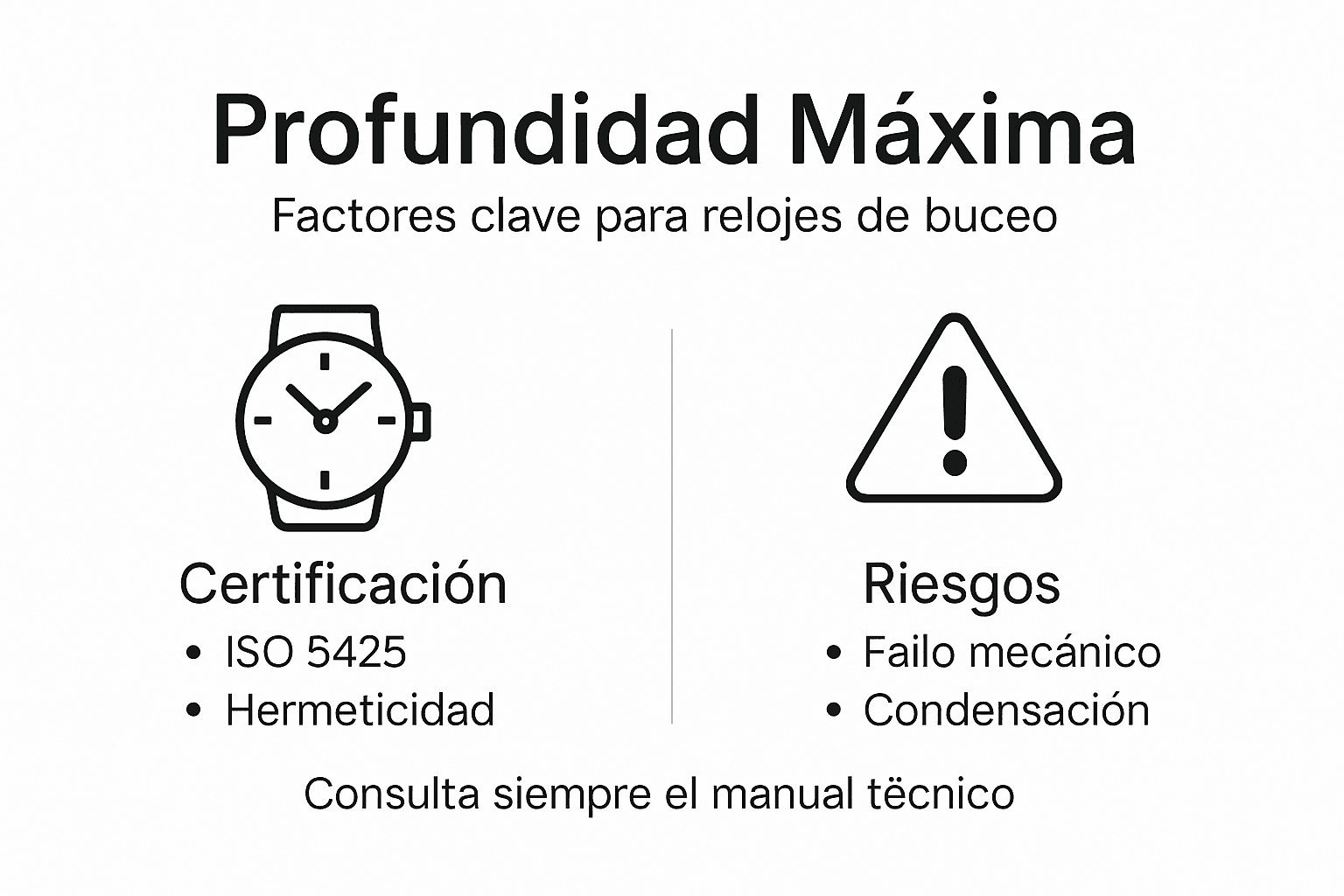
Infografía con los aspectos fundamentales sobre la certificación de profundidad en relojes

Riesgos y errores comunes por superar límites

Superar la profundidad máxima certificada no es una opción valiente. Es un error potencialmente mortal que compromete tu seguridad bajo el agua. Los riesgos aumentan exponencialmente a cada metro adicional.

Superar límites de profundidad incrementa riesgos como narcosis, toxicidad por oxígeno y problemas de descompresión grave. Tu cuerpo no puede adaptarse a esas presiones, sin importar tu experiencia. Los reloj que no cumplen normas fallan bajo presión, eliminando tu control del tiempo bajo el agua.

Los errores más comunes al superar límites son:

  • Mala planificación: No calcular correctamente el tiempo de fondo y paradas de descompresión.
  • Confianza excesiva: Creer que la experiencia supera las limitaciones fisiológicas reales.
  • Equipos no certificados: Usar relojes o computadoras de buceo sin certificación para esa profundidad.
  • Ignorar síntomas: Desconocer los signos de narcosis o toxicidad por oxígeno.
  • Descensos accidentales: Perder control y descender más allá del plan establecido.

Cada error tiene consecuencias físicas inmediatas. La narcosis por nitrógeno comienza alrededor de 30 metros y se intensifica rápidamente. A 100 metros, actúa como una borrachera severa que afecta tu juicio crítico.

Los errores comunes incluyen mala planificación y dependencia en equipos no certificados que pueden presentar fallos de hermeticidad. Un reloj certificado para 200 metros que usas a 350 metros fallará. El agua entra. Pierdes tu referencia de tiempo. La descompresión se vuelve caótica.

Los riesgos específicos del reloj incluyen:

  • Pérdida de hermeticidad: El agua entra en la caja, corrosionando el movimiento.
  • Fallo mecánico: El cristal se quiebra o los sellos ceden bajo presión extrema.
  • Imprecisión del tiempo: El movimiento no funciona correctamente, dando lecturas falsas.
  • Imposibilidad de reparación: Una falla bajo el agua no se puede solucionar en ese momento.

La realidad es brutal: si tu reloj no está certificado para esa profundidad, no tienes forma confiable de monitorear tu tiempo bajo el agua. Y sin tiempo preciso, no puedes planificar paradas de descompresión. Sin descompresión correcta, el riesgo de embolia o enfermedad descompresiva es real.

Un reloj que falla a profundidad no es un inconveniente. Es una emergencia que puede terminar en tragedia.

Consejo profesional: Establece un límite personal 20 metros por debajo de tu certificación de buceo y usa un reloj certificado 100 metros más profundo que tu límite personal; esto crea capas de seguridad que previenen decisiones impulsivas bajo presión.

Elegir el reloj adecuado según la profundidad

Elegir el reloj correcto no es una decisión cosmética. Tu reloj es tu instrumento de seguridad más personal bajo el agua. Debe estar diseñado específicamente para la profundidad donde buceas.

El primer paso es conocer tu tipo de buceo. ¿Eres buceador recreativo que explora arrecifes a 30-40 metros? ¿Buceas técnico que desciende a 100 metros o más? Tu respuesta determina todo lo demás.

Para elegir un reloj adecuado, considera su certificación ISO 6425 y la profundidad máxima certificada. Los relojes profesionales para buceo profundo resisten 300 metros o más, mientras que para buceo recreativo bastan modelos certificados para 100-200 metros. La certificación ISO 6425 es tu garantía de que alguien independiente verificó cada especificación.

Los criterios esenciales para seleccionar son:

  • Profundidad certificada: Debe ser 50-100 metros mayor que tu límite planificado.
  • Certificación ISO 6425: Busca este marcado en la esfera, no es opcional.
  • Válvula de helio: Necesaria si bucas con mezclas especiales o descompresiones largas.
  • Bisel unidireccional: Protege contra cálculos erróneos de tiempo si lo giras accidentalmente.
  • Corona atornillada: Crea un sello hermético adicional bajo presión extrema.
  • Resistencia a impactos: El reloj debe soportar golpes en rocas o equipamiento.

Cada profundidad tiene requisitos mínimos. A 100 metros necesitas un reloj con movimiento cronométrico preciso. A 300 metros, añade válvula de helio y materiales de mayor resistencia. A 600 metros, solo relojes específicamente diseñados para buceo técnico profundo funcionarán.

No confundas “resistencia al agua” con “certificación de buceo”. Un reloj “resistente a 300 metros” puede colapsar bajo buceo real. Uno “certificado para 300 metros” ha pasado pruebas de hermeticidad bajo esa presión.

Consideraciones prácticas al elegir:

  1. Verifica que el fabricante pueda proporcionar certificado de prueba de profundidad.
  2. Revisa la legibilidad bajo el agua: fuente clara y contraste visible.
  3. Prueba la corona atornillada: debe ser fácil de abrir pero hermética cuando está cerrada.
  4. Confirma que el movimiento es apropiado para la profundidad certificada.
  5. Asegúrate de que el bisel gira suavemente sin juego excesivo.

Tu reloj es tu respaldo cuando todo lo demás falla. El ordenador de buceo puede averiarse. La mano del compañero puede quedar fuera de alcance. Tu reloj sigue ahí, en tu muñeca, midiendo tiempo con precisión bajo cualquier condición.

El reloj adecuado para tu profundidad no es lujo. Es la herramienta básica que determina si regresas a la superficie con seguridad.

Consejo profesional: Antes de comprar, revisa la documentación de prueba de profundidad del fabricante y busca opiniones de buceadores profesionales que usen el mismo modelo a profundidades similares a las tuyas.

Protege tu inmersión con un reloj que cumple con la profundidad máxima certificada

La seguridad bajo el agua depende de un equipo que soporte las exigencias reales de la profundidad máxima certificada. Como explica el artículo, superar los límites de resistencia puede causar fallos severos que ponen en riesgo tu vida y anulan la función esencial de monitoreo del tiempo. En Aquastar entendemos esas necesidades porque desde los años 60 hemos desarrollado relojes diseñados exclusivamente para buceo profesional y recreativo, con la tecnología y certificaciones que garantizan hermeticidad, precisión y resistencia bajo presiones extremas.
https://aquastar.ch

No pongas en juego tu seguridad con productos sin respaldo comprobado. Descubre nuestra gama de relojes de buceo profesionales que respaldan cada inmersión con innovación y experiencia suiza. Estar equipado con un reloj Aquastar significa elegir un instrumento validado para las profundidades donde tú exploras. Visita ahora Aquastar y prepárate para sumergirte con confianza y el mejor soporte a tu lado.

Preguntas Frecuentes

¿Qué es la profundidad máxima certificada de un reloj de buceo?

La profundidad máxima certificada es el límite verificado al que un reloj puede funcionar sin perder sus propiedades de hermeticidad ni su precisión. Es resultado de pruebas bajo presión controlada.

¿Cuáles son los riesgos de usar un reloj no certificado para profundidades mayores?

Usar un reloj no certificado para profundidades mayores puede resultar en fallos de hermeticidad, pérdida de precisión y, en última instancia, poner en riesgo la seguridad del buzo al no poder medir el tiempo de inmersión correctamente.

¿Qué diferencia hay entre resistencia al agua y profundidad máxima certificada?

La resistencia al agua se refiere a la capacidad del reloj para soportar ciertas condiciones, mientras que la profundidad máxima certificada es la prueba específica que garantiza que el reloj funcionará adecuadamente a una cierta presión y profundidad.

¿Qué características debe tener un reloj para buceo en profundidades extremas?

Un reloj para buceo en profundidades extremas debe tener características como una certificación ISO 6425, válvulas de escape de helio, coronas atornilladas, y cristales de zafiro, todo ello diseñado para soportar condiciones extremas bajo el agua.

Recomendación

Posted on

Diferencias de diver y reloj casual en la práctica

Diferencias de diver y reloj casual en la práctica - diferencias de diver y reloj casual

Diferencias De Diver Y Reloj Casual: at a glance

Diferencias entre reloj diver y casual: certificación ISO 6425, funciones técnicas, materiales y cómo elegir la pieza adecuada para cada uso. Use this guide on diferencias de diver y reloj casual to weigh design choices, engineering trade-offs and how the category translates to real Aquastar dive watches.

TopicDiferencias de diver y reloj casual
Read time5-8 min
SourceAquastar editorial

Diferencias de diver y reloj casual en la práctica - diferencias de diver y reloj casual

Elegir entre un reloj diver y uno casual puede parecer sencillo hasta que la seguridad bajo el agua entra en juego. Para coleccionistas de Europa y buceadores recreativos, la diferencia clave es la certificación internacional ISO 6425, que garantiza la resistencia y funcionalidad del diver en profundidades extremas. Comprender estas distinciones te permitirá seleccionar la pieza adecuada, ya sea para tus inmersiones en el Mediterráneo o para destacar en una reunión sofisticada en París.

Diferencias De Diver Y Reloj Casual: Tabla de Contenidos

Puntos Clave

PuntoDetalles
Diferencias entre relojes Diver y CasualUn reloj Diver está diseñado para buceo y cumple con estándares de seguridad internacionales, mientras que un reloj Casual se centra en estética y comodidad diaria.
Importancia de la certificación ISO 6425Verifica que el reloj Diver cuente con la certificación ISO 6425, garantizando su resistencia y funcionalidad bajo el agua.
Componentes esenciales de un DiverAsegúrate de que el Diver tenga características como una corona roscada y un bisel unidireccional para máxima seguridad en el agua.
Materiales y durabilidadPrefiere un Diver de acero inoxidable 316L o titanio para una mejor resistencia a la corrosión y longevidad.

Qué distingue a los relojes diver y casuales

Los relojes de buceo y los casuales parecen similares a primera vista, pero sus diferencias técnicas son profundas y determinantes. Un reloj diver está construido para cumplir funciones específicas bajo el agua, mientras que un casual prioriza la estética y el confort diario. Conocer estas distinciones te ayudará a elegir el reloj correcto según tus necesidades reales.

La diferencia más fundamental radica en las certificaciones internacionales. Los relojes diver auténticos cumplen con la norma ISO 6425 para resistencia al agua, lo que significa que resisten al menos 200 metros de profundidad con garantías de seguridad. Los relojes casuales no persiguen estas certificaciones porque no están diseñados para buceo profesional.

Características técnicas que definen un diver

Un reloj diver auténtico posee rasgos específicos que lo hacen funcional bajo el agua:

  • Corona roscada: Sella herméticamente para evitar entrada de agua durante el buceo
  • Bisel unidireccional: Permite medir el tiempo de inmersión sin riesgo de lectura errónea
  • Manecillas luminiscentes: Ofrecen visibilidad clara en aguas profundas y oscuras
  • Cristal resistente: Soporta la presión extrema sin deformarse ni romperse
  • Caja robusta: Construcción reforzada que garantiza integridad estructural

Estas características no son decorativas. En buceo recreativo, una corona que falla puede inundar el reloj en segundos. Un bisel que gira accidentalmente puede costarte la vida si pierdes la referencia de tiempo de descompresión.

Los relojes diver no son lujos estéticos; son herramientas de seguridad que respaldan tu ordenador de buceo con información de tiempo confiable.

Los relojes casuales carecen de estas exigencias. Pueden tener agua resistencia de 30 a 100 metros, lo que significa que sobreviven salpicaduras y duchas, pero se inundarían inmediatamente bajo presión de buceo. Sus coronas no están roscadas, sus biseles no son unidireccionales y sus manecillas no brillan lo suficiente en profundidad.

Diferencias en materiales y construcción

Los diver emplean acero inoxidable de mayor espesor y aleaciones resistentes a la corrosión marina. Los casuales usan materiales más ligeros porque no enfrentan presiones extremas. Esta diferencia de peso y densidad refleja propósitos completamente distintos.

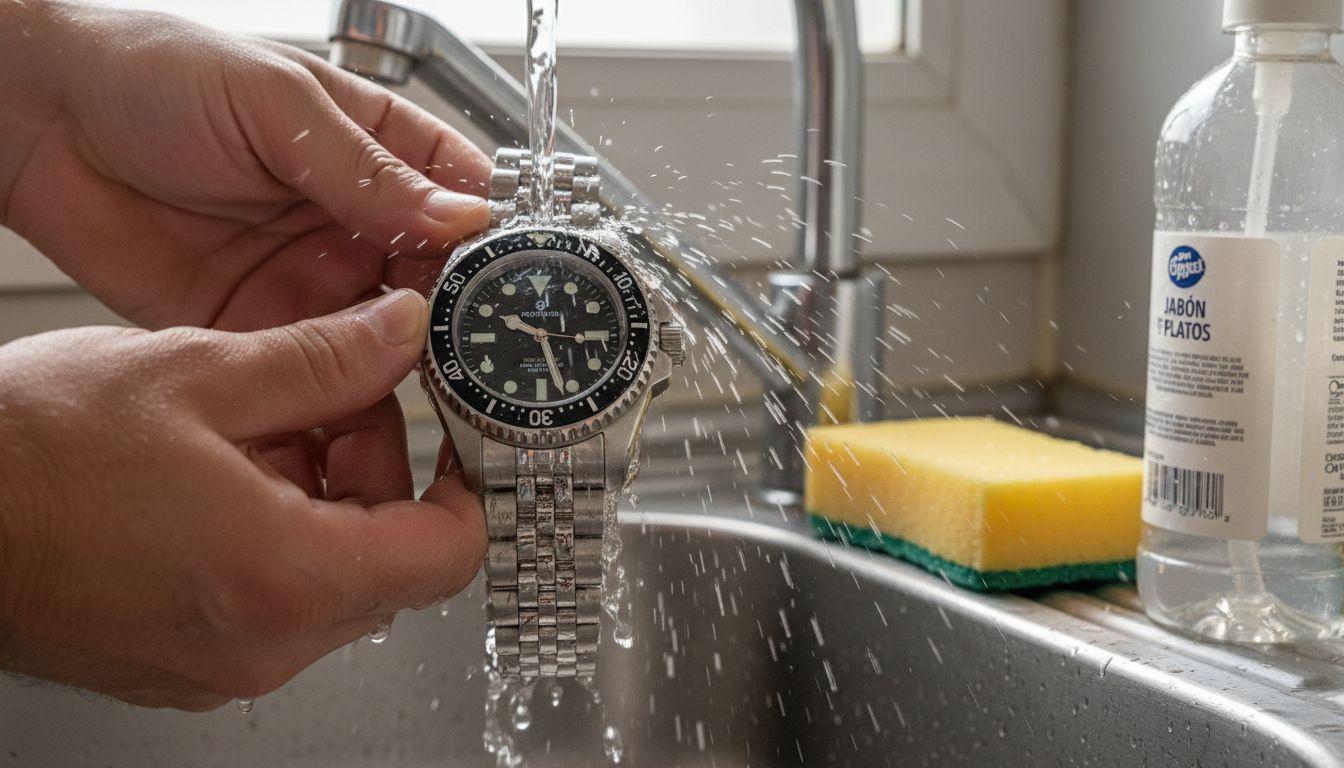
Enjuagando un reloj de buceo de acero bajo el grifo

La luminiscencia en divers utiliza compuestos de larga duración que brillan durante horas bajo oscuridad total. En relojes casuales, la luminiscencia es secundaria y a menudo menos efectiva. Como buceador, necesitas leer tu reloj a 30 metros de profundidad sin luz natural; un casual simplemente no cumple.

Para comprender mejor los beneficios prácticos de un diver frente a un reloj casual, aquí se resumen sus impactos en situaciones reales:

Escenario de usoDiver certificadoReloj casual
Buceo recreativoSeguridad y funcionalidad totalRiesgo elevado por fallos
Exposición a golpesProtege mecanismo y cristalPuede alterar precisión
Agua salada frecuenteSin corrosión a largo plazoDeterioro acelerado
Entornos magnéticosMantiene precisiónPosibles desviaciones
Uso urbano diarioMás pesado y robustoLigero y cómodo

También existen diferencias en tamaño y forma. Los divers suelen ser más grandes (40-45 mm típicamente) para mejorar legibilidad bajo el agua y en condiciones de visibilidad reducida. Los casuales tienden a ser más delgados y discretos para uso cotidiano en ciudad.

Diseño y propósito de uso

Un diver se construye pensando en funcionalidad bajo presión y oscuridad. Cada elemento sirve un propósito de seguridad. Un casual se diseña para belleza, comodidad y versatilidad en la vida diaria. Son filosofías de diseño opuestas.

Como coleccionista en Europa, quizás tengas un casual para reuniones de trabajo y un diver para tus viajes de buceo recreativo. Intentar usar un casual para buceo sería como usar zapatos de ciudad para escalar montañas: pueden verse bien, pero fallarán cuando los necesites.

Consejo profesional: Si buceas regularmente, invierte en un diver certificado como tu reloj principal acuático; será tu compañero confiable durante décadas, mientras que un casual podría traicionarte en el momento crítico.

Funciones y certificaciones técnicas del diver

Un reloj diver no es simplemente un reloj que resiste agua. Es un instrumento certificado que cumple estándares internacionales rigurosos para garantizar tu seguridad bajo el agua. La certificación ISO 6425 es el sello de confianza que distingue un verdadero diver de una imitación costosa.

La norma ISO 6425 establece requisitos específicos que todo reloj diver debe cumplir. Esta certificación no es opcional; es lo que diferencia un reloj seguro para buceo de uno que simplemente parece de buceo. Los fabricantes deben pasar pruebas exhaustivas para obtenerla, y los requisitos son claros y no negociables.

Requisitos principales de certificación

Todo reloj certificado bajo ISO 6425 debe resistir al menos 100 metros de profundidad con garantías de seguridad. Pero la profundidad es solo el comienzo. Existen otros requisitos críticos que debes conocer:

  • Visibilidad en oscuridad total: Debe leerse claramente a 25 cm de distancia sin luz externa
  • Resistencia a golpes: Soporta impactos sin perder funcionalidad
  • Protección magnética: Los campos magnéticos no pueden afectar la precisión
  • Corrosión salina: El reloj resiste exposición prolongada al agua salada sin deterioro
  • Marcado autorizado: Incluye texto que identifica la profundidad certificada

Estos requisitos responden a situaciones reales de buceo. Un golpe accidental contra una roca, la proximidad a equipos magnéticos, o inmersiones repetidas en agua salada son peligros comunes que un diver debe tolerar.

La certificación ISO 6425 no es publicidad; es una garantía legal que tu reloj ha superado pruebas que simulan condiciones extremas de buceo.

Funciones técnicas específicas del diver

Cada componente de un diver certificado sirve una función directa de seguridad. La corona roscada mantiene hermético el reloj bajo presión. El bisel unidireccional te permite calcular con precisión cuánto tiempo lleva sumergido. Las manecillas luminiscentes brillan horas bajo oscuridad total, incluso después de no estar expuesto a luz.

La caja presurizada distribuye fuerzas de presión de forma equilibrada, evitando que el cristal se quiebre o que la esfera se colapse. Esta arquitectura no es accidental; es el resultado de décadas de experiencia en diseño de instrumentos acuáticos.

Los materiales también cumplen funciones específicas. El acero inoxidable de alta calidad resiste la corrosión marina mejor que aleaciones estándar. Los cristales de zafiro soportan presión sin rayarse ni opacarse.

Pruebas que debe superar

Un reloj diver debe pasar pruebas de presión que simulan profundidades extremas. También se somete a pruebas de resistencia química con agua salada sintética durante períodos prolongados. Los campos magnéticos se aplican intentando desmagnetizar el movimiento. Los impactos se distribuyen desde múltiples ángulos.

Estas no son pruebas teóricas. Cada requisito corresponde a un escenario de buceo real que podría causar fallo catastrófico si el reloj no estuviera certificado.

Consejo profesional: Antes de comprar un diver, verifica que lleve el marcado “ISO 6425” y la profundidad máxima certificada en la esfera o caseback; sin estas marcas, no es un diver certificado aunque sea costoso.

Materiales y construcción frente al uso diario

Un reloj diver no es un complemento frágil que requiere cuidados especiales. Está construido para soportar tanto inmersiones profundas como el desgaste cotidiano de la vida real. Los materiales utilizados en su construcción determinan su longevidad y confiabilidad en ambos contextos.

Los relojes casuales privilegian la estética y la ligereza. Un diver prioriza la resistencia absoluta. Esta diferencia de filosofía se refleja en cada componente, desde la caja hasta el cristal. Un diver bien construido puede acompañarte durante décadas sin perder funcionalidad.

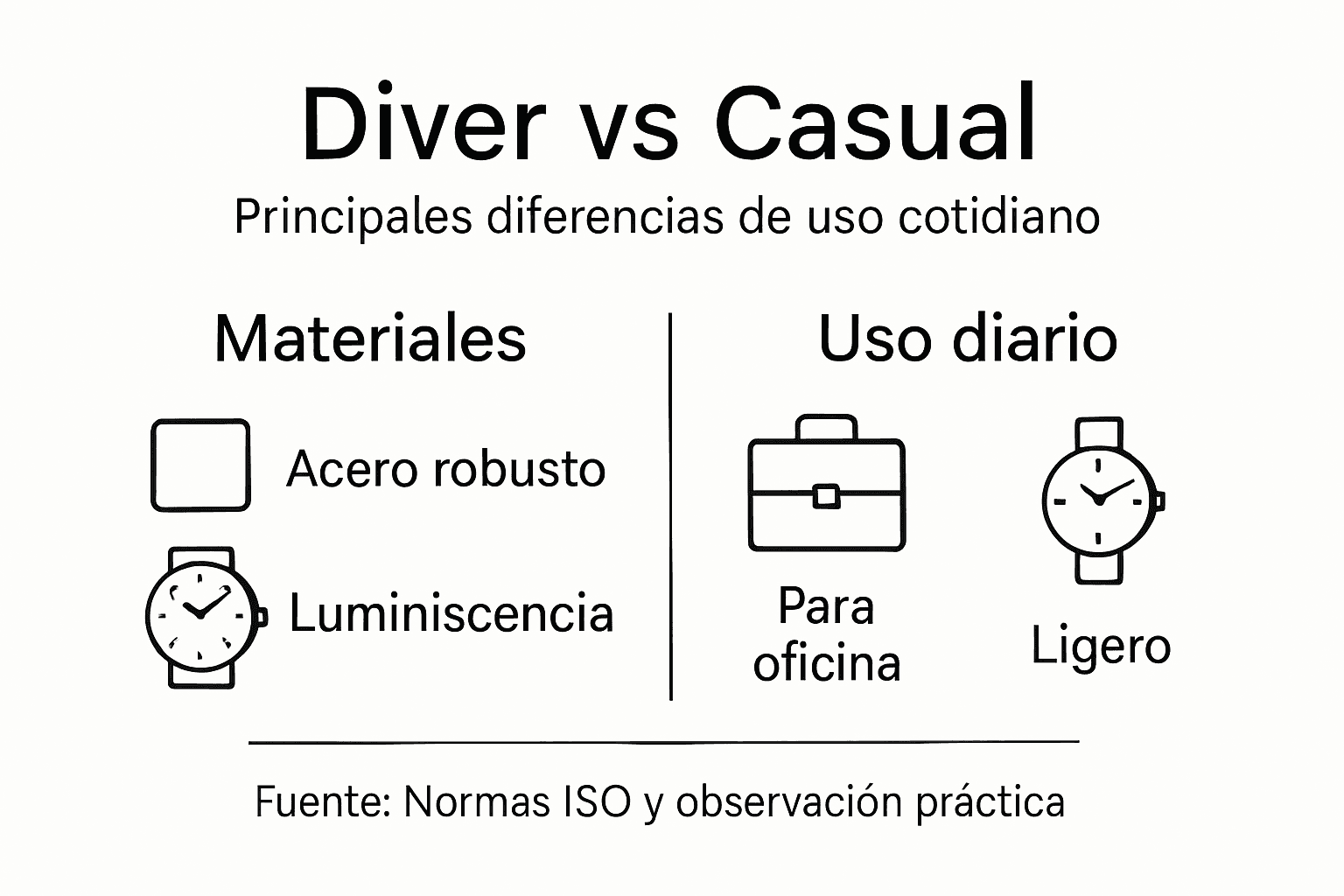
Infografía: ¿En qué se diferencian los relojes de buceo y los relojes informales?

Materiales de la caja y durabilidad

La mayoría de divers profesionales utilizan acero inoxidable 316L o titanio para máxima resistencia a la corrosión. El acero 316L contiene molibdeno, que lo hace significativamente más resistente al agua salada que el acero estándar. El titanio es aún más ligero y resistente, aunque más costoso de fabricar.

Los relojes casuales frecuentemente usan acero inoxidable estándar o aleaciones más económicas. Estos materiales funcionan bien para el día a día, pero su resistencia a la corrosión marina es limitada. Después de años de exposición al agua salada, pueden desarrollar manchas y corrosión superficial.

La diferencia es palpable. Una caja de diver mantiene su acabado después de décadas de uso. Una caja casual puede mostrar signos de deterioro en pocos años si se expone regularmente a agua salada.

Cristales y resistencia al impacto

Todos los divers auténticos utilizan cristal de zafiro sintético. Este material es extremadamente duro y resistente a arañazos. Un cristal de zafiro puede golpearse contra rocas submarinas y mantener claridad óptica perfecta. Los cristales casuales frecuentemente usan acrílico o cristal mineral, que se rayan más fácilmente.

La diferencia se nota cuando buceas. Un crystal rayado reduce la visibilidad y arruina la estética del reloj. El zafiro es casi imposible de rayar en condiciones normales, incluso after años de uso.

Cajas presurizada versus cajas estándar

Los divers tienen cajas robustas con arquitectura presurizada que distribuyen fuerzas de presión equilibradamente. Los casuales tienen cajas más delgadas diseñadas para comodidad y estética.

Una caja diver puede parecer más voluminosa en la muñeca, pero esa volumen sirve a un propósito. Las paredes más gruesas y la arquitectura reforzada evitan que el reloj implote bajo presión extrema. Las cajas casuales colapsarían rápidamente bajo la presión de buceo.

Comparación de durabilidad

Esta tabla muestra cómo difieren los materiales entre ambos tipos:

AspectoDiverCasual
Material cajaAcero 316L o titanioAcero estándar
CristalZafiro sintéticoAcrílico o mineral
Resistencia salinaExcepcionalModerada
Durabilidad bajo presiónCertificadaNo testada
Vida útil esperada20-30+ años5-10 años

Un diver bien mantenido puede servir a múltiples generaciones de buceadores. Un casual es un accesorio temporal que eventualmente mostrará signos de envejecimiento.

Consejo profesional: Elige un diver con acero 316L o titanio si buceas regularmente en agua salada; estos materiales requieren menos mantenimiento y conservan su apariencia durante décadas sin necesidad de pulido profesional costoso.

Errores frecuentes al elegir reloj para buceo

Muchos buceadores cometen errores críticos al elegir reloj, priorizando apariencia sobre funcionalidad. Estos errores pueden comprometer tu seguridad bajo el agua y resultar en una inversión desperdiciada. Conocer los errores más comunes te ayudará a tomar decisiones informadas y seguras.

El error más grave es confundir “reloj que parece diver” con “diver certificado”. Un reloj puede lucir profesional, tener bisel giratorio y parecer resistente, pero carecer completamente de certificación ISO 6425. Esta diferencia es la que separa seguridad de riesgo potencial durante tus inmersiones.

Error 1: Confundir apariencia con certificación

Muchos fabricantes producen relojes que imitan características de buceo sin cumplir estándares internacionales. Tienen biseles que giran, coronas que se ven roscadas y manecillas que brillan. Pero sin certificación ISO 6425 real, son simplemente relojes bonitos que se inundarán a profundidad.

La solución es verificar siempre el marcado en la esfera o caseback. Un diver auténtico tendrá “ISO 6425” grabado claramente. Si no ves esta certificación, no es un diver profesional sin importar su precio.

Este error es costoso. Algunos buceadores gastan cientos de euros en “divers” de marcas desconocidas que lucen impresionantes pero carecen de protección real.

Error 2: Elegir profundidad nominal insuficiente

Muchos casuales tienen “resistencia al agua 100 metros”. Suena profesional, pero 100 metros nominales son insuficientes para buceo recreativo seguro. El buceo recreativo llega típicamente a 40 metros, pero tienes margen de seguridad si tu reloj está certificado para 200 metros o más.

Algunos divers de nivel entrada están certificados para exactamente 100 metros. Es mejor elegir 200 metros como mínimo, proporcionando margen de seguridad para emergencias o profundidades inesperadas.

Error 3: Ignorar la legibilidad en oscuridad

Un reloj que funciona perfectamente en tu casa bajo luz artificial puede ser prácticamente ilegible a 30 metros de profundidad en agua turbia. La luminiscencia de baja calidad se desvanece después de minutos bajo oscuridad total. Los divers auténticos usan luminiscencia de larga duración que brilla horas.

Antes de comprar, prueba la luminiscencia en completa oscuridad. Enciérralo en un cajón durante la noche y revísalo a la mañana. Si apenas brilla, no es adecuado para buceo.

Error 4: Descuidar componentes esenciales

Algunos relojes carecen de características fundamentales que los hacen seguros bajo agua:

  • Corona no roscada: Se abre por presión de agua
  • Bisel bidireccional: Gira accidentalmente y pierdes referencia de tiempo
  • Cristal débil: Se empaña o raya impidiendo visibilidad
  • Batería estándar: Muere sin advertencia en buceo

Verifica que tu diver tenga todos estos componentes antes de invertir.

A continuación, se presenta un resumen sencillo de los errores más comunes al elegir un reloj de buceo y cómo evitarlos:

Error típicoRiesgo principalSolución recomendada
Guiarse solo por la aparienciaInundación bajo presiónVerificar existencia de certificación
Elegir profundidad insuficienteFalla en inmersiones realesOptar por mínimo 200 metros
Ignorar legibilidad en oscuridadDifícil lectura bajo aguaProbar luminiscencia duradera
Descuidar los componentes críticosFalla mecánica en buceoExigir corona roscada y bisel seguro
Elegir cuarzo baratoFallas sin avisoPreferir mecanismos automáticos

Los errores en selección de reloj diver no son cosméticos; pueden costarte la vida si el reloj falla en profundidad.

Error 5: No considerar el mecanismo

Los movimientos mecánicos automáticos son más confiables que cuarzo en buceo profesional. Funcionan sin batería y mantienen precisión bajo condiciones extremas. Los relojes casuales frecuentemente usan cuarzo económico que consume batería rápidamente.

Como coleccionista europeo, probablemente aprecies la mecánica. Invierte en un reloj con movimiento fiable certificado, no en uno que dependa de batería de consumo rápido.

Consejo profesional: Siempre solicita el certificado ISO 6425 del fabricante antes de comprar; si no pueden proporcionarlo o dudan, busca otro reloj independientemente del precio o marca.

Confía en un Diver Auténtico para tu Seguridad y Estilo

Entender las diferencias entre un reloj diver certificado y un reloj casual es vital para preservar tu seguridad bajo el agua. Si buscas un reloj que ofrezca funcionalidad real, durabilidad y cumplimiento con la norma ISO 6425, la elección correcta marcará la diferencia en cada inmersión. No te arriesgues a usar un reloj que solo quiere parecer un diver; necesitas un compañero confiable diseñado para resistir presiones extremas, golpes y corrosión marina.

https://aquastar.ch

Descubre cómo Aquastar, el único fabricante suizo dedicado exclusivamente a relojes de buceo profesionales, puede respaldar tu pasión y seguridad. Con patentes pioneras y una historia que sostiene los avances innovadores en relojería submarina, nuestros relojes mecánicos fueron creados para superar las exigencias que describimos en el artículo. Visita Aquastar y explora por qué un reloj diver profesional no es solo un accesorio sino una herramienta vital. Aprende más sobre su construcción y certificaciones aquí. Da el siguiente paso y equipa tu muñeca con la confianza que solo un verdadero diver puede ofrecer.

Preguntas Frecuentes

¿Cuál es la principal diferencia entre un reloj diver y un reloj casual?

Un reloj diver está diseñado específicamente para buceo, cumpliendo con la norma ISO 6425, mientras que un reloj casual prioriza la estética y no está construido para resistir presiones extremas.

¿Qué características técnicas debe tener un reloj diver?

Un reloj diver debe tener una corona roscada, bisel unidireccional, manecillas luminiscentes, un cristal resistente y una caja robusta. Estas características aseguran su funcionalidad bajo el agua.

¿Por qué es importante la certificación ISO 6425 en un reloj de buceo?

La certificación ISO 6425 garantiza que el reloj ha sido sometido a pruebas rigurosas y puede resistir al menos 100 metros de profundidad, asegurando su fiabilidad durante el buceo.

¿Puedo usar un reloj casual para buceo recreativo?

No se recomienda utilizar un reloj casual para buceo, ya que, aunque pueden resistir salpicaduras, no están diseñados para soportar la presión y las condiciones extremas bajo el agua.

Recomendación

Posted on

Guía de compra de relojes en 2025 para coleccionistas

Guía de compra de relojes en 2025 para coleccionistas - guía de compra de relojes en 2025

Guía De Compra De Relojes En 2025: at a glance

Guía de compra de relojes de buceo en 2025: necesidades reales, innovaciones, autenticidad, certificaciones y reputación de fabricantes. Use this guide on guía de compra de relojes en 2025 to weigh design choices, engineering trade-offs and how the category translates to real Aquastar dive watches.

TopicGuía de compra de relojes en 2025
Read time5-8 min
SourceAquastar editorial

Guía de compra de relojes en 2025 para coleccionistas - guía de compra de relojes en 2025

Elegir un reloj de buceo mecánico de alta calidad puede ser un desafío para coleccionistas y buceadores profesionales en Europa y América del Norte. Las demandas específicas de profundidad, resistencia y autenticidad marcan la diferencia entre una herramienta confiable y una inversión valiosa. En este artículo encontrarás cómo identificar tus necesidades reales y qué innovaciones en materiales, certificaciones y reputación de fabricantes son clave para obtener un reloj verdaderamente excepcional.

Guía De Compra De Relojes En 2025: Tabla de Contenidos

Resumen Rápido

Punto ClaveExplicación
1. Define tus necesidades de buceoDetermina si bucearás recreativamente o profesionalmente para elegir el reloj adecuado.
2. Considera innovaciones y materialesBusca materiales modernos como aleaciones avanzadas y zafiro antirreflectante para mayor durabilidad.
3. Verifica autenticidad y certificacionesAsegúrate de que el reloj tenga documentación y certificaciones internacionales como ISO 6425.
4. Inspecciona resistencia y funcionalidadRevisa la clasificación de profundidad y el funcionamiento de los botones para asegurarte de su fiabilidad.
5. Investiga la reputación del fabricanteOpta por marcas con buena trayectoria y servicio al cliente para garantizar un producto duradero.

Paso 1: Identifica tus necesidades de buceo y colección

Antes de comprar tu primer reloj de buceo o agregar uno a tu colección, necesitas entender exactamente qué tipo de uso le darás. Esto determina directamente qué características técnicas debes buscar y cuál será el reloj adecuado para ti.

Primero, responde estas preguntas clave sobre tu actividad de buceo:

  • ¿Practicas buceo recreativo o profesional?
  • ¿A qué profundidades máximas bucearás regularmente?
  • ¿Buceará en agua dulce, salada o ambas?
  • ¿Necesitas funciones de cronógrafo o solo lectura de tiempo?
  • ¿Es este reloj un instrumento funcional o una pieza de colección?

La profundidad es el factor más importante. Los relojes de buceo requieren resistencia mínima de 100 metros según estándares internacionales, pero los buceadores profesionales necesitan resistencias superiores a 300 metros. Si buceas ocasionalmente a 20-30 metros, un reloj de 300 metros es suficiente. Si practicas buceo técnico o comercial, necesitarás mayor resistencia.

También considera si tu reloj será un instrumento de trabajo junto a tu ordenador de buceo o un complemento estético. Los profesionales certificados por organizaciones como PDI International requieren herramientas confiables. Los coleccionistas pueden priorizar la historia, el diseño y la autenticidad mecánica del movimiento.

La diferencia entre un reloj para usar en cada inmersión y uno para coleccionar es significativa. Un reloj funcional necesita resistencia comprobada, cristal de zafiro resistente a ralladuras y cierre de seguridad en la correa. Un reloj de colección puede ser más raro o histórico, con movimientos exclusivos.

A continuación se presenta una tabla comparativa entre un reloj de buceo para uso funcional y uno de colección, para facilitar tu decisión:

CriterioReloj funcionalReloj de colección
Uso principalActividades de buceo bajo presiónValor histórico y estético
Material preferidoTitanio, acero resistente, zafiroMetales preciosos, bronce histórico
Certificaciones requeridasISO 6425, pruebas de laboratorioCertificado de autenticidad, historia
Valor a futuroDurabilidad y fiabilidad diariaPotencial revalorización a largo plazo

Tu decisión aquí define si buscas un reloj deportivo resistente o una pieza mecánica valiosa con provenance claro.

Documenta tus necesidades específicas en una lista. Esto te ayudará a filtrar opciones cuando comiences a investigar modelos concretos y a no desviarte por relojes hermosos que no se adaptan a tu uso real.

Consejo profesional: Habla con buzos experimentados en tu nivel de certificación; ellos conocen qué relojes funcionan realmente bajo presión y qué características son marketing versus funcionalidad probada.

Paso 2: Explora las innovaciones y materiales del mercado

En 2025, el mercado de relojes de buceo ha evolucionado significativamente con materiales y tecnologías que afectan directamente la durabilidad, precisión y valor de colección. Entender estas innovaciones te permite tomar decisiones informadas al comprar.

Los materiales modernos definen el rendimiento de tu reloj bajo agua. Los fabricantes ahora utilizan aleaciones avanzadas, cerámicas resistentes a la corrosión y cristales de zafiro mejorados. Estos elementos no solo protegen el movimiento sino que también afectan la estética y el valor a largo plazo.

Considerablemente, las ciencias de materiales avanzadas introducen metamateriales con propiedades únicas que mejoran la resistencia sin aumentar peso. Esto permite relojes más cómodos y confiables para inmersiones prolongadas.

Explorá estos elementos clave cuando busques:

  • Correa y cierre: Busca titanio o acero inoxidable de grado 300M resistente a agua salada
  • Cristal: Zafiro sintético con tratamiento antirreflectante es estándar en modelos profesionales
  • Caja: Acero quirúrgico o bronce para resistencia comprobada a la corrosión marina
  • Movimiento: Mecánica suiza o automática con reserva de marcha superior a 40 horas

La fabricación actual también incorpora tecnologías como la impresión 3D avanzada que permite precisión extrema en componentes internos. Algunos fabricantes experimentan con biomateriales sostenibles sin sacrificar funcionalidad.

Para ayudarte a comparar innovaciones recientes, consulta esta tabla de materiales y tecnologías clave para relojes de buceo en 2025:

ComponenteMaterial/InnovaciónBeneficio principal
Correa/cierreTitanio, acero 300MResistencia máxima a la corrosión
CristalZafiro antirreflectanteMayor durabilidad y visibilidad
CajaAcero quirúrgico, bronceProtección ante ambientes marinos
MovimientoSuizo automático ≥40 horasPrecisión prolongada y fiable
Componentes internosImpresión 3D avanzadaPrecisión y fabricación personalizada
Materiales verdesBiomateriales sosteniblesReducción del impacto ambiental

Compara especificaciones técnicas entre modelos. Dos relojes de 300 metros no son idénticos; uno puede usar cristal de plexiglás económico mientras otro utiliza zafiro de clase superior. Esta diferencia impacta durabilidad y reventa.

Los mejores relojes de buceo combinan tradición mecánica con materiales contemporáneos que responden a condiciones extremas reales.

Visitá sitios técnicos especializados, revistas de relojería y foros de coleccionistas. Compará el mismo modelo en diferentes años para ver cómo evolucionaron los materiales. Esto te da perspectiva sobre qué innovaciones son duraderas versus tendencias pasajeras.

Consejo profesional: Solicita certificados de autenticidad de materiales y pruebas de resistencia; los fabricantes respetables documentan estas especificaciones claramente en sus relojes de colección.

Paso 3: Evalúa la autenticidad y las certificaciones del reloj

Antes de invertir en un reloj de buceo, necesitas verificar que es auténtico y cuenta con las certificaciones necesarias. Un reloj falsificado o sin documentación apropiada no solo pierde valor rápidamente sino que también puede ser peligroso bajo el agua.

La autenticidad comienza con la documentación. Todo reloj profesional debe venir con certificado de garantía, documentación del fabricante y especificaciones técnicas verificables. Comprueba que coincidan el número de serie del reloj con el del certificado.

Una mujer revisa la autenticidad de un reloj y comprueba su documentación.

Busca las certificaciones internacionales que respaldan la calidad. Los relojes de buceo profesionales cumplen con estándares internacionales específicos que garantizan resistencia al agua, precisión y durabilidad bajo condiciones extremas. La certificación ISO 6425 es el estándar de oro para relojes de buceo.

Verifica estos elementos de autenticidad:

  • Número de serie: Debe estar grabado en la caja y coincidir con documentación oficial
  • Movimiento: Inspecciona el mecanismo interno; debe ser limpio y preciso
  • Acabado: Busca imperfecciones; los falsificados suelen tener detalles toscos
  • Peso: Un reloj auténtico tiene peso específico según sus materiales
  • Funcionamiento: La precisión debe estar dentro de especificaciones de fábrica

Hoy en día, muchos fabricantes serios utilizan sistemas de verificación digital mediante códigos seguros que puedes validar en línea. Ingresa el código en el sitio oficial del fabricante para confirmar que tu reloj es legítimo.

Solicita certificados de pruebas de resistencia al agua. Los laboratorios independientes verifican que el reloj mantiene estanqueidad en la profundidad declarada. Estos documentos son fundamentales para coleccionistas serios.

Un reloj sin certificación o con documentación dudosa no es una ganga; es un riesgo, tanto financiero como de seguridad bajo el agua.

Compra solo a vendedores autorizados o con historial verificable. Los distribuidores oficiales pueden proporcionar documentación completa y responden por la autenticidad. Si algo te parece sospechoso respecto a la documentación, camina hacia otro vendedor.

Consejo profesional: Contacta directamente al fabricante con el número de serie antes de comprar; ellos pueden confirmar si el reloj es auténtico y qué garantía aún le corresponde.

Paso 4: Verifica características de resistencia y funcionalidad

La resistencia al agua y la funcionalidad son lo que distingue un reloj de buceo genuino de un reloj elegante con estuche de buceo. Necesitas entender cómo se prueban estos atributos y qué significan realmente para tu uso.

Todo reloj de buceo profesional debe cumplir con la norma ISO 6425 para pruebas rigurosas que garantiza resistencia a profundidades de 100 metros o superior con uso repetido. Esto significa que el reloj fue sometido a presiones hidráulicas extremas en laboratorio, no solo sumergido brevemente.

La profundidad nominal no es la máxima a la que puedes bucear. Un reloj de 300 metros puede usarse seguramente a esa profundidad, pero bucear a la máxima profundidad constantemente reduce su vida útil. Considera usar el reloj a entre 50 y 70 por ciento de su clasificación nominal para máxima durabilidad.

Verifica estos aspectos específicos cuando inspecciones un reloj:

  • Clasificación de profundidad: Debe estar claramente grabada en la caja trasera
  • Cierre de la corona: Debe enroscar firmemente sin huecos ni movimiento lateral
  • Válvula de escape de helio: Esencial para buceo técnico a profundidades extremas
  • Funcionamiento de botones: Los pulsadores deben responder sin pegarse bajo presión
  • Movimiento de agujas: Deben rotar suavemente sin fricción visible

La resistencia al agua tiene clasificaciones específicas según la norma ISO 2281, y cada clasificación tiene limitaciones reales. Un reloj de 30 metros resiste salpicaduras, uno de 100 metros soporta nado, pero solo relojes de 300 metros en adelante son verdaderamente aptos para buceo profesional.

Prueba el reloj personalmente si es posible. Sumérgelo en agua destilada durante varios minutos observando si hay condensación en el cristal o entrada de agua. Esto indica fallo de sellado. Verifica que todas las funciones funcionen bajo presión sin resistencia anormal.

Un reloj de buceo debe ser tan confiable bajo agua como en tierra; cualquier duda es motivo para rechazarlo.

Solicita documentación de pruebas de resistencia realizadas por laboratorios independientes. Estas pruebas confirman que el reloj cumple especificaciones declaradas bajo condiciones reales extremas.

Consejo profesional: Antes de sumergirte con un reloj nuevo, llévalo a una inmersión de prueba a profundidad baja; observa el comportamiento del reloj en entorno real antes de confiar en él para buceos más profundos.

Paso 5: Confirma la reputación y garantías del fabricante

La reputación del fabricante es tan importante como las características del reloj. Un fabricante confiable responde por su producto, ofrece garantías claras y mantiene servicio al cliente excepcional durante años.

Investiga la historia del fabricante. ¿Cuánto tiempo llevan en el mercado? ¿Tienen presencia en ferias internacionales de relojería? ¿Fabrican bajo su propio nombre o producen para terceros? Los fabricantes con décadas de trayectoria demuestran compromiso real con la calidad.

La reputación corporativa se construye mediante transparencia y calidad consistente. Un fabricante serio comunica abiertamente sobre sus procesos, responde consultas técnicas, y no teme mostrar su taller o explicar decisiones de diseño.

Verifica estos indicadores de reputación confiable:

  • Garantía escrita: Debe ser clara, específica en duración y cobertura sin ambigüedades
  • Servicio postventa: ¿Ofrecen reparación autorizada? ¿Cuál es el tiempo de respuesta?
  • Política de devolución: ¿Permiten inspección completa antes de compra final?
  • Comunicación: ¿Responden preguntas técnicas con detalle y profesionalismo?
  • Certificaciones: ¿Son miembros de organizaciones relojeras internacionales reconocidas?

Busca opiniones en comunidades de coleccionistas establecidas. Foros especializados, grupos en redes sociales y publicaciones de relojería ofrecen perspectivas reales de otros compradores. Ten cuidado con reseñas que parecen publicitarias; busca crítica equilibrada.

La reputación también refleja los estándares de calidad y compromiso con el cliente. Fabricantes respetables documentan esto públicamente con certificaciones, testimonios verificables y reconocimiento de la industria.

Verifica si el fabricante responde consultas antes de compra. Un correo técnico respondido rápidamente indica que valoran clientes. Un silencio prolongado es bandera roja.

Una garantía fuerte de un fabricante con buena reputación es más valiosa que un precio bajo de un desconocido.

Contacta con otros coleccionistas que posean relojes del fabricante. Pregunta cómo fue su experiencia con garantía, servicio y disponibilidad de repuestos después de años de uso.

Consejo profesional: Antes de comprar, solicita referencias de al menos tres coleccionistas que hayan usado el servicio postventa del fabricante; sus experiencias reales te mostrarán exactamente qué esperar.

Eleva tu colección con relojes de buceo profesionales y auténticos

El desafío principal de esta guía es ayudarte a identificar un reloj de buceo que no solo sea funcional y resistente bajo el agua sino también una pieza auténtica válida para coleccionistas exigentes. Sabemos que buscas calidad comprobada, materiales innovadores y garantías que respalden tu inversión, aspectos críticos para diferenciar un reloj funcional de uno de colección con verdadera revalorización a futuro.

En Aquastar entendemos perfectamente estas necesidades. Somos la única manufactura suiza enfocada exclusivamente en relojes de buceo profesionales, creadores de piezas icónicas como el primer ordenador analógico de buceo y expertos en innovación técnica que garantizan resistencia y precisión conforme a los estándares ISO. Al elegir un reloj Aquastar accedes a movimientos mecánicos fiables, materiales resistentes a la corrosión marina y un legado que respalda cada movimiento.

https://aquastar.ch

Descubre cómo transformar tu experiencia de buceo y la fortaleza de tu colección con un reloj que combina historia, tecnología y autenticidad. No dejes pasar la oportunidad de proteger tu próxima inversión con la garantía y reputación de Aquastar. Visita Aquastar ahora y da el salto hacia un reloj que marcará la diferencia en cada inmersión y en tu colección.

Para conocer más sobre nuestra historia y tecnología pionera visita nuestra página principal y empieza hoy mismo a vivir la excelencia suiza diseñada solo para buzos reales.

Preguntas Frecuentes

¿Cómo puedo identificar un reloj de buceo auténtico para mi colección?

Para identificar un reloj de buceo auténtico, verifica su documentación, especialmente el número de serie y el certificado de autenticidad. Asegúrate de que el reloj tenga la certificación ISO 6425 y que todo coincida con lo que indica el fabricante.

¿Cuáles son las características esenciales que debo buscar en un reloj de buceo para coleccionistas?

Busca características como resistencia al agua de al menos 300 metros, cristal de zafiro, y un cierre de seguridad. Además, asegúrate de que el movimiento sea automático o mecánico, ya que estos son preferidos por los coleccionistas.

¿Cómo afecta el material del reloj a su valor y durabilidad?

El material del reloj tiene un impacto significativo en su valor y durabilidad. Materiales como el acero inoxidable de alta calidad o el titanio son ideales para la resistencia al agua y la corrosión, mientras que los metales preciosos pueden aumentar su valor de colección.

¿Qué tipo de certificaciones son importantes para un reloj de buceo de colección?

Es crucial que el reloj tenga certificaciones como la ISO 6425, que garantiza su resistencia y funcionalidad bajo el agua. Además, busca certificaciones de autenticidad y calidad que avalen el valor del reloj a largo plazo.

¿Cómo determinar si un reloj de colección tiene potencial de revalorización?

Evalúa la historia del fabricante, la rareza del modelo y las revisiones del mismo. Puedes observar si ha habido una tendencia de aumentos en su valor en el mercado secundario en los últimos cinco años, lo que indicaría un buen potencial de revalorización.

¿Qué precauciones debo tomar al comprar un reloj de buceo usados?

Al comprar un reloj de buceo usado, revisa cuidadosamente su estado general, funcionalidad y certificaciones. También es recomendable solicitar un período de garantía o una política de devolución para asegurarte de que clarificas cualquier duda post-compra.

Recomendación

Posted on

What Is a Waterproof Watch and How It Impacts Dive Safety

What Is a Waterproof Watch and How It Impacts Dive Safety - what is a waterproof watch

What Is A Waterproof Watch: at a glance

What is a waterproof watch? The myth of the term, depth ratings, ISO 6425 and the seals that actually protect your timepiece underwater. Use this guide on what is a waterproof watch to weigh design choices, engineering trade-offs and how the category translates to real Aquastar dive watches.

TopicWhat is a waterproof watch
Read time5-8 min
SourceAquastar editorial

What Is a Waterproof Watch and How It Impacts Dive Safety - what is a waterproof watch

Choosing the right dive watch can be confusing when manufacturers use terms like waterproof and water-resistant interchangeably. For professional divers across North America and Europe, understanding these definitions is more than marketing—it’s about ensuring accurate backup timing and safety underwater. This article clears up myths about waterproof watches, explains why depth ratings don’t tell the whole story, and shows how features like quality seals and ISO certification protect your investment during demanding dives.

Table of Contents

Key Takeaways

PointDetails
Understanding Water ResistanceWatches labeled as waterproof are typically water-resistant, with specific depth ratings that dictate their real-world usage.
Regular Maintenance is CrucialGaskets and seals degrade over time; regular servicing every 5 to 10 years is recommended to maintain water resistance.
Depth Ratings are MisleadingA watch rated for a certain depth does not mean it can be used safely at that depth due to varying pressure conditions.
ISO Certification MattersLook for ISO 6425 certification to ensure a watch meets professional diving standards and is reliable for safety underwater.

Defining Waterproof Watches and Common Myths

Waterproof watches are not actually waterproof in the absolute sense. What manufacturers call “waterproof” is more accurately described as water resistant—the watch can withstand exposure to water under specific conditions tested in laboratory environments.

The key distinction matters because most people misunderstand what their watch can actually handle. Water resistance ratings indicate pressure tolerance, not the depth you can safely dive to with the watch.

Understanding Water Resistance Ratings

Manufacturers express water resistance in two ways: atmospheres (bar) or meters. A watch rated at 3 bar (approximately 30 meters) means it withstood 3 atmospheres of pressure for 10 minutes in a controlled laboratory test—nothing more.

Here’s what each rating actually means for real-world use:

  • 3-5 bar (30-50m): Splash and brief immersion only; avoid showers
  • 10 bar (100m): Swimming and snorkeling permitted
  • 20 bar (200m): Freediving and recreational diving
  • 300+ bar: Professional saturation diving equipment

Common Myths That Get Divers Into Trouble

The most dangerous myth is that a watch rated “100 meters” can be worn to 100 meters depth. This is completely false. Laboratory testing doesn’t account for real-world conditions like dynamic pressure from swimming movements, temperature changes, or water entry through crown operation.

Another common misconception involves salt water versus fresh water. Many divers assume water resistance applies equally to both. Salt water is more corrosive and demands higher-quality sealing mechanisms.

A watch tested to 100 meters in a controlled lab may fail at 30 meters depth when subjected to the dynamic pressures of active diving.

Additionally, many assume a waterproof watch requires no maintenance. Seals degrade over time and need periodic inspection and replacement. Even professional dive watches from manufacturers specializing in diving equipment like Aquastar require regular servicing to maintain integrity.

Temperature fluctuations present another overlooked problem. A watch sealed in cold water may allow water ingress when exposed to sudden heat. Your watch might pass pressure tests yet fail under thermal stress.

Pro tip: Have your dive watch professionally serviced every 5 to 10 years and always check manufacturer guidance before immersing any watch beyond its rated depth.

Waterproof vs. Water-Resistant: Key Differences

The terms “waterproof” and “water-resistant” are not interchangeable, yet manufacturers and consumers use them loosely. Understanding the distinction protects your investment and keeps you safe underwater.

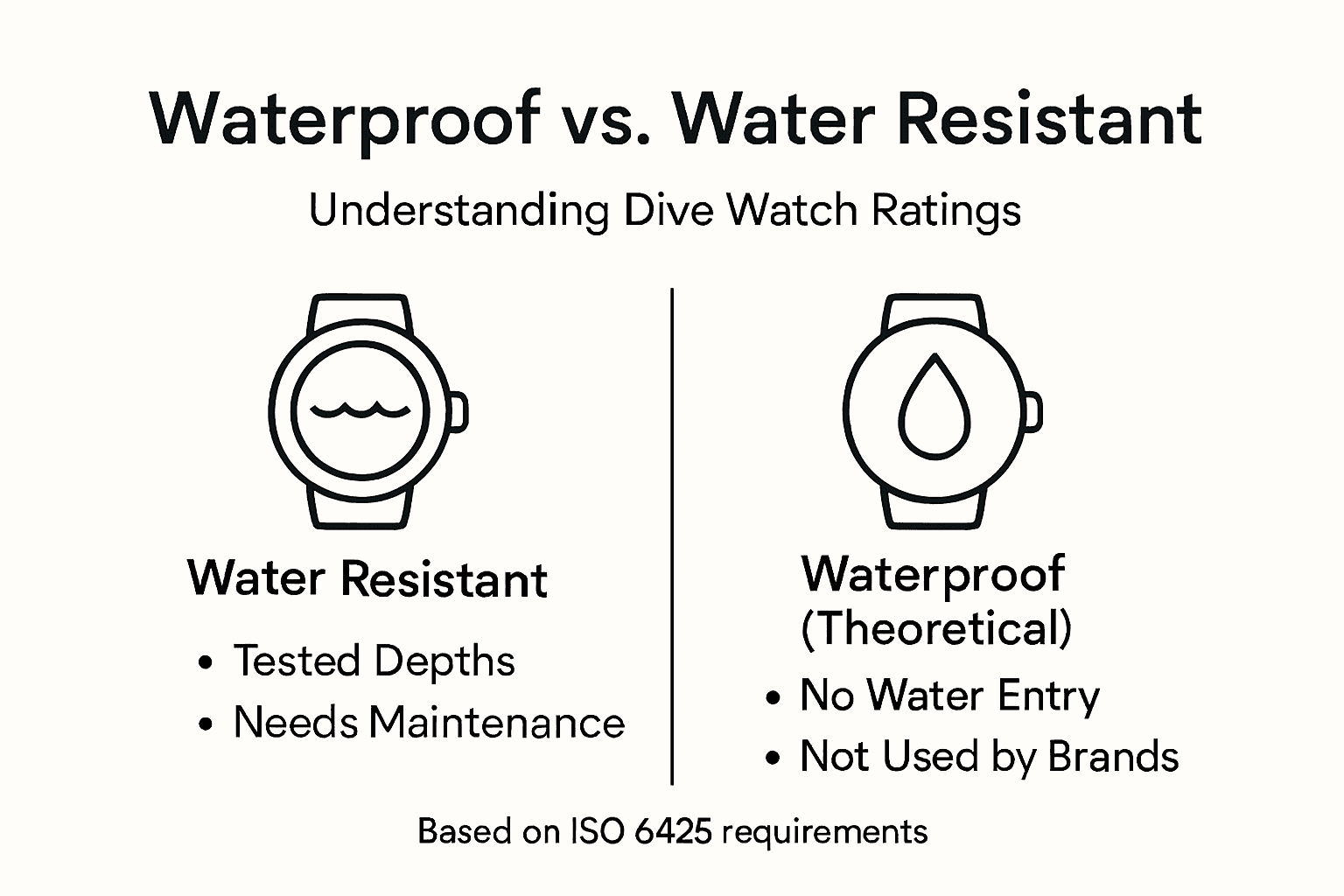
Waterproof means complete imperviousness to water. A truly waterproof product blocks water entry entirely, even under pressure or full submersion. Water-resistant means the product can withstand limited water exposure like splashes or light rain, but will eventually fail if submerged.

Most dive watches are actually water-resistant, not waterproof. The terminology matters when selecting equipment for professional diving.

Here’s how water-resistant and waterproof watches differ in real-world reliability and maintenance:

AttributeWater-Resistant WatchesWaterproof (Theoretical) Watches
Real-World ReliabilityProne to seal degradation, needs regular servicingWould resist water entry indefinitely if they existed
Suitability for DivingSuitable up to tested limits onlyNo known model meets true requirements
Maintenance NeedsGasket replacement and frequent checks requiredHypothetical, would need no seal work
Manufacturer ClaimsMarked with tested pressure ratingNever used due to liability and limits

The Practical Difference for Divers

IP ratings quantify protection levels for both water and solid particles. A watch rated IP67, for example, means it survives temporary immersion to 1 meter for 30 minutes but is not suitable for diving.

Here’s how these terms translate to real diving scenarios:

  • Water-resistant only: Safe for washing hands, light rain, splashes at the pool edge
  • Water-resistant (20+ bar): Suitable for snorkeling and recreational diving
  • Water-resistant (30+ bar): Designed for professional commercial diving operations
  • Waterproof (rare in watches): Theoretically submersible indefinitely under any condition

Why Manufacturers Avoid the Word “Waterproof”

No manufacturer of precision watches uses “waterproof” because it implies zero risk of water entry—an impossible standard given seals degrade over time. Even professional dive watches from heritage makers like Aquastar are engineered as water-resistant because this term acknowledges that maintenance and proper use matter.

Waterproof protection suits full submersion; water-resistant implies conditional usage. Divers must understand this distinction before entering the water.

Using a water-resistant watch beyond its rated depth creates dangerous situations. Your backup timing device fails exactly when you need it most—during emergency decompression procedures.

A 300-meter water-resistant watch is not waterproof; it is designed to resist 300 meters of static pressure under controlled conditions, nothing more.

Always review the manufacturer’s specifications and intended use case. A watch rated for snorkeling fails at diving depth. A professional dive watch may not be suitable for saturation diving.

Pro tip: Select your dive watch based on your actual diving depth and operations, then stay within manufacturer specifications—your safety depends on this clarity.

Features That Ensure True Waterproof Performance

True waterproof performance in dive watches depends on specific engineering elements working together. These features separate reliable backup timing devices from watches that fail when divers need them most.

The foundation starts with sealing technology. Gaskets made from rubber, nylon, or Teflon are positioned at every critical junction where water could enter the watch case. These gaskets compress when the watch is closed, creating a watertight seal.

Watchmaker servicing dive watch seals close-up

Critical Sealing Points

Three main areas require aggressive sealing:

  • Crystal gasket: Sits between the watch face and case, enduring constant pressure changes
  • Crown gasket: Protects the mechanism that winds and adjusts the watch; the most vulnerable entry point
  • Case back gasket: Seals the back of the watch after movement assembly

Many professional dive watches feature screw-down crowns and case backs that provide additional mechanical sealing beyond gaskets alone. These threaded components lock tightly, eliminating loose points where pressure forces water inward.

Material Selection Matters

The watch case itself must resist corrosion from salt water and pressure. Stainless steel and titanium are industry standards for professional dive watches because they resist oxidation and maintain structural integrity under stress. Cheaper alloys degrade quickly in salt water environments.

Internal sealing coatings fill microscopic gaps between components that gaskets alone cannot reach. These protective layers add another defense layer, especially critical for professional operations in harsh conditions.

Static laboratory testing reveals nothing about how seals perform under dynamic water pressure from swimming movements and depth changes divers experience regularly.

Beyond materials, design quality determines performance. Professional dive watches from makers like Aquastar incorporate these features because commercial and recreational divers depend on accurate timing for decompression calculations. Each component undergoes rigorous testing beyond minimum standards.

Regular maintenance preserves waterproof integrity. Gaskets compress permanently over time and must be replaced every few years. Service intervals vary by manufacturer and usage intensity, but skipping this maintenance guarantees eventual water entry.

Pro tip: Request gasket replacement and pressure testing at the recommended service interval (every 5 to 10 years) to maintain your watch’s waterproof integrity for critical diving operations.

International Standards and Dive Watch Regulations

Dive watches are not created equally. International standards exist to separate watches suitable for diving from ordinary timepieces marketed as waterproof. These regulations protect divers by establishing minimum safety requirements.

ISO 6425:2018 is the gold standard for dive watch certification. ISO 6425 defines requirements and test methods for any watch claiming to be suitable for diving operations. This standard requires watches to withstand 100 meters of water depth minimum and includes rigorous testing protocols updated as recently as 2024.

Infographic comparing waterproof and water resistant watches

What ISO 6425 Actually Requires

A watch cannot claim “dive watch” status without meeting these core specifications:

  • Water resistance tested to 125% of rated depth pressure
  • Unidirectional rotating bezel or time-control mechanism for decompression tracking
  • Crystal and case construction resistant to shock and impact
  • Legibility in complete darkness without external light sources
  • Shock resistance to prevent movement damage from impact
  • Corrosion resistance for salt water environments

These requirements separate professional-grade equipment from consumer watches with superficial waterproofing.

Voluntary Certification vs. In-House Testing

Participation in ISO testing remains voluntary for manufacturers, meaning some brands perform independent in-house testing instead. However, ISO 6425 certification remains the industry benchmark because it provides third-party verification and standardized protocols.

Watches meeting ISO 6425 standards carry a distinct marking on the case back or dial. This certification indicates the manufacturer invested resources to prove their product meets professional diving requirements. Aquastar’s legacy includes pioneering dive watch innovation alongside these international safety standards.

See how international standards enhance dive watch safety compared to in-house testing:

Standard TypeTesting ProtocolsThird-Party VerificationTypical Markings
ISO 6425 CertifiedRigorous, scenario-basedYesMark or emblem on case/dial
In-House Brand TestingVaries by manufacturerNoMay lack external marking
No Formal TestingNone or basic checks onlyNoMarketing claims only

ISO 6425 certified watches have undergone testing to ensure they perform reliably under actual diving conditions, not just laboratory controlled environments.

North American and European divers should prioritize ISO-certified watches as backup timing devices. The standard ensures your watch will function during critical decompression procedures when accuracy determines safety.

Regulatory compliance varies by jurisdiction. Commercial diving operations in North America and Europe often require ISO 6425 certification for backup equipment. Recreational divers benefit from this same protection even when not legally mandated.

Pro tip: Always verify ISO 6425 certification on any watch before using it as a backup timing device for diving operations, regardless of manufacturer claims.

Risks, Misuse, and Common Failure Points

Waterproof watches fail most often due to operator error, not manufacturing defects. Understanding how divers commonly damage their watches prevents expensive repairs and dangerous situations underwater.

The most critical mistake involves misunderstanding what depth ratings actually mean. Depth ratings indicate static pressure tolerance, not actual safe diving depth. Dynamic pressure from swimming movements, rapid depth changes, and body motion creates forces far exceeding laboratory test conditions.

Common Misuse Scenarios

These actions damage water-resistant watches faster than anything else:

  • Exposing watches to hot water or steam: Temperature changes force seals to expand and contract, creating microscopic gaps where water enters
  • Failing to screw down crowns: An unsecured crown allows water to flow directly into the movement, causing immediate damage
  • Wearing watches in chlorinated pools: Chlorine corrodes gaskets and seals, degrading waterproof integrity in weeks
  • Using soap or salt water without rinsing: Mineral deposits crystallize on seals, creating permanent damage pathways
  • Operating the crown while submerged: Water rushes into the movement when you pull out the crown at depth

Seal Degradation Over Time

Gaskets and seals are not permanent. Seals degrade gradually from age and chemicals, losing their compression ability even without obvious damage. A watch that passed pressure testing three years ago may fail at half that depth today.

Temperature extremes accelerate seal failure dramatically. Cold water followed by warm showers creates thermal stress that damages seals internally. Your watch might appear fine but fail catastrophically on the next dive.

A watch rated 300 meters will fail if seals are degraded, the crown is loose, or dynamic pressure exceeds static lab testing conditions.

Water entry causes visible and hidden damage. Moisture inside the case creates rust on metal components and fogging on the crystal. But unseen movement corrosion can affect timekeeping accuracy months after water entry occurs.

Poor maintenance accelerates all these failure modes. Professional divers skip servicing intervals at their peril. Regular gasket replacement and pressure testing catch problems before they become dangerous.

Pro tip: Never operate your dive watch crown while underwater, and rinse immediately with fresh water after any saltwater exposure to prevent seal degradation.

Choose True Reliability with Aquastar Dive Watches

Understanding the challenges of waterproof watches reveals how critical precise water resistance is for dive safety. The article highlights common myths, seal degradation, and the vital need for professional maintenance. For divers seeking a dependable timing device that meets rigorous standards and overcomes these pitfalls Aquastar offers a proven solution. Our heritage as the only Swiss watchmaker born exclusively to make dive watches means our designs integrate patented innovations that maintain integrity under dynamic water pressure and harsh environments.

https://aquastar.ch

Experience peace of mind during every dive with Aquastar’s professional mechanical watches engineered for commercial and recreational divers. Dive confidently knowing your backup timing device is crafted to withstand real-world conditions unlike generic water-resistant watches. Visit Aquastar’s official website now to explore dive watches that combine history innovation and uncompromising waterproof performance. Don’t risk failure underwater choose Aquastar and equip yourself with a watch designed specifically for the depths you explore.

Frequently Asked Questions

What does it mean when a watch is labeled as waterproof?

A watch labeled as waterproof is actually water-resistant, meaning it can withstand water exposure under specific conditions, but is not impervious to water entirely.

How are water resistance ratings determined for watches?

Water resistance ratings are tested in controlled laboratory environments and expressed in bar or meters, indicating the depth and pressure the watch can withstand for a limited time.

Can I wear a watch rated for 100 meters while diving to that depth?

No, a watch rated for 100 meters can only handle static pressure in lab conditions and may fail under dynamic water pressure from swimming and other activities at that depth.

What maintenance should I perform on my dive watch to ensure its waterproof integrity?

Regular servicing every 5 to 10 years, including seal inspections and replacements, alongside pressure testing, is essential to maintain the waterproof integrity of your dive watch.

Posted on

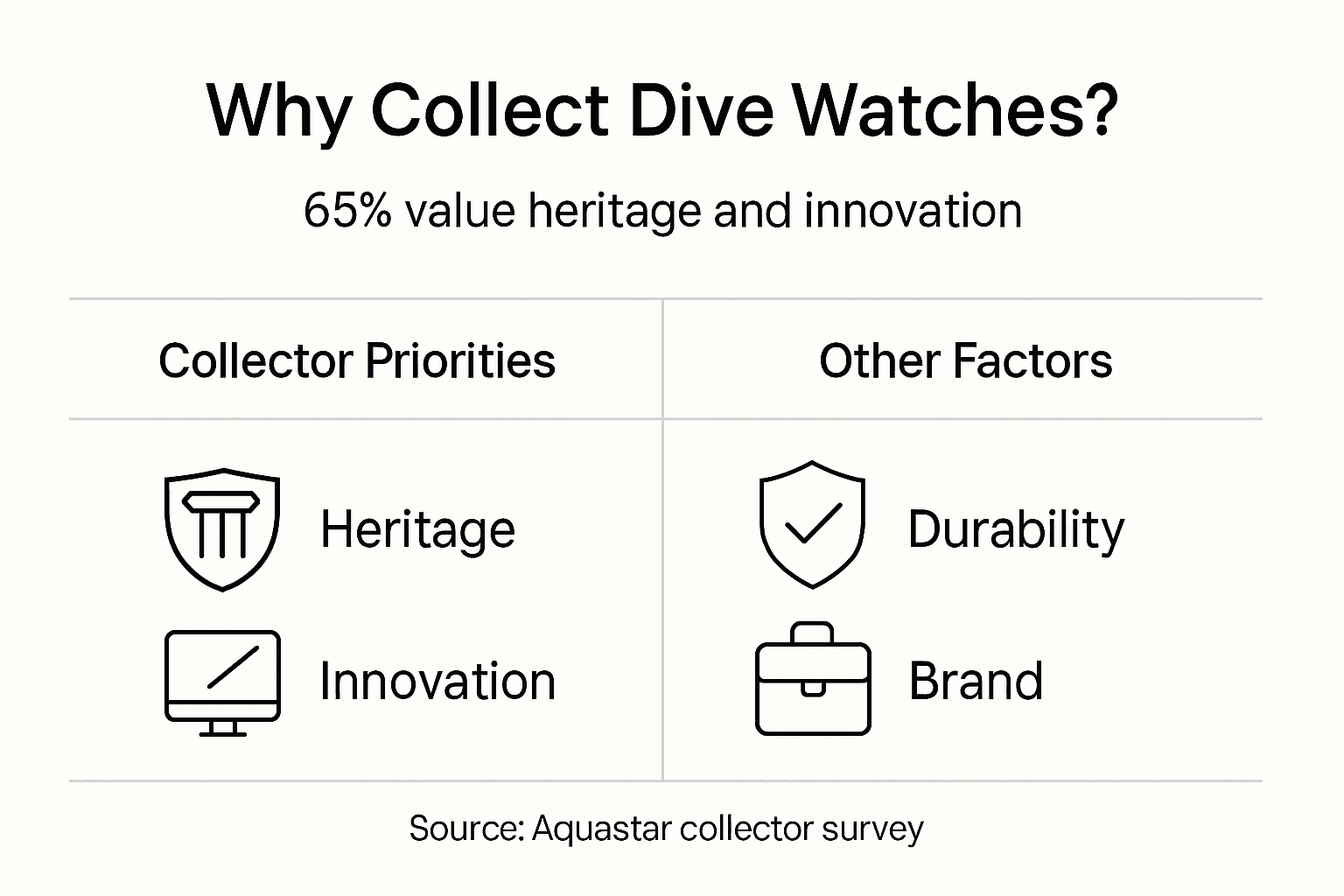
Why Choose a Dive Watch: 65% Collectors Value Heritage

Why Choose a Dive Watch: 65% Collectors Value Heritage - why choose a dive watch

Why Choose A Dive Watch: at a glance

Why choose a dive watch: heritage, engineering and the patented innovations behind serious underwater instruments — beyond marketing claims and ratings. Use this guide on why choose a dive watch to weigh design choices, engineering trade-offs and how the category translates to real Aquastar dive watches.

TopicWhy choose a dive watch
Read time5-8 min
SourceAquastar editorial

Why Choose a Dive Watch: 65% Collectors Value Heritage - why choose a dive watch

Not all dive watches with similar water resistance ratings deliver equal underwater reliability. A 300m rated watch from one brand might fail where another thrives because certification depth alone doesn’t guarantee robust engineering, tested seals, or proven durability. This article clarifies what separates authentic professional dive watches from marketing claims, exploring technical standards, historical innovations like Aquastar’s 1960s patents, and practical guidance for collectors and divers seeking timepieces that honor heritage while meeting modern underwater demands.

Table of Contents

Key Takeaways

PointDetails
ISO 6425 CertificationDive watches must meet strict standards for water resistance, luminosity, shock resistance, and magnetic protection to ensure professional underwater reliability.
Historical InnovationAquastar pioneered critical dive watch technologies in the 1960s, including the first analog dive computer and skindiver case design.
Mechanical AdvantageMechanical dive watches often surpass digital models in pressure cycling durability and temperature resistance under extreme conditions.
Collector AppealOver 65% of dive watch collectors prioritize historical patents and brand heritage when selecting timepieces for their collections.
Modern IntegrationDive watches serve as essential backup instruments complementing dive computers for enhanced safety and redundancy underwater.

Understanding What Makes a Dive Watch Unique

ISO 6425 defines minimum requirements that separate genuine dive watches from water resistant fashion pieces. These standards mandate 100m minimum depth rating, luminous markers visible at 25cm in darkness, resistance to magnetic fields and physical shocks, plus documented pressure testing protocols. Without this certification, a watch might handle rain but fails under actual diving stress.

Key technical features distinguish professional dive watch features from standard timepieces:

  • Pressure tested cases with multiple gasket seals preventing water ingress at depth
  • High contrast dials with luminous coating ensuring readability in murky water or night dives
  • Unidirectional rotating bezels tracking elapsed dive time safely
  • Screw down crowns and case backs creating watertight integrity
  • Shock resistant movements maintaining accuracy despite impacts

Aquastar’s heritage traces exclusively to dive watch manufacturing since founding. This singular focus drove innovations that established frameworks modern brands still follow. Their 1960s patents addressed timing precision, pressure resistance, and case engineering challenges that plagued early underwater timepieces. Understanding these technical foundations helps you evaluate whether a watch withstands real diving conditions or merely passes shallow water tests.

The difference matters during descents. A watch lacking proper ISO 6425 certification might flood at 30m despite claiming 200m resistance because rating tests differ from prolonged underwater exposure. Certification requires surviving thermal shock tests, sudden pressure changes, and sustained immersion that simulate actual dive profiles.

Historical Innovations That Shaped Dive Watches Today

Aquastar revolutionized underwater timekeeping by creating the first analog dive computer in the 1960s. The Aquastar Navigator combined depth measurement with elapsed time tracking, giving divers critical decompression data before digital computers existed. This innovation solved a life threatening problem where divers relied on separate depth gauges and timers, increasing error risk during complex ascents.

The brand introduced the skindiver case design that improved underwater ergonomics and comfort. Previous dive watches used bulky cases that snagged equipment or caused wrist fatigue during extended dives. Aquastar’s streamlined profile reduced drag while maintaining structural integrity under pressure, influencing case architecture across the industry.

Key milestones from Aquastar’s history include:

  • Filing multiple patents in the 1960s covering timing mechanisms and pressure resistant case designs
  • Pioneering the integration of dive timing complications in mechanical movements
  • Establishing waterproof crown systems that prevented accidental adjustment underwater
  • Developing luminous materials that remained legible at extreme depths

These innovations weren’t marketing gimmicks. They solved real problems commercial and military divers faced daily. The Aquastar Model 60 became standard issue for professional dive teams because it delivered reliable timing when electronic alternatives didn’t exist or failed in saltwater environments.

Many modern dive watch features trace directly to Aquastar’s patent work. Unidirectional bezels preventing accidental time reduction, redundant gasket systems, and shock mounted movements all emerged from solving practical underwater challenges. This legacy explains why collectors value brands with documented innovation history over newcomers copying established designs without contributing technical advances.

Technical Features Driving Dive Watch Performance

Helium escape valves enable saturation diving where divers live in pressurized chambers for days. During decompression, helium molecules trapped inside the watch case can crack the crystal if pressure releases too quickly. These valves automatically vent accumulated gas, protecting the watch during controlled ascents from extreme depths.

Advanced gasket materials determine real world water resistance. Modern dive watches use synthetic compounds like Viton or silicone that resist saltwater corrosion, temperature extremes, and compression set. Multiple gasket locations at the crown, case back, and crystal create redundant seals. If one gasket degrades, others maintain water resistance until service.

Movement engineering addresses underwater challenges:

  • Temperature compensated balance wheels maintain accuracy despite thermoclines
  • Anti magnetic shielding protects timing from electronic dive equipment interference
  • Shock absorption systems prevent impact damage from equipment handling
  • Sealed movements exclude moisture that causes lubricant breakdown

Pro Tip: Service your dive watch every three to four years even without visible issues. Gaskets degrade from saltwater exposure and age, compromising seals before you notice leaks. Pressure testing during service verifies continued water resistance.

Technical dive watch features must work together as an integrated system. A watch might have 500m depth rating but fail if the crown gasket deteriorates or the case back loosens slightly. Professional grade construction ensures every component meets the same reliability standard, preventing single point failures that could compromise the entire timepiece during critical dive phases.

Luminous materials require specific chemistry for underwater visibility. Modern Super LumiNova absorbs light quickly and glows for hours, unlike older radium based paints that were radioactive. The thickness and application method affect brightness underwater where ambient light drops dramatically below 30m. Quality dive watches apply luminous coating generously to hands and hour markers, creating clear contrast even in turbidity.

Common Misconceptions about Dive Watches

Water resistance ratings mislead buyers who assume higher numbers guarantee better performance. A watch rated 300m isn’t necessarily more reliable than a 200m model because ratings measure static pressure tolerance, not dynamic underwater conditions. Seal design, gasket quality, and case construction matter more than the rating number alone.

Mechanical dive watches often outperform digital models under repeated pressure cycling. Digital watches use electronic components and batteries vulnerable to pressure induced failures or temperature extremes. Mechanical movements have fewer failure points and tolerate wider environmental ranges. Professional saturation divers prefer mechanical watches for multi week chamber operations where battery replacement isn’t possible.

Key misconceptions that cause poor decisions:

  • Assuming any water resistant watch works for diving without ISO 6425 certification
  • Believing dive watches replace dive computers for decompression calculations
  • Thinking higher depth ratings automatically mean better build quality
  • Expecting dive watches to function perfectly without regular servicing

Dive watches serve as backup timing instruments, not primary dive computers. Computers calculate real time decompression obligations based on depth profiles, gas mixtures, and previous dive history. Dive watches provide redundant timing if computers fail, ensuring you can execute emergency ascent procedures. Confusing these roles creates dangerous situations where divers rely on insufficient information for safe decompression.

Another common misconception involves maintenance neglect. Owners assume dive watches need no service if they keep running. Gaskets degrade gradually from saltwater exposure, UV radiation, and age. By the time you notice moisture inside, corrosion has often damaged the movement. Proactive servicing prevents expensive repairs and maintains the watch’s dive readiness.

Comparing Mechanical and Digital Dive Watches for Professional Use

Mechanical dive watches deliver superior durability during saturation diving and extended underwater operations. They require no batteries, tolerate extreme pressure cycling without electronic failure, and maintain timing through temperature variations that affect digital components. Servicing intervals stretch five years or longer with proper care, reducing maintenance during remote deployments.

Mechanical versus digital dive watch comparison

Digital dive watches excel at data logging and real time decompression tracking. They record depth profiles, calculate tissue loading, and alert divers to ascent rate violations. Battery powered operation means lighter weight and often lower cost than comparable mechanical models. However, batteries fail unexpectedly, especially in cold water, and electronic components are vulnerable to pressure related failures.

FeatureMechanical Dive WatchDigital Dive Watch
Power SourceManual or automatic windingBattery (1 to 3 year life)
Pressure ToleranceExcellent under cyclingGood but electronic vulnerable
Decompression DataNone (backup timer only)Real time calculations
Servicing Interval4 to 5 yearsBattery changes plus periodic
Cold Water PerformanceUnaffectedBattery life reduced
Depth RecordingManual bezel trackingAutomatic logging

Your diving style determines the right choice. Technical divers conducting decompression dives need digital computers for safety critical calculations. Mechanical watches serve as backup timing to execute contingency plans if computers fail. Commercial divers in saturation prefer mechanical reliability during weeks long chamber operations where battery replacement creates complications.

Recreational divers benefit from both types:

  • Digital for primary dive computer functions and logging
  • Mechanical for backup timing and post dive wearability
  • Mechanical models often have better long term value retention
  • Digital provides more data for improving dive skills

Pro Tip: Carry a mechanical dive watch as backup even if you dive primarily with digital computers. Electronics fail, batteries die unexpectedly, and flooding can destroy a digital watch instantly. A mechanical backup ensures you can time safety stops and ascents if your primary computer fails at depth.

The mechanical versus digital debate isn’t about superiority but appropriate application. Serious divers own both, using digital for primary operations and mechanical as bulletproof backup. Collectors often prefer mechanical for heritage value, craftsmanship, and the satisfaction of owning functional art that requires no batteries.

Why Dive Watches Matter to Collectors: Heritage and Practicality

Over 65% of dive watch collectors prioritize historical innovation and documented patents when purchasing timepieces. This preference reflects appreciation for brands that contributed genuine technical advances rather than copying existing designs. Patents represent solved problems, risk taking innovation, and engineering creativity that elevated the entire industry.

Infographic of dive watch collector priorities

Aquastar’s unique position as the only Swiss manufacturer founded exclusively for dive watches creates distinct collector appeal. While other brands added dive models to existing catalogs, Aquastar’s entire expertise focused on underwater performance from day one. This specialization drove innovations other manufacturers later adopted, giving Aquastar pieces historical significance beyond their technical specifications.

Collectors value practical considerations alongside heritage:

  • Predictable servicing intervals reduce long term ownership costs
  • Mechanical reliability means decades of use with proper maintenance
  • Brand heritage increases resale value and collector demand
  • Documented dive use history adds provenance and authenticity

Durability enhances ownership satisfaction beyond the initial purchase. A well maintained mechanical dive watch functions for generations, becoming an heirloom that appreciates in value. Digital watches become obsolete as technology advances, but mechanical timepieces retain relevance because fundamental physics hasn’t changed. This longevity appeals to collectors viewing watches as long term investments.

The collector value of dive watches extends beyond financial returns. Owning a piece that pioneered technical solutions divers still rely on creates connection to horological history. Wearing an Aquastar Navigator knowing it invented the analog dive computer adds meaning routine timekeeping can’t match. This emotional connection drives collecting passion beyond mere acquisition.

Brand authenticity matters increasingly as dive watch popularity grows. Many manufacturers now produce dive styled watches that look the part but lack genuine dive heritage or ISO certification. Collectors research patents, historical dive team use, and technical innovations to separate authentic dive watches from fashion pieces borrowing the aesthetic without the substance.

Integrating Dive Watches with Modern Dive Technology

Dive watches complement electronic dive computers by providing redundant timing if primary systems fail. Computer flooding, battery death, or electronic malfunction can leave you without decompression data mid dive. A mechanical dive watch lets you time safety stops and ascent rates, executing conservative emergency procedures until you surface safely.

Coordinated use balances mechanical reliability with digital precision. Start your dive computer and note start time on your watch bezel simultaneously. Monitor both throughout the dive. If your computer fails, the watch provides elapsed time for calculating emergency decompression using standard tables you should carry as backup.

Modern integration practices:

  • Wear dive watch on opposite wrist from computer for easy simultaneous viewing
  • Set bezel at dive start matching computer activation time
  • Check both instruments during safety stops to verify agreement
  • Service watch regularly so it’s ready when computer fails

Commercial divers working in zero visibility or contaminated water often rely more heavily on mechanical watches. Electronic screens can malfunction in turbidity, while luminous mechanical dials remain visible. Gloves and thick drysuits make touchscreen computers difficult to operate, whereas large dive watch crowns and bezels work even with limited dexterity.

Modern applications extend beyond backup timing. Dive watches serve as surface interval timers between repetitive dives, track bottom time during commercial operations, and provide reliable timekeeping during equipment decontamination when you can’t access your phone. This versatility makes them practical tools, not just nostalgic accessories.
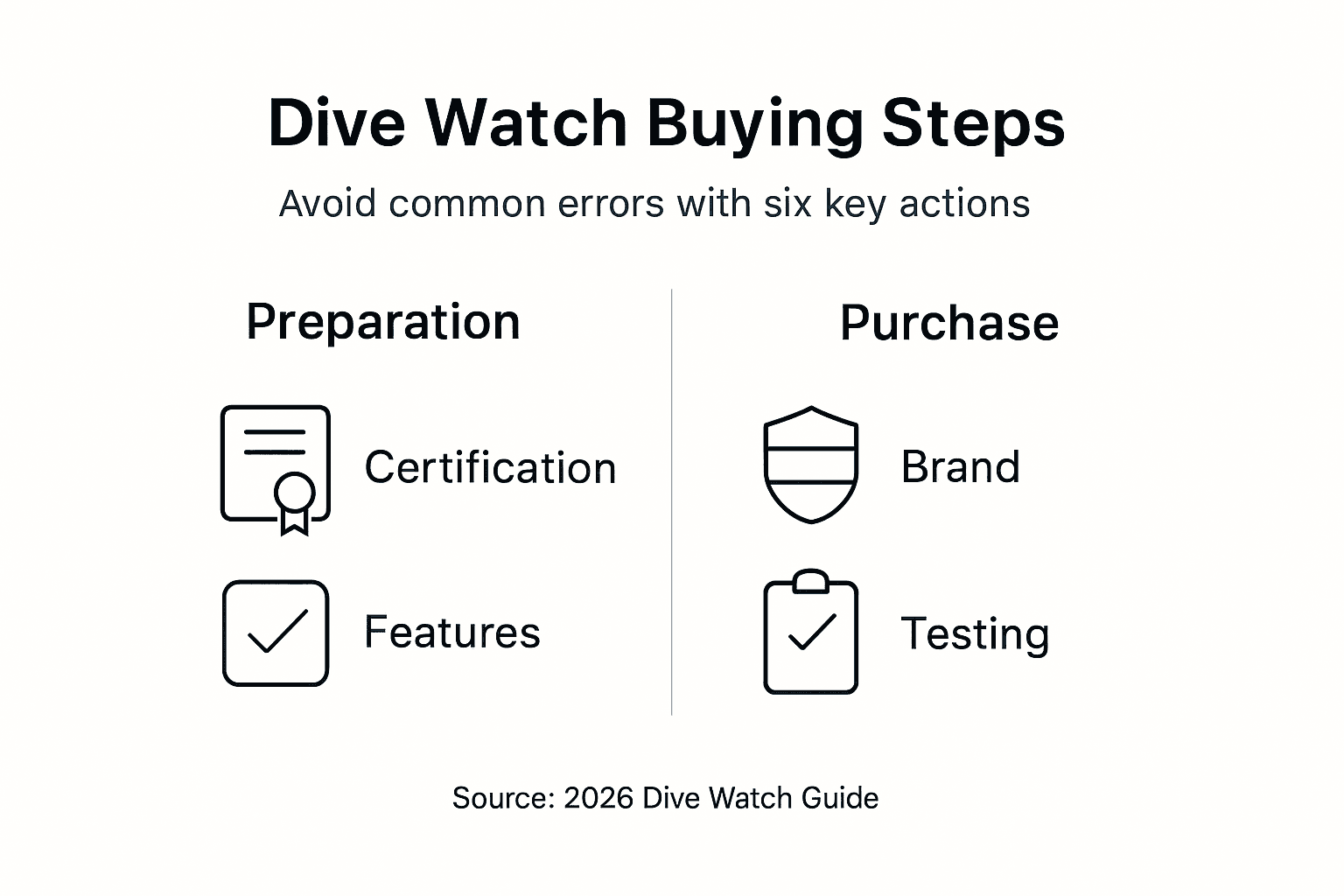
Recreational divers benefit from redundancy during travel. Remote dive locations might lack repair facilities if your computer breaks. A mechanical dive watch ensures you can continue diving safely using tables while your computer gets repaired or replaced. This backup capability provides peace of mind and protects your dive vacation investment.

Summary and Practical Advice for Choosing Your Dive Watch

Selecting the right dive watch requires balancing technical standards, heritage value, and practical application. Follow these steps to make an informed choice matching your diving needs and collecting interests.

  1. Verify ISO 6425 certification ensuring the watch meets professional underwater reliability standards rather than marketing claims.
  2. Research brand heritage and patent history to assess genuine innovation contributions versus design copying.
  3. Compare mechanical and digital features based on your diving style, whether recreational, technical, or commercial.
  4. Evaluate servicing logistics including local watchmaker availability and typical maintenance costs over ownership.
  5. Consider how the watch integrates with your existing dive computer and equipment for practical redundancy.
  6. Check luminous material quality and dial legibility ensuring visibility in conditions you typically dive.
  7. Assess case size and weight for comfort during extended wear both underwater and as daily timepiece.

Pro Tip: Prioritize watches with documented dive team use or military service history. These provide proven reliability evidence beyond manufacturer specifications and often have interesting provenance adding collector value.

Choosing the right dive watch means understanding your priorities. Technical divers need robust backup timing above all. Collectors value historical significance and brand innovation legacy. Recreational divers want reliable tools that transition from water to daily wear. Your primary use case determines which features matter most and where to invest your budget.

Authentic dive watches represent the intersection of engineering excellence and horological artistry. They solve real problems divers face while honoring decades of innovation that made modern diving safer. Whether you’re building a collection or gearing up for your next dive trip, selecting watches that combine proven heritage with contemporary reliability ensures satisfaction for years to come.

Explore Aquastar’s Legacy of Professional Dive Watches

Aquastar offers dive watches meeting rigorous ISO 6425 standards while embodying the historical innovations that shaped modern underwater timekeeping. Each piece reflects decades of exclusive dive watch focus, from the pioneering Navigator analog dive computer to contemporary models serving commercial and recreational divers worldwide.

https://aquastar.ch

Discover how professional dive watch features combine with Swiss craftsmanship in timepieces built for actual underwater use, not just dive styling. Whether you’re adding to your collection or selecting your first serious dive watch, Aquastar’s range balances technical excellence with the heritage serious collectors value. Explore their collector’s guide to understand what separates authentic dive watches from fashion pieces, or learn more about tool watch philosophy that prioritizes function over form. Each Aquastar watch represents commitment to the innovations their 1960s patents pioneered, continuing that legacy for today’s divers who demand reliability when it matters most.

Why Choose a Dive Watch FAQ

What makes a dive watch different from a regular watch?

Dive watches meet ISO 6425 standards requiring minimum 100m water resistance, luminous visibility at 25cm in darkness, and tested shock plus magnetic resistance. Regular watches lack these certifications and use lighter sealing that fails under diving pressure. The robust construction, pressure tested cases, and unidirectional bezels make dive watches reliable underwater tools rather than just water resistant accessories.

Can I use a dive watch instead of a dive computer?

Dive watches serve as backup timing instruments but cannot replace dive computers’ real time decompression calculations and depth monitoring. Computers track nitrogen loading across multiple dives and gas mixtures, providing safety critical data dive watches don’t offer. Using both together creates redundancy where your mechanical watch ensures safe ascent timing if your computer fails at depth.

How often should I service my dive watch to maintain water resistance?

Service intervals typically range from three to five years depending on diving frequency and environmental exposure. Saltwater, temperature extremes, and UV radiation degrade gaskets gradually even if the watch keeps running. Regular pressure testing during service verifies continued ISO 6425 compliance and prevents moisture damage that occurs before you notice visible leaks.

Why do collectors prefer mechanical dive watches over digital models?

Mechanical dive watches offer superior longevity, require no batteries, and maintain value through generations with proper care. Historical significance from brands like Aquastar that pioneered dive watch innovations adds heritage appeal digital watches lack. Collectors appreciate the craftsmanship, documented patents, and proven dive team use history that mechanical pieces provide alongside their practical backup timing function.

Posted on

Watch Lume Explained: Impact on Dive Watches

Watch Lume Explained: Impact on Dive Watches - what is watch lume

What Is Watch Lume: at a glance

What is watch lume? Radium, tritium and Super-LumiNova explained — how application, formulation and dial architecture decide nighttime legibility. Use this guide on what is watch lume to weigh design choices, engineering trade-offs and how the category translates to real Aquastar dive watches.

TopicWhat is watch lume
Read time5-8 min
SourceAquastar editorial

Watch Lume Explained: Impact on Dive Watches - what is watch lume

The glow from a professional dive watch dial is more than a badge of style—it is a vital feature that can determine safety when navigating underwater. Dive watch collectors in North America and Europe know that not all luminous materials are created equal. From the notorious hazards of radium to the advanced safety of strontium aluminate pigments, the history of lume reveals both crucial innovations and persistent myths. This article explains the basics of watch lume, the truth behind common misconceptions, and the development of luminous material technology.

Table of Contents

Key Takeaways

PointDetails
Lume FunctionalityLume enhances watch readability in darkness, essential for divers. It should be charged adequately for optimal performance underwater.
Material EvolutionModern luminous materials like Strontium Aluminate are far safer and more effective than older radioactive options like Radium and Tritium.
Application QualityThe method of lume application significantly affects brightness and longevity, distinguishing professional dive watches from standard models.
Collector ConsiderationsOriginal lume increases vintage watch value, emphasizing the importance of preservation over relume services among collectors.

Watch lume basics and common myths

Lume is the luminous material applied to watch hands and dials to make them readable in darkness. Without it, even the finest dive watch becomes useless when you’re underwater in low-light conditions or navigating at depth where natural light cannot reach. This property makes lume not just a convenience feature—it’s a survival tool for professional divers.

The history of lume reveals why divers care so much about choosing the right material. Early watch manufacturers used radium, a radioactive element that glowed brilliantly for decades without needing external light. The problem was clear once scientists understood radioactivity: radium caused serious health risks to workers and wearers alike. Manufacturers then switched to tritium, which is also radioactive but contained safely in sealed tubes on watch hands.

Today’s dive watches use phosphorescent pigments like zinc sulfide and strontium aluminate—materials that charge from ambient light and release that energy as visible glow. These modern formulations are completely safe and perform remarkably well in total darkness.

Common myths about lume

Most divers hold misconceptions about how lume works. Here are the facts:

  • Myth: Lume glows forever. Truth: Modern phosphorescent materials fade over time, typically lasting 6-12 hours of useful brightness in complete darkness.
  • Myth: Brighter lume means better lume. Truth: Brightness depends on charging conditions and material composition, but longevity matters more for dive watch reliability.
  • Myth: All lume formulations are identical. Truth: Quality varies significantly between manufacturers and application techniques, affecting both initial brightness and fade time.
  • Myth: You need sunlight to charge lume. Truth: Any visible light charges phosphorescent materials, including artificial light from dive lights or dive computers.

Modern lume materials are safe, effective, and reliable enough for professional diving when properly applied and maintained.

The application process matters

How lume is applied to a watch directly affects its performance underwater. The process involves mixing luminous powder with binders and carefully applying it to watch hands or dials. Poor application results in uneven brightness, faster fade rates, and inconsistent readability at depth.

Quality manufacturers fill recesses precisely, polish around the edges for cleanliness, and ensure complete coverage on critical reading surfaces. This attention to detail separates professional dive watches from consumer models. When you’re relying on your watch as a backup timing device underwater, these details matter tremendously.

Pro tip: Before each dive, expose your watch to bright light for at least two minutes to fully charge the lume, ensuring maximum visibility throughout your bottom time.

Types and history of luminous materials

Watch lume has evolved dramatically over more than a century. Understanding this progression reveals why modern dive watches perform so reliably in darkness and why older timepieces present health risks. The evolution reflects both scientific discovery and practical necessity for underwater operations.

The radioactive era

Early watch manufacturers discovered that radium produced an intense, self-sustaining glow. Radium required no charging from external light sources—it simply glowed continuously for decades. Factory workers painted dials by hand, often licking their brushes to maintain fine points. This practice, combined with inadequate safety protocols, caused widespread illness and death among manufacturers.

Radium became largely banned for consumer watches by the 1970s due to toxicity concerns. However, tritium emerged as a safer radioactive alternative. Tritium emits beta particles at lower energy levels and is sealed within tube-shaped hands, preventing direct skin contact.

Modern phosphorescent materials

Today’s professional dive watches rely entirely on non-radioactive luminous pigments that charge from ambient light. The current standards include:

  • Zinc sulfide: Earlier phosphorescent material offering moderate brightness and moderate fade times
  • Strontium aluminate: Modern formulation providing superior brightness and extended luminosity
  • Branded variants: Proprietary names like Super-LumiNova represent advanced strontium aluminate compounds engineered for maximum performance

Strontium aluminate-based pigments represent the significant advancement in both safety and performance. They absorb light energy efficiently and release it gradually over many hours, making them ideal for backup timing devices underwater.

Infographic showing watch lume materials evolution

Historical context and scientific evolution

Historical luminescent materials date back centuries to natural minerals like Bologna Stone, discovered in the early 1600s. Scientists gradually understood phosphorescence through experimentation and observation. The transition from radioactive materials to safe phosphorescent compounds represents genuine progress in both watchmaking and worker safety.

Modern strontium aluminate lume delivers the brightness and longevity that professional divers require without any radioactive hazards.

For dive watch enthusiasts, this history matters because it explains material choices. Vintage watches with tritium markings are safe to own but require proper handling. Contemporary dive watches use completely safe compounds that perform superbly in the demanding underwater environment.

Here’s a summary of the evolution and properties of watch lume materials:

Material TypeEra of UseMain PropertiesSafety Considerations
RadiumEarly-mid 20th c.Continuous glow, no rechargingHighly radioactive, hazardous
Tritium1960s-1990sSealed tubes, fades over yearsMild radioactivity, safer design
Zinc sulfide1970s-presentCharged by light, moderate glowNon-radioactive, safe
Strontium aluminate1990s-presentBright, long-lasting glowNon-radioactive, fully safe

Pro tip: When purchasing a vintage dive watch, verify whether it uses tritium or radium; tritium-marked watches are safe, while radium models should be professionally assessed before use.

How watch lume is applied and functions

Watch lume application is both a craft and a science. The process determines whether your dive watch will deliver reliable illumination at depth or fade quickly when you need it most. Understanding this process reveals why professional watches cost more than budget alternatives.

The application process

Applying lume begins with preparation. Watchmakers mix luminous powder with a resin binder to create a workable compound. This mixture must achieve the correct consistency—too thick and it won’t flow into fine details; too thin and it won’t provide adequate brightness.

The prepared lume is then carefully deposited into recesses on watch hands and dial markers. Precision matters here because uneven application creates uneven brightness underwater. After deposition, craftspeople polish away excess material to ensure clean edges and consistent visibility.

Watchmaker applying luminous paint to watch hand

Quality manufacturers spend considerable time on this step. Poor polishing leaves dried lume residue that obscures dial details and reduces readability. Professional dive watches receive meticulous attention during this finishing phase.

How phosphorescence works

Lume performs through a physical process called phosphorescence. The luminous pigment absorbs light energy from any visible source—sunlight, artificial light, or even your dive light. This absorbed energy excites electrons in the material.

When darkness falls, the excited electrons gradually release that stored energy as visible light. This process continues for hours, creating the characteristic green or blue glow you see underwater. The glow gradually dims as the electrons finish releasing their energy.

Different materials have dramatically different performance characteristics:

  • Zinc sulfide: Older formulation offering modest brightness and fade time
  • Strontium aluminate: Modern standard providing approximately ten times greater brightness and longevity than zinc sulfide

Phosphorescent materials continue improving through research and development. Strontium aluminate compounds represent the current peak of safety and performance for professional dive watches.

Performance underwater

Underwater, lume faces unique challenges. Cold temperatures slow the phosphorescence process slightly. Pressure has minimal effect on the chemical reaction. What matters most is adequate charging time before your dive and application quality during manufacturing.

Professional dive watch lume must deliver readable illumination throughout your entire bottom time without radioactive hazards.

This explains why backup timing becomes critical. Your dive computer provides primary timing, but your watch lume offers a redundant system when electronics fail or batteries deplete.

Pro tip: Charge your watch lume under bright artificial light for at least three minutes immediately before entering the water; this maximizes initial brightness and extends visible glow duration throughout your dive.

Safety regulations and material risks

Watch lume safety represents a critical consideration for both manufacturers and collectors. The history of luminous materials in timepieces reveals hard lessons about protecting human health. Modern regulations ensure that today’s dive watches pose no health risks from their illumination systems.

Historical hazards and why regulations exist

Radium was the first choice for watch luminescence. Workers handled it without protection, licking brush tips and ingesting particles. The consequences were devastating: widespread radiation poisoning, bone cancer, and premature death among manufacturers who trusted the technology.

These tragedies prompted regulatory action. Radium restrictions gradually took effect across North America and Europe during the 1970s. The lesson was clear: luminous materials require strict oversight to prevent occupational and consumer harm.

Tritium followed as an alternative, sealed within watch hands to minimize direct contact. While far safer than radium, tritium remains radioactive and subject to regulations on safe transport of radioactive materials.

Modern regulatory frameworks

Today’s phosphorescent lume materials operate under comprehensive safety oversight. The Toxic Substances Control Act provides regulatory authority in the United States, mandating that manufacturers report and restrict hazardous substances used in consumer products.

International standards also govern watch lume composition:

  • Material safety data sheets: Required documentation of all chemical components and hazard profiles
  • Toxicity testing: Independent verification that pigments pose no health risks through normal handling
  • Environmental compliance: Standards ensuring lume materials do not contaminate groundwater or ecosystems
  • Manufacturing oversight: Workplace safety requirements protecting production workers

These regulations apply to zinc sulfide and strontium aluminate formulations used in professional dive watches. Unlike radioactive predecessors, modern materials satisfy safety requirements without compromise.

Collector concerns with vintage watches

Vintage watches using radium require professional assessment before regular wear. Radium-marked dials continue emitting radiation indefinitely. Professional conservators can safely evaluate and sometimes remediate these pieces.

Tritium-marked watches present minimal ongoing risk. Sealed tritium loses potency gradually over 12-15 years, eventually becoming inert. These watches remain safe to wear and collect.

Modern dive watch lume materials meet all safety regulations and pose zero health risks during normal ownership and use.

Understanding this regulatory landscape helps collectors make informed decisions about vintage acquisitions and appreciate why contemporary watches cost more to produce.

Pro tip: If acquiring a vintage dive watch marked “Radium,” consult a professional horologist or conservator before wearing it; tritium-marked pieces are safe to wear without professional evaluation.

Dive watch collecting has evolved into a serious pursuit with distinct values and market dynamics. Lume condition and authenticity represent major factors influencing both collector interest and monetary value. Understanding collector priorities helps explain why some vintage watches command premium prices while others remain overlooked.

The originality premium

Collectors place exceptional value on original lume. A dive watch with its factory-applied luminous material intact represents a historical artifact—a snapshot of manufacturing standards from a specific era. This originality carries weight in collector circles far beyond mere functionality.

The debate over reluming divides the community. Relume services restore a watch to full brightness and functionality. However, originality and condition significantly impact value for serious collectors who view watches as stewardship items rather than mere possessions.

Aged, yellowed lume tells a story. It shows how a watch was used, when it was manufactured, and how time affected the specific pigment formula. Removing this patina erases historical information that cannot be recovered.

Value factors in the collector market

Dive watch valuations consider multiple lume-related elements:

  • Lume evenness: Consistent brightness across hands and dial increases value
  • Lume fade pattern: Specific yellowing characteristics indicate material age and authenticity
  • Completeness: Original hour markers with matching lume condition command premiums
  • Service history: Documentation of professional maintenance preserves value better than undocumented reluming

A watch with original, well-preserved lume from the 1960s may be worth 30-50% more than an identical model that has been relumed. The premium reflects collector preferences for authenticity and historical integrity.

The following table highlights key factors influencing vintage dive watch collector value:

FactorImpact on ValueReason for Importance
Original lumeHighShows originality and historical use
Relumed dialLowerLoses authenticity and patina
EvennessIncreasesIndicates careful manufacture
Faded patternPremiumVerifies age, collector interest

Ethical collecting and stewardship

Modern collector ethics emphasize treating items as stewardships with responsibility for preservation. This perspective shifts focus from personal enjoyment to historical responsibility.

From this viewpoint, original lume—even if yellowed or partially faded—maintains authentic historical value. The watch becomes a document of both technological development and manufacturing practices from its era.

Collectors increasingly recognize that original lume, despite fading, preserves irreplaceable historical context that reluming destroys forever.

This philosophical shift explains rising prices for well-preserved vintage pieces with untouched lume. The market rewards collectors who prioritize preservation over restoration.

Pro tip: When evaluating vintage dive watches, request high-resolution photographs of the lume under both regular and UV light to assess originality and condition before purchasing; aged lume shows specific characteristics that cannot be replicated.

Experience Reliable Dive Watch Lume with Aquastar

Understanding the importance of durable and effective watch lume is essential for every diver. The article highlights common challenges such as lume fading during your dive and uneven brightness from poor application. As a professional diver, you need a backup timing device that performs flawlessly in darkness without any safety risks. Aquastar has been pioneering dive watch technology since the 1960s, designing watches with advanced luminous materials that deliver consistent glow and readability underwater.

https://aquastar.ch

Dive deeper into Aquastar’s legacy of crafting professional mechanical dive watches built exclusively for underwater challenges. With patented innovations and meticulous lume application techniques, Aquastar watches ensure your timepiece charges rapidly and shines brightly throughout your entire bottom time. Don’t compromise safety or visibility; choose the dive watch trusted by commercial and recreational divers. Explore the full collection and the story behind our cutting-edge timekeeping solutions at Aquastar. Make your next dive safer by relying on proven expertise – visit Aquastar today.

Frequently Asked Questions

What is watch lume and why is it important for dive watches?

Watch lume is a luminous material applied to watch hands and dials, allowing them to be readable in darkness. It is especially crucial for dive watches as it serves as a survival tool for divers in low-light conditions underwater.

How long does modern lume last in complete darkness?

Modern phosphorescent materials typically provide useful brightness for about 6-12 hours in complete darkness, depending on the composition and charging conditions.

What are the main differences between tritium and modern phosphorescent materials?

Tritium is a radioactive substance contained in sealed tubes that emits a glow, while modern materials like strontium aluminate and zinc sulfide are non-radioactive and charge from ambient light, providing safer and more efficient illumination for dive watches.

How can I maximize the brightness and longevity of my dive watch lume?

To maximize brightness and longevity, expose your dive watch to bright light for at least two minutes before each dive. This ensures the lume is fully charged and ready for use during your time underwater.

Posted on

Chronograph Watches Explained: 55-Hour Dive Safety Guide

Chronograph Watches Explained: 55-Hour Dive Safety Guide - chronograph watch explained

Chronograph Watch Explained: at a glance

Chronograph watch explained for divers: how mechanical chronos with decompression scales and waterproof pushers serve as analog dive computers. Use this guide on chronograph watch explained to weigh design choices, engineering trade-offs and how the category translates to real Aquastar dive watches.

TopicChronograph watch explained
Read time5-8 min
SourceAquastar editorial

Chronograph Watches Explained: 55-Hour Dive Safety Guide - chronograph watch explained

Many divers dismiss chronograph watches as fashion accessories, unaware these instruments carry patented safety features designed to preserve life underwater. Aquastar pioneered mechanical dive chronographs in the 1960s, filing patents that transformed simple timekeepers into analog dive computers with decompression scales and water-resistant pushers. This guide explores the technical mechanisms, operational procedures, and safety functions that make chronograph watches essential backup instruments for professional and recreational divers worldwide.

Table of Contents

Key Takeaways

PointDetails
Patented Timing SystemsAquastar chronographs integrate rotating bezels with no-decompression scales enabling multi-dive nitrogen tracking.
Underwater Pusher OperationMechanical pushers feature specialized seals allowing start, stop, and reset functions during dives without water intrusion.
Analog Dive Computer HeritageAquastar created the first analog dive computer, the Navigator, combining elapsed time measurement with decompression calculations.
Modern Material EvolutionContemporary dive chronographs preserve vintage patented functions while upgrading to sapphire crystals and automatic movements.
Backup Safety RoleChronographs serve as reliable mechanical backups to electronic dive computers, requiring proper training for safe operation.

Introduction to Chronograph Watches in Diving

A chronograph watch combines standard timekeeping with independent stopwatch functions, featuring additional subdials and pushers that measure elapsed time intervals. The emergence of dive chronographs occurred in the early 1960s when commercial and military divers needed precise underwater timing beyond basic elapsed dive time. These specialized instruments became essential tools for managing decompression stops, tracking multiple dive sequences, and calculating nitrogen loading during repetitive dives.

Dive chronographs addressed critical functional demands that standard dive watches couldn’t meet. Divers required the ability to start and stop timing functions independently during underwater operations, measure specific work intervals, and track decompression obligations across multiple dives in a single day. The mechanical reliability of these instruments proved vital when electronic devices failed in saltwater environments or extreme pressure conditions.

Aquastar emerged as a pioneering manufacturer dedicated exclusively to dive watch production, filing multiple patents throughout the 1960s that established standards still used today. The brand introduced innovations like the skindiver case design and integrated decompression scales that transformed chronographs from simple timing tools into comprehensive dive safety instruments. These patents addressed specific underwater challenges:

  • Water-resistant pusher systems operating reliably at depth
  • Rotating bezels combining elapsed time with decompression limit calculations
  • High-contrast dial layouts readable in low-visibility conditions
  • Robust mechanical movements resisting pressure and temperature fluctuations
  • Corrosion-resistant case materials withstanding prolonged saltwater exposure

Mechanical Chronograph Mechanisms Specific to Diving

Mechanical chronographs employ two primary actuation systems: column wheel mechanisms and cam-actuated designs. Column wheel movements offer smoother pusher action and greater long-term reliability, making them preferred for professional dive applications where precise timing control matters. Cam-actuated systems provide simpler construction with fewer parts, though they typically deliver less refined pusher feel and increased wear over thousands of cycles.

The La Joux-Perret automatic column-wheel movement in the Aquastar Deepstar delivers 55 hours of power reserve with 200-meter water resistance, ensuring extended dive operation without manual winding. Automatic movements eliminate the need for crown manipulation underwater, reducing potential water ingress points. Manual wind chronographs offer thinner case profiles and direct tactile feedback during winding, appealing to divers who prefer traditional mechanical interaction.

Underwater close-up of dive chronograph

Water resistance for dive chronographs requires specialized engineering beyond standard watch construction. Pusher systems incorporate multiple gaskets, spring-loaded seals, and precisely machined tolerances preventing water penetration during underwater actuation. The pushers must maintain friction levels allowing deliberate operation while resisting accidental activation from bumps or pressure changes during descent and ascent.

Reliable underwater pusher operation depends on several mechanical factors. The spring tension must overcome water pressure at rated depths while remaining operable with gloved hands. Pusher stems require extended lengths reaching through thicker case walls needed for pressure resistance. Screw-down pusher designs add an extra security layer, though they prevent underwater chronograph use unless specifically engineered for submerged operation.

Pro Tip: Check your chronograph’s power reserve indicator before diving and ensure the movement operates at 28,800 vibrations per hour or higher for optimal timing accuracy during critical decompression calculations.

Key mechanical specifications affecting dive reliability include:

  • Movement frequency determining timing precision under varying temperatures
  • Mainspring torque curves affecting power delivery throughout reserve duration
  • Escapement design resisting magnetic fields from electronic dive equipment
  • Jewel count indicating bearing quality for long-term accuracy
  • Shock protection systems absorbing impacts during equipment handling

Aquastar’s Patented Chronograph Dive Functionalities

Aquastar’s patented rotating bezel system combines elapsed time measurement with no-decompression limit scales, creating a mechanical dive computer on your wrist. Introduced in 1962, this innovation allowed divers to track both current dive duration and permissible bottom time before requiring decompression stops. The dual-scale bezel rotates bidirectionally, enabling divers to set markers for planned ascent times while simultaneously monitoring actual elapsed minutes.

The no-decompression limit scale operates by aligning specific depth markers with elapsed time indicators. Divers set the bezel’s zero marker at dive start, then read the intersection of their current depth with elapsed time to determine remaining no-decompression minutes. This mechanical calculation provided critical safety information decades before electronic dive computers became affordable and reliable for recreational divers.

Aquastar’s analog dive computer features integrated decompression calculations directly into the bezel design. The modern Deepstar chronograph preserves these patented scales while adding contemporary materials and movements. The Navigator model took this concept further, becoming the first true analog dive computer combining chronograph functions with comprehensive decompression tables on rotating inner and outer bezels.

FeatureVintage Aquastar (1960s)Modern Re-Edition
Bezel FunctionPatented dual-scale decompressionSame patented scales preserved
Movement TypeManual wind column wheelAutomatic column wheel
Water Resistance200 meters200-300 meters
Crystal MaterialAcrylic domedSapphire with anti-reflective coating
Case ConstructionStainless steel 37-39mmStainless steel 39-42mm options

These patented features deliver tangible benefits for dive planning and safety management:

  • Immediate visual reference for remaining no-decompression time without electronic devices
  • Mechanical reliability unaffected by battery depletion or electronic failure
  • Intuitive operation requiring minimal training for basic dive timing
  • Redundant safety backup when primary dive computers malfunction
  • Historical accuracy preserving proven decompression calculation methods

Decompression and Dive Safety Features in Chronographs

No-decompression limit scales represent the maximum time divers can spend at specific depths before requiring staged ascents to off-gas accumulated nitrogen. These scales prove critical because exceeding no-decompression limits without proper stops risks decompression sickness. The Aquastar Deepstar’s bezel tracks both elapsed dive time and nitrogen loading calculations, providing real-time safety information throughout the dive.

Monitoring multiple dives using chronograph bezels requires systematic procedures:

  1. Set the bezel’s zero marker aligned with the minute hand at dive start to track total elapsed time.
  2. Note your maximum depth and cross-reference with the bezel’s depth markings to find your no-decompression limit.
  3. Monitor the chronograph subdial tracking cumulative bottom time if performing repetitive dives within 24 hours.
  4. Before starting a second dive, calculate your residual nitrogen group using the bezel’s tables and adjust permissible bottom time accordingly.
  5. Reset the chronograph between dives but maintain bezel position to track surface interval duration for nitrogen off-gassing.
  6. Cross-reference all bezel calculations with dive tables or electronic computers before committing to dive plans.

The chronograph’s elapsed time measurement differs fundamentally from comprehensive nitrogen tracking. While the stopwatch function accurately records minutes underwater, it cannot account for varying depths, ascent rates, or physiological factors affecting decompression needs. The bezel scales provide estimated guidelines based on standard dive table calculations, offering reasonable safety margins for recreational diving within sport diving limits.

Pro Tip: Always verify your bezel readings against your primary electronic dive computer’s real-time tissue loading calculations, using the mechanical chronograph as a secondary reference rather than sole safety instrument.

Mechanical chronographs carry important operational limitations underwater. They cannot measure actual nitrogen absorption rates, account for individual physiological differences, track multi-level dive profiles accurately, or adjust for altitude diving conditions. These instruments work best for square-profile dives at consistent depths, matching the assumptions built into traditional dive table calculations that informed their bezel scale designs.

Comparison of Vintage vs Modern Dive Chronograph Features

Vintage Aquastar dive chronographs from the 1960s and 1970s featured specific characteristics reflecting period manufacturing capabilities and diver preferences. Manual wind movements dominated this era, requiring crown winding every 40 to 48 hours but offering thinner case profiles appreciated by divers wearing watches under wetsuit cuffs. The patented bezel systems introduced on these vintage models established the foundation for modern dive chronograph functionality. Case sizes typically measured 37mm to 39mm, considered large for the period but modest by contemporary standards.

Modern re-editions preserve core patented functions while incorporating significant material and movement improvements. The contemporary Deepstar models feature sapphire crystals offering superior scratch resistance compared to acrylic, anti-reflective coatings improving underwater visibility, and automatic movements eliminating manual winding requirements. Stainless steel metallurgy has advanced, providing better corrosion resistance in saltwater environments. Water resistance ratings often extend to 300 meters with improved gasket materials and case construction techniques.

SpecificationVintage ModelsModern Re-Editions
MovementManual wind, 40-48hr reserveAutomatic, 55+ hour reserve
CrystalAcrylic domedSapphire with AR coating
Case Size37-39mm39-42mm options
Lume MaterialRadium/TritiumSuper-LumiNova
Bezel DesignAluminum insertCeramic or steel
Strap OptionsTropic rubber, leatherModern rubber, NATO, bracelet
Price Range$3,000-$8,000 (collector market)$2,500-$5,000 (new)

Modern Aquastar chronographs maintain the patented underwater timing functions that distinguished vintage models. The decompression scales, bidirectional bezel operation, and water-resistant pusher systems continue operating on identical principles. This functional continuity allows divers trained on vintage instruments to use contemporary models without relearning operational procedures. The updated materials and movements enhance reliability and durability while preserving the mechanical character collectors value.

Both vintage and modern forms attract distinct collector segments. Vintage enthusiasts prize original patented designs, historical significance, and the connection to pioneering dive exploration. These watches carry stories of actual underwater use during the golden age of recreational diving. Modern re-editions appeal to divers seeking proven functionality with contemporary reliability, warranty coverage, and the ability to actually use the watch for its intended purpose without risking irreplaceable vintage pieces. The vintage Deepstar chronographs command premium prices reflecting their historical importance and limited surviving examples in good condition.

Common Misconceptions and Technical Clarifications

The perception that chronographs serve only as fashion accessories ignores the engineering sophistication required for professional dive timing. Aquastar dive chronographs incorporate water-resistant pusher systems, patented decompression scales, and movements tested under extreme conditions, distinguishing them from decorative timepieces lacking functional dive capability. The patents filed by Aquastar addressed specific underwater timing challenges that fashion watches never intended to solve.

Pusher operation underwater requires specialized construction beyond standard water resistance. Many assume operating chronograph pushers compromises water resistance, but properly designed dive chronographs incorporate multiple sealing systems preventing water ingress during underwater actuation. The pusher stems extend through reinforced case tubes with spring-loaded gaskets maintaining pressure even when depressed. This engineering allows divers to start, stop, and reset timing functions during dives without flooding the movement.

Confusion often arises between chronograph elapsed time measurement and comprehensive dive computer functions. Chronographs measure time intervals accurately but cannot calculate real-time tissue nitrogen loading, track ascent rates, or account for multi-level dive profiles. Electronic dive computers incorporate physiological models, depth sensors, and algorithms adjusting decompression requirements based on actual dive conditions. The chronograph’s bezel scales provide estimated guidelines based on standard dive tables, offering reasonable safety margins for simple dive profiles.

Mechanical chronographs function as safety backups rather than dive computer replacements. Modern diving standards require electronic computers as primary instruments, with mechanical chronographs serving secondary roles. The redundancy proves valuable when batteries fail, electronics malfunction, or sensors provide questionable readings. Experienced divers maintain proficiency with mechanical timing and table-based calculations as foundational skills underlying electronic convenience.

Safe chronograph use requires proper dive training beyond simply reading the watch. Understanding decompression theory, recognizing nitrogen loading symptoms, planning conservative dive profiles, and executing controlled ascents all depend on comprehensive dive education. The chronograph provides timing data, but the diver must interpret that information correctly and make sound safety decisions. Collector misconceptions about dive chronographs often stem from viewing them as collectibles rather than functional instruments requiring operational knowledge:

  • Assuming all chronographs with rotating bezels qualify as dive instruments
  • Believing water resistance ratings alone determine dive suitability
  • Expecting mechanical chronographs to replace modern dive computers entirely
  • Operating pushers without understanding their water-resistant depth limitations
  • Neglecting regular pressure testing and gasket service for underwater reliability

Practical Operational Guidance for Using Chronographs in Dive Scenarios

Operating chronograph pushers underwater requires deliberate technique ensuring accurate timing without damaging sealing systems. Follow these procedures for safe underwater operation:

  1. Press the start pusher firmly and completely before releasing to ensure the chronograph mechanism fully engages without partial activation causing timing errors.
  2. Monitor the running seconds subdial confirming the chronograph activated properly, as partial pusher depression may not trigger the mechanism.
  3. Press the stop pusher with equal firmness at dive end or when timing specific intervals, holding briefly to ensure complete mechanism disengagement.
  4. Activate the reset pusher only after fully stopping the chronograph, never while the mechanism runs, to prevent damage to the column wheel or cam system.
  5. Limit underwater pusher operations to necessary timing functions, as excessive actuation increases gasket wear and potential seal degradation over time.
  6. Rinse the watch thoroughly in fresh water after saltwater diving, operating the pushers several times during rinsing to clear salt deposits from the pusher tubes.

Reading and aligning no-decompression bezel scales during multi-dive planning requires understanding the underlying decompression theory. Set the bezel’s zero marker at dive start, then track your maximum depth throughout the dive. The bezel’s depth markings intersect with elapsed time indicators showing remaining no-decompression minutes at that depth. For repetitive dives, calculate your residual nitrogen group based on surface interval duration and adjust the bezel accordingly before the second dive.

Best practices for elapsed time measurement emphasize conservative safety margins. Start the chronograph at descent rather than surface departure, capturing actual bottom time. Stop timing at ascent start rather than surface arrival, ensuring you account for all time spent at depth. Build in safety stops even when remaining within no-decompression limits, using the chronograph to time three to five-minute stops at 15 feet.

Mechanical chronographs carry important limitations compared to electronic dive computers. They cannot adjust for altitude diving, account for cold water exposure increasing decompression risk, track actual tissue nitrogen loading in real time, or warn of dangerous ascent rates. The Aquastar Deepstar chronograph pushers operate reliably underwater, but the watch provides estimated safety guidelines rather than comprehensive physiological monitoring.

Pro Tip: Program your electronic dive computer as your primary instrument and reference the mechanical chronograph’s bezel scales as a secondary check, using any discrepancies as signals to adopt the more conservative timing guideline.

Conclusion: Bridging Historical Innovation to Modern Dive Practice

Aquastar’s patented safety features and mechanical excellence established chronograph dive watches as essential professional tools rather than mere accessories. The integration of decompression scales, water-resistant pushers, and reliable column-wheel movements created instruments serving real safety functions during underwater operations. Modern re-editions preserve these proven innovations while incorporating contemporary materials and automatic movements enhancing reliability and user experience.

The enduring value of analog chronographs as professional dive backups persists despite electronic computer dominance. Mechanical reliability independent of batteries, intuitive operation under stress, and time-proven accuracy provide reassurance when primary systems fail. The blend of heritage and modern technology in contemporary Aquastar models honors historical innovation while meeting current dive standards and collector expectations. Understanding these instruments encourages informed use, proper maintenance, and appreciation for the engineering sophistication preserving life underwater.

Explore Aquastar’s Dive Chronograph Collection

Aquastar continues innovating professional dive chronographs building on six decades of patented safety features and mechanical excellence. Our comprehensive tool watch guide explores the engineering principles distinguishing functional dive instruments from fashion timepieces. Discover the differences between automatic and manual movements to determine which best suits your diving style and maintenance preferences.

https://aquastar.ch

The flagship Aquastar Deepstar 39mm Chronograph combines the original patented bezel design with a modern automatic column-wheel movement, sapphire crystal, and 200-meter water resistance. This watch serves both as a reliable dive backup and a connection to the pioneering innovations that transformed underwater timing. Whether you dive professionally, recreationally, or collect mechanical instruments with proven heritage, Aquastar’s chronographs deliver the functionality and reliability divers have trusted since 1962.

FAQ

What is a chronograph watch and how is it different from a standard dive watch?

A chronograph watch includes independent stopwatch functions with subdials and pushers for timing specific events, while standard dive watches primarily track elapsed dive time using a rotating bezel. Chronographs offer start, stop, and reset capabilities enabling precise measurement of multiple intervals during a single dive. The added complexity provides greater timing versatility for professional diving operations requiring detailed time tracking.

Can chronograph pushers be safely used underwater during dives?

Properly designed dive chronograph pushers feature specialized seals and spring-loaded mechanisms allowing underwater operation without water intrusion. Aquastar dive chronographs incorporate multiple gasket systems and reinforced pusher tubes maintaining water resistance during actuation at rated depths. Divers can start, stop, and reset timing functions throughout the dive when using chronographs specifically engineered for underwater pusher operation.

How do dive chronographs assist with decompression stops and safety?

Bezel scales on dive chronographs provide no-decompression limit estimates and track elapsed bottom time for decompression planning. Aquastar’s patented bezel design integrates depth markers with time scales allowing divers to monitor nitrogen loading across multiple dives. These mechanical calculations support safety planning alongside electronic dive computers, offering backup timing when primary instruments fail or require verification.

Are mechanical chronograph watches reliable compared to electronic dive computers?

Mechanical chronographs provide robust, independent timing functions as backup instruments but lack the physiological sensors and real-time calculations of electronic dive computers. They excel at measuring elapsed time and offering decompression estimates based on standard dive tables. Divers should use chronographs as supplementary safety tools rather than replacements for dive computers’ comprehensive monitoring of tissue loading, ascent rates, and multi-level profile tracking.

Posted on

How Does a Dive Watch Bezel Work? 60 Clicks for Safety

How Does a Dive Watch Bezel Work? 60 Clicks for Safety - how does a watch bezel work

How Does A Watch Bezel Work: at a glance

How does a dive watch bezel work? Unidirectional rotation, 60 clicks, materials and why the design choice can save or risk a decompression stop. Use this guide on how does a watch bezel work to weigh design choices, engineering trade-offs and how the category translates to real Aquastar dive watches.

TopicHow does a watch bezel work
Read time5-8 min
SourceAquastar editorial

How Does a Dive Watch Bezel Work? 60 Clicks for Safety - how does a watch bezel work

Many divers mistakenly believe rotating their bezel clockwise is safe, but this error can dangerously increase decompression sickness risk. Dive bezels are critical safety tools for measuring elapsed dive time. This guide reveals how bezels work mechanically and why design matters for underwater safety.

Table of Contents

Key Takeaways

PointDetails
Unidirectional rotationBezels rotate only counterclockwise to prevent extending dive time accidentally.
Precise ratchetingThe 60-click mechanism provides minute-by-minute timing accuracy underwater.
Aquastar innovationAquastar pioneered key bezel patents in the 1960s that shaped modern dive watch safety.
ISO 6425 complianceStandards mandate bezel features essential to certified dive watch performance.
Alignment mattersProper bezel setting at dive start is critical for accurate elapsed time tracking.

Introduction to Dive Watch Bezels

A dive watch bezel is a rotating ring surrounding the watch dial that serves as a timing device critical for diving safety. Its primary function involves tracking elapsed dive time by rotating the bezel to align with the minute hand at dive start. Historical development of ISO 6425 standards established bezels as mandatory safety features for professional dive watches.

The history of Aquastar demonstrates how Swiss innovation transformed basic timing rings into sophisticated safety mechanisms. Manual bezel alignment at dive start establishes a zero reference point that remains visible throughout the dive. This framework ensures divers can continuously monitor time underwater without checking secondary instruments.

Bezel design contributes to diver safety through several key mechanisms:

  • Visible time tracking that works independently of watch movement complications
  • Tactile feedback through ratcheting clicks that confirm bezel position changes
  • High contrast markers that remain readable in murky water or low light conditions
  • Rugged construction that withstands impacts and pressure changes during descent

Understanding these fundamentals prepares you to appreciate the sophisticated engineering behind modern dive watch bezels.

Mechanical Operation of Dive Watch Bezels

The mechanical operation begins with aligning the bezel’s zero marker, typically a luminous triangle, with the minute hand at dive start. This alignment creates your reference point for measuring elapsed time throughout the dive. The bezel rotates around the watch case perimeter via a ratcheting mechanism featuring internal teeth that engage with spring-loaded pawls.

This ratcheting mechanism produces discrete clicks as the bezel rotates. Typical bezels feature 60 discrete clicks to track each minute securely without slipping during dives. Each click represents one minute of rotation, providing both audible and tactile confirmation of position changes. The Aquastar Model 60 mechanics exemplify precision engineering in this ratcheting system.

Minute markers arranged around the bezel perimeter enable precise time reading:

  1. The first 15 minutes typically feature individual minute markers for decompression stop accuracy
  2. Markers from 15 to 60 minutes may show 5-minute increments for extended dive tracking
  3. Luminous coating on markers ensures visibility in all underwater conditions
  4. High contrast colors distinguish timing markers from dial elements

The click feedback serves an engineering purpose beyond user satisfaction. Underwater, you cannot rely on visual confirmation alone when adjusting the bezel with gloved hands. The mechanical clicks provide tactile assurance that the bezel has moved to the intended position.

Reading elapsed time during a dive follows a straightforward process. Check where the minute hand currently points on the bezel scale. That number indicates minutes elapsed since dive start. If your minute hand points to the 25-minute marker on your bezel, you have been underwater for 25 minutes.

Pro Tip: Always verify full engagement of the bezel’s ratchet clicks before descent to avoid slippage that could compromise timing accuracy during your dive.

Safety Importance of Unidirectional Bezels

The critical safety feature of modern dive bezels is their unidirectional rotation capability. These bezels can only rotate counterclockwise, never clockwise. This design prevents accidental clockwise rotation that could underreport elapsed dive time and create dangerous situations.

Hand rotating dive watch bezel on boat

Imagine accidentally bumping your bezel clockwise during a dive. A bi-directional bezel would allow this rotation, making it appear you have been underwater for less time than reality. You might believe you have 10 minutes of bottom time remaining when you actually have only 5 minutes. This miscalculation dramatically increases decompression sickness risk.

The ratchet mechanism enforces unidirectional rotation through asymmetric tooth design. Teeth angle in one direction, allowing counterclockwise movement while blocking clockwise rotation. Spring-loaded pawls engage these angled teeth, creating a mechanical lock against reverse movement. Accidental impacts can only rotate the bezel counterclockwise, which shows more elapsed time and keeps you safer.

Key differences between bezel types highlight safety evolution:

  • Obsolete bi-directional bezels allowed rotation in both directions, creating timing risks
  • Modern unidirectional bezels comply with ISO safety standards for bezels
  • Professional dive watches exclusively use unidirectional designs for certified safety
  • Recreational watches sometimes feature bi-directional bezels for non-diving timing functions

Rotating a bezel clockwise during a dive can hide elapsed time, potentially causing you to exceed safe bottom time limits and risk decompression sickness. Unidirectional design eliminates this danger by ensuring any accidental rotation only increases displayed time.

This mechanical safeguard represents decades of refinement in dive watch engineering. Understanding why your bezel only rotates one direction helps you appreciate the safety-first approach behind professional dive watch design.

Aquastar’s Historical Contributions to Bezel Design

Aquastar filed numerous patents in the 1960s that fundamentally shaped modern dive bezel functionality. These innovations addressed key limitations in existing bezel designs and introduced features now standard across the industry. The Aquastar history reveals pioneering work in bezel locking mechanisms and precision timing capabilities.

The brand introduced the first analog dive computer bezel, called the Navigator, which allowed divers to track multiple dive parameters simultaneously. This innovation integrated decompression calculation directly into bezel functionality, moving beyond simple elapsed time measurement. The Navigator bezel featured specialized scales for depth, time, and no-decompression limits.

Aquastar’s integration of compass markings with bezel functions created dual-use capability:

  • Directional orientation using cardinal point markers on the bezel
  • Simultaneous time tracking without compromising compass readability
  • Rotating bezel to align with compass readings for navigation bearing locks
  • Enhanced utility for technical divers requiring both timing and navigation tools
FeatureAquastar Innovation (1960s)Contemporary Standard Bezels
RotationUnidirectional with patent-protected lockingUnidirectional ratcheting
FunctionMulti-parameter dive computer integrationSingle function elapsed time
MarkersCompass integration with timing scaleTime markers only
Precision60-click mechanism for minute accuracy60-click or 120-click systems

These innovations influenced how manufacturers approached bezel design for professional applications. The analog dive computer concept demonstrated that bezels could serve computational functions beyond basic timing. Modern dive computers evolved from these mechanical predecessors, though Aquastar continues producing mechanical watches as reliable backups to electronic systems.

The impact of Aquastar’s 1960s patents extends to current safety standards and functionality expectations. Ideas pioneered decades ago now define what divers expect from professional-grade bezel mechanisms.

Common Misconceptions About Bezels

Several widespread myths about dive bezel use persist among both new and experienced divers. Rotating bezel clockwise is dangerous and does not enhance safety, contrary to what some believe. This misconception likely stems from confusion about how elapsed time tracking works with rotating bezels.

Another common myth suggests all bezels offer equal durability regardless of construction materials. Reality shows significant performance differences between aluminum, ceramic, and other bezel insert materials. Ceramic bezels resist scratching far better than aluminum alternatives, maintaining legibility over years of use. Aluminum bezels fade and scratch more easily, potentially compromising readability during critical dive moments.

Many divers incorrectly believe bezel setting at dive start is optional or can be approximated. This practice introduces timing errors that accumulate throughout the dive. Setting your bezel even two minutes off at dive start means your elapsed time reading remains two minutes inaccurate for the entire dive. Those two minutes could represent the difference between safe ascent and decompression obligation.

Corrections for these myths based on evidence:

  • Clockwise rotation reduces displayed elapsed time, potentially causing unsafe extended bottom time
  • Material choice directly impacts bezel longevity, readability, and resistance to underwater conditions
  • Precise bezel alignment at dive commencement is mandatory for accurate timing throughout the dive
  • Bezel accuracy depends on both mechanical precision and proper user technique

Some divers assume bezel clicks are purely aesthetic rather than functional. The ratcheting mechanism serves critical safety purposes by preventing accidental bezel movement and providing tactile position feedback. A bezel that rotates smoothly without clicks cannot maintain position reliably underwater when bumped against equipment or reef structures.

Pro Tip: Always set your bezel precisely at dive commencement to avoid timing errors that could compromise your safety during ascent and decompression stop planning.

Challenging these misconceptions with factual information helps divers use their bezels correctly and understand why specific design features exist.

Evolution of Bezel Materials and Mechanisms

Bezel construction has evolved dramatically from early aluminum inserts to modern ceramic materials. Aluminum bezels dominated early dive watch design due to low cost and ease of manufacturing. These bezels served their purpose but showed significant wear after regular diving use. Scratches accumulated on aluminum surfaces, and printed markers faded from saltwater exposure and UV light.

Ceramic bezel inserts represent a major advancement in durability and appearance retention. Ceramic material resists scratching from impacts that would gouge aluminum surfaces. The material maintains color vibrancy indefinitely, as pigments are embedded throughout the ceramic rather than printed on the surface. This longevity ensures your bezel remains fully legible even after years of professional diving.

Ceramic bezels do add weight to the watch case compared to aluminum alternatives. Some divers appreciate this added heft as it conveys quality and substance. Others prefer lighter aluminum for extended wear comfort. Material choice involves tradeoffs between durability, weight, and cost considerations.

Tactile click feedback has improved significantly through refined ratcheting mechanism design. Modern bezels offer crisper, more distinct clicks than vintage models. This enhancement matters underwater when you need immediate confirmation of bezel position changes. Improved spring tension and tooth geometry create more positive engagement that divers can feel even through thick neoprene gloves.

Material/TypeScratch ResistanceWeightColor RetentionClick FeelCost
Vintage AluminumLowLightFades over timeSoft clicksLow
Modern AluminumMediumLightGood with coatingModerate clicksMedium
CeramicExcellentHeavierPermanentCrisp clicksHigh
Bi-directional (obsolete)VariesVariesVariesSmooth rotationVaries
Unidirectional ModernGood to ExcellentModerate to HeavyExcellentPositive clicksMedium to High

Mechanical enhancements extend beyond materials to ratcheting tooth count and geometry. Some manufacturers offer 120-click bezels providing 30-second interval timing precision. These finer increments suit technical divers requiring precise timing for gas switches or decompression stops.

Comparison resources like bezel materials comparison guides help you evaluate options across different watch models and brands. Understanding material properties and mechanical refinements enables informed decisions when selecting dive watches for specific applications.

Regulatory Standards for Dive Bezels

ISO 6425 establishes mandatory requirements for dive watch bezels to ensure safety and reliability. These standards specify precise bezel characteristics that manufacturers must meet for official dive watch certification. Visible minute markers for the first 15 minutes and luminescence for underwater visibility are core requirements. The first 15 minutes receive special attention because this period covers most decompression stop timing.

Luminescence requirements ensure bezel markers remain visible in complete darkness or murky water conditions. Standards specify minimum brightness levels and glow duration after light exposure. Your bezel must provide readable time information even in zero-visibility situations where artificial light sources fail or become unavailable.

Anti-slip bezel features prevent accidental rotation during diving activities. Standards mandate bezel edges with sufficient grip texture for manipulation with gloved hands. Smooth bezels that work fine in showroom conditions become unusable underwater when wearing 5mm neoprene gloves. Knurling, scalloped edges, or raised grip points satisfy this requirement.

Bezel locking mechanisms represent an optional but valuable feature some manufacturers include. These locks prevent any bezel rotation until deliberately released by the diver. Locked bezels eliminate accidental adjustment risk entirely, though they require an extra step before each dive start.

Key standard requirements that impact bezel design:

  • Unidirectional rotation with secure ratcheting mechanism preventing backslip
  • Clear minute markings for at least the initial 15-minute period
  • Luminous coating on both bezel markers and watch hands for low-light legibility
  • Adequate grip surface for operation with diving gloves in underwater conditions
  • Resistance to corrosion from saltwater exposure over extended service life

Compliance with ISO 6425 standards affects every aspect of bezel engineering from material selection to mechanical design. These standards ensure certified dive watches meet minimum safety thresholds for professional use. Watches lacking certification may function adequately for recreational diving but cannot be trusted for commercial or technical diving applications.

Understanding regulatory requirements helps you distinguish between fashion watches with dive styling and genuine professional dive instruments engineered to precise safety specifications.

Practical Application of Dive Watch Bezels

Proper bezel use begins before you enter the water. Your pre-dive safety checks should include bezel verification alongside other equipment inspections. Confirm the bezel rotates smoothly through its full range and clicks positively at each position. Check that all markers remain clearly visible and that luminous coating charges adequately under light exposure.

Step-by-step bezel alignment procedure at dive start:

  1. Note the current position of your minute hand on the watch dial
  2. Rotate the bezel counterclockwise until the zero marker aligns precisely with the minute hand
  3. Verify alignment by checking from multiple angles to eliminate parallax error
  4. Confirm the bezel clicked into position and will not slip from light contact
  5. Begin your descent, confident that elapsed time tracking starts from an accurate zero point

Continuous time reading throughout your dive involves comparing the minute hand position to bezel markers. As your minute hand sweeps around the dial, it passes bezel markers indicating elapsed minutes. When the minute hand points to the 20-minute bezel marker, you have been underwater for 20 minutes. This reading method works independently of the hour hand position or specific time of day.

Immediate accurate bezel setting prevents timing errors that compromise dive planning. A bezel misaligned by even three minutes creates a three-minute error in all subsequent time readings. During ascent, those three minutes could mean the difference between adequate safety stop duration and cutting your decompression short. Timing inaccuracies up to five minutes can occur from careless bezel setting, creating serious decompression illness risk.

Pro Tip: Double-check bezel position during pre-dive safety checks by confirming the zero marker aligns exactly with your minute hand before entering the water.

Choosing bezels suited to your diving type involves considering your typical dive profiles. Recreational divers benefit from clear, simple bezel designs with high-contrast markers. Technical divers may prefer bezels with finer increment markings or specialized scales for gas planning. Professional commercial divers require the most robust bezel construction to withstand daily use in harsh conditions.

The professional dive watch features you prioritize depend on whether you dive recreationally or professionally. Understanding proper bezel application ensures you maximize safety benefits from this critical timing tool.

Explore Aquastar’s Advanced Dive Watch Bezel Technology

Aquastar’s cutting-edge bezel technology ensures precision timing and safety for professional and recreational divers. Each model features unidirectional ceramic bezels compliant with ISO 6425 standards, combining Swiss watchmaking heritage with modern materials engineering. The 60-click ratcheting mechanisms deliver tactile feedback you can feel through diving gloves, confirming accurate position setting underwater.

Discover how professional diver watch features translate pioneering 1960s innovations into contemporary dive instruments. Expert comparisons in our best dive watch brands 2026 guide help you evaluate bezel quality across manufacturers. The Aquastar Benthos Heritage II dive watch exemplifies how advanced bezel engineering supports reliable dive timing as a backup to electronic dive computers.

https://aquastar.ch

Frequently Asked Questions

How does a dive watch bezel prevent extending dive time accidentally?

Unidirectional bezel rotation ensures the bezel only moves counterclockwise, so elapsed time readings can only increase, never decrease. This mechanical design prevents underestimating dive time by making it impossible to accidentally rotate the bezel in a direction that would hide elapsed minutes. The ratcheting mechanism physically blocks clockwise rotation, eliminating the risk of accidental time extensions that could lead to decompression sickness.

Can I use a bi-directional bezel for professional diving?

Bi-directional bezels are considered unsafe for professional diving and have become largely obsolete in serious dive watch design. Professional dive watches exclusively use unidirectional bezels to comply with ISO 6425 safety standards. The ability to rotate in both directions creates unacceptable risk of accidentally reducing displayed elapsed time during a dive.

Why is bezel alignment at the start of the dive so important?

Proper bezel alignment establishes an accurate zero reference point for measuring elapsed dive time throughout your dive. Misalignment by even two or three minutes creates timing errors that persist for the entire dive, potentially causing you to exceed safe bottom time limits. Errors up to five minutes from careless setting can compromise decompression stop planning and increase decompression illness risk during ascent.

Which bezel material is best for durability?

Ceramic bezels offer superior scratch resistance and permanent color retention compared to aluminum alternatives. The material maintains legibility indefinitely because pigments are embedded throughout the ceramic rather than surface-printed. Choosing high-quality ceramic construction enhances your bezel’s readability over years of diving, which directly supports safety through consistent timing accuracy.

Posted on

6-Step Dive Watch Buying Process 2026: Avoid 40% Buyer Errors

6-Step Dive Watch Buying Process 2026: Avoid 40% Buyer Errors - dive watch buying process

Dive Watch Buying Process: at a glance

6-step dive watch buying process for 2026: certifications, movements, water resistance, mistakes to avoid and how to invest with confidence. Use this guide on dive watch buying process to weigh design choices, engineering trade-offs and how the category translates to real Aquastar dive watches.

TopicDive watch buying process
Read time5-8 min
SourceAquastar editorial

6-Step Dive Watch Buying Process 2026: Avoid 40% Buyer Errors - dive watch buying process

Choosing a mechanical dive watch is overwhelming. Between hundreds of brands, conflicting specs, and lookalike models, buyers often grab the wrong watch. Many purchase water-resistant fashion watches thinking they’re dive-safe, risking equipment failure underwater. This guide walks you through six proven steps to confidently buy a certified mechanical dive watch that meets professional standards, fits your diving needs, and delivers long-term value. You’ll learn to verify safety credentials, evaluate essential features, and avoid the mistakes that trap 40% of first-time buyers.

Table of Contents

Key Takeaways

PointDetails
ISO 6425 certification is mandatoryThis international standard ensures your watch meets water resistance, visibility, shock resistance, and reliability requirements for actual diving.
Core features protect your safetyMinimum 200m water resistance, unidirectional bezel, luminous markers, and screw-down crown are non-negotiable for dive use.
Budget options exist but require trade-offsEntry-level dive watches can function safely if certified, though materials and brand support may be limited.
Plan for regular servicing costsMechanical movements need professional maintenance every 5 to 10 years to preserve water resistance and accuracy.
Physical inspection prevents buyer’s remorseTest crown operation, bezel clicks, and strap fit over dive gear before purchase to catch issues early.

Introduction to Dive Watches and Buyer Needs

Mechanical dive watches are specialized tools built for underwater environments. They’re not fashion accessories with some water resistance. ISO 6425 certification is the authoritative international standard for mechanical dive watches, ensuring water resistance, visibility, shock resistance, and reliability under diving conditions. This certification separates genuine dive instruments from casual water-resistant watches.

The standard mandates specific capabilities. Watches must withstand minimum 100m water resistance in testing, though practical dive watches offer 200m or greater. They require unidirectional bezels that only rotate counterclockwise, preventing accidental time extension underwater. Luminous markers must remain visible in total darkness for extended periods. These aren’t luxury features but safety requirements.

Buyers fall into two camps. Recreational enthusiasts want reliable function for sport diving, valuing mechanical tradition and build quality. Professional divers need robust backup timing for commercial work, treating watches as essential safety equipment alongside electronic dive computers.

Aquastar’s dive watch heritage exemplifies why brand history matters. Since the 1960s, Aquastar pioneered innovations like the first analog dive computer and skindiver case design. These patents shaped modern dive watch standards. The brand focused exclusively on professional diving instruments when others treated dive watches as side projects. That specialized heritage translates to engineering depth you can trust.

Understanding certification and brand foundation is your starting point. Without this baseline knowledge, you can’t separate marketing hype from genuine capability. The certification ensures your watch won’t fail when you’re 30 meters down. The brand history indicates whether the company knows how divers actually use their equipment.

Key dive watch buyer profiles:

  • Recreational divers seeking ISO-certified mechanical backup timing
  • Professional commercial divers requiring redundant safety instruments
  • Watch enthusiasts valuing heritage brands with proven dive innovation
  • Technical divers needing robust construction for demanding environments

Prerequisites: What You Need to Know and Have Before Buying

Before you shop, establish your knowledge base and parameters. This preparation prevents impulse purchases and narrows your search to genuinely suitable options.

First, understand what ISO 6425 certification proves. It’s not a marketing badge but a rigorous testing protocol. Watches undergo pressure tests to 125% of rated depth, thermal shock cycles, and condensation checks. Only watches passing these torture tests earn certification. Never buy a dive watch without verifying this credential, regardless of brand promises.

Next, know the essential feature set. The unidirectional bezel lets you track elapsed dive time by aligning the zero marker with your minute hand at descent. It only rotates counterclockwise so accidental bumps shorten your perceived time underwater, adding a safety margin. Luminous markers use Super-LumiNova or tritium for zero-light visibility. Screw-down crowns seal the case against water intrusion. These aren’t optional upgrades but fundamental safety components.

Set your budget based on diving intensity. A minimum water resistance rating of 200 meters is essential for recreational diving, with professional dive watches often rated for 300 meters or greater to ensure safety margins. Recreational divers can start around $500 to $2,000 for certified automatic movements. Professional use demands $2,000+ for enhanced materials and deeper ratings. Remember that mechanical watches require servicing every 5 to 10 years, adding $200 to $600 per service to your ownership costs.

Access matters too. You need authorized dealers or verified sellers to guarantee authenticity. Counterfeit dive watches flood online marketplaces, and fake certification marks are common. Buying through authorized channels helps with identifying genuine dive watches and ensures warranty coverage.

Pro Tip: Prioritize watches with sapphire crystal over mineral glass or acrylic. Sapphire resists scratches from reef contact, boat ladders, and gear collisions. A scratched crystal degrades underwater visibility when you need it most. The upfront cost pays off in durability.

Essential knowledge checklist:

  • ISO 6425 certification requirements and verification methods
  • Minimum 200m water resistance for recreational diving safety
  • Unidirectional bezel operation and safety logic
  • Screw-down crown sealing mechanisms
  • Luminous marker types and visibility duration
  • Expected servicing intervals and maintenance costs

Step-by-Step Dive Watch Buying Process

Follow this sequence to systematically evaluate and purchase a dive watch that matches your needs without overpaying or compromising safety.

Step 1: Research ISO 6425 Certified Models

Start by filtering your search to only certified dive watches. Check manufacturer specifications and third-party reviews confirming certification. Don’t rely on “diver’s watch” marketing language. The ISO standard is specific and testable. Brands serious about diving publish certification details openly.

Step 2: Evaluate Key Feature Quality

Examine water resistance ratings first. Recreational diving demands minimum 200m, but 300m offers better peace of mind. Inspect bezel construction. It should click firmly with no play or backward rotation. Check lume quality by viewing the watch in darkness. Cheap lume fades within minutes. Quality lume glows for hours. Review detailed specifications on water resistance and features to understand what separates basic from professional-grade construction.

Step 3: Assess Mechanical Movement Reliability

Decide between automatic and manual-wind movements. Automatics wind from wrist motion, convenient for daily wear. Manual-wind offers slimmer cases but requires daily winding discipline. Research the specific movement’s reputation for accuracy and servicing availability. Swiss movements like ETA or Sellita are widely serviceable. In-house movements may require brand-specific service centers. Understand servicing intervals, typically 5 to 10 years for mechanical movements.

Step 4: Verify Brand Heritage and Support

Brand history reveals engineering depth. Companies with decades of dive watch focus understand real-world use cases better than fashion brands dabbling in sports watches. Aquastar’s 1960s patents in dive timing and case design demonstrate genuine innovation rather than trend-chasing. Check warranty terms, service center locations, and parts availability. A cheap watch from a fly-by-night brand becomes expensive if you can’t service it.

Step 5: Inspect Physical Details Thoroughly

Testing the dive watch’s crown and back case screw-down mechanisms before purchase ensures proper sealing and water resistance. Unscrew the crown and feel for smooth threading. Resistance or grinding indicates poor manufacturing or wear. Verify the case back seal is intact with no cracks or deformation. Try the strap or bracelet over a wetsuit sleeve if possible. Dive watches need extra length for neoprene coverage. Explore features critical for professional dive watches and understand dive watch case types and inspection priorities before your physical examination.

Hands testing dive watch at workshop bench

Step 6: Finalize With Budget and Warranty Balance

Compare your shortlist on total cost of ownership. Factor in purchase price, expected servicing costs, and warranty coverage. A $1,500 watch with 5-year warranty and local service beats a $1,200 watch requiring overseas repairs. Confirm return policies for online purchases. Make sure you have 30 days minimum to pressure-test your purchase decision.

Dive watch buying steps infographic

Pro Tip: Confirm bezel rotation is smooth and clicks only counterclockwise. Try rotating it both directions. Any clockwise movement, even slight, is a safety failure. The mechanism should feel positive with distinct clicks, not mushy or loose.

StepPurposeKey Action
1. Research CertificationEnsure safety standardsVerify ISO 6425 compliance in specs
2. Evaluate FeaturesMatch capability to needsCheck 200m+ rating, bezel, lume quality
3. Assess MovementPlan for reliabilityResearch servicing and accuracy reputation
4. Verify BrandConfirm long-term supportReview heritage, warranty, service network
5. Inspect PhysicallyCatch quality issues earlyTest crown, bezel, strap fit over gear
6. Finalize PurchaseBalance budget and valueCalculate total ownership cost with servicing

Common Buying Mistakes and How to Avoid Them

Even informed buyers fall into predictable traps. Recognizing these errors upfront protects your investment and safety.

The biggest mistake is skipping certification verification. Ignoring ISO standard verification leads up to 40% of buyers to unsafe watch purchases. Fashion brands slap “200m” on cases without proper testing. When the seal fails at depth, you’ve got an expensive paperweight and potential safety crisis. Always demand proof of ISO 6425 compliance.

Up to 40% of dive watch buyers make unsafe choices by skipping certification verification, purchasing water-resistant fashion watches instead of properly tested dive instruments.

Another common error is overlooking bezel and lume quality. A bidirectional bezel or weak luminescence might seem like minor compromises but they’re critical safety features. The bezel tracks your air supply timing. Weak lume means you can’t read your watch in low visibility. These aren’t aesthetic preferences but functional requirements.

Buyers frequently mismatch water resistance to their diving profile. A 100m-rated watch is only tested to that depth in ideal conditions. Real diving involves rapid pressure changes, temperature swings, and aging seals. Using a 100m watch for regular 30m dives courts failure. Always add a safety margin. Dive to 30m? Buy 200m minimum.

Case size creates problems too. A 44mm watch seems fine in the store but interferes with wetsuit cuffs underwater. Bulk catches on gear and restricts movement. Test the watch over your actual dive clothing before committing.

The final trap is ignoring maintenance realities. Neglecting maintenance schedules often results in watch malfunction and loss of water resistance. Mechanical movements drift without servicing. Seals dry and crack. A $2,000 watch becomes useless if you skip $300 servicing because “it still runs.” The mechanism might tick but water resistance disappears first.

How to avoid these mistakes:

  • Always verify ISO 6425 certification through official documentation before purchase
  • Personally test bezel rotation in both directions, reject any clockwise movement
  • Match water resistance rating to double your deepest planned dive depth
  • Try watch over wetsuit sleeve or thick clothing to confirm comfortable fit
  • Budget $200 to $600 every 5 to 10 years for professional servicing from day one
  • Use verification guides for authenticity checks before buying used or discounted models

Expected Results, Outcomes, and Maintenance Considerations

Understanding ownership realities prepares you for long-term satisfaction with your dive watch investment.

Mechanical watch servicing is recommended every 5 to 10 years for reliable operation and water resistance retention. This interval isn’t optional. Lubricants break down, seals compress, and movements accumulate microscopic wear. Skipping service voids warranties and risks catastrophic failure underwater. Plan for this expense from purchase day.

Servicing costs vary by complexity and brand. Basic automatic movements run $200 to $400 for cleaning, lubrication, and seal replacement. Complicated movements with additional functions cost $400 to $600 or more. Brand boutique service typically costs more than independent watchmakers but ensures original parts. Factor this into your budget calculations when comparing models.

Properly maintained mechanical dive watches last decades. Many vintage dive watches from the 1960s still function perfectly because owners followed service schedules. Your watch is an investment that appreciates through care, not a disposable gadget. The mechanical nature means parts can be replaced indefinitely with proper support.

Confidence in your purchase comes from following certified standards and choosing established brands. When you’ve verified ISO compliance, tested features, and selected a manufacturer with service infrastructure, you can trust your equipment. That confidence matters when you’re planning dive trips or working underwater professionally.

Maintaining dive safety post-purchase requires discipline. Rinse your watch in fresh water after every ocean dive to remove salt deposits. Avoid operating the crown or bezel underwater. Have seals pressure-tested at the recommended service interval (every 5 to 10 years), or before a major dive trip. Store the watch away from magnetic fields and extreme temperatures. These simple habits preserve functionality between service intervals.

Ownership expectations:

  • Professional servicing every 5 to 10 years maintains accuracy and water resistance
  • Service costs range $200 to $600 depending on movement complexity
  • Properly maintained mechanical dive watches function reliably for 20+ years
  • Pressure testing at the recommended service interval (every 5 to 10 years) catches seal degradation before dive failure
  • Fresh water rinsing after salt exposure prevents corrosion and crystal clouding

Learn more about long-term dive watch maintenance and collecting practices to maximize your investment value over decades.

Explore Aquastar’s Dive Watch Collection and Expertise

You now understand the buying process, critical features, and ownership responsibilities for mechanical dive watches. Aquastar offers ISO-certified professional dive watches built on 60 years of specialized innovation. From the pioneering analog dive computer to modern commercial diving instruments, every model reflects dedicated focus on underwater reliability.

https://aquastar.ch

Explore detailed comparisons of the best dive watch brands to see how heritage manufacturers differ from fashion entries. Learn systematic techniques for identifying genuine dive watches whether buying new or vintage. Understand exactly which professional dive watch features matter most for your specific diving profile and budget constraints. Aquastar’s curated collection and expertise help you confidently select a mechanical dive watch that performs when your safety depends on it.

Frequently Asked Questions About Buying Dive Watches

What does ISO 6425 certification mean for a dive watch?

ISO 6425 is an international standard proving a watch survives rigorous testing for underwater use. Certified watches pass pressure tests to 125% of rated depth, thermal shock cycles between temperature extremes, condensation resistance checks, and timing accuracy requirements. This certification guarantees the watch functions as genuine dive equipment, not just water-resistant jewelry.

How often should I service my mechanical dive watch?

Service your mechanical dive watch every 5 to 10 years regardless of whether problems appear. During service, watchmakers clean the movement, replace lubricants, install fresh seals, and pressure-test water resistance. Skipping this maintenance causes seal failure and movement damage, destroying water resistance long before the watch stops ticking. Budget $200 to $600 per service based on movement complexity.

Can I use a budget dive watch safely for recreational diving?

Yes, if the budget watch carries genuine ISO 6425 certification and meets minimum 200m water resistance. Affordable brands like Orient and Seiko offer properly certified dive watches under $500. You sacrifice premium materials like ceramic bezels or sapphire crystals, but core safety features remain intact. Always verify certification independently rather than trusting marketing claims.

Why is the unidirectional bezel crucial on a dive watch?

The unidirectional bezel only rotates counterclockwise to prevent dangerous timing errors underwater. You align the bezel’s zero marker with the minute hand at dive start to track elapsed time and air consumption. If the bezel accidentally rotates during the dive, counterclockwise movement shows more elapsed time than actual, giving you a safety margin. Clockwise rotation would show less time, risking air supply exhaustion.

How do I ensure the dive watch strap fits over a wetsuit?

Try the watch over your actual wetsuit sleeve before purchasing, or measure your wetsuit-covered wrist and compare to strap specifications. Most dive watches need bracelets or straps extending to at least 20cm for comfortable wetsuit wear. Some brands offer diver extension clasps that add quick length. Without proper fit, the watch slides around or restricts wetsuit seal, creating discomfort and safety issues during dives.

What water resistance rating do I actually need for recreational diving?

Recreational diving rarely exceeds 30 to 40 meters depth, but you should buy watches rated for minimum 200 meters. This safety margin accounts for dynamic pressure from swimming motion, rapid depth changes, aging seals, and testing tolerances. Professional divers working deeper or in harsh conditions should choose 300-meter ratings or greater. Never dive to a watch’s maximum rated depth in real conditions.

Posted on

4 dive watch types: 200m+ rated styles for 2026

4 dive watch types: 200m+ rated styles for 2026 - types of dive watches

Types Of Dive Watches: at a glance

4 types of dive watches: mechanical automatic, quartz, analog dive computer and saturation watch — pick the right tool for your diving style and budget. Use this guide on types of dive watches to weigh design choices, engineering trade-offs and how the category translates to real Aquastar dive watches.

TopicTypes of dive watches
Read time5-8 min
SourceAquastar editorial

4 dive watch types: 200m+ rated styles for 2026 - types of dive watches

4 dive watch types: 200m+ rated styles for 2026

Dive watch selection poses a complex challenge for collectors and divers in 2026. The market offers mechanical automatics, quartz precision timepieces, analog dive computers, and saturation watches, each engineered for distinct underwater environments. Understanding how movement types, water resistance ratings, bezel configurations, and historical innovations differ helps you match the right watch to your diving style, collecting goals, and budget. This guide breaks down selection criteria, compares four core watch types, and delivers situational recommendations to simplify your decision.

Table of Contents

Key takeaways

PointDetails
Selection criteriaWater resistance, movement type, bezel design, durability, and historical value shape your ideal dive watch choice.
Mechanical watchesAutomatic and manual movements deliver craftsmanship and collector appeal with 200m+ water resistance.
Quartz precisionBattery-powered quartz watches offer accuracy within ±10 seconds per month and suit recreational divers.
Analog dive computersIntegrated time and depth tracking supports technical diving with patented innovations from the 1960s.
Saturation watchesHelium escape valves and 1000m+ ratings enable professional commercial diving in extreme conditions.

Understanding dive watch selection criteria

Water resistance forms the foundation of any dive watch purchase. Mechanical automatic dive watches typically feature water resistance of at least 200 meters to comply with ISO 6425 standards, ensuring safe operation during recreational and professional dives. Movement type determines accuracy and maintenance requirements. Automatic and manual movements rely on mechanical gears and springs, delivering traditional craftsmanship but needing regular servicing every 3 to 5 years. Quartz movements use battery-powered oscillators for superior precision with minimal upkeep. Analog dive computers integrate depth sensors alongside timekeeping, while saturation watches withstand hyperbaric environments.

Bezel configuration directly impacts dive safety. Unidirectional bezels rotate counterclockwise only, preventing accidental extension of dive time if bumped underwater. Bidirectional bezels offer versatility for timing surface intervals but pose risks during active dives. Case design influences comfort and durability. Aquastar pioneered the skindiver ergonomic case in the 1960s, reducing bulk while maintaining structural integrity. Modern iterations balance slim profiles with robust construction.

Price and maintenance costs vary widely across watch types:

  • Mechanical automatics: $2,000 to $15,000, requiring servicing every 3 to 5 years at $300 to $800 per session
  • Quartz watches: $500 to $3,000, needing battery replacements every 2 to 3 years at $30 to $60
  • Analog dive computers: $4,000 to $12,000, demanding calibration and sensor checks annually
  • Saturation watches: $8,000 to $25,000, with specialized maintenance every 2 years

Pro Tip: Match your bezel type to your primary diving activity. Unidirectional bezels excel for bottom time tracking, while bidirectional models serve surface interval timing during multi-dive days.

Choosing a movement suited to your diving frequency enhances both safety and satisfaction. Technical divers benefit from analog dive computers tracking depth alongside elapsed time. Recreational divers find quartz reliability sufficient for weekend excursions. Collectors prioritize mechanical complexity and historical provenance. Budget-conscious buyers balance ISO 6425 certification with affordability. Understanding these criteria prepares you to evaluate specific watch types and their trade-offs.

Mechanical and automatic dive watches

Mechanical dive watches represent the traditional choice for collectors and diving purists. Automatic movements meet ISO 6425 standards with at least 200 meters of water resistance, ensuring reliable performance during recreational and technical dives. Manual-winding calibers offer slimmer case profiles, while automatic rotors eliminate daily winding routines. Power reserves typically span 40 to 70 hours, allowing weekend storage without losing timekeeping accuracy.

Craftsmanship defines mechanical appeal. Intricate gear trains, jeweled bearings, and hand-finished bridges create visual depth through transparent casebacks. Collectors value this mechanical artistry alongside historical significance. Aquastar’s 1960s patents introduced innovations like the skindiver case and analog depth integration, shaping modern dive watch evolution. These pioneering designs command premium prices in vintage markets and influence contemporary reissues.

Key features distinguish mechanical dive watches:

  • Unidirectional bezels with luminous markers for safe dive timing
  • Screw-down crowns and casebacks creating multiple seal points
  • Anti-magnetic shields protecting movements from compass interference
  • Luminous hands and indices using Super-LumiNova for low-light visibility
  • Robust movements withstanding shocks from boat impacts and rocky entries

Accuracy varies based on regulation quality. Standard movements lose or gain 5 to 10 seconds daily, while COSC-certified chronometers maintain -4 to +6 seconds per day. This variance matters less for diving safety than for daily wear precision. Mechanical watches require servicing every 3 to 5 years to maintain water resistance and lubrication, adding $300 to $800 per session to long-term ownership costs.

Pro Tip: Before purchasing a vintage mechanical dive watch, request recent service records and pressure test results. Water resistance degrades over decades, and gasket replacement ensures modern diving safety.

Collectors seeking historical depth should explore models tied to military contracts, professional diving agencies, or pioneering case designs. Mechanical automatics blend functional diving capability with investment potential, making them ideal for enthusiasts who value tradition and craftsmanship over pure utility.

Quartz dive watches and their precision advantages

Quartz movements revolutionized dive watch accuracy when introduced in the 1970s. Battery-powered oscillators vibrate at 32,768 Hz, delivering precision within ±10 seconds per month compared to mechanical movements that drift 150 to 300 seconds monthly. This accuracy proves valuable for divers timing decompression stops or surface intervals where precise minute tracking matters. Quartz crystals maintain stable frequency across temperature changes, ensuring consistent performance in cold water environments.

Maintenance requirements favor quartz models for everyday recreational divers. Battery replacements every 2 to 3 years cost $30 to $60, avoiding the multi-year service intervals and $300+ costs associated with mechanical calibers. Simple construction reduces failure points. Fewer moving parts mean less wear and greater shock resistance during boat entries or rocky shore dives. Many divers prefer this reliability over the romantic appeal of mechanical movements.

Price accessibility opens quartz dive watches to budget-conscious buyers. Models meeting ISO 6425 standards range from $500 to $3,000, delivering professional-grade water resistance and dive features at a fraction of mechanical costs. This affordability lets divers allocate funds toward dive computers, wetsuits, or travel instead of premium watch movements. Quartz watches serve as excellent backup timers for technical divers carrying primary dive computers.

Common misconceptions suggest quartz watches lack diving legitimacy:

  • Myth: Quartz movements cannot withstand deep diving pressures
  • Reality: Quartz calibers meet the same 200m+ ISO 6425 requirements as mechanical movements
  • Myth: Battery-powered watches fail more frequently underwater
  • Reality: Sealed battery compartments and solid-state electronics improve reliability over mechanical gears
  • Myth: Serious divers only trust mechanical watches
  • Reality: Professional dive teams worldwide use quartz models for backup timing

Collectors generally favor mechanical watches over quartz models due to simpler construction and lower craftsmanship appeal. Quartz movements lack the visual complexity of automatic rotors and gear trains visible through exhibition casebacks. This perception affects resale values, with quartz watches depreciating faster than mechanical equivalents. However, divers prioritizing function over collecting find quartz precision and low maintenance ideally suited to active use. Quartz dive watch options balance affordability with ISO certification, making them practical choices for recreational diving enthusiasts in 2026.

Analog dive computers and their unique features

Analog dive computers merge traditional timekeeping with depth measurement, creating specialized tools for technical diving. Aquastar pioneered this technology with the Navigator model in the 1960s, integrating a mechanical depth gauge into a wristwatch format. This innovation predated digital dive computers by two decades, offering divers real-time depth data alongside elapsed time without requiring separate instruments. Modern analog dive computers continue this dual-function tradition with enhanced accuracy and reliability.

Integrated depth sensors differentiate analog dive computers from standard dive watches. Bourdon tube mechanisms or electronic pressure transducers measure water pressure, converting it to depth readings displayed on dedicated subdials or rotating indicators. You track current depth, maximum depth, and bottom time simultaneously on a single wrist instrument. This consolidation reduces task loading during technical dives where monitoring multiple gauges competes for attention with buoyancy control and navigation.

Technical and commercial divers benefit most from analog dive computer capabilities:

  • Decompression planning: Track depth and time to calculate required safety stops
  • Redundancy: Provide backup depth data if primary digital computers fail
  • Ascent rate monitoring: Gauge depth changes to maintain safe ascent speeds below 30 feet per minute
  • Multi-level diving: Record depth variations across complex wreck or cave profiles

Aquastar’s patented innovations improved dive safety throughout the 1960s and 1970s. The Navigator’s mechanical depth integration eliminated the need for separate console gauges, freeing hands for task completion. Skindiver case designs reduced snag hazards on wrecks and caves while maintaining pressure resistance. These advancements influenced competitors and established standards still used in professional diving watches today.

“The analog dive computer represents the pinnacle of mechanical diving innovation, combining Swiss watchmaking precision with practical depth measurement in a single waterproof instrument.”

Price and complexity reflect specialized engineering. Analog dive computers like the Aquastar Navigator range from $4,000 to $12,000, positioning them above standard mechanical dive watches but below high-end saturation models. Annual calibration ensures depth sensor accuracy, adding $200 to $400 to ownership costs. Collectors value these watches for historical significance and technical innovation, driving strong secondary market demand for vintage examples.

Saturation and commercial dive watches

Saturation dive watches support the most extreme underwater work environments. Commercial divers living in hyperbaric chambers for weeks at depths exceeding 300 meters require watches engineered beyond recreational standards. Water resistance ratings start at 1000 meters, with some models tested to 3000 meters or deeper. Helium escape valves release trapped gases during decompression, preventing crystal blowouts that destroy standard watches in saturation diving protocols.

Commercial diver checking saturation dive watch

Helium molecules penetrate watch cases during extended deep dives. Saturation divers breathe helium-oxygen mixtures to avoid nitrogen narcosis, and tiny helium atoms infiltrate gasket seals over days of chamber exposure. During decompression, internal pressure builds faster than helium can escape through normal seals, potentially shattering crystals or popping casebacks. One-way valves automatically vent excess helium, maintaining case integrity throughout multi-day decompressions.

Corrosion resistance separates saturation watches from recreational models. Saturation dive watches outperform standard dive watches in corrosion resistance after 3 months saltwater exposure, maintaining seal integrity and crown function where standard watches fail. Specialized alloys, ceramic bezels, and titanium cases resist galvanic corrosion from prolonged seawater immersion. Commercial diving companies demand this durability for watches exposed to brine tanks, oil rigs, and subsea construction sites.

FeatureSaturation SpecificationStandard Dive Watch
Water resistance1000m to 3000m+200m to 500m
Helium escape valveRequiredNot included
Corrosion resistance3+ months saltwater1 month typical
Case materialsTitanium, specialized alloysStainless steel
Price range$8,000 to $25,000$2,000 to $8,000

Technical features enable professional use:

  • Reinforced crystals using sapphire or acrylic composite materials
  • Triple-sealed crowns with multiple O-ring barriers
  • Oversized luminous markers for visibility in turbid water
  • Screw-down crowguards protecting against accidental adjustments

Higher costs reflect extreme engineering and limited production volumes. Saturation watches serve a specialized market of commercial divers, military dive teams, and collectors seeking ultimate capability. Few recreational divers need 1000m+ ratings or helium valves, but professional dive watch features provide peace of mind for those pushing technical limits. Aquastar’s heritage in professional diving ensures their saturation models meet the rigorous demands of commercial work worldwide.

Comparing dive watch types: features and use cases

Direct comparison clarifies how each watch type serves distinct diving needs and collecting priorities. Mechanical automatic movements comply with 200m+ ISO 6425 water resistance standards, balancing traditional craftsmanship with recreational diving capability. Quartz precision suits budget-conscious divers prioritizing accuracy over mechanical complexity. Analog dive computers serve technical divers needing integrated depth tracking. Saturation watches provide extreme durability for commercial diving professionals.

Watch TypeWater ResistanceAccuracyMaintenanceCollector AppealPrice Range
Mechanical Automatic200m to 500m-5 to +10 sec/dayService every 3-5 years, $300-$800High, valued for craftsmanship$2,000 to $15,000
Quartz200m to 500m±10 sec/monthBattery every 2-3 years, $30-$60Low, functional focus$500 to $3,000
Analog Dive Computer300m to 600m±5 sec/day + depth sensorAnnual calibration, $200-$400Medium, historical innovation$4,000 to $12,000
Saturation1000m to 3000m+Varies by movementSpecialized service every 2 yearsHigh, extreme capability$8,000 to $25,000

Durability patterns separate recreational from professional models. Standard mechanical and quartz watches withstand typical diving impacts and saltwater exposure with regular rinsing and annual pressure testing. Saturation watches exceed corrosion resistance benchmarks with 3+ months saltwater tolerance, essential for oil rig work and commercial salvage operations. Titanium cases and ceramic bezels reduce weight while improving scratch resistance compared to stainless steel.

Collector appeal follows mechanical complexity and historical significance:

  • Mechanical automatics: Transparent casebacks reveal intricate movements, driving vintage market demand
  • Quartz models: Simpler construction limits collecting interest, focusing value on functionality
  • Analog dive computers: Patented depth integration and pioneering designs attract technology-focused collectors
  • Saturation watches: Extreme specifications and limited production create niche collector segments

Price reflects both manufacturing costs and market positioning. Mechanical watches command premiums for hand-assembled movements and Swiss heritage. Quartz affordability opens diving to broader audiences without sacrificing ISO certification. Analog dive computers justify higher costs through integrated depth sensing that eliminates separate gauge purchases. Saturation watch pricing covers specialized materials, helium valves, and rigorous testing protocols.

Pro Tip: Calculate total cost of ownership over 10 years, including service intervals and battery replacements. A $3,000 mechanical watch requiring $600 servicing every 4 years costs $4,500 total. A $1,200 quartz watch needing $50 batteries every 2.5 years costs $1,400 total, potentially better value for active divers.

Use case alignment determines best value. Recreational weekend divers maximize value with quartz precision and low maintenance. Serious collectors investing in mechanical heritage should explore models with documented provenance. Technical divers benefit from analog dive computer redundancy backing up primary digital computers. Commercial divers require saturation specifications matching job site demands. Understanding ISO 6425 standards ensures any choice meets legitimate diving requirements rather than fashion watch marketing.

Situational recommendations for dive watch selection

Matching watch type to diving style and collecting goals optimizes both safety and satisfaction. Your primary use case determines which features matter most and where to allocate budget. Consider these targeted recommendations based on specific diving profiles and collecting priorities.

  1. Commercial saturation divers working oil rigs, subsea construction, or military operations need saturation dive watches with helium escape valves and 1000m+ water resistance to survive hyperbaric chamber protocols and extended deep exposures.

  2. Recreational divers exploring reefs, wrecks, and shore dives on weekends benefit from mechanical automatics rated 200m to 300m with unidirectional bezels, balancing diving functionality with everyday wearability and collecting potential.

  3. Collectors seeking historical significance should prioritize models featuring Aquastar’s pioneering patents from the 1960s, including analog dive computers like the Navigator or original skindiver case designs that influenced modern dive watch evolution.

  4. Budget-conscious buyers maximizing value can select ISO 6425-certified quartz watches delivering professional water resistance and precision timing at $500 to $1,500, allocating remaining funds toward dive training, equipment, or travel.

  5. Technical divers conducting decompression dives, cave exploration, or wreck penetration gain redundancy from analog dive computers tracking depth and time simultaneously, providing backup data if primary digital computers fail during critical ascent phases.

  6. Vintage collectors building diverse collections should explore each category: mechanical automatics for craftsmanship, early quartz models documenting technology transitions, analog dive computers representing innovation milestones, and saturation watches showcasing extreme engineering.

Budget allocation matters beyond initial purchase. Factor servicing costs, insurance, and replacement parts into long-term ownership calculations. Mechanical watches require regular maintenance eating into diving budgets. Quartz models free funds for additional dives and equipment upgrades. Analog dive computers and saturation watches justify higher costs through specialized capabilities unavailable in standard models.

Geographic considerations influence watch selection. Divers in tropical climates benefit from corrosion-resistant materials and frequent rinsing protocols. Cold water divers need movements maintaining accuracy across temperature extremes. Traveling divers prioritize durability and easy servicing through international networks. Military diver watch requirements demonstrate how operational environments shape feature priorities.

Start with honest assessment of your diving frequency, depth ranges, and long-term collecting intentions. Weekend recreational divers rarely need saturation specifications or analog dive computer complexity. Serious collectors value mechanical heritage over pure functionality. Technical divers appreciate redundancy and integrated depth tracking. Collecting recommendations help align purchases with both immediate needs and future collecting trajectories, ensuring your dive watch serves you well for years of underwater adventures.

Explore Aquastar’s range of dive watches to find your perfect match

Aquastar crafts professional dive watches spanning mechanical automatics, analog dive computers, and saturation models tailored to the selection criteria and use cases outlined above. Our heritage of 1960s patents and pioneering innovations ensures every watch delivers both historical significance and modern reliability. Whether you need a tool watch for professional use, want to understand automatic versus manual movements, or require professional diver watch features for technical diving, our detailed guides help you compare models and select the ideal timepiece.

https://aquastar.ch

Visit our collection pages to explore specifications, view movement details through interactive galleries, and access expert buying advice developed from decades of dive watch manufacturing. We continue our tradition of supporting both commercial and recreational divers with watches engineered to back up modern dive computers while honoring Swiss watchmaking craftsmanship.

Frequently asked questions about dive watch selection

What are the key criteria to choose the right dive watch?

Prioritize water resistance meeting ISO 6425 standards at 200m minimum, select movement type based on accuracy needs and maintenance willingness, verify unidirectional bezel for dive timing safety, and assess durability through case materials and corrosion resistance. Budget and collecting goals determine whether mechanical craftsmanship, quartz precision, or specialized features justify higher costs.

How do mechanical dive watches compare to quartz for actual diving use?

Mechanical automatics offer traditional craftsmanship and collector appeal but require servicing every 3 to 5 years and drift 5 to 10 seconds daily. Quartz models deliver superior accuracy within ±10 seconds monthly, need only battery changes every 2 to 3 years, and cost significantly less. Both meet ISO 6425 standards, making quartz ideal for active diving and mechanical preferred for collecting.

When should I choose an analog dive computer over a standard dive watch?

Select analog dive computers when conducting technical dives requiring integrated depth and time tracking, needing backup data if primary digital computers fail, or collecting watches representing pioneering 1960s innovations like the Aquastar Navigator. The higher cost and complexity suit experienced divers valuing redundancy and historical significance over basic timekeeping.

What makes saturation dive watches necessary for commercial diving?

Saturation diving involves living in hyperbaric chambers for extended periods at extreme depths, causing helium molecules to penetrate watch cases. Without helium escape valves, internal pressure during decompression shatters crystals and damages movements. The 1000m+ water resistance and enhanced corrosion resistance withstand prolonged saltwater exposure that destroys recreational dive watches within weeks.

How much should I budget for dive watch ownership beyond purchase price?

Mechanical watches require $300 to $800 servicing every 3 to 5 years. Quartz models need $30 to $60 batteries every 2 to 3 years. Analog dive computers demand $200 to $400 annual calibration. Saturation watches involve specialized servicing every 2 years. Calculate 10-year total ownership costs including insurance, pressure testing, and gasket replacements to compare true value across watch types.