Posted on

What Is a No-Decompression Bezel on a Dive Watch?

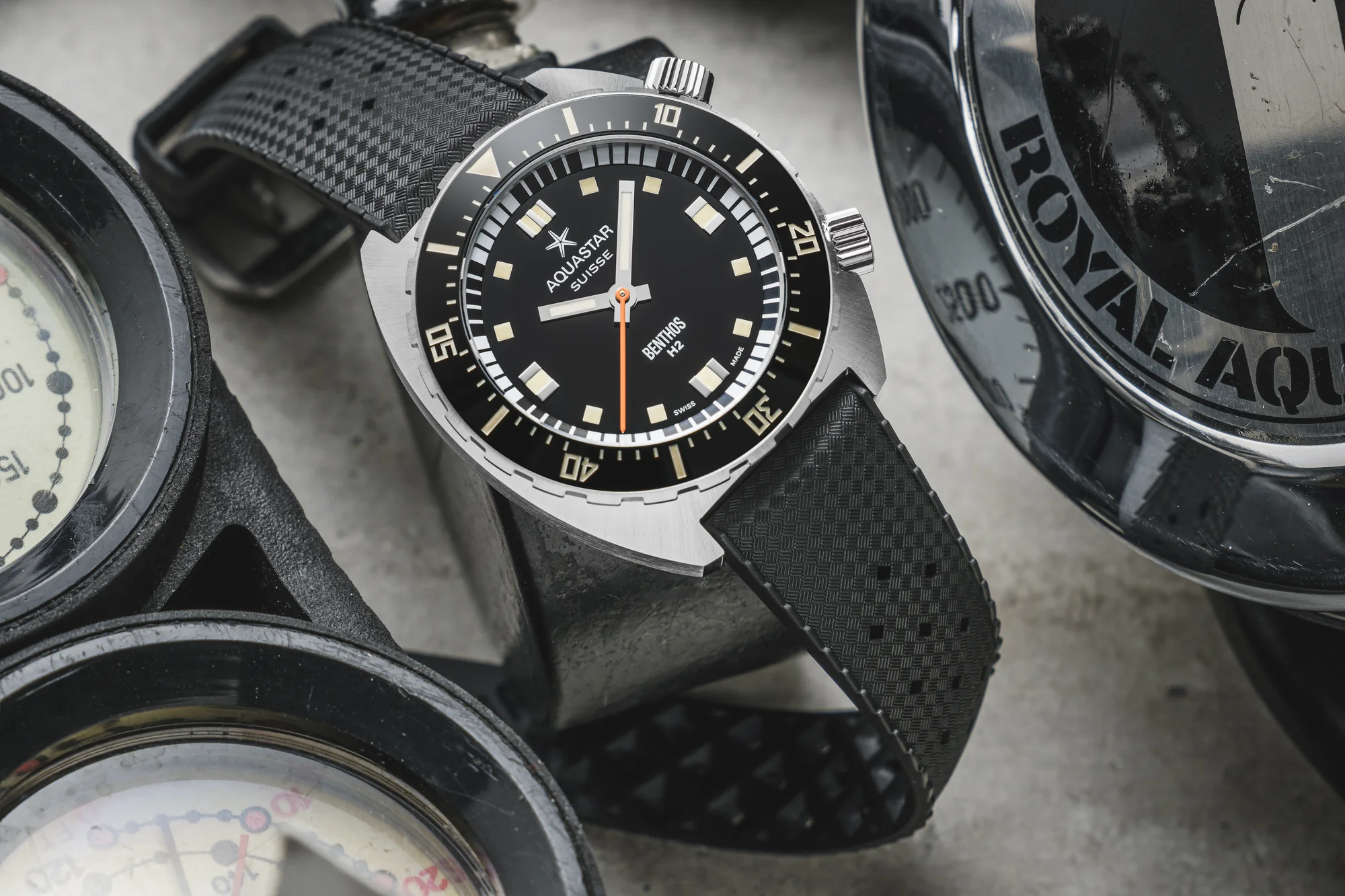
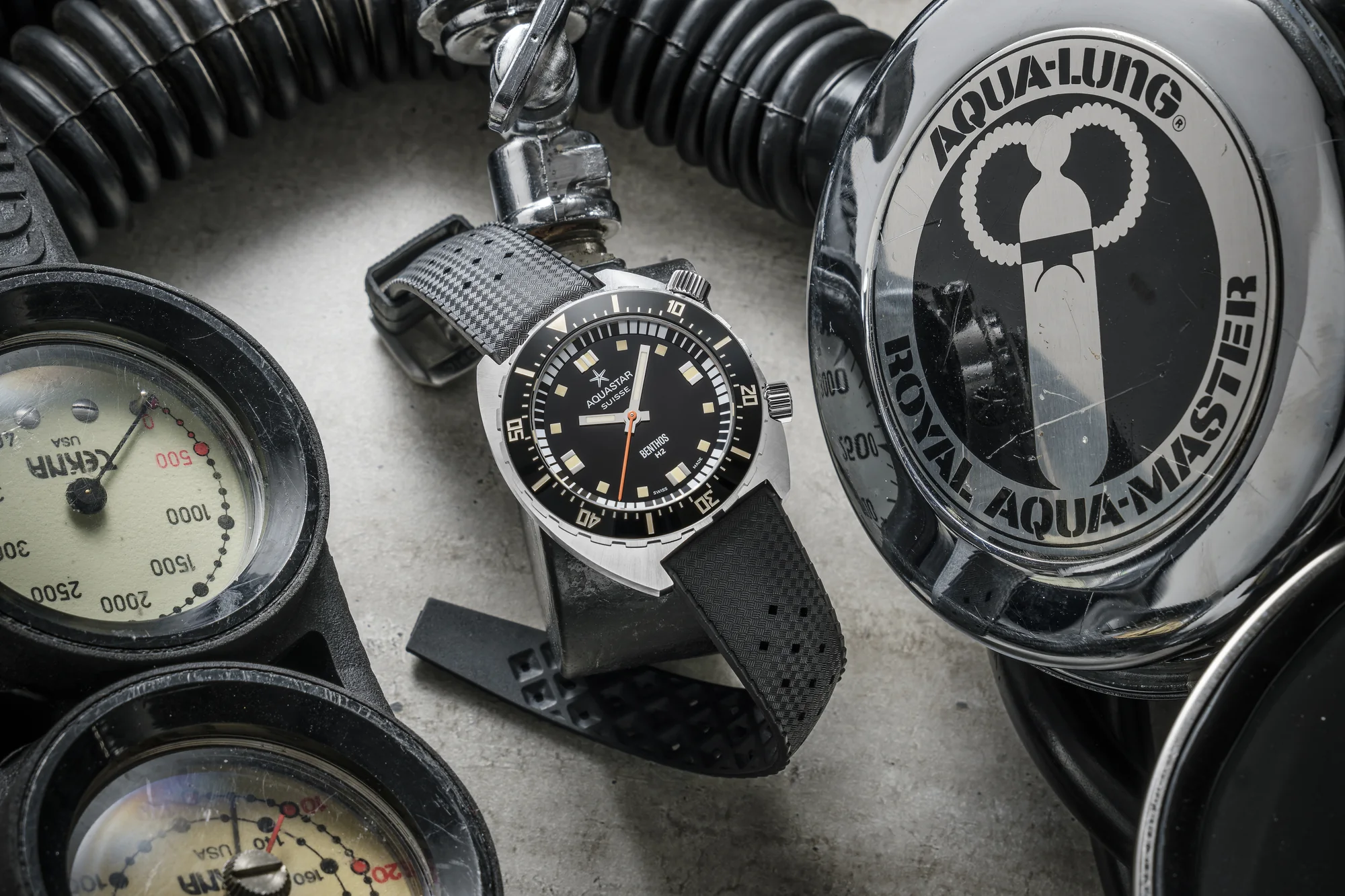
Aquastar dive watch

If you have spent any time researching vintage dive watches, you have probably seen a bezel crowded with numbers, coloured arcs, and small markings that look nothing like the simple 60-minute scale on a modern diver. That is a no-decompression bezel, and it answers one of the most consequential questions in scuba diving: how long can you stay at a given depth before you owe the water a decompression stop? This article explains what a no-decompression bezel is, how a diver actually read one underwater, why it mattered before dive computers existed, and what makes the Aquastar version historically significant.

What a no-decompression bezel actually does

A standard dive bezel measures one thing: elapsed time. You line the zero marker up with the minute hand at the start of a dive, and the bezel tells you how many minutes have passed. It says nothing about whether those minutes are safe. A no-decompression bezel goes a step further. It encodes the no-decompression limits, the maximum time you can spend at a given depth and still ascend directly to the surface without staged decompression stops.

Those limits come from decompression tables, the most famous early examples being the United States Navy tables. The deeper you go, the faster your body absorbs nitrogen, and the shorter your allowable bottom time becomes. At a shallow recreational depth you might have an hour or more. Go deeper and the safe window collapses to minutes. A no-decompression bezel takes that relationship and lays it out on the rotating ring around the dial, so a diver can read a depth-and-time answer at a glance instead of carrying a printed table and a slate.

How a diver read one underwater

The exact layout varied between makers, but the principle was consistent. The bezel carried a scale of depths, often expressed in meters, paired with the corresponding no-decompression time limit for each depth. A diver descending to, say, 30 meters would reference the marking for that depth and immediately see how many minutes of bottom time the tables allowed before decompression stops became mandatory.

In practice the bezel worked alongside the watch hands and the diver’s depth gauge. You noted your depth, found the matching figure on the bezel, and tracked elapsed time against that limit as the dive progressed. If your bottom time approached the figure the bezel showed for your depth, you knew it was time to begin your ascent while you could still surface directly. It was, in effect, a wearable slice of the decompression tables, calibrated so the answer was always on your wrist rather than in a pocket.

Why this mattered before dive computers

Today a dive computer tracks depth and time continuously and recalculates your remaining no-decompression limit second by second. In the 1960s none of that existed. Divers planned a dive from printed tables on the surface, then monitored it underwater using a depth gauge, a watch, and their own discipline. A no-decompression bezel reduced the mental arithmetic and the risk of misreading a table in cold, low-visibility water. For commercial and military divers whose work pushed depth and time hard, that was not a convenience feature. It was a margin of safety built into the instrument.

The single-dive limitation of most no-decompression bezels

There is a catch that most no-decompression bezels never solved. Nitrogen does not leave the body the instant you surface. After a dive, you carry residual nitrogen for hours, which means a second dive that day starts with your tissues already partly loaded. Your real no-decompression limit on that second dive is shorter than the table figure for a fresh, unsaturated diver. This is what divers call repetitive diving, and it is where a simple no-decompression bezel falls short.

Most no-decompression bezels are calibrated for a single descent. They give you the correct answer for one dive, then become misleading the moment you go back in the water that day, because they cannot account for the nitrogen you are still carrying. To dive repetitively and safely with one of those bezels, you still had to fall back on the full repetitive-dive tables with their surface-interval credits and residual-nitrogen groups. The bezel handled the easy case and left the hard case to paper.

The Aquastar no-decompression bezel

This is where Aquastar’s contribution stands apart. Aquastar developed the first and only no-decompression bezel designed to work across repetitive dives, not just a single descent. Where other bezels answered the question once and then went stale, the Aquastar system was built so a diver could account for successive dives in a day, the real-world pattern of professional and serious recreational diving. The mechanism was protected by Swiss patent CH 436 140, granted in 1964, and it became a defining feature of the Aquastar Deepstar.

That repetitive-dive capability is the heart of why the Aquastar bezel is more than a period curiosity. It addressed the exact gap that left other no-decompression bezels useful for only the first dive of the day. By engineering the decompression logic for repeated immersions, Aquastar turned the bezel from a single-answer convenience into a tool a working diver could trust across a full day in the water. For a company founded in 1962 by Frédéric Robert and built around the needs of divers rather than the dress-watch market, it was a characteristically practical piece of engineering.

Does a no-decompression bezel still make sense today?

For real-world dive planning, a modern dive computer has replaced the decompression bezel. It is more precise, it updates continuously, and it adjusts for your actual dive profile rather than a fixed table value. No serious diver today relies on a bezel alone to manage decompression risk. So in the strict functional sense, the no-decompression bezel is a piece of dive history rather than primary safety equipment.

What it still offers is a direct, mechanical link to the era when the dive watch genuinely was a life-support instrument. A no-decompression bezel is a record of how divers thought about nitrogen, depth, and time before electronics, and the cleverest examples show real ingenuity in compressing a decompression table onto a rotating ring. For collectors and enthusiasts, that is precisely the appeal: it is engineering you can read.

The takeaway

A no-decompression bezel translates the no-decompression limits from a printed table onto your wrist, letting a diver see at a glance how much bottom time a given depth allows before staged decompression becomes necessary. Most versions handle only a single dive, which is what makes the Aquastar bezel notable: it was engineered to work across repetitive dives, the situation every working diver actually faces. If you want to see that idea in its original context, explore the Aquastar Deepstar, the model built around the patented no-decompression bezel that defined this corner of dive-watch history.

Posted on

Dive Watch Size Guide: Diameter, Lug-to-Lug, Fit

Aquastar dive watch

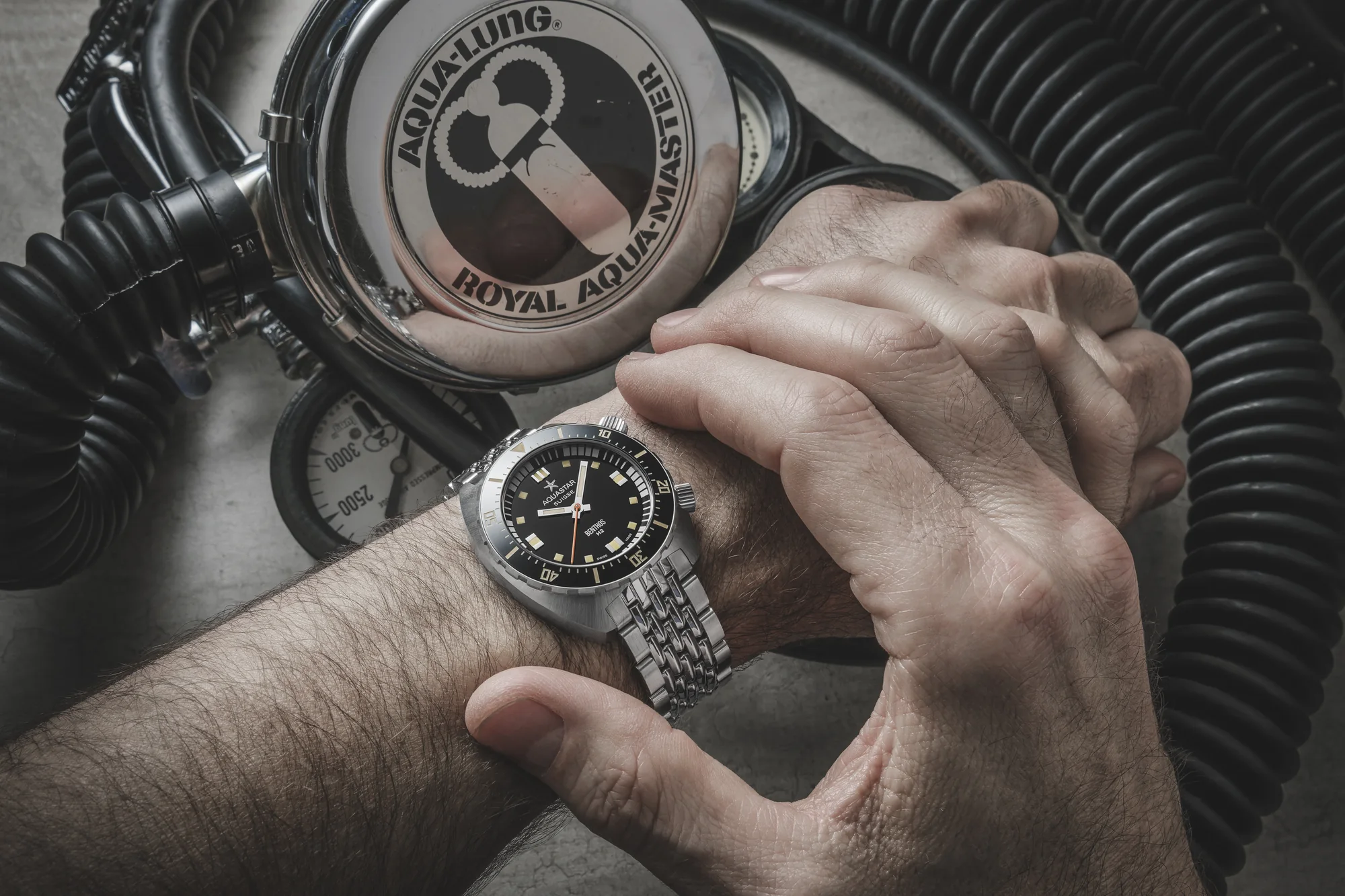
Buying a dive watch online means trusting a set of numbers: diameter, lug-to-lug, thickness, lug width. Those numbers decide whether a watch wears like it was made for you or slides around like a borrowed tool. This dive watch size guide explains what each measurement actually means on the wrist, why lug-to-lug is the figure most buyers overlook, and how to judge whether a 39mm, 42mm, or 44mm case will suit you before you ever strap it on.

Start With Your Wrist, Not the Watch

Before comparing case sizes, measure your wrist. Wrap a soft tape measure or a strip of paper around the flattest part of your wrist, just past the bone, and note the circumference in millimeters. Most adult wrists fall between 150mm and 200mm. That single figure does more to predict fit than any marketing photo of a watch on a model whose wrist you cannot see.

As a rough working framework: wrists under 160mm tend to suit cases around 38mm to 40mm, wrists from 160mm to 180mm are comfortable across most of the dive watch range from 40mm to 42mm, and wrists above 180mm can carry 42mm to 44mm or larger without looking undersized. These are starting points, not rules. Personal taste, sleeve fit, and the watch’s own proportions all shift the answer.

It also helps to know the shape of your wrist, not just its size. A flat, wide wrist handles a broad case better than a round, narrow one of the same circumference. If your wrist is round and tapers quickly, a large case will perch on top rather than sit flush, and that is where the next measurement becomes decisive.

Why Lug-to-Lug Matters More Than Diameter

Diameter gets all the attention, but lug-to-lug is the measurement that determines whether a watch fits at all. Lug-to-lug is the distance from the tip of the top lugs to the tip of the bottom lugs, the full vertical footprint of the case. It tells you how much of your wrist the watch will physically cover.

The reason it matters so much is simple geometry. If the lug-to-lug span is longer than the flat top surface of your wrist, the lug tips will overhang the edges. The strap then has to bend sharply over the corner of your wrist, the watch rocks, and it never sits securely. A 40mm watch with long, straight lugs can wear larger and less comfortably than a 42mm watch with short, downturned lugs. The headline diameter does not capture this at all.

As a guide, your lug-to-lug should not exceed the width of your wrist at the point where the watch sits. Many dive watches run roughly 47mm to 50mm lug-to-lug, so a wrist narrower than about 50mm across its flat section is the practical ceiling for those cases. When in doubt, prioritise lug-to-lug over diameter, because a case can look balanced at almost any width if it does not overhang.

Case Diameter: What the Numbers Really Tell You

Case diameter is the width of the case measured across the middle, usually excluding the crown. It is the figure brands lead with, and it does carry real information: it sets the dial’s apparent size, the legibility of the markers underwater, and the overall visual weight of the watch. But two watches of identical diameter can wear very differently depending on bezel width, dial colour, and how far the case extends beyond the bezel.

A wide bezel shrinks the dial and can make a 42mm watch read as more compact, while a thin bezel and an expansive dial can make the same diameter feel large. Dark dials tend to recede and look slightly smaller than bright ones. None of this changes the number on the spec sheet, which is exactly why diameter alone is a poor predictor of fit.

When 39mm Is Too Small (or Too Big)

A 39mm dive watch is often called the universal size, and for wrists between roughly 160mm and 180mm it is hard to get wrong. On a broad wrist above 185mm, though, a 39mm case can look lost, dwarfed by the surrounding skin, and a buyer who wants a clear tool-watch presence may find it underwhelming. On a slim wrist under 155mm, that same 39mm case can be the upper limit of comfort rather than the safe middle ground.

The lesson is that there is no absolute correct size. A 39mm reads as small on one wrist and substantial on another. Judge it against your own measurements rather than against a number someone online has declared ideal.

Thickness, the Forgotten Dimension

Diameter and lug-to-lug describe the footprint, but thickness decides how the watch lives on your wrist day to day. Dive watches are naturally thicker than dress watches because they need robust gaskets, a screw-down crown, a substantial caseback, and often a thick crystal to handle pressure. An automatic dive watch frequently sits between 12mm and 15mm tall, and that height affects whether it slides under a shirt cuff or catches on every doorframe.

Thickness is also where the movement choice shows up. A slim time-only automatic allows a more svelte case, while a dive chronograph with stacked pushers and sub-counters will always carry more height. If you wear long sleeves often or simply dislike a tall watch, treat thickness as a primary filter, not an afterthought. A well-proportioned case keeps its thickness in sensible relation to its diameter rather than stacking height for its own sake.

How a Dive Watch Should Sit for Actual Diving

If you intend to dive rather than admire, fit takes on a functional dimension. The watch has to remain secure and readable over a wetsuit, and the bezel has to be reachable with cold or gloved hands. This is where strap length and the right rubber or fabric strap matter as much as the case itself. A dive-rated strap such as a Tropic or ISOfrane style band needs enough length to clear a 5mm or 7mm wetsuit sleeve, and many divers keep an extra-long strap or an extension specifically for this.

For genuine underwater use, slightly larger is sometimes better. A bigger dial and bolder markers read faster at depth and in low visibility, and a wider bezel grip is easier to turn with numb fingers. That has to be balanced against everyday comfort, because most dive watches spend far more time at a desk than at 30 meters. The ideal is a case large enough to function as a tool and proportioned well enough to wear every day.

Lug width matters here too. It sets which straps you can fit, typically 20mm or 22mm on a modern dive watch, and a standard width keeps your options open across rubber, NATO, ISOfrane, and steel bracelets. A watch you can re-strap easily is a watch you can adapt to a wetsuit one weekend and a shirt cuff the next.

Putting the Measurements Together

When you compare two dive watches, read the spec sheet in this order: lug-to-lug first to confirm it will fit your wrist at all, then thickness to judge daily comfort, then diameter for presence and legibility, and finally lug width for strap flexibility. A watch that passes all four is far more likely to become a daily companion than one chosen on diameter alone.

  • Lug-to-lug: should not overhang the flat top of your wrist.
  • Thickness: 12mm to 15mm is typical for an automatic diver; lower wears more easily under a cuff.
  • Diameter: sets dial size and presence, but is shaped by bezel width and dial colour.
  • Lug width: 20mm or 22mm keeps strap options broad.

If you want to see how these proportions work on a purpose-built diver, the Aquastar Benthos family is designed around the balance between underwater legibility and everyday wearability, with case dimensions and standard lug widths that make re-strapping straightforward. Whatever you choose, measure your wrist first, weigh lug-to-lug above the headline diameter, and the numbers on the spec sheet will start telling you the truth about fit.

Posted on

Dive Watch Strap Types: Tropic vs ISOfrane vs NATO

Aquastar dive watch

Choosing a strap for a dive watch is rarely about looks alone. The four options most divers and collectors weigh up, vulcanised rubber in the Tropic style, ISOfrane, the woven NATO, and a steel bracelet such as the beads-of-rice (BOR), each behave differently in salt water, under a wetsuit cuff, and across a working day at a desk. This guide compares the main dive watch strap types on the criteria that actually matter: water resistance, security, comfort, and how each ages. By the end you should know which strap suits real diving, which suits daily wear, and why many owners keep more than one.

Tropic rubber: the original tropical dive strap

The Tropic strap dates to the dive watch boom of the late 1950s and 1960s, when collectors and divers needed something that would not rot, stretch, or stink the way leather did in warm, wet conditions. The answer was a perforated vulcanised rubber strap with a distinctive basket-weave or tyre-tread surface texture. It is supple, light, and quick to dry, and the perforations let water and air move through rather than trapping moisture against the wrist.

For period-correct vintage divers and for anyone who likes the look of a 1960s tool watch, a Tropic strap is hard to beat. It sits close to the case, tapers cleanly, and pairs naturally with a cushion case or a skin-diver profile. Modern reissues of the material use more stable rubber compounds than the originals, so the brittleness that plagued decades-old straps is largely a thing of the past.

Where the Tropic style asks for care is fit over a wetsuit. Because it is relatively thin and not especially long, a Tropic strap is happiest on bare skin or over a thin neoprene cuff. For deep cold-water diving in a thick suit you may run out of strap length, which is exactly where the next two options earn their place.

ISOfrane: thick, secure, built for the dive

ISOfrane is a heavier vulcanised rubber strap with a ribbed underside and a longer, more generous length than a typical Tropic. It was developed as a purpose-built diving strap, and the design priorities show: the ribbed channels lift the strap slightly off the skin so sweat and water clear quickly, the extra length accommodates a wetsuit cuff, and the thicker rubber resists nicks and tears.

On the wrist an ISOfrane feels substantial and planted. It is the strap many divers reach for when they actually intend to get the watch wet, because it combines the corrosion-immunity of rubber with security and a comfortable stretch under load. The trade-off is bulk: an ISOfrane adds visual and physical heft, which suits a larger 42mm-plus diver more than a slim 38mm dress-diver.

For saltwater use, rubber straps in general have one decisive advantage over fabric and, in some respects, over steel: there is nothing for salt crystals or grit to lodge into. A quick rinse under fresh water and the strap is clean. That simplicity is why rubber remains the default for serious diving.

NATO: the woven nylon all-rounder

The NATO strap is a single length of woven nylon that passes under the watch and back through a series of keepers, so the case is held against a continuous band of fabric. Its origin is military: a one-piece strap means that if one spring bar fails, the watch stays on the wrist rather than falling away. That redundancy is the NATO’s signature safety feature and the reason it earned a permanent place in tool-watch culture.

NATOs are cheap, endlessly interchangeable, and infinitely adjustable, which makes them the natural choice for casual daily wear and for changing a watch’s character in seconds. They also lift the case a couple of millimetres off the wrist because of the extra layer of fabric under the caseback, which some wearers love and others find sits too tall.

For actual diving, the NATO is a compromise. Nylon soaks up water and is slow to dry, salt and sand work their way into the weave, and a wet fabric strap against neoprene can shift around. It is a superb everyday and travel strap, and a genuinely safer option than a two-piece strap with marginal spring bars, but for repeated saltwater immersion most divers prefer rubber.

The steel bracelet: BOR and the daily-wear case

A well-made stainless steel bracelet, such as a beads-of-rice (BOR) design, is the most formal and arguably the most durable option. Steel does not perish, does not absorb water, and shrugs off years of wear in a way no rubber or fabric strap can match. A BOR bracelet in particular drapes well because its many small links flex around the wrist, giving a comfortable, almost liquid fit.

The considerations with steel are weight, sizing, and salt. A bracelet adds noticeable mass, it needs to be sized correctly with links removed for a proper fit, and after diving in salt water it should be rinsed thoroughly because brine can sit in the gaps between links and around the clasp. Good bracelets in marine-grade 316L stainless steel resist that corrosion well, but the rinse is still worth the minute it takes.

For a watch that has to move from the water to the office without a strap change, a steel bracelet is the most versatile single choice. It is the reason so many vintage and modern divers ship on a bracelet as the default and offer rubber as the dive-day alternative.

Which strap for which job?

There is no single best strap, only the right strap for what you are doing. A rough framework:

  • Actual diving, especially salt water: ISOfrane or another thick rubber strap, for length, security, and easy rinsing.
  • Vintage looks and warm-weather daily wear: a Tropic-style rubber strap, light and period-correct.
  • Casual everyday, travel, and quick character changes: a NATO, for redundancy, adjustability, and low cost.
  • Office-to-weekend versatility and maximum longevity: a steel bracelet such as a BOR.

Most owners settle on two: a bracelet or Tropic for daily life, and a longer rubber strap kept ready for the water. Because dive watches use standard lug widths and spring bars, swapping between them takes a couple of minutes and changes the watch completely.

If you are choosing a watch to build that small strap collection around, it helps to start with a true tool diver designed for the water in the first place. The Aquastar Benthos family carries the proportions and lug geometry that suit all four strap styles, from a clean rubber Tropic to a beads-of-rice bracelet, so you can match the watch to the dive or the day without compromise.

Posted on

Marine Nationale Dive Watches: A Short History

Aquastar dive watch

The phrase “Marine Nationale” carries real weight among dive watch collectors, and for good reason. From the 1950s through the 1980s, the French Navy equipped its combat divers with purpose-built dive watches sourced from a rotation of Swiss and French manufacturers. This article looks at that procurement history through the public record: which makers supplied the Marine Nationale, what those watches needed to do, and why issued French Navy dive watches remain among the most studied tool watches of the twentieth century.

Who Were the Marine Nationale Combat Divers?

The Marine Nationale is the navy of France. Its combat swimmers, the nageurs de combat, trace their lineage to units formed in the years after the Second World War, with the principal training and operational base established at Saint-Mandrier near Toulon. These were not recreational divers. They conducted reconnaissance, underwater demolition, and clandestine approach work, often at night and in poor visibility.

For that kind of work, a watch was not a luxury. It was a timing instrument. A diver needed to track elapsed bottom time, time a decompression stop, and coordinate a mission to the minute, all while wearing thick gloves and reading the dial by feel and faint light. The procurement requirements that grew out of these missions shaped the watches that the Marine Nationale issued, and indirectly shaped the wider dive watch category.

What a French Navy Dive Watch Had to Do

Issued dive watches were specified around a short list of hard requirements. The watch had to remain water resistant under working pressure, so a screw-down crown and properly gasketed case back were essential. It needed a rotating bezel to track elapsed time, ideally a unidirectional bezel so that an accidental knock could only shorten the indicated dive time, never extend it past the safe limit.

Legibility was non-negotiable. Large luminous markers, bold hands, and high contrast between dial and indices let a diver read the time in murky water. Many issued watches carried strong luminous compound on both the dial and the bezel pip at twelve, so that elapsed time stayed readable in the dark. Straps had to survive saltwater and expand over a wetsuit, which is one reason fabric and rubber straps became closely associated with military-issued divers.

Finally, issued watches were marked. The Marine Nationale engraved its property on the case back, and collectors today read those markings, often abbreviated and paired with a year, as the fingerprint that separates a genuine issued piece from a civilian model of the same reference.

The Swiss and French Makers Behind the Issue

The Marine Nationale did not rely on a single supplier. Over three decades it sourced dive watches from several manufacturers, awarding contracts as designs and budgets changed. This rotation is part of why French Navy dive watches are such a rich collecting field: there is no one canonical model, but a family of references spanning multiple brands and eras.

Across the broader French military procurement of the period, watchmaking expertise came from both sides of the border. Swiss workshops supplied the cases, movements, and dive-specific engineering that France’s combat divers depended on, while French houses contributed assembly, distribution, and in the case of aviation timing instruments, complete chronographs. The result was a procurement landscape where Swiss horology and French naval requirements met in a single tool on a diver’s wrist.

It is worth separating two categories that collectors sometimes blur. The French military also issued aviation chronographs under its own technical specifications, a separate lineage from the dive watches worn by the nageurs de combat. The dive watch story is specifically about water resistance, rotating bezels, and underwater legibility, rather than the slide-rule and flyback features that defined the issued pilot’s chronographs.

Aquastar and the Era of Professional Dive Tools

Aquastar belongs squarely to this era of purpose-built professional dive equipment. The brand was established in 1962 by Frédéric Robert, building on a watchmaking lineage that already included the Model 60 of 1957. Where many companies treated the dive watch as a styling exercise, Aquastar approached it as an instrument for divers who needed to manage decompression in the water.

The clearest expression of that philosophy is the patented no-decompression bezel introduced in 1962, the first and only no-decompression bezel designed to work across repetitive dives rather than a single descent. Aquastar’s Deepstar chronograph and, later, the Benthos line carried the brand’s diving intent forward, with the 1970 Benthos 500 standing as the first Swiss 500 meter dive watch. These were tools built for the same demanding underwater environment that drove military procurement across the period.

Today’s Aquastar collection continues in that line. The modern Deepstar revives the professional dive chronograph, while the Benthos family pairs the brand’s dive heritage with contemporary movements such as the Sellita SW200-1 in the Benthos Professional. The thread running through all of it is the same one that defined the Marine Nationale era: a watch built to be read and trusted underwater.

Why Issued Dive Watches Still Matter to Collectors

Military-issued dive watches occupy a special place in collecting because every design choice answered a real operational need. There is no marketing gloss on a property marking or a tritium-faded bezel. The patina is service history. That authenticity is exactly what draws collectors to French Navy pieces and to the wider category of mid-century tool divers.

For anyone buying a vintage or vintage-inspired diver today, the Marine Nationale lineage offers a useful checklist of what actually matters: a unidirectional bezel, strong lume, a secure screw-down crown, an honest depth rating, and a strap that suits real wear. Those priorities have not changed since the nageurs de combat first strapped on their issued watches.

The strap itself is part of the story. French Navy divers are closely associated with elastic and parachute-style fabric straps that could be threaded over a wetsuit and trusted not to slip, and that practical heritage feeds straight into how collectors dress these watches today. The same logic explains the enduring appeal of rubber options like the Tropic style and the ISOfrane, both built to survive saltwater and stay supple in cold water. A military diver chose a strap for security and survivability, not fashion, and that mindset is a good guide for anyone assembling an honest dive setup now.

If you want a modern watch built in that same professional spirit, the Aquastar Deepstar and the Benthos collection carry the brand’s diving heritage into the present, instruments designed first and foremost to be worn and read underwater.

Posted on

Do Dive Watches Hold Value Over Time?

Aquastar dive watch

A dive watch bought for $300 rarely behaves like one bought for $3,000, and a serious collector knows why. When people ask, do dive watches hold value, the honest answer is yes – but only certain ones, and only for specific reasons tied to heritage, build quality, rarity, and market trust.

That distinction matters. The category is crowded with everything from disposable fashion pieces to historically significant underwater instruments. A dive watch can look the part without having any of the qualities that make collectors return to it years later.

Do Dive Watches Hold Value Better Than Other Watches?

Compared with generic dress watches or trend-driven sports models, dive watches often hold value well because they sit at the intersection of utility, design, and collecting culture. The best examples were built for a purpose, and that purpose still carries weight. High legibility, rotating timing bezels, substantial water resistance, and durable cases are not decorative ideas. They come from real use underwater.

That functional lineage gives dive watches an advantage. Buyers tend to respect a watch more when its design language was earned in the field rather than invented by a marketing department. A watch with true dive pedigree, credible engineering, and a strong enthusiast following has a much firmer floor than one designed only to chase a luxury trend.

Still, there is no blanket rule here. Plenty of dive watches lose value quickly, especially mass-produced models with weak finishing, generic movements, and no meaningful identity. The category is strong, but the individual watch still has to prove itself.

What Actually Makes a Dive Watch Hold Value

Value retention in this segment comes down to a handful of forces that reinforce each other.

Heritage and legitimacy

Collectors pay attention to origin stories, but not the hollow kind. A dive watch holds value better when its design is connected to real underwater use, historically important references, or a brand with documented credibility in tool watches. That legacy gives a model context. It becomes more than a nice-looking steel sports watch.

This is why re-editions can perform surprisingly well when they are executed with discipline. If the watch preserves faithful proportions, original design intent, and the spirit of the historical reference while improving reliability, it can appeal to both vintage-minded buyers and modern wearers. Heritage has to be earned, though. A faux-retro watch with no lineage is usually easy for the market to spot.

Production numbers and scarcity

Scarcity matters, but only when there is real demand behind it. A low-volume release from a respected specialist can stay strong because supply remains tight and buyers understand what the watch is. A limited watch from an unknown brand with no collector base is just limited inventory.

Smaller production often helps dive watches because enthusiasts tend to favor focused brands over broad, diluted catalogs. If a model is hard to find, technically credible, and aesthetically coherent, secondary demand can remain healthy.

Build quality and specifications

Collectors may romanticize patina and old references, but they still inspect the hardware. Case execution, bezel action, dial detail, lume quality, bracelet engineering, movement selection, and overall finishing all affect long-term perception. A watch built with sapphire, ceramic or properly executed steel bezels, strong water resistance, dependable Swiss mechanical calibers, and well-resolved case architecture will usually age better in the market than a watch that cuts corners.

This does not mean every heavily specified watch becomes collectible. It means weak specifications often expose weak intent. Buyers notice when a watch is serious and when it is simply styled to appear serious.

Design staying power

The dive watches that hold value best are usually the ones that remain attractive after trends move on. Clean dial layouts, balanced proportions, and recognizable but not overstated case shapes tend to last. If a watch feels rooted in a specific era yet still wearable now, it has a better chance of sustaining demand.

That is one reason many vintage-inspired dive watches perform well. The strongest references were already tested by time once. When they return with restraint and technical updates, they can feel less temporary than oversized, aggressively styled modern pieces.

Which Dive Watches Tend to Lose Value Fast?

The fastest depreciation usually shows up in fashion-led dive watches, heavily discounted retail models, and pieces with no enthusiast following. If the watch was bought new at a price inflated by branding rather than substance, the secondary market tends to correct it quickly.

Another weak point is overproduction. When a brand floods the market with endless colorways, special editions, and near-identical references, collectability thins out. Buyers become less certain about which version matters. Confusion is rarely good for resale.

Poor servicing support can also damage value. Even a good-looking watch struggles long term if parts, warranty confidence, or movement support are unreliable. Serious buyers think beyond the initial purchase. They want to know the watch can be maintained properly a decade from now.

Do Dive Watches Hold Value as Investments?

Usually, they are better viewed as durable luxury goods with varying resale strength rather than pure investments. Some references appreciate sharply, especially if they become culturally important or were produced in small numbers. Most do not behave that way.

A better question is whether a dive watch limits downside while giving years of use. That is where strong models justify themselves. A well-made mechanical dive watch from a credible heritage brand can deliver ownership pleasure, real utility, and respectable retained value. That is a stronger proposition than buying a watch that feels obsolete the moment the warranty card is stamped.

Collectors who consistently make good buys tend to think like stewards, not speculators. They look for authenticity, coherence, and staying power. Price charts matter, but they are not the whole story.

How to Judge If a Specific Dive Watch Will Hold Value

Start with the brand. Does it have real standing in dive-watch history, or is it borrowing the aesthetic without the substance? Then look at the model itself. Is it part of a meaningful lineage? Was it produced in sensible numbers? Does it have a distinctive identity within the market, or is it interchangeable with dozens of others?

After that, inspect the execution. Dimensions should make sense. The movement should be dependable and serviceable. The case, bezel, dial, and lume should show care, not cost-cutting. Original packaging and papers still help on resale, but they matter more when the watch itself is already desirable.

Condition remains critical. Tool watches are meant to be worn, and honest wear is expected, but damage is another matter. Deep case refinishing, replacement parts, poor polishing, moisture intrusion, and sloppy service work can all drag down value. Provenance and originality still carry weight, particularly for historically important references.

The Role of Niche Brands and Heritage Reissues

This is where the conversation gets more interesting. The market has matured beyond logo recognition alone. Many buyers now prefer specialist brands with authentic underwater history, disciplined production, and enthusiast-grade execution. In that environment, a well-made heritage reissue can hold value better than a more famous but less focused competitor.

That outcome depends on credibility. A reissue must feel connected to an original instrument, not merely inspired by vintage style. Faithful case geometry, period-correct dial language, functional bezels, modern water resistance, and proven Swiss mechanics matter because they signal respect for the source material. Aquastar operates in that exact territory, where historical legitimacy and technical purpose carry more weight than broad luxury posturing.

For seasoned collectors, that focus is not a niche weakness. It is often the reason a watch remains desirable.

So, Do Dive Watches Hold Value?

Yes, the right ones do. The strongest value retention comes from dive watches with genuine heritage, disciplined design, technical legitimacy, and a collector base that understands what the watch represents. The weakest performers are usually those built around image alone.

If you want a dive watch that stands its ground over time, buy the one with a reason to exist. Look for real lineage, modern execution, sensible production, and the kind of engineering that still makes sense far from a display case. A serious dive watch should not need hype to matter – it should be able to earn its place on the wrist and keep it.

Posted on

Sapphire vs Mineral vs Acrylic Watch Crystal

Aquastar dive watch

The crystal is the clear window protecting your watch dial, and the material it is made from shapes how the watch looks, how it survives daily knocks, and how much a scratch will cost you to fix. Three materials dominate the market: sapphire, mineral glass, and acrylic. If you are weighing a sapphire watch crystal against a cheaper mineral or a vintage-style acrylic, this guide explains how each one behaves, where it shines, and where it lets you down, so you can match the crystal to the way you actually wear a watch.

The three crystal types at a glance

Watchmakers measure scratch resistance on the Mohs hardness scale, where talc sits at 1 and diamond at 10. Acrylic lands around 3, mineral glass around 5 to 6, and synthetic sapphire at roughly 9, second only to diamond among common materials. That single number explains most of the practical difference between the three, but hardness is not the whole story. A material can resist scratches superbly and still shatter on impact, or stay clear for decades yet pick up hairlines from a sleeve.

The honest summary is that each crystal trades one virtue for another. Sapphire is nearly scratch-proof but brittle and expensive. Mineral glass is cheap and reasonably tough but scratches and lacks the optical clarity of sapphire. Acrylic is light, shatter-resistant, and almost free to polish, but it scuffs if you look at it the wrong way. Knowing which trade-off suits you is more useful than chasing the hardest material on paper.

Sapphire crystal: the modern standard

Sapphire crystal is not mined. It is synthetic corundum, the same crystalline aluminium oxide as natural sapphire, grown in a furnace and then sliced, ground, and polished into a watch lens. Because it reaches around 9 on the Mohs scale, it shrugs off contact with almost everything you meet in a normal day. Keys, door frames, desk edges, and stone worktops will not mark it. Only a handful of materials, chiefly diamond and a few industrial abrasives, are hard enough to leave a scratch.

That hardness comes with a cost beyond price. Sapphire is brittle, so while it resists scratching it can crack or chip under a sharp, focused impact, particularly on an exposed edge. It is also harder to machine, which is why a sapphire crystal adds meaningfully to the cost of a watch. Domed and boxed sapphire profiles, prized for their vintage looks and edge-to-edge clarity, are more expensive again because of the extra grinding involved.

For a dive watch, sapphire has become the default for good reason. A diver lives a hard life around tanks, ladders, boat decks, and gravel entries, and a crystal that stays clear for years without polishing is a genuine advantage. The main thing to check is whether the sapphire carries anti-reflective coating, which we return to below, because raw sapphire is quite reflective and can mirror over in bright sun.

Mineral glass: the budget middle ground

Mineral crystal is ordinary glass that has been hardened, usually by tempering or by a chemical ion-exchange process that builds compressive stress into the surface. It sits in the middle of the range at roughly 5 to 6 on the Mohs scale, which means it resists casual contact better than acrylic but will still pick up scratches from sand, grit, and harder metals over time.

Its strengths are cost and impact behaviour. Mineral glass is inexpensive to produce, which is why it appears on the majority of affordable watches. It also tends to resist a sudden shock slightly better than untreated sapphire of the same thickness, because it is less brittle, though a hard enough knock will still crack it. The weakness is that once a mineral crystal is scratched it usually cannot be polished back to clarity the way acrylic can, so a marked mineral crystal is typically replaced rather than restored.

You will sometimes see hybrid descriptions such as “hardened mineral” or proprietary coated glass that claims sapphire-like surface hardness on a mineral base. These can be a sensible compromise on a mid-priced watch, but they rarely match the depth of scratch resistance you get from a solid sapphire crystal, and the thin hard layer can wear through with years of use.

Acrylic crystal: the vintage choice

Acrylic, also known by trade names such as hesalite and sometimes loosely called plexiglass, is a clear plastic. It was the standard watch crystal for much of the twentieth century and remains a deliberate choice on heritage-styled pieces today. At around 3 on the Mohs scale it scratches easily, and a week of normal wear can leave an acrylic crystal hazed with fine swirls.

What redeems it is that those scratches are almost entirely cosmetic and almost entirely reversible. A light hairline can be buffed out at home with a tube of polishing paste in a few minutes, and a deeper scuff comes out with a little more effort. Acrylic is also exceptionally shatter-resistant. Rather than cracking under impact it tends to flex, craze, or pop out of its seat in one piece, which is one reason it was trusted in demanding environments long before sapphire was common. It is light, warm to the touch, and gives vintage watches their characteristic soft, slightly distorted glow at the edges.

The trade-offs for a modern diver are real, though. Acrylic is softer, so it can wear thin over decades, and it does not offer the long-term clarity most buyers now expect. For a daily-wear tool watch that you would rather not fuss over, it is usually the wrong pick. For a faithful reissue or a collector who enjoys the ritual of an occasional polish, it can be exactly right.

Which crystal is best for a dive watch?

For a watch you intend to actually dive or swim with, sapphire is the most practical choice in nearly every case. Underwater visibility is already compromised, so you want a crystal that stays optically clean for years and resists the abrasive reality of sand, rock, and boat hardware. Sapphire delivers that, and its one weakness, brittleness, is manageable in a well-designed dive case where the crystal sits slightly recessed and the bezel takes the brunt of side impacts.

Mineral glass is a fair choice on an entry-level or beater diver where keeping the price down matters more than decade-long clarity. Acrylic, meanwhile, suits the collector who wants period-correct looks on a vintage-style piece and accepts the polishing routine that comes with it. There is no single right answer, only the answer that fits how hard you wear the watch and how much you mind the occasional scratch.

Anti-reflective coating and what to look for

Whatever the material, the coating on the crystal matters as much as the crystal itself for real-world legibility. Anti-reflective treatment is a microscopically thin layer, or several layers, applied to cut glare so you can read the dial at an angle and in bright light. It can be applied to the underside of the crystal, where it is protected from wear, to the top surface, where it works hardest but scratches more easily, or to both.

When you compare watches, it is worth asking three things: the crystal material, whether the sapphire is single or double domed for clarity, and where the anti-reflective coating sits. A double-domed sapphire with interior anti-reflective coating gives you the best of both worlds, a near scratch-proof surface with low glare and minimal coating wear. That combination is now common on serious dive watches and is a sign the maker has thought about how the watch is read underwater, not just how it photographs.

The bottom line

Choose sapphire if you want long-term clarity and rarely want to think about your crystal again, accept mineral glass if budget leads and you can live with eventual scratches, and pick acrylic only when vintage character and easy polishing matter more than everyday toughness. For a tool watch built to be worn hard in and out of the water, sapphire with anti-reflective coating is the choice that asks the least of you over the years. If you want to see that approach in practice, the Aquastar Benthos dive watch family pairs a robust dive case with a sapphire crystal built for legibility below the surface.

Posted on

What Makes a Watch Swiss Made? The Legal Definition

Aquastar dive watch

The words “Swiss Made” on a dial carry more weight than almost any other two words in watchmaking, yet most buyers have only a vague sense of what they actually guarantee. The label is not a marketing flourish. It is a legal designation governed by Swiss federal law, with measurable thresholds a watch must meet before a brand is allowed to print it. This article explains what makes a Swiss Made watch, what the ordinance does and does not promise, and why the distinction matters when you are deciding where to put your money.

The legal basis: a federal ordinance, not a slogan

The right to use “Swiss” or “Swiss Made” on a watch is regulated by a dedicated federal ordinance, sitting underneath Switzerland’s wider trademark and “Swissness” legislation. The current rules were tightened in a revision that came into force on 1 January 2017, raising the bar specifically because the previous, looser definition had allowed watches with a relatively thin Swiss contribution to wear the label.

Enforcement is taken seriously. The Federation of the Swiss Watch Industry, the trade body that represents most of the sector, actively monitors misuse and pursues legal action against products that claim Swiss origin without meeting the criteria. Because the designation is anchored in law rather than industry self-policing, a watch that prints “Swiss Made” without qualifying is committing an offence, not merely bending a convention.

The four core requirements for a Swiss Made watch

Under the post-2017 rules, a watch may only be described as Swiss when it satisfies several conditions at once. The headline criteria are as follows.

  • The movement is Swiss. The heart of the watch must itself qualify as a Swiss movement under a separate set of rules (covered below).
  • The movement is cased up in Switzerland. The act of fitting the movement into its case must take place on Swiss soil.
  • Final inspection by the manufacturer happens in Switzerland. The maker’s last quality check is carried out in the country.
  • At least 60 percent of the manufacturing costs are generated in Switzerland. This value threshold applies to the whole watch, not just the movement.

There is a fifth, easily overlooked requirement: the technical development of the watch must also be carried out in Switzerland. In other words, the design and engineering work that defines the product, not only its physical assembly, has to be Swiss. Together these conditions mean a genuine Swiss Made watch represents real economic and intellectual activity inside the country, not a foreign product given a Swiss veneer at the final step.

What counts as a “Swiss movement”?

Because the whole watch can only be Swiss if its movement is Swiss, the definition of a Swiss movement does a lot of the work. A movement qualifies when three things are true at the same time.

  • It is assembled in Switzerland.
  • It is inspected by the manufacturer in Switzerland.
  • At least 60 percent of the value of its components is of Swiss manufacture.

That 60 percent component-value rule is the part that changed most in the 2017 revision. The older standard counted only the value of the parts without a meaningful percentage floor on the whole, which made it possible to assemble a movement in Switzerland from a high proportion of foreign components and still call it Swiss. The current rule forces a majority of the movement’s component value to be genuinely Swiss before the label applies.

What Swiss Made does not guarantee

This is where buyers most often misread the label. “Swiss Made” is a statement about origin and value distribution. It is not, on its own, a statement about quality, accuracy, or water resistance. A watch can be fully Swiss Made and still use an industrial, mass-produced movement, while another watch with extraordinary finishing might fall just short of the threshold for reasons of sourcing rather than craft.

It is also worth being clear about what the ordinance does not require. It does not demand that 100 percent of the watch be made in Switzerland. A qualifying watch can legitimately contain foreign components, including parts of the case, dial, hands, or bracelet, provided the overall 60 percent cost threshold and the movement rules are met. The label tells you that the majority of the watch’s value and its core engineering are Swiss. It does not tell you that every screw was turned in a Jura workshop.

For dive watches specifically, the Swiss Made label says nothing about depth rating or whether a watch has been tested to a recognised diving standard. Those are separate questions answered by a maker’s own specifications and testing, not by the country-of-origin mark. A 200 meter or 300 meter rating and the “Swiss Made” line on a dial are two independent claims, and a careful buyer reads them as such.

Why the label still matters

Given those caveats, is “Swiss Made” worth caring about? For most serious buyers, yes. The designation guarantees that the technical development and a majority of the value were created within an ecosystem of specialist suppliers, movement makers, and finishing workshops that has been refined over more than a century. That ecosystem is precisely why independent movement specialists such as La Joux-Perret and ETA, and assemblers such as Sellita, can supply high-quality calibres to brands of every size.

The label also offers a degree of consumer protection. Because it is legally defined and actively enforced, it is far harder to fake than a vague claim like “Swiss design” or “Swiss heritage,” phrases that carry no legal weight at all. When you read “Swiss Made” on a dial, you are reading a claim the maker can be held to in court.

How to use this when buying

Treat “Swiss Made” as a meaningful baseline rather than a finish line. Confirm the exact movement a watch uses and look it up, since the calibre tells you far more about long-term reliability and serviceability than the country mark alone. Read the depth rating and any testing claims separately. And be wary of softer phrases that imitate the official label without meeting it, since those are exactly the wording a brand reaches for when it cannot qualify for the real thing.

Swiss dive watchmaking has a particularly deep version of this heritage, built around makers who developed genuine diving instruments rather than dress watches dressed up as tools. Aquastar belongs to that lineage, with a history in Swiss dive watches that runs back to the late 1950s and a current collection built on Swiss movements. If the ideas in this article are useful to you, exploring the Benthos family is a natural next step to see how the Swiss Made baseline translates into an actual modern dive watch.

Posted on

Hesalite vs Sapphire Dive Watch

Aquastar dive watch

A crystal can change the entire character of a dive watch. Not just how it looks in a product photo, but how it behaves under hard light, salt spray, desk wear, and years of use. In the hesalite vs sapphire dive watch debate, the right answer is rarely absolute. It depends on whether you value vintage fidelity, daily resilience, or the particular way a tool watch should age.

For collectors and serious buyers, this is not a minor specification. The crystal sits at the point where engineering meets experience. It affects legibility, case profile, historical accuracy, and how a watch carries itself on the wrist. On a purpose-built diver, that matters.

Hesalite vs sapphire dive watch: what changes in practice

Hesalite is an acrylic crystal. Sapphire is synthetic corundum, grown for extreme hardness and cut for watch use. On paper, the distinction sounds simple. On the wrist, it is more nuanced.

Sapphire is the modern standard for premium dive watches because it resists scratching far better than acrylic. If you wear your watch daily, rotate it through travel, or expose it to the usual contact points of modern life, sapphire keeps a cleaner surface for longer. Keys, zippers, countertops, and general abrasion that would mark hesalite will often leave sapphire untouched.

Hesalite answers with a different strength. It is softer, but also more forgiving under impact. Rather than shattering, it tends to deform or scratch. That characteristic gave it a long and legitimate place in professional and military watchmaking. A scratched acrylic crystal can often be restored with polish. A chipped or fractured sapphire crystal cannot be polished back into shape.

That does not make hesalite the tougher option in every context. It makes it the more forgiving one in a narrow sense. For a modern dive watch built to endure real wear, sapphire usually offers the better long-term balance of visual durability, water-ready confidence, and low-maintenance ownership.

The case for hesalite

Hesalite has qualities that enthusiasts understand immediately. It carries warmth. It bends light differently. It can produce the soft distortion and visual dome associated with mid-century dive instruments and early professional chronographs. If a watch is meant to preserve a historic silhouette and period-correct feel, hesalite often looks more authentic than sapphire, even before you examine the specifications.

There is also a tactile honesty to it. Hesalite picks up marks, yes, but those marks are often part of the ownership story rather than a terminal flaw. Collectors who appreciate vintage skin, tropical bezels, and honest case wear usually understand acrylic in the same spirit. It shows life. It can also be revived.

For heritage re-editions, that matters. A watch rooted in archival design can lose some of its original temperament when every surface becomes too hard, too perfect, too modern. Hesalite preserves some of that old-world character. On the right model, it is not a compromise. It is the point.

The limitation is obvious. Hesalite scratches with ease compared with sapphire, and a dive watch lives a harder life than a dress piece. Sand, metal hardware, ladders, equipment, and everyday surfaces all leave traces. If you want your crystal to remain crisp with minimal attention, hesalite asks more from the owner.

Why some collectors still prefer hesalite

The answer is rarely utility alone. It is visual depth, historical correctness, and the way the crystal completes the watch as an object. A diver with vintage proportions and a boxed or domed acrylic crystal can feel closer to the era that inspired it. For some buyers, that emotional and aesthetic accuracy is worth more than scratch resistance.

The case for sapphire

Sapphire earns its place on modern dive watches because it aligns with what contemporary owners actually do with them. Most luxury tool watches today are expected to move from ocean to office to long-haul travel without ceremony. In that environment, scratch resistance is not marketing language. It is a practical advantage.

A sapphire crystal keeps the dial looking sharp over time. That matters on a watch with a carefully executed handset, applied markers, or a highly legible timing layout. One deep scratch across the crystal can undermine the entire experience of wearing an otherwise finely built instrument. Sapphire reduces that risk dramatically.

Modern sapphire also offers excellent clarity, especially when paired with quality anti-reflective treatment. On a serious diver, where legibility is part of the watch’s purpose rather than decoration, that counts. A well-specified sapphire crystal can deliver a clean view of the dial in harsh daylight, underwater glare, or quick glances on the move.

From a buyer’s perspective, sapphire also fits the expectations of the premium Swiss category. It signals contemporary engineering and aligns with the broader package of ceramic bezels, high water resistance, strong gaskets, and modern manufacturing tolerances. For brands building dive watches to current performance standards, sapphire is often the natural choice.

Where sapphire gives up ground

Hardness is not invincibility. Sapphire is highly scratch resistant, but under a sharp enough impact it can chip or crack. It is also visually colder than hesalite to some eyes. On certain vintage-inspired watches, sapphire can look technically superior while feeling historically less convincing. That distinction matters more than many specifications sheets admit.

Vintage character versus modern use

This is where the hesalite vs sapphire dive watch question becomes interesting. Most buyers are not choosing between good and bad. They are choosing between two valid philosophies.

If the watch is meant to honor a historic instrument with discipline, hesalite may be the more faithful material. It preserves the look, feel, and optical behavior that belonged to the original era. A heritage diver should not always be modernized into sterility.

If the watch is meant to deliver daily reliability with fewer compromises, sapphire is usually the stronger answer. It matches how modern enthusiasts actually wear watches – frequently, hard, and without wanting to think about polishing the crystal after routine contact.

This is why many serious heritage brands reserve acrylic for watches where period correctness is central to the concept, while using sapphire where modern performance is part of the brief. Both choices can be right if they are honest to the watch.

Which crystal is better for an actual dive watch?

For most real-world dive watch buyers, sapphire is the more practical option. It offers stronger day-to-day durability, better long-term cosmetic preservation, and a specification set that suits a modern underwater tool. If you are buying one premium diver to wear often and hard, sapphire is difficult to argue against.

But that is not the full story. If your idea of a dive watch includes historical legitimacy, period-correct materials, and the pleasure of owning something closer to the original instrument, hesalite still has a place. Not because it is technically superior overall, but because a dive watch is more than a waterproof case and a hardness rating. It is also design language, lineage, and feel.

A brand like Aquastar, rooted in true underwater watch history, understands that material choices carry meaning beyond specification shorthand. The best dive watches do not chase modernity for its own sake. They use the right material for the purpose, the era, and the owner.

How to choose between hesalite and sapphire

Start with how you will actually wear the watch, not how you imagine owning it. If it will be a daily companion, travel watch, or one-watch collection piece, sapphire makes the better case. If it is a collector-led purchase driven by heritage, design fidelity, and vintage sensibility, hesalite may deliver more of what you are really buying.

Then consider your tolerance for wear. Some owners accept scratches as part of a tool watch’s life. Others want the dial to remain pristine for years. Neither view is wrong, but they lead to different crystals.

Finally, think about what drew you to the watch in the first place. If it was the shape of the case, the restrained proportions, the archival details, and the sense of mechanical continuity, do not treat the crystal as a minor line item. It is one of the components most responsible for whether a dive watch feels authentic or merely styled to look the part.

The right choice is the one that suits both the watch and the owner. Buy sapphire when you want modern resilience. Choose hesalite when you want the watch to carry more of its original soul. A serious dive watch deserves that level of thought.

Posted on

What Is ISO 6425? The Dive Watch Test Standard

A commercial diver in a Kirby Morgan helmet climbing aboard a dive boat, wearing an Aquastar Benthos Professional

If you have shopped for a dive watch, you have probably seen the term ISO 6425 used as shorthand for “a real diver’s watch.” It is an international standard that defines what a watch must do to be marketed as a divers’ watch, and it sets out a series of laboratory tests covering water resistance, legibility, shock, magnetism, and more. This article explains what ISO 6425 actually tests, what the “Diver’s” marking on a dial means, and why the absence of that exact wording does not tell you whether a watch is genuinely built for the water.

What ISO 6425 Is, and What It Covers

ISO 6425 is the international standard, first published in 1996 and revised since, that specifies the minimum requirements for watches described as divers’ watches. It is published by the International Organization for Standardization, the same body responsible for thousands of technical standards across every industry. The standard exists so that the phrase “divers’ watch” carries a consistent, testable meaning rather than being a marketing flourish.

The standard sets a baseline depth. To be described as a divers’ watch under ISO 6425, a watch must be rated to a minimum of 100 meters and must be tested accordingly. In practice most purpose-built dive watches go well beyond that floor, with 200m and 300m being common and some models rated to 500m or deeper. The 100m figure is the minimum threshold for the category, not a typical specification.

Crucially, ISO 6425 is a product test standard, not a brand certification programme in the way a consumer might imagine. The tests are designed to be carried out on the finished watch, and historically the standard allowed manufacturers to test their own production to its requirements. A watch can therefore meet every requirement of ISO 6425 whether or not a maker chooses to print the word “Diver’s” on the dial.

The Core Tests Inside the Standard

The headline requirement most enthusiasts know is the overpressure test. ISO 6425 requires that a divers’ watch be tested to 125 percent of its rated depth. A watch marked 200m, for example, must withstand a test pressure equivalent to 250m of water without leaking or showing condensation. This margin is deliberate. It builds in a safety buffer above the number printed on the dial, which is one reason the rated depth and the real-world comfort depth are not the same conversation.

Legibility is treated as a safety feature rather than a styling choice. The standard requires that the time be readable in total darkness at a distance of 25 centimeters, which is why dive watches carry strong luminous markers on the hands and hour indices. It also requires a clearly marked indication that the watch is running, typically a luminous running seconds hand, so a diver can confirm at a glance that the movement has not stopped. There must be a way to preset and read elapsed time, which is the job of the rotating bezel or, on some watches, an internal timing ring.

Beyond pressure and legibility, the standard layers on a battery of resistance tests. These include resistance to thermal shock from moving between warm and cold water, resistance to mechanical shock, resistance to magnetism, resistance to a defined salt-water environment to check corrosion behaviour, and a check that the strap or bracelet and its attachment are robust enough for the job. Watches intended for saturation diving with helium-rich gas mixtures face additional requirements, which is the context in which the helium escape valve appears.

The “Diver’s” Marking

When a watch fully conforms to the standard, the maker is permitted to mark the dial or case back with the word “Diver’s” followed by the rated depth, for example “Diver’s 200m.” Watches built to handle helium saturation diving may carry additional wording. This marking is a claim of conformity to the full test regime. Its presence is informative, but its absence is not proof of a watch’s limits, for reasons worth understanding.

Why Many Excellent Dive Watches Skip the Marking

Here is the part that surprises a lot of buyers. A great many respected Swiss makers, including long-established workshops with deep dive-watch heritage, build their watches to mechanical specifications that equal or exceed what ISO 6425 demands, yet do not print the “Diver’s” marking on the dial or pursue formal conformity documentation. This is a choice, not a shortfall.

There are several practical reasons. The marking and the surrounding conformity process carry administrative cost and paperwork that smaller or heritage-focused brands may decide is not worth it for their audience. Some makers prefer a clean, period-correct dial that reflects a design from before the standard existed, and adding modern conformity text would break that aesthetic. Others simply build to their own internal targets, which can be more demanding than the standard’s floor, and let the depth rating and construction speak for themselves. The result is that the printed “Diver’s” wording is a reliable positive signal when present, but a poor negative signal when absent.

This is worth stating plainly in Aquastar’s case. Aquastar watches are built as serious dive instruments with advertised depth ratings such as 200m, 300m, and 500m, but we do not present them as ISO 6425 certified. The depth figures quoted for our models are advertised specifications. The brand’s dive credibility rests on its documented history rather than on a certification mark: Aquastar was founded in 1962 by Frédéric Robert, its 1957 Model 60 is an early skindiver, and the 1970 Benthos 500 was the first Swiss watch rated to 500m. Heritage and engineering, not a dial inscription, are how we ask the watches to be judged.

How to Use ISO 6425 When You Shop

For a buyer, the standard is most useful as a checklist of what a competent dive watch should physically have, rather than as a single yes-or-no badge to hunt for. If you are evaluating a watch, look for the features the standard treats as essential and ask whether they are present and well executed.

  • A water-resistance rating of at least 100m, with 200m or more preferable for regular water use.
  • A unidirectional rotating bezel or internal ring for tracking elapsed time, so an accidental knock can only ever shorten the indicated dive, never lengthen it.
  • Strong luminous material on the hands and major indices, plus a running indicator such as a lumed seconds hand.
  • A screw-down crown and a robust case back to maintain the seal under pressure.
  • A secure strap or bracelet with a clasp suited to wear over a wetsuit.

If a watch has all of these and a credible depth rating from a maker with a real track record, it is a genuine dive watch in every meaningful sense, whether or not the dial says “Diver’s.” Conversely, a watch can carry dive styling, the bezel, the chunky case, the lume, without the underlying water resistance to back it up, which is why the rated depth and the construction matter more than the look.

The Bottom Line

ISO 6425 is a valuable standard. It gives the phrase “divers’ watch” a concrete, testable meaning and it codifies the safety features that decades of dive-watch development arrived at: real water resistance with a built-in margin, legibility in the dark, a tamper-resistant way to read elapsed time, and resistance to shock, heat, salt, and magnetism. Understanding what it tests makes you a sharper buyer.

What it is not is the only mark of a serious dive watch. The standard sets a floor, and many of the watches enthusiasts admire most clear that floor comfortably while choosing not to print the marking. Judge a dive watch on its depth rating, its construction, and the maker behind it. If you want to see how those qualities come together in a watch with genuine dive heritage, explore the Aquastar Benthos family, where the lineage traces directly back to the deep-diving instruments that helped define the Swiss dive watch.

Posted on

A Short History of Swiss Dive Watches

Aquastar dive watch

The story of the Swiss dive watch begins in the early 1950s, when a handful of Geneva and Jura workshops set out to build a wristwatch that could survive a working dive rather than just a swim. This short history of the Swiss dive watch traces how the category took shape: the breakthroughs in case sealing, the race to ever greater depth ratings, and the small independent makers, Aquastar among them, that pushed the genre forward. If you want to understand why a modern Swiss diver looks and behaves the way it does, the answers are almost all in this period.

The 1950s: When the Dive Watch Was Born

Before the 1950s there were water-resistant watches, but there was no agreed idea of what a purpose-built diving watch should be. That changed quickly. In 1953 the first generation of true dive watches reached the market, designed around a simple set of requirements that still define the category today: a case sealed against pressure, a legible dial readable in low light, and a rotating bezel to track elapsed time underwater.

Several of these early designs were developed in direct collaboration with military and professional divers, who needed to know exactly how long they had been down and how much air or no-decompression time remained. The watch became a piece of safety equipment rather than jewellery. That shift, from ornament to instrument, is the founding idea of the dive watch, and Swiss workshops were at the centre of it from the start.

It is worth remembering how young recreational scuba diving was at this point. The open-circuit aqualung had only become widely available after the Second World War, and the sport was expanding fast. Watchmakers were effectively designing for a market that was inventing itself year by year, which is one reason the decade produced so much rapid innovation.

The Super-Compressor and the Skindiver

Two design families came to define the late-1950s Swiss diver. The first was the Super-Compressor case, built around a case back that used water pressure itself to tighten the seal: the deeper you went, the harder the back was pressed against its gasket. Super-Compressor cases were typically supplied by a specialist case maker and used by many different brands, which is why watches from rival names of the era often share the same internal case architecture and the familiar twin-crown layout.

The second was the skindiver. These were comparatively slim, affordable dive watches aimed at the growing population of sport divers rather than naval units. The skindiver category favoured high-contrast dials, generous lume, and often a cushion-shaped case that sat comfortably on the wrist. Aquastar’s Model 60, which dates to 1957, belongs to this lineage of capable, wearable Swiss divers built for real use in the water.

What both families had in common was a focus on the parts that actually keep water out: the crystal, the crown, and the case-back gasket. Most of the dive watch’s evolution over the following two decades was really an evolution of those sealing surfaces, refined dive by dive and patent by patent.

Reading the Dive: Bezels and Decompression

The rotating bezel is the dive watch’s signature feature, and the Swiss industry spent the 1960s refining what it could do. The basic timing bezel lets a diver mark the start of a descent and read elapsed minutes at a glance. But for divers making repeated descents, a single elapsed-time scale was not enough. They needed help managing decompression, the staged ascent that lets absorbed nitrogen leave the body safely.

Aquastar’s documented contribution here is its no-decompression bezel, patented in 1962, which translated decompression-table information onto the watch so a diver could read safe limits directly during a dive. It is a good example of how the most useful dive watch innovations came from solving a specific in-water problem rather than from styling. Over the same period the unidirectional bezel, which can only rotate one way so an accidental knock can only ever shorten the indicated remaining time, became the safety standard it remains today.

Going Deeper: The 500-Meter Era

By the end of the 1960s, commercial and military diving was pushing far beyond recreational depths. Saturation diving, in which divers live for days at depth in a pressurised environment, created new engineering problems for watchmakers, including the now-famous issue of helium working its way into a watch case under pressure and needing a safe route back out during decompression.

Depth ratings climbed accordingly. Aquastar’s Benthos 500 of 1970 is documented as the first Swiss dive watch rated to 500 meters, a figure that was extraordinary for its time and that signalled how seriously the depth race was being taken. Ratings like 200m, 300m, and 500m are advertised performance specifications, the working envelope a watch is built to handle, and the leap to 500 meters showed that a relatively small Swiss workshop could compete on the hardest engineering metric in the field.

This is also where the modern hierarchy of dive watches took shape. A 100-meter watch became the practical floor for genuine recreational diving, 200m and 300m the everyday standard for serious divers, and 500m and beyond the territory of professional and saturation work. Those reference points, set largely in this era, still guide how buyers read a spec sheet today.

Why the Swiss Dive Watch Endured

Dive computers arrived in the 1980s and, in purely functional terms, made the mechanical dive watch optional. Yet the Swiss diver did not disappear. It survived because it had become something more than a single-purpose tool: a robust, legible, self-contained instrument that needs no battery for its core function, that carries decades of design heritage, and that performs as well on land as it does in the water.

The technical foundations laid between 1953 and 1970, sealed cases, the rotating bezel, high-grade luminous material, and honest depth ratings, are still the foundations of the watches built today. Modern movements have improved on the calibres of the period, and materials like sapphire crystal and current-generation luminous compounds have raised the baseline, but the basic recipe is remarkably unchanged. That continuity is exactly why collectors and divers still reach for a Swiss diver in 2026.

If reading about this period leaves you wanting to see how that heritage carries into a current watch, the Aquastar Benthos collection is a direct descendant of the 500-meter line that helped define the depth era, and the Model 60 traces its design back to the skindiver tradition of the late 1950s. Both are good places to see how the history above turns into something you can actually wear.